Scotland's Peatland Standard - Consultation draft
Have your say in the development of the draft Scotland's Peatland Standard.
Have your say in the development of the draft Scotland's Peatland Standard.
A first for the sector this document aims to provide a framework for the protection, management and restoration of peatlands across Scotland.
The consultation opened on 21 May 2026 and closes at noon on Friday 28 August 2026.
Read the draft below and complete the online feedback form.
Guidance on how to respond and online feedback form are available at the bottom of this web page.
Webinar: Join us on 03 August 2026 to hear more about this consultation and how to complete the questionnaire.
Book your place 3 August from 15:30hrs until 16:30hrs
Contents
- Chapter 1 - Introduction
- Chapter 2 - Peat Formation and Its Ecological and Environmental Functions
- Chapter 3 - Objectives, Outcomes, and Success Indicators
- Chapter 4 - Scotland’s Peatland Standard Principles
- Chapter 5 - Requirements and Guidance Framework
- Chapter 6 - Protecting Peatlands
-
Chapter 7 - Managing Peatlands
-
Managing Peatland Vegetation alongside Grazing and Agriculture
- Legal Requirements - Managing Peatland Vegetation alongside Grazing and Agriculture
- Essential Good Practice Requirements - Managing Peatland Vegetation alongside Grazing and Agriculture
- Additional Supporting Practice - Managing Peatland Vegetation alongside Grazing and Agriculture
- Guidance - Managing Peatland Vegetation alongside Grazing and Agriculture
- Managing Peatland Vegetation with Muirburn
- Managing Herbivore Impacts
-
Managing Afforested Peatlands or Woodlands Adjacent to Peatlands
- Legal Requirements - Managing Afforested Peatlands or Woodlands Adjacent to Peatlands
- Essential Good Practice Requirements - Managing Afforested Peatlands or Woodlands Adjacent to Peatlands
- Additional Supporting Practice - Managing Afforested Peatlands or Woodlands Adjacent to Peatlands
- Guidance - Managing Afforested Peatlands or Woodlands Adjacent to Peatlands
-
Managing Scrub and Tree Encroachment on Peatlands
- Legal requirements - Managing Scrub and Tree Encroachment on Peatlands
- Essential Good Practice Requirements - Managing Scrub and Tree Encroachment on Peatlands
- Additional Supporting Practice - Managing Scrub and Tree Encroachment on Peatlands
- Guidance - Managing Scrub and Tree Encroachment on Peatlands
- Managing Peat Cutting for Domestic Fuel
- Commercial Peat Extraction
-
Managing Peatland Vegetation alongside Grazing and Agriculture
- Chapter 8 - Restoring Peatlands
- Chapter 9 - Organising Your Operational Activity
- Chapter 10 - Assessing Outcomes
- Annexes
Chapter 1 - Introduction
1-1 Scotland has some of Europe's most extensive and ecologically significant peatlands, covering approximately 2 million hectares. Peatlands are recognised as vital ecosystems within iconic landscapes, integral to biodiversity, climate regulation and water management. To safeguard and enhance Scotland’s peatlands, the Scottish Government has established a number of laws, policies, strategies, plans, regulations and incentives for their protection, management and restoration.
The Scope of Scotland’s Peatland Standard
1-2 The purpose of Scotland’s Peatland Standard is to provide a technical framework to support implementation of Scottish Government policies and objectives for the protection, management, and restoration of peatlands.
1-3 Scotland’s Peatland Standard aims to:
- Provide leadership in technical matters to improve practices.
- Introduce principles to guide decision making.
- Clarify legislative and regulatory requirements.
- Connect to key sources of information to support decision-making that safeguards and enhances peatland function.
1-4 In doing this, Scotland’s Peatland Standard aims to:
- Improve the effectiveness and consistency of peatland protection, management, and restoration.
- Align approaches across sectors, including conservation, agriculture, forestry, sporting management, development, planning and consenting processes.
Scotland’s Peatland Standard does not introduce new legal obligations. It provides a peatland-centred confirmation of existing policies and legislative frameworks to support consistent application across all sectors.
1-5 Scotland’s Peatland Standard will help:
- Funding applicants and practitioners undertaking work to explain their approach to caring for peatlands — showing how proposals meet objectives, technical principles and requirements, and follow operational good practice.
- Regulators, funders, statutory bodies, and other stakeholders test whether proposals have followed the framework recommended by Scotland’s Peatland Standard.
- All stakeholders evaluate outcomes of activities.
Context and Policy Alignment
1-6 Scotland’s Peatland Standard supports the delivery of Scottish Government commitments. These are set out in strategies, plans, and policies which collectively confirm Scotland’s peatlands are nationally and internationally significant ecosystems which support biodiversity, regulate water, preserve fossil archives, and store substantial quantities of carbon. However, the policies and plans also highlight that a large proportion of Scotland’s peatlands are degraded due to historical land use and ongoing pressures.
1-7 The key strategies, policies, and plans that have guided development of Scotland’s Peatland Standard are:
- The Wildlife Management and Muirburn (Scotland) Act 2024 regulates the controlled burning of moorland, which can damage ecosystems and cause wildfires. It prohibits all muirburn on peatlands except under licence for specific purposes.
- Natural Environment (Scotland) Act 2026 which sets legally binding targets to halt biodiversity loss, restore nature, and puts biodiversity on an equal footing to climate targets.
- National Planning Framework 4 (NPF4) which tackles climate change, protects nature, supports wellbeing economy, and embeds net-zero emissions in the planning system, influencing all future planning decisions. This includes Policy 5 with provision for significant protection of peatland and carbon rich soils. Developers must apply the following mitigation hierarchy as set out in NPF4 at the earliest stage of design:
- Avoid – by removing the impact at the outset,
- Minimise – by reducing the impact,
- Restore – by repairing damaged habitats,
- Offset – by compensating for the residual impact that remains, with preferences to on-site over off-site measures.
- Scotland’s draft Climate Change Plan: 2026-2040 which outlines over 150 actions to achieve net-zero greenhouse gas emissions by 2040. This includes a commitment to protect and manage peatlands and an ambition to restore 400,000 hectares of degraded peatlands by 2040.
- Land Use and Agriculture Just Transition Plan which sets out how Scottish Government will move to a net-zero, climate-resilient economy by 2045, whilst ensuring fair process and creating green jobs, particularly in high-emission sectors.
- Peatland ACTION Five-Year Partnership Plan 2025-2030 This plan is the first in a series of rolling five-year plans designed to deliver Scotland’s long-term vision for peatland restoration.
- Scottish Biodiversity Strategy to 2045 which sets targets for halting biodiversity loss by 2030 and restoring Scotland’s biodiversity. This includes actions for a more targeted approach to peatland restoration.
- The Environment Strategy for Scotland which acts as an overarching framework, uniting environmental, climate and sustainability policies to restore nature by 2045, using a precautionary approach. (Taking action without full scientific certainty).
- Scottish National Adaption Plan 2024 -2029 (SNAP 3) which is the Scottish Government’s strategy to build resilience against the impacts of climate change.
- National Flood Resilience Strategy which sets out a vision for a flood resilient Scotland through to 2045. Peatlands in good condition provide many benefits, including, but not limited to, reducing risks of flooding and improving water quality.
- Scotland's Fourth Land Use Strategy: 2026-2031 which sets out a new vision and objectives to support the development of integrated land use.
The Development of Scotland’s Peatland Standard
1-8 NatureScot has developed Scotland’s Peatland Standard in collaboration with Peatland ACTION delivery partners, regulators, scientific advisers and practitioners, drawing on:
- Technical expertise from the Peatland ACTION programme and the Technical Advice Working Group, (2024). Membership includes a broad range of expert practitioners and academics across the peatland restoration sector in Scotland. Annex F Members of the Technical Advice Working Group for detail.
- Practitioner experience from peatland restoration and land management across Scotland.
- Current scientific evidence on peatland function, degradation, and recovery.
- Engagement with stakeholders across land management, development, conservation, and regulatory sectors.
1-9 This is the first edition of Scotland’s Peatland Standard. NatureScot will review it periodically to ensure it remains aligned with evolving science, policy and practice.
1-10 Scotland’s Peatland Standard complements, but does not replace, statutory requirements or existing technical guidance. It should be used alongside supporting resources, including the Peatland ACTION Technical Compendium and relevant regulatory guidance.
Audience
1-11 Not everyone who uses this document will need to read it cover to cover. It is expected that all readers should read Chapters 2 - 5 and remaining Chapters according to their needs. Scotland’s Peatland Standard is intended for all individuals and organisations involved in activities that may affect peatlands.
1-12 Scotland’s Peatland Standard aims to support users by providing a decision-making framework which promotes consistency, transparency, and improved outcomes.
How To Use Scotland’s Peatland Standard
1-13 The Peatland Standard needs to be read by decision makers collectively, because of the inter-relationship between each chapter.
1-14 Scotland’s Peatland Standard sets out the objectives, principles and requirements to guide the peatland activity pathways of protection, management, and restoration – collectively caring for peatlands.

1-15 When applying Scotland’s Peatland Standard to activities affecting peatlands, the following layers of content work together:
- Peat formation and its ecological and environmental functions. This context underpins the rationale for many of the activities and helps the reader understand peatlands. Chapter 2 has more information on peat formation.
- Objectives describe what good outcomes look like for each activity pathway (Protect, Manage, or Restore). They are the benchmark against which decisions and activities should be assessed. Success indicators are given for each objective to show how outcomes can be evaluated. Chapter 3 and Annex C has detailed explanation on objectives.
- Principles guide how decisions should be made — particularly in complex, novel or locally specific circumstances where prescriptive rules are not sufficient. The Universal Principles apply across all activity pathways, whilst the remaining Principles are pathway activity specific. Principles in Chapter 4 and Annex C for detailed explanation of each principle.
- Requirement and Guidance Framework sets out what must, should or could be done for specific activities. They are organised into Legal Requirements, Essential Good Practice, Additional Supporting Practice, and Guidance.
- Organising an Operational Activity - Chapter 9 - contains the requirements and guidance for planning a project including site assessment, implementation, management supervision, and aftercare.
- Assessing outcomes – Chapter 10 - This chapter helps determine whether the chosen peatland activity has met its objectives and whether the peatland is responding as expected.
- The Annexes (A to H) provide additional information to support the main chapters. The Annexes are intended for practitioners, ecologists, and advisers who need to understand principles or objectives before applying them. Policymakers and land managers can use the main document without consulting the annexes routinely.
1-16 The following diagram outlines how Scotland’s Peatland Standard has been organised with peatland formation and function being the basis of the objectives, principles and subsequent requirements detailed in Scotland’s Peatland Standard.
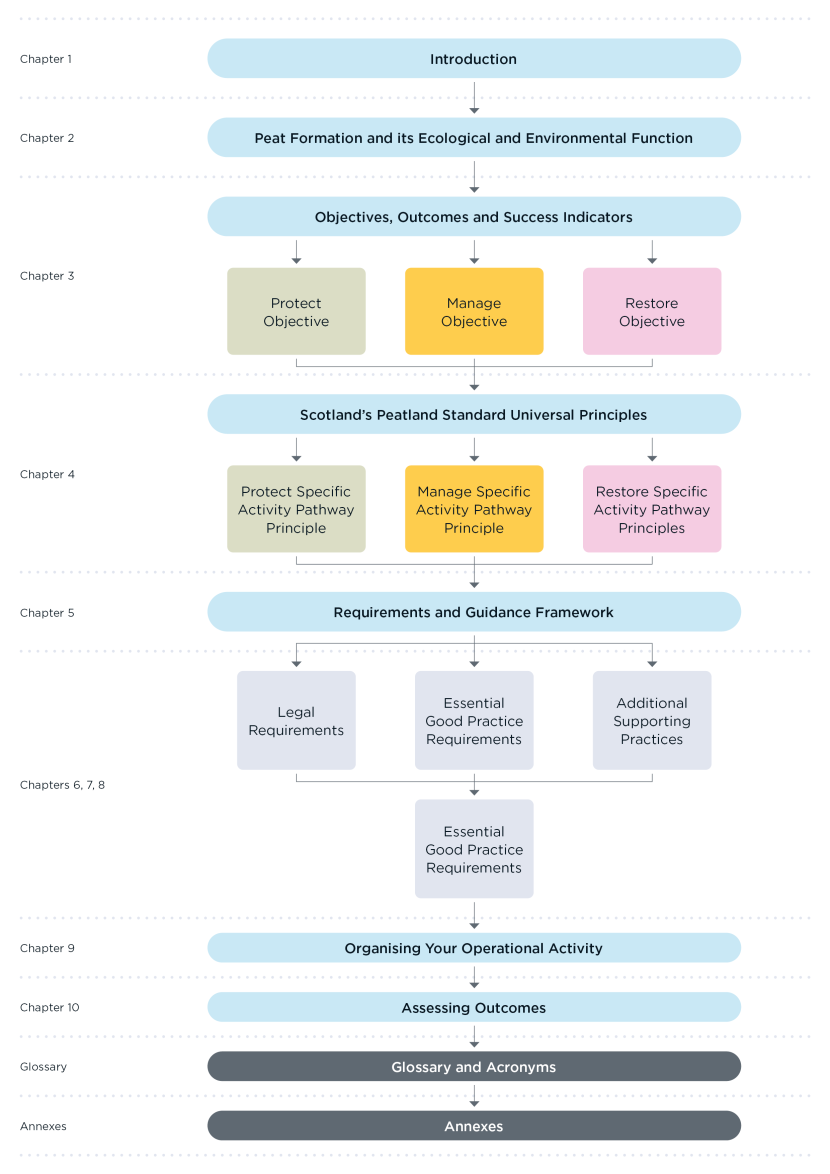
Figure 2 - How Scotland's Peatland Standard is organised - Flow chart
Click for a full description
Illustration of the main chapters and sub-sections within Scotland's Peatland Standard
Chapter one = Introduction
Chapter two = Peat formation and its ecological and environmental function
Chapter three = Objectives, outcomes and success indicators
Chapter three Sub-section= Protect objective
Chapter three Subsection = Manage objective
Chapter three Sub-section = Restore objective
Chapter four = Peatland Standard Universal Principles
Chapter four sub-section = Protect specific activity pathway
Chapter four sub-section = Manage specific activity pathway
Chapter four sub-section = Restore specific activity pathway
Chapter five = requirements and guidance framework
Chapter six, seven and eight = Legal requirements
Chapter six, seven and eight = Essential good practice requirements
Chapter six, seven and eight = Additional supporting practices
Chapter nine = Organising your operational activity
Chapter Ten = Assessing outcomes
Glossary
Acronyms
Annexes
Chapter 2 - Peat Formation and Its Ecological and Environmental Functions
2-1 This chapter introduces information about how peat has formed, how it is maintained, and why it is found in different conditions in Scotland.
2-2 This chapter covers:
- The peat formation process
- Natural processes, modifications, and stressors
- Ecosystem’s function and interactions
- The effects of Climate change on the natural and artificial processes
2-3 It is important to consider and reference the natural processes and the modifications and stressors when deciding which activity pathway is the most appropriate to use; protect, manage or restore.
Peat and Peat Formation
2-4 Peat formation describes the natural process of how peat is established, how it grows, and how it is eroded and can become degraded.
2-5 Peat is a type of soil formed from plant material that has accumulated over thousands of years under waterlogged, low-oxygen conditions. Where drainage is impeded and temperatures are low, dead plant material only partially decomposes, building up slowly into deep deposits of organic rich peat. In Scotland, when the substrate is saturated for most of the year, peat tends to accumulate at an approximate rate of less than 1mm per year. A soil is classified as peat in Scotland when its surface organic layer contains more than 60% organic matter and is at least 50cm deep.
2-6 Scotland’s peatlands support a range of habitat types, notably blanket bogs, raised bogs, fens, and montane peatlands occurring within different landforms and waterflow within a catchment (hydrogeomorphology) and varying climatic conditions. For more information, NatureScot Commissioned Report 701: Scotland's peatland - definitions and information resources and the categorisation of habitats in Scotland’s Planning Biodiversity Metric.
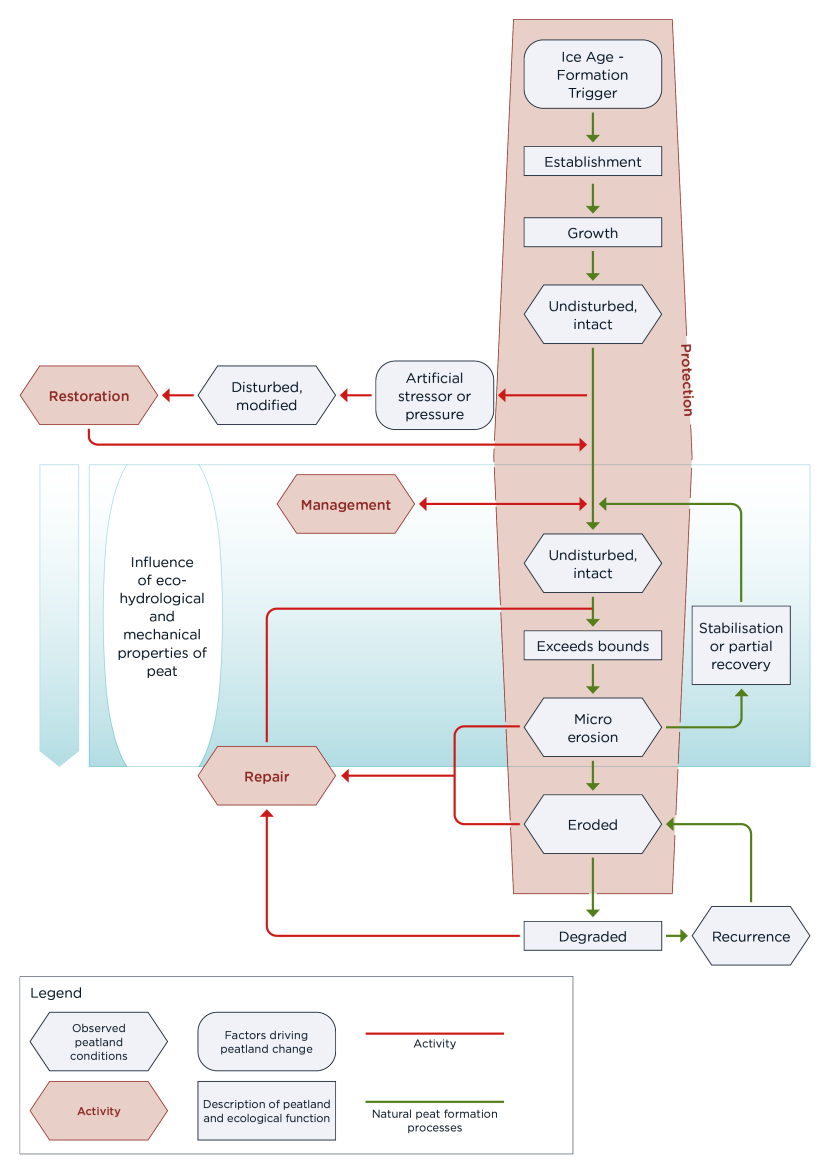
Figure 3 - Natural process of peat formation (the vertical column and right-hand side). The relationship of the protect, manage, and restore activities, and the artificial stressors or modifications (left side).
Click for a full description
Flow diagram showing the natural lifecycle of peatland, from formation through to degradation, alongside human interventions.
The central vertical column shows the natural progression starting with 'Ice Age Formation Trigger' at the top followed by 'Establishment' then onto 'Growth', 'Undisturbed, intact'. After 'Undisturbed, intact' an ‘Artificial stressor or pressure’ intercepts the flow and can shift the peatland condition to a ‘Disturbed, modified’ state, from which ‘Restoration’ is possible.
If an 'Artificial stressor or pressure' does not intercept an 'Undisturbed intact' state the pathway continues onto 'Management'. Within the management zone the diagram shows a second ‘Undisturbed, intact’ state that can tip into ‘Exceeds bounds’ leading, followed by ‘Micro erosion’, which can then tip the peatland condition towards an ‘Eroded’ and finally a ‘Degraded’ state.
The ‘Degraded’ and ‘Eroded’ state are linked by a ‘Recurrence’ loop.
‘Stabilisation’ or ‘Partial Recovery’ is shown as an alternative pathway from the ‘Eroded’ state. ‘Repair’ and ‘Management’ are shown as intervention activities feeding back into the cycle.
A side label indicates the influence of eco-hydrological and mechanical properties of peat.
A legend defines four symbol types for the flow diagram: observed peatland conditions, factors driving peatland change, activities, and descriptions of peatland and ecological function. Two different line colours distinguish activities from natural peat formation processes.
2-7 The peat formation process governs the relative health of ecosystem function. It is therefore important to understand the components of the peat formation process. These include:
- The circular dependency of the soil substrate and the peatland vegetation. The health and condition of the vegetation community depend on favourable soil and hydrological properties, and vice versa.
- The conditions supporting a low level of litter biomass decomposition, leading to a net growth of peat. This is driven by hydrological and climatic conditions.
- A peatland can expand until it becomes bounded by one or several natural features or until the stability and functionality of the peat mass within the existing system boundaries becomes compromised. Examples of natural boundaries presented by the landscape are slopes or watercourses.
- The physical movement of peat before and after it is has exceeded its natural bounds is determined by the mechanical properties of peat. The physical movement of peat explains the development of features such as cracking or eroding edges but can also change the hydrological conditions triggering surface water erosion or the development of peat pipes. The rate of movement is generally thought to be higher in upland areas compared to lower altitude peatlands which tend to show fewer signs of natural degradation.
- Natural processes driven by the mechanical and hydrological properties of peat and peatlands help explain many of the eroded features found in peatlands in Scotland.
- Once degraded, peatlands can experience a process of recurrence. Bare peat within gullies and on the faces of hags can revegetate after a long period of erosion has occurred.
Stressors and Triggers Contributing to Peatland Degradation
2-8 Many peatlands have been modified by human activity to support other land uses, including drainage, burning, over-grazing and afforestation.
2-9 These can be thought of as additional drivers and triggers of erosion and degradation processes. They affect the resilience of the peatland vegetation and its circular dependency with the favourable soil properties (see above). Others may accelerate the natural processes of degradation. For example, compaction and/or disturbance of vegetation from herbivores can result in higher amounts of surface water running at a sufficient energy to trigger surface erosion of peat which then continues until an eroded gully is formed.
2-10 Climate change is a stressor that is described in more detail below.
Ecosystem Function
2-11 Ecosystem function refers to the overall performance of an ecosystem and includes all the biological, geochemical, and physical processes and their interactions that take place within it. A peatland with a healthy ecosystem function will be more resilient to stressors and environmental challenges. A healthy peatland will continue to provide ecosystem services that are essential for a thriving economy and human well-being, including clean water, water management, and carbon storage. A healthy, resilient peatland ecosystem also supports biodiversity, along with a wide range of other benefits for communities and the economy.
2-12 Ecosystem function changes over time and is governed by the peat formation process.
2-13 Optimal ecological function in terms of peat growth would occur soon after the establishment phase but may decrease from the point that the peatland has exceeded its natural bounds. Annex G - Understanding Scotland’s peatlands has more details.
The Effects of Climate Change
2-14 Climate conditions are a significant factor in driving the mechanisms of peat formation and degradation. Peat will continue to accumulate and degrade, but climate change will affect these processes even more.
2-15 The predicted changes to the climate i.e. milder, wetter winters and hotter, drier summers, will cause an increased rate and instance of surface erosion and potentially trigger peat slides and alterations to drainage networks. Such events can also threaten the structural integrity of restoration features such as dams and bunds and could reverse or hinder peatland protection or restoration activities.
2-16 Changes to peatland plant community composition and phenology are also predicted under future climate change conditions and could reduce the ability of peatlands to sequester carbon. For example, Sphagnum species are critical for peat accumulation and stability, but they are becoming less abundant on peatlands. Wildfires on peatlands not only produce significant carbon emissions, but can cause further drying of degraded peatlands and reduce the abundance of Sphagnum mosses.
2-17 These climate pressures will create feedback loops that accelerate peatland degradation and complicate restoration efforts. Protection, management, and restoration activities should therefore consider how the effects of climate change will affect the formation, degradation, and restoration processes.
2-18 In practice this means:
- Designing activities to withstand extreme weather, for example sizing dams and bunds to accommodate increased peak flows and more frequent flood events, not just historical averages. See the Peatland ACTION Technical Compendium.
- Planning for adaptive management by building in monitoring and review plans, so that management activities can be adjusted over the project lifetime. Chapter 10 Assessing Outcomes contains further information.
- Avoiding activities that increase peatland vulnerability, such as compromising hydrology or reducing vegetation cover during periods of drought-stress.
- Annex H Natural Flood Management and Drought Resilience has further details on this topic.
Chapter 3 - Objectives, Outcomes, and Success Indicators
3-1 This chapter outlines objectives, outcomes, and success indicators to support technical decisions when caring for peatlands in Scotland.
3-2 It sets out what good peatland care looks like across the three activity pathways:
- Protect - avoiding damage and preventing new pressures on existing ecological function.
- Manage - reducing, mitigating, or stabilising pressures to maintain peatland function.
- Restore - involves carrying out an activity or activities on a modified or degraded peatland which is designed to promote natural processes and help degraded peatlands regain their optimal ecological function.
3-3 An activity is a planned single event or a set of actions undertaken over a long period of time. These can be carried out for individual pathways or for more than one. In all cases, the activity should have defined objectives and identifiable outcomes against which progress can be assessed.
3-4 For each activity pathway, Scotland’s Peatland Standard defines:
- the objective — what we are trying to achieve?
- the outcomes — the changes or conditions that should result?
- the success indicators — how you can tell whether the outcomes are being achieved?
This is summarised in the Table 1 below.
| Activity Pathway | Protect | Manage | Restore |
|---|---|---|---|
| Activity Pathway summary | Protect peatland that is in good ecological condition. | Manage peatland that is degraded or under pressure. | Restore peatland that is damaged or modified. |
| Objective | Avoid damage and prevent new pressures. | Reduce threats and maintain ecological function. | Intervene to repair function and support recovery. |
| Outcome | Natural functions are maintained; no new degradation occurs. | Rate of degradation is halted or significantly slowed; no new degradation occurs. | Peatland moves towards optimal ecological function over time. |
| Success Indicator | Carbon deposits remain stable. | Degradation is halted or reduced. | Reduction in carbon emissions and increased cover/diversity of positive indicator species. |
3-5 Chapter 10 Assessing Outcomes has more information on how to monitor success indicators in practice.
3-6 Activities on the three pathways are not mutually exclusive — different parts of a single site may require different approaches. As such, Scotland’s Peatland Standard recommends protect first, then manage threats or repair damaged functions, and then restore.
Protect Objective
3-7 The protect pathway applies where peatland is currently in good ecological condition: the objective is to keep it that way.
Outcome
3-8 Peatlands in good ecological condition continue to deliver their full range of benefits; and are protected from new damage or deterioration.
Success Indicators
3-9 Protection is succeeding when:
- The area and depth of peatland, and the carbon held within it, remain stable, with no evidence of erosion or shrinkage unless part of the natural peat formation process.
- Hydrology is functioning naturally: water moves through and across the peatland without evidence of artificial drainage, drying, being disrupted or being overly re-wetted and saturated.
- Peatland plant and wildlife communities are present and in good condition.
- The peat continues to store and accumulate carbon, with no significant loss through erosion or oxidation.
- Peat structure and function, peat depth and spatial extent are stable or increasing, and the biochemical function of the soil and plant system is stable.
Manage Objective
3-10 The manage pathway applies where an activity is needed to maintain peatland health or prevent further degradation. This can include controlled grazing of peatlands to improve vegetation structure and composition. It also applies where peatlands are delivering Scottish Government policy outcomes, but where a full restoration is not planned. An example of this would be afforested peatlands.
Outcome
3-11 Management activities slow, halt or reverse the rate of peatland degradation. Where full restoration is not the goal, the management maintains the best achievable ecological function for that peatland type.
Success Indicators
3-12 Management is succeeding when:
- The rate of degradation is significantly reduced or halted within a reasonable timescale.
- The peatland is not approaching a ‘degradation tipping point’ beyond which restoration would no longer be possible.
- The abundance of positive indicator peatland species is stable or improving.
- Where a transitional habitat has been established, it supports biodiversity and does not compromise ecological function or promote erosion and degradation processes.
Restore Objective
3-13 The restore pathway applies to degraded, modified, or damaged peatlands where active work is needed to help the peatland regain natural or good ecological function.
Outcome
3-14 Restoration activities trigger or support natural recovery processes. Over time, the peatland moves along the desired restoration trajectory towards optimal or good ecological function — with a natural hydrological regime, presence of peat-forming vegetation, and increasing resilience to pressures.
Success Indicators
3-15 Restoration is succeeding when the peatland is moving along the desired recovery trajectory, evidenced by examples in the table below.
| Recovery Trajectory | Success Indicator Evidence |
|---|---|
| Hydrology |
|
| Vegetation |
|
| Peat structure and function |
|
| Resilience |
|
Chapter 4 - Scotland’s Peatland Standard Principles
4-1 Principles have been developed to support consistent and informed professional judgement on decisions that affect the protection, restoration and management of peatlands.
4-2 Principles guide how decisions should be made - particularly in complex, novel, or locally specific circumstances - where prescriptive rules are not sufficient. They apply across all activity pathways. Annex C has a more detailed explanation of each principle.
How To Use the Principles in Decision Making
4-3 Scotland’s Peatland Standard’s Principles should be used as a mechanism to support decision making and should be applied alongside the objectives to make decisions. If alternative approaches are used, they should be supported by robust technical knowledge or experience.
Who Are the Principles For?
4-4 Scotland’s Peatland Standard’s Principles should be used by land managers, or advisors, in all decision making on land use activities that could affect peatland or contains peat soils.
4-5 The seven Universal Principles are to be applied in decision making to meet all, or any, of the objectives for the three pathways of protection, management, and restoration. The six Specific Activity Pathway Principles only apply to the specific activity targeted within a particular pathway objective.
Universal Principles
4-6 Table 3 below describes the Universal Principles and how they apply across all activity pathways. They are equally important and are not presented as a hierarchy.
Number | Principle | Applies to |
|---|---|---|
| 1 | Obtain knowledge of the specific peatland and how it functions so that potential impacts and the effectiveness of actions are fully understood. | All Pathways |
| 2 | Consider the impact of activities on a short-and long-term basis. | All Pathways |
| 3 | Carry out actions only when they are required to meet the objectives for protection, management, and restoration. | All Pathways |
| 4 | Minimise disturbance of peatland vegetation and the compaction and disturbance of peat. | All Pathways |
| 5 | Maintain the natural hydrological properties and connectivity of the peatland or match it with a comparable natural system or geomorphological type. | All Pathways |
| 6 | Reduce or remove all significant threats to the peatland habitats | All pathways |
| 7 | Assess outcomes using the most appropriate recognised monitoring method considering the objectives. | All pathways |
Specific Activity Pathway Principles
4-7 Table 4 below describes the principles that apply to specific activity pathways. They are equally important and are not presented as a hierarchy.
| Number | Principle | Applies to Activity Specific pathway |
|---|---|---|
| 8 | Protect the integrity, condition and functional properties of the peatland and the surrounding associated habitats. | Protect |
| 9 | Maintain or improve peatland functions by considering the individual and combined impacts of each management activity or regime | Manage |
| 10 | Activities should remediate all modifications and degradation features that negatively impact the functionality of the peatland. | Restore |
| 11 | Do enough and no more to meet the objectives | Restore |
| 12 | Minimise the duration and number of times the peat is reformed or handled. | Restore |
| 13 | Restore peatland habitat to achieve the optimal recovery of peatland hydrology and peat-forming vegetation communities | Restore |
Chapter 5 - Requirements and Guidance Framework
5-1 Once objectives and principles for activities have been considered, the next stage in decision making is considering detailed requirements. These are a combination of legal requirements, essential good practice requirements, additional supporting practice and guidance.
5-2 Scotland’s Peatland Standard presents these requirements for the three activity pathways.
- Protect in Chapter 6 - Protecting Peatlands
- Manage in Chapter 7 - Managing Peatlands
- Restore in Chapter 8 - Restoring Peatlands
The requirements are framed by the following interpretations.
Legal Requirements
5-3 Legal requirements are statutory obligations set out in relevant Scottish legislation and regulations. Failure to comply with the legal requirements may result in prosecution.
Essential Good Practice Requirements
5-4 Essential Good Practice Requirements define the minimum expectations for achieving sustainable peatland protection, management, and restoration. They are not statutory duties but include Scottish Government Policies.
5-5 Essential Good Practice Requirements should be applied unless they are not relevant to the specific site, activity or project stage. Where they are not applied, Scotland’s Peatland Standard recommends that, where relevant, landowner(s), tenant(s), practitioner(s), land manager or agent, developers and decision makers record their site-specific reasoning.
5-6 Essential Good Practice Requirements should be applied unless they are not relevant to the specific site, activity or project stage. Where they are not applied, Scotland’s Peatland Standard recommends that, where relevant, Landowner(s), Tenant(s), practitioner(s), Land Manager or agent, developers and decision makers record their site-specific reasoning.
5-7 Scotland’s Peatland Standard distinguishes between statutory legal requirements and other frameworks that, while not legally binding, provide the relevant industry standard which should be adhered to. Scottish Government policies such as NPF4 and other Standards such as the United Kingdom Forestry Standard are therefore presented as Essential Good Practice requirements.
Additional Supporting Practice
5-8 Additional Supporting Practice describes actions that can enhance outcomes and add value. It is not legal or essential, and it may not be applicable in every scenario, but supports effectiveness of activities, and increases resilience and long-term success. The Additional Supporting Practice is drawn from experience in peatland protection, management and restoration. Decision makers should consider implementing Additional Supporting Practice where it is proportionate to the outcomes sought.
Guidance
5-9 Guidance provides supporting information to help users interpret and implement the requirements. It provides signposting to methods, examples, and practical considerations. Guidance does not introduce additional requirements.
Chapter 6 - Protecting Peatlands
6-1 The aim of protecting peatlands is to safeguard and support their natural ecological function and minimise further deterioration of degraded areas, whilst integrating with wider land uses and activities.
6-2 This chapter sets out requirements on how peatlands should be protected in relation to:
- Scottish Biodiversity Strategy
- Biodiversity Duty
- Peatlands and woodland creation
- Peatlands and development
- Peatlands and agricultural activities
6-3 The Chapter should be read in conjunction with Chapter 2 Peat Formation and Its Ecological and Environmental Functions, which details the processes that have supported the development of peatlands over the millennia.
Scottish Biodiversity Strategy
6-4 The Scottish Government Scottish Biodiversity Strategy commits to protecting 30% of land and sea by 2030 (known as the 30 by 30 Framework).
Legal requirements - Scottish Biodiversity Strategy
6-5 Legal requirements for the Scottish Biodiversity strategy.
- The Scottish Government Scottish Biodiversity Strategy commits to protecting 30% of land and sea by 2030 (known as the 30 by 30 Framework). Protected Areas and Other Effective Area-Based Conservation Measures (OECMs) will also enhance biodiversity connectivity and resilience. OECMs are branded as Nature30 sites. Peatlands will be eligible for inclusion as Nature30 sites.
- The Scottish Biodiversity Strategy commits to building and strengthening Scotland’s Nature Networks to give nature the space to function properly and adapt to the changing environmental conditions driven by climate change. Connecting fragmented peatland habitats provides essential ecological corridors and linkages to support biodiversity and climate resilience.
Guidance - Scottish Biodiversity Strategy
6-6 Guidance for the Scottish Biodiversity Strategy.
- Where available, review Local Authority local connectivity maps or planned Nature Networks to ascertain where a peatland site could enhance local biodiversity and ecological connectivity without fragmenting existing Nature Networks. At the time of writing these are expected in 2026.
- Refer to Scottish Government plan Biodiversity: delivery plan 2024 to 2030.
- Further information can be within The Global initiative 30 x 30 Explained.
Biodiversity Duty
6-7 A biodiversity duty rests on all public bodies in Scotland.
Biodiversity Duty Legal Requirements
6-8 Legal requirements for Biodiversity Duty.
- Under the Nature Conservation (Scotland) Act 2004, “It is the duty of every public body and office holder, in exercising any functions, to further the conservation of biodiversity so far as it is consistent with the proper exercise of those functions”. Peatlands support habitats and species that are contained within the Scottish Biodiversity list, which helps identify and inform actions.
Biodiversity Duty Legal Guidance
6-9 Guidance for Biodiversity Duty.
- Biodiversity duty rests on all public bodies in Scotland. Discover how your organisation can conserve biodiversity and how to report on it.
Peatlands and Woodland Creation
6-10 This section shows how peatlands are protected in the context of woodland creation.
Legal Requirements - Peatlands and Woodland Creation
6-11 Legal requirements for peatlands and woodland creation.
- The Forestry and Land Management (Scotland) Act 2018 require Scottish Ministers to promote sustainable forest management, which includes the protection of carbon rich soils.
- The Environmental Impact Assessment (Forestry) (Scotland) Regulations 2017 require screening and, where applicable, consent for woodland creation, deforestation, forest roads, or quarries, all of which are likely to have significant effects on peatlands or their hydrological regime.
- The Environmental Authorisations (Scotland) Regulations 2018 apply to regulated activities defined under Regulations 3 and 4. Regulated activities require authorisation before they can be carried on and must be carried on in compliance with the relevant conditions or general binding rules (as applicable). More information can be found on SEPA’s website or by contacting SEPA.
Essential Good Practice Requirements - Peatlands and Woodland Creation
6-12 Essential good practice requirements for peatlands and woodland creation.
- The UK Forestry Standard (2024) underpins sustainable forest management and associated Forest and Soils and Biodiversity Guidelines provide best practice for managing peat soils and protecting adjoining habitats. This indicates woodland should not be established on deep peat (>50 cm) or within areas identified as priority peatland habitat.
- Where afforested peatland is present, follow Scottish Forestry’s Practice Guide Deciding the future management of afforested deep peatlands. This considers forest-to-bog restoration, including tree removal and rewetting, in accordance with UKFS Forests and Soils guidance. It recommends:
- Shallow peat is a vital carbon store, and careful consideration should be given to whether to establish woodland on shallow peat soils (30 - 50cm). If woodland is established on shallow peat, the least intensive cultivation methods should be used to successfully establish a new woodland (Scottish Forestry Cultivation Guidance).
- Maintain an unplanted buffer between woodland and peatland; to ensure that the peatlands hydrology is not adversely affected, and secondly to reduce the instances of seed dispersal onto the peatland. Buffer width should reflect factors driving seed dispersal rates, such as prevailing winds and the tree species type adjacent and its specific seed dispersal characteristics. A minimum buffer of 50m is recommended, but this should be increased when adjacent to sensitive habitats, to reduce the risk impacts to the surrounding habitats. Buffer size and management should be decided through a site-specific assessment. Forests and Peatland Habitats Guidance Note and the supplementary guidance contains more information about the importance of how to ensure that plantations don’t negatively impact on peatland habitats.
- Special consideration needs to be given to buffers around bog woodland because these should support scattered native bog-woodland trees whilst reducing the risk of seed dispersal from non-native and non-bog woodland tree and scrub species (Relevant Chapter 7 Managing Forestry and Woodlands on or Adjacent to Peatlands and Annex H Forestry and Woodland Removal for further information on bog woodland).
- Scottish Forestry guidance on cultivation for upland productive Woodland creation states plans should demonstrate that there will be no hydrological impact (e.g. drainage, soil compaction, or tree rooting) which will adversely affect the adjacent peatland condition.
- Map and protect peatland habitats when planning woodland creation areas and boundaries. (use up-to-date spatial data which can be found on the Open Data Hub and support decision making with ground truthing surveys as appropriate).
- When natural colonisation of native trees has occurred on an existing peatland, the decision of whether to remove or retain these should be made by using the Management specific principles from Chapter 4 Scotland’s Peatland Standard Principles.
Additional Supporting Practices - Peatlands and Woodland Creation
6-13 Peatlands and Woodland Creation additional supporting practices.
- Restrict new native woodland planting to mineral soils or shallow peat where hydrological separation from peatland systems is appropriate. For further information see Annex H Peat Depth and Condition Surveys.
- When carrying out forestry operations, use low-ground pressure machinery and minimise soil disturbance, avoiding drains or deep cultivation near peatland margins. Cultivation Guidance – Scottish Forestry and UKFS, provide a framework to help practitioners make appropriate choices for cultivation on peat.
- Consider maximising opportunities to integrate native woodland, especially riparian woodland, and peatland restoration to deliver multiple ecosystem benefits and climate resilience.
Peatlands and Woodland Creation Guidance
6-14 Guidance for Peatlands and Woodland Creation.
- UK Forestry Standard promotes woodland expansion that complements peatland restoration and provision of ecosystem services. It highlights:
- In theory native woodland buffers may enhance the resilience of the peatland when they are hydrologically separated from peatland systems. However, where possible, carrying out restoration of adjacent degraded peatlands before adjacent woodland creation activities are completed would reduce the risk of tree and scrub encroachment on the degraded peatland.
- Conversely, woodland too close to peatland margins can increase evapotranspiration and nutrient loading. A site-specific hydrological assessment proportionate to the scale of planting and potential impacts could therefore determine the appropriate separation and design.
- Scotland’s catalogue of spatial data where you can find, share and reuse spatial data provided by Scottish public sector organisations.
Peatlands and Development
6-15 This section shows how peatlands are protected when development projects are planned and implemented.
Legal Requirements - Peatlands and Development
6-16 Legal requirements for peatlands and development.
- Under the Town and Country Planning (Scotland) Act 1997, planning authorities must consider environmental impacts through Environmental Impact Assessment (EIA) for specific developments.
- The Environmental Authorisations (Scotland) Regulations 2018 apply to regulated activities defined under Regulations 3 and 4. Regulated activities require authorisation before they can be carried on and must be carried on in compliance with the relevant conditions or general binding rules (as applicable). More information can be found on SEPA's Website or by contacting SEPA.
Essential Good Practice Requirements - Peatlands and Development
6-17 Essential good practice for peatlands and development.
- Planning applications should be determined in accordance with National Planning Framework 4 (NPF4) alongside Local Development Plans. Decision makers should weigh up all of the relevant policies and considerations in applying balanced planning judgement.
- Policy 3 (Biodiversity), Policy 4 (Natural Places) and Policy 5 (Soils) require that carbon rich soils are protected. Where impacts are permitted, developments must demonstrate mitigation and enhancement consistent with national targets for nature recovery and net-zero emissions. For priority peatland habitats, this would mean that additional restoration measures beyond those required to achieve the 1:10 offsetting ratio (lost:restored) are required for enhancement.
- Policy 5 seeks to minimise the impact on soils, including peat and carbon rich soils, and maximise protection of these valuable natural resources in the long term.
- Policy 5 (part d) states that where development on peatland, carbon-rich soils or priority peatland habitat is proposed, a detailed site-specific assessment will be required. They must identify baseline depths, habitat condition, quality and stability, the likely effects of the development on peatland, (including soil disturbance) and the likely net effects of the development on climate emissions and loss of carbon.
- Proposals affecting peatland systems should undertake habitat surveys, peat depth surveys, and hydrological surveys to inform project design, and use spatial mapping to identify and exclude sensitive areas.
- Development proposals should follow the mitigation hierarchy – avoid, minimise, mitigate, compensate – and prioritise avoidance of peatland through early spatial planning, routing, and micro-siting, informed by up-to-date peat depth and habitat survey data. Apply the following mitigation hierarchy as set out in NPF4 at the earliest stage of design:
- Avoid – by removing the impact at the outset
- Minimise – by reducing the impact
- Restore – by repairing damaged habitats
- Offset – by compensating for the residual impact that remains, with preferences to on-site over off-site measures.
- Where peatland restoration is proposed as compensation or enhancement, the Habitat Management Plan (HMP) or equivalent should describe details of protection mitigations, including proposed techniques, timescales, surveys, and measurable outcomes; and the planning application should demonstrate how the proposed restoration will offset any carbon and negative biodiversity impacts caused by the development.
Peatlands and Development Additional Supporting Practice
6-18 Additional supporting practice for peatlands and development
- When selecting locations for carbon offsetting, undertake a peatland condition assessment to identify restoration potential – for example using the Peatland ACTION Condition Assessment.
- When identifying restoration or enhancement sites, consider land uses adjacent, existing consents, and opportunities to contribute to wider Nature Networks and Policy 3 of NPF4 Policy 3.
- Where feasible and consistent with the Universal and Activity specific Principles, carry out construction work in stages rather than all at once, to reduce the overall impact on the peatland at any one time and makes it easier to identify issues and adapt the workflow if needed. Annex H Managing Access to Site - has further relevant information.
Guidance - Peatlands and Development
6-19 Guidance for peatlands and development.
- SEPA guidance on On-site Management of Excavated Peat sets out SEPA’s position on when a waste management authorisation is required to manage excavated peat on the site of origin during development projects.
- Scottish Government has guidance on the assessment of peat volumes, reuse of excavated peat, and minimisation of waste.
- NatureScot guidance on Advising on peatland, carbon-rich soils and priority peatland in development management.
- Scottish Government has provided guidance on carrying out peatland site surveys.
- Scottish Government has guidance on best practice methods to identify, mitigate, and manage peat slide hazards.
- Scottish Government has published a carbon calculator for determining the carbon impact of windfarm developments in Scotland .
- NatureScot has standing pre-application advice to developers and consultants who are preparing applications and EIA reports for onshore windfarm developments .
- NatureScot has developed shared good practice guidance during windfarm construction
- NatureScot has published Developing with Nature guidance on securing positive effects for biodiversity from local development in support of NPF4 Policy 3c.
- NatureScot has a suite of guidance and information to help inform good practice in construction to ensure impacts of developments are minimised.
Peatlands and Agricultural Activities
6-20 This section provides guidance on protecting peatlands whilst carrying out agricultural activities.
Legal Requirements - Peatlands and Agricultural Activities
6-21 Legal activities for peatlands and agricultural activities.
- Peatlands are subject to the Good Agricultural and Environmental Condition (GAEC) 6 requirements. These protect peatlands and wetlands with a soil depth of 50cm or greater and covered by semi-natural vegetation consisting of sphagnum mosses and cotton grasses. Arable land and improved grassland on peat soil is excluded from this requirement. Greenhouse gas emissions are limited further by prohibiting specific agricultural activities.
- The Environmental Authorisations (Scotland) Regulations 2018 apply to regulated activities defined under Regulations 3 and 4. For example, these include abstraction of water from the water environment, certain building or engineering works, the construction, alteration, and operation of certain impounding works, certain discharges to the water environment, the storage and application of certain substances, and the keeping of livestock. Regulated activities require authorisation before they can be carried out and must be carried out in compliance with the relevant conditions or general binding rules (as applicable). More information can be found on SEPA’s website or by contacting SEPA.
- The Agriculture, Land Drainage and Irrigation Projects (EIA) (Scotland) Regulations 2017 requires a screening decision for projects that increase the agricultural productivity through drainage of uncultivated land or semi-natural areas, including peatlands. This also applies to other projects involving the use of uncultivated land for intensive agricultural purposes (e.g., for the application and storage of fertiliser or manures; liming, ploughing, draining, and reseeding, where a screening decision is needed).
- The Wildlife Management and Muirburn (Scotland) Act 2024, prohibits all muirburn except under licence for specific purposes. (Other relevant chapters include Chapter 7 Managing Vegetation, with Muirburn).
- In addition to under the Environmental Authorisations (Scotland) Regulations 2018, fertiliser (including manure and slurry) applications are regulated under Nitrate Vulnerable Zone (NVZ) rules.
Essential Good Practice Requirements - Peatlands and Agricultural Activities
6-22 Peatlands and agricultural activities essential good practice requirements
- Comply with GAEC 5, by avoiding intensive or new agricultural activity on peatlands or adjacent land that would impact water tables or water supplies negatively, impact peatland plant communities, cause erosion, compact soils, and/or introduce nutrients.
- Maintain or restore hydrological integrity by blocking agricultural drains where feasible. Refer to the Technical Compendium for detailed specifications.
- Retain peatland vegetation cover and do not expose bare peat to livestock/herbivore poaching or use heavy machinery that could damage vegetation. Refer to the Technical Compendium for more information.
- Establish buffers between arable land and peatland margins to reduce diffuse pollution and nutrient runoff. ( GAEC 1 protects water against pollution).
- GAEC 3 relates to the protection of ground water against pollution.
- Use low ground pressure vehicles and ensure compatible and sustainable grazing regimes on peat or wet soils.
- See also Chapter 7 Managing Herbivore Impacts for guidance regarding on peatland soils.
Additional Supporting Practice - Peatlands and Agricultural Activities
6-23 Peatlands and agricultural activities additional supporting practice
- Liaise early with the Scottish Government Rural Payments and Inspections Directorate (SGRPID) when Agri-environment activities or land-use changes may affect peatlands.
- Integrate peatland protection measures within Whole Farm Plans,Agri-Environment Climate Scheme (AECS) applications, or Natural Capital assessments.
- Monitor peatland edges for erosion, enrichment (e.g. rush or nettle encroachment), and water quality changes.
- Encourage the conversion of marginal agricultural land on deep peat back to wet grassland or restored bog habitat.
- Avoid new tracks and livestock feeding stations on or near peat soils. Heavy livestock should also be avoided on or near peat soils, unless part of an agreed and well justified grazing plan to improve peatland vegetation.
Guidance - Peatlands and Agricultural Activities
6-24 Peatlands and agricultural activities guidance
- The Farm Advisory Service provides checklists and up to date guidance on GAECS that apply in Scotland.
- Rural Payments and Services have published a quick guide to requirements affecting peatlands and wetlands.
- NatureScot guidance on managing grazing on peatlands can be used to inform decisions.
- Case study showing how low-intensity grazing or management which supports biodiversity and hydrological stability can be compatible with peatland restoration.
- Monitor restoration sites adjacent to farmland for edge effects (nutrient drift, invasive species spread, or water abstraction impacts).
- Farming and Water Scotland offers guidance on efficient fertiliser application.
- SEPA guidance on rural diffuse pollution.
- SEPA guidance on on-site management of excavated peat sets out SEPA’s position on when a waste management authorisation is required to manage excavated peat on the site of origin during development projects.
- NatureScot has published guidance to support farmers and land managers, promoting training and guidance for farmers.
- SRUC offers advice for agricultural, food and land-based businesses.
- NatureScot has guidance on farming with nature, supporting sustainable food production, climate and nature.
Chapter 7 - Managing Peatlands
7-1 Management is an activity that is carried out on a peatland to ensure it functions optimally as an ecosystem and to prevent or slow further degradation.
7-2 The requirements for managing peatlands are presented for the topics:
- Managing Peatland Vegetation alongside Grazing and Agriculture
- Managing Peatland Vegetation with Muirburn,
- Managing Herbivore Impacts
- Managing Forestry and Woodlands on or adjacent to Peatlands
- Managing Scrub and Tree Encroachment on Peatlands,
- Managing Peat Cutting for Domestic Fuel
- Commercial Peat Extraction.
Managing Peatland Vegetation alongside Grazing and Agriculture
7-3 This section shows how peatlands can be managed alongside agriculture and grazing activities.
Legal Requirements - Managing Peatland Vegetation alongside Grazing and Agriculture
7-4 Legal requirements for managing peatland vegetation alongside grazing and agriculture:
- When contractually obliged, comply with The Good Agricultural and Environmental Condition (GAEC) 6, which defines peat as organic matter with a peat thickness of at least 50cm. GAEC 6 prohibits practices that degrade carbon-rich peat and wetland soils, including excessive grazing, poaching, or cultivation of organic soils. Consider and manage the combined impacts of livestock and wild herbivores on peatlands to inform the management of all herbivores. (See also Chapter 7 Managing Herbivore Impacts).
- Agricultural operations on protected sites must align with existing management agreements, Agri-Environment Climate Scheme (AECS) prescriptions, or relevant site management plans.
- The Environmental Authorisations (Scotland) Regulations 2018 apply to regulated activities defined under Regulations 3 and 4. For example, these include abstraction of water from the water environment, certain building or engineering works, the construction, alteration, and operation of certain impounding works, certain discharges to the water environment, the storage and application of certain substances, and the keeping of livestock. Regulated activities require authorisation before they can be carried on and must be carried on in compliance with the relevant conditions or general binding rules (as applicable). More information can be found on SEPA’s website or by contacting SEPA. Specifically relevant in this section, Water GBR 19, rule (c) provides: (c) livestock feeders must not be positioned within 10 metres of any— (i) river, burn, ditch, or loch, as measured from the top of the bank, (ii) wetland, (iii) spring that supplies water for human consumption, (iv) well or borehole that is not capped in such a way so as to prevent ingress of water, or (v) transitional water or coastal water, as measured from the shoreline. In relation to shelters, Water GBR 19, rule (a) provides: Significant erosion or poaching of any land that is within 5 metres of any— (i) river, burn, ditch, or loch as measured from the top of the bank, (ii) wetland, (iii) spring that supplies water for human consumption, (iv) well or borehole that is not capped in such a way so as to prevent ingress of water, or (v) transitional water or coastal water, as measured from the shoreline, must be prevented.
- Grazing or stock management that may affect designated peatlands (e.g. SSSIs, SACs, or SPAs) must comply with site conservation objectives. Changes to livestock levels may require consent or assessment under the relevant Protected Area legislation.
Essential Good Practice Requirements - Managing Peatland Vegetation alongside Grazing and Agriculture
7-5 Essential good practice requirements for managing peatland vegetation alongside grazing and agriculture:
- Establish clear grazing objectives for the site that are consistent with the Universal and Activity specific Principles and the Objective outcomes.
- Set and maintain stocking levels that avoid damage to peat soils, hydrology, and specialised vegetation, particularly on deep or waterlogged peat.
- Prevent the creation of bare peat from excessive trampling and poaching through stock control, temporary removal, or exclusion from areas where necessary.
- Monitor grazing impacts at appropriate intervals and adjust management promptly where adverse effects on peat condition are identified.
Additional Supporting Practice - Managing Peatland Vegetation alongside Grazing and Agriculture
7-6 Additional supporting practice for managing peatland vegetation alongside grazing and agriculture:
- Adjust stocking densities, timing, and duration according to site wetness, season, vegetation condition, and recovery progress.
- Exclude livestock from saturated, eroding, or recently restored areas until vegetation is re-established.
- Avoid placing shelters on wetlands.
- Carry out a Herbivore Impact Assessment (HIA) to ensure that grazing and browsing levels are appropriate. A HIA is a survey method used to monitor and assess the effects of large herbivores, measuring indicators such as browsing, grazing and trampling to inform future land management.
Guidance - Managing Peatland Vegetation alongside Grazing and Agriculture
7-7 Guidance for managing peatland vegetation alongside grazing and agriculture:
- Grazing by wild herbivores is a natural part of the peatland’s ecosystem, but tolerance to herbivores differs between peatland types. Blanket bog and raised bog vegetation are easily damaged by trampling, while dry heath and grassland area are more resilient and can stand higher densities of herbivores.
- All peatland types may benefit from light or seasonal grazing. In extensive upland systems, low-intensity cattle / sheep or mixed grazing can support structural diversity of the vegetation if carefully managed. Peatland Action Case study referring to mob grazing at Tardoes Farm.
- Partial exclusion may be appropriate. In fens, winter-only grazing may be appropriate for tackling excess biomass. In bogs, intensive spring grazing may be appropriate for controlling birch scrub or purple moor grass although stock should be removed before poaching or damage to the bog surface occurs.
- Use an adaptive approach to grazing, trial small changes, monitor response, and adjust stocking or timing accordingly.
- NatureScot has published guidance to support farmers and land managers, promoting training and guidance for farmers
- Farm Advisory Service information of protecting peatlands
- Peatland ACTION - Peatland Management Guidance – grazing and muirburn
- Peatland Action Blog - What's the connection between peatland restoration and futureproofing your farm business
- See related Chapters 7 Managing Vegetation, with Muirburn, and Chapter 7 Managing Herbivore Impacts.
Managing Peatland Vegetation with Muirburn
7-8 This section contains information of how to manage peatland vegetation with muirburn.
Legal Requirements - Managing Peatland Vegetation with Muirburn
7-9 Legal requirements for managing peatland vegetation with muirburn:
- The Wildlife Management and Muirburn (Scotland) Act 2024 prohibits all muirburn except under licence for specific purposes. Muirburn on peatland habitat must be deemed to be necessary to obtain a license. The Act has categorised peatland as having a peat depth of > 40cm. (The Licencing requirement has not yet been enacted at time of publication).
- Comply with The Wildlife Management and Muirburn (Scotland) Act 2024 and the Muirburn Code (2026). Following the introduction of the new muirburn licence in Autumn 2026, the muirburn season will change to 15 September to 31 March and it will be an offence to carry out muirburn without a licence.
- All controlled fire activities must be carried out by sufficiently trained personnel using personal protective equipment and appropriately maintained equipment for fire control. Following the introduction of the Muirburn Code (2026) anyone conducting muirburn must have completed an approved training course.
- Vegetation management within designated sites (SSSIs, SACs, SPAs) must comply with site-specific conservation objectives and may require consent under the Nature Conservation (Scotland) Act 2004 or appraisal under the Habitats Regulations.
Essential Good Practice Requirements - Managing Peatland Vegetation with Muirburn
7-10 Essential good practice requirements for managing peatland vegetation with muirburn:
- When conducting muirburn, practitioners should have regard to the Muirburn Code (2026).
- Ensure licensed burns are small-scale, a cool-burn, and discontinuous to minimise soil heating and moss loss. Burn only heather tops, not litter or moss layers.
Additional Supporting Practice - Managing Peatland Vegetation with Muirburn
7-11 Additional supporting practice for managing peatland vegetation with muirburn:
- Record fire events, cutting, or swiping locations, intensity, and frequency to inform adaptive management. Integrate monitoring with site condition assessments or Peatland ACTION restoration plans.
- Rewetted peatlands, or near-natural peatlands, may help to reduce wildfire spread and restoration should be prioritised as part of long-term fire-risk mitigation strategies.
Guidance - Managing Peatland Vegetation with Muirburn
7-12 Guidance for managing peatland vegetation with muirburn:
- NatureScot has a spatial data hub that visualises the extent of land that may be classified ‘peatland’, as defined in the associated muirburn legislation Muirburn Peatland Map
- NatureScot has provided information on how to prepare for new licence requirements for all muirburn to be introduced in Autumn 2026.
- Further information can be found here: Peatland ACTION case study – What’s the connection between peat and wildfire?
- The IUCN UK Peatland Programme has a publication which explores recent evidence from the UK and North America demonstrating the importance of peatland restoration in increasing resilience to wildfire in the context of a changing climate.
- See sections relating to Managing Herbivore Impacts, Managing Scrub and Tree Encroachment on Peatlands, and Peat Depth and Condition Surveys.
Managing Herbivore Impacts
7-13 This section shows how the impacts of all herbivores on peatlands can be managed.
Legal requirements - Managing Herbivore Impacts
7-14 Legal requirements for managing herbivore impacts:
- Comply and implement any specific guidance or advice issued by NatureScot under The Deer (Scotland) Act 1996. This may include undertaking specific actions to reduce damage to or to enhance the natural environment.
- When the area of peatland has been entered into a grant scheme or management agreement, comply with all terms and conditions.
Essential Good Practice Requirements - Managing Herbivore Impacts
7-15 Essential good practice requirements for managing herbivore impacts:
- Wild Deer Best Practice (WDBP), guidance such as the methodologies referenced by Peatland ACTION, a detailed Habitat Impact Assessment (HIA) should be used to understand the current impacts from large herbivores (such as sheep and deer) and to inform herbivore management plan objectives that aim to facilitate effective peatland restoration. Knowing herbivore density estimates, and how they use an area, is important when deciding how best to manage populations for effective peatland protection, management, or restoration. Obtain accurate information on current herbivore densities on the peatland and consider how herbivores use a site throughout the year, including seasonal use.
Additional Supporting Practices - Managing Herbivore Impacts
7-16 Additional supporting practices for managing herbivore impacts:
- Deer density estimates can be obtained from deer count data. Information on deer occupancy could also be considered where available. See also Deer Counting guidance and NatureScot guidance on deer management Best Practice Guidance - Habitat Impact Assessment methodology for more information.
- The resilience of a peatland to trampling and browsing will be site-specific and may be localised within a site. A light level of grazing/browsing can be beneficial on some sites to prevent scrub and tree encroachment.
- Consider a landscape scale approach to grazing management. Monitor herbivore impacts regularly and manage numbers to ensure that damage does not occur. For example, where the peatland communities are particularly vulnerable at certain times of the year (i.e. periods of drought stress or during winter), livestock numbers should be reduced during these times if possible.
- Where the HIA shows moderate or high herbivore impacts, the removal or reduction of livestock, or an increased deer cull, could be considered. Aim to achieve HIAs with low or low-moderate impacts across the restoration area and for this to be maintained.
- Localised and widespread grazing/browsing pressures and/or trampling may exacerbate peat erosion, and this could be considered as part of a wider peatland management plan approach. Herbivore pressures need to be addressed rather than avoided or omitted from a restoration plan to ensure that whole hydrological units are restored.
Guidance - Managing Herbivore Impacts
7-17 Guidance for managing herbivore impacts:
- Contact your local Deer Management Group to obtain deer count data
- NatureScot Peatland ACTION management guidance on grazing may assist when considering suitable livestock grazing densities
- Scotland’s Farm Advisory Service - How to complete a Habitat Impact Assessment (video)(2020)
- Peatland ACTION - Assessing herbivore impact for Peatland ACTION applications (2025)
- IUCN UK Committee Peatland Programme Briefing Note No.7: Grazing and Trampling (2014)
- Scottish Forestry has guidance for Woodland Herbivore Impact Assessment Method – User guide
- Peatland ACTION case study: What’s the connection between peat and sheep? shows how peatland restoration can improve grazing
- NatureScot – Managing Scotland’s wild deer (2026) provides information to inform decisions
Managing Afforested Peatlands or Woodlands Adjacent to Peatlands
7-18 This section shows how afforested peatlands or woodlands adjacent to peatlands can be managed limiting environmental harm.
Legal Requirements - Managing Afforested Peatlands or Woodlands Adjacent to Peatlands
7-19 Legal requirements for managing afforested peatlands or woodlands adjacent to peatlands:
- Felling Permissions from Scottish Forestry – under the Forest and Land Management (Scotland) Act 2018 and Felling (Scotland) Regulations 2019 - are required for the removal of a trees, regardless of planning status. There are some exemptions that may be applicable and you should check with Scottish Forestry.
- Environmental Impact Assessment (Forestry) Regulations 2017 – projects exceeding one hectare or within a sensitive site (SAC, SSSI) require an EIA screening opinion from Scottish Forestry.
- Ensure compliance with Plant Health (Official Controls and Miscellaneous Provisions) (Scotland) Regulations 2019 (e.g. Statutory Plant Health Notices from Scottish Forestry).
- The Environmental Authorisations (Scotland) Regulations 2018 (EASR) apply to regulated activities defined under Regulations 3 and 4. For example, these include the storage and application of pesticides. Regulated activities require prior authorisation in compliance with the relevant conditions or general binding rules (as applicable). More information can be found on SEPA’s website or by contacting SEPA.
Essential Good Practice Requirements - Managing Afforested Peatlands or Woodlands Adjacent to Peatlands
7-20 Essential good practice requirements for managing afforested peatlands or woodlands adjacent to peatlands:
- Under the UK Forestry Standard and associated regulatory frameworks, forest plans should identify and map peatland soils and habitats, document threats, and propose actions to manage and reduce threats.
- Use peatland maps to assist with identifying deep peat under land cover that is not visibly recognisable as peatland.
- Follow Scottish Forestry guidance: Deciding Future Management Options for Afforested Deep Peatland to determine whether sites should be restored or restocked.
- Control of Woodland Removal Policy – presumes in favour of woodland protection. No compensatory planting is required for the trees removed for forest-to-bog restoration which enhances priority habitat. See also NPF4: Policy 6.
- Plan and document felling operations and timber extraction to reduce impacts on soil, water, and adjacent peatland or wetland habitats. See the Peatland ACTION Technical Compendium or Scottish Forestry’s Managing Forest operations to protect the water environment for further guidance on appropriate operational techniques to prevent to prevent compaction on particularly wet sites.
- The UK Forestry Standard stipulates the use of buffers, which are larger than those required by regulation, to protect the water environment from the use of pesticides and herbicides.
- Plan extraction and haulage routes to minimise peat disturbance, compaction, rutting, and sediment release. See also Annex H Managing Access to Site and Forestry Scotland and Scottish Natural Heritage Publication – Floating Roads on Peat.
- Use appropriate clearance methods that minimise soil disturbance and follow UKFS Practice Guide: Managing Forest Operations to Protect the Water Environment.
- Scottish Forestry - Guidance on Cultivation for Upland Productive Woodland Creation (2025) should be consulted to minimise disturbance of peat soils and carbon emissions.
- In accordance with The Control of Pesticides Regulations 1986 and the Pesticides: code of practice for using plant protection products in Scotland, limit herbicide use; but where no mechanical alternative methods can be used, use targeted low-impact methods (e.g. stem injection) under appropriate conditions.
Additional Supporting Practice - Managing Afforested Peatlands or Woodlands Adjacent to Peatlands
7-21 Additional supporting practice for managing afforested peatlands or woodlands adjacent to peatlands:
- Use NatureScot’s interface of non-native woodland and peatland areas dashboard to identify ecological risk from non-native conifer seedlings encroaching into nearby peatlands.
- Map, document, and assess existing woodland and scrub on and adjacent to peatland sites and record native bog woodland, wet woodland, and non-native coniferous forest, to inform restoration and monitoring plans.
- Prioritise the removal of non-native or invasive species from the peatland and surrounding area but do not remove native peatland species such as Betula nana and Myrica gale.
Guidance - Managing Afforested Peatlands or Woodlands Adjacent to Peatlands
7-22 Guidance for managing afforested peatlands or woodlands adjacent to peatlands:
- Please refer to UKFS, the Forestry and Woodland Removal – Project Management section.
- Scottish Forestry - Forests and Peatland Habitats guidance (2000) provides information relating to peatland types and how they are affected by forestry activities. Note that some information has been superseded.
- Scottish Forestry - Forest and peatland habitats - guideline note (2025) provides information to support decisions on whether to restore or restock an afforested peatland. It shows how to protect carbon stores while meeting forestry standards.
Managing Scrub and Tree Encroachment on Peatlands
7-23 This section shows how scrub or tree encroachment can be managed on existing open peatlands.
Legal requirements - Managing Scrub and Tree Encroachment on Peatlands
7-24 Legal requirements for managing scrub and tree encroachment on peatlands:
- Comply with requirements for SACs, SSSIs, SPAs and Ramsar sites where woodland proposals may affect qualifying peatland features.
- Tree felling and scrub removal must avoid adverse impacts on protected species, habitats, and all operations must be compliant with all relevant legislation. (For more details, see Chapter 7 Managing Afforested Peatlands or Woodlands Adjacent to Peatlands, and Chapter 6 Peatlands and Woodland Creation.)
- The Environmental Authorisations (Scotland) Regulations 2018 (EASR) apply to regulated activities defined under Regulations 3 and 4. For example, these include the storage and application of pesticides, and operating vehicles, plant or machinery in or near any surface water or wetland. Regulated activities require authorisation before they can be carried on and must be carried on in compliance with the relevant conditions or general binding rules (as applicable). More information can be found on SEPA’s website or by contacting SEPA.
- See also Annex H Drinking Water Catchments and Private Water Supplies and Annex H Buffers to Watercourses and Pollution Prevention regarding Water Environment and Water Services (Scotland) Act 2003 (WEWS) and Environmental Authorisations (Scotland) Regulations 2018 (EASR) Regulations.
Essential Good Practice Requirements - Managing Scrub and Tree Encroachment on Peatlands
7-25 Essential good practice requirements for managing scrub and tree encroachment on peatlands:
- Determine the conservation value of existing native trees and scrub and whether they exist in a stable relationship with the peatland to inform whether they should be retained or removed. For example, Betula nana and Myrica gale are important native peatland species and should be retained. Use the Universal and Activity Specific Principles when making these decisions.
- There is a specific bog woodland habitat (Habitat 91DO) where scattered native trees and shrubs are found in a relatively stable relationship with other bog species. This rare priority habitat has a clear definition under EU Habitats Directive (Annex 1) and should be retained. The ecological value of scrub can be determined using the Supporting Guidance for Managing Scrub of Conservation Value.
- Remove non-native trees and scrub from peatlands but retain native scrub and trees where they occur naturally. Any negative impacts on peatland hydrology or coverage of peat forming species should also be considered. Refer to the Peatland ACTION Technical Compendium for further information on methods.
- Avoid the risk of spreading invasive or pathogenic material and apply the measures described in Annex H Plant Health and Biosecurity.
Additional Supporting Practice - Managing Scrub and Tree Encroachment on Peatlands
7-26 Additional supporting practice for managing scrub and tree encroachment on peatlands:
- On some peatlands, scrub and tree encroachment can cause drying and alterations to hydrology and can compete with and shade out developing bog plant communities. Raise the water table early to suppress excessive tree and scrub regeneration and support native peatland species that have a higher tolerance to water such as Betula nana and Myrica gale.
- Use appropriate methods that minimise disturbance to peat. (Refer to relevant section on Universal Principles for further info).
- Avoid use of herbicides where possible; where there is no practical alternative mechanical method, use targeted applications (e.g. stem injection) under suitable conditions. (See also Annex H Drinking Water Catchments and Private Water Supplies, and Annex H Buffers to Watercourses and Pollution Prevention).
- Dispose of removed material responsibly.
- Monitor and manage any regrowth to maintain open bog habitat.
Guidance - Managing Scrub and Tree Encroachment on Peatlands
7-27 Guidance for managing scrub and tree encroachment on peatlands:
- The following guidance helps when managing scrub and trees:
- Natural England IN124 Scrub Management Handbook
- NatureScot – Montane Scrub and Wood Pasture Guidance
- (Scottish Forestry) Forestry Commission – Managing Invasive Forestry Species explains how recent legislation relating to invasive and non-native woodland species applies in Scotland and offers advice on managing them.
- Scottish Forestry – Biosecurity Guidance gives a management system designed to reduce risks from pests and pathogens and enhance resilience and biosecurity.
- Forestry Commission – Woodland Herbivore Impact Assessment provides a method of assessing and monitoring the impact of large herbivores on woodland habitats
- Biosecurity - Forest Research contains a set of precautions that aim to prevent the introduction and spread of harmful organisms.
Managing Peat Cutting for Domestic Fuel
7-28 This section provides legal requirements and guidance information on how to manage peat cutting for domestic fuel on crofts.
Legal Requirements - Managing Peat Cutting for Domestic Fuel
7-29 Legal requirements for managing peat cutting for domestic fuel:
- Comply with the Crofters (Scotland) Act 1993 (as amended) and individual Common Grazings Regulations, which prescribe rights and responsibilities for domestic peat cutting.
- Follow Section 137 of the Guidance for Common Grazings, which requires restoring the soil and surface to a suitable condition after extraction.
- Cutting peat for domestic use is not considered to be damaging under Good Agricultural and Environmental Condition (GAEC) 6 – which protects peatlands and wetlands and promotes sustainable cutting practices that minimise greenhouse gas emissions.
Essential Good Practice Requirements - Managing Peat Cutting for Domestic Fuel
7-30 Essential good practice requirements managing peat cutting for domestic fuel:
- Use hand tools (tairsgeir or peat iron) rather than mechanised equipment.
- Cut only what is needed for personal domestic use and avoid creating new banks where existing cuttings can be used.
- Maintain hydraulic connectivity between the peat bank and surrounding peatland; avoid deep drains or barriers to natural water movement.
- Replace turf vegetation side up, ensuring firm contact with the peat surface to promote regrowth and restore an acrotelm layer.
- Prevent oxidation and carbon loss by limiting the exposure of bare peat and minimising disturbance and compaction by machinery.
- Reinstate old and unused cuttings by re-profiling the slopes using techniques from the Peatland ACTION - Technical Compendium.
Additional Supporting Practice - Managing Peat Cutting for Domestic Fuel
7-31 Additional supporting practice for managing peat cutting for domestic fuel:
- Plan access routes carefully to minimise heavy vehicle tracking and peat compaction; use temporary matting if necessary.
- Restrict access and removal of peats to dry weather to avoid rutting and erosion.
- Engagement with crofting communities can help sustain traditional skills while promoting minimal impact cutting and restoration techniques
Guidance - Managing Peat Cutting for Domestic Fuel
7-32 Guidance for managing peat cutting for domestic fuel:
- The Crofting Commission guidance for crofters and Common Grazing Committees outlines their responsibilities in the management, maintenance and improvement of common grazings, including extraction of peat for domestic use.
- IUCN Briefing Note 5 on Domestic Peat Extraction provides information on how peatland function is impacted by peat cutting.
- Annex H Managing Access to Site offer points to consider when accessing areas for peat cutting.
- The Good Peat Guide offers insight into the history of and the various methods used for peat extraction.
Commercial Peat Extraction
7-33 This section provides legislation and guidance information on how industrial peat extraction is managed on peatlands.
Legal requirements - Commercial Peat Extraction
7-34 Legal requirements for commercial peat extraction:
- Comply with Policy 5 of National Planning Framework 4 (NPF4) which requires that new commercial peat extraction, including extensions to existing sites, will only be supported where the extracted peat meets requirements set out in NPF4.
- New peat extraction site proposals would need to obtain planning permission from the local planning authority.
- Current planning permission for commercial peat extraction that allows working the extraction site can continue until such time as the permission expires or considered through a ‘Review of Old Mineral Permission’ (ROMP) process, which can seek new operating conditions.
Essential good practice requirements - Commercial Peat Extraction
7-35 Essential good practice requirements for commercial peat extraction:
- National Planning Framework 4 outlines that development proposals for new commercial peat extraction, including extensions to existing sites, will only be supported where:
- The extracted peat is supporting the Scottish whisky industry,
- There is no reasonable substitute,
- The area of extraction is the minimum necessary, and the proposal retains an in-situ residual depth of peat of at least 1 metre across the whole site, including drainage features,
- The time period for extraction is the minimum necessary,
- There is an agreed comprehensive site restoration plan which will progressively restore, over a reasonable timescale, the area of extraction to a functioning peatland system capable of achieving carbon sequestration.
- National Planning Framework 4 makes it clear that proposals for new commercial peat extraction, including extensions to existing sites, are not supported except in very limited circumstances.
Chapter 8 - Restoring Peatlands
8-1 This chapter provides information that explains the restoration process and should be read in conjunction with Chapter 2 Peat Formation and Its Ecological and Environmental Functions and Annex G - Understanding Scotland’s peatlands.
8-2 In contrast to Chapters 6 and 7, the requirements for restoring peatlands are presented collectively and not grouped under specific topics. This reflects the immaturity of the restoration sector, with the essential good practice and guidance drawn from practitioner’s expert opinion and, in many cases, has not been documented in published literature.
Legal Requirements - Restoring Peatlands
8-3 Legal requirements for restoring peatlands:
- Comply with all planning conditions attached to consents granted by planning authorities or under other regulatory regimes relating to peatland restoration activities. The process for attaining planning consent for restoration is set out in Annex H.1.14: Permitted Development Rights.
- The Environmental Authorisations (Scotland) Regulations 2018 (EASR) apply to regulated activities defined under Regulations 3 and 4. Restoration activities may be regulated activities which require authorisation before they can be carried out. Regulated activities must be carried out in compliance with the relevant conditions or general binding rules (as applicable). More information can be found on SEPA’s website or by contacting SEPA.
- Where restoration projects are supported by funded grants or awards, adhere to all contractual binding terms and conditions for example Peatland ACTION Condition of funding.
Essential Good Practice Requirements - Restoring Peatlands
8-4 Essential good practice requirements for restoring peatlands:
- Recognise that restoration is a process which can take many years to be completed.
- Make decisions considering the peat formation process and that peatlands often have a dynamic nature acting over varying timescales (See Chapter 2 Peat Formation and Its Ecological and Environmental Functions).
- When preparing plans detailing restoration activities, distinguish between erosion and degradation features caused by natural peat formation process, and those modifications, stressors, or erosion features that were caused by artificial means. This should be considered when setting objectives, designing operational activities and assessing outcomes.
- Design activities(s) to provide the favourable conditions to support natural processes to enable the peatland to recover its ecological function.
- Ensure that when developments require restoration activities to be carried out to compensate for losses as part of the planning conditions, that this is considered during project design, along with any other levels of the NPF4 mitigation hierarchy that may be required.
- Activities should be designed to re-establish the growing conditions that support the recovery of specific peatland vegetation which will promote peatland formation (Refer to Principle 13 and Annex C).
- Adopt the Universal and activity specific Principles, as stated in Chapter 4 for restoration when making decisions. Follow the most appropriate technical guidance for the given objectives and circumstances.
- Where afforested peatland is present, follow Scottish Forestry’s Practice Guide Deciding the future management of afforested deep peatlands. This considers forest-to-bog restoration as an option, including tree removal and rewetting, in accordance with UKFS Forests and Soils guidance. Techniques are described in the Peatland ACTION Technical Compendium.
- When planning and implementing operational activities, implement all legal and essential good practice requirements as contained within Chapter 9 Organising Your Operational Activity and Annex H Organising Your Operational Activity Checklist. Consider implementing the Additional Supporting Practice requirements.
- Manage herbivore densities on peatlands that are being restored to facilitate the successful recovery of vegetation and prevent damage to the surface of the peat. This can be important on recently restored peatland sites where vegetation is sparse or absent, and features such as dams and reprofiled slopes, are particularly fragile and require time to recover. Additionally, new vegetation growth (which may be enhanced by seed lime and fertiliser) can attract herbivores onto newly restored areas and concentrate their impacts. See also Chapter 7 Managing Peatlands for more information.
- After an appropriate period, survey and assess if the initial activity has worked or if they need follow up work to consolidate the initial work. These follow up activities are called ‘aftercare’ to differentiate them from management activities. See Chapter 9 Organising Your Operational Activity and Annex H Management, Supervision and Aftercare for further detail.
- Use reference ecological systems and Chapter 10 Assessing Outcomes to assess progress and outcomes.
Additional Supporting Practice - Restoring Peatlands
8-5 Additional supporting practice for restoring peatlands:
- When designing projects, maximise the benefits of securing carbon stores, capturing carbon, water quality, and flood alleviation when activities are consistent with the Principles set out in Chapter 4 Scotland’s Peatland Standard Principles.
- Site level biodiversity actions such as creating pools or creating hibernacula can be carried out to benefit species such as dragonflies and adders if this does not compromise the natural processes driving recovery or maintenance of ecosystem function and resilience to climate change. Natural processes can be compromised if an assessment concludes that the trade-off is positive.
- Seek Peatland Code registration, validations and verification to obtain independent assessment to provide assurance of restoration quality and outcomes. Peatland Code v2.1 (IUCN Peatland Programme, 2024).
Guidance - Restoring Peatlands
8-6 Guidance for restoring peatlands:
- NatureScot Peatland ACTION website provides information on how to carry out restoration activities. The Peatland ACTION Technical Compendium describes the techniques that are commonly used. The forthcoming decision trees will guide decisions towards using the most appropriate methods for a range of scenarios.
- Ecological restoration, Restoration ecology, ecological recovery, ecological repair, interventions (or activities) are terms often referred to by scientists and practitioners. They are defined in the glossary.
- Building on current practice:
- Restoration is a process that is expected to last for many years. At some point, a restoration project may be assessed and the conclusion drawn that optimal ecosystem health has been re-established. In that instance, the restoration process would be completed, and the peatland either protected or managed from that point onwards.
- The concept of a ‘restoration tipping point’ being reached can be helpful to assess progress. This is when the recovery of the peatland reaches a point of no return, and the natural recovery processes are strong enough for the optimal ecological functions to be restored in time.
- There are probably many different restoration trajectories that are playing out across peatland restoration projects in Scotland. These vary from site to site and with local conditions. An optimal restoration trajectory often involves supporting the natural processes to re-establish as quickly and fully as is possible. This reduces the risk of an undesirable trajectory. Remedying this requires additional resources.
- Recovery of ecological function will be influenced by the context, including the peat formation stage, site history, and ongoing management. Potential outcomes with respect to short- or long-term timescales may be limited to only initiating the recovery or achieving partial recovery. For example, emission reductions can be achieved relatively quickly but carbon sequestration may only occur after several years of initially continuing to act as a carbon source. The time for habitats to resemble the reference target habitat community or for water quality downstream to improve would be independent to carbon fluxes and have different timescales.
- There are also a range of activities that can improve environmental conditions, reverse degradation and fragmentation, and that are part of the restorative continuum. These include reduction of impact or removing stressors, remediation, rehabilitation, or replacement. These activities are separate to the restoration activity pathway since they have different objectives and trajectories of ecological recovery. These additional pathways may be regarded to be part of the management activity pathway as described in Chapter 7 Managing peatlands. Please see the glossary for definitions of these terms.
Chapter 9 - Organising Your Operational Activity
9-1 This chapter introduces the operational activity that will support decision making for all of the activity pathways: Protect, Manage, or Restore. It covers:
- Project Planning and Design – Effective planning establishes the foundation for legally compliant, environmentally sound, and successful peatland protection, management and restoration. This stage confirms whether the activity is appropriate, feasible, and aligned with the site’s ecological, hydrological, and land-use context. It identifies legal constraints, land ownership and management interests, statutory designations, infrastructure, and environmental sensitivities that may influence project feasibility, design, and sequencing.
Assessments and surveys - Provide the evidence base required to inform site-specific design, risk management, and method selection. They identify the physical, ecological, and hydrological characteristics of the peatland and detect sensitivities and constraints that may influence the feasibility, design, and sequencing of restoration.
Surveys should be proportionate to site complexity and risk, and may include peat depth and condition surveys, peat slide risk assessments, hydrological assessments, protected species surveys, and plant health inspections.
- Implementation & Delivery – This section translates site-specific survey findings, and project objectives into operational design and implementation. This stage determines the methods, specifications, sequencing, and operational controls required to achieve the intended outcomes while minimising environmental harm.
Management, Supervision and Aftercare – Management and supervision mean setting in place a process of checking and assessing previous work to ensure that activities or mitigations deliver as intended. This can involve carrying out site visits or interpreting monitoring reports or data and a commitment to plan and implement aftercare if required. Supervision should be designed as part of the project planning process for any of the activity pathways. Supervision for management purposes is normally carried out over a relatively short-term period and relates specifically to the activities or mitigations that have already been put in place.
Follow up actions are termed ‘aftercare’ to differentiate them from those activities carried out within the management activity pathway. Aftercare remedies are related specifically to the restoration techniques that were used.
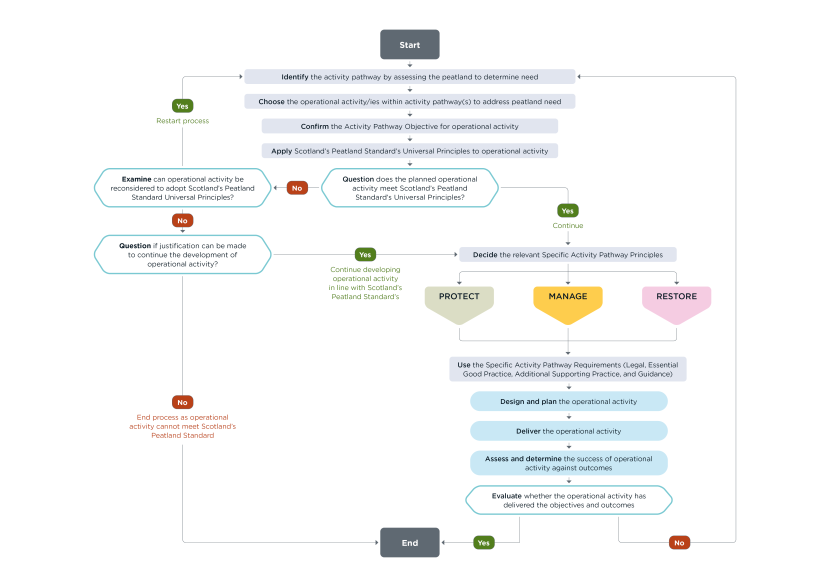
Figure 4 - Decision-making flowchart for assessing operational activities against Scotland's Peatland Standard, guiding users through needs, objectives, principles, and delivery across Protect, Manage, or Restore pathways
Click for a full description
Flowchart showing the operational activity decision-making process under Scotland’s Peatland Standard.
The process starts at the top and follows a vertical sequence of four action steps:
‘Identify the activity pathway by assessing peatland need’
‘Choose the operational activity or activities within the relevant pathway’
‘Confirm the Activity Pathway Objective’
‘Apply Scotland’s Peatland Standard’s Universal Principles’.
The flow then reaches decision junction asking whether ‘the planned operational activity meets Scotland’s Peatland Standard’s Universal Principles’.
If yes, the process continues to a step where the relevant ‘Specific Activity Pathway Principles’ are decided, these pathways are ‘Protect’, ‘Manage’ and ‘Restore’.
These pathways converge into a further sequence of action steps:
‘use the Specific Activity Pathway Requirements covering legal, essential good practice, additional supporting practice, and guidance’, followed by,
‘Design and plan the operational activity’, followed by
‘Deliver the operational activity’, Followed by
‘Assess and determine the success of the operational activity against outcomes’, followed by the final step to ‘Evaluate whether the operational activity has delivered the objectives and outcomes.
If the objective have been met the process ends. If the objectives have not been met the process loops back to the very start ‘identify the activity pathway by assess the peatland need and so on…
If the ‘Universal Principles question’ is answered no, the process moves to steps examining whether the ‘activity can be reconsidered to adopt the Universal Principles’. If yes, the process restarts. If no, a further question asks whether justification can be made to continue the activity. If yes, the activity continues in line with Scotland’s Peatland Standard. If no, the process ends, as the operational activity cannot meet Scotland’s Peatland Standard.
9-2 The supporting detail for these topics listed below are explained in Annex H - Organising Your Operational Activity, which serves as a checklist to help plan, design, deliver, and supervise an operational activity. The range of operational advice to be considered is complex and extensive.
- Project Planning and design
- Pre-planning an Activity
- Land ownership and Management
- Managing Access to Site
- Landscape Character and Visual Impact
- Designing Protection Mitigations
- Protected Species
- Health and Safety
- Utilities and Other Infrastructure Considerations in Planning
- Unexploded Ordnance (UXO)
- Mapping Hydrological Units
- Drinking Water Catchments and Private Water Supplies
- Natural Flood Management and Drought Resilience
- Archaeology, Palaeoecology and Heritage Assets
- Permitted Development Rights
- Forestry and Woodland Removal
- Scrub and Tree Management
- Assessments and surveys
- Peat Depth and Condition Surveys
- Peat Slide Risk Assessment
- Groundwater Dependent Terrestrial Ecosystems (GWDTE)
- Implementation & Delivery
- Management of site works
- Buffers to Watercourses and Pollution Prevention
- Damming Artificial Drains and Gullies
- Management, Supervision and Aftercare
- Supervision and Aftercare
- Plant Health and Biosecurity
- Supporting Information for Organising an Operational Activity
- Project Management Checklist
Chapter 10 - Assessing Outcomes
10-1 Scotland’s Peatland Standard guides the assessment of outcomes of an activity and does not cover national monitoring programmes. Assessment of outcomes can provide evidence to inform future projects, improve peatland practice, and support national commitments to biodiversity recovery and climate mitigation. More information on monitoring methods can be found here: Peatland ACTION data, research and monitoring.
10-2 Assessing outcomes involves checking whether an activity is achieving what it set out to do and whether the peatland is responding as expected. This applies to all peatland activity pathways – protect, manage, or restore.
10-3 The starting point is the objectives for the relevant activity pathway: protect, manage, or restore, and their associated success indicators (See Chapter 3 Objectives, Outcomes, and Success Indicators).
10-4 The requirements below set out what must and should be done to assess outcomes proportionately and effectively.
Legal Requirements - Assessing Outcomes
10-5 Legal requirements for assessing outcomes:
- Carry out all monitoring to meet all conditions attached to any planning consents.
Essential Good Practice Requirements - Assessing Outcomes
10-6 Essential good practice requirements for assessing outcomes:
- Each activity should be assessed according to their respective objectives and the success indicators (Chapter 3 Objectives, Outcomes, and Success Indicators).
- Use the most appropriate proxy by considering which ecological function is most likely to be impacted upon or improved by the activity.
- Assessment should be proportionate to the size, scale and nature of the activity, including the peatland, condition and whether the approach used is well-established or innovative. Innovative methods should be monitored more intensely and thoroughly.
- Make assessments by comparing with near natural examples of the peatland type that is assumed to be functioning well.
- Identify the most appropriate methodology and attributes for measuring the chosen proxy – this should be repeatable.
- Record the baseline for a sufficient duration to assess peatland, in terms of the ecological function, degradation processes or modification.
- Record information about the activity including the design and specification, how it was implemented, and the dates of the activities.
Additional Supporting Practice - Assessing Outcomes
10-7 Additional supporting practice for assessing outcomes:
- Use Peatland ACTION’s Condition categories to record baseline and subsequent changes.
- Share the results of assessments with others including Peatland ACTION for capturing lessons, including good and poor outcomes to ensure poor methods / outcomes are not repeated. If the monitoring method used is scientifically robust, this may be useful for research purposes.
Guidance - Assessing Outcomes
10-8 Guidance for assessing outcomes:
- Directly measuring all aspects of a peatland’s ecological function or health is impossible because it consists of so many mechanisms or processes. Instead, proxies are used which are measurable, or noticeable components that are thought to indicate progress towards a success indicator and objective. Examples that can be used are carbon flux, vegetation communities, species assemblages, hydrological properties, soil bulk density, and the absence of erosion features or threats. The Conserving Bogs: The Management Handbook more details.
- Photographs, videos and drone footage can be useful for recording observations and providing context when used alongside information relating to the proxies, attributes and for making conclusions with reference to the indicators of success.
- The cost of monitoring over large scales means that often only one or a few proxies are used which only provides a partial understanding. Various methods are used to measure the proxies, such as fixed-point photography, vegetation surveys using quadrats or transects, dip wells, or even sensors in watercourses to measure organic compounds in the water.
- Recording baseline and subsequent responses is very useful. It can be challenging to interpret data and relate it to the whole ecological function.
- Some proxies, such as the presence of mobile species, can be influenced very strongly by macro population dynamics. Therefore, the data collected may be less reflective of the peatland’s ecological health and more affected by other factors that are unrelated such as climatic conditions, predator prey relationships, and winter foraging opportunities.
- The forthcoming National Peatland Monitoring Framework will provide information on how to monitor peatlands across Scotland. This will cover the protection, management and restoration of peatlands. See also The Peatland ACTION Partnership Monitoring Strategy and Restoration Monitoring Network and hydrological monitoring.
- More information on available data and examples of monitoring projects can be found here: Peatland ACTION - Data, research and monitoring webpage.
Annexes
The Annexes below provide supporting material that underpins and expands on the content of Scotland’s Peatland Standard. They are intended to be read alongside the main document, rather than in sequence, and users are encouraged to consult specific Annexes.
Annex | Content | Most Useful for |
|---|---|---|
Annex A | Glossary | Information of frequent terms used |
Annex B | Abbreviations | Information |
Annex C | The development of Scotland’s Peatland Standard Principles | All decision-making, especially in complex or novel situations |
Annex D | Peat Depth and Classification Systems | Information |
Annex E | Peatland Action Programme Delivery Partners | Information |
Annex F | Members of the Technical Advice Working Group | Information |
Annex G | Understanding Scotland’s Peatlands | Information |
Annex H | Organising your Operation Activity | Operational delivery |
How to respond - Instructions and online feedback form
Scotland has around two million hectares of peatlands representing around a quarter of Scotland’s land surface. Healthy peatlands provide a wide range of ecosystem services and benefits. They play a critical as well as their role in mitigating climate change by capturing and storing atmospheric carbon and helping us to adapt to a changing climate. Peatlands are also rich in biodiversity, often supporting unique species that are specially adapted to this habitat.
About this consultation
The development of the draft Scotland's Peatland Standard aims to provide a framework for the protection, management and restoration of peatland in Scotland.
Scotland's Peatland Standard fulfils the commitment made in Scotland's Climate Change Plan: 2026–2040 that “in 2026, we will consult on and launch Scotland’s Peatland Standard which will ensure quality and consistent peatland restoration standards".
What we are asking
NatureScot has been working with stakeholders to develop this first iteration of Scotland's Peatland Standard. Given that we are exploring a new concept within a complex operating environment, we want to draw as many views as possible from different people operating in the sector. These views will inform the development of Scotland's Peatland Standard and ensure it does what it sets out to do.
Thus, we are now asking for your input on this first draft and are inviting comments from anyone with an interest in Scotland’s peatlands, including practitioners, land managers, regulators, funders, researchers, and members of the public.
This consultation will help us consider the changes that needed before publication at the end of 2026 to make sure Scotland's Peatland Standard works.
We are seeking your views on whether the draft is:
- Navigable – how clear and accessible is its scope, structure and presentation?
- Ambitious – how feasible are the objectives and outcomes it is seeking to progress?
- Adding value – how complete and proportionate is its content – the principles and requirements – and is it adding value beyond current operational guidance?
- Useable – How effective will it be as a tool for supporting decision-making?
- Complete – have we missed anything that should be included, and is the level of detail balanced?
- In context – could the standard lead to unintended consequences beyond its peatland protection, management and restoration remit.
- Balanced – overall, is the standard balanced in its presentation of background, objectives, principles, requirements and supporting information
How to respond
The draft Scotland’s Peatland Standard is available to read on this web page.
Please submit your responses using the online response form.
There are a total 37 questions. The first three questions are required, and after that you do not need to answer every question. Please respond to those most relevant to your experience and role. Most questions have supplementary text boxes for your comments.
The consultation opened on 21 May 2026 and closes at noon on Friday 28 August 2026.
Responses received after the closing date may not be considered before the publication.
Short video will help you to respond to consultation of the draft of Scotland's Peatland Standard.
Duration
01:54
Webinar: Online information session to hear more about Scotland's Peatland Standard draft consultation and how to complete the questionnaire.
Duration
16:03
What happens next
A summary of consultation responses will be published following the close of the consultation period, setting out the key themes raised and how they will inform the published Standard.
We aim to publish the first version of Scotland’s Peatland Standard before the end of 2026.
Contact
If you have any questions about this consultation, please email us: [email protected]
How to contact us for general feedback or queries about this consultation
If you have any questions about this consultation, please email us: [email protected]
Webinar sessions
Join us at one of our Scotland's Peatland Standard open consultation draft webinars.
Your views on the draft of Scotland's Peatland Standard open consultation are important to us. To facilitate participation, we are running a series of online webinars. The webinars aim to guide participants on how to respond to the questionnaire, with sessions scheduled on 24 June, 3 July and 3 August 2026.
Book your referred date online:
24 June from 14:00hrs until 15:00hrs
3 July from 10:00hrs until 11:00hrs
3 August from 15:30hrs until 16:30hrs
Annex A - Glossary of terms
Acrotelm
The surface layer of an active peat-forming mire, composed of the most recently deposited material, within which the water table fluctuates and where water moves more freely than in lower peat layers. See also Catotelm.
Activity
A planned single or a set of actions undertaken over a long period of time on a peatland site with the aim of implementing one or a combination of the activity pathways. In all cases, the activity should have defined objectives and identifiable outcomes against which progress can be assessed.
Aftercare
Follow up activities are termed “aftercare” to differentiate them from the activities carried out within the management activity pathway. Aftercare remedies relate specifically to the restoration techniques used and could be many years after the activity.
Amorphous
Amorphous peat is a highly decomposed, organic-rich soil where original plant structures have broken down, resulting in a dark, compact, and plastic material when wet.
Appropriate assessment
Regulation 48 of The Conservation (Natural Habitats, &c.) Regulations 1994, as amended, requires an authority, before deciding to undertake, or give any consent, permission or other authorisation for certain plans or projects likely to have a significant effect on a European site in Great Britain (either alone or in combination with other plans or projects), to make an ‘appropriate assessment’ of the implications for the site in view of that site’s conservation objectives (Reference National Planning Framework 4).
Biodiversity (or biological diversity)
The variability among living organisms from all sources including, inter alia, terrestrial, marine and other aquatic ecosystems and the ecological complexes of which they are part; this includes diversity within species, between species and of ecosystems (UN Convention on Biological Diversity).
Biomass
Biomass is biological material derived from living or recently living organisms.
Blanket bog
Bog habitat which deposits expanses of peat that blanket the landscape. Includes both active and degraded versions of this habitat with semi-natural vegetation.
Bog
A mire which derives all its water supply from rain, snow or mist. Names in Gaelic include Bog; boglach; carr; fèithe; mòine; Mòinteach; poll. See also ‘Mire’.
Buffer
A buffer is a strip/zone, a designated area of land, located adjacent to a sensitive feature, designed to act as a protective barrier against environmental damage.
Bulk density
Also called apparent density, is the mass of the bulk material divided by its bulk volume.
Carbon-rich soils Organo-mineral and peat soils are known as carbon-rich soils. A peat soil is defined in Scotland as when soil has an organic layer at the surface which is more than 50cm deep (see ‘organo-mineral soil’ or ‘peaty soil’ and ‘humus soils’).
Carbon sequestration
The long-term removal, capture, or sequestration of carbon dioxide from the atmosphere to slow or reverse atmospheric carbon dioxide (CO2) pollution and to mitigate or reverse climate change.
Carbon sink
A carbon sink is a natural or artificial reservoir that accumulates and stores CO2 for an indefinite period.
Carbon Flux
Carbon flux is the rate and direction of carbon exchange - specifically carbon dioxide CO2 between the soil and the atmosphere.
Catotelm
The lower layer of an active peat forming mire which remains permanently waterlogged, and through which water usually moves less freely. See also Acrotelm.
Compaction
Peat has unique combination of properties: low bulk density, high porosity, and due to the structure of its pores. Soil compaction reduces the pore space within soil and may reduce the volume of peat soil (compression). This can restrict water infiltration into the soil, reduce water storage capacity, increase soil bulk density and may reduce peat depth.
Compensation
EIA and EcIA guidance define this term as: Measures taken to offset the loss of, or permanent damage to, ecological features despite mitigation. In NPF4 this is referred to as offsetting.
Conservation area
Areas which has special architectural or historic interest that are considered worthy of protection. Their selection, assessment and designations are carried out by the planning authority.
Cultural significance
Aesthetic, historic, scientific or social value for past, present or future generations. Cultural significance can be embodied in a place itself, its fabric, setting, use, associations, meanings, records, related places and related objects.
Decomposition Peat soils develop where plant growth exceeds plant decomposition, and this commonly occurs where the anoxic conditions associated with waterlogging hinder the breakdown of plant material.
Drought stress
A condition that occurs when a plant doesn't have enough water, which can be caused by a lack of rainfall or high temperatures.
Ecology
The relationships between organisms living things and their environment.
Ecological function
A term used to describe the roles organisms or processes play in an ecosystem.
Ecological processes
Are the dynamic attributes of ecosystems, including interactions among organisms and interactions between organisms and their environment. Ecological processes are the basis for ecosystem self-maintenance. Ecosystem functions can also refer to those dynamic attributes which most directly affect metabolism, principally the sequestering and transformation of energy, nutrients, and moisture.
Ecological protection
To protect ecology from harm or damage. This would include protecting the ecosystem’s functions and health. Effective protection should maintain the level of ‘ecosystem services’ provided.
Ecological recovery
The state or condition of key ecosystem attributes relative to the reference ecosystem, that can be partial or full.
Ecological repair
Repairing a single mechanism or mechanism within the wider ecological function.
Ecological restoration
The process of assisting the recovery of an ecosystem that has been degraded, damaged or destroyed.
Ecosystem
All the living things (plants, animals, and people) and process in an area and the way they affect each other and the environment.
Ecosystem function
The ecological and physicochemical processes that occur within an ecosystem. See Ecological processes.
Ecosystem health
Is a measure of the status or condition of ecosystems. The state or condition of an ecosystem in which its dynamic attributes are expressed within ‘normal’ ranges of activity relative to its ecological stage of development.
Ecosystem services
The direct and indirect processes or materials such as clean water, energy, climate regulation, and nutrient cycling that are naturally provided by ecosystems for human health and quality of life. Also known as ecological services or ‘natural capital’.
Enhancement
Enhancement of biodiversity, including by restoring degraded habitats and building and strengthening nature networks. This requirement is to provide significant biodiversity enhancements for development falling under NPF4 Policy 3b, these measures are in addition to the restoration and offsetting requirements.
Erosion
Peat erosion starts with the loss of peat vegetation cover. Vegetation can be damaged by natural processes which can be made worse by inappropriate land management practices such as unsuitable draining or burning of the land, trampling by animals and people and by pollution.
Evaporation
The process of a liquid changing to a gas.
Evapotranspiration
Combined loss of water to the air by evaporation from the soil or surface water and transpiration from plants and animals.
Fen
Fens receive water from surface runoff and/or groundwater in addition to direct atmospheric deposition. A ‘lagg’ fen is immediately adjacent to a raised bog.
Flush / Flushes
Area where water from underground – called groundwater – flows out onto the surface to create freshwater and wetland habitats.
Geomorphology
The branch of geology that describes with the structure, origin, and development of the topographical features of the earth's surface.
Grazing / Browing
When an herbivore eats grass and other herbaceous plants or different parts of woody vegetation.
Groundwater
Water which is below the surface of the ground in the saturation zone and in direct contact with the ground or subsoil.
Groundwater Dependant Terrestrial Ecosystems (GWDTEs)
GWDTE are a category of wetlands, which derive their water supply primarily from a groundwater body, rather than deriving their water from rain and surface water saturated soils.
Gully
Gullies are channels cut through peatland usually by running water.
Habitat Impact Assessment
Habitat Impact Assessment as explained in Best Practice Guidance is a methodology for measuring and assessing current impact of grazing on habitats. (The term is often used interchangeably with Herbivore Impact Assessment).
Hag (g)
Cliff edge peat features where peat has eroded to leave a vertical face. Can be single edge features or connect to form isolated islands with an eroding face on all sides.
Herbivore
An organism that feeds mostly on plants.
Herbivore Impact Assessment (HIA)
A survey method used to monitor and assess the effects of large herbivores on habitats by measuring indicators such as browsing, grazing and trampling to inform land management. (The term is often used interchangeably with Habitat Impact Assessment).
Hibernacula
Hibernacula are features (typically below ground) that some species use throughout the winter to conserve energy and protect themselves from the cold.
Historic environment
The historic environment is ‘the physical evidence for human activity that connects people with place, linked with the associations we can see, feel and understand’.
Historic environment asset
An asset (or ‘historic asset’ or ‘heritage asset’) is a physical element of the historic environment – a building, monument, site, place, area or landscape identified as having cultural significance.
Holocene
The Holocene is the current geological epoch, representing the last ~11,700 years of Earth’s history following the end of the last major ice age
Hydrological connectivity
The physical linkage of water and sediment which facilitates the transfer of matter, energy, and organisms within, or between elements of the hydrologic cycle.
Hydrology
The study of water on Earth to understand its distribution, circulation and presence.
Hydrophobic
In relation to soil, tending to repel water, or rather than absorbing, causing run off.
Impacts
These can be direct or indirect which result in changes to functioning of the habitat/soil or loss of the habitat/soil.
Intact Peatland
A peatland which has formed naturally and has not been modified. It may be degraded through the natural processes of peat formation.
Local Development Plan (LDP)
A plan produced by every authority in Scotland, forming the other component of the statutory development plan alongside NPF4. They set out land use policies and proposals, specific to each local authority.
Management
Peat management refers to the responsible stewardship or handling of peat, for example preventative, or protective (of carbon), by minimising disturbance, compaction, or the responsible management of browsing herbivores on a landscape scale or peatland development and restoration in a transparent and accountable manner.
Microbes
Microbes (or microorganisms) are tiny living things that can only be seen with a microscope. Main types include bacteria, viruses and fungi.
Microbial
Relating to or caused by microbes.
Minimise
Reducing the impacts.
Mire
A wetland that supports peat-forming vegetation. Some people use this this term to include wetlands on mineral soils.
Mitigation Hierarchy – NPF4
Indicates the order in which the impacts of development should be considered and addressed.
These are:
i. Avoid – by removing the impact at the outset
ii. Minimise – by reducing the impact
iii. Restore – by repairing damaged habitats
iv. Offset – by compensating for the residual impact that remains, with preference to on-site over off-site measures.
Modifications
Many peatlands have been modified by human activity to support other land uses, including drainage, burning, over-grazing and afforestation.
Monitoring
Monitoring of an activity as part of a management system, key functions of this role include monitoring performance and compliance and providing leadership.
National Planning Framework 4
National spatial strategy for Scotland. It sets out Scotland's spatial principles, regional priorities, national developments and 33 specific national planning policies that directly influence all planning decisions.
Nature network
A Nature Network is a joined-up system of places important for wild plants and animals, on land and in water. It allows plants, animals, seeds, nutrients and water to move from place to place and enables the natural world to adapt to change, providing plants and animals with places to live, feed and breed.
Negative indicator species
Organisms - often plants - that signify poor habitat quality, degradation, or intense disturbance within an ecosystem. They typically thrive in environments with low biodiversity, high nutrient levels, or unsuitable management, often acting as competitive, dominant, or invasive species. Their presence indicates a need for management intervention. See Assessing outcomes chapter for more information.
Natural Capital
Natural capital refers to the stock of natural resources on Earth, encompassing both renewable and non-renewable sources. Understanding the relationship a farm has with its natural capital assets through a natural capital assessment can help make informed on-farm decisions.
Offsetting
Measures designed to compensate for a residual impact, in a development proposal.
Ombrotrophic
Dependent upon atmospheric sources (mainly precipitation) for the supply of water and nutrients.
Organo-mineral
Organo-mineral and peat soils are known as carbon-rich soils. A peat soil is defined in Scotland as when soil has an organic layer at the surface which is more than 50cm deep. These are mineral soils but also considered to be carbon rich.
Oxidation
The process of a substance or chemical element oxidizing. In the context of peatlands this refers to the loss of water.
Palaeoecology
The study of fossil animals and plants to deduce their ecology and the environmental conditions in which they lived.
Peat
Peat is defined as the partially decomposed remains of plants and soil organisms which have accumulated at the surface of the soil profile.
Peat Mantles
Peat deposits are a mantle which sits above rock, gravel or clays.
Peat pipe
An underground, natural channel or tunnel that forms within peat, acting as a drain that allows water through flow or outlet.
Peat slide
Medium to large-scale landslides in which failure initiates as large rafts of material which subsequently break down into smaller blocks and slurry.
Peat soil
In Scotland is defined as soil with a surface peat layer with more than 60% organic matter and of at least 50cm thickness. (often termed organic soils)
Peatland
Under NPF4, peatland is “defined by the presence of peat soil or peaty soil types. This means that “peat-forming” vegetation is growing and actively forming peat or it has been grown and formed peat at some point in the past”.
Peatland Bounds
The physical extent of peat-forming ecosystems.
Peatland Habitat
There are four main natural peatland habitat types in Scotland: blanket bog, raised bog, fen and bog woodland.
Peatland Restoration
Carrying out a planned activity which in combination with natural processes restores the hydrological function and coverage and good condition of priority peatland habitat vegetation, resulting in a peatland that is actively forming peat and sequestering carbon.
Phenology
The study of life cycle events of living organisms on Earth. Plant community phenology studies the timing of recurring biological life cycle events - such as budding, leafing, flowering, and senescence - across a group of species.
Poaching (vegetation)
Severe damage to soil and pasture caused by animal hooves (especially cattle) in wet conditions, creating compacted, muddy, and waterlogged ground.
Positive indicator species
A positive indicator species is an organism whose presence, thriving population, or high abundance indicates a healthy, unpolluted, or specific high-quality habitat. Their sustained presence acts as a reliable biological sign that environmental conditions are stable and ecologically valuable. See Assessing outcomes chapter for more information.
Priority Peatland Habitat
Peatlands support a variety of habitats and important biodiversity. Some are identified as a priority habitat in the UK BAP, Scottish Biodiversity List and Annex 1 of the ‘Habitats Directive’ and are protected.
Protect
Ensuring that the natural features of special interest (peatlands and all biodiversity therein) within a designated area remain in good health, now and in the future.
Proxy
Proxies are measurable indicators that reliably stand in for or represent the broader condition, function or process that cannot be directly measured. Examples include, water tables, vegetation, used to infer the habitats health.
Raised bog
Bog habitat which is characterised by an accumulation of peat that rises above the surrounding landscape often in lowland wet floodplains and/or often over the surface of existing fen peat.
RAMSAR sites
Wetlands designated under the Ramsar Convention on Wetlands of International Importance.
Redox Status
Redox status (short for reduction-oxidation) refers to the balance between oxygen availability and electron activity in the soil. It is a measure of how "aerated" (oxidized) or "waterlogged" the soil is, which directly impacts the behaviour of chemicals and nutrients.
Rehabilitation
Generic term used for ecological repair activities that aim to restore ecosystem functioning but does not aim to bring back the full suite of species and attributes of a native reference system. This may be because native ecosystem recovery is not possible due to the consideration of other objectives. This may apply to sites that have been highly modified for a long time.
Reinstatement
Use of peat on-site in construction or reinstatement e.g. restoration of hardstanding areas, borrow pits, road verges, peatland restoration etc. or off-site to restore peatland areas. This form of peat use involves protecting excavated peat, and returning it to where it was taken from, in its original order (acrotelm overlying catotelm). This can restore the hydrology to support peatland, providing that best practice is followed.
Remediation Activities
Any remediation activity to address land contamination. The removal of contaminants, pollutants or other similar types of threats. This also includes the repairing of damage to soil, water and sediments, or the removal of non-native trees.
Replacement
Involves establishing a crop or a different habitat than was originally found on the site. Not generally compatible with the objectives of restoration but could be for management. Replacement may compromise or reduce the ecosystem functional health of the peatland.
Restoration activities
Interventions that have the goal of achieving substantial ecosystem recovery towards the reference ecosystem.
Restoration ecology
The science that supports the practice of ecological restoration, from other forms of environmental repair in seeking to assist recovery of native ecosystems and ecosystem integrity.
Restore
Repairing damaged habitats.
Revegetate
Revegetation of bare peat involves using techniques that aim to stop or reverse bare areas of peat surfaces, so that they are protected from erosion, stabilising the peat surface in the process. Using peat and/or peatland vegetation that has been excavated during the construction of a development; often surrounding windfarm infrastructure, or for landscaping. This form of peat use will often result in revegetation but unlikely to be peatland, however, it can have a role in protecting the surrounding peatland and conserving carbon and biodiversity providing that best practice is followed. This is likely to have higher carbon emissions than reinstate.
Schedule monument
Archaeological sites or monuments of national importance that are legally protected under the Ancient Monuments and Archaeological Areas Act 1979
Snagging
Process of inspection necessary to compile a list of minor defects or omissions in works for the contractor to rectify.
Sphagnum moss
A non-vascular plant that thrive in wet areas (such as bogs) where their remains become compacted with other plant debris to form peat.
Tipping point (Degradation)
When a peatland is degrading, a tipping point is ultimately reached when the net carbon balance switches from a sink to a source, compromising the long-term stocks and storage of carbon. Can lead to loss of keystone species and the disruption in the complex feedback mechanisms that govern peatland functions.
Tipping point (Restoration)
This is when the recovery of the peatland during the restoration process reaches a point of no return, barring any additional stressors or modifications being introduced. The natural recovery processes are strong enough for the optimal ecological functions to be restored in time.
Topography
The physical shape and features of the land surface appearance of the natural features of an area of land, especially the shape of its surface.
Use of peat
Using peat and/or peatland vegetation that has been excavated during the construction of a development, for a suitable purpose. Use of peat, of appropriate volumes of peat and or peatland vegetation can be carried out for Reinstatement, Revegetation and Peatland Restoration.
Waste
A substance or object is considered waste when the holder discards it, intends to discard it, or is required to discard it. In the context of peatland activities, this includes any excavated or removed material that the holder cannot or will not use on the site of excavation and that must therefore be disposed of, treated, or managed under applicable waste regulations.
Water table
Boundary between the unsaturated zone and the saturated zone underground. Below the water table, groundwater fills any spaces between sediments and within rock. Water table can be at or above the surface if visible water is present.
Woodland
Land under stands of trees with a canopy cover of at least 20%, or having the potential to achieve this, including integral open space, and including felled areas that are awaiting restocking (replanting). The minimum area is 0.1 ha and there is no minimum height.
World heritage sites
Internationally important cultural and/or natural heritage sites which have been inscribed for their “Outstanding Universal Value”.
Annex B - Abbreviations
Agri-Environment Climate Scheme (AECS)
Association of Local Government Archaeological Officers Scotland (ALGAO)
The Construction (Design & Management) Regulations 2015 (CDM)
Chartered Institute of Ecology and Environmental Management (CIEEM)
The Construction Industry Research & Information Association (CIRIA)
Digital Elevation Model (DEM)
Environmental Authorisations Scotland Regulations 2018 (EASR)
Ecological Clerk of Works (ECoW)
Environmental Impact Assessment (EIA)
Forest Industry Safety Accord (FISA)
Good Agricultural and Environmental Conditions (GAEC)
Geographical Information Systems (GIS)
Groundwater Dependant Terrestrial Ecosystems (GWDTE)
Habitat (or Herbivore) Impact Assessment (HIA)
Habitat Regulations Appraisal (HRA)
International Union for Conservation of Nature (IUCN)
Joint Nature Conservation Committee (JNCC)
Light Detection and Ranging (LiDAR)
National Planning Framework 4 (NPF4)
Other Effective Area-Based Conservation Measures (OECM)
Private water supplies (PWS)
Special Area of Conservation (SAC)
Scottish Archaeological Research Framework (ScARF)
Scotland’s Environmental and Rural Services (SEARS)
Scottish Environment Protection Agency (SEPA)
Scottish Natural Heritage (NatureScot) (SNH)
Special protected Areas (SPA)
Site of Special Scientific Interest (SSSI)
Scottish and Southern Energy (SSEN)
Scottish Power Energy Networks (SPEN)
United Nations Educational, Scientific and Cultural Organization (UNESCO)
UK Forestry Standard (UKFS)
Unexploded ordnance (UXO)
Annex C - The Development of Scotland’s Peatland Standard Principles
C-1 Principles are often used in decision processes when there are complex factors determining whether objectives are achieved. This is especially true when specifications must be adapted for local circumstances and flexibility is required.
C-2 Principles can also help guide innovation and improvement of techniques, whilst also ensuring Sub-optimal approaches are not used. Some decision making in other mature sectors can rely on regularly reviewed detailed technical specifications. This is not the case in peatland protection, restoration or management, with many of the outcomes not evidenced.
C-3 Principles can also help assess what trade-offs are acceptable when balancing the benefits of carrying out an activity, versus the negative impact of doing so.
C-4 The principles by essence need to be non-specific to be relevant across as wide a scope as possible. They could be viewed on a scale of broad/general grading to detailed/specific – where the principles are at one extreme and the specifications on the other.
C-5 The principles have been developed in a peatland sector context using the high-level principles as set out in International principles and standards for the practice of ecological restoration (second edition, published in 2019 in Restoration Ecology journal vol 27, No. S1, pp. S1-S46).
The Seven Universal Principles and Activity Pathway Specific Principles – Explanation, Interpretation and Clarification
C-6 Most of the principles fall within two main types - avoiding the introduction of threats or stressors on the peatland function and carrying out actions that would improve the natural processes that drive or maintain function.
C-7 Each principle is stated below, with explanations, clarifications, and examples given of their application. These are not exhaustive and so should still be applied in more circumstances than are listed.
C-8 The principles are listed in order of necessity. In terms of high-level priorities, the most immediate action is to protect what is already there, followed by managing out threats to existing peatlands, then to restore ecosystem function to modified peatlands and lastly manage highly eroded peatlands since they cannot be fully restored. The most important decision of all is to decide whether an activity is required or not.
Scotland’s Peatland Standard’s Universal Principles
The following section provides in depth explanation, clarity and examples on how to apply the universal principles.
1. Obtain Knowledge of the Specific Peatland and How it Functions so that Potential Impacts and the Effectiveness of Actions are Fully Understood
C-9 Explanation: Adopt a whole system integrated approach to achieve multiple benefits. This means that the surrounding land uses and habitats should be considered in preparing plans to meet the objectives of plans and activities to help care for peatlands. The interactions between each land use or habitat should be identified and understood when making decisions.
C-10 Clarity: This also means that the surrounding land uses should consider the possible negative impacts that they could present to the peatlands function. It is important to reference the objectives and other principles when making decisions. Scotland’s Peatland Standard provides an introduction to the information required to do this.
C-11 Applications: Any instances where peatlands may be affected. Examples include when deciding upon grazing regimes, wildfire mitigation and plans and implementation actions. Also, when complying with: NPF4, Forest Plans, Woodland Creation projects, cross compliance including GAEC, environmental conditionality link to support payments, Peatland Management Plans and Habitat Management Plans, river basin management plans, peatland restoration proposals, Protected Area plans.
2. Consider the Impact of Activities on a Short - and Long-term Basis
C-12 Explanation: Peatlands are ancient. Indicators or measurement of positive or negative change in peatland function often takes a long time to present and identify. Actions taken to protect, maintain and restore peatlands should be sustainable and long lasting.
C-13 Clarity: Innovative methods or actions can still be used if there is no evidence of success recorded.
C-14 Applications: When proposing activities during design and implementation of restoration proposals, considering impacts of developments on natural processes and the soil properties and the consider the other principles.
3. Carry out Actions only When they are Required to meet the Objectives for Protection, Management, and/or Restoration.
C-15 Explanation: The aim of this principle is to help decide when to intervene; to protect, manage or restore peatlands. It is to ensure that activities are only carried out if there is a clear benefit in doing so. The intention is also to prevent unnecessary activities that could compromise the peatland’s functions. For example, it may be counterproductive to compact and disturb peatland vegetation as this can trigger the alter the hydrological conditions and soil properties that support the desirable peatland specific species. It may also trigger the development of surface erosion.
C-16 Clarification: This should not be interpreted as a reason not to carry out activities when they are required to meet the objectives. This principle is intended to provide a balanced steer, empower professional judgement and encourage discussion.
C-17 Applications: When designing and implementing all activities.
4. Minimise Disturbance of Peatland Vegetation and the Compaction and Disturbance of Peat
C-18 Explanation: Presented along with Principle 5 and 6 as of equal importance, they are dependent on each other to maintain good function, prevent degradation, and promote natural successional processes. Excessive compaction and disturbance can also trigger and drive degradation processes of peatlands with good function. Positive indicator species play an important role in establishing the target habitat communities immediately after land use activities which effectively kick-start recovery.
C-19 Clarity: This should not discourage carefully planned and targeted activities that are designed to counteract and repair peatland areas with higher-than-normal rates of water conductance. This can result from drainage effects from modifications over the long term and result in the acrotelm being oxidised. Where this has been carefully assessed, targeted activities using methods to compact the peat can be used to restore the hydrological conditions.
C-20 Applications: All activities and decisions. Including; if a machine’s specifications are fit for purpose, agreeing protection measures, assessing outcomes of supervising management activities, to designing and carrying out restoration activities.
5. Maintain the Natural Hydrological Properties and Connectivity of the Peatland or Match it with a Comparable Natural System or Geomorphological Type.
C-21 Explanation: Natural hydrological conditions supported the growth of the peatland over many years. When altered, this compromises the ability of this peat mass to be maintained or to continue forming. It also compromises the recovery of peatland vegetation since it also relies on the same growing conditions.
C-22 For restoration activities, re-wetting techniques should be chosen and designed to restore the hydrological regimes and properties of the peatland that resemble those of the original peatland in that location. In other words, the landform and hydrology of that area that supports the formation and maintenance of peat.
C-23 The aim is to restore a hydrological regime that experiences all the dynamism and relative amounts or strengths of water supply, resistance/conductance, and discharge.
C-24 Clarity: This does not mean that any measure to increase the wetness of the peat is positive or desirable. This applies when protecting, managing and restoring peatlands.
C-25 Applications: Plans and implementation of all activities. This includes agreeing protection measures, designing and carrying out restoration activities, and assessing the outcomes of monitoring the results of activities. Examples are deciding upon actions to maintain hydrological connectivity around roads or infrastructure is to provide adequate numbers of culverts or introduce materials into the foundations that allow water flow underneath. Examples would be where to establish trees, to ensure this has a beneficial effect and not a negative impact.
C-26 Additional notes: Match the hydrological properties and connectivity of the peatland or geomorphological type of the natural system: In the uplands increasing the water supply or decreasing the water conductance could have undesirable effects. For example, if a restored flushed peatland on a slope has a large volume of water passing through it, the methods employed could introduce a barrier to water movement, resulting in undesirable effects. It could increase the risk of a peat slide occurring, speed up and/or trigger surface erosion as water is not contained within the acrotelm and is forced onto the surface.
C-27 The above example is often found in upland blanket bogs with undulating and gently or steeply sloping terrain. Shallow depressions or gullies that are sloped and carry water from large areas of peatlands into water courses support valuable vegetation communities that depend on wet peat. The types and specifications of restoration methods used in these areas need to take account of this.
C-28 Several activities can alter the hydrological connectivity, supply, conductance/resistance and discharge of water in the peat. This affects the ecosystem function of the peatland across a footprint that varies with geomorphological peat type and hydrology. Activities include installing infrastructure which introduce a stone barrier or compact peat. This can slow down water flow in an undesirable way resulting in an altered supply and discharge of water on a specific part of the peatland.
C-29 The impact of an activity upon the peatland, depends on what the hydrological conditions were when the peat was forming previously. For example, even a floating road usually reduces the flow of water below it, as it has compacted the acrotelm which is where most of the water is transported through the peat. Whilst in some instances this may be regarded as a positive impact for example wetting the peat helps drive peat formation. This often means that the peat on the other side of the road is now experiencing a reduced water supply. This may have lesser obvious effects on an ombrotrophic bog but could have significant impacts on a fen or upland flushed peat within a concave bowl. The hydrological conditions are dynamic, changing with respect to the precipitation events, i.e. constant variation between periodic droughts and deluges. Altered peatlands may not be able to cope with an altered supply, conductance and discharge of water, leading perhaps to unusual peat formation patterns, corresponding peat loss and triggering and then driving erosion and degradation over the longer term.
6. Reduce or Remove all Significant Threats to the Peatland Habitats.
C-30 Explanation: Threats or stressors on peatland function can be presented individually, but often there are multiple stressors that act cumulatively. All reduce functional traits and resilience to climate change to varying degrees. Tackling these threats often requires long term actions and a commitment of ongoing management.
C-31 Clarity: An assessment should consider the impacts on natural processes that are maintaining or restoring the peatland. These include the hydrological conditions and the cover and condition of positive indicator species. Threats include drainage features, modifications, physical barriers to water movement such as tracks or roads, encroachment of non-native tree and plant species, salinity, severity and frequency of fires, over grazing and poaching from livestock or wild deer, trampling, nutrient deposition and nutrification (atmospheric and aquatic). This principle is designed to encourage a holistic approach.
C-32 Applications: All plans/ proposals that adopt a holistic approach.
7. Assess Outcomes using the most Appropriate Recognised Monitoring Method Considering the Objectives.
C-33 Explanation: This is a broad principle that should be achieved on several levels, through national monitoring strategies and locally on a site-by-site basis. The latter is important when deciding whether aftercare or management is required.
C-34 Clarity: Monitoring methods should be fit for purpose, proportionate, and effective.
C-35 Applications: All protection, management and restoration activities where resources are available.
Activity Pathway Specific Principles - Protection
This section explains and clarifies the activity pathway and application for the protection of peatlands.
8. Protect the Integrity, Condition and Functional Properties of the Peatland and the Surrounding Associated Habitats.
C-36 Explanation: This includes Annex 1 and priority habitats and 'features of Protected Areas', and other habitats listed on the Scottish Biodiversity List. These are the habitats that are regarded to be of the highest value.
C-37 Clarity: These habitats are as important as peatland habitats.
C-38 Applications: Development proposals, restoration proposals for accessing and working peatland sites.
Activity Pathway Specific Principles – Management
This section explains and clarifies the activity pathway and application for the management of peatlands.
9. Maintain or Improve Peatland Functions by Considering the Individual and Combined Impacts of Each Management Activity or Regime.
C-39 Explanation: The activities within the managed category include those which are improving the structure or species community in some way, or are delivering non peatland specific objectives, or both. This usually involves a trade-off between objectives. Examples are
- Deciding upon a grazing regime that improves the condition of the habitat or the peat forming function.
- Setting an optimal herbivore density to ensure trampling or poaching does not compromise the management objectives.
- Devising a wildfire risk assessment and mitigation plan to achieve a fire resilient landscape.
C-40 Clarity: This is about balancing objectives and considering the impacts of proposed actions or reviewing and amending regimes already in place.
C-41 Applications: All management activities.
Activity Pathway Specific Principles – Restoration
This section explains and clarifies the activity pathway and application for the restoration of peatlands.
10. Activities Should Remediate all Modifications and Degradation Features that Negatively Impact the Functionality of the Peatland.
C-42 Explanation: This principle should be considered along with the second restoration principle to provide a balanced approach to meeting the objectives. These principles speak directly to the indicators of success relating to ecological function. All the hydrological units that are found across the peatland unit should be restored adopting an integrated watershed management approach. This ensures that the whole of the peatland is more likely to reach the restoration tipping point. It is important to distinguish between micro-erosion features that may self-repair or recover after a reduction of grazing regime or the removal of another threat, and those features that are not going to recover in time.
C-43 Clarity: This principle should not be used to over-rule the protection principles - all must be considered together and weighed up for a given circumstance.
C-44 Applications: Within the design process.
11. Do Enough and No More to Meet the Objectives.
C-45 Explanation: This Principle should be considered along with the 13th principle to provide a balanced approach to meet the objectives. These objectives speak directly to the Ecosystem function. This principle is intended to avoid the use of over engineered solutions or techniques, as more disturbance risks unintended consequences such as alteration of the hydrology and can compromise ecological function. This is a high-level concept or aspiration, which is intended to rationalise and minimise workflows, wastage, and maximise efficiency when delivering the objectives.
C-46 This aligns with other principles, such as minimising compaction and disturbance of peat, since more work usually entails more of this happening. It should also promote the adaptations of specifications to suit local circumstances. For example, the creation of overly high bunds is counterproductive because they either subside over time releasing significant carbon dioxide or remain an artificial feature that can attract tree colonisation. They may also increase the risk of fires spreading in some circumstances.
C-47 Clarity: This principle should not be used to propose doing less activities than are deemed to be required. This does not mean that ‘less should be done than has proven successful in the past’, but it does mean ‘do not do more than has proven sufficient in the past, without justification’.
C-48 Applications: Decision making with regards to comparing two different restoration methods that may appear to be equal with no strong preference given the circumstance or local conditions. This principle is also useful when improving machine operator workflows.
12. Minimise the Duration and Number of Times the Peat is Reformed or Handled.
C-49 Explanation: This principle speaks directly to the workflows used by machine operators and to designers who are proposing site specific techniques or specifications. This is applicable to workflows for re-profiling hags, creating surface bunds or any activity that involves disturbing peat. This aligns with the 2nd principle - the need to minimise compaction and disturbance, however this principle builds upon this by providing a clear steer for complex workflows with many stages. For example, it is common to see a mitigation included in many soil or habitat restoration plans that if the result from the first attempted work is not satisfactory, then follow up work will be carried out to rectify this. This is normally not applicable to peatland restoration activities and is often counter-productive to the objectives. The result from the first attempt should be optimal first time when re-profiling hags, re-profiling drains, and ground smoothing. There is usually no opportunity to remedy an error or shortfall in the workflow/ specifications used, without further compacting or disturbing the peat. This would be highly undesirable and may even have been the reason the first attempt was not successful.
C-50 Clarity: In the spirit of the ‘do enough and no more to meet the objectives’ principle, insofar as it is not intended to result in less work being done than is required to meet the objectives.
C-51 Applications: When deciding and improving on operator workflows when using peat, e.g. borrowing peat for installing peat dams, bunds, and when re-profiling hags. When designers are preparing specifications based on site conditions and needs.
13. Restore Peatland Habitat to Achieve the Optimal Recovery of Peatland Hydrology and Peat-forming Vegetation Communities.
C-52 Explanation: ‘Optimal’ often means quickly but there may be exceptions. Many of the peatland positive indicators act as very prolific pioneer species. This means they can usually be relied upon to recolonise or regenerate quickly before negative indicators not associated with peatland habitats can establish and begin to suppress them. However, speed is thought to be an important factor in the establishment of natural processes and traits that drive the restoration process towards meeting the objectives. When the process is slow, for example, when revegetating an eroded gully, the risk of a once every five-year deluge event washing the partially recovered vegetation becomes greater as the time taken to reach a condition that is robust and resilient increases. Another example is when restoring forest to bog habitats, since bare peat can provide a very favourable seed bed that non-native tree can establish and develop on, whereas this is rare on revegetated sites. In this case, the risk of the restoration process travelling in a different trajectory increases as the time taken to revegetate with positive indicators lengthens.
C-53 Clarity: This principle should provide leadership in improving or developing new techniques and comparing them with established methods. These improvements are most likely to involve linking more strongly with natural processes, rather than using over engineered alternatives. Maximise the alignment and use of natural processes to achieve successful restoration.
C-54 Applications: When comparing two different restoration methods, when sequencing and planning multiple phase activities within a project area, and as a reference for monitoring and assessing progress along a restoration trajectory. Other examples include the retention of peatland habitat remnants on forest to bog restoration sites, the use of donor turves for revegetating bare peat, and the spreading of sphagnum are examples of actions that increase the speed of recovery. This principle also suggests that for Forest to Bog sites, that restoration activities should be carried out as soon after felling as possible. Not doing so risks the site heading along a different non-peatland restoration trajectory – leading to additional carbon emissions, degradation of peat, and additional legacy costs. This principle may be useful when considering the timing of activities as part of a development, in relation to the sequencing of work around a project area with multiple phases of work.
Annex D - Peat Depth and Classification Systems
D-1 Different thresholds of peat depths are used for applying guidance and regulation. Each threshold is derived from evidence with respect to the purpose and impacts. Examples are given here:
- The IUCN UK Peatland Programme defines peat as soil with at least 30 cm of organic material based on the capacity to support peat-forming processes. The Peatland Code adopts this threshold for restoration eligibility.
- Peatland ACTION advises the majority of the peatland within a project must have a peat depth of over 50cm. Exceptions of 30cm depth may be considered for restoration if they form an intrinsic component of the peat hydrological unit.
- Scottish Forestry uses ≥50 cm to define ‘deep peat’ for planning woodland creation projects and when making restocking decisions. The UK Forestry Standard advises against afforestation on peat ≥50 cm deep or where the hydrological integrity of adjacent bogs could be compromised.
- The Wildlife Management and Muirburn (Scotland) Act 2024 uses 40 cm or more as a threshold for requirements.
- The Muirburn Code (2026) defines the peat depth threshold as 40cm or more in thickness.
- Scottish Environment Protection Agency (SEPA) use The National Planning Framework 4 (NPF4) definition of carbon rich soils which includes the definition of peat soil in Scotland as when soil has an organic layer at the surface which is more than 50cm deep. Organo-mineral soil or peaty soil is soil which has an organic layer at the surface less than 50cm thick and overlies mineral layers (e.g. sand, silt and clay particles).
- Rural Payments and Services require two conditions to be met for land to be considered as peatlands: the soil must have a peat thickness of at least 50cm and it must be covered by semi-natural vegetation.
- See also Soils in Scotland: Guide to soil types and the Origins of the Soil Survey of Scotland 50 cm threshold to define a Peat soil.
- See also Peatland ACTION Peat depth and condition data survey guidance
Annex E - Peatland ACTION Programme Delivery Partners
E-1 Peatland ACTION Programme delivery partners:
The Scottish Government, NatureScot, Cairngorms National Park Authority, Loch Lomond & the Trossachs National Park Authority, Scottish Water, and Forestry and Land Scotland.
E-2 Partners:
Argyll Countryside Trust, Carloway Estate Trust, Crichton Carbon Centre, Flow Country Partnership, Glasgow & Clyde Valley (GCV) Green Network Partnership (Clyde Peatlands), Shetland Amenity Trust, and Tweed Forum.
Peatland ACTION also work closely with others such as Butterfly Conservation – ‘Bogsquad’, Heather Trust, IUCN UK Peatlands Programme, Scottish Land and Estates.
Annex F - Members of the Technical Advice Working Group
F-1 Representatives from the following organisations formed the Technical Advice Working Group:
University of Highlands and Islands
James Hutton Institute
Aberdeenshire Council
The Cairngorms National Park Authority
Caledonian Climate Partners
Crichton Carbon Centre
Forestry and Land Scotland
Scottish Forestry
The Highland Council
International Union for Conservation of Nature (IUCN)
Loch Lomond and Trossachs National Park Authority
Shetland Amenity Trust
Argyll Countryside Trust (ACT)
Glasgow & Clyde Valley (GCV) Green Network Partnership
The Tweed Forum
ADL Nature
Zora Ecosystems
Bidwells
RSPB
Scottish Water
Annex G - Understanding Scotland’s Peatlands
G-1 This Annex includes additional information relating to the history of Scotland’s peatlands, the peat formation processes, the mechanisms of erosion and modifications leading to degradation, and the process of restoration.
History of Peatlands in Scotland
G-2 Understanding the history of Scotland’s peatlands provides a useful context for understanding why, and how, peatlands have been shaped into in their current condition.
G-3 From early communities relying on peat for fuel through to the modern recognition of peatlands’ global environmental importance, it is helpful to reflect on the dynamic interaction between people and nature. Integrating this understanding highlights the cultural significance of peatlands and fosters a broader appreciation of their ecological, social, and economic value.
G-4 Scottish peatlands began forming over 10,000 years ago following the last glaciation. During this epoch, there have been long-term climatic fluctuations. In the early Holocene, peat began to form. As the climate warmed, waterlogged conditions enabled the slow accumulation of organic material. This process created extensive (albeit thinner) peat deposits across the uplands, setting the stage for later human use and a distinctive ecological setting.
G-5 When early farming communities settled in the uplands in the late Neolithic period, the uplands were already blanketed in peat, developed over thousands of years of post-glacial recovery. Prehistoric populations at that time would likely have cut peat for a range of purposes, such as a fuel resource, as suggested by palaeoecological evidence.
G-6 Later, during the Medieval Warm Period (circa 950-1250 AD), it has been inferred from reconstructed records that climatic conditions drove the expansion of scrub and woodland, which modified hydrological regimes and temporarily reduced peat accumulation.
G-7 Subsequent cooling trends and extensive slash-and-burn practices used to clear vegetation further transform these environments.
G-8 The earliest documented references to burning peatlands for grazing (‘muirburn’) date to the early 1400s. Then, between the 1780s and the mid-1810s, extensive drainage and burning expanded with the shift to a sheep-based economy in the UK that contributed to the Highland Clearances. The widespread practice of cutting open hill drains on blanket bog to improve grazing resulted in a large proportion of modified bog in Scotland.
G-9 Alongside drainage, peat cutting by hand (for domestic fuel) would have been commonplace, particularly in coastal areas where people had been relocated following the Highland Clearances.
G-10 Peat extraction and removal would have been widespread, often targeting the margins of peatlands, either to support distilleries (for heating and malting) or to convert peatlands to agriculture.
G-11 From the 1940s to the 1980s, approximately 20% of Scottish peatlands, including 67,000 ha in the Flow Country of Caithness and Sutherland, were impacted by large-scale planting of non-native conifers, mainly Sitka spruce and Lodgepole pine. This was the unintended consequence of a post-war timber shortage, the need to create jobs and support the local economy, a new forestry strategy, and a generous tax incentive system.
G-12 Before the EU Habitats Directive, significant conservation efforts were underway in Scotland to protect blanket bogs. In 1988, the government designated over 140,000 hectares of open habitat, primarily blanket bog, as Sites of Special Scientific Interest (SSSIs). In addition, in the 1990s, the Royal Society for the Protection of Birds (RSPB) pioneered large-scale restoration intervention in Forsinard Flows National Nature Reserve with EU-LIFE funding, including the first “forest-to-bog” restoration project. This was driven by concerns over the negative impacts of afforestation on biodiversity in the Flow Country, especially breeding waders on surrounding designated blanket bog sites and was followed by other large-scale interventions across a range of sites. Later, in the late 1990s, the EU Habitats Directives provided further mechanisms to protect and designate important peatland areas in Scotland.
G-13 Scottish Planning Policy 2010 Introduced for the protection of peatland within built development. The role of peatland restoration in reducing greenhouse gas (GHG) emissions was highlighted more prominently with the publication of the IUCN UK Commission of Inquiry on peatlands.
G-14 In 2012, Scotland launched its Peatland ACTION Programme, initially known as the Green Stimulus fund, which later transitioned to its current form and nomenclature to fund large-scale restoration interventions to combat climate change. In 2011, following policy changes, the guidance stated that afforestation of peat soils deeper than 50 cm was to be avoided. Guidance was published stating that restocking of afforested peatlands should be determined by appropriate carbon balance, potential tree growth (yield class), and wider environmental factors.
G-15 Then, in 2015, Scotland launched its National Peatland Plan aiming to ‘protect, manage and restore peatlands’ to maintain their natural functions, biodiversity and benefits. At the same time, the IUCN Peatland Code was introduced as the first mechanism to attract private investment for GHG emissions reduction through restoration. By then, EU LIFE-funded projects had enabled restoration and management intervention of over > 30,000 ha of Scottish, peatlands but this was about to ramp up.
G-16 The Scottish Government declared a climate emergency on April 28, 2019, and was thereby the first country to make such a declaration. In 2020, £250 million was pledged by the Scottish Government to support restoration and management efforts to put 250,000 ha of peatlands on the road to recovery by 2030. The Peatland Action Annual Review 2023-24 states ‘Approximately 75,000 hectares of previously damaged peatland habitat have benefited directly from restoration activities.’
G-17 In 2023, areas of “Forest to Bog” primarily from the second EU LIFE project, were formally integrated into the Peatlands of Caithness and Sutherland SAC. While much of the initial EU LIFE project focused on drain blocking in already designated SSSI and SAC areas, the assessment and subsequent designation of these additional restored areas marked a significant milestone in peatland conservation. Finally, a key achievement in Scottish peatland conservation came in July 2024, when the Flow Country became the first and only peatland to be recognised as a UNESCO World Heritage Site.
An Introduction to the Peatland Formation Process
G-18 The peat formation process includes peat establishment, growth, and degradation.
G-19 Peatlands are wetland ecosystems that cover around 3% of the Earth land surface. They are found in areas of high-altitude regions due to cool and wet climatic conditions, or tropical regions. Plants have become adapted to the challenging conditions of waterlogged and acidic soils. Impeded drainage drove peat formation processes by preventing dead plant material from fully decomposing. Over the millennia, this resulted in a near constant accumulation of organic matter within large peat deposits. Peatlands across the world store more than twice the carbon stocks than those of all other vegetation types combined.
G-20 Scotland has a relatively high cover of peatlands (around 20% of its land). This is a legacy of the geological and geomorphological processes that happened during the Quaternary geological period which saw repeated reworking of Scotland superficial landforms through the movement of glacial icesheets and change in sea levels. This led to the removal of previous vegetation and soils creating a perfect ground for the development of new peatlands. Since the end of the last Ice age, peat deposits have been accumulated at a relatively slow rate (an average of 1mm/years) reaching depth of over 10 metres at their peak.
G-21 In Scotland, the presence of extensive glacial landforms gave rise to the accumulation of material in shallow depressions, which led to the formation of Basin or Raised bogs. Elsewhere, low temperatures and high rainfall enabled accumulation of peat directly on the bare poorly drained quaternary landform (planification) to create a large extent of Blanket bogs.
G-22 Peatlands are highly diverse systems with complex organisation in their vegetation, topography, peat deposits and the geological landscape that support the whole peatland mass. This complexity is echoed in variation in the storage capacity, flow patterns of both the surface water body and the superficial groundwater in the peat deposits.
Vegetation and Peat: A Self-sustaining System
G-23 All plant species and habitat communities have optimal growing conditions with varying tolerances. Peatlands are natural systems where the living plant communities have built up its own growing media (peat soils) over time. In turn, the soil properties are providing the necessary conditions for the peatland habitats to survive and thrive. In an ecologically functioning peatland, this results in the formation of a vertical stratification of peat soils with a very dynamic shallow surface layer (acrotelm). Some partial decomposition occurs in these upper layers. The water table fluctuates within this layer and has a relatively high hydraulic conductivity, allowing water movement laterally. The catotelm (peat layer) is found below the acrotelm and generally remains permanently waterlogged and anaerobic. Decomposition of plant material, particularly sphagnum species is minimal, leading to the slow accumulation of amorphous peat.
The Peatland Vegetation Community and the Protective Layer of the Acrotelm
G-24 The acrotelm includes the freshly decomposed material and roots of the plants. This layer protects the peat from direct exposure to the atmosphere and weather. The vegetation - depending on its ‘roughness’ also slows surface water runoff, reducing erosion, and regulates water levels by limiting evaporation. This stabilisation reduces the range of the wet and dry fluctuations experienced at the peat surface by the vegetation. More information is available here: IUCN Briefing note - Peat Bog Ecosystems: Structure, Form State and Condition
G-25 The rate of peat accumulation varies, with the decomposition rate has the strongest effect on peat formation. Long-term averages over the Holocene suggest a typical accumulation rate of less than 1 mm per year in northern peatlands, with estimates from northern Scotland indicating rates closer to 0.6 mm per year. It is important to note that peat does not accumulate uniformly over time, because of the varying climatic and topographic conditions.
G-26 There is a dynamic balance or equilibrium between peat accumulation and decomposition. Humification is a process whereby organic material becomes increasingly decomposed and compacted, reducing volume and moisture content. While some mass loss occurs due to humification, this is counterbalanced by the slow but continuous accumulation of new peat. This may only occur when the peatland is in good condition with an absence of modifications or degraded features.
Peatland Plant Species and their Habitat Niches
G-27 Plant species that thrive in peatland are adapted to very acidic and nutrient poor growing conditions. Varying nutrient availability governs the presence or absence of specific peatland plant species across the various habitat types. In addition, each species has specific growing preferences and varying tolerances for wet or dry(er) conditions. The species cover varies year to year, fluctuating in extent and vigour depending on seasonal variability. These factors are significant in governing the hydrological conditions of the peat.
Conditions Allow only a Limited Decomposition of Litter
G-28 The conditions of peat soils limit the soil microbial communities’ activity thereby reducing the decomposition of dead plant material. This allows accumulation to form peat deposits over time, resulting a more stable and organic carbon store. Oxidation (decay) of the dead plant material and peat naturally occurs during dry periods.
G-29 Seasonal fluctuations of temperature also influence the rate of decomposition. A proportion of the remaining material will be incorporated into the peat as hydrological and climatic conditions allow.
G-30 The hydrological regimes control the formation of the peatland system as it influences oxygen and gas diffusion rates, redox status, (oxygen availability), nutrient availability and cycling, and species composition and diversity.
G-31 The hydrological regimes experienced in the surface layer of the peatland (acrotelm) produces a favourable balance between the water supply, the hydraulic conductivity (resistance / conductance) through, and discharge from the peat of a given bulk density/ porosity.
How Peatlands become Degraded
G-32 A full explanation of how peatlands become degraded cannot be presented yet with confidence. This annex will be updated as conclusions will be drawn from scientific studies in the future. In general, it is thought that the erosion features and degradation resulting from natural and artificial means can be explained by considering the hydrological and mechanical properties of peat, the impacts of artificial stressors and climatic conditions.
Peatland Microbial Communities and Decomposition Processes
G-33 Unlike other soil types, peatlands generally have low microbial activity due to their waterlogged, oxygen-poor conditions. This slows decomposition, allowing organic material to accumulate and form peat over time. The microorganisms present in peatlands, including bacteria, archaea, protists, and some fungi, have adapted to these unique conditions and fulfil specialised roles in carbon and nutrient cycling. Their composition varies by depth and habitat, with some species associated with water-saturated environments and others interacting closely with specific vegetation types.
G-34 Microorganisms in peatlands exist in water-saturated environments, but certain species are specifically associated with standing water, while others form part of the plant microbiome (which include mesofauna, fungi, bacteria, archaea, protists, algae). Their composition is highly diverse and roles and vary with peat depth (Andersen et al., 2013; and with different microcosm characteristics; Kitson and Bell, 2020). They also vary within specific habitats within the peatland, with some preferring the water environment, and others preferring specific vegetation types. Examples include micro-algae, associated with mosses and peat porewaters, which can contribute contributing 10-30% of peatland fixation of atmospheric Carbon by photosynthesis (Hamard et al., 2021a; 2021b).
G-35 Microorganisms play a vital role in peatland ecosystem processes. However, diversity and drivers of their composition and function in peatlands are poorly understood. What is clear is that the rate and direction of many of these processes depend on the interplay of physical, chemical and biological factors (hydrology, microorganism composition, oxygen availability, pH, temperature, nutrient availability, vegetation and peat carbon chemistry) (Andersen et al., 2013; Kitson and Bell, 2020; Robinson et al., 2023; Robroek et al., 2015; Rydin and Jeglum, 2013).
G-36 Microorganisms found in peatland also have roles in other processes, such as nutrient cycling, which impacts plant growth. For example, mediated by Cyanobacteria or methanotrophs facilitate the process of nitrogen fixing whereby nitrogen is removed from the atmosphere into the soil where plants can use and access it and use it to support their growth, peatland plants can obtain a proportion of nitrogen needed for growth from biological fixation (Yin et al., 2022, Kitson and Bell, 2020). For example, evidence suggests that methanogenic archaea produce methane through anaerobic respiration in the catotelm/anoxic zone, which can be converted by methanotrophic bacteria into carbon dioxide in the acrotelm/oxic zone (Robinson et al., 2023).
G-37 Some microorganisms are present throughout peat waters due to the high-water content of peat (typically around 90%). However, specific microbial communities are also associated with distinct habitats within peatlands, such as standing waters and plant microbiomes.
Hydrological Function of Peatlands
G-38 Peatlands primarily receive water through precipitation, with additional inputs from groundwater and surface water depending on the geomorphological type. Local factors such as topography, geography, and landform influence these inputs.
Definition of Hydrological Unit
G-39 A hydrological unit functions as a distinct hydrological entity. These units, also called mesotopes, represent separate peatland components with their water dynamics, such as a named bog or fen. Hydrological units are typically interconnected within a larger peatland complex (macrotope), forming a network of water flow across the landscape. In a blanket bog, for example, multiple mesotopes that were once separate may now be linked by water movement between domes and fen areas. A hydrological unit is influenced by topography, geology, and vegetation factors. Identifying these units’ aids in tailoring restoration activities to specific hydrological conditions.
Hydraulic Conductivity – Water Movement Through Peat
G-40 Hydraulic conductivity refers to how easily water can move through the peat. In peatlands, water movement varies depending on the depth and porosity. The upper layer of peat, known as the acrotelm, is more porous and less dense, allowing water to flow through it more easily.
G-41 A high rate of water flow through the acrotelm on slopes experiencing high amount of water supply is desirable in many circumstances. This is because a reduced throughflow would force an increase in the Saturation Excess Overland Flow, triggering erosion. In contrast, the deeper layer, called the catotelm, becomes denser and more compact as the peat breaks down over time. This reduced porosity in the catotelm slows down the movement of water, helping maintain a high-water table crucial for peat formation.
Water Discharge and Hydrological Balance
G-42 In unmodified peatlands, water is typically discharged downslope into water bodies or watercourses through overland flow or near-surface percolation within the acrotelm. The amount of water discharged generally equals the amount supplied minus losses from evaporation, evapotranspiration, or drainage. Low hydraulic conductivity at depth limits vertical drainage, preserving the high-water table essential for peat accumulation.
Implications for Restoration
G-43 Recognising and understanding these hydrological properties within specific hydrological units is vital for designing effective peatland restoration activities. Tailoring activities to the unique characteristics of each hydrological unit enhances the outcomes and promotes the long-term sustainability of peatland ecosystems.
Climate-Driven Degradation Processes
G-44 It is important to consider the changing climate with respect to the formation, protection, management and restoration processes. Climate will change across Scotland by increasing the frequency and severity of extreme events for temperature and precipitation. Factors influencing the processes need to be considered holistically and in combination. For example, the combination of wetter and drier extremes drives erosion processes to a greater extent.
G-45 Change in precipitation levels and extremes – frequency and intensity of deluges and droughts may affect habitats and promote the development of bare peat pans, increase the likelihood of peat slides and bursts, increase surface water erosion rates and extents, and increase erosion rates in gullies.
G-46 Change in temperatures impacts on plant growth and increases the frequency of freeze thaw cycles. Fewer days of snow cover could affect the rates of erosion of surface peat. Global temperatures are predicted to increase by two degrees centigrade by the 2050s (and in the UK). This temperature is roughly equivalent to the Holocene thermal max, characterised by more woodland and scrub than heath and peat forming systems.
G-47 The above factors also promote the spread and health of pathogens and invasive species including microbial species, and an increase in the risk of wildfires.
G-48 Changes to peatland plant community composition and phenology are also predicted under future climate change conditions and could reduce the ability of peatlands to sequester carbon (Antala et al., 2022). For example, Sphagnum species are critical for peat accumulation and stability but they are becoming less abundant on peatlands (Antala et al., 2022).
G-49 These climate pressures will create feedback loops that accelerate peatland degradation and complicate restoration efforts. Thus, interventions on peatlands should consider how the effects of climate change will affect the formation (including degradation) and restoration processes.
Artificial processes / stressors
G-50 The artificial stressors drive the natural processes of degradation to a greater extent.
G-51 Each stressor has a varying degree of influence, and some act in combination. In theory, the impact would depend on whether the peatland’s natural resilience or robustness is exceeded by the stressor. The degradation processes vary across the seasons and between years. For this reason, it is useful to consider the effects and impacts of stressors using scenarios that reflect extreme conditions.
G-52 The rate of peat accumulation can be altered over time by artificially introduced features, stressors, or disturbance events. Each can have a negative or positive impact at a local level on the rate of accumulation or subsidence. These include drainage features (peat excavation, transport infrastructure), soil compaction, vegetation disturbance (fires, grazing), and correspondingly in other areas when the levels of water bodies are raised. These can also act as triggers for degradation as detailed in the next section.
G-53 Drainage impacts leading to subsidence of peat and a reduction in porosity. This affects the growing conditions of the vegetation species, favouring more heathy species and the suppression of peatland specific species. The development of bare peat areas can occur where growing conditions become unfavourable beyond the tolerance limits of the main species. Higher parts of the topography can experience a contraction of peat, with wetter hollows continuing to support peat forming vegetation. The suppression of the water table in some areas of the peatland affects the vegetation communities, leaving them more vulnerable to fire damage, and colonisation by invasive tree species. Another impact of drainage can be that it creates confluences of water flows leading to oversaturated peat in specific areas. This could have two effects – triggering surface water erosion and possibly leading to peat instability and perhaps slides and bursts.
G-54 Linear drainage and/ or barrier features often change the hydraulic conductance/ resistance of lateral water movement through the acrotelm. The surrounds can experience an increase or reduction of water supply and/ or water discharge. This can be visualised as supplying more water to some areas whilst starving others. This has corresponding effect on peat formation or subsidence rates. Whether an increased rate of peat formation is viewed as a desirable outcome will depend on what the long-term impact is, i.e. whether the peat unit will sustain peat growth in a relatively stable condition, or whether this will trigger erosion and degradation processes.
G-55 Peat compaction leading to a change in bulk density of the acrotelm, promoting changes in the hydrological conditions which in turn alter the growing conditions and resilience of vegetation to extreme climatic events.
G-56 Overgrazing can contribute to the compaction of peat, cause additional nutrient input from urine and dung which can alter the structure and cover of vegetation. This can change the roughness provided by the vegetation with respect to slowing down surface water movement, therefore promoting surface water erosion leading to areas of bare peat establishing.
G-57 Bare peat – absence of peatland vegetation. Without the protective layer of vegetation, the peat is exposed to the full effects of sunlight, wind, frost, precipitation and surface water flows. Bare peat increases evaporation and draw down of the water table in the locality. This often leads to additional oxidation which may leave the peat in a hydrophobic condition that does not support the re-establishment of peatland species. This can also lead to the formation of cracks that could lead to subsurface water flows and erosion.
G-58 Fire damage alters the structure and species composition of the vegetation with possible knock-on impacts on the hydrology and soil properties that support peatland species. Further impacts result when the relative abundance of species causing higher rates of evapo-transpiration increases within the community.
G-59 Nitrogen deposition can suppress species of vegetation that are intolerant of atmospheric pollution levels caused by emissions, for example from intensive poultry and pig farms nearby.
G-60 Climate Change will present greater extremes of wet and dry periods, and milder winters. See the section above for more details.
Visible Signs of Erosion and Degradation Features
G-61 It is important to identify the triggers and mechanisms that drive erosion and degradation processes so that it is understood how they can be cared for. These need to be read in conjunction with the peat formation information above. Within each peatland system this creates a complex network of natural subsystems that have developed to fit their local conditions and so may operate differently to their adjacent areas across landscape gradient.
G-62 When peatland subsystems grow and extend outside their natural boundaries, they can become instable and can trigger naturally occurring local erosion or landslide events.
G-63 Recognising the structural and ecological elements of intact natural systems is important for making decisions to care for them.
Micro - erosion
G-64 Micro-erosion is often a precursor to more significant erosion. However, the early signs of this may also occur as part of natural seasonal variability and frequency of severe deluge events. The appearance and natural re-vegetation may be thought of as an ‘ebb and flow’ of vegetation decline and regrowth (during years when extreme events are less severe).
G-65 It occurs when cyclical wetting, drying, and direct pressures (compaction/disturbance from for example trampling and grazing) stress the peat surface. This results in small, frequent losses of acrotelm and vegetation, typically as bare peat patches that may interlink to form micro-gullies. Other signs include abundant lichens and non-Sphagnum mosses and algae-covered, drying, and cracked peat surfaces. Micro-erosion is commonly found at the margins of more extensive erosion features, within dendritic channel networks, and in the headwaters of erosion complexes.
G-66 Micro-erosion reduces peat absorbency, increasing surface erosion via wind, overland flow, splash erosion, and needle ice formation. Additionally, near-surface compaction limits the peat’s hydraulic capacity, reducing its ability to retain and transport water. These conditions create an unfavourable environment for many peatland vegetation species, establishing a positive but undesirable feedback loop that accelerates further erosion and eventual peat volume loss.
Meso - erosion
G-67 Meso-erosion features include peat cracking, fracturing, discontinuities, and peat pipes. These reduce peat’s natural resistance to water flow, increasing permeability and altering its water storage capacity. As bulk permeability increases, peat loses its ability to regulate hydraulic connectivity and transport effectively.
G-68 Meso-erosion can be driven by natural peat formation processes (e.g., peat pipes), long-term climatic factors (e.g., extended droughts, warming), or mass movements (e.g., peat slides). These features are exacerbated when the acrotelm is lost or slumping and cracking occur at the edges of disturbed peat areas. Without intervention, meso-erosion can worsen over time, resulting in macro-loss of peat, such as peat pipe collapse, particularly when combined with extreme waterlogging.
G-69 Peat pipes are challenging to address in restoration and doing so can be undesirable because this can introduce a further barrier to hydraulic conductivity. Peat-Pipe-Research provides further details.
Macro-loss of peat
G-70 Macro-loss occurs when long-term erosion processes result in significant peat mass loss. One driver is excessive surface or subsurface water flow, exceeding the peat’s ability to resist damage. Combined with extreme drying events during droughts, this can lead to severe landscape-scale erosion.
G-71 Peat pipes can collapse, forming gullies though these can also be caused by surface water erosion. Surface water erosion can gradually develop into gully systems, with small-scale erosion features enlarging over time. Both processes are essential but vary between sites.
G-72 This category includes hagged systems, often containing unvegetated peat pans where gullies connect. Large-scale peat loss in these systems is common, a result of the latter stages of peat formation when the peatland has outgrown its natural confines.
Peatland Restoration – Trajectories and Tipping points
G-73 There are a range of possible ‘natural’ peatland types found in Scotland that can be used as a target reference or “envelope” for the restoration activity. These include fens, mires, and blanket bogs, etc.
G-74 After the restoration activity has been carried out, the restoration process should travel along a restoration trajectory towards the target state. In theory, ecosystem services will recover and will reach a “recovery” tipping point. This may be defined as a point where a particular ecosystem service is recovering and becomes beneficial. One example would be when a peatland landscape reverts from being a carbon source to being a carbon sink.
G-75 When restoring a peatland, the objective is to move towards this ‘near natural’ envelope, but each site may end up in a different part of trajectory based depending on the context. Another way of thinking about this “restoration tipping point” is the moment where a restored site falls within the natural range of similar sites; this may or may not be when all the attributes have recovered fully, but when self-sustaining feedback mechanisms between ecology, hydrology and physical properties of the peat have recommenced, and some ecosystem services are functional.
G-76 Accordingly, restoration trajectories towards this “restoration tipping point” will vary depending on degradation status and legacies, as well as climate, landscape, connectivity and intervention type. When determining whether a restoration trajectory intervention is successful, consider both the starting point and desired end target point.
G-77 A successful restoration outcome for a highly degraded site may initially be a reduction in bare peat and a stabilisation of the remaining carbon stock. With appropriate ongoing management or natural successional processes such as recurrence, this would halt further degradation, and facilitate the recovery of plant communities and processes, reconnecting these habitats with the wider landscape.
G-78 Early indicators of failure would include lack of re-vegetation, stable or increasing area of bare peat and continued export of aquatic carbon.
G-79 Unfortunately, there is no single “desired” trajectory for a given site (considering the peat types, it’s hydrology and climate variations across the country, etc. This means that all sites may have a different end point, as explained above.
G-80 Conversely, when a peatland is degrading, a tipping point is ultimately reached when the net carbon balance switches from a sink to a source, compromising the long-term stocks and storage of carbon. This is linked to the loss of keystone species and to disruption in the complex feedback mechanisms that govern peatland functions (Waddington et al., 2015).
G-81 The restoration process does not follow a linear trajectory. The restoration tipping point is at a point above the divergence between the desired states and the alternative and subsequent decline state.
Annex H - Organising Your Operational Activity
Contents
-
Project Planning and Design
- Pre-planning an Activity
- Land Ownership and Management
- Managing Access to Site
- Landscape Character and Visual Impact
- Designing Protection Mitigations
- Protected Species
- Health and Safety
- Utilities and Other Infrastructure Considerations in Planning
- Unexploded Ordnance (UXO)
- Mapping Hydrological Units
- Drinking Water Catchments and Private Water Supplies
- Natural Flood Management and Drought Resilience
- Archaeology, Palaeoecology and Heritage Assets
- Permitted Development Rights
- Forestry and Woodland Removal
- Scrub and Tree Management
- Assessments and Surveys
- Implementation & Delivery
- Management, Supervision and Aftercare
- Supporting Information for Organising an Operational Activity
H-1 Checklist of operational activity that will support decision making as introduced in Chapter 9 Organising Your Operational Activity, the following topics listed are in a chronological order, and not in order of importance.
Project Planning and Design
H-2 The following section of the Annex provides legislative requirements and the relevant guidance and considerations that should be considered when planning a peatland activity.
Pre-planning an Activity
H-3 The following section provides guidance on pre-planning a peatland activity and the relevant guidance and considerations.
Essential Good Practice Requirements - Pre-planning an Activity
H-4 Essential good practice for pre-planning an activity:
- Effective planning establishes the foundation for legally compliant, environmentally sound, and successful peatland protection, management, and restoration. This stage confirms whether the activity is appropriate, feasible and aligned with the site’s ecological, hydrological, and land-use context.
- Planning is essential to avoid or minimise environmental harm, avoid legal breaches, and prevent costly delays and redesign arising from incomplete or inadequate preparation. This aligns with established land management standards, which emphasise planning as a prerequisite for sustainable environmental outcomes and regulatory compliance.
Land Ownership and Management
H-5 As land ownership and land management structures vary across the country, it is essential that project managers and operators understand the context and structures within which they are operating. Developing a project which could oppose or restrict a party’s rights or obligations could lead to difficulties when protecting, managing, or restoring peatland habitats. There may be overlapping aims for the use and management of peatlands, and it is therefore, ensuring all relevant parties have been informed about an activity and have had a chance to input to its design would be considered good practice.
Essential Good Practice Requirements - Landownership and Management
H-6 Essential good practice requirements for landownership and management:
- The views and requirements of all parties with ownership or land management interests should be considered. In the case of land under crofting tenure, information can be sought from sources such as ScotLIS or the Register of Crofts.
- Proposals must identify and document all parties with ownership, tenancy, crofting, grazing, sporting, or other land management interests within the site boundary and any areas affected by peatland activities. These should include, where relevant all landowner and tenant contact details, details of previous consultations, current and / or future land or grazing management plans and supporting rural payments, and any legal agreements.
Managing Access to Site
H-7 This section contains information about how to access sites or create access.
Legal requirements - Managing Access to Site
H-8 Legal requirements for managing access to site:
- Comply with The Construction (Design & Management) Regulations 2015. (CDM)
- Comply with the Town and Country Planning (Scotland) Act 1997. If required, the construction of a track, including the excavation of material or benching, to form a temporary route for machines is classed as development and requires consultation with the local planning authority.
- The Environmental Authorisations (Scotland) Regulations 2018 (EASR) apply to regulated activities defined under Regulations 3 and 4. Restoration activities may be regulated activities which require authorisation before they can be carried on. Regulated activities must be carried on in compliance with the relevant conditions or general binding rules (as applicable). More information can be found on SEPA’s website or by contacting SEPA.
- Obtain necessary consents from landowners and regulatory authorities such as Transport Scotland for trunk road access or Network Rail and Railway Operators for access across railways. This should be done from the outset to ensure any requirements are incorporated into the project planning stage. Gaining permission for access may require entering into legal agreements and require the need to cover costs of these bodies facilitating access.
- Comply with Land Reform (Scotland) Act 2003 (LRSA) statutory rights of responsible access for non-motorised recreational activities such as walking, cycling, angling and horse riding. These rights are supported by the Scottish Outdoor Access Code (SOAC), which outlines mutual responsibilities for the public and land managers. Access rights apply to most peatland areas unless specific exemptions apply (e.g. for health and safety or restoration work).
Essential Good Practice Requirements - Managing Access to Site
H-9 Essential good practice requirements for managing access to site:
- Use existing tracks or routes to minimise damage to the surrounding habitats using existing watercourse crossings wherever possible. Track construction should be avoided wherever possible to minimise impacts.
- If using fords, follow SEPA’s regulatory guidance on the use and installation of fords.
- Suitable routes, including contingency routes, should be marked on site maps or constraint maps and monitored for condition throughout the works. Routes should only be used if unlikely to cause permanent damage to vegetation or surrounding habitats. Remedial works must be carried out for any damage caused.
- During mobilisation and demobilisation, different routes for low ground pressure excavators should be considered due to their wide tracks and any narrow entry or pinch points.
- Consider the impact of daily vehicle use for low-ground pressure excavators, including machine operators and refuelling. Depending on factors such as project duration or presence of soft ground, this could include phasing or using one route for travel in and a separate route for travel out.
- For daily access, contractors should consider the impact and practicality of different types of vehicles used e.g. Softracks, Argocats, CanAms, Hagglunds. Using tracks rather than wheels on an Argocat reduces ground impacts but they can be more costly to repair and maintain. Tracks may slip more in certain ground conditions.
Additional Supporting Practice - Managing Access to Site
H-10 Additional supporting practice for managing access to site:
- Avoid steep slopes, recently restored areas, springs, flushes, areas of soft ground or areas where vegetation is newly established and vulnerable to disturbance.
- For large or multiyear sites, phase the works to avoid access over recently restored areas. If a contractor must return to a further away part of the site (e.g. because of protected species buffers), ensure to leave a suitable access corridor to reach missed areas, avoid narrow corridors in site planning, as this will funnel contractor access and increase the likelihood of compaction.
- The upland growing season can be very short. Therefore, tracked areas can take a long time to recover. Adopt sensitive driving techniques such as avoiding excessive speeds, resulting in wheel/track spin, avoiding tight turns and control descending machinery to reduce shear pressure on surface vegetation.
- Access should minimise rutting and exposure of bare peat. Use matting, bog mats, alternate routes that can be used of short periods to allow vegetation recovery and temporary watercourse crossings to minimise damage.
- Where restoration activities temporarily restrict public access, land managers should follow the access management principles outlined in the planning guidance. An Access Management Plan may be required to:
- Map existing access routes, including hazard maps, core paths or rights of way.
- Address any planning conditions related to access.
- Consider inclusive infrastructure design (e.g. gates, path surfaces).
- Identify opportunities for long-term improvements to access.
- Map existing access routes, including hazard maps, core paths or rights of way.
- HSE guidance and the Good Practice During Wind Farm Construction support the safe integration of access rights with site operations. Responsible public access should be accommodated where compatible with site protection and restoration outcomes.
- See also NatureScot Guidance good practice for tracks construction
- IUCN Briefing – New publication: Tracks and roads on peatlands
Landscape Character and Visual Impact
H-11 This section is about considerations for the landscape and its character and possible impacts on the visual impact, when planning a peatland activity.
Legal Requirements - Landscape Character and Visual Impact
H-12 Legal requirements for landscape character and visual impact:
- Comply with National Planning Framework 4 (NPF4) policies on landscape character and visual impact.
Additional Supporting Practice - Landscape Character and Visual Impact
H-13 Additional supporting practice for landscape character ad visual impact:
- Where relevant, undertake proportionate landscape and visual assessment.
Guidance - Landscape Character and Visual Impact
H-14 Guidance for landscape character and visual impact:
- Refer to NatureScot guidance on peatland restoration in protected landscapes to inform siting, design, and mitigation.
Designing Protection Mitigations
H-15 The following section provides legislative requirements when designing protection mitigations for a peatland activity and the relevant guidance and considerations.
Legal Requirements - Designing Protection Mitigations
H-16 Legal requirements for designing protection mitigations:
- Check if there are any statutory protection for scheduled monuments, listed buildings, and conservation areas on the peatland. The Historic Environment (Amendment) (Scotland) Act 2011 and the Planning (Listed Buildings and Conservation Areas) (Scotland) Act 1997 must be complied with. Further information for this can be found on Local Authority planning portals or on Trove.Scot.
Essential Good Practice Requirements - Designing Protection Mitigations
H-17 Essential good practice requirements for designing protection mitigations:
- Develop a mitigation plan to protect the peat and peatland habitat to achieve objectives.
- Proposals within or adjacent to European Sites should align with conservation objectives detailed in the Conservation Advice Package for each site.
- Consider protected habitats adjacent to the site when assessing impacts of an operational activity.
Guidance - Designing Protection Mitigations
H-18 Guidance for designing protection mitigations:
- Use NatureScot SiteLink or Scotland’s Environment Web to identify where Protected Areas are located and understand their specific protection.
- Where an operational activity intersects or hydrologically connects with the Flow Country World Heritage Site, apply the UNESCO Guidance and Toolkit for impact assessment in a World Heritage context, for both possible positive and negative impacts on Outstanding Universal Value (OUV).
- NatureScot provides detailed guidance on Development Management and the Natural Heritage (2026) and further information on National Designations including Special Areas for Conservation (SACs).
- NatureScot’s InformedDECISION tm can be used by those seeking statutory advice, SSSI consent or Pre-application consultation. The How and when to consult NatureScot Checklist should also be consulted.
- European Site Casework Guidance: How to consider plans and projects affecting Special Areas of Conservation (SAC’s) and Special Protection Areas (SPAs).
Protected Species
H-19 Certain species are protected by law, meaning that it can be illegal to kill, injure or disturb some animals and/or destroy or cause damage to their places of rest and/or shelter. It is everyone’s responsibility to act within the law.
Legal Requirements - Protected Species
H-20 Legal requirements for protected species:
- When undertaking peatland restoration work, all parties involved must ensure that there are no negative impacts on protected species and that they comply with all relevant legislation including the Wildlife and Countryside Act 1981 (as amended); the Conservation (Natural Habitats, &c.) Regulations 1994 (as amended); and the Protection of Badgers Act 1992 as amended by the Wildlife and Natural Environment (Scotland) Act 2011 and any relevant guidance, standards and codes of practice.
- If protected species are present on a site, a species protection plan must be produced which provides details on suitable mitigation measures to avoid or minimise impacts on the species and to ensure that all parties involved will work within the constraints of the law. Mitigation could include changing the timing of the works and ensuring appropriate disturbance buffer distances are in place. The species protection plan should also include a summary of any residual impacts once the above measures are considered and details of any licensing requirements.
- If a licence is deemed necessary for a project, an application would need to be made to NatureScot licensing.
Essential Good Practice Requirements - Protected Species
H-21 Essential good practice requirements for protected species:
- Identifying which protected species are present on a site and understanding the constraint(s) this poses before undertaking restoration work
- All ecological assessments and species surveys should be undertaken and prepared by suitably qualified and experienced ecologists.
- Local Fisheries Trusts should be consulted to ensure all protected species and site-specific interests (e.g. salmon redds) are considered.
- Species surveys methods, mitigation and species protection plans should follow published best practice guidance for the species concerned;
- If a project is likely to affect a designated European site, an Appropriate Assessment as part of a Habitat Regulations Appraisal (HRA) will be required to be carried out by the competent authority and this may require specific species surveys to be undertaken to inform the HRA process; and
- All workers on a peatland restoration site should be made aware of the potential presence of protected species and what to do if they encounter a protected species during works.
Additional Supporting Practice - Protected Species
H-22 Additional supporting practice for protected species:
- Undertake long-term monitoring of protected species on restored peatlands to demonstrate the effectiveness of restoration in improving biodiversity. Where possible, a baseline record is undertaken prior to restoration works to enable comparison and assessment. (See NatureScot Peatland ACTION spatial data portal, NBN Atlas and PeatDataHub for sharing long-term site-specific data.
- In some cases, protected species use important habitat features which are not legally protected (e.g. adder hibernacula). Where these features might be lost due to restoration, consideration should be given to replacement features if this is compatible with restoration.
Guidance - Protected Species
H-23 Guidance for protected species:
- Peatland ACTION - Species Surveys Guidance and Templates for protected species
- NatureScot Peatland ACTION guidance on Peatland Restoration and Breeding Birds
- NatureScot Standing advice for planning consultations - Water Voles
- Naturescot Standing advice for planning consultations - Otters
- Disturbance Distances in selected Scottish Bird Species – NatureScot Guidance
- ARG UK – Advice note 10: Reptile Survey and Mitigation Guidance for Peatland Habitats
Health and Safety
H-24 The following section provides the relevant legislative requirements that are important to consider when planning health and safety for peatland activities.
Legal Requirements - Health and Safety
H-25 Legal requirements for health and safety:
- Comply with The Health and Safety at Work etc Act 1974.
- Comply with The Construction (Design & Management) Regulations 2015. (CDM)
- The landowner or manager must discharge their statutory duty of care under The Occupiers’ Liability (Scotland) Act 1960 in relation to people visiting land, whether they are there with permission.
- Employment, third parties and public liability insurance must be in place where it is a contractual condition.
Additional Supporting Practice - Health and Safety
H-26 Additional supporting practice health and safety:
- Management documentation should include reference to industry advice, risk assessments, supervision and review points, actions to implement and improve and lessons learned logs; and
- Seek advice of a CDM specialist to ensure all requirements have been met.
- Before commencing work, all personnel must undergo a site-specific induction, as mandated by the Construction (Design and Management) Regulations 2015. This induction informs workers about site rules, potential hazards, and safety procedures, promoting a safer working environment.
Guidance - Health and Safety
H-27 Guidance for health and safety:
- Health and Safety Executive Planning for Construction Work
- Health and Safety Executive Managing Health and Safety in Construction
- Peatland ACTION Restoration and The Construction (Design and Management) Regulations 2015
- The Forest Industry Safety Accord (FISA) Safety Guides for managing Health and Safety in forest to bog sites are also a useful resource.
Utilities and Other Infrastructure Considerations in Planning
H-28 The following section provides relevant legislative requirements when considering utilities and other infrastructure in planning an activity on peatlands.
Legal Requirements - Utilities and Other Infrastructure Considerations in Planning
H-29 Legal requirements for utilities and other infrastructure considerations in planning:
- These are statutory obligations under the Health and Safety at Work etc. Act 1974, Electricity at Work Regulations 1989, Management of Health and Safety at Work Regulations 1999, and other asset-specific legislation.
- Contractors must prepare Risk Assessments and Method Statements (RAMS) setting out safe systems of work when working near utilities and infrastructure.
- Utility network companies must be contacted to provide current information on their assets and requirements before works commence.
- Works near electricity lines; clearance measurements must be provided by the Network Operator (e.g. SSEN, SPEN[ST1] ).
- A GS6 line height measurement must be obtained to confirm safe clearance.
- Where works are within the 10-metre line vicinity zone (the distance varies with voltage), a safe system of work must be agreed upon, which may involve a temporary shutdown or the use of machine limiters.
- If ground levels are raised (e.g. with brash or stone), clearance must be re-measured before use.
- When working near railways, Network Rail and the relevant operator must be contacted to secure legal permissions and incorporate safety requirements.
Essential Good Practice Requirements - Utilities and Other Infrastructure Considerations in Planning
H-30 Essential good practice requirements for utilities and other infrastructure considerations in planning:
- A comprehensive search should be conducted for all utilities and infrastructure (overground, overhead, and underground) using reliable data sources and ground surveys.
- Locations and routes should be mapped using GIS to inform project design and contractor planning.
- Searches should extend across the site, access routes, and the wider hydrological unit to identify potential indirect risks.
- Goalposts and a clearly marked, taped entrance should be installed at agreed overhead line crossings to prevent ambiguity.
- Future infrastructure (e.g. wind farm cabling, new tracks, or grid connections) should be considered during project development in consultation with landowners and planning authorities.
Guidance - Utilities and Other Infrastructure Considerations in Planning
H-31 Guidance for utilities and other infrastructure:
- Overground utilities are usually visible, but conditions such as snow, fog, or low light can obscure them.
- Electricity infrastructure is mapped on Ordnance Survey products and can be used to support hazard mapping.
- Some underground pipelines are marked by above-ground posts or plates, but many lack clear surface indicators.
- Online search tools and landowner knowledge can supplement information from utility providers.
- See HSE GS6 Avoiding danger from overhead power lines for detailed advice.
- See FISA Safety Guide 807 Undertaking tree work next to railways for further detail.
- The following list includes links to each utility network provider:
- Water and Sewers - Scottish Water
- Gas - Scottish Gas Network
- Electricity – Scottish and Southern Energy and Scottish Power Energy Networks
- Telecommunications - Openreach
Unexploded Ordnance (UXO)
H-32 The following section provides the relevant legislative information required to consider the possibility of an UXO on peatlands.
Legal Requirements - Unexploded Ordnance (UXO)
H-33 Legal requirements for unexploded ordnance (UXO):
- Comply with The Health and Safety at Work etc Act 1974.
- Comply with The Construction (Design & Management) Regulations 2015.
Guidance - Unexploded Ordnance (UXO)
H-34 Guidance for unexploded ordnance (UXO):
- Some sites across Scotland have a higher likelihood of encountering explosive weapons resulting from training, home defence or enemy action that either failed to detonate or were otherwise discarded either deliberately, accidentally, or ineffectively. These items, collectively known as unexploded ordnance (UXO), represent a significant risk and must be considered during the development and delivery of all peatland activities.
- The Construction Industry Research and Information Association (CIRIA) guide - Unexploded ordnance (UXO) A guide for the construction industry (C681).
Mapping Hydrological Units
H-35 The following section provides the relevant legislative information required when considering mapping hydrological units in planning an activity on peatlands.
Additional Supporting Practice - Mapping Hydrological Units
H-36 Additional supporting practice mapping hydrological units:
- Consider the entire hydrological unit during an operational activity to ensure restored areas are not adversely impacted by unrestored erosion features or drainage channels or access to the site.
- Assessing topographical high and low points can help identify hydrological units. Geology may contribute to more complex groundwater flow pathways, i.e. where groundwater might be coming from a wider catchment than the topographical catchment area suggest.
- Map and protect continuous peat mantles to avoid disrupting hydrological connections. See also ‘Conserving Bog: The Management Handbook’ for more information.
- Consider how changes in water movement in one area can affect adjacent areas, particularly upslope and downslope of site. For example, decreases and increases in water availability or changes to water chemistry might impact priority habitats.
- Restoration works on drainage channels or erosion features should start at the highest point and proceed downward. This helps to prevent water build-up behind lower dams and the risk of them washing out. It also helps to reduce water flows into works areas helping with pollution prevention and the risk of sedimentation of downstream waterbodies.
- The Environmental Authorisations (Scotland) Regulations 2018 apply to regulated activities defined under Regulations 3 and 4. For example, these could include certain activities undertaken for peatland restoration, such as impounding works. Regulated activities require authorisation before they can be agreed on and must be carried on in compliance with the relevant conditions or general binding rules (as applicable). The level of authorisation depends on the nature and risk of the activity. More information can be found on SEPA’s website or by contacting SEPA.
- Assess the catchment context of your work site and select appropriate techniques. For example, where gullies must convey high flows, damming may not be appropriate.
Guidance - Mapping Hydrological Units
H-37 Guidance for mapping hydrological units:
- Use hydrological models and maps alongside ground truthing surveys to delineate hydrological units and catchments, including sources, flow paths and drainage pathways.
- Geographical Information Systems (GIS) and Digital Elevation Models (DEMs) can help identify peatland hydrological units, allowing topographic indices to be calculated to assist in this process.
- Consider using the Tope System to classify peatland hydrological units, identifying microtopes, mesotopes, and macrotopes to reflect varying scales of hydrological connectivity, within the site and at a landscape scale.
Drinking Water Catchments and Private Water Supplies
H-38 The following section provides the relevant legislative requirements when considering a peatland activity near drinking water catchments and private water supplies.
Legal Requirements - Drinking Water Catchments and Private Water Supplies
H-39 Legal requirements for drinking water catchments and private water supplies:
- The Environmental Authorisations (Scotland) Regulations 2018 apply to regulated activities defined under Regulations 3 and 4 . For example, these could include certain activities undertaken for peatland restoration. Regulated activities require authorisation before they can be carried on and must be carried on in compliance with the relevant conditions or general binding rules (as applicable). The level of authorisation depends on the nature and risk of the activity. More information can be found on SEPA’s website or by contacting SEPA.
- Private Water Supplies (PWS) are regulated under the Private Water Supplies (Scotland) Regulations 2006 (as amended). All PWS must be registered with the relevant local authority.
Essential Good Practice Requirements - Drinking Water Catchments and Private Water Supplies
H-40 Essential good practice requirement for drinking water catchments and private water supplies:
- At the project design stage, identify whether the site lies within a drinking water catchment or may influence a PWS. This should form part of the baseline assessment and risk appraisal.
- Where Scottish Water assets or catchments may be affected, contact the Sustainable Land Management Team at Scottish Water at [email protected]; Provide a grid reference, site boundary and outline of proposed works. Scottish Water will advise on site-specific constraints and mitigation.
- Identify any PWS through consultation with the relevant local authority Environmental Health department and through site enquiry. Where a PWS is identified, establish its source and indicative catchment.
- Where works lie within or are hydrologically connected to a drinking water catchment, assess pollution risk and implement proportionate mitigation, including buffers, sediment control and pollution prevention measures.
H-41 In the event of an incident on a peatland restoration site that has the potential to affect Scottish Water’s infrastructure or supply, you must notify Scottish Water immediately and follow incident reporting procedures. Reference the Sustainable Land Management Team. Contact Us - Scottish Water.
Guidance - Drinking Water Catchments and Private Water Supplies
H-42 Essential good practice guidance for drinking water catchments and private water supplies:
- Peatland ACTION case study: What’s the connection between peat and drinking water catchments?
- Additional Scottish Water information can be obtained from Sustainable Land Management - Scottish Water.
Natural Flood Management and Drought Resilience
H-43 Peatlands in a functioning condition are characterised by a persistent high-water table close to the surface. This saturated state enables peat to store and slowly release large volumes of water, supporting baseflows during dry periods and increasing resilience to drought. Restoration that re-wets degraded peat reinstates this storage function and slows the movement of water through the system, without reducing the total volume passing downstream. Catchment-scale modelling, including Natural Flood Management Through Peatland Restoration: Catchment-Scale Modelling of Past and Future Scenarios in Glossop, UK, demonstrates that restored peatlands can delay and attenuate (reduce) peak flows during storm events, contributing to natural flood management and reducing downstream flood risk.
Legal Requirements - Natural Flood Management and Drought Resilience
H-44 Legal requirements for natural flood management and drought resilience:
- The Environmental Authorisations (Scotland) Regulations 2018 apply to regulated activities defined under Regulations 3 and 4. For example, these could include certain activities undertaken for peatland restoration. Regulated activities require authorisation before they can be carried on and must be carried on in compliance with the relevant conditions or general binding rules (as applicable). The level of authorisation depends on the nature and risk of the activity. More information can be found on SEPA’s website.
Additional Supporting Practice - Natural Flood Management and Drought Resilience
H-45 Additional supporting practice for natural flood management and drought resilience:
- Depending on your activity, map all drains and erosion features which are to be worked to slow water flows.
- Assess where the hydrological unit extends into, borders, or includes neighbouring properties, urban areas, or forest-to-bog restoration.
- A consultation should be carried out to ensure there will be no impact on other stakeholders' interests.
- Measures may be needed to ensure that any rewetting will not adversely impact neighbouring land uses.
Guidance - Natural Flood Management and Drought Resilience
H-46 Guidance for natural flood management and drought resilience:
- SEPA Flood Maps – Can be used to check for long term flood risk in an area in Scotland or to check planning proposals.
- OS Open Rivers - An open dataset of the high-level view of watercourses in Great Britain.
- Peatland ACTION Case study: What's the connection between peat and natural flood management?
- See also Annex H.2.2: Peat Slide Risk Assessment
Archaeology, Palaeoecology and Heritage Assets
H-47 The information in this section provides the relevant legislation requirements when dealing with archaeology, palaeoecology and heritage assets.
Legal Requirements - Archaeology, Palaeoecology and Heritage Assets
H-48 Legal requirements for archaeology, palaeoecology and heritage assets:
- The Historic Environment (Amendment) (Scotland) Act 2011 and the Planning (Listed Buildings and Conservation Areas) (Scotland) Act 1997 provide statutory protection for scheduled monuments, listed buildings, and conservation areas.
- The Town and Country Planning (General Permitted Development and Use Classes) (Scotland) Order 1992, as amended, requires heritage considerations under prior notification for peatland restoration.
- If works are likely to affect a scheduled monument, consent from Historic Environment Scotland (HES) must be obtained before work begins.
- Where archaeological remains may be present, the relevant Local Authority Archaeologist (via ALGAO Scotland) must be consulted.
Essential Good Practice Requirements - Archaeology, Palaeoecology and Heritage Assets
H-49 Essential good practice for archaeology, palaeoecology and heritage assets:
- Identify any known or potential heritage or archaeological features early in project planning using available datasets (e.g. Historic Environment Record, Canmore).
- Consult HES or the Local Authority Archaeologist before ground disturbance or hydrological modification in areas of archaeological potential.
- Record and report any discoveries during works following the procedures outlined in the ALGAO Scotland Guidance for Peatland Restoration and the Historic Environment in Scotland.
- Avoid operations that could alter or dewater peat deposits containing organic archaeological material.
Additional Supporting Practice - Archaeology, Palaeoecology and Heritage Assets
H-50 Additional supporting practice for archaeology, palaeoecology and heritage assets:
- Incorporate a desk-based assessment and, where necessary, field evaluation into site planning.
- Design restoration works to retain, rather than expose or relocate, heritage assets.
- Ensure contractors are briefed on the potential for encountering buried archaeological materials and the appropriate reporting procedure.
- Where restoration identifies new finds, share data with national and local records to enhance collective understanding.
Guidance - Archaeology, Palaeoecology and Heritage Assets
H-51 Guidance for archaeology, palaeoecology and heritage assets:
- Ensure those working on peatlands are aware of the importance of heritage assets and the historic environment and encourage them to recognise evidence and assist in gathering information.
- Familiarise yourself and contractors with basic fossil types and signs of archaeological interest.
- If carrying out palaeoecological surveys, employ minimal-intervention techniques, such as pollen analysis, to preserve intact peat profiles, particularly in areas with fossilised remains that could contain stable carbon. Consider providing access and interpretation to heritage assets of significant cultural and historical interest.
- Historic Environment Scotland (HES) - Managing Change in the Historic Environment.
- Chartered Institute for Archaeologists (CIfA) - Codes, regulations and standards, and guidance.
- Scottish Archaeological Research Framework (ScARF) can be consulted for regional context.
- Consult PastMap to find out more about the heritage in an area
- Peatlands and the Historic Environment: Guidance for Carrying out Peat Restoration
- ALGAO Scotland - Guidance for Investigating and Managing Lithic Scatter Sites in Scotland
- Historic Environment Scotland - GIS layers available for download
- Scottish Palaeoecological Archive Database offers a map-based search option for locating existing study sites.
Permitted Development Rights
H-52 The following section provides the relevant legislative requirements and guidance for when planning an activity on a peatland.
Legal Requirements - Permitted Development Rights
H-53 Legal requirements for permitted development rights:
- Class 20A of The Town and Country Planning (General Permitted Development) (Scotland) Order 1992 specifies permitted development rights for peatland restoration projects. This is subject to prior notification/ prior approval by the planning authority.
- Submit prior notification to the planning authority where required and provide sufficient detail to enable the determination of whether prior approval is necessary.
- Detail any flood risk considerations as part of the Prior Notification submission to planning authorities under Class 20A of The Town and Country Planning (General Permitted Development and Use Classes) (Scotland) Amendment Order 2020.
Additional Supporting Practice - Permitted Development Rights
H-54 Additional supporting practice for permitted development rights:
- Prepare a clear operational activity development plan, supported by topic-specific design guidance, to identify and address site constraints before submission.
- Have regard to Planning Circular 2/2015: Non-domestic Permitted Development Rights, including consideration of archaeology, flood risk, pollution prevention and potential effects on forestry. Planning authorities may require an assessment of any material planning consideration relevant to the site.
- Engage early with statutory consultees, including SEPA, NatureScot, and Scottish Forestry, and secure any separate regulatory consents before submitting prior notification. Early engagement reduces delay and avoids duplication.
- Where the operational activity is phased, submit a single, comprehensive prior notification where practicable. Class 20A permits development to commence within 10 years of approval; a coordinated submission reduces the need for repeat notifications and consultation.
Guidance - Permitted Development Rights
H-55 Guidance for permitted development rights:
Heads of Planning Scotland (HOPS) provides guidance and good practice documents regarding Prior Notification and Prior Approval in Scotland, see Guidance Notes for Prior Notification and Prior Approval Form
Forestry and Woodland Removal
H-56 The following section provides the relevant legislation requirements when planning harvesting activities on peatland.
Legal Requirements - Forestry and Woodland Removal
H-57 Projects involving woodland removal for peatland restoration must comply with forestry and planning regulations:
- Forest and Land Management (Scotland) Act 2018 – Requires a felling permission to fell a tree and makes it an offence to fell a tree without permission, unless there is an exemption. Tree felling requires permission from Scottish Forestry.
- The Felling (Scotland) Regulations 2019 – Sets out the rules for when a felling permission is required, the process for granting licences, exemptions, enforcement, and restocking duties.
- The Forestry (Exemptions) (Scotland) Amendment Regulations 2021 – Clarifies when exemptions apply; forest-to-bog restoration requires felling permission even if the site is considered permitted development under planning law.
- The Forestry (Environmental Impact Assessment) (Scotland) Regulations 2017– An EIA screening opinion may be required if:
- The project is ≥1 hectare; or
- It affects a sensitive site (e.g. a designated site for example SAC, SPA, SSSI), or
- Significant environmental effects are likely.
- The project is ≥1 hectare; or
- Projects must adhere to the Planning (Scotland) Act 2019 andTown Country Planning (Scotland) Act 1997 where relevant, especially if prior notification or approval from the local authority is required.
- Felling permission and an EIA screening opinion should be obtained from Scottish Forestry before submitting an application to the local authority for prior notification or approval.
- The Environmental Authorisations (Scotland) Regulations 2018 (EASR) apply to regulated activities defined under Regulations 3 and 4. For example, these include the storage and application of pesticides, and operating vehicles, plant or machinery in or near any surface water or wetland. Regulated activities require authorisation before they can be carried on and must be carried on in compliance with the relevant conditions or general binding rules (as applicable). More information can be found on SEPA’s website or by contacting SEPA.
Essential Good Practice Requirements - Forestry and Woodland Removal
H-58 Essential good practice requirements for forestry and woodland removal:
- Plan and document felling operations and timber extraction to reduce impacts on soil, water, and adjacent peatland or wetland habitats. Consider winch extraction, brash mats, and use low-ground-pressure machinery or modified machinery with tree shears.
- Recover as much of the brash as possible. See the Peatland ACTION Technical Compendium for further guidance on adapted harvesting techniques to prevent compaction on wet sites.
Guidance - Forestry and Woodland Removal
H-59 Guidance for forestry and woodland removal:
- The UK Forestry Standard (UKFS) provides the overarching sustainable forestry principles that should be followed.
- Woodland Removal for Peatland Restoration favours woodland retention but makes exceptions for peatland restoration, which delivers significant public benefit.
- No compensatory planting is required for forest-to-bog restoration. Scottish Government’s Control of Woodland Removal - Policy provides implementation guidance.
- Decisions relating to peatland restoration on afforested sites will be guided by the Practice GuidePeatland and it’s Supplementary Guidance to support restoration planning and to determine where restocking or natural regeneration may be more appropriate.
- Guidance on the forestry EIA process and the Environmental Impact Assessment for forestry projects application guidance.
- Plan and implement robust biosecurity protocols for all machinery, footwear, and tools to prevent pathogen and invasive species spread.
- Scottish Forestry Guidance on Woodland Removal for Peatland Restoration.
- Scottish Forestry’s Supplementary guidance to support the FC Forests and Peatland Habitats Guideline Note
- UKFS Practice Guide-Managing Forest operations to protect the water environment
Scrub and Tree Management
H-60 Peatlands that are in good condition can benefit from a close ecological relationship with scattered native trees and scrub to provide habitat diversity and improved resilience to climate change. However, trees and scrub may grow on degraded peatlands where the water table has been altered by drainage, burning and/or over-grazing and increase water removal and cause further drying and degradation. Trees and scrub on degraded peatlands may need removing prior to restoration. After rewetting, a consistently high and stable water table should hinder tree growth and woodland regeneration at scale but support some scattered trees and scrub growing in the right place. The removal of all non-native trees and scrub following re-wetting should be undertaken to maintain peatland integrity.
H-61 There is a specific bog woodland habitat (Habitat 91DO, JNCC) where scattered native trees and shrubs are found in a relatively stable relationship with other bog species: this rare priority habitat has a clear definition under EU Habitats Directive (Annex I). The Native Woodland Model suggests that there is potential for more bog woodland.
There is no clear definition of how many native trees or scrub are compatible with peatland recovery, and bog woodland recovery, to achieve a stable relationship. Therefore, each site should be closely monitored and assessed to inform post-restoration management.
Legal Requirements - Scrub and Tree Management
H-62 Legal requirements for scrub and tree management:
- Projects involving woodland removal must comply with forestry and planning regulations. (for more information, see Annex H.1.15: Forestry and Woodland Removal).
- Tree felling and scrub removal
- The Environmental Authorisations (Scotland) Regulations 2018 (EASR) apply to regulated activities defined under Regulations 3 and 4. For example, these include the storage of, and operating vehicles, plant or machinery in or near any surface water or wetland. Regulated activities require authorisation before they can be carried on and must be carried on in compliance with the relevant conditions or general binding rules (as applicable). More information can be found on SEPA’s website or by contacting SEPA. You can also check SEPA guidance on control of plants in or near to water:
- Pesticide application near water on SEPA website: Pesticide application near water | Beta | SEPA | Scottish Environment Protection Agency.
- Pesticide in water on SEPA website: Pesticide application in water | Beta | SEPA | Scottish Environment Protection Agency.
Essential Good Practice Requirements - Scrub and Tree Management
H-63 Essential Good Practice Requirements - Scrub and Tree Management
- Ensure compliance with applicable schemes and permissions, such as the Agri-Environment Climate Scheme (AECS). Evaluate whether management options and capital items under AECS are sufficient for the site.
- Prioritise the removal of non-native and invasive tree and scrub.
- Assess the impact versus the conservation value and ecological significance of native trees and scrub before removal (Supporting Guidance for Managing Scrub of Conservation Value). For example, scrub encroachment can cause drying and alterations to hydrology and shade-out developing bog plant communities.
- Implement biosecurity protocols for machinery, footwear and tools to prevent the spread of undesirable species and pathogens.
Additional Supporting Practice - Scrub and Tree Management
H-64 Additional supporting practice for scrub and tree management:
- Restore the water table as soon as possible to reduce the likelihood of unwanted natural regeneration of trees and scrub.
- Monitor and map areas of non-native and invasive species and remove the source of the non-native species where possible. Long-term control of non-native and invasive species to inform post-restoration management.
- See The Peatland ACTION Technical Compendium for techniques.
- Avoid using herbicides when alternative mechanical methods can be used. If chemical control is necessary, use targeted application techniques (e.g. stem injection) to minimise impacts on non-target species.
- Ensure the responsible disposal of any vegetation that is removed to prevent seed dispersal and regeneration.
Guidance - Scrub and Tree Management
H-65 Guidance for scrub and tree management:
- Prevent the introduction, regrowth and spread of invasive and problematic species (e.g. rhododendron) and follow biosecurity regulations and guidance.
- CIEEM Scrub Management Handbook
- IUCN (2024) Successful Forest to Bog Restoration: demonstrating success
- NatureScot – Mountain Heath and Montane Scrub
- Scottish Forestry – Managing Invasive and Non-native Species
- Check if the woodland is ancient with NatureScot Wood pasture and parkland
- Forestry and Land Scotland Biosecurity Guidance
- Scottish Forestry – prevent pests and diseases
Assessments and Surveys
H-66 Assessment and surveys provide the evidence base required to inform site-specific design, risk management, and method selection. They identify the physical, ecological, and hydrological characteristics of the peatland and detect sensitivities and constraints that may influence the feasibility, design, and sequencing of a peatland activity.
H-67 Surveys must be proportionate to site activity, complexity and risk. They may include peat depth and condition surveys, peat slide risk assessments, hydrological assessments, protected species surveys, and plant health inspections. Additional surveys, such as Groundwater Dependent Terrestrial Ecosystems assessments, Unexploded Ordnance (UXO) risk assessments, and archaeological assessments, may be required depending on site history and location. See Annex H.1: Project Planning and Design for more information.
H-68 These assessments help identify hydrological units, drainage patterns, erosion features, and areas of instability, and inform the selection of approaches for your activity (Protect, manage, or restore) using The Seven Universal Principles, Activity Pathway Specific Principles for Protection, Management, or Restoration, and Technical Compendium.
H-69 Survey findings inform project planning and design (Annex H.1: Project Planning and Design), implementation methods and sequencing (Annex H.3: Implementation and Delivery), and ongoing supervision requirements (Annex H.4: Management, Supervision, and Aftercare).
H-70 Robust assessment reduces uncertainty, supports defensible professional judgement, and ensures methods are appropriate for site conditions. This reduces the risk of unintended damage, or regulatory non-compliance.
Peat Depth and Condition Surveys
H-71 The following section provides the necessary information and legislative requirements when considering peat depth and condition surveys for your activity.
Legal Requirements - Peat Depth and Condition Surveys
H-72 Legal requirements for peat depth and condition surveys:
- Peat depth and condition surveys must be undertaken where required to support statutory processes for example:
- The Wildlife Management and Muirburn (Scotland) Act 2024, prohibits all muirburn except under licence for specific purposes. The Act has categorised peatland as having a depth of > 40cm. To acquire a licence, a baseline survey is required to determine depth.
Essential Good Practice Requirements - Peat Depth and Condition Surveys
H-73 Whilst the following are not legally required for many peatland activities, a peat depth survey proportionate to project scale and size, should be undertaken on peatland sites to help inform decision-making.
- NPF4 Policy 5d, requires that: “where development on peatland, carbon-rich soils or priority peatland is proposed, a detailed site-specific assessment will be required, to identify:
- the baseline depth, habitat condition, quality and stability of carbon rich soils.
- the likely effects of the development on peatland, including on soil disturbance; and
- the likely net effects of the development on climate emissions and loss of carbon”.
- Cross-cutting wildlife law includes Wildlife and Countryside Act 1981 duties, including offences relating to wild birds and Schedule 1 disturbance, which can be relevant to the timing and method of works and surveys.
- The survey must provide sufficient spatial coverage and resolution to accurately characterise peat depth and condition across the site.
- Survey results must be recorded and retained to support planning, implementation, and future monitoring.
Additional Supporting Practice - Peat Depth and Condition Surveys
H-74 Additional supporting practice for peat depth and condition surveys:
- A peatland condition assessment is required to understand the potential for restoration and is usually surveyed in tandem with peat depth.
- Peatland condition should be classified using a recognised and standardised condition classification system. Such as Peatland code, Peatland ACTION, National Vegetation Classification (NVC), or UK Habitat Classification (UKHab).
- The condition assessment can be used to inform:
- Whether protection, management, or restoration is appropriate,
- The selection and design of activities,
- Risk identification and mitigation,
- Expected restoration trajectory and outcomes.
- The detail required for a Peat depth survey varies, depending on your operational activity. Surveys should be conducted on at least a 100 m x 100 m grid as a minimum resolution.
- Condition classification should be based on observable indicators, including:
- Erosion features such as hags, gullies, and bare peat,
- Presence and influence of artificial drainage,
- Vegetation composition and presence of peat-forming species,
- Evidence of drying, compaction, or land use modification,
- Evidence of afforestation or forestry disturbance.
Guidance - Peat Depth and Condition Surveys
H-75 Guidance for peat depth and condition surveys:
- Peat depth and condition assessment provides the foundation for informed peatland management and restoration. Other potential field signs include:
- Evidence of current or historical peat extraction,
- Vegetation cover is low to absent within the bare peat area (with little or no cover of peat-forming species),
- Evidence of herbivores may be causing or contributing to the degradation and compaction of the peat,
- Peat cracking from surface drying and other topographical features, such as freeze-thaw patterns, may be evident.
- Scottish Government peatland survey guidance for developments on peatland should be followed for peatland surveys relating to developments on peatland.
- Various peatland mapping resources are available, some are listed below, these can provide useful estimates to use as a starting point, but field-based measurements are usually needed to provide further detail and greater accuracy. It is important to use the most appropriate methodology for the purpose and need.
- Peatland ACTION – Peat depth and peat condition survey guidance and recording form guidance
- IUCN Peatland Code Field Protocol
- Scottish Government – Peatland survey guidance
- Peatland Drainage and Erosion Scotland - Dataset - Natural Asset Register Data Portal
- Carbon and Peatland 2016 Map
- National Soil Map of Scotland
- James Hutton Institute Soil Maps list
- Aerial mapping such as Bing Virtual Earth or ESRI Satellite
- Ordnance Survey mapping such as Mini Scale or 1:250 00 Colour Scale Raster Ordnance Survey mapping such as Mini Scale or 1:25,000 Colour Scale Raster
- LiDAR data
- Peatland ACTION Guidance for Data, research and monitoring
Peat Slide Risk Assessment
H-76 The following section provides essential good practice requirements regarding peat slide risk assessments and the relevant guidance and considerations.
Essential Good Practice Requirements - Peat Slide Risk Assessment
H-77 Essential good practice requirements for peat slide risk assessment:
- The completion all necessary questions in the lowland raised bog or blanket bog protocols within NatureScot Research Report 1259 - A risk-based approach to peatland restoration and peat instability as appropriate to generate risk assessment of restoration or other actives on peatland before works or restoration undertaken.
- Where a high risk is identified then those areas should be removed from the restoration plan.
Additional Supporting Practice - Peat Slide Risk Assessment
H-78 Additional supporting practice for peat slide risk assessment:
- Train personnel to identify signs of peat instability and develop risk management protocols.
- Consideration may be required for medium risk areas due to site specific condition and site dependent risk receptors. Prepare and implement a monitoring plan for sites post-peatland activity where a medium risk has been identified.
Guidance - Peat Slide Risk Assessment
H-79 Guidance for peat slide risk assessment:
- Scottish Government has provided guidance for Peat Landslide Hazard and Risk Assessments: Best Practice Guide for Proposed Electricity Generation Developments
Groundwater Dependent Terrestrial Ecosystems (GWDTE)
H-80 The following section provides legislative requirements on GWDTE and the relevant guidance and considerations.
Legal Requirements - GWDTE
H-81 Legal requirements for GWDTE:
- The Environmental Authorisations (Scotland) Regulations 2018 (EASR) apply to regulated activities defined under Regulations 3 and 4. For example, these include certain activities in relation to groundwater. Regulated activities require authorisation before they can be carried on and must be carried on in compliance with the relevant conditions or general binding rules (as applicable). More information can be found on SEPA’s website or by contacting SEPA.
Essential Good Practice Requirements - GWDTE
H-82 Essential good practice requirements for GWDTE:
- Identify potential GWDTE at the design stage. Use desk-based review of topography, geology, hydrological mapping, aerial imagery and OS features such as springs, issues or sinks, followed by a site walkover survey.
- Map springs, seepages, flushes and areas of groundwater emergence.
- Maintain a vegetated, undisturbed buffer of at least 10 m between ground reprofiling, excavation or smoothing works and identified GWDTE, unless site-specific risk assessment justifies otherwise.
- Do not track over, excavate within, or stockpile materials on a GWDTE.
- Do not divert run-off from tracks, drains or access routes onto a GWDTE.
- Where drains intersect a flush or spring line, design restoration to reinstate or protect the natural groundwater flow path.
- Assess hydrological connectivity upslope of GWDTE and ensure works do not interrupt groundwater recharge or alter flow paths.
Additional Supporting Practice - GWDTE
H-83 Additional supporting practice for GWDTE:
- Engage early with SEPA where groundwater abstractions, sensitive wetlands or complex hydrogeology are present.
- Use site-specific hydrological assessment to determine appropriate buffer distances and mitigation, particularly on steep slopes or where substantial peat excavation is proposed.
- Sequence works to avoid disturbance during prolonged wet periods where groundwater emergence is most evident.
- Monitor GWDTE condition during and after works where there is a moderate to high risk of impact.
Guidance - GWDTE
H-84 Guidance for GWDTE:
- Groundwater-dependent wetlands often occur as base-rich flushes, spring mires or seepage zones within peatland mosaics. They may support distinct vegetation communities and can be sensitive to small changes in groundwater chemistry or flow.
- A precautionary approach is appropriate where field identification is uncertain or hydrogeological pathways are complex.
- SEPA standing guidance to Planning on Assessing the Impacts of Development Proposals on Groundwater Abstractions and Groundwater Dependent Terrestrial Ecosystemand Development Management Consultation Thresholds and Standing Advice.
- CIEEM Guidelines for Ecological Impact Assessment in the UK and Ireland: Terrestrial, Freshwater, Coastal and Marine.
Implementation & Delivery
H-85 Planning and delivery translate site-specific evidence, survey findings, and project objectives into operational design and implementation. This stage determines the methods, specifications, sequencing, and operational controls required to achieve the intended outcomes while minimising environmental harm.
H-86 Project design must apply the principles, along with decision trees and the Technical Compendium, to select appropriate restoration techniques based on peat condition, hydrology, and risk factors. This includes planning drain blocking, rewetting measures, vegetation management, and pollution prevention controls.
H-87 Operational planning must also consider access routes, machinery selection, buffers to watercourses, (GWDTE), infrastructure protection, and the mitigation measures for protected species identified during surveys. Appropriate pollution prevention measures must be implemented to protect water quality and ecological integrity.
Management of Site Works
H-88 The information in this section provides relevant guidance and considerations when managing sites of varying sizes and complexity.
Essential Good Practice Requirements - Management of Site Works
H-89 Essential good practice requirements for management of site works:
- Confirm that all matters identified under Annex H.1: Project Planning and Design are considered prior to mobilisation.
- Secure all authorisations, permissions and approvals before commencement. Ensure all conditions or rules are complied with.
- Hold a pre-start meeting to confirm roles, responsibilities, method statements, environmental safeguards, and communication protocols.
- Undertake regular supervision appropriate to the scale and complexity of the project. Increase oversight during early stages to confirm methods are effective and to correct issues promptly.
- Share relevant spatial data and updated plans to ensure works align with agreed restoration objectives.
Additional Supporting Practice - Management of Site Works
H-90 Additional supporting practice for the management of site works:
- On large scale or complex projects, consider employing an Ecological Clerk of Works (ECoW) to provide independent oversight and assessment of environmental compliance.
- Exclusion zones should be clearly established, and site plans marked out before works commence.
- Use site diaries or digital reporting tools to document progress, observations, and necessary adaptations.
- Consider contingency plans to manage adverse site conditions, weather, or unforeseen ecological constraints.
Guidance - Management of Site Works
H-91 Guidance for the management of site works:
- During delivery, regular supervisory visits should confirm compliance with specifications, health and safety, any authorisation conditions or rules, and agreed mitigation measures (e.g. species protection, pollution prevention, access management). Progress should be reviewed with contractors, with adaptive management applied as required.
- Further practical details on project start-up and supervision are provided in Annex H.5.1: Project Management Checklist.
Buffers to Watercourses and Pollution Prevention
H-92 The information in this section provides the necessary legislative requirements and guidance when considering watercourses and pollution prevention.
Legal Requirements - Buffers to Watercourses and Pollution Prevention
H-93 Legal requirements for buffers to watercourses and pollution prevention:
- The Environmental Authorisations (Scotland) Regulations 2018 (EASR) apply to regulated activities defined under Regulations 3 and 4. Regulated activities require authorisation before they can be carried on and must be carried on in compliance with the relevant conditions or general binding rules (as applicable). More information can be found by contacting SEPA or on SEPA’s website e.g.:
- The installation and removal of temporary crossings must comply with the general binding rules for Temporary crossings, structures or works. Existing river crossings and fords should be used where practicable.
- There are general binding rules for Operating vehicles, plant or machinery in or near any surface water or wetland.
- There are general binding rules for the storage and application of fertiliser.
- You must apply for a registration for the construction, modification, removal or operation of any impoundment in inland surface waters, or wetlands, for peatland restoration or wetland creation.
Essential Good Practice Requirements - Buffers to Watercourses and Pollution Prevention
H-94 Essential Good Practice Requirements for buffers to watercourses and pollution prevention:
- Identify sensitive receptors and assess pollution risks at the design stage.
- Map all watercourses and hydrological pathways to identify crossings, pinch points, erosion features and areas of direct connectivity.
- Design and map pollution-prevention measures, including silt traps, temporary bridges, settlement areas, and other sediment-control measures.
- Determine buffer distances through documented site-specific risk assessment. Consider slope, ground conditions, vegetation cover, hydrological connectivity, scale of peat disturbance, and working method.
- Ensure buffers and mitigation measures prevent mobilisation of peat solids into watercourses, lochs or water supplies.
Additional Supporting Practice - Buffers to Watercourses and Pollution Prevention
H-95 Additional supporting practice for buffers to watercourses and pollution prevention:
- SEPA Environmental Authorisations (Scotland) Regulations 2018 (EASR) guidance (WAT-G-002) on impoundments for peatland restoration or wetland creation recommends a minimum 5 m buffer between bare peat surface and watercourses to help minimise risks to the water environment. This distance is advisory and is not specified within the standard conditions for registration-level activities. Departures from advisory distances must be justified and documented.
- Apply a precautionary approach on steep slopes, in areas of strong hydrological connectivity, or where work involves substantial peat excavation or movement.
- Practitioners should determine buffer distances based on site-specific risk assessment rather than applying fixed distances.
Guidance - Buffers to Watercourses and Pollution Prevention
H-96 Guidance for buffers to watercourses and pollution prevention:
- Plan the works to minimise the duration and extent of exposed peat. Sequence operations to reduce sediment mobilisation, for example, by working from the top of the slope downward where appropriate.
- Avoid ground disturbance during periods of high rainfall or when soils are saturated, particularly on steep or directly connected slopes.
- Clearly document buffer decisions, pollution prevention measures, and contingency arrangements within the Construction Method Statement or project plan.
- Where activities occur within drinking water catchments or near PWS, seek early engagement with relevant stakeholders and incorporate any site-specific requirements into design and implementation.
- Environmental Authorisations (Scotland) Regulations 2018 (EASR)
- See also Annex H.2.3: Groundwater Dependent terrestrial Ecosystems
Damming Artificial Drains and Gullies
H-97 The information in this section provides the relevant legislation requirements when dealing with damming artificial drains and gullies.
Legal Requirements - Damming Artificial Drains and Gullies
H-98 Legal requirements for damming artificial drains and gullies:
- The Environmental Authorisations (Scotland) Regulations 2018 (EASR) apply to regulated activities defined under Regulations 3 and 4. For example, these include the construction, alteration and operation of certain impounding works, and certain building or engineering works e.g. Impoundments for peatland restoration or wetland creation. Regulated activities require authorisation before they can be carried on and must be carried on in compliance with the relevant conditions or general binding rules (as applicable). More information can be found by contacting SEPA or on SEPA’s website.
Essential Good Practice Requirements - Damming Artificial Drains and Gullies
H-99 Essential good practice requirements for damming artificial drains and gullies:
- As peatland restoration aims to restore natural processes, assessing the natural hydrology is important to ensure dams are only installed in artificial drains or erosion features such as gullies and avoid impacting on natural watercourses.
- Whilst Ordnance Survey mapping may provide some information on the natural watercourses on site, a site-specific ground truthing assessment of the water features should be undertaken to locate small watercourses which do not always appear on Ordnance Survey mapping. It will also help distinguish between artificial drains, erosion features such as gullies and natural watercourses.
Additional Supporting Practice - Damming Artificial Drains and Gullies
H-100 Additional supporting practice for damming artificial drains and gullies:
- Produce a map of all artificial drains, erosion features and watercourses across a site with all proposed works shown.
- Consult relevant local interests where appropriate, including River or Fisheries Trusts and NatureScot, to identify site-specific sensitivities such as:
- Salmon redds
- Freshwater pearl mussel populations
- Otter or water vole habitat
- Designated sites
Guidance - Damming Artificial Drains and Gullies
H-101 Guidance - Damming Artificial Drains and Gullies:
- The key regulatory risk in drain blocking is misclassifying a natural watercourse as an artificial drain.
- Carry out hydrological assessment by ground truthing and document justification rather than relying upon mapping or assumed feature type.
Management, Supervision and Aftercare
H-102 Management and supervision mean setting in place a process of checking and assessing previous work to ensure that activities or mitigations deliver as intended. This can involve carrying out site visits or interpreting monitoring reports or data and a commitment to plan and implement aftercare if required.
H-103 Ongoing or long-term monitoring of outcomes in relation to the ecological function has a different purpose and is not necessarily linked to an activity. This type of monitoring or assessment is described in Chapter 10 Assessing Outcomes.
Supervision and Aftercare
H-104 Management supervision should be designed as part of the project planning process for any of the activity pathways. Supervision for management purposes is normally carried out over a relatively short-term period and relates specifically to the activity or mitigations that have already been put in place.
H-105 Follow up activities are termed “aftercare” to differentiate them from the activities carried out within the management activity pathway. Aftercare remedies relate specifically to the restoration techniques used.
Essential Good Practice Requirements - Supervision and Aftercare
H-106 Essential good practice requirements for supervision and aftercare:
- When supervising a protection activity pathway, the mitigation measures should be assessed according to whether they have achieved their purpose.
- When supervising a management activity pathway activity or regime, adaptive management measures should be identified and carried out promptly – for example, to review herbivore densities.
- When supervising a Restoration activity, the restoration process can consist of one or multiple activities. Some restoration techniques need follow up work required to consolidate the initial activity. Usually this entails checking the integrity of restoration features and planning remedies accordingly so that the objectives will be met. Examples are failure of vegetation establishment, or unintended interactions with infrastructure.
- Supervision may identify that aftercare needs to be carried out.
Guidance - Management, Supervision and Aftercare
H-107 Guidance for supervision and aftercare:
- Monitor herbivore impacts regularly and manage herbivore numbers to ensure that damage does not occur.
- NatureScot Peatland ACTION information on livestock grazing densities and may assist on considering livestock grazing densities and deer management.
- Farm Advisory Service Best Practice Guides: How to complete a Habitat Impact Assessment (video).
- Farm Advisory Service offers advice on grazing plans - Developing grazing plans for the conservation of semi-natural habitats.
- Peatland ACTION provides guidance - Assessing herbivore impact for Peatland ACTION applications.
- Wild Deer Best Practice Guidance for Scotland – Dwarf Shrub Heath.
- Peatland ACTION case study: What’s the connection between peat and sheep?
- NatureScot guidance: Managing Scotland’s wild deer guidance.
Plant Health and Biosecurity
H-108 The information in this section provides the relevant legislation requirements when dealing with plant health and biosecurity guidance.
Legal Requirements - Plant Health and Biosecurity
H-109 Legal requirements for plant health and biosecurity:
- Ensure compliance with regulations under The Plant Health Act 1967, including any updates on regulated pests, plant movements, and plant health protocols.
- The Habitats Regulations concerning Annex V species (e.g., Sphagnum spp.) ensure that donor sites are not adversely affected during translocations.
- The Environmental Authorisations (Scotland) Regulations 2018 apply to regulated activities defined under Regulations 3 and 4. For example, these include the storage and application of pesticides. Regulated activities require authorisation before they can be carried on and must be carried on in compliance with the relevant conditions or general binding rules (as applicable). More information can be found by contacting SEPA or on SEPA’s website.
- Ensure compliance with Plant Health (Official Controls and Miscellaneous Provisions) (Scotland) Regulations 2019 (e.g. Statutory Plant Health Notices from Scottish Forestry).
Essential Good Practice Requirements - Plant Health and Biosecurity
H-110 Essential good practice requirements for plant health and biosecurity:
- Complete a biosecurity risk assessment and incorporate site-specific measures in operational plans and pre-commencement briefings.
- Clean and disinfect footwear, tools, equipment, and vehicles before and after visiting each site.
- Store and transport contaminated PPE and clothing in sealed bags for later disinfection. These must not be reused until properly cleaned.
- Source plant materials from local, certified nurseries with documented provenance and biosecurity protocols. Bare-root or plug plants are preferred over seeds or spores due to lower pest and pathogen risk.
- Avoid sourcing from suppliers handling multiple species or with complex supply chains lacking traceability.
- Use heather brash and Sphagnum only where appropriate, with prior assessment of risks such as disease transmission or donor site degradation.
- Integrate periodic plant health inspections into monitoring and maintenance programmes.
Additional Supporting Practice - Plant Health and Biosecurity
H-111 Additional supporting practice for plant health and biosecurity:
- Visiting the riskiest sites last when conducting multiple site visits in one day.
- Avoiding livestock areas or known infected sites, where possible.
- Minimising the use of imported materials (e.g., coir logs and hessian) unless proven free of pests and contaminants.
- Providing biosecurity training and toolbox talks to contractors, staff, and volunteers to reinforce awareness and practice.
- Encouraging completion of the Non-Native Species Secretariat e-learning module (20 minutes) for all field-based personnel.
- Mapping translocation areas and logging the movement of materials to facilitate traceability and adaptive management.
Guidance - Plant Health and Biosecurity
H-112 Guidance for plant health and biosecurity
- Include a mobile biosecurity kit with the following:
- Clean water (5L minimum), stiff brush, bucket or boot tray,
- Disinfectant (e.g. Propeller or Cleankill), spray head and leakproof container,
- Gloves, eye protection, wipes, sealed bags for PPE,
- COSHH guidance and safety data for each product.
- Further biosecurity guidance is available from the Plant Health Centre
- Further guidance is available from the Heather Trust about harvesting heather.
- Harvesting Heather CIEEM Guidance: Harvesting and using Heather
- Monitor for pathogens of concern, including Heather Beetle, a common pest that may complicate restoration when transferring heather brash. Site-specific risk assessments and standard operating procedures can help manage its impact.
- IUCN provides guidance for Reintroductions and Other Conservation Translocations
- The Plant Healthy biosecurity framework provides a recognised standard for nursery sourcing and hygiene protocols.
- Tree pests and diseases can be reported using the Tree Alert website,
- Find out where to send samples of dead wildlife on the WILDCOMS website.
- The Scottish Outdoor Access Code sets out the public’s rights and responsibilities when visiting the countryside, including NNRs
- This website tells you what you can do to help stop the spread of invasive plants.
Supporting Information for Organising an Operational Activity
H-113 The next section of this Annex is a helpful checklist providing practical steps for the planning, delivering, and supervising all peatland activities.
Project Management Checklist
H-114 This checklist provides practical steps for planning, delivering, and supervising activities and projects. It is intended as a supporting tool to the guidance in Chapter 9 Planning Your Operational Activity, helping project managers and contractors apply good practice consistently on site.
H-115 Start-up:
- Confirm all necessary authorisations, permissions and consents are in place.
- Arrange practical aspects of the pre-commencement meeting (e.g. machinery delivery, contractor staff availability).
- Establish and clearly mark exclusion zones (e.g. around watercourses, protected species, sensitive habitats, nesting birds, archaeological features).
- Provide a site overview and peatland activity objectives to all contractor staff.
- Review health and safety management with contractors, including site-specific risks and controls, to ensure compliance.
- Share examples of good practice relevant to the work.
- Conduct demonstration exercises to agree on methods.
- Supervise initial works to ensure tasks are understood and correctly implemented.
- Provide a written plan of works with maps and mark out targeted areas to be worked.
H-116 Supervision and Delivery:
- Schedule supervisory visits in advance with the lead contractor.
- Receive regular updates on progress and planned activities.
- Check completed works against agreed-upon specifications and address any snagging issues.
- Oversee specific works as required and provide feedback.
- Confirm next stages of work and mark out new areas if needed.
- Conduct systematic checks to ensure that restoration techniques are applied correctly.
- Ensure contractors share spatial data of completed works to assess progress and efficiency.
- Review health and safety compliance, including fuel storage and availability of spill kits.
- Verify mitigation measures are effective (species protection, pollution prevention, access routes).
- Ensure efforts are made to minimise disturbance to peat and habitats, and that disturbed areas are reinstated promptly.
- Adjust site operations where required (workflow, techniques, design refinements).
- If restoring activity, liaise with monitoring teams to ensure the safeguarding of equipment and that post-restoration monitoring is established promptly.
NatureScot – Scotland’s Peatland Standard – Privacy Notice
The Open consultation will support the preparation and publication of Scotland’s Peatland Standard (SPS) by NatureScot and partners. SPS will provide technical guidance to promote the protection, management and restoration of peatlands across Scotland.
The open consultation consists of two main parts. Firstly, to provide three engagement sessions to encourage participation, and secondly, to obtain responses to the consultation using Microsoft Forms.
What kind of personal data we collect and why
We collect the following personal data.
Email address
- To send an appointment invite to you to one of the three engagement sessions
- To contact you to discuss or clarify your responses with respondents
- To notify you when the summary report is available on webpage.
Role (Landowner, Land manager or Agent, Contractor, Environmental advisor or consultant, Funder or investor, Regulator – agency or Local authority, researcher or academic, community organisation, individual stakeholder, other – text box)
To categorise and analyse responses so that common themes can be identified and actions planned accordingly.
Area of business (farming or crofting, forest of woodland management, sporting management, or development, conservation, other)
To categorise and analyse responses so that common themes can be identified and actions planned accordingly.
Country you live or work in (Scotland, England Wales or Northern Ireland, Ireland, Rest of World)
We welcome responses from other places but need to identify if responses are specific to other country’s legislative or policy frameworks that are not applicable in Scotland. Technical issues may vary according to the peat types found in each country.
How we obtain your personal data
Personal data is gathered directly from you during one or more of the methods below:
- There will be three engagement sessions provided. The organisation and booking system will use Microsoft forms to gather emails from attendees who have registered for these events.
- During the sessions, NatureScot staff may may record responses by named individuals if they are identified.
- We will record information submitted in Microsoft forms – there are 19 questions with numerous free text boxes.
How we use your personal data
NatureScot uses the data submitted by you to:
- Send appointment invites for the sessions to attendees,
- Ensure your survey responses have been included in the analysis,
- Contact you with further information as requested.
When and why, we share your personal
We will not share your personal information. The survey results will be shared with the appointed contractor for collating and analysing responses and preparing a summary report for publishing online that will be publicly available. All responses will be anonymised, and no personal information will be shared with the contractor.
Our legal basis for using your personal data
We process your personal data so we can carry out our duties, and as a result we are processing your data for the performance of a task carried out in the public interest, or exercising official authority vested in us.
In some situations, we may rely on legitimate interests as our legal basis for processing.
Your Personal Data Rights
Information about your data protection rights — including access, rectification, restriction, objection, and how to exercise them.
You have the right to:
- Ask for copies of information about you and be told why we’re using it;
- Have incorrect information about you corrected.
- Object to your information being used by NatureScot because of your specific situation.
- Restrict our use of information about you where:
- we are using incorrect information.
- our use of your information is unlawful, and you want us to restrict its use rather than delete it.
- NatureScot doesn’t need your information anymore, but you need it for legal action.
- you have the right to object to information, and you are using that right.
The UK Information Commissioner also has more information about your rights on their website.
How long we keep your data
NatureScot will retain the Peatland Standard Consultation questionnaire data for four years until August 2030, so that responses from this consultation can be accessed during the first review of Scotland’s Peatland Standard. The third-party contractor has no access to your personal information.
All Teams recordings are subject to a 60-day retention policy.
Teams Meetings Chat are subject to a 15-day retention policy.
Refer to our website to read NatureScot’s main Privacy Notices
How we are keeping your data secure
NatureScot aims to protect your personal information through a system of organisational and technical security measures. NatureScot will ensure that:
- All data provided is transferred in a secure manner, encrypted in transit and at rest.
- All personal individual contact data is only used for the purposes specified.
- Data is stored securely within the platform which has been penetration tested and meets the criteria specified within the National Cyber Security Centre 14 Cloud Security Principles assessment.
- The database that houses the results of assessments, user data and user authentication is currently hosted in the UK.
Subject Access Requests
If you would like to know more about the personal information we hold about you, please write/email the Data Protection Officer, NatureScot, Battleby, Redgorton, Perth, PH1 3EW [email protected] giving us your name and contact details and a description of the data you want to see. We will respond as soon as we can and by 30 days after your request at the latest. We might ask you to provide some form of identification, so we don't give data about you to the wrong person by mistake.
How you can contact us
Please contact NatureScot’s Data Protection Officer (DPO) if you want to discuss any data related issues. The DPO can be contacted in the following ways:
By email: [email protected]
By post: Battleby, Redgorton, Perth, PH1 3EW,
By phone: 01738 444177
Last updated: