Scottish Planning Biodiversity Metric - Development and Guidance
This web page outlines the work that NatureScot is undertaking to develop a biodiversity metric for Scotland’s planning system, to support delivery of National Planning Framework (NPF4) Policy 3b. If you have any queries or comments, please email: [email protected].
A: Proposed habitat classification approach for terrestrial habitats
A key recommendation identified in the SRUC report was to review the English metric’s habitat classifications to make sure these were fit for purpose in Scotland. Related feedback was received in responses to our key issues consultation, where stakeholder opinions differed on which classification system would be most suitable to underpin a Scottish metric. To review the English metric’s habitat classifications and inform any decisions regarding the proposed classification approach for the SPBM, we commissioned experienced botanists Ben and Alison Averis to provide an independent perspective on potential habitat classifications that could be used in a Scottish metric. Their review report was submitted to us at the end of March 2025 (“the Averis review”).
Having considered the review’s recommendations, and discussed further with both the Averis’ and UKHab Ltd, we propose to adapt the English metric classification approach in a way that retains reliance on the UK Habitat Classification (UKHab) as an underlying basis for metric categories. However, our intended approach may also require limited use of the National Vegetation Classification (NVC) to help subdivide existing UKHab categories or English metric groupings.
UKHab is the main classification system used in the current English metric, although the English metric’s habitat categories are generally based on a simplified/incomplete use of the UKHab system. The Averis review recommends that English metric categories, as well as UKHab categories, can be improved for use in Scotland by subdivision, and that modification is particularly required when considering upland habitats. The review report recommends use of NVC to help guide the subdivision of existing metric categories.
In deciding upon a proposed approach, we have considered alternatives, such as creating a new, bespoke Scottish metric classification, that would have been more heavily based on NVC groupings. However, retaining underlying reliance on UKHab has several advantages. For example, it follows a more certain pathway, provides an appropriate level of information for metric purposes, and allows for greater read across to English metric habitat scores. Easier ‘read across’ provides a good starting point from which we can justify any departures.
Implications for stakeholders
An implication of the proposed approach is that familiarity with UKHab will be helpful to those using the future Scottish metric. Our current expectation is that some familiarity with NVC, especially those NVC types necessary to distinguish between certain metric categories in semi-natural and upland ecosystems, will also be useful if using the Scottish metric tool. In some cases, habitat survey that identifies NVC vegetation communities may also still be required to be carried out for other purposes, such as to identify Groundwater Dependent Terrestrial Ecosystems (GWDTEs) and to offer greater detail on habitats (e.g. for upland onshore wind farm sites).
Familiarity with UKHab survey protocols will be helpful if using the Scottish metric. We will explore the survey and mapping protocols that may be appropriate for Scottish metric use.
Next steps for terrestrial habitat classification in the Scottish Planning Biodiversity Metric
Although this is the habitat classification approach that we broadly intend to take, ongoing work is required to finalise the list of Scottish metric terrestrial habitats (and their associated multiplier scores). We are still reflecting on the detail of the Averis review’s recommendations and engaging in further discussion to facilitate this. Our work on a Scottish metric habitat categorisation does not necessarily rely on UKHab Ltd making changes to its own habitat classification, although they are considering this based on the Averis’ recommendations. We are continuing to explore these matters with UKHab Ltd to seek as much alignment as possible between Scottish metric and UKHab habitat categories. It is possible that when the first version of the SPBM is published, some of the key Averis review recommendations to split UKHab categories using NVC may be covered with new/updated UKHab codes.
Finally, in November the Scottish Government published an updated list of species and habitats of principle importance (the Scottish Biodiversity List). We are in discussions with relevant colleagues to consider the correspondence between our emerging Scottish metric habitats list and the updated Scottish Biodiversity List of habitats.
We hope this update is helpful in signalling our intentions regarding Scottish metric habitats. We will be discussing the emerging metric habitats list with selected stakeholders in due course and will provide more detailed information as part of our main consultation on the draft tool and user guidance.
B: Guidance on the use of existing biodiversity metrics in the Scottish Planning System
Guidance on the use of existing biodiversity metrics in the Scottish Planning System is intended to be helpful for applicants, planning authorities and other interested parties. It provides:
- Good practice advice on use of metrics in advance of a Scottish Government commissioned Scottish biodiversity metric being available.
- An explanation of the key differences between the two main currently published metric tools: the English statutory biodiversity metric; and the Scottish and Southern Energy Renewables (SSER) biodiversity project toolkit.
C: Initial consultations and key issues
During this initial consultation phase of the Scottish metric project, key stakeholder groups and contacts were identified. Initial views were sought on the key issues to be addressed when developing a Scottish metric, via a public consultation and a key stakeholder roundtable discussion.
NatureScot consulted on its paper, A Biodiversity Metric for Scotland's Planning System - Key Issues, in spring 2024. Key themes and headline messages that were identified through the consultation have been summarised in a short paper: Scottish biodiversity metric - Key issues consultation - Initial overview of responses.
A roundtable discussion on the development of a Scottish metric for the planning system was held in May 2024. A summary of the comments and topics discussed during the roundtable is available in the meeting summary note.
A wide range of views on the Scottish Planning Biodiversity Metric were shared through the key issues consultation and roundtable discussion. Although these broadly supported the key issues previously identified and the proposed project approach, a number of additional matters were raised by stakeholders. All feedback provided through these initial consultations is being considered and will be used to inform the development of the metric.
D: Useful links relating to biodiversity enhancement in Scotland
- Scottish Government’s National Planning Framework 4 (NPF4) was adopted in February 2023, placing the twin climate and nature crises at the heart of Scottish planning policy.
- Scottish Government’s Planning guidance: Biodiversity released in December 2025
- Scottish Government commissioned research into “Approaches to Measuring Biodiversity in Scotland” (“the SRUC report”), which was published in September 2023.
- NatureScot guidance on using existing biodiversity metrics for planning in Scotland: Guidance on the use of existing biodiversity metrics in the Scottish planning system.
- NatureScot guidance on how development can enhance biodiversity: Planning and development: Enhancing biodiversity
- An introductory presentation providing a useful overview of the Scottish Planning Biodiversity Metric project, originally presented at an Improvement Service event in December 2024, is available to view on YouTube.
- NatureScot guidance on securing positive effects for biodiversity from local development to support NPF4 policy 3(c): Developing with Nature guidance. (Note that a new illustrated version is due to be published in early 2026.)
- NatureScot position statement on the acceptability of delivering NPF4 Policy 3 biodiversity measures on protected areas released in September 2025
- Some Scottish planning authorities provide local guidance on biodiversity enhancement within their areas. For example, the Highland Council adopted their biodiversity enhancement planning guidance in May 2024.
- The Chartered Institute for Ecology and Environmental Management (CIEEM) published a position paper on the implementation of a biodiversity metric in Scotland in September 2025.
E: England’s statutory biodiversity metric and associated information
Useful links relating to England’s Statutory Biodiversity Metric
- England’s statutory biodiversity metric and supporting guidance: Statutory biodiversity metric tools and guides
- UK Government guidance on how to measure impacts on biodiversity with the metric: Calculate biodiversity value with the statutory biodiversity metric.
- UK Government information on the BNG approach in England: Biodiversity net gain.
- Natural England provides access to previous versions of the statutory biodiversity metric and supporting guidance: Archive site for legacy biodiversity metrics.
- The Planning Advisory Service (PAS) provides advice on biodiversity net gain for local authorities, which includes a helpful FAQs page.
- CIEEM have compiled a list of resources to support the delivery of BNG in England: Biodiversity net gain resources, and a new technical guide Mandatory Biodiversity Net Gain in England: Technical Guide.
Overview of Englands Statutory Biodiversity Metric
This information provides an overview of England’s statutory biodiversity metric, the adaption of which provides the starting point for developing a Scottish biodiversity metric for planning. It does not provide detailed information on its methodology and application. This, and guidance on its use, can be found on the Department for Environment, Food & Rural Affairs pages of the UK Government website.
Under England’s planning system, most development (unless exempted) can not be granted planning permission unless it can show that it will provide at least a 10% uplift in the biodiversity value of the site (i.e. delivering ‘biodiversity net gain’). Biodiversity value is measured in standardised ‘biodiversity units’, which are required to be calculated using the statutory biodiversity metric tool. This is an Excel spreadsheet created tool, that provides a standardised approach to quantifying the level of biodiversity on a development site pre-intervention, and what is intended to exist following development (post-intervention). The tool is founded on habitats as a proxy for measuring biodiversity (rather than an alternative such as species or ecosystem health), and the application of a set of pre-determined multipliers. These multipliers have been established based on current scientific understanding and expert opinion of habitats under ‘average’ environmental conditions in England.
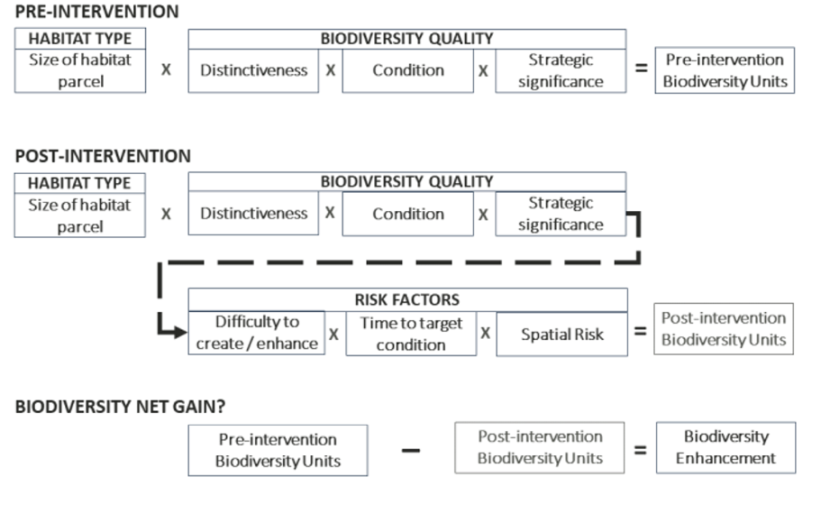
Figure 1
Click for a full description
Overview of the component parts of England’s statutory biodiversity metric, indicating the range of categories with their multipliers that are applied in calculating biodiversity units.
For the site in question, the metric seperately calculates the biodiversity value (in biodiversity units) of what currently exists pre-intervention, and what will remain or is planned to be established post-intervention. It does this by multiplying the area or linear extent of each different habitat identified on the site, by pre-determined multipliers for each of the metric’s component parts – Distinctiveness, Condition, Strategic Significance and three Risk Factors. The biodiveristy units calculated for the three different forms of habitat - area of habitat (ha), length of hedgerow (km) and length of watercourses (km) - are processed separately, and can not be summed, traded or converted between them.
For calculating biodiversity units for the baseline, a site’s habitats are identified and their condition is assessed. The habitat type identified determines the level of distinctiveness, and informs the level of strategic significance, to be applied. The extent of each habitat is then multiplied by the appropriate pre-determined multipliers (for distinctiveness, condition and strategic significance), to calculate the number of pre-intervention biodiversity units of the site.
This is repeated for the habitats that will exist post-intervention, but with an additional set of predetermined ‘risk factors’ applied to account for the uncertainty, time-lag and any separation between existing and future biodiversity. Each habitat type has pre-determined levels of difficulty assigned in either creating or enhancing them, and the average time required to reach a defined condition. The spatial risk factor is determined by where in relation to the development site the habitat is being delivered, penalising off-site in favour of on-site provision. Each of these risk multipliers are applied to the habitats that will be enhanced or created post-intervention (existing habitats that remain unchanged are not exposed to risk).
The difference in biodiversity units between the pre-intervention score and post-intervention score indicates whether biodiversity net gain will be delivered, and the scale of uplift that will be achieved.
To apply the metric tool, a competent person is required to identify and classify the extent of different habitats within the site and assess their current condition (based on ecological survey), and establish their strategic significance (based on a review of the Local Nature Recovery Strategy or alternative strategy). This establishes the pre-intervention score. They also need to establish what habitats will remain, be enhanced or created and the condition it is intended to achieve post-intervention, and the strategic significance of these habitats. Inputting this information in to the metric tool automatically assigns the pre-determined multipliers for each habitat in calculating the appropriate number of biodiversity units.
It is recognised that the metric has limitiations. While it is underpinned by ecological evidence and expert opinion, it is still applying a relatively simply and broad-brush approach to calculating change in biodiversity. Habitat as a proxy for biodiversity does not consider landscape structure, and the intricacies, complexities and functioning of ecosystems that biodiversity depends upon. Nonetheless the metric provides a useful tool for informing decisions on delivering the policy’s requirements when appropriately applied.
Last updated: