Deer Management - Our work across the country - Localised picture
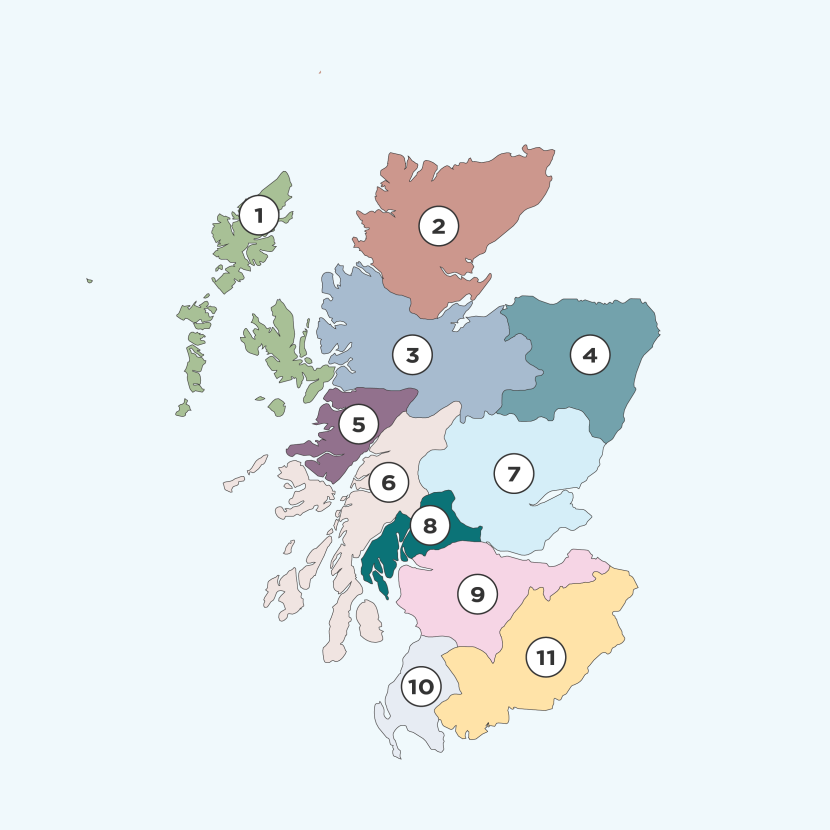
Map of Areas
This map of Scotland shows the country divided into 11 separate areas. Each area is numbered from one to 11 and the numbers correspond to the sections detailed below. Each of the sections describes deer-related work we are undertaking in the corresponding part of the country. Find out about our National-scale deer work and information on deer in Scotland in general.
Note that for now neither Orkney nor Shetland are shown on the map because these groups of islands do not have deer on them. When our use of these areas extends to encompass nature more generally, Shetland and Orkney will be represented.
Area 1 - The Hebrides
Agricultural impacts
In the Western Isles, we are working to reinvigorate collaborative structures to address a range of impacts to public interests. We are providing census data, assisting with deer counts and delivering Best Practice events to improve skills.
Deer vehicle collisions
We have undertaken a project looking in detail at possible mitigation options for reducing deer vehicle collisions (DVCs) on roads on the Isle of Lewis. A report from this work has been published on our website and we are liaising with the Local Authority and Police Scotland with regard to addressing concerns associated with DVCs.
Further information on our work in relation to DVCs can be found on our website.
Area 2 - Northern Highlands
Agricultural impacts
At Strathnaver, our regulatory intervention through Section 10 of the Deer (Scotland) Act 1996 in 2024 has resulted in increased deer culls in key properties, ongoing bi-annual deer census to monitor presence in vulnerable areas and regular liaison with the grazings clerk to monitor and react to damage as required. We are now recommending that this site is removed from the priority list as appropriate management is in place.
Deer vehicle collisions
In conjunction with Transport Scotland, during our autumn DVC awareness raising around Helmsdale on the A9 in northern Scotland we gathered vehicle speed data within an area where extra signage was placed. The data suggests that the presence of the signage did not effect a reduction in vehicle speeds.
Further information on our work in relation to DVCs can be found on our website.
We are also working with the local community to reduce the impacts of deer within Helmsdale.
Sika deer
One of four areas from which collectively the vast majority (c85%) of the reported sika cull is derived. We are developing an action plan to help direct further activity aimed at reducing sika numbers and limiting the spread of this invasive non-native species.
Regulatory action
NatureScot is pursuing regulatory action under Section 8 of the Deer (Scotland) Act 1996 against More Works Holdings, the owners of Loch Choire Estate in Sutherland. We are duty bound to share the details of this with other parties with an interest and have directly informed the East Sutherland Deer Management Group, The Association of Deer Management Groups, Highland Council and the Altnaharra Community Council. The landowner appealed against the S8 and we are currently within the appeals process.
We are supporting Northern DMG to update their cull plan and increase their hind culls in order to deliver red deer density of less than eight per km2. This will require regular monitoring of the winter hind cull.
North Ross DMG are in the process of preparing a deer management plan under S6a. Their target deer density is eight per km2.
Area 3 - West and Central Highlands
Deer management incentive scheme pilots
NatureScot is running two deer management incentive scheme pilot projects. One of these is the South Loch Ness scheme. This covers 527km2 and encompasses land on the south side of the Great Glen. This scheme is focused on female and juvenile sika deer and is incentivising the cull.
Across the two incentive schemes there is a budget of £210K. For South Loch Ness, payment rates are based on £70 per adult female and £35 per juvenile and on a minimum cull rate of five deer per km2.
Further information on the incentive schemes can be found on our website.
We are also supporting a deer management incentive scheme running in the Cairngorms National Park and administered by the National Park authority.
Sika deer
One of four areas from which collectively the vast majority (c85%) of the reported sika cull is derived. We are developing an action plan to help direct further activity aimed at reducing sika numbers and limiting the spread of this invasive non-native species.
Regulatory action
At West Grampian DMG, a deer census has been completed; Cairngorms National Park Authority (CNPA) led the project, which is linked to the Heritage Horizon Awards, 5/5/5 project and several larder infrastructure projects.
For South Ross DMG, a helicopter count is planned for winter 2026. A draft deer management plan has been delivered by the Strathfarrar sub-group of the DMG. Three deer management plans remain outstanding, and we are monitoring the situation.
Venison processing and infrastructure
We are running two schemes promoting and delivering community stalking on public land. We now have community stalking established at Creag Meagaidh National Nature Reserve (NNR) and at Beinn Eighe NNR.
Area 4 - Moray and Aberdeenshire
Agricultural impacts
At Cabrach we are actively supporting a local collaborative group to review impacts and annual cull delivery. A 2024 deer census indicated that population reduction has not fully manifested and required further commitment across key properties for hind-cull targets. Damage levels remain acute, linked to fewer but larger groups of deer as a possible result of increased culling pressure. The forum is actively engaged and committed to increased cull targets and work is underway to explore other options including further use of out-of-season authorisations and the viability / appetite for live capture / capture for culling.
Deer management incentive scheme
We are supporting a deer management incentive scheme running in the Cairngorms National Park. This scheme is administered by the National Park authority and aims to harvest an additional 1400 hinds for the 2025/’26 season. If achieved, this may negate the need for regulatory action.
Regulatory action
At West Grampian DMG, a deer census has been completed; Cairngorms National Park Authority (CNPA) led the project, which is linked to the Heritage Horizon Awards, 5/5/5 project and several larder infrastructure projects.
Area 5 - North and West Lochaber
Landscape scale priorities
This area lies within a government priority area for Atlantic rainforest restoration, supported by a number of environmental non-government organisations, including the Alliance for Scottish Rainforests (ASR). Within Area 5, key projects are distributed across the Morvern, East Loch Shiel, Knoydart, and West Lochaber Deer Management Groups (DMGs). Reductions in deer densities across these areas will be required to secure the recovery and long-term resilience of native woodland and Atlantic rainforest habitats.
Regulatory action
Progress within the East Loch Shiel Deer Management Group (DMG) will be reviewed. The western part of the DMG is currently in receipt of funding through the Nature Restoration Fund and the Rainforest Restoration Fund (RRF), with RRF support being used to deliver deer population reductions. In contrast, the eastern part of the DMG is expected to be experiencing an increase in deer numbers.
Moidart Deer Management Group lies within a core Atlantic rainforest area. NatureScot expects the delivery of measurable reductions in deer densities to ensure designated sites are managed sustainably and to support the recovery of Atlantic rainforest habitats.
West Lochaber Deer Management Group is currently reviewing its Deer Management Plan (DMP). Ongoing concerns remain regarding deer impacts in the western part of the group and on adjacent properties to the north, out with the DMG boundary. Given the importance of these sites, the plan will be reviewed upon submission.
A full drone census of the Morvern DMG area is due in 2026. The findings will help determine future action. Land within the DMG falls within one of the Alliance for Scottish Rainforests (ASR) project areas, and several projects receive NRF funding.
Area 6 - Midwest Argyll
Venison processing and infrastructure
We are Working closely with Scottish Venison, SAOS, Lowland Deer Network Scotland, Scottish Government and other relevant parties to encourage and develop greater collaboration regarding use of deer larders.
As part of SAOS Low Ground Venison Supply Chain Project, we are working with stakeholders, including Lowland Deer Network Scotland and Scottish Venison, exploring community larder and processing infrastructure at various scales. A third round of funding applications opened on 18 June 2026.
Sika deer
One of four areas from which collectively the vast majority (c85%) of the reported sika cull is derived. We are developing an action plan to help direct further activity aimed at reducing sika numbers and limiting the spread of this invasive non-native species.
Regulatory action
In parts of south Islay, red, roe and fallow deer have reached very high numbers and they are now causing agricultural and environmental damage as well as impacting public spaces. We are working with landowners within the Islay DMG to develop a control agreement under Section 7 of the Deer (Scotland) Act 1996 as amended.
Deer management incentive scheme
We are supporting a deer management incentive scheme running in the Cairngorms National Park. This scheme is administered by the National Park authority and aims to harvest an additional 1400 hinds for the 2025/’26 season.
Landscape scale priorities
The rainforest-related deer management priority areas of Cowal, Appin – Glen Creran, Moidart and East Loch Shiel and Morvern are all encompassed within larger landscape scale restoration priority area relating to the Atlantic rainforests, which also include Knapdale, Craignish, Knoydart and South Assynt along with interests from Wild Strathfillan, Loch Abar Mor and the Nevis Landscape Partnership. In this extensive area, we are working with a range of stakeholders to protect and enhance the Atlantic rainforest habitat, and a key part of that work is around deer management.
Area 7 - East Central
Deer management incentive scheme
We are supporting a deer management incentive scheme running in the Cairngorms National Park. This scheme is administered by the National Park authority and aims to harvest an additional 1400 hinds for the 2025/’26 season. If achieved, this may negate the need for regulatory action.
Sika deer
One of four areas from which collectively the vast majority (c85%) of the reported sika cull is derived. We are developing an action plan to help direct further activity aimed at reducing sika numbers and limiting the spread of this invasive non-native species.
Regulatory action
At West Grampian DMG, a deer census has been completed; Cairngorms National Park Authority (CNPA) led the project, which is linked to the Heritage Horizon Awards, 5/5/5 project and several larder infrastructure projects.
At Caenlochan we are monitoring progress with the deer reduction under Section 7 of the Deer (Scotland) Act 1996.
Area 8 - West Central
Deer management incentive schemes
NatureScot is supporting a deer management incentive scheme running in Loch Lomond and the Trossachs National Park, and administered by the National Park authority. The data being collected is mostly being gathered via the NatureScot deer app.
Venison processing and infrastructure
We are Working closely with Scottish Venison, SAOS, Lowland Deer Network Scotland, Scottish Government and other relevant parties to encourage and develop greater collaboration regarding use of deer larders. Loch Lomond and the Trossachs National Park has funded a mobile trailer chiller trailer which NatureScot has procured and will manage deployment across key areas within the Park area to provide additional capacity for carcass storage.
As part of SAOS Low Ground Venison Supply Chain Project, we are working with stakeholders, including Lowland Deer Network Scotland and Scottish Venison, exploring community larder and processing infrastructure at various scales. A third round of funding applications opened on 18 June 2026.
Regulatory action
At Glenartney progress to be reviewed. Loch Lomond and the Trossachs National Park incentive scheme helping to reduce deer numbers and may be sufficient.
In West Cowal a number of privately-owned commercial woodlands are not being managed for their deer and are acting as a source of deer to surrounding areas. Regulation here will support land managers in tackling the high deer numbers. This will be beneficial to the surrounding habitats as well as to the future of the forestry. Delivery of a deer management plan under S6a of the Deer (Scotland) Act 1996 will formalise on the ground delivery, which will be reviewed, working closely with the Cowal Deer management group.
At Balquhidder DMG a Risk assessment to consider options under regulatory action to enable more coordinated and assured management has been undertaken, in addition to considering how the Loch Lomond and the Trossachs National Park incentive scheme may help to reduce deer numbers sufficiently.
Landscape scale priorities
The rainforest-related deer management priority areas of Cowal, Appin – Glen Creran, Moidart and East Loch Shiel and Morvern are all encompassed within larger landscape scale restoration priority area relating to the Atlantic rainforests, which also include Knapdale, Craignish, Knoydart and South Assynt along with interests from Wild Strathfillan, Loch Abar Mor and the Nevis Landscape Partnership. In this extensive area, we are working with a range of stakeholders to protect and enhance the Atlantic rainforest habitat, and a key part of that work is around deer management.
Deer Groups and Forums
We are contributing to several deer groups or forums within and to the south of the Central Belt to support their deer management activity.
Area 9 - Central Lowlands
Deer management incentive scheme pilots
NatureScot is running two deer management incentive scheme pilot projects. First trialed in 2024-25, they are running for a third year in 2026-27.
One project is covering 1599 km2 in the Central Belt. This is a significant increase in area from the first year and the scheme boundary now extends from Alexandria in the west to beyond Broxburn in the east, and from Rutherglen in the south to Flanders Moss in the north.
The project aims to incentivise deer managers to harvest more roe and red deer (in particular female and juvenile deer) in addition to those they would normally take, and has both a rural and more urban component.
Further information on the incentive schemes can be found here: here.
Venison processing and infrastructure
We are Working closely with Scottish Venison, SAOS, Lowland Deer Network Scotland, Scottish Government and other relevant parties to encourage and develop greater collaboration regarding use of deer larders.
As part of SAOS Low Ground Venison Supply Chain Project, we are working with stakeholders, including Lowland Deer Network Scotland and Scottish Venison, exploring community larder and processing infrastructure at various scales. A third round of funding applications opened on 18 June 2026.
This is an increasingly significant area of work where the increasing the provision of lardering facilities will hopefully lead to an increase in the number of deer harvested.
Landscape scale priorities
Central Scotland deer management priority area is a focus for work in the central belt. An important aspect of this is gaining a better understanding of deer populations within the area, and we are undertaking a programme of deer censuses, often using a thermal camera on a drone, to assist with this.
Deer vehicle collisions
We are working with Transport Scotland to gather information on deer vehicle collisions (DVCs) and to consider potential mitigation options. Further information on our work in relation to DVCs can be found on our website.
Deer Groups and Forums
We are contributing to several deer groups or forums within and to the south of the Central Belt to support their deer management activity.
Muntjac
We respond to and investigate reported suspected sightings of muntjac. In the past few years we have followed-up six possible sightings. Thus far, however, no muntjac have subsequently been found.
Area 10 - Galloway
Venison processing and infrastructure
We are Working closely with Scottish Venison, SAOS, Lowland Deer Network Scotland, Scottish Government and other relevant parties to encourage and develop greater collaboration regarding use of deer larders.
As part of SAOS Low Ground Venison Supply Chain Project, we are working with stakeholders, including Lowland Deer Network Scotland and Scottish Venison, exploring community larder and processing infrastructure at various scales. A third round of funding applications opened on 18 June 2026.
Deer Groups and Forums
We are contributing to several deer groups or forums within and to the south of the Central Belt to support their deer management activity.
Muntjac
We respond to and investigate reported suspected sightings of muntjac. In the past few years we have followed-up six possible sightings. Thus far, however, no muntjac have subsequently been found.
Area 11 - Dumfriesshire and Borders
Venison processing and infrastructure
We are Working closely with Scottish Venison, SAOS, Lowland Deer Network Scotland, Scottish Government and other relevant parties to encourage and develop greater collaboration regarding use of deer larders.
As part of SAOS Low Ground Venison Supply Chain Project, we are working with stakeholders, including Lowland Deer Network Scotland and Scottish Venison, exploring community larder and processing infrastructure at various scales. A third round of funding applications opened on 18 June 2026.
Deer management training project
We have provided financial support to the Scottish Forestry lowland deer management training project.
Deer Groups and Forum
We are contributing to several deer groups or forums within and to the south of the Central Belt to support their deer management activity.
Muntjac
We respond to and investigate reported suspected sightings of muntjac. In the past few years we have followed-up six possible sightings. Thus far, however, no muntjac have subsequently been found.
Last updated: