2024 MPA Report to Parliament
Scottish Ministers must present a report to Parliament setting out information on our Marine Protected Area network every six years.
Every six years Scottish Ministers must present a report to Parliament setting out information on our Marine Protected Area network. This is a requirement under the Marine (Scotland) Act 2010 and should include the number of MPAs, progress against the sites' Conservation Objectives, and additional actions, such as Marine Conservation Orders.
The previous MPA Report to Parliament was published in 2018 - read our blog post summarising the report.
Read the 2024 MPA Report to Parliament here.

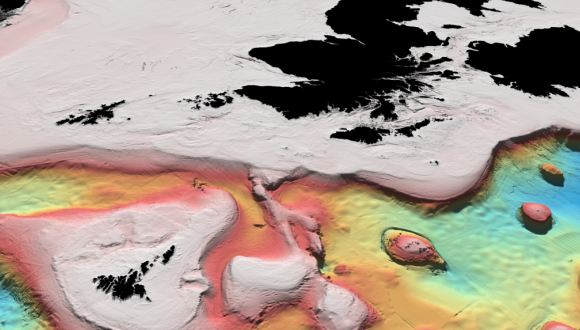
Scottish Marine Protected Area Network Map
NatureScot's role
We have worked with the Joint Nature Conservation Committee to shape the report, and have provided the analysis to update the Annexes showing progress towards MPA objectives and replication of features within the network, as well as highlighting some of the evidence base through case studies and spotlights.
Our advice has supported the selection and designation of the 17 new MPAs, and MPA management, for example, through the publication of 76 Conservation and Management Advice documents (CMAs). We have also continued to add to the evidence base through research and monitoring. Further information on individual sites and the CMAs can be found via Sitelink.
Key facts
- Seventeen new Marine Protected Areas since 2018 means that more features are now part of the Scottish MPA network. Thirteen of these sites have been designated for birds and five include mobile species such as minke whale, basking shark, Risso’s dolphin and flapper skate. Three sites have had their boundaries extended.
- The majority of sites in the network (70%) have partially implemented management measures.
- Work is currently underway to implement management measures for fishing activity across a large proportion of the Scottish Marine Protected Area network. A public consultation on measures for inshore MPAs and Priority Marine Features is planned for 2025.
- The majority of sites are either moving towards (30%) or partially moving towards (47%) their conservation objectives, highlighting that the condition of features is generally varied within sites.

A brightly coloured rocky reef community in Loch Carron MPA, ©NatureScot
Marine birds
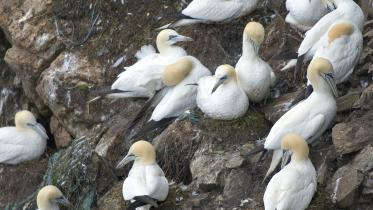
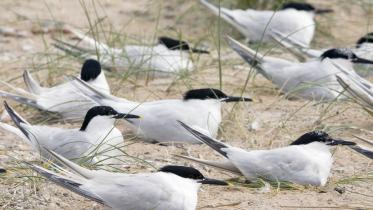
13 of the 17 new MPAs have been designated for marine birds, and two of the three MPAs extended are to afford increased protection for seabirds. Marine birds are currently faced with a wide range of pressures including climate change, changes in food supply, fisheries bycatch, predation, pollution, disease, and onshore and offshore development. Of the 58 Special Protection Areas (SPAs) and the 6 Nature Conservation MPAs designated to help marine birds, the majority have Conservation Objectives to ‘restore’ or ‘recover’ their protected features. Most SPAs have been assessed as partially moving towards their Conservation Objectives. For full details see the tables for Special Protection Areas and Nature Conservation MPAs.

Black guillemot, ©Kim McEwen
MPA progress towards objectives
In support of the 2024 MPA Report to Parliament we have published a series of tables which give more detail on the progress towards MPA objectives for the sites that make up the Scottish MPA network. Click here to download the tables.
Case Studies
Management measures are already in place and making a difference at many MPAs. Get to know some of our MPAs better and find out about the work underway by having a look at the case studies in the report. See also:
- Marine data and citizen science – explore the types of data that support our evidence base.
- Loch Carron MPA – learn about the journey to protect the world’s largest known flame shell bed.
- Red Rocks and Longay MPA - site of the first flapper skate egg nursery to be identified in the world.
A critically endangered flapper skate has been successfully hatched in captivity in what is thought to be a world first for the species.
Duration
02:09
Part of an international MPA network
Scotland’s MPA network contributes to international networks at European, North-east Atlantic and global scales.
We have commitments to MPAs under the United Nation’s Convention on Biological Diversity and under the OSPAR Convention. OSPAR is a commitment by 15 European governments to protect the North-east Atlantic marine environment, and includes working to establish an ecologically coherent network of MPAs in the region.
Scotland's MPAs also contribute to the UK MPA network. Read their latest report on progress.
Dive deeper into Scotland’s MPA network
See our Marine Protected Areas section for more information about Scotland’s MPA network. NatureScot’s SiteLink also allows you to find out more about Scotland’s Marine Protected Areas – providing information on protected features, site boundaries, conservation objectives and other information on MPA management.
Last updated: