Peatland ACTION - Mapping current and future workforce and skills requirements in peatland restoration
Author: Alison Cairns (EKOS)
Published: November 2025 [1]
Cite as: Alison Cairns (EKOS) 2026. Mapping current and future workforce and skills requirements in peatland restoration. NatureScot Peatland ACTION report.
This report, or any part of it, should not be reproduced without the permission of NatureScot. This permission will not be withheld unreasonably. The views expressed by the author(s) of this report should not be taken as the views and policies of NatureScot.
Contents
- Keywords
- Acknowledgements
- Abbreviations
- Introduction
- Context
- Executive Summary
- Challenges to Scaling Up
- Rethinking skills models to meet sector needs
- Workforce development and skills challenges
- Learning from Other Sectors
- Workforce Numbers and Forecast
- Summary – Key Conclusions
- Summary – Key Recommendations
- 1. Introduction
- 2. Policy context
- 3. Current peatland restoration activity
-
4. Stakeholder consultations and insights
-
4.1 Stakeholder feedback
- 4.1.1 Skill Issues and gaps
- 4.1.2 Agent challenges and insights
- 4.1.3 Tendering process challenges and impact on workforce stability issues
- 4.1.4 Funding Structure: Effects on Project Delivery and Workforce Development
- 4.1.5 Seasonal and environmental constraints on restoration work
- 4.1.6 Procurement process specific challenges
- 4.1.7 Stakeholder views on the Peatland Code
- 4.1.8 Engagement with planning system
- 4.1.9 Contractor Location
- 4.1.10 Use of contractor frameworks
-
4.1 Stakeholder feedback
- 5. Contractor and consultants’ skills and workforce needs survey
-
6. Peatland restoration workforce: Demand, composition, trends, and challenges
-
6.1 Key occupations and stakeholders in peatland restoration
- 6.1.1 Summary flow of roles
-
6.1.2 Roles and responsibilities in the peatland restoration process
- a. Policy development and strategic planning (high-level decision-making)
- b. Project planning and site selection (pre-restoration assessment)
- c. Funding and grant allocation (resource mobilisation)
- d. On-the-ground restoration (implementation phase)
- e. Monitoring and long-term management (post-restoration assessment)
- 6.2 Workforce composition by occupation in the peatland restoration sector
- 6.3 Contractor work continuity and contract models
- 6.4 Contribution of landowners / managers and the scientific community to the restoration sector
- 6.5 Drivers of demand for peatland restoration workers
-
6.6 Labour market challenges for the peatland restoration workforce
- 6.6.1 Employment and job stability in peatland restoration
- 6.6.2 Aging workforce and depopulation in rural and island communities
- 6.6.3 Integrated Land Use: Balancing Restoration and Development Pressures
- 6.6.4 Upskilling and professionalisation
- 6.6.5 Skills implications of technological advancements in peatland restoration
-
6.1 Key occupations and stakeholders in peatland restoration
- 7. Skills landscape in Scotland: Pathways and training for peatland workers
- 8. Forecast workforce required to meet the targets
-
9. Conclusions: Building a future-ready peatland workforce and delivery model
- 9.1 Rethinking skills models to meet sector needs
- 9.2 Workforce development and skills challenges
- 9.3 Addressing training gaps and building capacity
- 9.4 Data challenges impede effective workforce planning
- 9.5 Contractor-specific challenges
- 9.6 Procurement challenges
- 9.7 Tackling Peatland Code bottlenecks and complexity
- 9.8 Addressing landowner engagement gaps
- 9.9 Balancing efficiency and workforce sustainability
- 9.10 Aligning funding models with workforce and restoration needs
- 9.11 The case for continued and increased investment in Peatland ACTION
- 9.12 Final reflections
- 10. Recommendations and suggested actions
- References
Keywords
peatland; restoration; skills; contractor; workforce.
Acknowledgements
NatureScot and the authors would like to thank the contributors to this report for their time in engaging with the research team and providing such insightful feedback.
Abbreviations
AECS – Agri-Environment Climate Scheme
BAP – Biodiversity Action Plan
BSI – British Standards Institute
CCS – Carbon Capture and Storage
CNPA - Cairngorms National Park Authority
CPD – Continuing Professional Development
CSR – Corporate Social Responsibility
EIA – Ecological Impact Assessment
FE - Further Education
FLS - Forestry & Land Scotland
FTE – Full-time Equivalent
GHG – Greenhouse Gas
GIS – Geographic Information System
HE - Higher Education
LLTNP – Loch Lomond and The Trossachs National Park
MA - Modern Apprenticeship
NP - National Parks
PA - Peatland ACTION
PAMG – Peatland ACTION Management Group
PAO – Peatland ACTION Officer
PCS – Public Contracts Scotland
PDRs – Planning Development Rights
PEAT – Peatland Ecosystem Analysis Tool
SAC - Special Area of Conservation
SDS – Skills Development Scotland
SEPA – Scottish Environment Protection Agency
SLE - Scottish Land & Estates
SRDP – Scottish Rural Development Programme
SRUC – Scotland’s Rural College
SSSI - Site of Special Scientific Interest
SWT – Scottish Wildlife Trust
UHI – University of the Highlands and Islands
UKCP – UK Climate Projections
VVBs – Validation and Verification Bodies
Introduction
Mapping current and future workforce and skills requirements in Peatland Restoration
EKOS was commissioned by NatureScot to provide research services:
- to provide intelligence on the current scale of the sector.
- better understand the future jobs and skills requirements across the whole peatland restoration sector.
- offer analysis from which the enhancement of current skills and training provision to meet future sector needs can be developed.
Context
Achieving Scotland’s ambitious peatland restoration targets demands a substantial and sustained expansion of the workforce, along with enhanced upskilling and clear career pathways.
Investment in workforce development initiatives has played a key role in supporting the efforts of the sector in doubling the restoration output over recent years. The focus of Peatland ACTION Delivery Partners in improving delivery mechanisms and strengthening workforce capacity provides a vital platform from which to accelerate progress and realise Scotland’s wider climate and ecological ambitions.
Executive Summary
Scotland’s peatland restoration sector has made significant progress in recent years, with outputs more than doubling and a growing pool of skilled practitioners now in place. This success reflects the strong commitment and collaboration of the Scottish Government, NatureScot, and delivery partners through the Peatland ACTION (PA) programme. While the sector is still relatively young, the foundations laid through strategic investment, programme design, and stakeholder engagement provide a platform for future growth.
Challenges to Scaling Up
Sustaining and accelerating this momentum will require addressing a set of interconnected challenges. Short-term (government) funding cycles, complex procurement and administrative processes, and fragmented workforce data all constrain the sector’s ability to expand. Annual funding windows, even where funding is multi-year, create pressures for contractors to bid once for multiple years, limiting flexibility and contributing to short-term contracts and seasonal employment. Misalignment with the Peatland Code and planning delays further reduce workforce stability and limit opportunities for career progression. Continuing to tackle these structural barriers is essential to building a resilient, growing workforce capable of delivering restoration at scale.
Rethinking skills models to meet sector needs
As an emerging sector, peatland restoration has a unique opportunity to adopt innovative skills models that reflect both the ecological nature of the work and the geographies in which it takes place. Restoration activity is largely concentrated in rural and remote areas, where employment can be fragmented and seasonal, and where traditional job models may not easily apply.
Persistent skills shortages - particularly in technical areas such as project validation- are already limiting the sector’s growth and its ability to access carbon finance. These roles require significant expertise but are often offered only part-time or seasonally, making them less attractive or sustainable as long-term careers.
To overcome these challenges, policymakers will need to support more flexible, innovative approaches to workforce development that reflect the realities of rural economies. There is a need to create full-time, secure occupations by designing roles that combine restoration with wider land and nature-based tasks—such as surveying, estate management, conservation, or biodiversity monitoring.
Stakeholders recommend:
- Exploring staggered or rolling funding windows to smooth out seasonal peaks and create more stable work opportunities
- Integrating restoration and validation skills into broader environmental or land-based roles to build career viability in rural areas
- Developing clear training and accreditation pathways, including apprenticeships, modular CPD, and cross-sector qualifications
This approach would help to create resilient, year-round jobs, attract a more diverse workforce, and ensure that the sector has the capacity to meet Scotland’s growing restoration ambitions - while also supporting rural economic development and the just transition.
Workforce development and skills challenges
The peatland restoration sector benefits from a workforce possessing many of the necessary technical skills; however, significant challenges remain in workforce development, recruitment, and retention. The demanding and remote nature of restoration projects contributes to high turnover and seasonal employment instability, undermining workforce continuity. Additionally, validation capacity shortages create bottlenecks, delaying project signoffs and slowing overall progress. Addressing these issues requires targeted support for local contractors, improved collaboration between local and non-local firms, and strategic investments in skills development.
Key existing issues include:
- Specialist technical training: There is a continued need for enhanced training focused on peatland restoration techniques and ecological validation. On-the-job, practical training is preferred by many contractors, but expanding accessible, high-quality training programmes will help build capacity and consistency. The development of dedicated peatland training sites is currently in progress. In order to deliver training on live sites, each location must be mapped, planned, and submitted under Permitted Development Rights (PDR). This process presents an opportunity to create real-life, hands-on training environments that reflect the complexities of actual restoration work.
- Recruitment and retention: The demanding physical conditions, remote and often isolated work sites, and seasonal nature of peatland restoration contribute to high turnover and workforce instability. Improving working conditions and creating clearer career pathways will be important to attract and retain skilled workers.
- Shortage of validation experts: A critical bottleneck exists due to limited numbers of qualified Peatland Code validators and ecological assessors, delaying project approvals and reducing workforce efficiency.
- Limited career progression: The sector currently lacks well-defined career development pathways, which can discourage longer-term commitment and skills advancement.
- Digital and technological literacy: As peatland restoration increasingly incorporates remote sensing, GIS mapping, data management, and digital validation tools, there is a growing demand for workers with digital competencies to improve efficiency and accuracy.
- Project management and administrative expertise: The complex procurement, funding, and regulatory environments require project management skills to navigate processes effectively and reduce administrative delays.
- Cross-disciplinary knowledge: Roles at the interface of ecology, hydrology, carbon markets, and environmental policy require workers to have broader interdisciplinary skills and understanding, particularly for consultancy and leadership positions.
- Communication and stakeholder engagement: Effective engagement with landowners, local communities, regulators, and funding bodies is essential to project success. Developing communication skills will help build trust and encourage wider participation in restoration efforts.
- Health, safety, and environmental compliance: Given the challenging and sensitive nature of peatland sites, ongoing training in site-specific safety practices and regulatory compliance remains vital.
Despite many contractors and consultants stating during the research that technical skills were not a major concern, NatureScot and Peatland ACTION partners have encountered real issues where poor technical delivery has compromised restoration outcomes. In some cases, mistakes stemmed from a lack of understanding of peatland-specific techniques or ecological sensitivities. Addressing this may require a more formal approach - such as mandatory training, certification, or periodic revalidation - to ensure those delivering restoration meet consistent standards. This would align peatland restoration with other regulated sectors where formal upskilling and compliance are essential to maintaining quality and protecting environmental integrity.
Learning from Other Sectors
Other emerging Scottish sectors provide useful lessons. The renewable energy sector, particularly onshore and offshore wind, expanded rapidly through multi-year government funding, coordinated planning, structured training pathways, and formalised safety and technical certifications. More established sectors, such as forestry and habitat restoration, demonstrate how multi-year funding, integrated project planning, and career pathways support workforce stability and growth. Lessons from these sectors can guide peatland restoration, helping reduce seasonal pressures, strengthen career pathways, and support sustainable sector development.
Workforce Numbers and Forecast
EKOS have estimated that the current workforce in the Peatland restoration sector is around 400 FTE workers as outlined in Table E.1.
| Occupation | Total number of workers | Percentage of total workforce |
|---|---|---|
| Peatland ACTION Partner | 87.9 | 23% |
| Agents | 50 | 13% |
| Peatland Code Validators | 5 | 1% |
| Ecologist/ site surveyors | 40 | 10% |
| Contractors | 200 | 52% |
| Total | 382.9 | 100% |
Based on current capacity and projected restoration demand, the peatland restoration workforce could grow substantially. Under a medium demand scenario (doubling activity to 20,000 hectares), around 750 full-time equivalents (FTE) would be required. A high demand scenario (35,000 hectares) would require approximately 1,250 FTEs – see Table E.2.
| Occupation | Low Demand Scenario (10,000 Hectares) | Medium Demand Scenario (100% increase to 20,000 hectares) | High Demand Scenario (250% increase to 35,000 Hectares) |
|---|---|---|---|
| PA Partner | 87.9 | 132 | 198 |
| Agents | 50 | 125 | 200 |
| Peatland Code Validators | 5 | 12.5 | 20 |
| Ecologist/ site surveyors | 40 | 80 | 140 |
| Contractors | 200 | 400 | 700 |
| Total | 382.9 | 749 | 1,258 |
Key roles include PA partners, agents, Peatland Code validators, ecologists/site surveyors, and contractors. These projections underscore the scale of workforce expansion needed and highlight the importance of coordinated investment, skills development, and workforce planning.
Summary – Key Conclusions
- Scotland’s peatland restoration sector has made significant progress, demonstrating growing capacity, collaboration, and technical expertise.
- Realising its full potential, however, is constrained by short-term funding cycles, seasonal work patterns, and fragmented systems.
- A strategic, long-term approach is needed to align workforce planning, investment, and delivery with national restoration and climate targets.
- The sector must continue its professionalisation journey - stabilising employment, establishing clear career pathways, and embedding robust training routes.
- Persistent skills shortages, particularly in technical and validation roles, limit restoration capacity and access to private finance.
- Procurement and administrative burdens discourage smaller contractors and reduce delivery efficiency.
- Fragmented data and inconsistent reporting hinder effective workforce forecasting and performance monitoring.
- Land use tensions (particularly with renewables) and limited landowner engagement continue to constrain restoration opportunities.
- There is a strong case for continued and increased investment in Peatland ACTION, alongside systemic reform and strengthened coordination to secure long-term sustainability and delivery capacity.
Scotland’s peatland restoration sector stands at a pivotal and promising moment. Strong progress through Peatland ACTION, underpinned by growing collaboration and investment, has created a solid foundation for future growth. The programme has shown a clear commitment to listening to stakeholder feedback and adapting delivery approaches - an approach that will be vital as the focus shifts toward strengthening workforce capacity and skills development. By continuing to build on this momentum, fostering year-round employment, and embedding long-term training and career pathways, the sector is well placed to achieve its restoration ambitions and deliver lasting environmental and economic benefits across Scotland.
Summary – Key Recommendations
- Develop visible and secure long-term skills pathways, supported by expanded practical and accredited training opportunities.
- Address trainer shortages and establish formal apprenticeship and professional development routes.
- Create a centralised workforce data hub to inform evidence-based planning and investment.
- Continue and expand multi-year funding to enable workforce stability and support business confidence.
- Simplify procurement processes and strengthen support for smaller and rural contractors.
- Encourage streamlining of the IUCN Peatland Code and expansion of validator capacity to unlock private finance.
- Strengthen landowner engagement and communication around restoration benefits and funding options.
- Align policy frameworks and delivery systems to balance restoration, development, and just transition goals.
- Enhance coordination and leadership across government, industry, and training partners to maintain momentum and scale delivery effectively.
Scotland’s peatland restoration sector stands on solid foundations. The expertise, collaboration, and delivery capacity built to date provide a strong platform for the next phase of growth. With sustained investment, coordinated leadership, and continued innovation, Scotland is well placed to remain a world leader in peatland restoration - delivering lasting environmental, social, and economic benefits.
1. Introduction
The peatland restoration sector in Scotland is growing rapidly due to the Scottish Government’s commitment to tackling climate change, enhancing biodiversity, and improving water quality. According to Scotland’s National Peatland Plan, peatlands cover more than 20% of Scotland's land area; hence restoring degraded peat bogs is a major environmental priority.
Peatland restoration is a key element of Scotland’s climate change strategy. Peatlands in Scotland have been degraded for centuries, mainly due to forestry, agriculture, and livestock grazing, and have commonly been drained. A functioning peatland is a net carbon store, as peat formation traps carbon in the soil. Peatlands are composed of peat, a type of soil formed from partially decomposed vegetation that has accumulated in a waterlogged environment. This incomplete decomposition prevents the release of carbon dioxide into the atmosphere, instead locking it into the soil.
Peatlands are the world’s largest natural carbon stores, holding twice as much carbon as all the world’s forests combined while covering only 3% of the planet’s land area [2]. The widespread degradation of peatlands has led to a significant source of carbon emissions, currently estimated to contribute between 5% and 10% of global emissions [3]. In addition to emitting carbon degraded peatlands reduce biodiversity, disrupt water supplies, and limit opportunities for recreation and public access.
In Scotland, peatlands are extensive, covering approximately 23% of the total land area; however, around 75% to 80% of these peatlands are damaged [4]. These degraded peatlands are estimated to emit around 1.6 million tonnes of carbon per year, accounting for over 15% of Scotland’s total carbon emissions [5]. However, peatland restoration can reduce these emissions and, over time, return the landscape to a functioning carbon sink that actively sequesters carbon dioxide from the atmosphere.
1.1 Peatland restoration techniques
Peatland restoration involves a range of techniques, including:
- Ditch blocking – Many peatlands were historically drained through artificial ditches. Blocking these ditches helps restore the natural water level and rewet the peatland.
- Reprofiling – Eroded peatland surfaces, particularly “hags” (exposed peat banks), require reprofiling using excavators to stabilise the land, encourage vegetation regrowth, and prevent further erosion.
- Scrub clearance – Drained peatlands often become overgrown with scrub vegetation, which draws moisture from the soil and worsens degradation. Removing scrub through manual cutting, permitted herbicides (often a last resort), or machinery helps retain water and restore peatland function.
- Surface smoothing – In forest-to-bog restoration, the peat is rewetted and the ploughed ridges and furrows unmodified using several ground smoothing techniques.
- Bunding – A bund is a barrier that holds water in the peatland, preventing leaks through subsurface cracks and allowing water to pool, creating the conditions necessary for peat formation.
1.1.1 Policy and investment in peatland restoration
Recognising the importance of peatlands for carbon storage, the Scottish Government announced a £250 million ten-year funding package in 2020 aimed at restoring 250,000 hectares of degraded peatland by 2030. This initiative aligns with Scotland’s commitment to achieving net-zero carbon emissions by 2045.
The Peatland ACTION partnership, led by Scottish Government is the primary delivery for peatland restoration in Scotland. Established to accelerate restoration efforts, Peatland ACTION provides funding, training, and technical support to land managers and restoration practitioners.
1.1.2 Scaling up peatland restoration efforts
To meet the Scottish Government’s target of restoring 250,000 hectares by 2030, the scale of restoration efforts must continue to increase significantly. In 2023/24, 10,360 hectares were restored and a record 14,860 hectares of degraded peatlands were restored throughout 2024/25, exceeding the 2024 Programme for Government commitment. This represented a 42% increase over the 10,360 hectares restored during 2023/24.
A total of almost 90,000 hectares has been restored since 1990; however, this remains below the required annual average of 25,000 hectares. To address this, the Scottish Government aims to restore a further 35,000 hectares over financial years 24/25 and 25.26 [6], followed by 35,000 annually between 2026 and 2030. The Scottish Budget 2025-26 has committed to an investment of £35.5 million towards peatland restoration, a 32% increase from last year’s budget [7].
A key challenge in achieving these targets is ensuring that the sector has access to a sufficiently skilled workforce to undertake restoration work. This report will explore workforce development needs, skills gaps, and opportunities to build capacity within the sector to support Scotland’s ambitious peatland restoration goals.
1.2 Background
EKOS was commissioned by NatureScot to provide research services:
- to provide intelligence on the current scale of the sector.
- better understand the future jobs and skills requirements across the whole peatland restoration sector.
- offer analysis from which the enhancement of current skills and training provision to meet future sector needs can be developed.
1.2.1 Research aims
As outlined in the Statement of Requirements, there are five key aims to the study:
- What does the sector look like currently, in terms of job types and roles, numbers of people involved directly and indirectly?
- What would the sector need to look like in terms of skills and FTEs/individuals to meet the figure of 35,000 hectares restored each year by 2026?
- Are there skills and/or other barriers which impact on availability of skilled people and the growth of the sector?
- How might different delivery scenarios (scenarios to be developed, but might include, for example, increased reliance on private finance; increasing private sector role in design; further development of remote sensing etc) vary the requirement for skills and jobs?
- What is required in addition to current skills development initiatives to ensure sufficient skills are in place to plan, finance, deliver and monitor 35,000 Ha a year of restoration?
1.2.2 Methodology
To support these aims, the following methodologies were employed:
- Desk research and data analysis – A review of relevant policy documents, programme and sectoral data to provide context and inform the evaluation.
- Stakeholder interviews – A total of 40 interviews were conducted with key contributors to the peatland restoration sector, including Peatland ACTION partners, contractors, agents, and training providers.
- Contractor survey – A targeted survey was distributed to peatland restoration contractors and relevant consultants, yielding 27 responses.
2. Policy context
This section presents the policy landscape and funding drivers surrounding the skills needs for peatland restoration in Scotland. A full list of policy and strategic documents examined is available in the references section.
2.1 Overview
Peatland covers over 20% of Scotland’s land area, around 2 million hectares, but approximately 75%-80% of this peatland is degraded and in poor condition. These degraded peatlands contribute around 15% of Scotland’s greenhouse gas emissions, making them the country’s largest source of emissions after transport (Scottish Government, 2015).
Addressing climate change and biodiversity loss remains a key priority for the Scottish Government and governments worldwide. In this context, peatland restoration is critically important, offering significant carbon sequestration potential alongside wider social, economic and environmental benefits.
In Scotland, peatland restoration is underpinned by a strong policy framework that supports national and UK-level objectives across climate, biodiversity, and land use. It forms a central pillar of Scotland’s net-zero strategy, contributing to environmental resilience and the country’s broader climate commitments.
However, despite this strong policy alignment, several challenges remain in accelerating peatland restoration. Chief among these is cost. Financial barriers continue to limit the scale and pace of restoration activity. To overcome this, strategies have increasingly focused on unlocking additional funding through mechanisms such as the Peatland Code, which supports carbon trading linked to peatland restoration. Stakeholders consider these market-based approaches as crucial for attracting private investment and expanding the reach and impact of restoration efforts.
2.2 Skills landscape and development
Alongside funding constraints, skills shortages have emerged as a critical challenge for the further expansion of the peatland restoration sector to meet current targets. As a rapidly growing and still-emerging industry, the sector is facing increasing pressure around workforce capacity and skills development.
While Scotland currently possesses some of the foundational skills required for peatland restoration (SDS, 2020), several persistent challenges remain. These include rural workforce shortages, a lack of clear career pathways, and an ageing population. The sector needs a broader, more adaptable workforce, underpinned by targeted training and development.
A key barrier is the absence of clear entry routes into the field, coupled with limited alignment between existing skills provision and the evolving needs of the sector. This disconnect has resulted in workforce shortages, driven by both skills shortages (e.g., peatland validators) and funding. In response, national policies stress the importance of expanding workforce development to build the skilled labour needed to support both current restoration efforts and future ambitions.
The first Peatland Skills Plan (2022) [8] identified core priorities, including building contractor capacity, strengthening design and technical expertise, and attracting new entrants to the field. These themes are now embedded in the current Peatland Skills Plan 2024–26, which outlines the key issues and actions required to support the delivery of 35,000 hectares of peatland restoration annually by 2026.
The 2024–26 Plan is structured around four strategic themes:
- Enhancing skills and capacity for restoration design and monitoring
- Developing the delivery workforce and upskilling the contractor base
- Engaging and developing the future workforce
- Expanding expertise in private and blended finance for peatland restoration
Peatland restoration offers a wide and growing range of career opportunities, including e.g. for specialists in peatland ecology and hydrology; in remote sensing / data analysis; in project management; in green finance; in delivery of peatland restoration works in fragile environments. However, the sector also faces major demographic and structural challenges. These include rural population decline, limited housing availability, and the outward migration of younger people - all contributing to a shrinking labour pool in communities within peatland areas. This issue is further compounded by Scotland’s ageing workforce (see Figure 2.1), with the Highland region - where much of the peatland restoration takes place - having an older population and a steeper decline in working-age residents than the national average, raising concerns about future capacity as demand for skilled professionals grows
Figure 2.1 Population Change by Age – 2014 to 2024 (Highland & Scotland). Source: SDS RSA Data Matrix (2025)
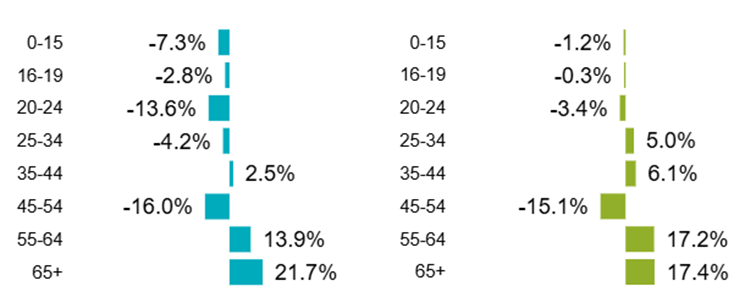
Figure 2.1 Population Change by Age (2014 to 2024) (Highland & Scotland)
Click for a full description
Two bar graphs showing the percentage increase or decrease of different age groups for Highland Scotland compared to the whole of Scotland for the period 2014 to 2024.
Highland results per age groups:
0-15 years -7.3%
16-19 years -2.8%
20-24 years -13.6%
25-34 years -4.2%
35-44 years +2.5%
45-54 years -16.0%
55-64 years 13.9%
65+ years 21.7%
Scotland results per age groups:
0-15 years -1.2%
16-19 years -0.3%
20-24 years -3.4%
25-34 years +5.05%
35-44 years +6.1%
45-54 years -16.1%
55-64 years +17.2%
65+ years +17.2%
Source: SDS RSA Data Matrix (2025)
In addition, peatland restoration work requires specialist knowledge and seasonal timing, which do not always align with conventional labour market models. The sector must also respond to broader pressures such as technological change, rising operational costs (e.g., living wage, NI, rising costs of inputs), and a need for greater environmental expertise. Together, these factors highlight the need to maintain a coordinated and sustained approach to skills development to ensure the sector can meet its ambitious restoration targets.
2.3 Conclusion: Bridging policy and skills: Advancing Scotland's peatland restoration
Despite a robust and supportive policy context, there are challenges in skills planning and development within the peatland sector. These include limited alignment between current training provision and industry needs, unclear entry routes into the sector and limited opportunities for upskilling. This gap is particularly pronounced in rural areas, where economic diversification and sustainable job creation are vital.
Efforts are already underway to address these challenges and develop skills planning and workforce investment at the scale required. The Peatland ACTION programme, led by NatureScot, has taken steps to build capacity within the sector through training courses and initiatives designed to provide entry points to the sector, development of guidance materials, provision of CPD opportunities and support for knowledge exchange across delivery partners. These early investments have helped raise awareness of skills needs and provide a foundation for more structured workforce development. However, there is still some work to do - SRUC and UHI, key to training provision in this space, are currently facing capacity constraints, which may limit the ability to scale up delivery in the short term.
Importantly, peatland restoration should not be viewed solely as a new full-time career path, but as a complement to existing rural roles, strengthening the resilience of local livelihoods. Farmers, crofters, forestry and estate workers, wind farm staff, and habitat surveyors can integrate restoration activities - such as machine work, maintenance, and monitoring - into their existing operations, creating new income streams and helping land-based businesses diversify in response to environmental and economic change.
Addressing these capacity gaps is crucial - not only for meeting Scotland’s ambitious peatland restoration targets but also for developing a skilled, adaptable workforce capable of responding to evolving restoration techniques and climate challenges. Achieving this requires targeted, demand-driven skills development, including accessible pathways for new entrants, reskilling opportunities for those in related sectors, and stronger alignment between policy ambitions and workforce readiness. With strategic investment in training and a sustained focus on rural workforce development, Scotland can secure the talent needed to restore peatlands at scale, support its climate goals, and enhance the resilience of the rural economy.
3. Current peatland restoration activity
This section provides an overview of how peatland restoration activity in Scotland is currently managed by NatureScot and its partners, along with a summary of restoration efforts to date. The information presented is based on desk research.
It is important to note that there are challenges associated with programme-level data on workforce participation and skills development. At present, there are no formal reporting mechanisms in place for landowners or delivery bodies to record workforce data, limiting the ability to assess labour demand, capacity, and skills gaps across the sector.
3.1 Number of Peatland ACTION programme projects
A total of 130 peatland restoration projects were delivered in 2024/25, representing a 24% increase from the 105 projects completed in 2023/24, which was itself a 22% increase from the 86 projects delivered in 2022/23.
3.2 Hectares of peatland restored through the Peatland ACTION programme
In 2023/24, a total of 10,360 hectares of peatland were restored through the Peatland ACTION programme - an increase of around 24% from the 8,360 hectares restored in 2022/23. In 2024/25, the programme delivered the restoration of 14,860 hectares, exceeding the Programme for Government commitment and representing a 42% increase over 2023/24 [9]. Our assessment focuses on the current workforce and projects it forward based on Scottish Government restoration targets. We note that some areas are quicker and easier to restore, allowing larger volumes of restoration with the same workforce input, while other areas require more labour-intensive work; as a result, higher restoration outputs do not necessarily equate to a larger workforce. One of our key recommendations is to track workforce data over time, since consistent historical data did not previously exist and trends cannot be reliably compared across years.
The number of projects grew by a smaller amount, which has resulted in the average area restored per project rising over time. The average was 88 hectares per project in 2022/23, 100 in 2023/24 and 114 in 2024/25. This rise is likely due to the programmes focus on targeting resources on larger projects.
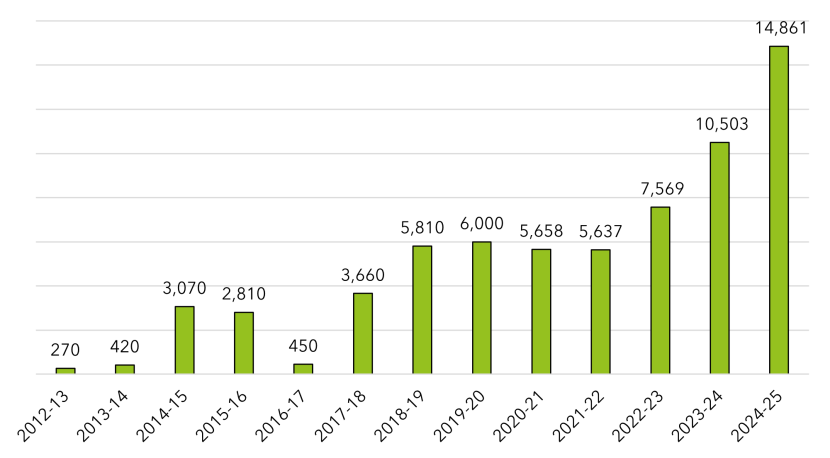
Peatland ACTION publishes long-term restoration data on its website, tracking progress since the programme’s inception in 2012. As shown in Figure 3.1, approximately 29,000 hectares of peatland have been restored since 2020/21 alone. Notably, 2023/24 marks the first year that over 10,000 hectares were restored in a single year and in 2024/25 almost 15,000 hectares were restored.
Figure 3.1 Peatland ACTION programme – Peatland restored (hectares)
Peatland ACTION programme – Peatland restored (hectares)
Click for a full description
Bar chart showing the number of hectares delivered by the Peatland ACTION Programme between December 2012 and end of March 2025.
Horizontal (x) axis shows financial year e.g. 2012-13 meaning March 2012 to March 2013 and so on for each subsequent financial year until 2024-25
Vertical (y) axis shows the number of hectares on the road to recovery.
Data: 2012-13 = 270 ; 2013-14 = 420 ; 2014-15 = 3,070 ; 2015-16 = 2,810 ; 2016-17 = 450 ; 2017-18 = 3,660 ; 2018-19 = 5,810 ; 2019-20 = 6,000 ; 2020-21 = 5,658 ; 2021-22 = 5,637 ; 2022-23 = 7569; 2023-24 = 10,503; 2024-25 = 14,861
Source: NatureScot [10] and Scot Gov (2024)
Source: NatureScot [10] and Scot Gov (2024)
3.3 Contractors
A total of 34 contractors were involved in peatland restoration in 2023/24, a slight decrease from 37 in 2022/23. However, it is important to note that seven of the contractors counted in 2022/23 operated solely as sub-contractors. This suggests that the overall delivery capacity may have remained broadly stable year-on-year, with some variation in the way work was structured and delivered across projects.
Of the 34 contractors active in 2023/24, 23 had also been involved in peatland restoration in 2022/23, while 11 were new to the sector. Additionally, 12 contractors who participated in 2022/23 did not undertake any restoration work in 2023/24, suggesting there is latent demand from contractors to do more peatland work. This could be due to a variety of reasons, such as unsuccessful bids for 2023/24 contracts or a decision to leave the sector. Going forward, improved data collection at the procurement and final report stage could provide further clarity on this.
In total, 48 unique contractors have contributed to peatland restoration work between 2022/23 and 2023/24.
3.4 Machine days
Machine days refer to the total number of days that machinery is actively used on-site for peatland restoration activities.
The number of machine days used for peatland restoration in 2023/24 was 12,840, reflecting a slight increase of 2% from the 12,231 machine days used in 2022/23. This has resulted in a decrease in the number of machine days required to restore one hectare, from 1.46 in 2022/23 to 1.39 in 2023/24.
There is significant variation in the number of machine days required to restore one hectare, ranging from a low of 0.12 to a high of 3.22. This variation is likely due to several factors, including:
- Accessibility of the site – more remote locations are harder to access quickly with machinery.
- Level of degradation – more degraded sites require more intensive restoration work.
- Levels of vegetation – areas with thick vegetation or tree coverage need additional effort for clearance before restoration can begin.
- Contractor experience and expertise – experienced contractors may be more efficient in using machinery for restoration tasks.
4. Stakeholder consultations and insights
To gather views and develop a comprehensive understanding of the current skills challenges and opportunities within peatland restoration in Scotland, EKOS conducted an extensive stakeholder consultation process. This process involved engaging with a diverse range of actors across the sector, including contractors, agents, landowners, public bodies, National Parks and education institutions. This took the form of one-to-one interviews, small group discussions, and a workshop style session with NatureScot’s Peatland ACTION Management Group (PAMG).
The following stakeholders were consulted:
- Public bodies: NatureScot, Forestry and Land Scotland, SEPA, Scottish Water, Scottish Government, Scottish Funding Council
- National Park Authorities: Loch Lomond & the Trossachs and Cairngorms
- Education Institutions: University of Highlands and Islands, SRUC
- Peatland Contractors
- Peatland Agents
- Ecologists/Consultants
- Peatland Code Validators
- Research Groups: James Hutton Institute
All consultations were carried out between January and March of 2025.
EKOS set out to identify the key skills challenges and barriers affecting peatland restoration in Scotland, while also exploring opportunities to enhance processes and outcomes to support the Scottish Government’s target of restoring 250,000 hectares by 2030.
Through consultations with 40 stakeholders with hands-on experience in the sector, the study gathered diverse perspectives on planning, delivery, funding, skills, and validation. The findings offer valuable insights into the sector’s strengths and gaps, highlighting critical areas for capacity building and providing practical recommendations to strengthen future restoration efforts.
| Key Area | Stakeholder Views | Solutions Proposed by Stakeholders |
|---|---|---|
| Skills issues and gaps | - Technical skills not the main priority; finding workers for remote conditions is a challenge. - High turnover due to job demands and location. - On-the-job training preferred over formal training. | - Prioritise on-the-job training. - Expand the number of qualified professionals for project validation. |
| Peatland Code Validation stage shortages | - Shortage of professionals to validate and sign off restoration work, causing delays. - limited capacity among accredited validation bodies creates a significant bottleneck | - Increase the number of accredited validation bodies. - explore ways to help increase capacity within accredited bodies. |
| Tendering issues | - Tender decisions clustered in spring create uncertainty, overbidding, and delays. - Single annual deadline restricts long-term planning. | - Distribute tender deadlines more evenly throughout the year. - Increase awareness and support in using PCS with stakeholders. |
| Strength of multi-year funding | - Annual funding cycles limit long-term project planning and investment. | -Continue multi-year funding commitments to enhance financial certainty. |
| Deadlines | - One annual deadline compress planning, causing delays and pressure on contractors, surveyors, and ecologists. It encourages multiple applications at once. | - Stagger tender application deadlines to reduce pressure, reduced over commitment by contractors and improve planning. |
| Procurement process | - Repetitive information requirements increase administrative burden. - Public Contracts Scotland is difficult for smaller companies to navigate. | - Streamline procurement to enable information reuse. - Simplify PCS processes for smaller contractors. |
| Planning permission delays | - Council planning departments lack capacity or knowledge, causing delays. | - Improve local planning knowledge and capacity. - Develop a national land database of pre-surveyed land. |
| Contractor location issues | - Non-local contractors may face disadvantages entering the sector. | - Recognise non-local contractors who employ local staff and build local delivery capacity. |
| Other issues | - Snow payments don’t account for extended bad weather. - tendering process needs more commercial awareness. - Aligning private finance with restoration timelines is challenging. - Landowners need incentives to engage with restoration. | - Revise snow payment policies for weather flexibility. - Enhance commercial awareness in tenders. - Explore long-term private finance models. - Increase landowner engagement and incentivisation. |
4.1 Stakeholder feedback
This section categorises key feedback from consultees into relevant sub-sections. While some challenges affect multiple stakeholders (e.g., contractors and agents), issues specific to certain groups are highlighted where relevant.
4.1.1 Skill Issues and gaps
Summary of the key findings from stakeholder consultations.
Contractor challenges and insights
A key finding from stakeholder consultations was that contractors self-reported that the availability of workers with the necessary technical skills - such as operating excavators in remote or rural areas - was not a major challenge. Most contractors reported that they could source skilled workers or provide training when required, indicating that skills gaps were generally manageable within the sector.
Notably, many of the contractors involved in the consultations were already experienced in peatland restoration, with established knowledge of the sector's specific requirements. This may partially explain the limited reporting of skills gaps, as contractors new to the sector, who might typically face steeper learning curves, were underrepresented in the feedback. It suggests that as peatland restoration scales up and attracts new entrants, there is likely to be a need for continuing targeted training to bridge skills gaps for those less familiar with restoration practices.
However, some contractors did express concerns about growing competition for skilled workers from other expanding industries in Scotland, particularly the renewable energy sector. Wind farm developments, for example, often offer a more predictable pipeline of projects, enhanced job security, and higher wages. This comparative stability can make it more challenging for peatland restoration projects to attract and retain experienced contractors, particularly in regions where demand for land-based skills is high.
Challenge in finding right workers
A significant challenge identified by contractors was sourcing the right type of individual for peatland restoration work. Projects are often located in remote and isolated areas, with much of the work taking place during cold and dark winter months. Contractors highlighted high turnover rates among workers, attributing this to the demanding nature of the job: extended periods away from family, limited on-site facilities, and the repetitive nature of restoration tasks.
Many contractors observed that the most successful and resilient workers tended to come from backgrounds already familiar with rural and challenging environments - such as former ghillies, estate workers, and those with experience in forestry or gamekeeping. Their familiarity with outdoor work in remote settings made them better suited to handle the physical and logistical demands of peatland restoration. This underscores the importance of targeted recruitment and training strategies to attract workers with the right type of background and adaptability for the unique conditions of the peatland sector.
Training provision and capacity challenges
Several contractors and other stakeholders in the sector had participated in training delivered by NatureScot, with universally positive feedback. Attendees reported that the courses were both valuable and practical, equipping them with knowledge relevant to peatland restoration projects. Similarly, the Crichton Carbon Centre's training programmes, which have been running since 2017 and are delivered as part of Peatland ACTION, were well-regarded for their hands-on approach and sector-specific focus.
Despite the positive reception of these formal training opportunities, many contractors preferred training new operators directly on the job. They cited several reasons for this:
- Real-world conditions: Contractors noted that it is challenging to replicate the unpredictable terrain, variable weather, and logistical constraints of peatland sites in a controlled training environment. For example, operating heavy machinery like excavators on waterlogged ground or restoring degraded bogs requires a practical understanding that can only be gained through direct experience.
- Geographical barriers: Given the remote locations of many peatland projects, sending staff away for training can be both time-consuming and costly. Contractors found it more efficient to conduct hands-on training on-site, where workers could learn in the exact conditions they would face during restoration work. This could also help with assessing whether they were the right fit for the type of work.
Training and education providers did however identify a critical gap in capacity. The growing demand for practical skills training - such as peatland restoration techniques, site monitoring, CDM Regulations (Construction Design and Management), tendering processes, and fieldwork - has outpaced the current supply of qualified trainers. At present, only a small number of individuals have the expertise to deliver these courses, with many of them conducting training alongside their primary job responsibilities.
This bottleneck limits the number of courses available and restricts the sector's ability to upskill its workforce. Stakeholders suggested that expanding the pool of qualified trainers through targeted "train-the-trainer" programmes could significantly increase capacity. This would not only meet rising demand but also enhance the quality and accessibility of peatland restoration training across Scotland.
Skills shortages
In addition to contractor skills, specific gaps were identified during the validation stage of peatland restoration projects entering the Peatland Code. Stakeholders highlighted a shortage of qualified professionals capable of validating agents' initial carbon plans, conducting follow-up assessments, and formally signing off on completed restoration work. This has led to project delays, as the limited number of validators struggles to keep pace with the current workload - a challenge that is likely to intensify as restoration activity scales up to meet Scottish Government targets.
The Soil Association is actively working to address this bottleneck by expanding its pool of accredited validators, with several individuals currently progressing through the accreditation process. However, it remains unclear whether the primary constraint lies in a shortage of suitably qualified individuals, or in the limited number of organisations accredited by the IUCN to carry out this work. Additionally, seasonality may be contributing to capacity pressures, with concentrated periods of validation activity creating workload peaks. A more sustainable approach - such as spreading applications and validation work more evenly throughout the year - may be needed to support long-term workforce development and ensure validation capacity keeps pace with sector growth.
4.1.2 Agent challenges and insights
Agents reported that the application processes for Peatland ACTION and the Peatland Code are not well aligned, resulting in unnecessary complexity and administrative burdens.
- Programme misalignment: Peatland ACTION focuses primarily on funding physical restoration projects, while the Peatland Code is designed to facilitate carbon credit generation and demands rigorous carbon verification.
- Duplication of effort: Both programmes often require similar information - such as site assessments, restoration plans, and ecological surveys - to be submitted separately, contributing to delays and inefficiencies.
- Uncoordinated timelines: Approval processes for the two programmes are managed independently, with different timelines and stages that complicate project planning and execution.
- Skills gaps in carbon verification: Several agents noted that navigating the carbon verification requirements of the Peatland Code demands specific technical expertise in carbon accounting and ecological monitoring - skills that are currently in short supply. This shortage can slow down project validation and increase dependency on external consultants, adding costs and extending timelines.
- Keeping up to date with policy and legislation: Agents emphasised the importance of staying informed about evolving environmental policies, carbon market regulations, and restoration guidelines, which directly impact application processes and project compliance. The fast-paced changes in policy were noted as challenging for smaller firms and independent agents who may lack the capacity for continuous monitoring of legislative updates.
- Capacity for application support: Agents also highlighted a need for enhanced skills in grant application writing and project documentation, particularly for newer agents unfamiliar with the intricacies of peatland restoration and carbon credit frameworks.
Agents reported that misalignment between the Peatland ACTION and Peatland Code application processes may be contributing to several challenges:
- Increasing the administrative burden on agents and project teams, diverting skilled staff time from technical tasks (e.g., site assessments, restoration design) to paperwork and process management, which can have an impact on productivity.
- Creating inefficiencies and delays that reduce the effective operating window for on the ground work and complicate workforce planning, such as scheduling contractors and validators.
- Discouraging participation or investment from smaller contractors and new entrants who may lack the capacity to navigate duplicative or complex processes, thereby limiting workforce growth and diversification. Thus, a need to upskill/provide training on the likes of PCS.
- Underscoring the growing need for cross-system skills - such as project coordination, funding compliance, and regulatory navigation - that, while not traditionally core peatland restoration competencies, are increasingly vital for successful project delivery.
Addressing this process misalignment could help reduce friction in project delivery, make better use of existing workforce capacity, and improve conditions for upskilling and expanding the sector.
While each scheme has to stand alone to meet its policy and financial objectives, the practical reality is that the vast majority of peatland projects in Scotland now seek to combine both funding sources.
As such, stakeholders believe there is a strong case for better coordination and communication between the two processes - not to merge or constrain them, but to identify where administrative alignment, clearer guidance, and targeted support could reduce burdens for agents and accelerate project delivery.
Additionally, investing in training for agents on carbon verification and project documentation would enhance understanding of both schemes. Improved coordination between the two programmes would reduce administrative burdens and better support agents in meeting project deadlines. This co-ordination could also improve efficiency and reduce costs e.g., reduction in agent fees, with less duplication of work and a more streamlined process.
4.1.3 Tendering process challenges and impact on workforce stability issues
Both contractors and agents raised significant concerns about the current tendering process for peatland restoration projects. Tender opportunities were heavily concentrated in spring in recent years, which created a bottleneck complicating job planning and increasing workload peaks. Contractors often submitted multiple bids to improve their chances of winning work, but when awarded several contracts simultaneously, would have to row back on certain works due to being over committed. As such, this mismatch would lead to project delays.
The single annual tender deadline also results in substantial project reallocations after awards, further delaying project initiation and reducing sector efficiency. Compounding this, the spring period - optimal for restoration due to favourable weather - is consumed by tender preparation and paperwork rather than on-site work.
NatureScot has recognised this issue and looked to address it by moving the tender deadline to September, which is helping to smooth contractor workflows. To improve things further, stakeholders recommended introducing staggered or multi-year tendering cycles and streamlining procurement requirements. They felt this would help reduce contractor overload, stabilise workloads, improve planning, and encourage long-term workforce development.
These tendering challenges contribute to uncertainty in workload and funding. Contractors and agents reported that this unpredictability discourages investments in skills development, such as hiring apprentices or upskilling staff. The “feast or famine” cycle also undermines workforce retention, as many firms rely on short-term seasonal hires, limiting opportunities for structured career progression and losing staff to more stable sectors such as wind energy and forestry.
4.1.4 Funding Structure: Effects on Project Delivery and Workforce Development
Several consultees highlighted that, in the past, the focus on single-year funding cycles posed significant challenges for peatland restoration. Many sites are large and complex, requiring multi-year planning to ensure effective and comprehensive delivery. When only annual funding was available, projects often had to be re-tendered and re-approved each year, creating inefficiencies, administrative burdens, and disrupting continuity.
NatureScot addressed this in 2021/22 by offering multi-year funding (up to 3 years) and assuming the financial risk themselves, even though they continue to receive budgets annually from the Scottish Government. However, despite this progress, some contractors remain unaware of the change or continue to view the work as fragmented and unpredictable. This contributes to an ongoing perception that funding is short-term and contracting insecure.
It is also important to note that this perception may be shaped not just by funding cycles, but by the short-term nature of individual contracts themselves. For example, a contractor may secure a 12-week contract with a specific estate, requiring them to quickly scale up in anticipation of delivery. At the same time, they may have submitted bids for several other restoration projects - some of which they may win, some not. This dynamic creates real uncertainty: contractors must prepare for the possibility of winning none, some, or all the work, making planning for staffing and resources extremely difficult. In cases of overcommitment, delays can occur, or work may be subcontracted out to manage delivery.
These issues are often exacerbated by the once-a-year application deadline. NatureScot hopes that shifting the application window to September, with project starts in April, will give contractors greater forward visibility and support better seasonal and workforce planning. A more consistent approach across Peatland ACTION delivery partners may also help build confidence and reduce inefficiencies in the sector.
The biggest challenge for us is the continuity of peatland work. There simply isn’t enough certainty and there isn’t enough of it about to be able to focus solely on it as an area of business, or to hire staff solely for peatland work. Currently, we have to ‘tool up’ at certain points in the year, but without any guarantees that we will actually have a pipeline of work.
Moreover, while multi-year funding is available through NatureScot, the short-term nature of many individual contracts can still limit opportunities for structured career development pathways such as apprenticeships, which typically require sustained, multi-year commitments to be viable. As a result, despite the shift in funding policy, the way restoration work is commissioned and delivered may still undermine the sector’s ability to build and retain a skilled, resilient workforce.
Need for predictable, multi-year funding
Stakeholders highlighted that consistent and predictable funding streams facilitate the development of multi-year project pipelines, enabling better strategic planning and resource allocation. This would not only improve project completion rates but also support workforce stability and skills development, allowing contractors to confidently invest in training, equipment, and staff retention.
By aligning funding mechanisms more closely with on-the-ground realities, multi-year funding helps reduce administrative duplication, minimise project delays, and enhance the sector’s overall efficiency and capacity to deliver high-quality restoration.
4.1.5 Seasonal and environmental constraints on restoration work
Contractors identified spring - prior to the bird breeding season - as the most suitable period for peatland restoration work, along with late summer and early autumn. However, the need to dedicate significant time to tender preparation and bidding during these optimal windows reduces the time available for on-site restoration activities.
A critical bottleneck exists in the application and approval timeline. Applications that were submitted in spring of 2024 and 2025 were often not approved until summer, which, coupled with other delays, shifts much restoration work into autumn and winter. These seasons present the most challenging conditions due to adverse weather, limiting productivity and the potential scale of restoration efforts.
In terms of the deadlines for application for peatland work, they are currently creating significant bottlenecks. You only have certain availability for ecologists, peatlands surveyors, validators etc. Therefore, if there are loads of projects being prepared for and then won around the same time of the year, this can create significant issues. Furthermore, you often have a situation where contractors are bidding for multiple different projects, which they often then win but are then unable to actually deliver as they have over bid – it comes back to the lack of continuity of work.
To address ongoing timing challenges, NatureScot’s “Change Conversation” initiative under the Peatland ACTION programme brought stakeholders together to improve delivery processes and establish a more consistent pipeline of work.
It was announced in May 2025, that the application deadline will move permanently to September each year (beginning with September 2025, then September 2026, and so on). Applications will be assessed over the winter, with approved projects starting from 1 April the following year – this is intended to give contractors a longer and more predictable planning horizon. Some stakeholders noted that while the shift in deadlines is expected to ease some seasonal bottlenecks and improve mobilisation timelines, the application and approval process still feels compressed. This can create pressure when trying to align project design, permissions, and workforce availability within a short timeframe, particularly for those aiming to begin work in the spring.
Efforts have also been made to extend the working season by opening up restoration activities during the bird breeding season. While this change could increase the available working period, contractors have raised concerns about the risks involved. There remains the potential for work to be halted or disrupted if breeding birds are found on site, with labour and equipment left idle and no alternative tasks readily available. This uncertainty discourages some contractors from fully engaging in restoration projects during this sensitive period, potentially slowing overall progress.
In addition to weather-related constraints, the seasonal concentration of tendering and restoration work creates demand bottlenecks for specialist services such as surveyors and ecologists. These professionals experience intense workload peaks during application seasons, followed by quieter periods, complicating recruitment and retention in these critical roles.
The Change Conversation [11] reflects a proactive, collaborative approach by NatureScot and stakeholders to refine restoration processes, better align timing, and secure a more reliable and efficient delivery pipeline across Scotland.
4.1.6 Procurement process specific challenges
Accessibility barriers and challenges for smaller contractors were noted. While some consultees acknowledged that efforts had been made to simplify the application process, many - particularly newer entrants and smaller contractors - still found the Public Contracts Scotland system difficult to navigate. The platform's complexity can be a barrier for some stakeholders, highlighting that larger firms, equipped with dedicated administrative teams, are better positioned to manage the documentation requirements. This structural advantage enables them to participate more effectively in the tendering process, while smaller companies often struggle to keep pace due to limited resources.
The tendering process was something I was not particularly used to and found a bit of a challenge, particularly given I had never gone through the likes of PCS before. Although the challenging nature of it was probably more so due to my lack of experience than from it being too challenging - potentially some training could be available on navigating the tendering process.
To address these challenges, stakeholders recommended targeted training for smaller contractors to improve their familiarity with the procurement system, enabling them to better compete for restoration projects. This support would help level the playing field and make the procurement process more accessible and inclusive. While such support is available through membership of the Supplier Development Programme, the issue may lie in communication and awareness - many contractors may not know that this assistance exists or how to access it.
4.1.7 Stakeholder views on the Peatland Code
The Peatland Code is a key mechanism for supporting peatland restoration in Scotland, but a few consultees highlighted several challenges with its implementation.
Limited validation and verifications bodies
A few consultees expressed concern about the limited number of accredited validation and verification bodies (VVBs). Currently, only two organisations - the Soil Association and Organic Farmers & Growers - are approved to validate projects. This constrained pool of VVBs has created a bottleneck in the system, contributing to a backlog of projects awaiting validation. While restoration work can technically commence after a project has been registered and submitted for validation, delays in completing validation can still impact confidence, planning, and access to carbon finance - ultimately slowing the pace and scalability of peatland restoration efforts.
Complexity of the Peatland Code
Several consultees highlighted the complexity of the Peatland Code and its associated carbon credit system. The rules and processes were described as challenging to understand, particularly for those new to the sector. This lack of clarity and understanding the rules and processes can discourage participation and limit the growth of peatland restoration projects, as stakeholders struggle to navigate the requirements effectively. Consultees highlighted the need for continued training on the Peatland Code.
4.1.8 Engagement with planning system
The planning process required for Peatland Restoration projects was identified by various consultees as a source of delay and frustration. This was most commonly mentioned by agents, as they are directly involved in the process. While the precise causes of delay were unclear - given the often opaque nature of council planning departments - it was hypothesised that they stem either from a general lack of capacity within planning teams or from limited familiarity with Peatland Restoration projects. A couple of consultees suggested that targeted training and skills development for planning officers on the specific requirements of peatland restoration could help improve understanding and reduce delays. One National Park Authority noted that, as peatland restoration is classified as development work, higher levels of bureaucracy apply (e.g., planning permissions and associated documentation). NatureScot noted that Permitted Development Rights (PDR) processes were introduced to help streamline the consent process.
4.1.9 Contractor Location
Perceptions of fairness came though in the comments. Some contractors, particularly those based outside the Highlands, feel that they could contribute more to peatland restoration if offered the opportunity. While their head offices are not local, many have the capacity, expertise, and workforce to deliver projects, often employing local staff or subcontracting work to regional businesses. These contractors believe that, if more widely considered in project allocations, they could play a meaningful role in helping Scotland meet its ambitious restoration targets, while also supporting local economies.
On the other hand, Peatland ACTION partners report that procurement rules do not allow restrictions based solely on the geographic location of a business. While there are also acknowledged benefits to engaging local contractors - such as strengthening local supply chains, reducing travel costs, and supporting regional economic development - these benefits do not guarantee that local businesses are awarded contracts.
4.1.10 Use of contractor frameworks
There were mixed views among stakeholders regarding the use of frameworks as a mechanism for funding and delivering peatland restoration projects. Some noted that frameworks - such as those employed by Scottish Water - offer greater certainty for contractors, enabling them to invest in staff, training, and equipment thanks to a more predictable pipeline of work. This stability can support workforce development and sector growth over the longer term.
However, others expressed concern that frameworks may become a “closed shop,” limiting access for smaller or newer contractors and reducing competition. This could result in contracts being awarded to a limited pool of providers who may not always offer the best value or be best suited to specific project needs.
It is worth noting that frameworks are just one approach. Alternatives, such as the medium- and long-term contracts used by Forestry and Land Scotland (FLS), offer another model. These are more exclusive by nature but can provide even greater certainty and longer-term planning horizons for contractors. Ultimately, there is a trade-off to be made between inclusivity and continuity. A balanced approach may be required - one that recognises the benefits of long-term investment and workforce stability, while also supporting diversity and competition within the sector. A clearer articulation of the values and outcomes that different models are designed to support would help inform future procurement strategies.
5. Contractor and consultants’ skills and workforce needs survey
A survey was distributed to all contractors, consultants and agents who have been involved in Peatland Restoration to ask them about the past, current and future activity in the sector.
There was a total of 27 respondents to the survey. The majority of respondents were either ecologists or current contractors, Figure 5.1.
Figure 5.1 Respondent Role
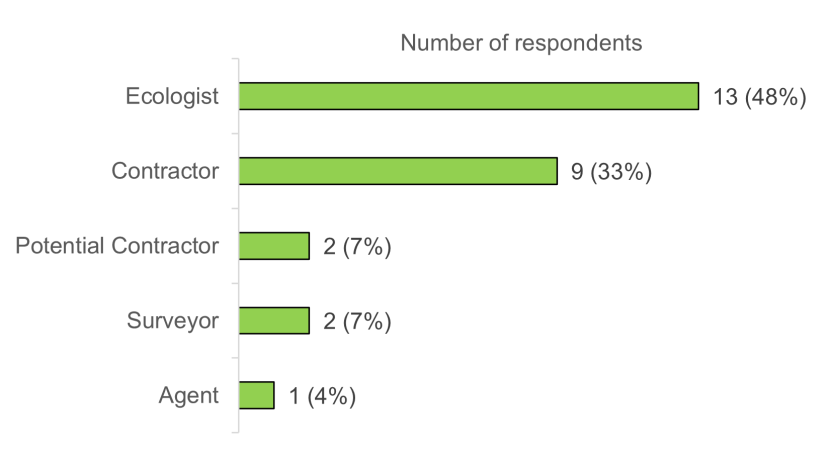
Figure 5.1 Respondent role
Click for a full description
Bar chart showing the role of respondents to the survey.
Ecologists = 13 (48%)
Contractors = 9 (33%)
Potential contractors = 2 (7%)
Surveyors = 2 (7%)
Agents = 1 (4%)
Total number of respondents = 27
The vast majority of respondents (89%) have either previous or current experience of peatland restoration work, Figure 5.2.
Figure 5.2 Respondent experience
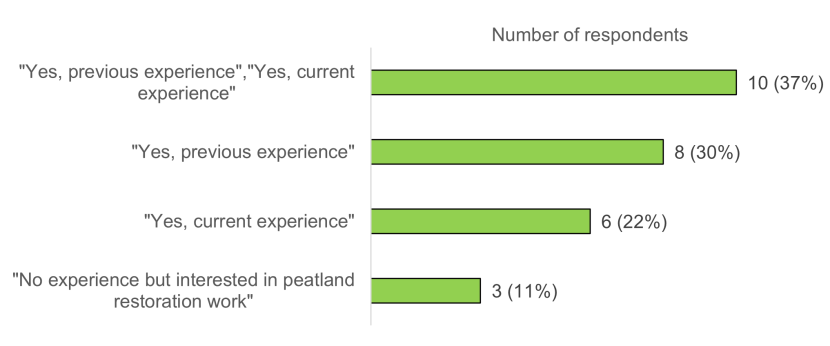
Figure 5.2 Respondent experience
Click for a full description
Bar chart showing the experience of respondents in peatland restoration.
Have current or previous experience = 10 (37%)
Have previous experience = 8 (30%)
Have current experience = 6 (22%)
Have no experience but are interested in peatland restoration work = 3 (11%)
Total number of respondents = 27
The majority (59%) of respondents’ businesses have been in operation for more than 10 years, whilst a significant minority (30%) have been in operation for between 1 and 3 years, Figure 5.3.
Figure 5.3 Length of business operation
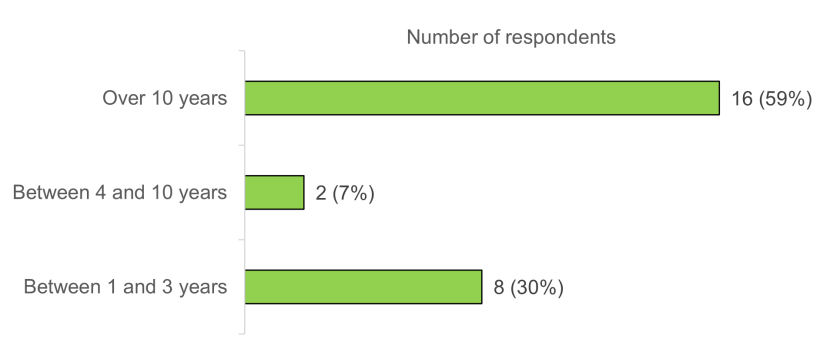
Figure 5.3 Length of business operation
Click for a full description
Bar chart shows length of time respondents have been in business.
Over 10 years = 16 (59%)
Between 4 and 10 years = 2 (7%)
Between 1 and 3 years = 8 (30%)
Total number of respondents =26
The most common location of respondents was in the Highlands (30%) and outside Scotland (19%), Figure 5.4.
Figure 5.4 Respondent location
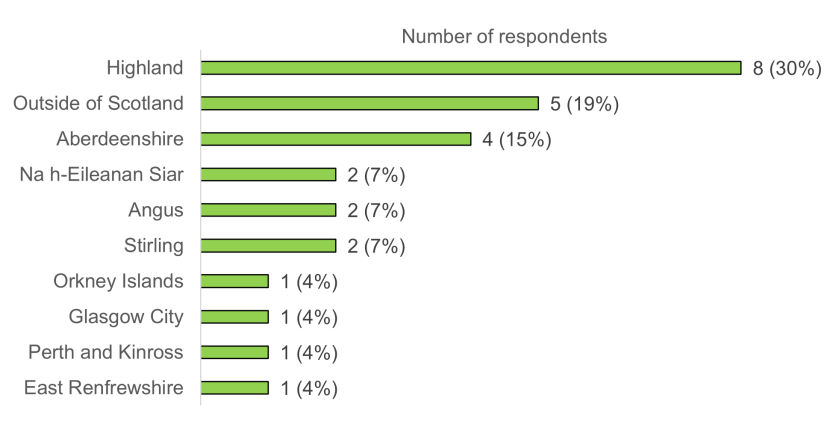
Figure 5.4 Respondent location
Click for a full description
Bar graph showing location of respondents by local authority area.
Highland = 8 (30%)
Outside Scotland = 5 (19%)
Aberdeenshire = 4 (15%)
Na h-Eileanan Siar = 2 (7%)
Angus = 2 (7%)
Stirling = 2 (7%)
Orkney Islands = 1 (4%)
Glasgow City = 1 (4%)
Perth and Kinross = 1 (4%)
East Renfrewshire = 1 (4%)
Total number of respondents = 27
The most common way that respondents became aware of peatland restoration work was through public bodies (74%), followed by Public Contract Scotland (44%) and word of mouth (41%), Figure 5.5.
Figure 5.5 Awareness of peatland restoration
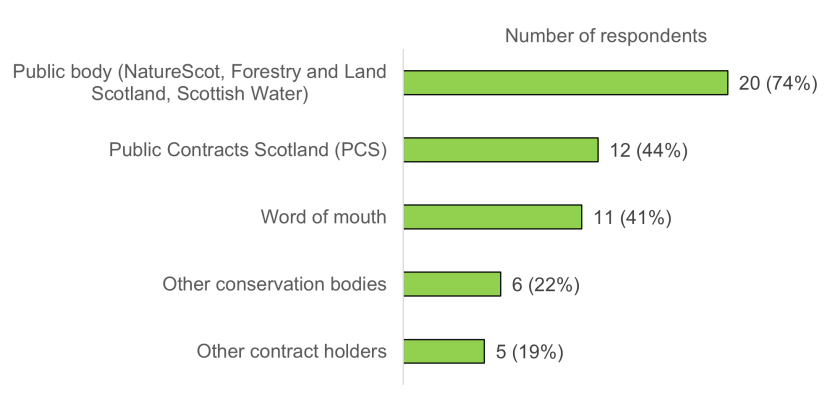
Figure 5.5 Awareness of peatland restoration
Click for a full description
Bar chart describes how respondents became aware of peatland restoration.
Via public bodies = 20 (74%)
Via Public Contracts Scotland = 12 (44%)
Via Word of Mouth = 11 (41%)
Via other conservation bodies = 6 (22%)
Via other contract holders = 5 (19%)
Total number of respondents = 27, Multiple responses possible
5.1 Skills requirements
Respondents were prompted with a multiple-choice question listing potential technical and practical skills requirements for peatland restoration.
Respondents identified computer literacy and IT skills as the most important technical requirement for peatland restoration (85%), followed closely by the ability to read and understand instructions, write reports and emails, basic numeracy, and an understanding of peatland restoration’s importance (all at 81%), as shown in Figure 5.6.
This emphasis on core digital and communication skills reflects findings from the Scottish Government’s recent review of transferable skills in Scotland’s land-based and aquaculture sectors, which highlights how these foundational skills are critical for workforce adaptability across multiple land-based industries (Scottish Government, 2024). This alignment underscores the importance of embedding these transferable skills within peatland restoration training programmes to support cross-sector mobility and sector resilience.
Figure 5.6: Technical and practical skills required
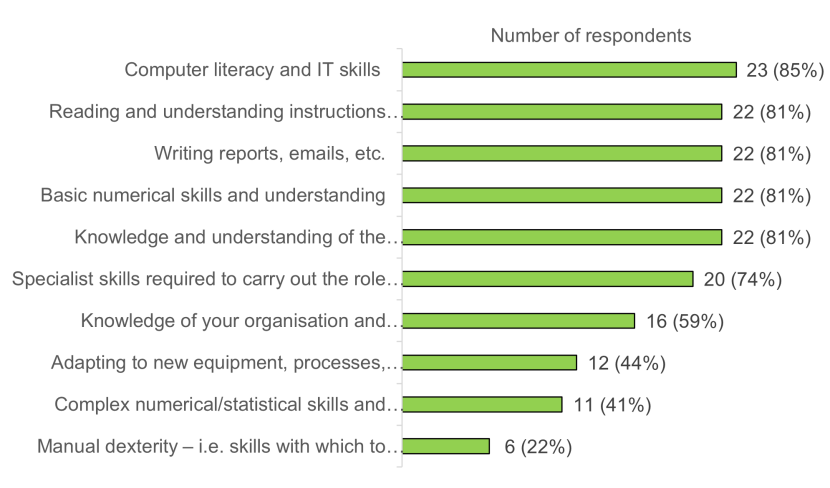
Figure 5.6 Technical and practical skills required
Click for a full description
Bar chart showing skills identified by respondents as important in peatland restoration.
Computer literacy and IT skills = 23 (85%)
Reading and understanding instructions = 22 (81%)
Writing reports, emails etc = 22 (81%)
Basic numerical skills and understanding = 22 (81%
Knowledge and understanding of the importance of peatland = 22 (81%)
Specialist skills to carry out the role = 20 (74%)
Knowledge of your organisation and products of services = 16 (59%)
Adapting to new equipment, processes, materials etc = 12 (44%)
Complex numerical or statistical skills = 11 (41%)
Manual dexterity - i.e. skills with which to ... = 6 (22%)
Total number of respondents = 24
Respondents were asked an open-ended question about the specialist technical skills required for peatland restoration. The most commonly identified skill was GIS mapping (56%), followed by restoration techniques (26%), animal surveys (19%), and ecological understanding (19%). Figure 5.7.
Figure 5.7 Specialist technical skills required
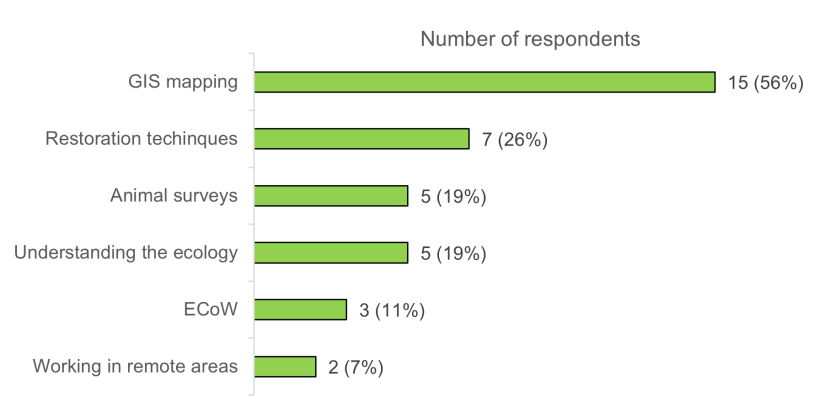
Figure 5.7 Specialist technical skills required
Click for a full description
Bar chart showing responses to an open-ended question about technical skills required.
GIS mapping was identified by 15 (56%)
Restoration techniques was identified by 7 (26%)
Animal surveys was identified by 5 (19%)
Understanding ecology was identified by 5 (19%)
Ecological Clerk of Works (ECoW) was identified by 3 (11%)
Working in remote areas was identified by 2 (7%)
Total number respondents = 24
Respondents were then prompted with a multiple-choice question listing potential personal skills required for peatland restoration. The most commonly identified skills were creative and innovative thinking, teamwork, time management and task prioritisation, project management, and problem-solving - each cited by 78% of respondents (see Figure 5.8).
Figure 5.8 Personal skills required
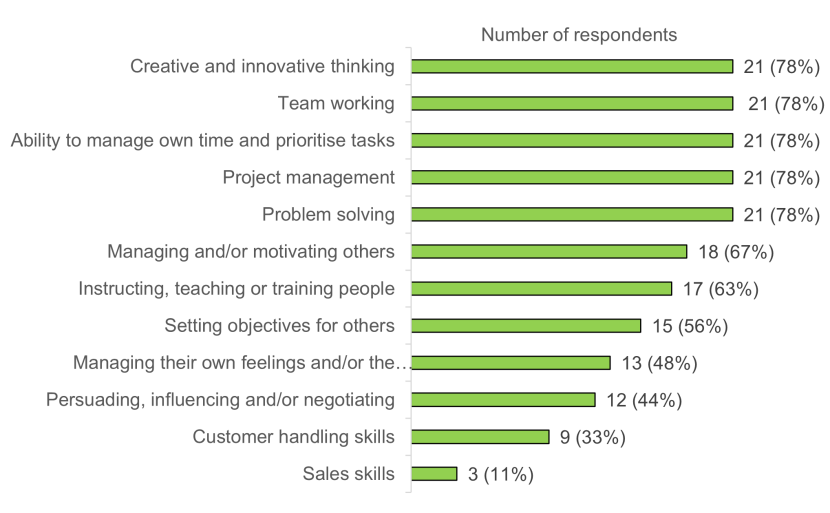
Figure 5.8 Personal skills required
Click for a full description
Bar graph shows responses to a multiple-choice question about personal skills required
creative and innovative thinking = 21 (78%)
team working (78%) = 21 (78%)
ability to manage own time and prioritise tasks = 21 (78%)
project management = 21 (78%)
problem solving = 21 (78%)
managing and / or motivating others = 18 (67%)
instructing, teaching or training people = 17 (63%)
setting objectives for others = 15 (56%)
managing their own feelings and / or the feelings of others = 13 (48%)
persuading, influencing or negotiating = 12 (44%)
customer handling skills = 9 (33%)
sales skills = 3 (11%)
Total number of respondents = 27
Respondents were then prompted with a multiple-choice question about skills gaps within their workforce. The most commonly identified deficiencies were preparation of site restoration plans (33%), environmental compliance for projects (26%), site surveying and monitoring (19%), and IT/GIS competency (15%) (see Figure 5.9).
Figure 5.9 Workforce skills lacking
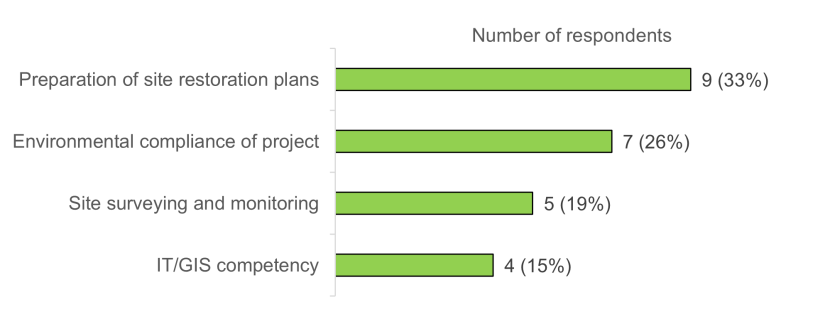
Figure 5.9 Workforce skills lacking
Click for a full description
Bar graph shows responses to a multiple-choice question about workforce skills gaps
Preparation of site restoration plans = 9 (33%)
Environmental compliance of project = 7 (26%)
Site surveying and monitoring = 5 (19%)
IT or GIS competency = 4 (15%)
Total number respondents = 27
5.2 Training
Most respondents (20, or 74%) reported that their employees have undertaken training in peatland restoration.
Among those with training experience, 40% said the training fully met their needs, while 60% felt it only somewhat met their needs.
Respondents who reported that training fully met their needs generally described it as excellent and comprehensive.
Those who felt the training somewhat met their needs most commonly cited the need for more practical, on-the-job training (four responses) and the limited availability of training opportunities (two responses).
5.3 Barriers
The most commonly identified barriers to expanding peatland restoration work were winter-month operations (56%), difficulties accessing sites (52%), and increased costs (48%), as shown in Figure 5.10. It is worth noting that skills and recruitment challenges ranked only fifth among barriers to expansion and were not identified as a primary constraint on further peatland restoration.
Figure 5.10 Barriers to expansion
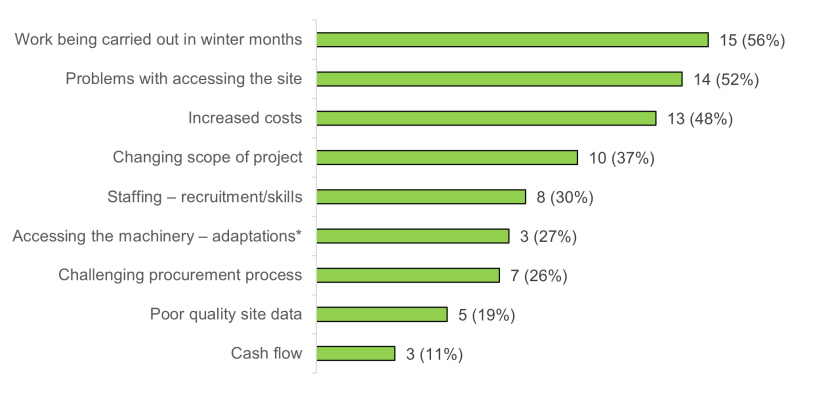
Figure 5.10 Barriers to expansion
Click for a full description
Bar graph shows most commonly identified barriers to expansion of peatland restoration work
Work in winter months = 15 (56%)
Problems with accessing the site = 14 (52%)
Increased costs = 13 (48%)
Changing scope of project = 10 (37%)
Staffing – recruitment or skills = 8 (30%)
Accessing machinery - adaptations = 3 (27 %)
Challenging procurement processes = 7 (26%)
Poor quality site data = 5 (19%)
Cash flow = 3 (11%)
Total number respondents = 27
Total number respondents for machinery adaptation as question only relevant for contractors = 11
Half of respondents expect the amount of peatland restoration work they undertake in the future to increase, while a third remain uncertain (see Figure 5.11). Among those anticipating growth, the primary reasons cited were an increase in available work (four responses) and existing capacity to expand (two responses). For those unsure, the main concerns were difficulties with the tendering process (two responses) and a reduction in feasibility studies (two responses).
Figure 5.11 Future levels of peatland restoration
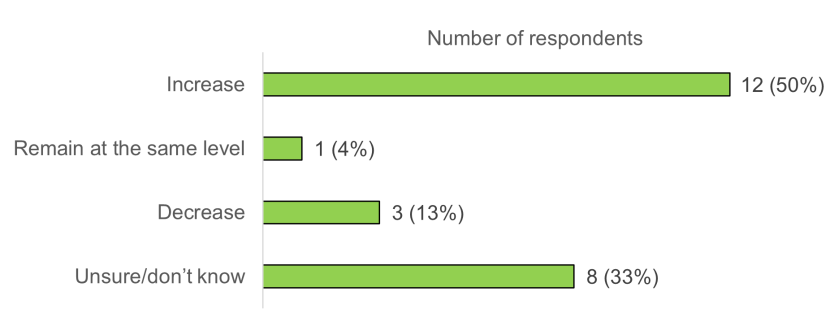
Figure 5.11 Future levels of peatland restoration
Click for a full description
A bar graph shows the results from a survey question about the amount of time their business/employees will spend on peatland restoration work over the next 5 years.
Increase = 12 (50%)
Remain at the same level = 1 (4%)
Decrease = 3 (13%)
Unsure/don’t know = 8 (33%)
The total number of respondents was 24
Respondents were asked to estimate the number of hectares they could restore operating at optimal capacity with their current workforce and machinery. Ten responses indicated they could gradually expand their work to restore over 20,000 hectares by 2029/30, Figure 5.12.
Figure 5.12 Future levels of peatland restoration
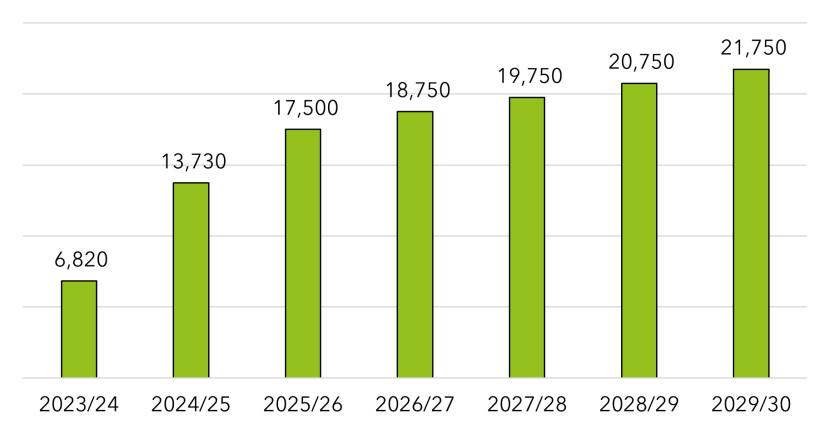
Figure 5.12 Future levels of peatland restoration
Click for a full description
A bar graph shows the results from the survey question where respondents were asked to estimate the number of hectares they could restore in each financial year, operating at optimal capacity with their current workforce and machinery. There were 10 respondents and their responses are aggregated
2023/24 = 6,820 hectares
2024/25 = 13,730 hectares
2025/26 = 17,500 hectares
2026/27 = 18,750 hectares
2027/28 = 19,750 hectares
2028/29 = 20,750 hectares
2029/30 = 21,750 hectares
Total number respondents =10
The main factors respondents identified to help increase their peatland restoration work were more tender opportunities (56%) and finding ways to carry out work during the bird breeding season (Figure 5.13). Many contractors noted that they had the capacity to deliver additional restoration, however this should be viewed with some caution, as there were examples of contractors bidding for work that they were unable to complete within the initial timescales they had stated.
Figure 5.13 Help to increase amount of work
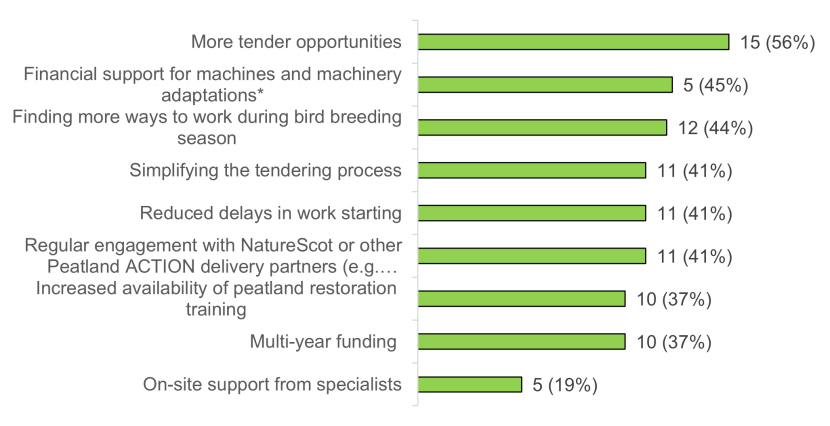
Figure 5.13 Help to increase amount of work
Click for a full description
Bar chart shows the results from a ranked, multiple choice survey question about what could help to increase the amount of peatland restoration work taken on.
There were 27 responses
More tender opportunities = 15 (56%)
Financial support for machines and machinery adaptations = 5 (45%)
Finding more ways to work during bird breeding season = 12 (44%)
Simplifying the tendering process = 11 (41%)
Reduced delays in work starting = 11 (41%)
Regular engagement with NatureScot or other Peatland ACTION delivery partners (e.g. Forestry Land Scotland, Scottish Water) = 11 (41%)
Increased availability of peatland restoration training = 10 (37%)
Multi-year funding = 10 (37%)
On-site support from specialists = 5 (19%)
Total number of respondents = 27
*Total number of respondents for machinery adaptation as question only relevant for contractors = 11
Respondents were asked open-ended questions about the main opportunities and challenges facing their workers in the sector. The most commonly identified opportunities included: a significant volume of potential future work (eight responses), workers possessing relevant skills to take on more work (three responses), and the sector’s support for employment in rural areas (three responses).
The key challenges highlighted were difficulties with the tendering process (six responses), the concentration of peatland work within the winter months (five responses), and the last-minute nature of many tender opportunities (four responses).
5.4 Machinery and adaptations
Six respondents reported having purchased or adapted machinery specifically for peatland restoration work, with a collective investment of £2.8 million to date - an average of approximately £470,000 per respondent. Additionally, four respondents provided estimates for future machinery expenditure through 2030, projecting a total investment of £1.7 million (around £430,000 per respondent). Consultees noted that access to suitable machinery is a key factor influencing the ability of firms to employ and retain staff, as the availability of equipment directly affects the volume and continuity of restoration work, and therefore the stability of the available workforce.
6. Peatland restoration workforce: Demand, composition, trends, and challenges
The labour market for peatland restoration workers is shaped by several key factors, including demand for restoration services, availability of skilled labour, seasonal work patterns, and broader trends in the transition to net zero and a low carbon economy. In this section we will explore these dynamics in detail, examining current workforce demand, job roles and composition of the sector, and training opportunities within the sector. The information presented in this section was gathered from desk research and the consultation process.
Peatland restoration is a multidisciplinary effort requiring collaboration between policymakers, funders, ecologists, land managers, contractors, and researchers. Each role plays a critical part in ensuring restoration projects are effectively planned, funded, executed, and monitored to support climate targets, biodiversity conservation, and sustainable land management.
This section outlines the key job roles involved in the peatland restoration process, from policy and funding allocation to on-the-ground restoration work and long-term site monitoring. Understanding these roles is essential for workforce planning, skills development, and ensuring Scotland meets its ambitious peatland restoration targets.
6.1 Key occupations and stakeholders in peatland restoration
The peatland restoration workforce is drawn from a range of sectors. The list below provides a summary overview of the key occupations and stakeholders involved in the sector. Their roles are illustrated in the peatland restoration process flowchart at Figure 6.1 and explored in more detail in Section 6.2. These include:
- Civil engineering and rural contractors – Excavator operators and heavy machinery specialists responsible for carrying out restoration activities.
- Surveyors and ecological surveyors – Professionals who assess peatland condition, measure carbon storage, and provide ecological surveys.
- Restoration practitioners – Including handwork teams (often part of civil teams) and specialists in ecology and hydrology who design and implement restoration interventions.
- Land managers, estate staff, forestry and agriculture professionals – This group includes landowners, farmers, and agricultural workers, as well as land managers and estate staff who integrate peatland restoration into broader land-use strategies. They ensure that restoration efforts align with environmental goals and play a critical role in the management and execution of restoration activities.
- Carbon finance advisors – Experts who support landowners in accessing funding through carbon markets, ensuring restoration efforts are financially viable.
- Scottish Government and Peatland ACTION (PA) partner staff – Representatives from government agencies such as NatureScot, Scottish Water, Forestry and Land Scotland (FLS), along with the National Parks, who oversee and support the implementation of restoration policies and initiatives, as well as contract and collaborate to deliver peatland restoration projects.
- Agents – Environmental consultants or third-party contractors who facilitate project delivery, manage landowner relationships, and help navigate regulatory frameworks.
- Other support staff – Additional workers such as project managers, technical specialists, and administrative staff who support the day-to-day operation and coordination of restoration activities.
6.1.1 Summary flow of roles
Figure 6.1 illustrates the peatland restoration process, highlighting key roles and their place in the workflow.
Figure 6.1 Peatland restoration process

Figure 6.1 Peatland restoration process
Click for a full description
An illustration of the peatland restoration process as steps from left to right in ascending order starting with Policy Development in the bottom left, then Site Planning and Selection, Funding and Grants, Restoration Work, with Monitoring & long term management at the top right
Figure 6.1 provides an overview of the peatland restoration process, and the following section delves into the specific roles and responsibilities associated with each stage of the process.
6.1.2 Roles and responsibilities in the peatland restoration process
Summary of the key findings.
a. Policy development and strategic planning (high-level decision-making)
At the highest level, government bodies and regulatory agencies establish the strategic framework for peatland restoration, set funding priorities, and oversee policy implementation:
- Scottish Government and UK Government – Develop national climate, biodiversity, and land use policies and allocate funding for restoration initiatives, such as the Peatland ACTION Programme.
- NatureScot, FLS, Scottish Water and the National Park Authorities– Design and implement peatland restoration strategies, ensure regulatory compliance, and oversee delivery of the Peatland ACTION programme.
- Carbon Market and Investment Bodies (e.g., Peatland Code, Green Finance Groups) – Provide funding opportunities through carbon credit schemes and biodiversity offsetting mechanisms.
⬇ Funding and guidelines are passed to the next stage.
b. Project planning and site selection (pre-restoration assessment)
Before restoration begins, a range of professionals assess site conditions, identify priority areas, and develop detailed restoration plans:
- Peatland ACTION Project Officers, Land Agents, and Specialist Restoration Consultants – Coordinate early project development, engage with landowners, and ensure that proposed activities align with funding requirements and restoration standards.
- Ecologists and Environmental Consultants – Carry out peat depth surveys, habitat and biodiversity assessments, and ensure environmental compliance, such as avoiding disturbance to protected species or nesting birds.
- Hydrologists and GIS Specialists – Map peatland condition and degradation, assess hydrological systems, and design site-specific interventions based on topography and water flow data.
- Forestry and Land Scotland (FLS), Land Managers, and Estate Staff – Identify and prioritise suitable restoration sites, provide on-the-ground knowledge, facilitate land access, and liaise with landowners and tenants.
- Specialist Contractors and Technical Advisors – May contribute to early site scoping by offering practical input on site feasibility, access constraints, and implementation methods.
- Specialists within Peatland Action partners and others who promote the benefits of peatland restoration and provide technical advice.
⬇ Site plans and technical reports are passed to the next stage.
c. Funding and grant allocation (resource mobilisation)
Securing financial resources is critical to the delivery of peatland restoration projects. Multiple organisations and actors are involved in mobilising and administering funding:
- Peatland ACTION Programme – Provides and administers public funding to support eligible restoration projects, guiding applicants through the application and approval process.
- Peatland Code – Offers a voluntary certification framework that enables landowners to generate and sell carbon credits from restoration projects. The Code includes a validation and verification process to ensure projects meet required standards and deliver measurable carbon benefits. This process instils confidence in investors.
- Local Authorities and National Park Authorities – Play a role in the planning and regulatory framework, particularly through the Prior Notification process, which ensures appropriate oversight and planning alignment for restoration activities.
- Landowners – Seek funding through grant programmes and increasingly explore blended finance models, including private investment and carbon finance, to support restoration work.
- Agents and Advisors – Assist landowners with funding applications, navigate regulatory requirements, and support registration and validation under the Peatland Code.
⬇ Funding and project approvals are passed to the next stage.
d. On-the-ground restoration (implementation phase)
This phase involves direct intervention to restore degraded peatlands:
- Restoration contractors and machine operators – Use heavy machinery to block drainage channels, reprofile land, construct bunds and dams and rewet peatlands
- Ecological clerk of works –implement biodiversity protection measures.
⬇ The restored site is passed to the next stage.
e. Monitoring and long-term management (post-restoration assessment)
Ongoing monitoring and site management are critical to ensuring the long-term success and sustainability of peatland restoration projects:
- Scientific researchers and carbon analysts – Monitor carbon sequestration, biodiversity gains, and hydrological changes to assess the ecological and climate impacts of restoration work.
- Land managers – Responsible for routine site maintenance, preventing re-degradation, and coordinating follow-up restoration activities as needed.
- Policy and reporting bodies (e.g. NatureScot, Scottish Water, Forestry and Land Scotland, SEPA) – Track progress against policy objectives, compile monitoring data, and provide reports for funders, decision-makers, and national strategies.
- Community and volunteer groups – While volunteers play only a minor role in the sector, they are occasionally involved in the maintenance phase, for example, managing regeneration in forest-to-bog projects after rewetting or supporting habitat enhancements. Their involvement also serves to engage local communities and raise awareness of restoration work.
Each stage of this process is interconnected, requiring collaboration across sectors to achieve Scotland’s peatland restoration and climate goals.
6.2 Workforce composition by occupation in the peatland restoration sector
This section examines the workforce composition by occupation within the peatland restoration sector, providing an overview of the various roles involved in carrying out restoration activities effectively. However, it is important to note that data on the workforce is limited, with significant data gaps due to the following:
- There is no established, comprehensive system for tracking the size, composition, and employment patterns of the peatland restoration workforce. Without formal data collection processes, it becomes difficult to gather accurate and up-to-date information on workers in the sector.
- Fragmented workforce: The workforce involved in peatland restoration is often fragmented across various sectors making it challenging to gather consistent data from a centralised source.
- Short-term and project-based employment: Much of the work in peatland restoration is project-based or seasonal, with workers hired for specific tasks or limited timeframes. This short-term nature of employment can lead to gaps in workforce tracking, as workers may move between projects or sectors, further complicating data collection.
- Lack of industry standardisation: The peatland restoration sector is an emerging sector and relatively niche and may not be as standardised as other sectors. There may be no universally agreed-upon methods for categorising or tracking workers across the industry, leading to inconsistent data reporting.
- Lack of policy or regulatory frameworks: There are insufficient policies or regulatory frameworks in place that require employers or stakeholders in peatland restoration to report workforce data, leaving a gap in the information available.
- Complexity of workforce roles: Peatland restoration involves a wide range of skills, from environmental scientists and ecologists to contractors and labourers. The diversity of roles can make it difficult to collect data that accurately reflects the different types of work and specialisation within the sector.
A full list of all the current job roles can be found in Annex A.
6.2.1 Present peatland restoration workforce and key stakeholders in Scotland
This section presents the current workforce engaged in Peatland Restoration across Scotland. Given uncertainties around the exact level of employment in the industry, we have employed multiple methods to derive robust estimates, as outlined in each section below.
a. Peatland ACTION (PA) partners
Peatland ACTION is funded by the Scottish Government and delivered through Peatland ACTION partners in collaboration with local authorities, landowners, estates, contractors, and conservation groups.
i. NatureScot
NatureScot leads Scotland's national programme for peatland restoration through Peatland ACTION, focused on restoring degraded peatlands to enhance biodiversity, water quality, and climate change mitigation.
Workforce Estimate: 50 staff members, equating to 49.4 FTE positions.
ii. Forestry and Land Scotland (FLS)
FLS is instrumental in peatland restoration within Scotland's national forests and lands, balancing environmental stewardship with land management.
Workforce Estimate: 48 staff contributing to peatland activities, approximately 24 FTE dedicated solely to restoration.
iii. Scottish Water
As a public body, Scottish Water supports peatland restoration to improve water quality and supply.
Workforce Estimate: 4 FTE staff working directly in Peatland Restoration.
vi. Cairngorms National Park Authority (CNPA) & Loch Lomond and the Trossachs National Park (LLTNP)
These national park authorities contribute to peatland restoration within their boundaries as partners in the Peatland ACTION programme.
Workforce Estimate: 6 FTE for CNPA and 4.5 FTE for LLTNP.
6.2.2 Workforce composition of wider stakeholders outside Peatland ACTION partners
Summary of the key findings.
a. Agents
Private and third-sector agents including RSPB play a growing role in managing and designing peatland restoration projects. Currently, Peatland ACTION estimates there are three main agencies with approximately 25 between them working on peatland restoration and approximately 12 additional consultancies employing one to two FTEs each on peatland restoration. In addition, whilst RSPB staff are employed on wider conservation work, there are estimated to be approx. 8 FTE who are also directly involved in designing schemes.
Total Workforce Estimate: 50 FTE agents engaged in Peatland Restoration in 2023/24.
b. Peatland Code validators
These professionals are responsible for verifying carbon credits under the Peatland Code, ensuring restoration projects meet carbon market standards.
Workforce Estimate: 5 FTE.
c. Ecologists
Survey data indicates that ecologists employ around 332 people, with approximately 40 FTE dedicated to peatland restoration, inclusive of peatland depth surveying and ecological assessments.
Total Workforce Estimate: 40 FTE in 2023/24.
d. Archaeologists
Archaeological surveys in peatland restoration are minimal, and the workforce in this sector is considered very small.
e. Peatland restoration contractors
Contractor workforce estimates were derived using three distinct methodologies to ensure reliability and accuracy in calculating employment levels within the peatland restoration sector:
- Industry coefficient against programme expenditure
- The Scottish Wildlife Trust estimates that peatland restoration projects create approximately 1 job per £70,000 spent [12]. This figure, adjusted for inflation to £81,000, was applied to NatureScot's expenditure of approximately £9 million in 2023/24. This resulted in an estimate of 110 FTE jobs. Since NatureScot projects account for roughly two-thirds of Peatland ACTION activity, this was scaled up to reflect the entire Peatland ACTION programme, providing an estimate of 166 FTE jobs.
- Contractor survey data
- Surveys of contractors reported a total of 962 employees. After adjusting for the proportion of work directly related to peatland restoration, this figure reduced to 62 FTE jobs. Scaling this to represent the total number of contractors involved in 2023/24, the estimate rose to 234 FTE jobs.
- Survey of projects completed
- Survey data showed that projects typically last an average of five months, with 97 projects carried out in 2023/24. This translates to approximately 40 full-year equivalent projects. With an average of 4.5 employees per project, this method provided an estimate of 183 FTE jobs.
Each methodology produced a slightly different estimate, yet all were broadly in line with sector expectations, providing confidence in the numbers. Taking the average of the three methods and rounding for clarity, we estimate there are approximately 200 FTE contractor jobs engaged in Peatland Restoration for 2023/24.
Total Workforce Estimate: 200 FTE in 2023/24.
6.3 Contractor work continuity and contract models
The structure of contracts and project delivery models in peatland restoration varies significantly, impacting the stability and continuity of contractor work.
- Forestry and Land Scotland (FLS) contracts: FLS operates on a structured contract model where winning contractors secure a 3 + 1 + 1-year agreement. This model provides a greater degree of certainty over the pipeline of work, allowing contractors to plan resources and retain skilled staff over a longer period compared to shorter project-based contracts.
- NatureScot and National Parks funded projects: In contrast, the NatureScot and National Park restoration projects follow a more decentralised approach. Landowners typically tender independently for restoration work on their projects, which are generally limited to a few months. This fragmented tendering process can create gaps in work for contractors, making workforce retention and long-term planning more challenging.
- Collaborative regional projects – Monadhliath DMG: In the Monadhliath Deer Management Group (DMG) area, a different approach has been implemented. Here, Strath Caulaidh Ltd manages a regional collaborative project, aiming to streamline contractor resources across multiple projects. This strategy not only improves efficiency but also enhances work continuity, mitigating some of the instability seen in more fragmented tendering processes.
These differing contract models illustrate the potential benefits of regional coordination and long-term agreements in reducing workforce volatility and improving job security for contractors in peatland restoration.
6.3.1 Seasonal and diversified employment patterns
Although the estimated FTE is 200, the actual number of people working as contractors is likely to be significantly higher. Peatland restoration is largely seasonal, with peak activity in the autumn and winter months. Additionally, many contractors diversify their work outside of peatland restoration due to the sector's seasonal nature and variability in project availability. For these reasons, the total number of contractors involved is estimated to be between 400 and 600 individuals during 2023/24.
6.3.2 Summary of workforce estimates
| Category | FTE Jobs | % of Total Workforce |
|---|---|---|
| NatureScot | 49.4 | 13% |
| FLS | 24 | 6% |
| Scottish Water | 4 | 1% |
| CNPA | 6 | 2% |
| LLTNP | 4.5 | 1% |
| Agents (incl RSPB) | 50 | 13% |
| Peatland Code Validators | 5 | 1% |
| Ecologists | 40 | 10% |
| Contractors | 200 | 52% |
| Total | 382.9 | 100% |
The workforce plays various roles, from fieldwork and restoration to programme management, ecological surveying, and project design. Peatland ACTION partners, agents, ecologists, and contractors work in unison to achieve Scotland's climate and biodiversity goals through effective peatland restoration.
6.4 Contribution of landowners / managers and the scientific community to the restoration sector
In addition to the core workers involved in the restoration project development and delivery, it is important to consider how landowners/managers, communities and the research and academic institutions contribute to the peatland restoration sector.
6.4.1 Environmental organisations
Environmental and conservation charities play a significant role in peatland restoration and protection. Their work includes restoring degraded peatlands on nature reserves, promoting sustainable land management practices in partnership with landowners, and advocating for policy changes to support peatland conservation. These organisations also contribute to wider land restoration and rewilding initiatives, ensuring tree planting schemes do not damage peatlands, and champion nature-based solutions for climate and biodiversity challenges.
6.4.2 Landowners and land managers
Landowners, both private and community, are crucial in peatland restoration, given that much of Scotland's degraded peatland lies on privately and community-owned estates. They are responsible for sustainable management, providing access for surveys and restoration activities, applying for funding, and participating in carbon markets to support restoration efforts.
Key roles and responsibilities:
- Land stewardship and sustainable management
- Providing access and facilitating restoration activities
- Applying for funding and grants
- Engaging in carbon markets
6.4.3 Community landowners and trusts
Community landowners, including local development trusts, contribute significantly to peatland restoration and local employment. Their projects not only advance climate and biodiversity goals but also drive skills development and community engagement.
6.4.4 Research and academic institutions
Research bodies like The James Hutton Institute, University of Edinburgh, University of the Highlands and Islands, and the Flow Country Research Hub provide expertise in peatland restoration, carbon storage, and land use impacts, supporting evidence-based decision-making in restoration projects.
It is important to note that academic and research roles involved in peatland science are typically classified under Standard Occupational Classification (SOC) codes associated with the education sector. As such, these roles are not captured within the land-based SOC codes that typically reflect occupations like conservation workers, land managers, or ecological surveyors. This separation makes it challenging to fully account for the scientific workforce contributing to peatland restoration within broader assessments of the land-based workforce.
Quantifying the exact number of FTE staff dedicated specifically to the scientific research underpinning peatland restoration in Scotland is challenging, as this work is distributed across multiple institutions and often integrated into broader research agendas. However, we can provide some insights into the capacities of key organisations involved:
a. The James Hutton Institute
The James Hutton Institute is a major research organisation in Scotland, employing approximately 579 staff as of 2023 [13]. While not all are focused on peatland research, the institute conducts significant work in land use, carbon sequestration, and ecosystem services, which includes peatland studies.
b. University of Edinburgh
The University of Edinburgh has hosted over 50 peatland research projects across the natural and physical sciences over the past two decades. The university employs over 12,390 full-time equivalent staff, with a substantial number engaged in environmental and climate-related research [14].
c. University of the Highlands and Islands (UHI)
UHI, particularly through its Institute for Biodiversity and Freshwater Conservation, has researchers specialising in forestry, land management, and ecology [15]. While specific FTE numbers are not publicly available, the institute's focus areas align closely with peatland restoration science.
The Environmental Research Institute (ERI) is based in Thurso, Scotland and is part of the University of the Highlands and Islands, North Highlands. Since 1999 this multidisciplinary team has sought to transcend scientific boundaries to undertake and promote high-calibre research, innovation, and education in the environmental sciences that ‘makes a difference’. The ERI Peatland team benefits from unrivalled access to The Flow Country peatlands of Caithness and Sutherland: covering 4000 km2, they represent largest expanse of blanket bog in Europe and a site of global significance, inscribed since 2024 as the world’s first and only UNESCO World Heritage Site. Their research seeks to provide underpinning evidence that can drive changes in policy and practice to ensure a resilient future for the Flow Country peatlands and rivers, and a just transition for its people. They currently have 33 staff with several specialising in peatland.
d. Flow Country Research Hub
The Flow Country Research Hub coordinates research activities in one of the world's largest blanket bog ecosystems. It brings together scientists from various institutions to study peatland ecology, carbon storage, and restoration techniques [16]. While exact staffing numbers are not specified, the hub represents a significant collaborative effort in peatland research.
In summary, while precise FTE figures dedicated solely to peatland restoration science are not readily available, Scotland hosts a robust network of researchers and institutions actively engaged in this field. This collective expertise supports evidence-based decision-making in peatland restoration projects across the country.
6.5 Drivers of demand for peatland restoration workers
Peatland restoration is a growing sector, driven by Scotland’s net zero targets, climate resilience strategies, and biodiversity commitments. The Scottish Government has set an ambitious goal of restoring 250,000 hectares of peatland by 2030, increasing the demand for restoration professionals.
Key drivers of demand include:
- Government funding (e.g., Peatland ACTION, Agri-Environment Climate Scheme)
- Carbon markets and private investment (e.g., Peatland Code projects)
- Water quality improvements and flood mitigation policies
- Biodiversity and conservation strategies
6.5.1 Seasonal and geographic factors affecting peatland restoration
Peatland restoration is highly seasonal, with the ideal window for work typically occurring during drier days to prevent damage to fragile ecosystems. However, much of the work ends up being carried out in wet conditions (unavoidable in Scotland), adding uncertainty to project duration and contractor capacity. The legal requirement to protect species causes some projects to be delayed until work can take place outside the most sensitive seasonal periods. Additionally, snow and frozen ground are significant weather-related barriers that can further impact timelines. This seasonal nature creates challenges in:
- Job security and workforce retention – Many roles are short-term or project-based.
- Recruitment cycles – High demand for workers during peak restoration periods.
- Rural workforce availability – Projects are often located in remote areas, requiring a local skilled workforce. While this work could be conducted by contractors from outside the region, it is generally associated with higher costs due to travel, accommodation, and subsistence expenses.
6.5.2 Managing peatland restoration during the bird breeding season
A key challenge for peatland restoration in Scotland is the need to comply with legislation protecting bird species during breeding seasons. These typically run from April to July but can start in February and extend into September depending on the species and site-specific circumstances.
Without specific mitigation measures, restoration activities could have the potential to disturb or harm protected species, however over the last 3 years, restoration activities have been able to happen during the breeding season through the implementation of species protection plans supported by ecological surveys and assessments.
The introduction of this risk-based approach allows more work to be carried out throughout the year, supporting the achievement of Scottish Government’s peatland restoration targets. The NatureScot Bird Breeding Guidance protocol can be found at Annex C.
6.5.3 Mitigation measures and progress
Mitigation measures are increasingly being employed to minimise ecological disruption while allowing restoration work to continue without a full seasonal halt. These include:
- Pre-application and pre-operational ecological surveys to identify active nesting sites and assess site-specific requirements.
- Development of species protection plans that may establish buffer zones around nests and resting places.
- Sequencing and timing work to implement protection plans, scheduling less disruptive tasks during critical breeding periods.
- Use of alternative techniques such as lower-impact machinery or hand-restoration methods in sensitive areas to further reduce disturbance.
6.5.4 Recent restoration activity during the breeding season
In 2023/24, a total of 871 hectares were restored between April and June 2023, accounting for approximately 9% [17] of the total land restored that year. While still a relatively small proportion, this represents significant progress, and the proportion is expected to grow as mitigation strategies are refined and implemented more widely.
These adaptive approaches ensure that peatland restoration activities are delivered in full compliance with legal protections for biodiversity. By considering species protection during the project planning and delivery stages, these practices support Scotland’s climate and biodiversity goals while enabling the sector to operate more effectively across a greater proportion of the year.
6.6 Labour market challenges for the peatland restoration workforce
The labour market for peatland restoration workers is evolving, with both challenges and opportunities shaping the sector’s future. Addressing workforce gaps and adapting to new industry trends will be crucial for ensuring a sustainable and skilled workforce.
6.6.1 Employment and job stability in peatland restoration
Investment in peatland restoration creates both opportunities and challenges for job security and long-term employment. While the demand for skilled workers is increasing, job stability is influenced by several factors, including project-based funding, seasonal work patterns, and the need for specialised training.
- Reliance on public funding – A significant proportion of restoration jobs are dependent on government grants and subsidies. This reliance creates uncertainty, as shifts in funding priorities or policy changes could impact job availability.
- Project-based employment – Many peatland restoration projects are funded in phases, resulting in short-term contracts that can lead to employment gaps between projects. This creates challenges for workforce retention and career progression.
- Emerging private investment – The growth of carbon credit schemes, biodiversity offsetting, and green finance initiatives is gradually improving long-term employment prospects. As businesses invest in natural capital markets, more stable funding sources for peatland restoration are emerging.
6.6.2 Aging workforce and depopulation in rural and island communities
Many skilled workers in land-based sectors are approaching retirement age, leading to concerns about future workforce shortages. In addition, rural depopulation–driven by outward migration of young people and limited job opportunities–further exacerbates the issue. Research from Skills Development Scotland (SDS) [18] highlights demographic challenges affecting Scotland’s rural economy, with recruitment difficulties in industries such as agriculture, forestry, and conservation.
6.6.3 Integrated Land Use: Balancing Restoration and Development Pressures
Peatland restoration operates within a wider landscape of land use sectors - such as forestry, agriculture, and renewable energy - all of which face shared pressures to deliver environmental, social, and economic outcomes. While these sectors are not inherently in conflict, competition for land is real, particularly from energy developments such as wind farms, which can offer substantial financial returns to landowners. These economic incentives often far exceed those available through public funding for restoration or nature-based outcomes, creating a powerful driver of land use decisions.
This dynamic underscores the need for strategic policy alignment and robust regulatory frameworks that actively manage and balance these competing interests. A clearer and more integrated approach is required - one that ensures energy and climate policy objectives are delivered in harmony with peatland restoration goals. Through careful spatial planning, transparent governance, and cross-sector collaboration, Scotland can support both its renewable energy ambitions and its commitments to biodiversity and carbon sequestration by enabling peatland restoration to proceed alongside, rather than in competition with, energy developments.
In practice, the workforce involved in peatland restoration may pivot between sectors based on seasonal demand and project availability. For example, contractors and ecological consultants engaged in restoration often work in forestry, renewable energy, or infrastructure projects during off-peak periods. This fluidity helps maintain workforce stability but can also create competition for skilled labour, particularly in rural regions where specialist skills are in short supply.
A 2025 report by CXC [19] highlighted that approximately 15% of restoration contractors also engage in forestry projects, while 10% work in renewable energy developments during gaps in peatland project availability. This adaptability underscores the interconnection between land-based sectors and the importance of integrated planning to prevent workforce shortages during critical restoration windows.
To address the potential loss of workers to competing sectors, the peatland restoration sector can adopt several strategies:
- Enhancing workforce development and training programmes to broaden skills applicable across land management sectors, improving worker retention by increasing employment flexibility within restoration.
- Developing longer-term contracts and collaborative regional projects (such as the Monadhliath DMG model), providing more consistent work pipelines and reducing the lure of more stable employment in other sectors.
- Improving wages and working conditions where possible to make restoration roles more competitive relative to forestry or renewable energy jobs.
- Strengthening cross-sector partnerships to facilitate coordinated planning and workforce sharing, enabling smoother transitions for workers between sectors and minimising labour shortages.
By adopting these approaches, the peatland restoration sector can better retain skilled workers, improve job security, and sustain momentum towards Scotland’s ambitious restoration and climate goals. This is covered in more detail in the conclusions and recommendations.
6.6.4 Upskilling and professionalisation
Peatland restoration currently depends on a blend of traditional land management skills and specialist ecological knowledge. However, formal training pathways specific to peatland restoration are still limited, which can restrict the sector’s capacity to meet growing demand and integrate new technologies and methods effectively.
The Peatland Skills Plan [20] highlights a critical need for accredited qualifications and structured Continuing Professional Development (CPD) opportunities to support workforce growth and professionalisation. These would provide clear career pathways and improve workforce retention by enhancing job security and recognition. NatureScot’s Peatland ACTION programme has made important progress in this area by developing and delivering a coordinated programme of CPD activities, helping to build technical capacity across the sector. Continued investment in and expansion of these initiatives will be essential to meet the scale of restoration targets and ensure a skilled, adaptable workforce.
Upskilling efforts are essential to equip existing workers with new technical capabilities – such as drone operation, GIS, remote sensing, and advanced monitoring techniques – enabling them to adapt to evolving restoration practices and technology use.
Reskilling is equally important, especially as workers may pivot between related sectors like forestry or renewable energy. Facilitating the transition into peatland restoration from these areas requires tailored training to bridge knowledge gaps and build peatland-specific expertise. Ongoing efforts by NatureScot and partners to develop and deliver targeted training programmes and CPD opportunities are helping to support this transition. For example, the New Entrant Operator Scheme provides hands-on experience for those new to the sector, and regional training sessions - such as one recently held in Shetland - offer practical, location-specific skills development. These initiatives equip individuals with the capabilities needed to operate effectively in peatland environments. Moreover, investing in formal training and professional development will:
- Improve consistency and quality across projects
- Support the integration of innovation and best practices
- Foster a more resilient and adaptable workforce prepared for future sector challenges
Overall, developing robust upskilling and reskilling frameworks is key to sustaining and expanding the peatland restoration workforce in line with Scotland’s ambitious environmental targets.
6.6.5 Skills implications of technological advancements in peatland restoration
The adoption of new technologies such as drones, Geographic Information Systems (GIS), and remote sensing is transforming peatland restoration practices by enabling more precise site monitoring, detailed planning, and accurate carbon assessments. According to a report by the International Union for Conservation of Nature [21] (IUCN, 2023), these innovations reduce costs and enhance restoration efficiency. This evolution creates several key skills requirements for the workforce:
- Technical proficiency: Workers need training in operating drones and using GIS software to capture and analyse spatial data effectively. This includes skills in data collection, processing, and interpretation relevant to peatland ecosystems.
- Data analysis and interpretation: The ability to manage and interpret complex datasets from remote sensing and monitoring tools is essential. Skills in using analytical software and understanding ecological and carbon metrics become critical.
- Project planning and adaptive management: Technological tools allow for dynamic, evidence-based planning. Restoration professionals require skills to integrate tech-generated insights into adaptive project management and decision-making processes.
- Cross-disciplinary knowledge: Combining technological expertise with ecological understanding is necessary to ensure that tech applications align with conservation objectives and ecosystem needs.
- Continuous learning: As technology rapidly evolves, ongoing professional development and upskilling will be vital to keep pace with innovations and emerging best practices.
By fostering these skills, the peatland restoration sector can enhance efficiency, reduce costs, and improve environmental outcomes, supporting Scotland’s broader climate and biodiversity goals.
7. Skills landscape in Scotland: Pathways and training for peatland workers
Scotland's skills landscape is underpinned by a mix of formal education, vocational training, and on-the-job experience. For peatland restoration workers, training opportunities span from entry-level practical skills to advanced ecological and land management expertise.
Key training and education providers include the Crichton Carbon Centre, Scotland's Rural College (SRUC), the University of the Highlands and Islands (UHI), and Lantra Scotland, which accredits several sector-specific courses. These organisations offer tailored skills pathways designed to meet the unique demands of peatland restoration work. All of this is currently supported by Peatland ACTION: for example, the UHI course is 100% funded, the SRUC course is 50% funded, and PA staff provide significant content while also commissioning external contractors to deliver specialist topics. Additionally, the Crichton Carbon Centre peatland training programme is fully funded by Peatland ACTION.
To date, training provision across the sector has expanded significantly. Between 2023 and 2025, Peatland ACTION-led events have delivered around 586 places, SRUC courses have provided 100 places, and Crichton Carbon Centre-led courses are estimated to have supported approximately 450 participants. Collectively, these providers have delivered practical site visits, open days at peatland locations, and online learning modules. Course topics cover essential areas such as peatland condition assessment, project planning, restoration techniques, site management and safety, GIS and spatial data and, species protection each tailored to meet the evolving needs of the sector.
Feedback from survey respondents has been overwhelmingly positive, highlighting both the relevance and quality of the training provided. Stakeholders have also reported growing demand, with some courses currently operating waiting lists, underscoring the need for expanded training capacity to meet workforce development goals.
These peatland-specific training opportunities are crucial for:
- Providing hands-on experience and real-world knowledge essential for safe and effective restoration work.
- Building core competencies that are not fully addressed in general land management or ecological courses.
- Meeting industry demand by expanding training capacity to support workforce growth and resilience.
Strengthening and expanding these training programmes will be vital to upskill existing workers, attract new entrants, and ultimately build a highly skilled, adaptable peatland restoration workforce capable of meeting Scotland's ambitious environmental objectives.
7.1 Skills pathways for peatland workers
Entry-level and practical skills:
- Workers can enter the sector through hands-on roles such as machine operators, restoration contractors, and field technicians.
- Many gain skills through direct employment with land management organisations, conservation groups, or contractors specialising in habitat restoration.
- Short courses and informal training (e.g., delivered by NatureScot or Forestry and Land Scotland) help develop essential fieldwork skills.
7.1.1 Peatland-specific training and apprenticeship development
Modern Apprenticeships in land and nature-based work: Modern Apprenticeships in Land and Nature Based work (Game & Wildlife; Environmental Conservation) provide structured training and certification for those entering land-based industries and include peatland restoration in the learning outcomes. However, the new apprenticeship frameworks that include peatland restoration are not yet live.
7.1.2 Further and Higher Education
- Colleges such as Scotland’s Rural College (SRUC) and UHI (University of the Highlands and Islands) offer courses in land use management, forestry, and ecological conservation, conservation, and environmental science.
- Universities provide degrees in ecology, environmental science, and natural resource management, supporting roles in research, planning, and policy.
7.2 Specialist training for skilled roles
- Peatland restoration requires specific skills such as hydrological assessment, ecological surveying, and GIS mapping. Examples include mapping restoration sites using GIS software, conducting peat depth surveys, and performing hydrological impact assessments to design effective re-wetting strategies.
- Peatland ACTION is the primary funder and coordinator of CPD (Continuing Professional Development) across the sector, supporting training partners such as the Crichton Carbon Centre and Scotland’s Rural College (SRUC). These programmes offer specialist courses in peatland restoration techniques, habitat management, and ecological monitoring. CPD topics delivered through the PA programme include peatland hydrology, peat slide risk assessment, Habitat Impact Assessments (HIA), species protection (e.g. reptiles, water voles, and otters), lowland raised bog restoration, bog plant identification, and water environment safeguards during operations.
- Training programmes for contractors and consultants help ensure quality and consistency in restoration work. Lantra Scotland’s accredited courses include practical modules on machine operation for rewetting projects, erosion control techniques, and habitat restoration planning.
7.3 Training provision for peatland workers
Peatland restoration relies on a blend of formal training, on-the-job experience, and practical skills development. Training provision for peatland workers is structured across several key areas:
- On-the-Job Training: Many workers gain essential skills through hands-on experience at active restoration sites. This practical exposure allows workers to understand restoration techniques, health and safety protocols, and ecological considerations in real-time.
- Funded Training Programmes: Peatland ACTION, in collaboration with NatureScot and other partners, delivers training designed to build capacity in the sector. These programmes often include site-based learning, practical restoration techniques, and project management skills.
- Certification and Licensing: Many restoration activities require formal certifications. For example, machinery operation (e.g., chainsaw use, digger operation), herbicide application, and health and safety standards require accredited training. These certifications ensure that work is conducted safely and in line with environmental regulations.
- Industry Collaboration: Key environmental organisations, including NatureScot, Forestry and Land Scotland (FLS), and third-sector conservation groups, contribute significantly to peatland training. They support skills development through collaborative projects, practical training days, and knowledge-sharing events.
7.4 Role of sector training bodies in peatland worker development
Several sector training bodies play a vital role in supporting skills development and accreditation for peatland restoration workers and organisations. These bodies provide tailored training, qualifications, and certifications that equip the workforce with the necessary expertise.
7.4.1 Training and qualifications
- Organisations like Lantra Scotland offer a range of accredited courses tailored to land management and environmental conservation, including peatland restoration.
- The Lantra Customised Provision Award developed by Yorkshire Peatland Partnership is comparable to short courses available at institutions such as SRUC.
- Qualifications covering forestry, habitat management, and environmental conservation are relevant to peatland restoration roles.
- Many peatland operators hold certifications from recognised schemes including the Construction Skills Certification Scheme (CSCS), Construction Plant Competence Scheme (CPCS), and National Plant Operators Registration Scheme (NPORS).
- A significant portion of the peatland contractor workforce is trained through modern apprenticeships and on-the-job upskilling managed and delivered by the Construction Industry Training Board (CITB) Scotland, which supports skills development, accreditation, and qualifications for the construction industry.
7.4.2 Specialist courses
- Lantra Scotland delivers courses that are essential for peatland restoration, such as land-based machinery operation, ecological surveying, hydrological assessments, and species identification.
- They also provide training in restoration techniques, vegetation management, and the use of monitoring equipment, ensuring that workers can contribute effectively to restoration efforts.
- CIEEM (Chartered Institute of Ecology and Environmental Management) also delivers professional training courses relevant to peatland restoration, particularly in ecological assessment, species protection, and environmental best practice.
7.4.3 Sector-specific development
- As the land and nature-based sector skills body sponsored by the Scottish Government, Lantra Scotland plays a strategic role in supporting skills development initiatives that address the evolving needs of sectors such as peatland restoration. They work with key stakeholders, including government agencies, environmental organisations, and industry experts, to ensure that training aligns with the current and future demands of the sector.
7.5 Conclusion
The peatland restoration workforce in Scotland plays a crucial role in meeting national climate and biodiversity goals, yet it faces notable challenges related to skills development, funding stability, and sectoral competition. While the Peatland ACTION (PA) programme has been instrumental in driving training and skills development, current offerings remain limited. The lack of formalised training pathways and insufficient apprenticeship opportunities restrict workforce growth and professionalisation. Expanding peatland-specific training programmes and establishing accredited qualifications will be critical for building capacity and enhancing the quality of restoration efforts.
Moreover, technological advancements such as GIS mapping, drone monitoring, and hydrological assessment are reshaping restoration practices, highlighting the need for targeted upskilling and continuous professional development. Strategic investment in these areas, alongside improved access to training, will equip the workforce with the expertise required to meet growing restoration demands.
Addressing these gaps through focused skills development, technological integration, and financial stability will not only strengthen Scotland's peatland restoration capacity but also contribute to its broader environmental and climate ambitions.
8. Forecast workforce required to meet the targets
As outlined in Section 4, we have estimated that the current workforce in the Peatland restoration sector is around 400 FTE workers as outlined in Table 8.1.
| Occupation | Number of Total workers | Percentage of total workforce |
|---|---|---|
| PA Partner | 87.9 | 23% |
| Agents | 50 | 13% |
| Peatland Code Validators | 5 | 1% |
| Ecologist/ site surveyors | 40 | 10% |
| Contractors | 200 | 52% |
| Total | 382.9 | 100% |
8.1 Scenarios
We have outlined a number of scenarios for the future trajectory of peatland restoration in Scotland and then forecast the workforce required to meet each scenario. These scenarios were chosen to indicate the difference between the required workforce based upon the future trajectory of the peatland restoration sector.
The scenarios are:
- Low-Demand Scenario: Minimal funding and slow expansion of projects. This is essentially the status quo provision and means that the 10,000 hectares will be restored per annum.
- Medium-Demand Scenario: Steady growth aligned with current policy and funding trends. In this scenario 20,000 hectares of peatland will be restored per annum.
- High-Demand Scenario: Significant funding increases and policy-driven acceleration of restoration efforts. In this scenario 35,000 hectares of peatland will be restored per annum.
8.2 Workforce required
Using a very simple method, we can estimate the amount the workforce required by each scenario by multiplying the number of FTE job by the increase in hectares restored. This can be found in Table 8.2.
| Occupation | Low Demand Scenario (10,000 Hectares) | Medium Demand Scenario (100% increase to 20,000 hectares) | High Demand Scenario (250% increase to 35,000 Hectares) |
|---|---|---|---|
| PA Partner | 87.9 | 176 | 308 |
| Agents | 50 | 100 | 175 |
| Peatland Code Validators | 5 | 10 | 17.5 |
| Ecologist/ site surveyors | 40 | 80 | 140 |
| Contractors | 200 | 400 | 700 |
| Total | 382.9 | 766 | 1,340 |
However, it is unlikely that all job roles will grow at the same rate as suggested by Table 8.2. We will examine each job category individually.
8.2.1 Peatland ACTION partners
Employment within Peatland ACTION Partners is unlikely to increase proportionally with the number of hectares restored. Core programme management functions, such as financial accounting, strategic planning, and programme monitoring are expected to accommodate additional workload without significant staffing increases. Similarly, project design activities are not anticipated to scale linearly, as an increasing share of this work will be undertaken by private and third-sector agents.
Conversely, roles involving direct advice and support to landowners, project developers, and contractors are likely to grow in closer alignment with restoration area expansion.
Moreover, assuming programme growth depends on addressing existing administrative bottlenecks (as discussed in the conclusions), the need for new staff to manage additional projects should be moderated.
Based on these factors, we have conservatively estimated a 50% increase in the current Programme Management workforce for every additional 10,000 hectares of peatland restored.
8.2.2. Agents
Private and third-sector agents are expected to play an increasingly prominent role in the programme, especially as the share of project management and design carried out by Peatland ACTION partners declines. With the introduction of multi-year funding, which helps simplify project development processes and reduce duplication of effort, the administrative burden is lessened. Additionally, proposed changes to application deadlines and project start dates may further improve planning and delivery, potentially reducing the scale of workforce expansion needed. On this basis, we have assumed a 150% increase in the current agents’ workforce for every additional 10,000 hectares of peatland restored.
8.2.3 Peatland code validators
The shortage of Peatland Code validators was highlighted by several consultees as a critical bottleneck in advancing peatland restoration projects. Consequently, we anticipate that the growth rate of Peatland Code validators will need to outpace that of other job roles.
Accordingly, we have assumed a 150% increase in the current Peatland Code validator workforce for every additional 10,000 hectares of peatland restored.
8.2.4 Ecologist/site surveyors
The number of Ecologists and Site Surveyors is expected to increase proportionally with the number of hectares restored, as the time required to survey each hectare remains consistent regardless of the total area. Therefore, efficiencies in this area are limited.
We have consequently assumed a 100% increase in the current Ecologist/Site Surveyor workforce for every additional 10,000 hectares of peatland restored.
8.2.5 Contractors
Similar to Ecologists and Site Surveyors, the contractor workforce is expected to grow proportionally with the number of hectares restored. Since most contractors are directly involved in practical peatland restoration, administrative efficiencies are unlikely to significantly impact workforce requirements.
Therefore, we have assumed a 100% increase in the current contractor workforce for every additional 10,000 hectares of peatland restored.
Table 8.3 presents the projected Peatland Restoration workforce based on these assumptions. Under the medium demand scenario, the workforce is expected to total approximately 750 FTE staff, while under the high demand scenario, it could reach around 1,250 FTE staff.
| Occupation | Low Demand Scenario (10,000 Hectares) | Medium Demand Scenario (100% increase to 20,000 hectares) | High Demand Scenario (250% increase to 35,000 Hectares) |
|---|---|---|---|
| PA Partner | 87.9 | 132 | 198 |
| Agents | 50 | 125 | 200 |
| Peatland Code Validators | 5 | 12.5 | 20 |
| Ecologist/ site surveyors | 40 | 80 | 140 |
| Contractors | 200 | 400 | 700 |
| Total | 382.9 | 749 | 1,258 |
9. Conclusions: Building a future-ready peatland workforce and delivery model
Scotland’s peatland restoration sector stands at a key turning point. While progress is evident - driven by Peatland ACTION and growing interest in carbon finance - persistent challenges continue to constrain the sector’s ability to scale. A clear consensus has emerged: to meet national restoration and climate targets, the sector must prioritise workforce development, align operational frameworks with long-term needs, and strengthen stakeholder engagement.
Compressed delivery windows, short-term funding cycles, and fragmented systems currently limit efficiency, limit new entrants, and suppress the emergence of a skilled, resilient workforce. A more strategic, future-facing approach is required - one that supports year-round employment, sustains business continuity, and embeds skills development into the heart of peatland delivery models.
9.1 Rethinking skills models to meet sector needs
As an emerging sector, peatland restoration has a unique opportunity to adopt innovative skills models that reflect both the ecological nature of the work and the geographies in which it takes place. Restoration activity is largely concentrated in rural and remote areas, where employment can be fragmented and seasonal, and where traditional job models may not easily apply.
Persistent skills shortages - particularly in technical areas such as project validation - are already limiting the sector’s growth and its ability to access carbon finance. These roles require significant expertise but are often offered only part-time or seasonally, making them less attractive or sustainable as long-term careers.
To overcome these challenges, policymakers will need to support more flexible, innovative approaches to workforce development that reflect the realities of rural economies. In particular, there is a need to create full-time, secure occupations by designing roles that combine restoration with wider land and nature-based tasks - such as surveying, estate management, conservation, or biodiversity monitoring.
Stakeholders recommend:
- Exploring staggered or rolling funding windows to smooth out seasonal peaks and create more stable work opportunities
- Integrating restoration and validation skills into broader environmental or land-based roles to build career viability in rural areas
- Developing clear training and accreditation pathways, including apprenticeships, modular CPD, and cross-sector qualifications
This approach would help to create resilient, year-round jobs, attract a more diverse workforce, and ensure that the sector has the capacity to meet Scotland’s growing restoration ambitions - while also supporting rural economic development and the just transition.
9.2 Workforce development and skills challenges
The peatland restoration sector benefits from a workforce possessing many of the necessary technical skills; however, significant challenges remain in workforce development, recruitment, and retention. The demanding and remote nature of restoration projects contributes to high turnover and seasonal employment instability, undermining workforce continuity. Additionally, validation capacity shortages create bottlenecks, delaying project signoffs and slowing overall progress. Addressing these issues requires targeted support for local contractors, improved collaboration between local and non-local firms, and strategic investments in skills development.
Key existing issues include:
- Specialist technical training: There is a continued need for enhanced training focused on peatland restoration techniques and ecological validation. On-the-job, practical training is preferred by many contractors, but expanding accessible, high-quality training programmes will help build capacity and consistency. The development of dedicated peatland training sites is currently in progress. In order to deliver training on live sites, each location must be mapped, planned, and submitted under Permitted Development Rights (PDR). This process presents an opportunity to create real-life, hands-on training environments that reflect the complexities of actual restoration work.
- Recruitment and retention: The demanding physical conditions, remote and often isolated work sites, and seasonal nature of peatland restoration contribute to high turnover and workforce instability. Improving working conditions and creating clearer career pathways will be important to attract and retain skilled workers.
- Shortage of validation experts: A critical bottleneck exists due to limited numbers of qualified Peatland Code validators and ecological assessors, delaying project approvals and reducing workforce efficiency.
- Limited career progression: The sector currently lacks well-defined career development pathways, which can discourage longer-term commitment and skills advancement.
- Digital and technological literacy: As peatland restoration increasingly incorporates remote sensing, GIS mapping, data management, and digital validation tools, there is a growing demand for workers with digital competencies to improve efficiency and accuracy.
- Project management and administrative expertise: The complex procurement, funding, and regulatory environments require project management skills to navigate processes effectively and reduce administrative delays.
- Cross-disciplinary knowledge: Roles at the interface of ecology, hydrology, carbon markets, and environmental policy require workers to have broader interdisciplinary skills and understanding, particularly for consultancy and leadership positions.
- Communication and stakeholder engagement: Effective engagement with landowners, local communities, regulators, and funding bodies is essential to project success. Developing communication skills will help build trust and encourage wider participation in restoration efforts.
- Health, safety, and environmental compliance: Given the challenging and sensitive nature of peatland sites, ongoing training in site-specific safety practices and regulatory compliance remains vital.
Despite many contractors and consultants stating during the research that technical skills were not a major concern, NatureScot and Peatland ACTION partners reported encountering issues where poor technical delivery has compromised restoration outcomes. In some cases, mistakes stemmed from a lack of understanding of peatland-specific techniques or ecological sensitivities. Addressing this may require a more formal approach - such as mandatory training, certification, or periodic revalidation - to ensure those delivering restoration meet consistent standards. This would align peatland restoration with other regulated sectors where formal upskilling and compliance are essential to maintaining quality and protecting environmental integrity.
9.3 Addressing training gaps and building capacity
One critical constraint is the shortage of trainers and qualified teaching staff. Experienced professionals can often earn more delivering restoration work than training others, creating a barrier to expanding provision.
To overcome this, stakeholders propose dual pathways where practitioners are supported to teach part-time, on a modular or seasonal basis. This would:
- Expand the pool of trainers
- Keep training aligned with current industry practice
- Support a new generation of skilled workers entering the sector
This model has precedent in other sectors and could offer a practical, cost-effective way to grow capacity quickly.
9.4 Data challenges impede effective workforce planning
A lack of consistent, centralised data on Scotland’s peatland restoration workforce presents a significant barrier to effective skills forecasting and long-term sector planning. Fragmented employment, combined with voluntary and inconsistent reporting, limit visibility into workforce numbers, trends, replacement and future requirements. This constrains efforts to track and forecast labour demand, identify skills gaps, and respond proactively to sector needs - particularly as restoration targets increase.
Establishing a robust, standardised framework for collecting workforce and labour market information (LMI) is essential. This should include mechanisms to monitor workforce inflows and outflows, skill levels, training uptake, and regional workforce capacity. Without this, it will be difficult to measure the scale and nature of workforce growth or anticipate potential declines in key roles.
Alongside this, all Peatland ACTION partners would benefit from strengthened reporting requirements across the project lifecycle - from the initial funding application stage through to final reporting. Currently, workforce data collected by Peatland ACTION partners and contractors is limited making it difficult to draw meaningful insights or assess progress at a national level.
Improving data collection, reporting consistency, and central coordination would not only support more effective workforce development but also enhance programme transparency, accountability, and delivery outcomes.
9.5 Contractor-specific challenges
Contractors face logistical difficulties related to remote project locations, leading to higher costs and coordination challenges for non-local firms. Weather-related payment structures do not adequately account for the range of adverse conditions, increasing financial risks. The seasonal restrictions, especially around bird breeding seasons, create uncertainty and risk for contractors regarding site access and work scheduling. Addressing these challenges through logistical support, improved weather-based payment models, and extended restoration windows would help contractors maintain workforce stability.
9.6 Procurement challenges
The current procurement process - particularly under public procurement rules - can be difficult to navigate, especially for small to medium-sized contractors. Repetitive documentation has limited their commercial flexibility, and a lack of tailored procurement routes for environmental work reduce competitiveness and deter participation. While training and support are available through the Supplier Development Programme to help contractors engage with procurement platforms such as Public Contracts Scotland (PCS), awareness of these resources remains low. Stakeholders noted that NatureScot could do more to promote and facilitate access to this training. It is worth noting that NatureScot’s move to mandatory use of PCS was introduced to improve transparency and ensure that restoration tenders are visible and accessible to a broader range of contractors. Streamlined procedures and more flexible procurement models could further enhance participation and lead to improved project delivery outcomes.
9.7 Tackling Peatland Code bottlenecks and complexity
The Peatland Code plays a critical role in unlocking private finance for restoration but faces two major challenges:
- Validation bottlenecks – The limited number of accredited validation bodies can slow project approval, cause delays in carbon credit issuance, and in-turn may undermine investor confidence (as reported during stakeholder consultation).
- Perceived complexity – The technical standards required to ensure market integrity are challenging for smaller or newer organisations, particularly in a context of carbon price volatility and uncertain future returns.
To address these issues, stakeholders recommend:
- Training and upskilling new validation staff in collaboration with accreditation bodies
- Creating clearer guidance and pre-approved pathways for projects that wish to move from Peatland ACTION into the Code
- Encouraging joint training to support understanding of both systems without merging them
There is also concern about administrative duplication between Peatland ACTION and the Peatland Code. While each scheme serves a distinct purpose, better coordination - without compromising their independence - is needed to streamline processes for blended finance projects.
9.8 Addressing landowner engagement gaps
Landowners are central to restoration but often view the process as complex, bureaucratic, or financially uncertain. Although 100% public capital funding is currently available, this may not continue. Improved engagement and early clarity on future funding models could incentivise greater participation now. Strengthening the workforce and skills pipeline will also be critical to delivering the scale of restoration work required, ensuring there is both the labour capacity and expertise to match the growing pipeline of projects.
There is a strong case for:
- Simplifying messaging and support management
- Providing clearer routes to blended finance
- Reassuring landowners around risk, timelines, and financial viability
Despite positive steps by NatureScot - such as offering multi-year funding and procurement support - many stakeholders remain unaware or unclear about available opportunities.
Recommendations include continuing to provide:
- Regular, consistent communication through trusted channels
- Targeted information sessions and guidance
- Improved signposting of funding and training support
9.9 Balancing efficiency and workforce sustainability
NatureScot has adopted a single annual funding round for Peatland ACTION with the intent to:
- Maximise summer restoration activity
- Offer early grant decisions to aid contractor planning
- Fully allocate the annual budget with clarity and control
While this model supports operational efficiency, it may inadvertently compress delivery into short seasonal peaks, limiting job security and workforce growth. Smaller contractors, in particular, find it difficult to manage this concentrated workload or to invest in their workforce when work is unpredictable and time bound.
This tension between efficiency and sustainability highlights the need for a more integrated approach - one that balances delivery requirements with the workforce and capacity needed to deliver them.
9.10 Aligning funding models with workforce and restoration needs
The research highlights a structural tension between delivering restoration efficiently within existing programme frameworks and building the long-term workforce needed to sustain and expand activity. At present, the operating model naturally prioritises maximising outputs within a defined annual cycle. While this supports short-term delivery, it does not fully enable the development of a stable, year-round workforce with the skills and capacity required for long-term growth. This raises an important question about whether current systems are optimally aligned with Scotland’s future restoration ambitions.
To meet national climate and biodiversity targets, Scotland’s peatland workforce model will need to evolve. This includes enabling more secure and continuous employment, supporting structured upskilling, and ensuring capacity is available throughout the year rather than concentrated in short delivery windows. A more strategic, forward-looking approach to funding, workforce planning, and delivery design will be essential to building a resilient sector capable of supporting high-quality restoration at scale.
9.11 The case for continued and increased investment in Peatland ACTION
There is a strong strategic, economic, and environmental rationale for sustained and expanded investment in the Peatland ACTION programme. Scaling up restoration is essential for achieving net zero, enhancing biodiversity, and supporting a just transition in rural and island economies.
Additional investment would:
- Build a larger and more predictable pipeline of projects
- Support the creation of secure, skilled jobs
- Enable formal training, apprenticeship, and accreditation pathways
- Leverage greater levels of private finance alongside public funding
Such investment would deliver wide-ranging social, economic and environmental value, strengthening communities at the heart of Scotland’s emerging nature-based economy.
9.12 Final reflections
Delivering Scotland’s peatland restoration ambitions will require continued reform and improved alignment across the workforce, funding, and delivery landscape. Priorities should include:
- Aligning funding and delivery systems with evolving workforce needs
- Reducing administrative burden while protecting scheme integrity
- Investing in long-term skills and sector-wide capacity
Work already underway to refine and align delivery models is helping to address workforce challenges, but sustained attention will be needed. A more joined-up, forward-looking approach to investment, programme design and training will be critical to building and maintaining the skilled workforce required to deliver restoration at scale. This will position Scotland as a global leader in nature restoration and support the transition to a resilient, nature-positive economy.
10. Recommendations and suggested actions
Recommendations and suggested actions for the main areas of work.
10.1 Workforce stability and skills development
- Develop long-term employment pathways: NatureScot, PA Partners, and Training Providers to create further stable employment opportunities.
- Support on-the-job training products: Peatland ACTION, contractors, and industry stakeholders should prioritise industry-led mentoring and peer-to-peer learning. This includes on-site training opportunities - not as part of a contracted job but delivered on real-life peatland restoration projects specifically created as training sites. These settings provide invaluable, hands-on experience in authentic conditions, helping to build skills, confidence, and workforce readiness.
- Enhance cross-sector collaboration: NatureScot, Forestry Scotland, and Conservation Agencies to strengthen links with renewables.
- Expand digital and technological training: NatureScot and Training Providers to increase focus on GIS mapping, remote sensing, and data management.
- Foster interdisciplinary skills development: NatureScot, PA Partners, and Scottish Government to create pathways that integrate ecological and technological skills.
10.2 Workforce data and planning
- Establish a centralised workforce data hub:NatureScot, PA Partners, and Scottish Government to create a system to aggregate workforce data, enabling long-term sector analysis and better workforce planning.
- Standardise workforce reporting: NatureScot and Scottish Government to introduce policies requiring consistent data reporting from contractors, ensuring comprehensive data collection across the sector.
- Leverage procurement and funding applications: NatureScot and Public Contracts Scotland to improve data extraction from procurement and funding processes to track workforce trends more effectively.
- Enhance data transparency: NatureScot and Scottish Government to regularly publish labour market intelligence such as data, analysis, and insights about the workforce, employment trends, skills supply and demand, salary data, forecasts and related economic factors to support informed decision-making and improve sector visibility.
10.3 Funding and financial planning
- Continue multi-year funding commitments: NatureScot and PA Partners to advocate for long-term, multi-year funding settlements to provide employers and contractors with financial certainty. This stability will enable sustained workforce investment, long-term employment contracts, and the development of structured training and upskilling programmes.
- Develop flexible funding models: NatureScot to introduce phased or rolling funding allocations that reduce dependency on annual cycles. This will help employers plan staffing and training needs more effectively, minimise seasonal workforce fluctuations, and support continuous professional development and retention.
- Increase investment in high-demand areas: Public sector partners, including NatureScot and HIE, to prioritise additional funding in regions with limited restoration workforce capacity (e.g. the North of Scotland). Targeted investment in these areas will help attract and retain skilled workers, expand local training provision, and build a resilient regional workforce capable of delivering restoration projects at scale.
10.4 Procurement process improvement
- Streamline procurement process: NatureScot to simplify Public Contracts Scotland procurement procedures, especially for smaller businesses, to reduce administrative burdens.
- Introduce and/or enhance procurement training: NatureScot and PA Partners to review formalised training programmes that help new entrants navigate procurement, ensuring better understanding of key requirements and best practices.
- Explore supplier accreditation: NatureScot to consider implementing a pre-qualification system for suppliers, reducing repetitive documentation and making the bidding process more efficient.
10.5 Enhancing planning processes and regulatory alignment
- Improve planning knowledge and capacity: Scottish Government and NatureScot to work with Local Planning Authorities to deliver targeted engagement and training for local planning officers to reduce delays and improve understanding of restoration projects.
10.6 Policy and regulatory alignment
- Expand validation capacity: NatureScot, Peatland Code, and Scottish Government to work collaboratively to increase validation bodies and skilled professionals, reducing bottlenecks in project approvals.
- Clarify carbon market and Peatland Code guidelines: NatureScot and Scottish Government to provide clearer guidance and training on carbon pricing and eligibility to increase confidence and participation in carbon credit generation.
10.7 Seasonal and weather-related challenges
- Extend the restoration season: NatureScot and PA Partners to explore ways to continue to expand restoration work into spring and summer. Ensuring a better pipeline of work and thus encouraging contractors to invest in long term training and workforce development.
- Develop flexible work planning models: NatureScot and contractors should implement contingency plans that allow for adjustments to project sequencing in response to unforeseen disruptions. In parallel, evaluate and explore opportunities to scale up or replicate collaborative regional delivery models - such as the approach used within the Monadhliath Deer Management Group area - to improve resilience, coordination, and resource sharing across projects.
- Clarify and support contingency planning responsibilities: While contingency clauses for unpredictable weather are important, it is generally the landowner - not Peatland ACTION partners - who holds the contractual relationship with the contractor delivering the work. This arrangement is often poorly understood, particularly where landowner-contractor relationships have not been formally established. NatureScot and PA partners should focus on providing guidance and best practice advice to support landowners and contractors in embedding contingency planning within their contracts. Different arrangements may apply in cases such as Forestry and Land Scotland (FLS), where the landowner and contractor relationship is managed differently.
References
[1] Barton, D.N., et al. (2018) The role of peatlands in flood management and water quality regulation. Environmental Management, 62(4), pp.123-136.
[2] British Standards Institution (BSI) (2019) Natural Capital and Biodiversity Offsetting.
[3] Carbon Market Watch (2020) Peatland Restoration and Carbon Markets.
[4] Farm Advisory Service (FAS) (n.d.) Practical Guide: Managing Peatlands and Upland Habitats.
[5] International Union for Conservation of Nature (IUCN) (2023) Harnessing Technology for Peatland Restoration.
[6] IUCN UK Peatland Programme (n.d.) How the Peatland Code Works.
[7] Loisel, J. and Gallego-Sala, A. (2022) Ecological resilience of restored peatlands to climate change. Communications Earth & Environment, 3(1), p.208.
[8] NatureScot (2015) Scotland’s National Peatland Plan: Working for Our Future.
[9] NatureScot (2020) Peatland Restoration: A Key Element in Scotland’s Nature-Based Solutions to Climate Change.
[10] NatureScot (2022) Peatland Skills Plan.
[11] NatureScot (2022) Scotland’s Biodiversity Strategy 2022-2045.
[12] NatureScot (2024) Peatland ACTION: Update and Conversation on Change to Support the Expansion of Peatland Restoration in Scotland.
[13] NatureScot (n.d.) Peatland ACTION.
[14] NatureScot (n.d.) Peatland ACTION: What We Have Achieved.
[15] Scottish Environment Protection Agency (SEPA) (n.d.) River Basin Management Planning.
[16] Scottish Government (2020) Securing a Green Recovery on the Path to Net Zero: Update to the Climate Change Plan 2018-2032.
[17] Scottish Government (2023) Scottish Greenhouse Gas Statistics 2021 - Scottish Greenhouse Gas Statistics 2021 - gov.scot
[18] Scottish Government (2024) Programme for Government.
[19] Scottish Government (2024) Scotland’s Land Use Strategy: Annual Progress Report 2023-2024.
[20] Scottish Government (2024) Scottish Biodiversity Delivery Plan 2024-2030.
[21] Scottish Government (2024) Scottish Biodiversity Strategy to 2045.
[22] Scottish Wildlife Trust (2021) Nature Recovery Plan: Nature Jobs Briefing.
[23] SEFARI (2023) The Cost of Peatland Restoration in Scotland.
[24] Skills Development Scotland (SDS) (2020) Climate Emergency Skills Action Plan 2020-2025.
[25] United Nations Environment Programme (UNEP) (n.d.) Peatlands store twice as much carbon as all the world’s forests.
Annex A: Peatland restoration job roles
Table A1 provides further information on the key responsibilities and partner organisations for the range of job roles involved in peatland restoration. These job roles include:
- Programme management – this includes leadership and executive, governance and coordination, planning and communications, technical advice, workforce planning and development, nature finance, delivery, funding, data and evidence, peatland specialists and Peatland ACTION officers (PAOs)
- Agents
- Peatland Code officers/validators
- Ecologists/ site surveyors
- Contractors
- Landowners and estate managers
- Training and education providers
Further information can also be found in the NatureScot organogram in Figure A1. There is a total of 50 people employed by NatureScot across these teams. The vast majority of these roles are full time, and these 50 jobs equate to 49.4 FTE positions.
| Occupation | Description and key responsibilities | Partner/Employer organisations |
|---|---|---|
| Programme Management | ||
| Leadership and executive | Providing strategic leadership functions. | NatureScot |
| Governance and coordination | Providing a centre Peatland ACTION support service | NatureScot |
| Planning and communications | Stimulating demand for restoration. | NatureScot |
| Technical advice | Providing advice on the technical aspects of peatland restoration. | NatureScot |
| Workforce planning and development | Improving workforce skills and competence | NatureScot |
| Nature finance | Coordinating and encouraging private investment | NatureScot |
| Delivery | Supporting the delivering of peatland restoration projects | NatureScot |
| Funding | Assessing application forms and allocating funding | NatureScot |
| Data and evidence | Managing the production & collation of data | NatureScot |
| Peatland specialists | Provision of specialist advice | NatureScot |
| Peatland ACTION Officers (PAOs) | Identify potential peatland restoration sites and projects. Provide guidance on restoration plans. Monitor restoration works. Help obtain funding from Peatland ACTION. | NatureScot; Argyll Countryside Trust, Carloway Estate Trust, Glasgow & Clyde Valley Green Network Partnership (Clyde Peatlands), Crichton Carbon Centre, Shetland Amenity Trust, Loch Lomond and the Trossachs National Park Authority, Cairngorms National Park Authority, and Tweed Forum |
| Agents | Develop the project on behalf of the landowner and are required to: Develop the project pre-plan; Organise Peatland depth survey (this can be organised by Peatland ACTION); Organise ecological surveys; Procure contractor through PCS; Complete application process for Peatland ACTION funding; Complete application for Peatland Code accreditation; and Procure specialist consultants to complete any of above tasks.
Some agents are Peatland Restoration specialists, whose sole role is to develop projects. Many others are part of more diversified organisations with other land or property management roles. Some project partners take on the agents’ project development role themselves. | Private sector |
| Peatland Code Officers/Validators | Officers provide independent validation and verification to ensure the integrity and quality of the proposed project. Key responsibilities include Support activity, including project registration on the UK Land Carbon Registry; Support promotion and training of the Peatland Code for those developing projects; and responding to approached from buyers, project developers and other interested parties. | An approved Validation & Verification Body (VVB) based upon the eligibility criteria as set out by the Peatland Code Executive Board.
There are currently two VVBs who have been approved the Executive Board, which are the Soil Association and Organic Farmers and Growers. SAC Consulting were an approved VVB, however eligibility changes meant that SAC no longer meet the requirements. SAC are currently in the process of reapplying for accreditation. |
| Ecologist/ site surveyors | Baseline assessment and site surveying, such as flora/vegetation surveys, habitat classification, wildlife and biodiversity monitoring (to assess ecosystem health), and soil and hydrology testing),
Planning restoration and design input, such as ecological impact assessments (EIAs), species and habitat restoration planning, and water management recommendations.
Support implementation by providing ecological supervision (for example, preventing damage to sensitive habitats or protected species during construction), vegetation planting and seeding, and adaptive management (for example, provide real-time feedback and recommend adjustments to avoid unintended ecological impacts).
Long-term monitoring such as post-restoration vegetation surveys, wildlife, and biodiversity monitoring (to assess impact of peatland restoration on ecosystem), carbon and soil health monitoring, and remote sensing and data analysis (for example, to track large-scale vegetation recovery). | Private sector |
| Contractors | Contractors conduct the physical Peatland Restoration works once the project has been approved. There are four main job roles carried out by contractors, although it should be noted that there is often considerable overlap between these job roles depending on the types of work being carried and the size of the contractors’ businesses.
Job roles include: Administration roles – (undertake essential administrative tasks, such as HR, payroll, etc. They also undertake procurement exercises).
Machine operators – (carry out the bulk of Peatland restoration, operating excavators within peatlands. Tasks include bunding and hag reprofiling).
Non-machine operators (undertake any peatland restoration where machines are not required. This includes tasks such as dam building and scrub clearance).
Site supervisors (in some projects a site supervisor may be used to oversee restoration work. This is likelier if jobs using large number of machines), | Private sector |
| Landowners and Estate Managers | Manage their estates sustainably, integrating peatland restoration into broader land use strategies. They collaborate with Peatland ACTION (NatureScot), Forestry and Land Scotland (FLS), and the Scottish Environment Protection Agency (SEPA) to identify and implement restoration projects.
Some will initiate private restoration projects, directly creating employment for contractors, ecologists, and land managers. They are required to work closely with conservation organisations and local authorities to ensure that projects align with Scotland’s restoration priorities.
By restoring peatlands, landowners can generate carbon credits under the Peatland Code, providing financial incentives while supporting Scotland’s Net Zero targets. Participation in carbon markets encourages private investment, with the aim that restoration efforts remain economically viable. | |
| Training and education providers | Equip participants (often contractors or ecologists) with the knowledge, skills, and practical expertise required to deliver effective and sustainable peatland restoration projects – this typically involves short and practical-based courses. | Crichton Centre; Scotland's Rural College (SRUC); University of Highlands and Islands |
Figure A1 Peatland ACTION Team Organigram
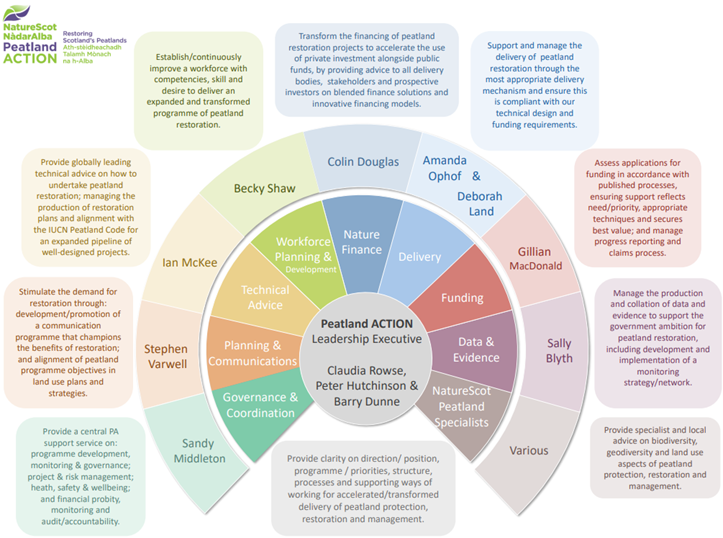
Figure A1. Peatland ACTION Team Organigram
Click for a full description
A diagram which shows the NatureScot Peatland ACTION team structure as a circular organigram.
9 segments in the circle represents a sub team with a central circle denoting the leadership executive. An explanation of what work each sub team carries out along side the person’s name leading that sub team.
Source: NatureScot
Annex B – Contractor and Consultant Questionnaire
Questions and notes for interviewer.
Topic Guide – Contractor
NatureScot: Mapping Current and Future Workforce and Skills Requirements in Peatland Restoration
Notes for interviewer
Use the guide flexibly and tailor appropriately depending on the stakeholder e.g., contractor, skills body, agent, partner. Interviewee has been sent questions/question areas in the email from NatureScot Peatland Action Team.
Provide interviewee with overview of scope and timing of the research:
NatureScot wish to commission research to help inform efforts to develop a suitably skilled workforce, in sufficient numbers to meet the ambitious 2030 target for peatland restoration. The aims of the current research are to:
- provide intelligence on the current scale of the peatland restoration sector.
- better understand the future jobs and skills requirements across the peatland restoration sector.
- offer analysis from which the enhancement of current skills and training provision to meet future sector needs can be developed.
- The detailed objectives of this research are to:
- provide an assessment of the number and type of full-time equivalent (FTE) jobs currently involved in the peatland restoration sector and estimate the numbers of skilled individuals reflected in those FTE figures.
- analyse the current level and types of skills available to the peatland restoration sector and the demand for these skills.
- understand future demand for skills and the number of FTEs/individuals required to enable the 2030 target (and preceding milestones) to be achieved.
- provide an estimate of the geographic spread of current and future jobs and skills across Scotland.
- understand the extent to which those working in related sectors (civil, forestry, renewables) may be able to pivot to take up opportunities in the peatland sector, the barriers (if applicable) to them doing so, along with skills needs arising from this move.
- identify where skills gaps or shortages within the peatland restoration sector in Scotland remain and suggest additional measures required to address them.
EKOS are engaging with all relevant stakeholders in order to provide a series of recommendations to support the forecast skills needs required to meet the target.
Final reporting is due by the end of March 2025. We are consulting with peatland action partners, contractors, agents, skills bodies, and training providers.
Make interviewee aware that the information they provide as part of this interview will be used for the purposes of this research only and any notes will be deleted on completion of the research. EKOS will report to NatureScot in aggregate form only - no information that could identify the interviewee as an individual or organisation will be made publicly available.
| Are you happy to proceed with the interview? (consent) | |
| Yes | ☒ |
| No | ☐ |
| Name | |
| Job title | |
| Organisation | |
| Role in Peatland Restoration | Contractor, agent etc. |
| Date of interview | |
| Interviewer | Interviewer |
Questions
- What role have you had in peatland restoration to date? Past and present engagement in Peatland Restoration work, including location, duration of work, machinery used?
- Did you use sub-contractors, casual labour for any of the jobs? Why did you need them? (skills shortage etc.)
- What barriers did they face in delivering the work? (site specific)
- Have you been on any peatland restoration training? Which training? How did they rate it? is there a need for training - what kind of training?
- What would enable you to do more peatland restoration in the future?
- Do you have any other views/thoughts on what the government (via Peatland Action) need to do to achieve the target?
Contractor Online Questionnaire
Questions to ask interviewee (contractor)
Section A: About your business/organisation
| 1 | Please provide the following details (contact and name of business) | Details |
| A | Contact name | |
| B | Name of business |
| 2 | How many Full-time Equivalent (FTE) employees does your business/organisation employ? If self-employed, please enter 1. | Details |
| A | Question type: open-ended |
| 3 | How long has your business/organisation been trading for? | Details |
| A | Under 12 months | |
| B | Between 1 and 3 years | |
| C | Between 4 and 10 years | |
| D | Over 10 years |
| 4 | Where is your business / organisation based? Please tick all that apply. | Details |
| A | Local authority list (include Nationally across Scotland) – dropdown list. | |
| B | Outside of Scotland |
| 5 | Does your business have any previous or current experience of working in the peatland restoration sector? Please tick all that apply. | Details |
| A | Yes, previous experience | |
| B | Yes, current experience | |
| C | No experience but interested in peatland restoration work | |
| D | No experience and no interest – route to end |
| 6 | Approximately what proportion of your work was peatland restoration in the following financial years? Please enter a percentage (%). Please include any administration staff who may be involved. An estimate will do. | % |
| A | 2023/24 financial year (i.e. April 2023-March 2024) | |
| B | 2024/25 financial year (i.e. April 2024-March 2025) |
| 7 | Approximately what proportion of your annual revenue was generated from peatland restoration in the following financial years? Please enter a percentage (%). An estimate will do. | % |
| A | 2023/24 financial year (i.e. April 2023-March 2024) | |
| B | 2024/25 financial year (i.e. April 2024-March 2025) |
| 8 | How would you describe your business’ involvement in peatland restoration? | Please tick all that apply. |
| A | Practical restoration of open ground | |
| B | Practical restoration (forest-to-bog) | |
| C | Consulting – designing and managing restoration schemes | |
| D | Consulting – including hydrological and ecological surveys | |
| E | Heavy machinery lease | |
| F | Maintenance of restored peatland | |
| G | Other – please specify |
| 9 | If you are involved in practical restoration, what type of activities does your business carry out? | Please tick all that apply. |
| A | Blocking artificial drains | |
| B | Bunding interventions above and below ground | |
| C | Gully and bare peat restoration: flow management | |
| D | Gully and bare peat restoration: stabilisation and revegetation | |
| E | Forest-to-bog restoration | |
| F | Scrub removal | |
| G | Track removal or reinstatement | |
| H | Surveying - specify | |
| I | Other – please specify |
| 10 | What type of surveying does your business do to inform peatland restoration? ONLY ASK IF Q9=H | Please tick all that apply. |
| A | Bird surveys | |
| B | Peatland depth surveys | |
| C | Mapping surveys (including remote sensing and drone technology) | |
| D | Habitat surveys | |
| E | Species surveys | |
| F | Other – please specify |
| 11 | What other work does your business primarily do? | Please tick all that apply. |
| A | Construction (including housebuilding and excavation) | |
| B | Environmental conservation (including habitat restoration) | |
| C | Farming and agriculture | |
| D | Forestry and arboriculture | |
| E | Horticulture and landscaping | |
| F | Land-based engineering | |
| G | Rural land management services | |
| H | Renewables (including windfarms) | |
| I | Transport and roads (including highways and haulage) | |
| J | Warehousing and logistics | |
| K | Other – please specify |
Section B: Peatland Restoration work to date
ONLY ASK Q12 to Q19 IF Q8=(A,B,F,H,I).
| 12 | Overall, how many hectares did you restore in the following financial years? | Number of hectares |
| A | 2023/24 financial year (i.e. April 2023-March 2024) | |
| B | 2024/25 financial year (i.e. April 2024-March 2025) |
| 13 | In the financial years listed below, how many peatland sites have you been involved in restoring? | 0 | 1 | 2-5 | 6 to 10 | 11+ |
| A | 2023/24 financial year (i.e. April 2023-March 2024) |
|
|
|
|
|
| B | 2024/25 financial year (i.e. April 2024-March 2025) |
|
|
|
|
|
Please provide specific details for your three most recent peatland restoration projects (if applicable).
| 14 | Please complete the following details for Site 1. | Details |
| A | Location of Site 1 | LA dropdown list |
| B | Start date |
|
| C | End date |
|
| D | Duration of work | XX months |
| E | Hectares restored | XXXX hectares |
| F | Number of people working on the job/restoration site 1 |
|
| G | Type of restoration | Multi-choice list from Q8 |
| 15 | Please provide a very brief description (one or two sentences) of the peatland restoration site(s) and the work that was/is required. |
| A |
| 16 | Please complete the following details for Site 1. | Details |
| A | Location of Site 1 | LA dropdown list |
| B | Start date |
|
| C | End date |
|
| D | Duration of work | XX months |
| E | Hectares restored | XXXX hectares |
| F | Number of people working on the job/restoration site 1 |
|
| G | Type of restoration | Multi-choice list from Q8 |
| 17 | Please provide a very brief description (one or two sentences) of the peatland restoration site(s) and the work that was/is required. |
| A |
| 18 | Please complete the following details for Site 1. | Details |
| A | Location of Site 1 | LA dropdown list |
| B | Start date |
|
| C | End date |
|
| D | Duration of work | XX months |
| E | Hectares restored | XXXX hectares |
| F | Number of people working on the job/restoration site 1 |
|
| G | Type of restoration | Multi-choice list from Q8 |
| 19 | Please provide a very brief description (one or two sentences) of the peatland restoration site(s) and the work that was/is required. |
| A |
Job Roles and Skills
| 20 | What job roles have been involved in the peatland restoration work? | Please tick all that apply. |
| A | Machine operator | |
| B | Labourer | |
| C | Forester | |
| D | Surveyor | |
| E | Community engagement and education | |
| F | Ecologist | |
| G | Health and safety | |
| H | Quantity surveyor | |
| I | Contracts manager | |
| J | Administration | |
| K | Other – please specify |
| 21 | What technical and practical skills were required by your workforce in the peatland restoration work, including bidding for the work? | Please tick all that apply. |
| A | Computer literacy and IT skills | |
| B | Reading and understanding instructions (e.g. mapping and surveys) | |
| C | Writing reports, emails, etc. | |
| D | Communicating in another language | |
| E | Basic numerical skills and understanding | |
| F | Complex numerical/statistical skills and understanding | |
| G | Manual dexterity – i.e. skills with which to repair, mend, assemble, etc. | |
| H | Adapting to new equipment, processes, materials, etc. | |
| I | Specialist skills required to carry out the role in question | |
| J | Knowledge and understanding of the importance of peatland restoration | |
| K | Knowledge of your organisation and products/services offered | |
| L | Other – please specify |
| 22 | What specialist technical and practical skills were required by your workforce in the peatland restoration work? For example, site safety and management, reprofiling peat hagg, blocking and reprofiling drains, mapping using GIS software, using drone technology, remote sensing etc. |
| A | Question type: open-ended |
| 23 | What personal skills were required by your workforce in the peatland restoration work? | Please tick all that apply. |
| A | Creative and innovative thinking | |
| B | Instructing, teaching or training people | |
| C | Sales skills | |
| D | Customer handling skills | |
| E | Persuading, influencing and/or negotiating | |
| F | Team working | |
| G | Managing and/or motivating others | |
| H | Ability to manage own time and prioritise tasks | |
| I | Setting objectives for others | |
| J | Managing their own feelings and/or the feelings of others as isolated/remote workers | |
| K | Project management | |
| L | Problem solving | |
| M | Other – please specify |
| 24 | Does your workforce lack any of the following skills to carry out additional peatland restoration work? | Please tick all that apply. |
| A | Preparation of site restoration plans | |
| B | Site surveying and monitoring | |
| C | Environmental compliance of project | |
| D | IT/GIS competency | |
| E | Other – please specify |
Section C: Use of sub-contractors
| 25 | Have you used any sub-contractors for peatland restoration work? | Please tick all that apply. |
| A | Yes, we used sub-contractors – specify. | |
| B | Yes, we were a sub-contractor – specify. | |
| C | No sub-contractors involved – exclusive option |
| 26 | What proportion of peatland restoration work that your business did was carried out by sub-contractors? ONLY ASK IF Q25=A | % |
| A |
| 27 | What job roles did/do you have to sub-contract to take on peatland restoration work? ONLY ASK IF Q21=A | Please tick all that apply. |
| A | Machine operator | |
| B | Labourer | |
| C | Forester | |
| D | Surveyor | |
| E | Community engagement and education | |
| F | Ecologist | |
| G | Health and safety | |
| H | Quantity surveyor | |
| I | Contracts manager | |
| J | Administration | |
| K | Other – please specify |
| 28 | What technical/practical skills did/do you have to sub-contract to take on peatland restoration work? ONLY ASK IF Q21=A | |
| A | Computer literacy and IT skills | Please tick all that apply. |
| B | Reading and understanding instructions (e.g. mapping and surveys) | |
| C | Writing reports, emails, etc. | |
| D | Communicating in another language | |
| E | Basic numerical skills and understanding | |
| F | Complex numerical/statistical skills and understanding | |
| G | Manual dexterity – i.e. skills with which to repair, mend, assemble, etc. | |
| H | Adapting to new equipment, processes, materials, etc. | |
| I | Specialist skills required to carry out the role in question | |
| J | Knowledge and understanding of the importance of peatland restoration | |
| K | Knowledge of your organisation and products/services offered | |
| L | Other – please specify |
Section D: Barriers
| 29 | Did your business experience any of the following barriers in carrying out the peatland restoration work? Please tick all that apply. | |
| A | Increased costs | |
| B | Changing scope of project | |
| C | Problems with accessing the site | |
| D | Staffing – recruitment/skills | |
| E | Accessing the machinery – adaptations | |
| F | Poor quality site data | |
| G | Cash flow | |
| H | Other – please specify | |
Section E: Machinery
ONLY ASK Q30 to Q32 IF Q8=(A,B,F,H,I).
| 30 | Have you made any adaptations to machinery to do the peatland restoration work? | Tick one |
| A | Yes, have made adaptations and plan further adaptations – if yes, estimate cost | |
| B | Yes, have made adaptations but do not plan any further adaptations | |
| C | No, have not made any adaptations but plan to make adaptations | |
| D | No, have not made any adaptations and do not plan to make any adaptations | |
| E | Unsure/don’t know |
| 31 | Please provide an estimated cost of the machinery adaptations to date or those planned in the future to carry out peatland restoration work. | £ (an estimate will do) |
| A | Cost of machinery adaptations to date | £ |
| B | Cost of machinery adaptations to 2030 | £ |
| 32 | Did you have to purchase, share or lease any new machinery to carry out peatland restoration work? | Tick all that apply |
| A | Yes, we had to purchase new machinery - specify | |
| B | Yes, we had to share new machinery – specify | |
| C | Yes, we had to lease new machinery - specify | |
| D | No, we already had the required machinery |
Section F: Meeting the 2030 Target
The Scottish Government has an ambitious target of 250,000 hectares of peatland being restored by 2030.
| 33 | If operating at optimal capacity with existing workforce and machinery, how many hectares of peatland restoration would you be able to restore? ONLY ASK IF Q8=(A,B,F,H,I). | Number of hectares |
| A | 2023/24 financial year (i.e. April 2023-March 2024) | |
| B | 2024/25 financial year (i.e. April 2024-March 2025) | |
| C | 2025/26 financial year (i.e. April 2025-March 2026) | |
| D | 2026/27 financial year (i.e. April 2026-March 2027) | |
| E | 2027/28 financial year (i.e. April 2027-March 2028) | |
| F | 2028/29 financial year (i.e. April 2028-March 2029) | |
| G | 2029/30 financial year (i.e. April 2029-March 2030) |
| 34 | Do you think the amount of time your business/employees will spend on peatland restoration work will increase, decrease or remain at the same level over the next five years to 2030? | Tick one that applies |
| A | Increase | |
| B | Remain at the same level | |
| C | Decrease | |
| D | Unsure/don’t know |
| 35 | Please explain why. |
| A | Question type: open-ended |
| 36 | What could help to increase the amount of peatland restoration work you do/take on? | Rank the top three for your business. |
| A | Financial support for machines and machinery adaptations | |
| B | Simplifying the tendering process | |
| C | Multi-year funding | |
| D | Reduced delays in work starting | |
| E | Regular engagement with NatureScot or other Peatland ACTION delivery partners (e.g. Forestry Land Scotland, Scottish Water) | |
| F | Finding more ways to work during bird breeding season | |
| G | Increased availability of peatland restoration training | |
| H | On-site support from specialists | |
| I | More tender opportunities | |
| J | Other – please specify |
| 37 | What do you see as the main opportunities and challenges for you/your workers in peatland restoration? | Add comments |
| A | Opportunities – open-ended | |
| B | Challenges – open-ended |
Section G: Awareness and Training
| 38 | How did you become aware of peatland restoration work? | Tick one |
| A | Public body (NatureScot, Forestry and Land Scotland) | |
| B | Other contract holders | |
| C | Word of mouth | |
| D | Other conservation bodies | |
| E | Public Contracts Scotland (PCS) | |
| F | Other – please specify |
| 39 | Have you or any of your employees participated in any training or skills development related to peatland restoration? | Tick one |
| A | Yes – please specify | |
| B | No | |
| C | Unsure/don’t know |
| 40 | Did the training or skills development provide you with the right skills for your peatland restoration work? | Tick one |
| A | Yes - fully | |
| B | Yes - somewhat | |
| C | A little | |
| D | Did not provide business with the right skills for peatland restoration |
| 41 | Why do you say this? |
| A | Question type: Open-ended |
Section H: Final Comments
| 42 | Do you have any final comments you would like to make related to peatland restoration and ability to meet the Scottish Government target of 250,000 hectares of peatland being restored by 2030? |
| A | Question type: open-ended |
Annex C - NatureScot Bird Breeding Guidance Protocol
Undertaking management and restoration work on Scotland’s peatland habitats has the potential to conflict with Scotland’s wild birds breeding on these habitats. NatureScot Peatland ACTION guidance on undertaking work in the bird breeding season sets out a protocol that all parties involved in peatland restoration are required to follow to ensure that they stay within the constraints of the law.
Annex D – Wider Stakeholder Feedback
During the stakeholder consultation element of the primary research the EKOS team received a variety of feedback from various organisations (contractors, agents, peatland action staff etc) working within the peatland sector. Some of this wasn’t directly linked to skills or workforce issues, however it was felt it was still useful wider feedback to note. As such, these wider stakeholder points are detailed in this appendix.
Complexity and administrative burden
Both contractors and agents expressed concerns that the procurement process for peatland restoration projects is overly burdensome and administratively complex. A key issue highlighted was the duplication of effort in tender applications, with contractors repeatedly required to provide similar information - such as experience, competencies, and organisational capacity - for each submission. This process increases administrative workload and consumes valuable time.
Stakeholders suggested introducing a streamlined system that would allow core application information to be reused across multiple tenders. Centralising and storing key details could make applications more efficient and improve overall sector productivity. Options discussed include aligning documentation, application criteria, and timelines between Peatland ACTION and the Peatland Code, and creating a pre-approved or automatic certification pathway for Peatland ACTION-funded projects to progress more smoothly.
While the Public Contracts Scotland platform has simplified some aspects of tendering, smaller or newer firms without dedicated administrative support still face challenges, potentially favouring larger companies. Contractors acknowledged that some paperwork is inevitable when public funding is involved, but further simplification would be beneficial if possible.
Securing commitments before funding confirmation
Another significant challenge identified was the expectation for contractors to secure commitments before project funding is confirmed. This requirement introduces substantial risk, as contractors must allocate resources and prepare for project delivery without the certainty of funding. For smaller firms, this financial risk is particularly acute, often limiting their ability to participate in larger-scale projects. Stakeholders suggested that more flexible contracting mechanisms could alleviate this pressure, allowing for conditional commitments that are contingent on confirmed funding.
Strengthening Communication and Engagement
A critical barrier identified in our discussions with stakeholders is the lack of awareness and clarity around key programme elements, including multi-year funding and procurement support. Despite NatureScot’s proactive measures, many stakeholders remain unaware of available opportunities. A consistent, accessible, and proactive engagement approach is important to build trust, support effective planning, and unlock the sector’s full potential.
Other comments
During the stakeholder consultation respondents were invited to share any final comments. The most common feedback was their enthusiasm to expand operations and contribute to Scottish Government targets (five responses). Other notable comments included the need for greater funding certainty and guaranteed support (three responses), a stronger emphasis on the long-term sustainability of projects (one response), concerns that procurement processes are overly burdensome (one response), and a suggestion for tenders to include more specific requirements (one response).
Annex E - Wider Context and Issues
Discussions with stakeholders, supported by desk-based research, identified additional contextual factors and issues, outlined below.
Private Finance
Unlocking private investment remains challenging due to misaligned timelines between ecological recovery and investor return expectations. A clearer, more robust investment framework supported by government guarantees or standardised models could reduce perceived risks and enhance confidence in the voluntary carbon market.
Landowner Engagement
Engaging landowners is critical to expanding restoration, yet many face barriers related to awareness, complexity, and financial uncertainty. Simplified messaging, targeted incentives, and clearer communication on evolving funding landscapes will be key to increasing landowner participation and maintaining a robust pipeline of projects.
Land Use and Systemic Barriers
Competing land use pressures - particularly from renewable energy developments - can at times complicate or delay restoration activity. There can also be competition for skilled staff between peatland restoration and renewable energy contractors, with the latter often able to offer higher pay and more stable employment. A more integrated and pragmatic approach to land use policy would help to balance restoration and development objectives, supported by clearer guidance and practical mechanisms such as adjusted restoration-to-damage ratios or integrated site planning.
The Case for Continued Investment and Strategic Reform
There is a compelling case for sustained and increased Scottish Government investment in Peatland ACTION to meet Scotland’s climate, biodiversity, and Just Transition goals. Greater and more predictable funding would enable contractors to grow securely, facilitate the creation of formal training and accreditation routes, and support meaningful career pathways in land-based industries.
Scaling effectively will require ongoing development of skills models. This includes embedding peatland specific skills into broader career structures and fostering stronger collaboration between industry and training providers.
Peatland restoration is increasingly embedded within Scotland’s climate, biodiversity, land use, and economic policy frameworks, positioning it as a cornerstone of the country’s environmental and Just Transition strategies. This strong policy alignment is essential for securing long-term funding, enabling regulatory support, and integrating peatland restoration into carbon markets and regional development plans - ensuring its continued growth and contribution to addressing climate change and enhancing ecosystem resilience.
Uncertainty around carbon prices
A further challenge is the inherent uncertainty surrounding future carbon prices. Peatland restoration projects are, by their nature, long-term commitments, yet the unpredictable nature of carbon markets means there is no guaranteed rate of return for investors. This uncertainty makes it difficult to secure the kind of long-term private investment needed to scale up restoration efforts across Scotland. Compounding this is the concern that poor integrity or insufficient evidence of actual and predicted carbon emission reductions could significantly undermine market confidence. Ensuring credibility in carbon savings is therefore critical, and a key reason why the Peatland Code remains necessarily complex at this stage. While the current rigour may pose a barrier for some, it plays a vital role in building investor trust and maintaining the environmental and financial integrity of the scheme.
Peatland restoration Projects by partner organisation
An analysis of the breakdown of projects by partner organisation shows that all PA partners have experienced increases in the number of projects since 2022/23, as illustrated in Figure E.1.
Figure E.1 Number of projects by partner organisation
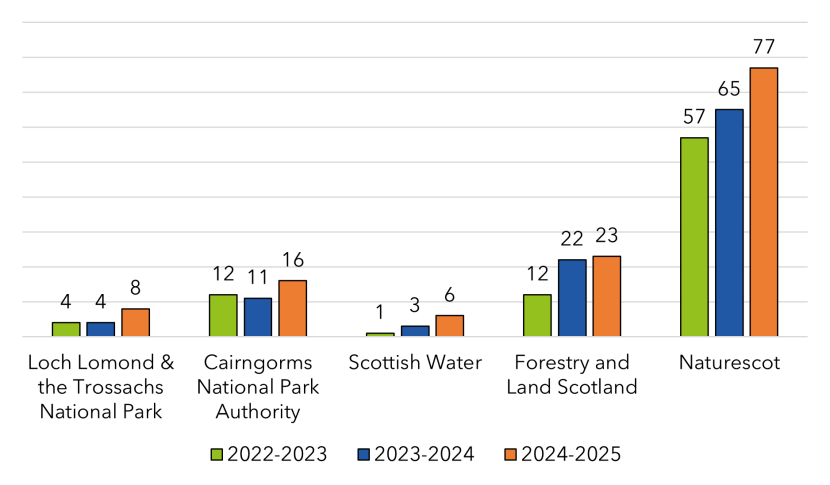
Figure E.1: Number of projects by partner organisation
Click for a full description
A histogram which shows the number of projects carried out by each partner organisation within Peatland ACTION from right to left in the years 2022/23, 2023/24 and 2024/25 using colours green, blue and orange respectively.
Loch Lomond and the Trossachs National Park
2022/23 = 4
2023/24 = 4
2024/25 = 8
Cairngorm National Park Authority
2022/23 = 12
2023/24 = 11
2024/25 = 16
Scottish Water
2022/23 = 1
2023/24 = 3
2024/25 = 6
Forestry and Land Scotland
2022/23 = 12
2023/24 = 22
2024/25 = 23
NatureScot
2022/23 = 57
2023/24 = 65
2024/25 = 77
A similar trend is observed in the number of hectares restored, with all PA partners showing an increase, as shown in Figure E.2.
Figure E.2: Hectares restored by partner organisation
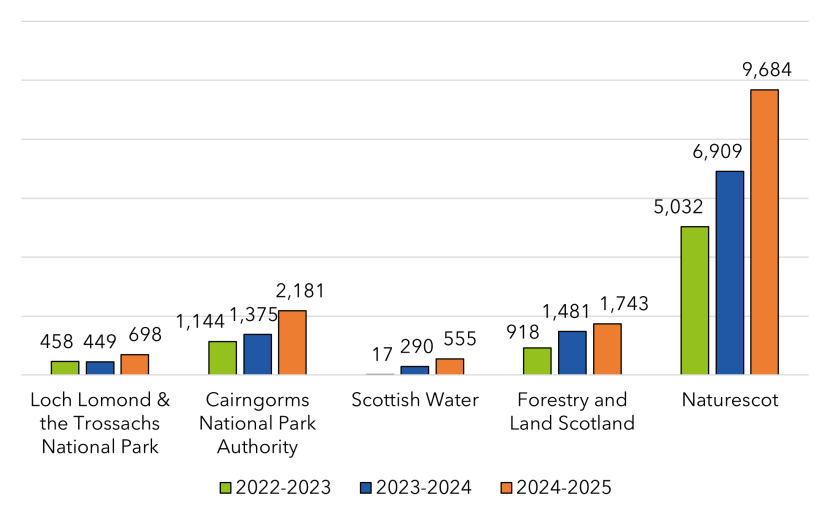
Figure E.2 Hectares restored by partner organisation
Click for a full description
A histogram which shows the number hectares of restoration carried out by each partner organisation within Peatland ACTION from right to left in the years 2022/23, 2023/24 and 2024/25 using colours green, blue and orange respectively.
Loch Lomond and the Trossachs National Park
2022/23 = 458 hectares
2023/24 = 449 hectares
2024/25 = 698 hectares
Cairngorm National Park Authority
2022/23 = 1,144 hectares
2023/24 = 1,375 hectares
2024/25 = 2,181 hectares
Scottish Water
2022/23 = 17 hectares
2023/24 = 290 hectares
2024/25 = 555 hectares
Forestry and Land Scotland
2022/23 = 918 hectares
2023/24 = 1,481 hectares
2024/25 = 1,743 hectares
NatureScot
2022/23 = 5,032 hectares
2023/24 = 6,909 hectares
2024/25 = 9,684 hectares
Funding
A total of £10.7 million was allocated to fund peatland restoration works by NatureScot in 2023/24. Of this amount, just under £9 million was spent during the period, representing 84% of the committed funds. It is likely that the remaining funds were spent in 2024/25 due to delays in project progress, as shown in Figure E.3.
With a total of 6,185 hectares restored through NatureScot funding, this equates to approximately £1,500 per hectare restored.
Figure E.3: Total Spend 2023/24
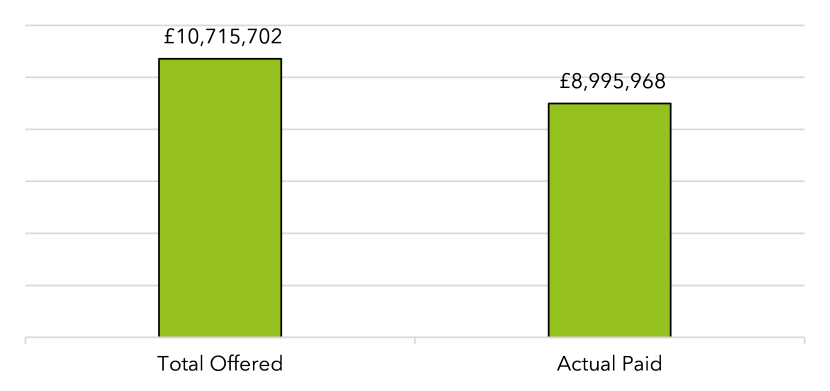
Figure E.3 Total funding offered and spend 2023/24 by NatureScot Peatland ACTION
Click for a full description
Bar graph showing the total funding offered and actual spend by NatureScot Peatland ACTION in 2023/24
Total Offered £10,715,702
Actual paid £8,995,968
References
[1] This report, or any part of it, should not be reproduced without the permission of NatureScot. This permission will not be withheld unreasonably. The views expressed by the author(s) of this report should not be taken as the views and policies of NatureScot.
[2] Peatlands store twice as much carbon as all the world’s forests
[3] Ecological resilience of restored peatlands to climate change | Communications Earth & Environment
[5] Scottish Greenhouse Gas statistics: 2021
[6] Peatland ACTION - Working in peatland restoration | Peatland ACTION
[8] The Peatland Skills Plan 2024–26 is available to share with interested parties, along with the preceding 2022–24 Plan.
[10] https://www.nature.scot/climate-change/nature-based-solutions/peatland-action/peatland-action-what-we-have-achieved
[11] NatureScot+3X (formerly Twitter)+3X (formerly Twitter)+3
[12] Nature's recovery can create 7,000 new jobs in Scotland | Scottish Wildlife Trust
[14] From the Amazon to the Scottish Highlands: Local and Global peatlands research - Edinburgh Earth Initiative
[16] https://adaptation.scot/app/uploads/2024/08/rspb-forsinard-flows-peatland-restoration.pdf?utm_source=chatgpt.com
[17] Source: NatureScot
[18] Skills Development Scotland (SDS) (2020). Climate Emergency Skills Action Plan 2020-2025.
Executive summary of report to NatureScot
Context
Achieving Scotland’s ambitious peatland restoration targets demands a substantial and sustained expansion of the workforce, along with enhanced upskilling and clear career pathways.
Investment in workforce development initiatives has played a key role in supporting the efforts of the sector in doubling the restoration output over recent years. The focus of Peatland ACTION Delivery Partners in improving delivery mechanisms and strengthening workforce capacity provides a vital platform from which to accelerate progress and realise Scotland’s wider climate and ecological ambitions.
Executive Summary
Scotland’s peatland restoration sector has made significant progress in recent years, with outputs more than doubling and a growing pool of skilled practitioners now in place. This success reflects the strong commitment and collaboration of the Scottish Government, NatureScot, and other Delivery Partners through the Peatland ACTION (PA) programme. While the sector is still relatively young, the foundations laid through strategic investment, programme design, and stakeholder engagement provide a platform for future growth.
Challenges to Scaling Up the Workforce
Sustaining and accelerating this momentum will require addressing a set of interconnected challenges. Short-term (government) funding cycles, complex procurement and administrative processes, and fragmented workforce data all constrain the sector’s ability to expand. Annual funding windows, even where funding is multi-year, create pressures for contractors to bid once for multiple years, limiting flexibility and contributing to short-term contracts and seasonal employment. Misalignment with the Peatland Code and planning delays further reduce workforce stability and limit opportunities for career progression. Tackling these structural barriers is essential to building a resilient, growing workforce capable of delivering restoration at scale.
Rethinking skills models to meet sector needs
As an emerging sector, peatland restoration has a unique opportunity to adopt innovative skills models that reflect both the ecological nature of the work and the geographies in which it takes place. Restoration activity is largely concentrated in rural and remote areas, where employment can be fragmented and seasonal, and where traditional job models may not easily apply.
Persistent skills shortages - particularly in technical areas such as Peatland Code project validation- are already limiting the sector’s growth and its ability to access carbon finance. These roles require significant expertise but are often offered only part-time or seasonally, making them less attractive or sustainable as long-term careers.
To overcome these challenges, policymakers will need to support more flexible, innovative approaches to workforce development that reflect the realities of rural economies. There is a need to create full-time, secure occupations by designing roles that combine restoration with wider land and nature-based tasks—such as surveying, estate management, conservation, or biodiversity monitoring.
Stakeholders recommend:
- Exploring staggered or rolling funding windows to smooth out concentrated tendering periods and create more stable work opportunities
- Integrating restoration and validation skills into broader environmental or land-based roles to build career viability in rural areas
- Developing clear training and accreditation pathways, including apprenticeships, modular CPD, and cross-sector qualifications.
This approach would help to create resilient, year-round jobs, attract a more diverse workforce, and ensure that the sector has the capacity to meet Scotland’s growing restoration ambitions - while also supporting rural economic development and the just transition.
Workforce development and skills challenges
The peatland restoration sector benefits from a workforce possessing many of the necessary technical skills; however, significant challenges remain in workforce development, recruitment, and retention. The demanding and remote nature of restoration projects contributes to high turnover and seasonal employment instability, undermining workforce continuity. Additionally, validation capacity shortages create bottlenecks, delaying project signoffs and slowing overall progress. Addressing these issues requires targeted support for local contractors, improved collaboration between local and non-local firms, and strategic investments in skills development.
Key existing issues include:
- Specialist technical training: There is a continued need for enhanced training focused on peatland restoration techniques and ecological validation. On-the-job, practical training is preferred by many contractors, but expanding accessible, high-quality training programmes will help build capacity and consistency. The development of dedicated peatland training sites is currently in progress. In order to deliver training on live sites, each location must be mapped, planned, and submitted under Permitted Development Rights (PDR). This process presents an opportunity to create real-life, hands-on training environments that reflect the complexities of actual restoration work.
- Recruitment and retention: The demanding physical conditions, remote and often isolated work sites, and seasonal nature of peatland restoration contribute to high turnover and workforce instability. Improving working conditions and creating clearer career pathways will be important to attract and retain skilled workers.
- Shortage of validation experts: A critical bottleneck exists due to limited numbers of qualified Peatland Code validators and ecological assessors, delaying project approvals and reducing workforce efficiency.
- Limited career progression: The sector currently lacks well-defined career development pathways, which can discourage longer-term commitment and skills advancement.
- Digital and technological literacy: As peatland restoration increasingly incorporates remote sensing, GIS mapping, data management, and digital validation tools, there is a growing demand for workers with digital competencies to improve efficiency and accuracy.
- Project management and administrative expertise: The complex procurement, funding, and regulatory environments require project management skills to navigate processes effectively and reduce administrative delays.
- Cross-disciplinary knowledge: Roles at the interface of ecology, hydrology, carbon markets, and environmental policy require workers to have broader interdisciplinary skills and understanding, particularly for consultancy and leadership positions.
- Communication and stakeholder engagement: Effective engagement with landowners, local communities, regulators, and funding bodies is essential to project success. Developing communication skills will help build trust and encourage wider participation in restoration efforts.
- Health, safety, and environmental compliance: Given the challenging and sensitive nature of peatland sites, ongoing training in site-specific safety practices and regulatory compliance remains vital.
Despite many contractors and consultants stating during the research that technical skills were not a major concern, NatureScot and Peatland ACTION partners have encountered issues where poor technical delivery has compromised restoration outcomes. In some cases, mistakes stemmed from a lack of understanding of peatland-specific techniques or ecological sensitivities. Addressing this may require a more formal approach - such as mandatory training, certification, or periodic revalidation - to ensure those delivering restoration meet consistent standards. This would align peatland restoration with other regulated sectors where formal upskilling and compliance are essential to maintaining quality and protecting environmental integrity.
Learning from other sectors
Other emerging Scottish sectors provide useful lessons. The renewable energy sector, particularly onshore and offshore wind, expanded rapidly through multi-year government funding, coordinated planning, structured training pathways, and formalised safety and technical certifications. More established sectors, such as forestry and habitat restoration, demonstrate how multi-year funding, integrated project planning, and career pathways support workforce stability and growth. Lessons from these sectors can guide peatland restoration, helping reduce seasonal pressures, strengthen career pathways, and support sustainable sector development.
Workforce numbers and forecast
EKOS have estimated that the current workforce in the Peatland restoration sector is around 400 FTE workers as outlined in Table 1.
| Occupation | Number of Total workers | Percentage of total workforce |
|---|---|---|
| Peatland ACTION Partner | 87.9 | 23% |
| Agents | 50 | 13% |
| Peatland Code Validators | 5 | 1% |
| Ecologist/ site surveyors | 40 | 10% |
| Contractors | 200 | 52% |
| Total | 382.9 | 100% |
Based on current capacity and projected restoration demand, the peatland restoration workforce could grow substantially. Under a medium demand scenario (doubling activity to 20,000 hectares), around 750 full-time equivalents (FTE) would be required. A high demand scenario (35,000 hectares) would require approximately 1,250 FTEs – see Table 2.
| Occupation | Low Demand Scenario (10,000 Hectares) | Medium Demand Scenario (100% increase to 20,000 hectares) | High Demand Scenario (250% increase to 35,000 Hectares) |
|---|---|---|---|
| Peatland ACTION Partner | 87.9 | 132 | 198 |
| Agents | 50 | 125 | 200 |
| Peatland Code Validators | 5 | 12.5 | 20 |
| Ecologist/ site surveyors | 40 | 80 | 140 |
| Contractors | 200 | 400 | 700 |
| Total | 382.9 | 749 | 1,258 |
Key roles include Peatland ACTION partners, agents, Peatland Code validators, ecologists/site surveyors, and contractors. These projections underscore the scale of workforce expansion needed and highlight the importance of coordinated investment, skills development, and workforce planning.
Summary – Key Conclusions
- Scotland’s peatland restoration sector has made significant progress, demonstrating growing capacity, collaboration, and technical expertise.
- Realising its full potential, however, is constrained by short-term funding cycles, seasonal work patterns, and fragmented systems.
- A strategic, long-term approach is needed to align workforce planning, investment, and delivery with national restoration and climate targets.
- The sector must continue its professionalisation journey—stabilising employment, establishing clear career pathways, and embedding robust training routes.
- Persistent skills shortages, particularly in technical and validation roles, limit restoration capacity and access to private finance.
- Procurement and administrative burdens discourage smaller contractors and reduce delivery efficiency.
- Fragmented data and inconsistent reporting hinder effective workforce forecasting and performance monitoring.
- Land use tensions (particularly with renewables) and limited landowner engagement continue to constrain restoration opportunities.
- There is a strong case for continued and increased investment in Peatland ACTION, alongside systemic reform and strengthened coordination to secure long-term sustainability and delivery capacity.
Scotland’s peatland restoration sector stands at a pivotal and promising moment. Strong progress through Peatland ACTION, underpinned by growing collaboration and investment, has created a solid foundation for future growth. The programme has shown a clear commitment to listening to stakeholder feedback and adapting delivery approaches—an approach that will be vital as the focus shifts toward strengthening workforce capacity and skills development. By continuing to build on this momentum, fostering year-round employment, and embedding long-term training and career pathways, the sector is well placed to achieve its restoration ambitions and deliver lasting environmental and economic benefits across Scotland.
Summary – Key Recommendations
- Develop visible and secure long-term skills pathways, supported by expanded practical and accredited training opportunities.
- Address trainer shortages and establish formal apprenticeship and professional development routes.
- Create a centralised workforce data hub to inform evidence-based planning and investment.
- Continue and expand multi-year funding to enable workforce stability and support business confidence.
- Simplify procurement processes and strengthen support for smaller and rural contractors.
- Streamline the Peatland Code and expand validator capacity to unlock private finance.
- Strengthen landowner engagement and communication around restoration benefits and funding options.
- Align policy frameworks and delivery systems to balance restoration, development, and just transition goals.
- Enhance coordination and leadership across government, industry, and training partners to maintain momentum and scale delivery effectively.
Scotland’s peatland restoration sector stands on solid foundations. The expertise, collaboration, and delivery capacity built to date provide a strong platform for the next phase of growth. With sustained investment, coordinated leadership, and continued innovation, Scotland is well placed to remain a world leader in peatland restoration—delivering lasting environmental, social, and economic benefits.
Last updated: