Biodiversity Challenge Fund (BCF)
This project is now closed.
The Biodiversity Challenge Fund (BCF) is a competitive fund launched in February 2019 which specifically encouraged applicants with innovative projects that improved biodiversity, and addressed the impact of climate change, by increasing the resilience of our most at-risk habitats and species and creating large areas of new or restored habitat.
A total of 49 projects were delivered over the duration of the Fund.
In 2019, funding was awarded to 21 projects. A second round was launched later in 2019, fulfilling commitments made in the 2018 and 2019 Programmes for Government to establish and then to extend a Biodiversity Challenge Fund. Seeking to support targeted nature-based solutions that helped to tackle the climate emergency, a further 15 projects secured funding in July 2020.
The Fund was further boosted by additional funds from the 2020 Programme for Government with a third round in 2020 for transformational projects which improved habitats, safeguarded species and tackled the causes of biodiversity loss. Thirteen successful projects were announced in 2021 as part of the final round of the Fund.
Outcomes and eligibility
The Intergovernmental Science-Policy Platform on Biodiversity and Ecosystem Services (IPBES) global assessment in May 2019 showed unprecedented global declines in nature.
The State of Nature Scotland Report 2019 reflected that in the five decades since consistent scientific monitoring began there has been a 24% decline in average species abundance across monitored wildlife.
The high-level priorities of the Biodiversity Challenge Fund aligned with the IPBES direct drivers of biodiversity loss:
- Land and sea-use change
- Direct exploitation of organisms
- Climate change and its impacts
- Pollution
- Invasive non-native species (INNS)
Successful projects
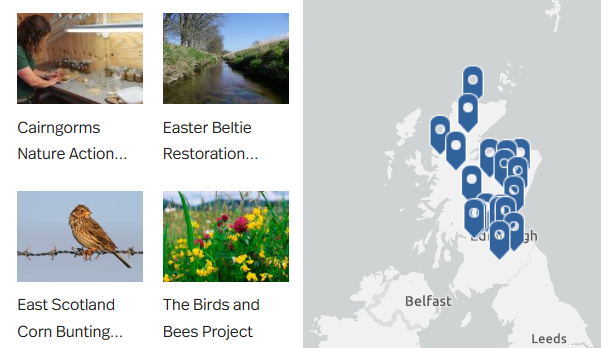
Visit our Project showcase page for further information, project images and project locations across Scotland:
Summaries of each project awarded funding can be found below.
Round 1
Tweed Forum: Tweed Invasives Project
To tackle the problem of INNS along the Scottish sections of the river Tweed and its Scottish tributaries:
1. Controlling INNS through spot spraying with herbicide through a combination of seasonal project officers, specialist contractors and trained volunteers.
2. Re-establishment of native flora and fauna in areas where invasive plants have been removed from the riverside and associated wetland and woodland habitat.
3. Rust fungus control of Himalayan balsam.
4. Biosecurity measures to ensure no new species enter the catchment and rapid response protocols.
Royal Botanic Garden Edinburgh: Edinburgh Shoreline – The Wild Line
To restore habitats along 27km of Edinburgh’s shoreline by:
1. removal of invasive plant species currently affecting seabird habitat and population resilience across the Forth estuary,
2. applying proof-of-concept research in biodiverse coastal infrastructure to achieve industry-scale implementation on sea defences at eight locations,
3. creating an extensive, habitat-rich, coastal park.
Edinburgh and Lothians Greenspace Trust: Little France Park
To restore and improve the biodiversity value of Little France Park in Edinburgh by enhancing the quality of existing habitats (hedges, scrub), reinstating degraded habitats (grassland) and creating a network of new, high-value habitats targeted at butterflies (northern brown argus, common blue, small copper), thus creating a key link in a green corridor from Edinburgh city centre to Midlothian.
The Froglife Trust: Come Forth for Wildlife
To improve the biodiversity of 12 sites in Falkirk for the benefit of amphibians and reptiles through the creation of ponds and scrapes, restoration of wetland areas and improvement of terrestrial habitats including creation of wildflower meadows.
To enhance habitat connectivity in 4 neighbourhoods in Falkirk through community-led creation and restoration of ponds, and creation of wildlife features such as hibernacula, in urban greenspaces.
Borders Forest Trust: Restoring Montane Scrub and Bearberry in the Wildheart of Southern Scotland
The restoration of 50ha of montane scrub at Corehead, Carrifran Wildwood and Talla and Gameshope in the central Southern Uplands of Scotland. And, the pioneering restoration of the upland heath dwarf shrub Bearberry Arctostaphylos uva-ursi to the Carrifran Wildwood, which forms part of the Moffat Hill SSSI and SAC.
Trees for Life: Carn na Caorach Montane Woodland Enclosure
The purpose of this grant is to make provision for an enclosure to allow woodland generation and to plant 14ha of native woodlands. The aim is to use volunteers to bring trees on in the nursery and plant them in the enclosure to complete the woodland cover (approximately a further 250 ha) over the following 10 years.
Dee District Salmon Fishery Board: Dee Riparian Habitat Project
To implement practical measures to create, restore and enhance riparian habitats throughout the catchment of the River Dee to include native tree planting, introduction of wooded structures and enhancement of wooded buffer strips.
Kyle of Sutherland Fisheries Trust: Partnership working to enhance three key freshwater pearl mussel populations in the north, south and west of Scotland
To improve c 14.8km of riparian and 2.9km of instream habitat to support freshwater pearl mussels and salmonids at three sites in Scotland.
Buglife Scotland: Central Scotland B-lines
The purpose of the ‘Central Scotland B-Lines’ project is to create a network for nature by increasing the area of wildflower-rich grasslands and restoring habitat connectivity within East Dunbartonshire, South Lanarkshire, Falkirk and Edinburgh.
Scottish Canals: Greening Pinkston Basin
Establishment of wetland refuge habitat within the Pinkston basin area using a Floating Wetland system and involving the planting of over 3,600 native aquatic plants to form an aquatic and terrestrial habitat suitable for fish, insects, amphibians, birds and mammals.
Glasgow City Council (on behalf of the Seven Lochs Partnership): Seven Lochs and Cumbernauld SpRiNT (Species Rich Networks Team)
To deliver 21 habitat creation and enhancement projects in parks, amenity greenspaces and green corridors across the Seven Lochs and Cumbernauld Living Landscape project areas – focusing on increasing species richness (especially pollinator species, and at Seven Lochs also water vole), and bringing sites into positive conservation management.
RSPB Scotland:Curlews in Crisis Scotland
The purpose of the grant is to work in partnership within specific areas of Caithness and Ayrshire to increase suitable breeding habitat for curlew through targeted management and to conduct studies of success against control sites. The project will advocate curlew friendly proposals that could be applied elsewhere.
St Andrews Botanic Garden: St Andrews Green Corridors
To develop, enhance and link two key habitat corridors across the town of St Andrews in Fife in order to reduce habitat loss, establish and implement a sustainable management plan for invasive species and reduce ecological fragmentation of the space resulting from years of development and lack of management for biodiversity.
National Trust For Scotland: Invasive non-native species (INNS) control in North West Scotland
Invasive non-native plant control at Balmacara, Corrieshalloch, Torridon and Inverewe.
Royal Society for the Protection of Birds: Fetlar Red-Necked Phalarope Habitat Management
To undertake management works to restore and significantly improve two key breeding sites for the rare red necked phalarope at the Mires of Funzie and nearby second site and install three data loggers.
Cairngorms National Park Authority: Cairngorms Nature Action Plan
Action for Aspen – fencing and stock removal to allow natural regeneration of aspen suckers, planting up 3ha. of aspen to improve connectivity between existing sites. Male or female trees will be added to single sex stands to increase reproduction and genetic diversity.
Rare Invertebrates in the Cairngorms - making the area more favourable for pine hoverfly and other pollinator species by captive rearing of pine hoverfly for release, creation of stumps for larval development and providing young rowan with protective tubing.
Angus Council: River South Esk Catchment – 2020 Source to Sea Challenge
To undertake various works and associated monitoring on and around the River South Esk in Angus – montane enclosure for woolly willow, riparian planting of native broad leaved trees, riverbank restoration and introduction of large woody debris and de-culverting and wetland creation on the Den Burn in Brechin.
RSPB Scotland: East Scotland Corn Bunting Project
The purpose of this grant is to provide advice to land managers to benefit at-risk farmland birds particularly corn bunting, within eastern Scotland. The grant supports staff costs to provide the advice and also ensure delivery of the specific land management targets defined in the application.
ScotFWAG: The Birds and Bees Project
The purpose of the grant is to allow ScotFWAG to facilitate the restoration and expansion of extensively managed species-diverse grassland to help reconnect farmland habitats. This will be achieved through their use of their suite of Farmland advisors throughout Scotland working in partnership with 55-60 farmers to create up to 0.5ha of habitat on each farm.
Forestry and Land Scotland (FLS): Improving conditions around protected areas to increase connectivity around and within freshwater pearl mussel SACs
To remove impediments to fish movement on three key tributaries of the River Borgie SAC, and increase broadleaf riparian woodland on the River Oykel SAC and tributaries of the River Evelix and River Borgie SAC.
Dee Catchment Partnership: Easter Beltie Restoration Project
To establish a new area of river corridor and floodplain through the creation of a new meandering channel, connected to its floodplain and re-connected to the downstream river corridor, enriched by riparian native tree planting, woodland and open wet ground.
Round 2
Tweed Forum: Upper Yarrow Landscape Initiative
To restore a previously straightened part of the Little Yarrow tributary of the River Tweed, creating a natural, meandering river channel, within a 12 ha floodplain, restored to a mosaic of natural wetlands and native woodland.
RSPB Scotland: Enhance, Create and Pollinate - creating pollinator friendly habitats across Scotland
The purpose of this grant is to create approximately 91ha of pollinator friendly habitat in various locations across Scotland.
Galloway Fisheries Trust: Water of Luce and Tarf Water headwaters climate resilience fish project
To undertake a range of in stream works, riparian planting and planting of willow stakes at the headwaters of the River Luce and upper Tarf Water tributary to improve instream habitats, reduce erosion and sediment washout and increase resilience to the impacts of climate change.
Woodland Trust Scotland: Loch Arkaig – Glen Mallie Forest Edge Restoration
Fell-to-recycle all non-native trees across 88ha at Glen Mallie, Loch Arkaig to enable the recovery of the native woodland habitat, through creating space for regeneration and reducing the shade and persistent litter created by non-native conifers.
Scottish Wildlife Trust: Protecting and enhancing species rich grassland
The purpose of the project is to deliver tangible biodiversity benefits to species-rich grassland and other priority habitats through appropriate management techniques. This will be achieved through purchase of materials and improvements to infrastructure to allow more effective site management.
Spey Fishery Board for the Spey Catchment Initiative: Re-wooding the River Calder
Establish up to 20ha of riparian woodland along 3.5 km of the River Calder, an upland tributary of the Spey (SAC), by installing deer fencing to remove grazing pressure, planting with native tree species and encouraging natural regeneration.
Cairngorms National Park Authority (CNPA): Cairngorms Wetlands
To deliver key wetland habitat and species conservation actions from the Cairngorms Nature Action Programme, particularly: improving breeding and foraging habitats of red and amber listed waders, mammals and invertebrates and restoring Freshwater Pearl Mussel populations within the River Spey catchment trialling host fish encystment.
Trees for Life:West Affric Montane Woodland Habitat Expansion
Extend three existing native woodland exclosures by a total of 61 hectares on the NTS West Affric estate to secure the seed sources they have generated, plant 15ha with appropriate, native, montane tree species at a density of 500 per ha to increase the seed source for montane species and improve montane woodland habitat connectivity.
Dee District Salmon Fishery Board: Garbh Allt & Upper Muick River Restoration Project
To restore and enhance instream and riparian habitats along two sub-catchments of the River Dee through removal of artificial embankments, reconnection of backwater channels and reintroduction of woody structures to create habitat for a range of aquatic species and reduce flooding impact.
Loch Lomond Fisheries Trust: The Endrick Legacy Project
Undertake control measures for Japanese knotweed, giant hogweed and American skunk cabbage, American mink and American signal crayfish in the Endrick catchment.
Undertake a number of small scale riparian tree planting schemes in key spawning / juvenile habitat areas.
Improve access for migratory fish to spawning habitat through improving/replacing water gates, unblocking streams and removing other man-made restrictions.
RSPB Scotland: Clyde Valley Waders - Enhancing Landscapes in South West Scotland
The RSPB led project in partnership with 17 Landowners and SAC Consulting Solutions will give direct action to improve habitat and species management and improve the survival rates of upland waders as well as study these successes to allow promotion of better practice. The project will result in increased connectivity between breeding sites in the landscape scale in the area around Crawfordjohn.
Loch Lomond and the Trossachs National Park Authority: Inversnaid Invasive Non-native Plant Species Control Project
The initial treatment principally of invasive Rhododendron as well as small populations of Japanese knotweed and American skunk cabbage around Inversnaid on east Loch Lomond. As part of this the Park will train volunteers in the safe use of herbicides and will purchase appropriate equipment, PPE and herbicide.
RSPB Scotland (on behalf of Inner Forth Futures Partnership): Inner Forth Futures Wetland Habitat Network
Wetlands at five sites around the Forth will be improved with new habitats created, degraded habitats improved, hydrology and saline lagoons managed, and invasive species removed.
North Isles Landscape Partnership: North Isles Habitat Management and Restoration
The project has enhanced and restored some of the key natural habitats of the North Isles.
10 hectares of grassland on Egilsay has been restored to benefit breeding waders (including curlew, snipe, lapwing and redshank) and improve the botanical diversity of the grasslands to benefit pollinators (including the great yellow bumblebee). The work involved cutting and removing rank vegetation that had little biodiversity value, and implementing appropriate grazing regimes to maintain the habitats in the future.
22.3 hectares of grassland and wetland improvements have been undertaken on Papa Westray to benefit breeding waders (curlew, snipe, lapwing, redshank) and corncrake, and to improve the botanical diversity. The work involved cutting and removing rank vegetation that has little biodiversity value, digging scrapes and implementing appropriate grazing regimes to maintain the habitats in the future.
2.3 hectares of habitat improvements have been undertaken on Sanday to benefit breeding waders and wildflowers. The work involved digging scrapes, fencing and implementing an appropriate grazing regime.
Forth Rivers Trust: Revive the Allan
To undertake an initial phase of the Revive the Allan project that will enhance the riparian corridor between Milton of Panholes and Deaf Knowe, reconnecting the floodplain to the river using a pre-railway channel, creating new wetlands and undertaking green banking in support of natural flood management solutions.
Round 3
Lockett Agri-Environmental for the River Peffery Restoration
To re-meander a historically straightened and deepened 800m section of the River Peffery, connecting it back to its floodplain, creating and enabling an increase in wetland habitat and rewetting 8 ha of the floodplain.
Forth Rivers Trust for the River Teith Catchment Project
To improve riparian and in-stream biodiversity of the River Teith SAC, through riparian tree planting, green bank protection and woody debris placement.
Dee District Salmon Fishery Board for the Glen Muick - River and Wetlands Restoration
To restore the middle and lower parts of the River Muick, a major tributary of the River Dee, and its floodplain, by implementing a range of practical measures such as native riparian tree planting, reconnecting a backwater channel and installation of dams and instream structures to enable wetland creation and enhancement. This will have a transformational cumulative positive impact for the river, the catchment and the wildlife that depends upon it.
Glasgow City Council for the Glasgow's Green Urban Connectors
To integrate biodiversity into the fabric of the urban environment in south east Glasgow through the reconfiguration of amenity landscape management and maintenance, uniting the designated Local Nature Reserve and Sites of Importance for Nature Conservation with the green river corridors, parks, amenity managed open green spaces and woodlands to form ‘active travel’ corridors for wildlife.
Loch Lomond Fisheries Trust for the Wild Blane Water Project
To widen and improve the structure of the riparian corridor, treat a range of Invasive Non Native Species (INNS) and increase biodiversity, achieved through riparian fencing to manage stock grazing, small scale planting of trees, restoration of eroded riverbanks and establishing hedgerows.
Kyle of Sutherland Fisheries Trust for the restoring of pearl mussel habitat in a tributary of Loch Shin
To help support the fragile freshwater pearl mussel population within a tributary of Loch Shin. The project will help to restore riverine habitat by introducing gravels and installing large wood structures to provide habitat diversity and act to maintain the introduced gravels in-situ.
Heriot-Watt University for the Oyster Ark - brood stock to bolster wild oyster habitats and secure Scottish supply for restoration
To seek-out remnant wild Scottish oyster habitats, assess their population sizes, disease status, presence of aggressive Invasive Non Native Species (INNS), and, where appropriate, move a portion as brood-stock to Scotland’s biosecure hatchery to spawn future generations. Tens of thousands of oysters will be returned to bolster the remnant wild populations. The native oyster Ostrea edulis is a Priority Marine Feature (PMF) for conservation.
Edinburgh & Lothians Greenspace Trust Shawfair Connections to create a new biodiverse park next to Wisp in Midlothian.
This will include creating native meadows, planting trees, scrub and hedges, making bee bank habitats and planters for butterflies. The project aims to create green corridors between the city of Edinburgh, through Craigmillar Castle Park, Little France Park, on to Wisp Park, and the surrounding countryside, including Woolmet Bing.
University of St Andrews creating Urban Meadows for Pollinators
To create a linked network of urban meadows managed for biodiversity with supporting woodland and scrub, running through St Andrews’ main wildlife corridors of the Swillken Burn and Kinness Burn and along the southern banks of the Eden Estuary to Guardbridge.
Orkney Islands Council to transform Papdale Park
To transform an open grassed area with low biodiversity value into a vibrant biodiverse public park with trees, shrubs, wildflower meadow and meandering burn.
Seawilding for the Seawilding community-led Seagrass Restoration Project - Loch Craignish
To create Scotland’s first community-led seagrass restoration project with the aim of reinforcing the fragmented seagrass meadows of Loch Craignish. The project will develop best-practice, low-cost methodologies using a mobile seagrass seed processing unit, and develop a “how-to” practical guide, with the aim of rolling-out community-led seagrass restoration to other coastal communities.
Local land manager working with the Scottish Chough Forum for the provision of a safe communal roosting site for red-billed choughs
To provide a safe, communal roost site for red-billed chough on Islay adjacent to key feeding areas.
Arkaig Community Forest SCIO for the Loch Arkaig Pinewoods - Landscape Scale Native Woodland Restoration
Landscape scale native woodland regeneration to increase the resilience and carbon sequestration potential of the native woodland at Loch Arkaig Pine Forest over the next five years (2021-2026).
The focus will be on managing grazing pressure, re-establishing new nature-rich habitats and training and skills development. Specifically: establishment of a deer larder and processing unit combined with the development of a community venison scheme and associated programme of training and skills development; establishment of a native tree nursery and plant propagation unit, to produce local provenance trees for native woodland expansion projects in Lochaber. This will also include an associated programme of training and skills development focused on tree seed collection, processing, and propagation; establishment of pontoon facilities plus shelter and welfare facilities to enable safe and inclusive working conditions for deer management and forest management activities within the remote forests at Loch Arkaig.
Guidance
- NatureScot Standard Terms and Conditions of Funding
- Guidance for applicants: Financial information and records
- Landowner Permission form
- Funding Privacy Notice
Contact
Last updated: