Sharks and Skates of Scotland Report: White skate (Rostroraja alba)
An extract from the Sharks and Skates of Scotland Report.
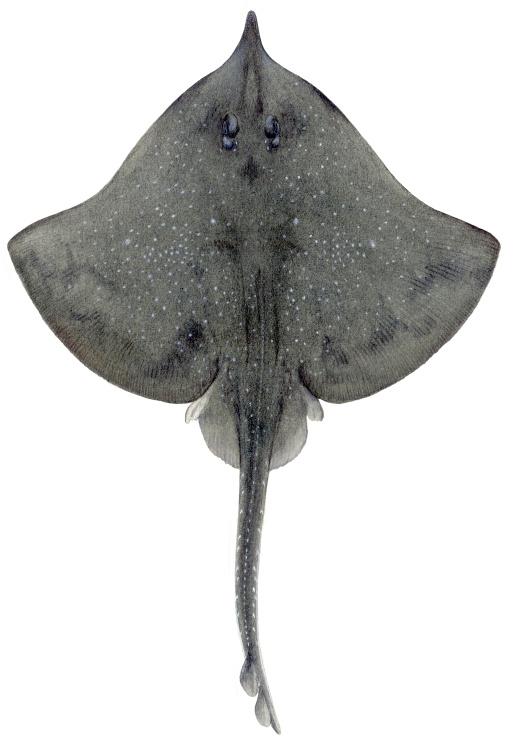
White skate - Rostroraja alba (Lacepède, 1803)
Occurrence in Scotland: Shelf and slope. Occasional. Found on the continental shelf off west Scotland.
Synonym(s): Raja alba; Order: Rajiformes; Family: Rajidae
Common name: White skate, bottlenose skate, spearnose skate
AlphaID: 105896 TSN Code: 564123
Note: This species is largely unknown to modern-day fishermen and may occasionally be misidentified as other large skates such as Dipturus spp. Landings around Scotland are assumed to be Shagreen skate Leucoraja fullonica (ICES, 2018). Both fisheries landings and discard data for Rostroraja alba are very limited and may be confused with those of other species, and as such, are considered unreliable. Furthermore, White skate are very rarely caught in scientific trawl surveys, suggesting survey trawls are not appropriate for monitoring the status of this species (ICES, 2024).
Population status
Scotland and Northeast Atlantic: Decreasing. The species is suspected to have declined by >50% over the past three generations (75-90 years) in European waters based on anecdotal evidence that suggests localized extinctions (Ellis et al., 2015).
Global: Decreasing. Overall, White Skate is suspected to have undergone a population reduction of 50–79% over the past three generation lengths (90 years) due to suspected regional and local extinctions due to levels of exploitation and habitat degradation, and a decline in its extent of occurrence (Serena et al., 2024).
Conservation listings
- IUCN Red List Global: Endangered (assessment 30 August 2022)
- IUCN Red List Europe: Critically endangered (assessment 08 December 2014)
- IUCN Red List Mediterranean: Endangered (assessed 25 March 2016)
- CITES: Not listed
- CMS: Not listed
- OSPAR: Threatened and/or Declining Species
- Listed on The Sharks, Skates and Rays (Prohibition of Fishing, Trans-shipment and Landing) (Scotland) Order 2012
- Feature of Conservation Importance in England and Wales (FOCI)
- Species of Principal Importance in Wales and England (SPI)
- Listed on Schedule 5 of the Wildlife and Countryside Act 1981 (as amended) in England and Wales
- Prohibited under EU Regulations 2018/120 and 2019/124
- Listed on the UK and EU’s ‘Prohibited Species’ list as documented in the ‘Written Record of fisheries consultations between the United Kingdom and the European Union for 2025’ for UK waters of ICES Subareas 6,7 and 8 and for EU waters of ICES Subareas 6 to 10.
Range and distribution
White skate are a widely distributed, but rare, species that have been found in the eastern Atlantic from the British Isles down to South Africa, as well as in the Mediterranean (Ellis, et al., 2015; Serena et al., 2024). Over the last 100 years or more White skate populations have significantly declined and are nearing local extinction in several areas, including the Celtic Seas Ecoregion (ICES, 2018), the Bay of Biscay and Atlantic Iberian waters (Ellis et al., 2010; 2015). They are also rare in the Azores and the mid-Atlantic ridge region. Not a single White skate was recorded in the CEFAS groundfish surveys around the British Isles between 1967-2002, even though the surveys took place within the skates known habitat range (Ellis et al., 2005). Occasional individuals are caught in Irish Groundfish surveys (ICES, 2018). There are now only two known refuges of White skate in the Northeast Atlantic, both on the Irish west coast (Tralee Bay and inner Galway Bay), which are also thought to be spawning areas for the species (Varian et al., 2010). There was a sighting of a White skate in the Sound of Jura based on angler photographs in 2018, but this was not verified by genetic analysis. Two (verified) White skate egg cases washed ashore in the Sound of Jura in 2022.
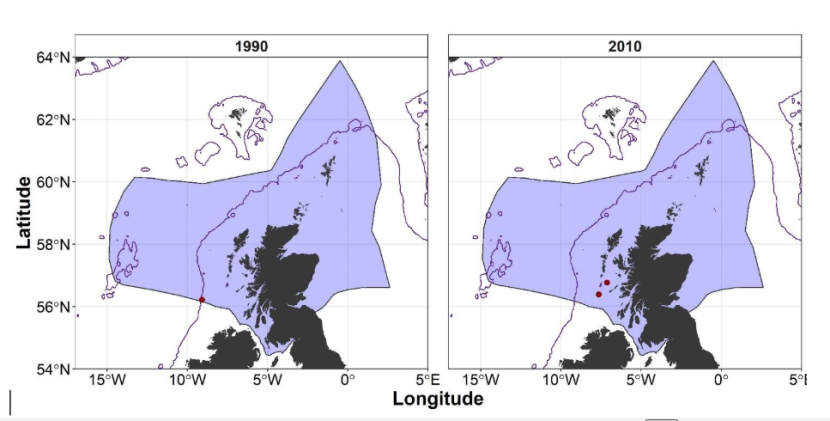
ICES DATRAS records for White skate (Rostroraja alba), 1990-2019.
Click for a full description
Two maps of the EEZ of Scotland showing the ICES (International Council for the Exploration of the Sea) DATRAS (database of trawl surveys hosted by ICES) records for White skate (Rostroraja alba) from bottom trawl surveys conducted between 1990 and 1999; and 2010 and 2019. Red points represent trawl shoot positions in which White skate (R. alba) were captured. From 1990 to 1999, there is a single record representing White skate (R. alba) being caught in a single trawl on the edge of the continental shelf on the west coast of Scotland, directly west of the Isle of Mull. From 2010 to 2019 there are 2 red points representing White skate (R. alba) being captured in 2 trawls, one to the south of the Isle of Barra and 1 to the east. A change in the number or distribution of records over time does not reflect a change in occurrence or abundance since data have not been corrected for effort.
Habitat
White skate inhabit the continental shelf and slope at depths of 10–750 m and are thought to prefer sandy and detrital seabed-types, including partially landlocked sandy bays (Ellis et al., 2010; Weigmann 2016, Ebert and Dando 2021).
Biology and Ecology
The biology and ecology of this large-bodied skate is largely unknown for northern European waters; however, there is some data available from studies in the Mediterranean. In the Mediterranean, maximum size is 200 cm TL and males mature at 75–119 cm TL and females mature at 80–129 cm TL (Capapé 1976, Yıgın and Ismen 2010, Kadri et al. 2014). Reproduction is oviparous with an estimated fecundity of 55–158 eggs per year, the incubation period is approximately 15 months, and size-at-hatching is 25–30 cm TL (Stehmann and Burkel 1984, Serena 2005, Kadri et al. 2014, Ebert and Dando 2021, Mancusi et al. 2021, Marongiu et al. 2021). In the Mediterranean, male age-at-maturity is estimated as 20 years, female age-at-maturity is estimated as 24 years, and maximum age for the species is estimated as 35 years (Kadri et al. 2014) with a generation length of 30 years.
Human interactions
Like other large-bodied skates, White skate are highly vulnerable to over-exploitation due to their slow life history traits and high catchability in demersal fishing gear (Ellis et al., 2010). Historically the species was targeted but is now prohibited throughout much of its range in UK and European waters, meaning any individuals caught must be returned to the sea. ICES advised that a precautionary approach is applied, and that there should be zero catches in each of the years 2024–2027 for the Northeast Atlantic and adjacent waters (ICES, 2023).
References
Capapé, C. 1976. Contribution à la biologie des Rajidæ des côtes Tunisiennes. Raja alba Lacépède, 1801: répartition géographique et bathymétrique, sexualité, reproduction, fécondité. Annales de l'Institut Michel Pacha 9: 23–47.
Ebert, D.A. and Dando, M. 2021. Field guide to sharks, rays & chimaeras of Europe and the Mediterranean. Princeton University Press, Plymouth, U.K.
Ellis, J., Morey, G & Walls, R. 2015. Rostroraja alba (Europe assessment). The IUCN Red List of Threatened Species 2015: e.T61408A48954174. Ellis, J.R. et al., (2005) ‘The Distribution of Chondrichthyan Fishes Around the British Isles and Implications for Conservation’, Journal of Northwest Atlantic Fisheries Science, 35, pp. 195–213.
Ellis, J.R. et al., (2010) UK fisheries for skates (Rajidae): History and development of the fishery, recent management actions and survivorship of discards. ICES CM 2010/E:10. Available at: http://www.nwwac.org/_fileupload/Papers and Presentations/2016/06 FG Skates and Rays/Ellis, Silva et al., 2010_ICES CM E10.pdf (Accessed: 24 February 2020).
Ellis, J.R., Morey, G & Walls, R.H.L. 2016. Rostroraja alba (Mediterranean assessment). The IUCN Red List of Threatened Species 2016: e.T61408A16527881. ICES. (2023). White skate (Rostroraja alba) in subareas 1-10, 12 and 14 (the Northeast Atlantic and adjacent waters). In Report of the ICES Advisory Committee, 2023. ICES Advice 2023, rja.27.nea.
ICES (2024). Report of the Working Group on Elasmobranch Fishes (WGEF). ICES Scientific Reports. 06:75. 994 pp. https://doi.org/10.17895/ices.pub.26935504
Kadri, H., Marouani, S., Bradai, M.N., Bouaã¯n, A. and Morize, E. 2014. Age, growth, mortality, longevity and reproductive biology of the White Skate, Rostroraja alba (Chondrichthyes: Rajidae) of the Gulf of Gabès (Southern Tunisia, Central Mediterranean). Turkish Journal of Fisheries and Aquatic Sciences 14.
Kadri, H. et al., (2015) ‘Age, growth, longevity, mortality and reproductive biology of Dipturus oxyrinchus, (Chondrichthyes: Rajidae) off the Gulf of Gabès (Southern Tunisia, central Mediterranean)’, Journal of the Marine Biological Association of the United Kingdom, 95(3),. 569–577.
Mancusi, C., Massi, D., Baino, R., Cariani, A., Crobe, V., Ebert, D.A., Ferrari, A., Gordon, C.A., Hoff, G.R., Iglesias, S.P., Titone, A. and Serena, F. 2021. An identification key for Chondrichthyes egg cases of the Mediterranean and Black Sea. The European Zoological Journal 88(1): 436–448.
Marongiu, M.F., Porcu, C., Bellodi, A., Cannas, R., Carugati, L., Cau, A., Mulas, A., Pesci, P. and Follesa M.C. 2021. On the presence of the Endangered White Skate Rostroraja alba in Sardinian waters. Mediterranean Marine Science 22(1): 137–140.
Serena, F. 2005. Field identification guide to the sharks and rays of the Mediterranean and Black Sea. FAO Species Identification Guide for Fishery Purposes, FAO, Rome.
Serena, F., Charles, R., Ellis, J.R., Johnston, G. & Pacoureau, N. 2024. Rostroraja alba. The IUCN Red List of Threatened Species 2024: e.T61408A183781512.
Stehmann, M. and Burkel, D.L. 1984. Rajidae. In: P.J.P. Whitehead, M.-L. Bauchot, J.-C. Hureau, J. Nielsen & E. Tortonese (eds) Fishes of the North-eastern Atlantic and Mediterranean. Vol. 1. pp: 163–196. UNESCO, Paris.
Varian, S. et al., (2010) Heritage Research Project R00261 To investigate Critical Habitats for Threatened Species of Shark and Ray Final Report. Kilkenny. Available at: https://marinedimensions.ie/wp-content/uploads/2019/04/Final-Report-HCR00261-Final-June11-GDPR.pdf Weigmann, S. 2016. Annotated checklist of the living sharks, batoids and chimaeras (Chondrichthyes) of the world, with a focus on biogeographical diversity. Journal of Fish Biology 88(3): 837-1037.
Yıgın, C. and Ismen, A. 2010. Age, growth, reproduction and feed of bottlenose skate, Rostroraja alba(Lacepède, 1803) in Saros Bay, the north Aegean Sea. ICES Annual Science Conference CM 2010/E:25.