Sharks and Skates of Scotland Report: Velvet belly lanternshark (Etmopterus spinax)
An extract from the Sharks and Skates of Scotland Report.
Velvet belly lanternshark - Etmopterus spinax (Linnaeus, 1758)
Occurrence in Scotland: Deep-water. Resident. Found on the slopes both sides of the Rockall Trough, the Anton Dohrn seamount, to the west and southwest of Rockall, Rosemary Bank, the southern slopes of the Wyville Thomson ridge and the continental shelf off NW Scotland.
Synonym(s): Squalus spinax; Order: Squaliformes Family: Etmopteridae
Common name: Velvet belly lanternshark
AlphaID: 105913; TSN Code: 160670
Population status
Scotland and Northeast Atlantic: Decreasing. An 81% decline is estimated between 1970 and 2001, after which abundances in Scottish waters were stable or fluctuated (Guallart et al., 2015a; Neat et al., 2015). Data from the Porcupine Bank survey also indicated fluctuations without a discernible trend from 2001 to 2023 (ICES, 2024); however, surveys in the Cantabrian Sea and Galician waters indicate an increase in biomass during this period (ICES, 2024).
Global: Decreasing. A reduction of 30–49% estimated over three generation lengths (23 years) based on abundance data and actual levels of exploitation (Finucci et al., 2021).
Conservation listings
- IUCN Red List Global: Vulnerable (assessment 31 August 2020)
- IUCN Red List Europe: Threatened (assessment 03 September 2014)
- IUCN Red List Mediterranean: Least Concern (assessment 25 March 2016)
- CITES: Not listed
- CMS: Not listed
- OSPAR: Not listed
- Listed on the UK’s ‘Prohibited Species’ list as documented in the ‘Written Record of fisheries consultations between the United Kingdom and the European Union for 2025’ for UK waters of ICES Subareas 5-10
- Zero TAC under EU Regulation 2018/2025 & Regulation 2023/194
- Prohibited under EU Regulation 2025/202
- Listed on The Sharks, Skates and Rays (Prohibition of Fishing, Trans-shipment and Landing) (Scotland) Order 2012.
- Included in the NEAFC measures prohibiting directed fishing for deep-sea sharks
Range and distribution
Velvet belly lanternsharks are native to the Eastern Atlantic and the Mediterranean. In the Northeast Atlantic, their range extends from Iceland across to Norway (the Norwegian Deep) and southwards to the coast of West Africa (Gabon) and out to the Azores and Cape Verde (Ebert & Stehmann, 2013). In British waters, the species is found on the continental slopes of the Celtic Seas and Rockall Trough (Ellis et al., 2005; Neat et al., 2015).
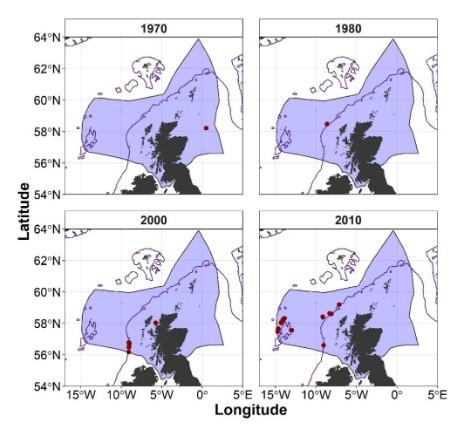
ICES DATRAS records for Velvet belly lanternshark (Etmopterus spinax), 1980-2019.
Click for a full description
Four maps of the EEZ of Scotland showing the ICES (International Council for the Exploration of the Sea) DATRAS (database of trawl surveys hosted by ICES) records for Velvet belly lanternshark (Etmopterus spinax) from bottom trawl surveys conducted between 1970 and 1979, 1980 and 1989, 2000 and 2009 and 2010 and 2019. Points represent trawl shoot positions in which Velvet belly lanternshark were captured. From 1970 to 1979, there was a single data point in the North Sea. From 1980 to 1989 there was a single record just off the edge of the continental shelf northwest of the Outer Hebrides. From 2000 to 2009, there were more records just off the continental shelf on the west coast of Scotland and a single record in the Minch to the north of the Isle of Skye. Finally, from 2010 to 2019 there were a number of records just off the continental shelf on the west coast of Scotland and a few records on the slopes around the Rockall Plateau. A change in the number or distribution of records over time does not reflect a change in occurrence or abundance since data have not been corrected for effort.
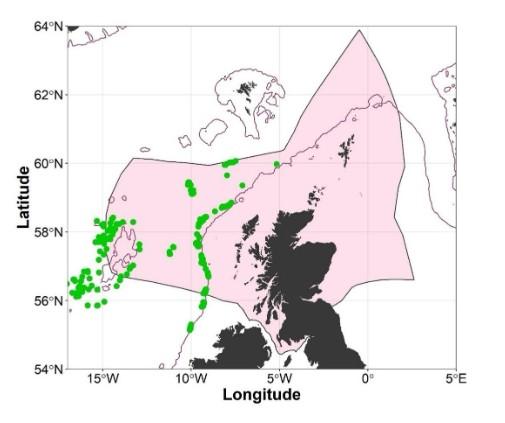
Records for Velvet belly lanternshark (Etmopterus spinax) from SIAMISS and deep-water fisheries surveys undertaken by the Marine Directorate 1996 – 2019.
Click for a full description
Map of the economic exclusion zone (EEZ) of Scotland showing records for Velvet belly lanternshark (Etmopterus spinax) from the Scottish-Irish anglerfish and megrim industry-science survey (SIAMISS) and deep-water fisheries surveys undertaken by Marine Directorate 1996-2019. Records are illustrated as green points and are exclusively located off the west coast of Scotland and Northern Ireland, off the edge of the continental shelf. Records occur to the east of the Rockall Trough (on the continental shelf slope), with some records in the Rockall Trough to the west and northwest of the Outer Hebrides. There are numerous records on the slopes around the Rockall Plateau.
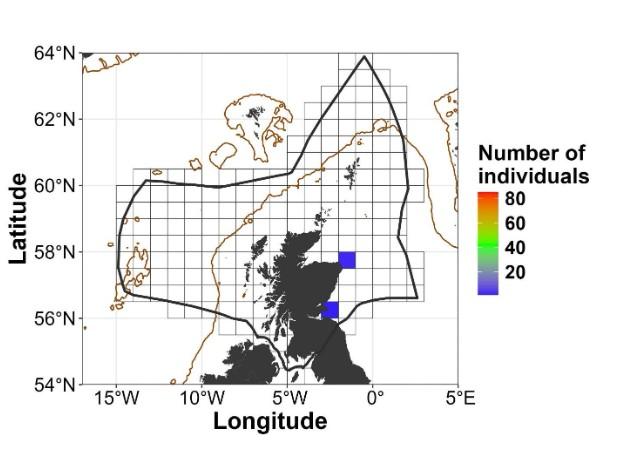
Landings data from commercial fishing vessels in ICES rectangles for Velvet belly lanternshark (Etmopterus spinax) 2011-2019.
Click for a full description
Map of the economic exclusion zone (EEZ) of Scotland showing landings data per ICES (International Council for the Exploration of the Sea) rectangle for Velvet belly lanternshark (Etmopterus spinax) recorded by commercial fishing vessels from 2011 to 2019. Values are presented as the number of individuals landed per trip. Data is illustrated in a heat map, colouring each ICES rectangle from 0 (white) to 81 (red). Small numbers of landings illustrated by blue rectangles representing 0 to 20 individuals were reported around Peterhead and in the Firth of Forth.
Habitat
Velvet belly lanternsharks are found in both demersal and mesopelagic habitats in depths ranging from 70 – 2000 m (Guallart et al., 2015), but mostly between 200 – 500 m on soft substrate (Finucci et al., 2021). In the Rockall Trough, the species is common on upper slope areas between depths of 300 – 1000 m (Neat et al., 2015). The species is thought to have distinct regional populations in the Northeast Atlantic (McMillan et al., 2016).
Biology and Ecology
Velvet belly lanternsharks are small-bodied, deep-water lanternsharks, with individuals ranging from 11 cm to 65 cm TL in surveys of the Rockall Trough (Neat et al., 2015). Data on reproductive biology is lacking for Scottish waters. In Portuguese waters, the maximum age of this shark is estimated at 20 years, and the ages at maturity for males and females are estimated at 3.97 and 4.67 years, respectively (Coelho and Erzini, 2005; Gennari and Scacco, 2007). Length at maturity for males is 24–34 cm TL and for females 30–41 cm TL (Ebert et al., 2013). Velvet belly lanternsharks are ovoviviparous, giving birth to live young, with fecundity ranging from 9– 27 oocytes, with an average of 7.59 embryos per reproductive cycle (Coelho and Erzini, 2008; Mattı´na et al., 2024). Litter sizes range from 1 to 21 pups and are proportionate to the size of females. Newborns measure about 14 cm TL (Ebert & Stehmann, 2013). The species may have a triannual reproductive cycle, typical of deep-sea squalid sharks. The gestation period is approximately 12 months, followed by a resting period of 12 months before the female becomes pregnant again (Coelho & Erzini, 2008; Ebert & Stehmann, 2013). Multiple paternity (polyandry) is documented in this species (Duchatelet et al., 2020b). There is evidence of segregation at depth according to sex and size in Icelandic and Portuguese waters (Coelho & Erzini, 2010; Mattı´na et al., 2024), with larger, older and mostly mature specimens found predominantly at greater depths, with females migrating from deeper mating grounds to shallower nursery areas (Coelho & Erzini, 2010). In Iceland, females at late maturity and small juveniles were found on the central South Icelandic shelf, suggesting this area may be a critical reproductive habitat (Mattı´na et al., 2024). Mating activity appears to be highest in winter months (Ebert & Stehmann, 2013). Persistent organic pollutants have been detected in the muscle and embryonic tissues of Velvet belly lanternsharks in the Mediterranean Sea, and maternal transfer of pollutants has been demonstrated. However, the health implications, including any effect on individual and population-level fitness of this finding, have not been determined (Consales et al., 2023).
Velvet belly lanternsharks primarily feed on benthopelagic animals away from the bottom, including small fishes, squids, and crustaceans, including krill (Fanelli et al., 2009; Ebert & Stehmann, 2013; Besnard et al., 2022; Rodríguez-García et al., 2024). In common with many species in the family Etmopteridae, Velvet belly lanternsharks are capable of bioluminescence. Light is emitted from specialised light organs (photophores) in the skin, and in Velvet belly lanternsharks the spines also emit light. Bioluminescence is under hormonal control (Duchatelet et al., 2020a; Duchatelet et al., 2021), and its ecological function is thought to be predominantly camouflage (counterillumination).
Human interactions
There is currently no targeted fishery for this species, and it has been subject to a zero Total Allowable Catch since 2010. The species has been listed as prohibited since 2015 (ICES, 2024). However, Velvet belly lanternsharks may be incidentally caught in deep-water demersal trawl (particularly those targeting Norway lobster, Nephrops norwegicus), longline, and handline fisheries in the Northeast Atlantic, and discard survival is presumed to be low (Ebert & Stehmann, 2013; Guallart et al., 2015; Clarke et al., 2016; Finucci et al., 2021). The segregation at depth according to sex and size has implications for population structure, where subsets of the population (e.g. females and juveniles) may be more vulnerable to fisheries exploitation.
References
Besnard, L., Duchatelet, L., Bird, C. S., Le Croizier, G., Michel, L., Pinte, N., ... & Mallefet, J. (2022). Diet consistency but large-scale isotopic variations in a deep-sea shark: the case of the velvet belly lantern shark, Etmopterus spinax, in the northeastern Atlantic region and Mediterranean Sea. Deep Sea Research Part I: Oceanographic Research Papers, 182, 103708.
Clarke, M. et al., (2016) Ireland Red List No. 11: Cartilaginous fish [sharks, skates, rays and chimaeras]. Dublin, Ireland
Coelho, R. and Erzini, K. (2005) ‘Length at first maturity of two species of lantern sharks (Etmopterus spinax and Etmopterus pusillus) of southern Portugal’, Journal of the Marine Biological Association of the United Kingdom, 85, pp. 1163–1165. doi: 10.1017/S0025315405012245.
Coelho, R. and Erzini, K. 2008. Life history of a wide-ranging deepwater lantern shark in the north-east Atlantic, Etmopterus spinax (Chondrichthyes: Etmopteridae), with implications for conservation. Journal of Fish Biology 73: 1419-1443.
Coelho, R. and Erzini, K. (2010) ‘Depth distribution of the velvet belly, Etmopterus spinax, in relation to growth and reproductive cycle: The case study of a deep-water lantern shark with a wide-ranging critical habitat’, Marine Biology Research. Taylor & Francis Group , 6(4), pp. 381–389. doi: 10.1080/17451000802644706.
Consales, G., Bottaro, M., Mancusi, C., Neri, A., Sartor, P., Voliani, A., ... & Marsili, L. (2023). Persistent organic pollutants (POPs) in three bathyal chondrichthyes from the north-western Mediterranean Sea. Marine Pollution Bulletin, 196, 115647.
Duchatelet, L., Claes, J. M., Delroisse, J., Flammang, P., & Mallefet, J. (2021, December). Glow on sharks: state of the art on bioluminescence research. In Oceans (Vol. 2, No. 4, pp. 822-842). MDPI.
Duchatelet, L., Delroisse, J., & Mallefet, J. (2020a). Bioluminescence in lanternsharks: Insight from hormone receptor localization. General and Comparative Endocrinology, 294, 113488.
Duchatelet, L., Oury, N., Mallefet, J., & Magalon, H. (2020b). In the intimacy of the darkness: Genetic polyandry in deep‐sea luminescent lanternsharks Etmopterus spinax and Etmopterus molleri (Squaliformes, Etmopteridae). Journal of Fish Biology, 96(6), 1523-1529.
Ebert, D.A., Fowler, S. and Compagno, L. 2013. Sharks of the World. Wild Nature Press, Plymouth.
Ebert, D.A. and Stehmann, M.F.W. (2013) Sharks, batoids, and chimaeras of the North Atlantic. FAO Species Catalogue for Fishery Purposes. No. 7. Rome: Food and Agricultural Organization of the United Nations (FAO). Ellis, J.R. et al., (2005) ‘The Distribution of Chondrichthyan Fishes Around the British Isles and Implications for Conservation’, Journal of Northwest Atlantic Fisheries Science, 35, pp. 195–213.
Fanelli, E. et al., (2009) ‘Feeding habits of blackmouth catshark Galeus melastomus Rafinesque, 1810 and velvet belly lantern shark Etmopterus spinax (Linnaeus, 1758) in the western Mediterranean’, in Journal of Applied Ichthyology. John Wiley & Sons, Ltd, pp. 83–93. doi: 10.1111/j.1439-0426.2008.01112.x.
Finucci, B., Derrick, D., Dia, M., Ducrocq, M., Neat, F.C., Pacoureau, N., Serena, F. & VanderWright, W.J. 2021. Etmopterus spinax. The IUCN Red List of Threatened Species 2021: e.T161388A124475610. Accessed on 07 March 2025.
Gennari, E., & Scacco, U. (2007). First age and growth estimates in the deep water shark, Etmopterus spinax (Linnaeus, 1758), by deep coned vertebral analysis. Marine Biology, 152, 1207-1214.
Guallart, J. et al., (2015) Velvet Belly Lanternshark, Etmopterus spinax, The IUCN Red List of Threatened Species 2015: e.T161388A48913532. (Accessed: 12 March 2020).
ICES (2024). Report of the Working Group on Elasmobranch Fishes (WGEF). ICES Scientific Reports. 06:75. 994 pp.
Mattı´na H, Campana SE, Jakobsdo´ttir K (2024) Environmental preferences and critical habitat for the velvet belly lanternshark (Etmopterus spinax) in Icelandic waters. PLoS ONE 19(3): e0299544. https://doi.org/10.1371/journal. pone.0299544
McMillan, M.N., Izzo, C., Junge, C., Albert, O.T., Jung, A. and Gillanders, B.M. 2016. Analysis of vertebral chemistry to assess stock structure in a deep-sea shark, Etmopterus spinax. ICES Journal of Marine Science 74(3): 793–803
Neat, F.C. et al., (2015) ‘The diversity, distribution and status of deep-water elasmobranchs in the Rockall Trough, north-east Atlantic Ocean’, Journal of Fish Biology. Blackwell Publishing Ltd, 87(6), pp. 1469–1488. doi: 10.1111/jfb.12822.
Rodríguez-García, C., Gonçalves Neto, J. B., García-Romero, C., Domínguez-Bustos, Á. R., & Cabrera-Castro, R. (2024). Feeding habits of two shark species: velvet belly, Etmopterus spinax (Linnaeus, 1758) and blackmouth catshark, Galeus melastomus (Rafinesque, 1810), present in fishing discards in the Gulf of Cádiz. Environmental Biology of Fishes, 107(2), 159-172.