Genetic Scorecard Indicator - Bottlenose dolphin
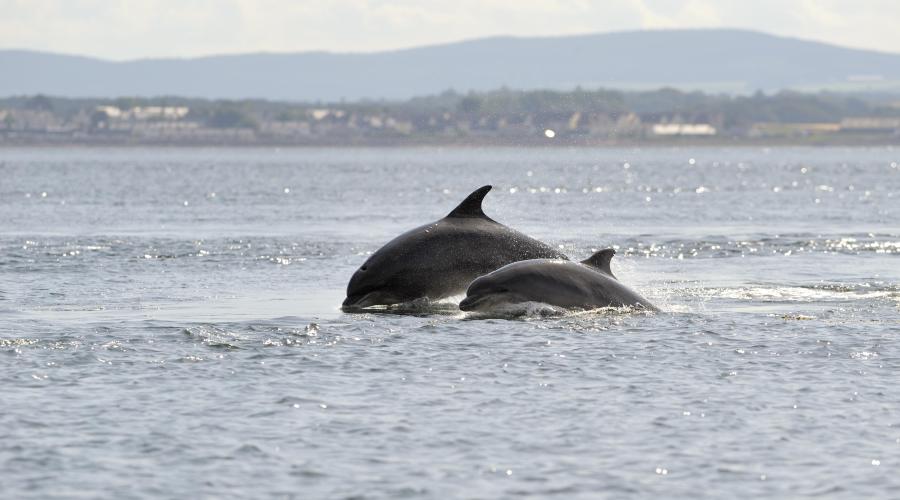
Bottlenose dolphin (Tursiops truncatus)

IUCN Category:
- Great Britain: Not assessed (indicated above)
- Europe: Data deficient
- Global: Least concern

Genetic Health Status:
- Scottish Risk: Moderate (indicated above)
- UK Risk: Moderate
- Scottish Mitigation status: Effective
- UK Mitigation status: Effective
Background
Bottlenose dolphins (Tursiops truncatus) are found in cold temperate to tropical waters globally. In the UK, they are primarily located in the Irish Sea, Scottish east coast, Scottish west coast, and the western English Channel.
Coastal populations in the UK, such as those in Cardigan Bay and the Scottish east coast, have shown stability or increases. In contrast, the larger and more widespread offshore populations are less understood. There is limited exchange between the coastal and offshore groups.
Bottlenose dolphins exhibit high levels of phenotypic polymorphisms, with distinct coastal and offshore ecotypes identified based on morphological, behavioural, and ecological evidence. Coastal populations demonstrate strong site fidelity.
Studies have highlighted genetic differentiation between coastal and offshore populations and among different coastal groups. Notable research includes work by Hoelzel et al. (1998), Natoli et al. (2004), Segura et al. (2006), Tezanos-Pinto et al. (2009), Moura et al. (2020), and Louis et al. (2021).
In the UK, the two main resident coastal populations are found in the Irish Sea, centred around Cardigan Bay (Wales), and along the Scottish east coast from the Moray Firth extending southwards to Northeast English waters. Smaller inshore groups are also present on the Scottish west coast and the western English Channel.
Current Threats
The coastal populations are exposed to human activity to a greater extent than those offshore. The key anthropogenic pressures include pollution (e.g. polychlorinated biphenyls (PCBs): Jepson et al., 2016; Zanuttini et al., 2019), disturbance, injury or death as a result of underwater noise (Buckstaff et al., 2013; Pirotta et al., 2015; Fernandez-Betelu et al., 2021), disturbance or collision with vessels (Pirotta et al., 2015), and disturbance from recreational activities. Although not a target species, offshore groups may be impacted by the annual Faroes hunt, with 98 taken in 2022 (Whaling.FO, 2024).
Contribution of Scottish/UK population to total species diversity
The global population is around 750,000 (Wells et al., 2019), with an estimated 50,795 for UK waters (IAMMWG, 2025) making up c. 7% of global population. Resident coastal dolphins are generally less genetically diverse than their offshore counterparts (Hoelzel et al., 1998; Natoli et al., 2004; Segura et al., 2006, Tezanos-Pinto et al., 2009; Louis et al., 2021). Analysis of molecular variance suggests that the Moray Firth (Scotland) group is genetically more closely related to animals of Cardigan Bay (Wales) than to their nearest neighbours in west Scotland, and that they also have a markedly lower genetic diversity than the other coastal groups in UK waters (Parsons et al., 2002).
Genetic risks
Diversity loss: population declines
Historically, inshore populations disappeared from the Severn Estuary, the Humber Estuary and the Firth of Forth towards the end of the 19th century (Pinn et al., 2018). This will likely have resulted in some loss of genetic diversity.
Global Biodiversity Framework Indicators
Population definitions:
Bottlenose dolphins have distinct coastal and offshore ecotypes with limited exchange between them. For UK waters, bottlenose dolphins are divided into 7 management units (IAMMWG, 2023)
Ne500: The proportion of populations that have an effective population size of more than 500.
Ne classifier: demographic. The census sizes indicate that all coastal populations are below the Ne 500 threshold. Only the Oceanic and Offshore Southwest populations meet the Ne500 threshold.
Proportion of populations with Ne > 500 (Scotland) = 2/4
Proportion of populations with Ne > 500 (UK) = 2/7
PM: Proportion of populations that existed in 2000 that still exist in 2025.
There have been no populations lost since 2000.
- Proportion of populations maintained in Scotland = 4/4
- Proportion of populations maintained in UK = 7/7
Diversity loss: functional variation
Functional variation
Behavioural plasticity and habitat specialization are considered important drivers of genetic isolation and low genetic diversity in bottlenose dolphins despite the lack of geographic barriers (Dizon et al., 1992; Hoelzel et al., 1998; Natoli et al., 2005; Möller et al., 2007; Fernández et al., 2011; Kopps et al., 2014).
Divergent lineages
The relationships among bottlenose dolphin lineages are particularly contentious due to the propensity for this highly mobile species to show fine-scale patterns of population genetic structure (e.g. Natoli et al., 2004; Gaspari et al., 2015). Moura et al. (2020) indicate that there was a major early division in the genus Tursiops between Australasian and North Atlantic coastal habitats (giving rise to T. aduncus and T. truncatus respectively) with the geographically widespread offshore lineage evolving later. Subsequently, the offshore lineages became globally distributed, with some evidence of secondary colonisation of coastal habitats occurring thereafter. Small scale population structure and small Ne suggest that some divergent populations may be at risk.
Hybridisation/Introgression
Several species of dolphins known to hybridize with T. truncatus in captivity and in the wild (Hodgins et al., 2014; Crossman et al., 2016; Gridley et al., 2018; van Geel et al., 2022).
Low turnover - constraints on adaptive opportunities
This a long-lived species which produces few offspring - a female potentially has 6 to 8 calves in her lifetime (Reynolds et al., 2000). Bottlenose dolphins become sexually mature between 5 and 15 years old, with a gestation of about 12 months producing a single calf which is nursed for approximately 20 months (Reynolds et al., 2000).
Cumulative Risk Summary
Overall Genetic Health Status
Scotland
- Risk: Moderate
- Mitigation: Moderate
Great Britain/UK
- Risk: Effective
- Mitigation: Effective
Although widespread, local populations demonstrate strong and long-term site fidelity which can lead to genetic isolation.
Overall Genetic Health status explanation
Coastal groups are less genetically diverse and more exposed to human activity. Genetic studies are ad hoc and rare at the national scale.
In situ genetic threat level
In situ genetic threat level
- In situ Risk for Scotland: Moderate
- In situ Risk for UK: Moderate
Although widespread, local populations demonstrate strong and long-term site fidelity which can lead to genetic isolation.
Confidence in in situ threat level
- Confidence score for Scotland: Medium
- Confidence score for UK: Medium
Assessment based on extensive data regarding biology, population differentiation and some older genetic studies.
Ex situ representation
Bottlenose dolphins are no longer kept in captivity in the UK. They can, however, be found in captivity in Europe and other parts of the world.
Current conservation actions
Bottlenose dolphins are recognised as a Priority Marine Feature (PMF) in Scotland. This aims to ensure that development and use of the marine environment does not have a significant effect on their national status.
Three Special Areas of Conservation (SAC) have been designated with bottlenose dolphin as a qualifying feature with a further 11 SACs listing the species as a non-qualifying feature. Human activities with the potential to have adverse effects on protected sites, such as construction and dredging, are managed through a licensing and consents process. The UK has several voluntary wildlife watching guidelines/codes of conduct which are publicly available.
The UK Cetacean Conservation Strategy, published in 2025, is intended to support decision making and identify actions necessary to maintain or improve the conservation status of cetaceans in UK waters.
Defra and the Scottish Government fund national strandings schemes for cetaceans which aim to collate, analyse and report data for all cetacean strandings around the coast of the UK, including the causes of death.
| Ex situ | Translocation | Habitat management | Legal protection of habitat or species | Regulation of exploitation | Control of INNS/pests/pathogens |
|---|---|---|---|---|---|
| - | - | X | X | - | - |
Population assessment/monitoring
Population
Demographic
N pops assessed/monitored in Scotland = 2/4.
N pops assessed/monitored in UK = 2/7.
NE Atlantic European waters are surveyed every six years (Gilles et al., 2023). The inshore population of the Scottish east coast has been surveyed annually using photo-ID mark-recapture methods since 1989 (Cheney et al., 2024) and the population of the Irish Sea annually since 2001 (Evans and Waggitt, 2023).
Genetic
N pops assessed/monitored in Scotland = 0/4.
N pops assessed/monitored in UK = 0/7.
Genetic surveys of UK populations are ad hoc and rare.
Further Research
Ensure monitoring is maintained at national and international levels.
References
Buckstaff, K. C., Wells, R. S., Gannon, J. G. and Nowacek, D. P. (2013). Responses of bottlenose dolphins (Tursiops truncatus) to construction and demolition of coastal marine structures. Aquatic Mammals 39: 174-186.
Cheney, B.J., Arso Civil, M., Hammond, P.S. and Thompson, P.M. (2024). Site Condition Monitoring of bottlenose dolphins within the Moray Firth Special Area of Conservation 2017-2022. NatureScot Research Report 1360.
Crossman, C.A., Taylor, E.B., Barrett-Lennard, L.G. (2016). Hybridization in the Cetacea: widespread occurrence and associated morphological, behavioral, and ecological factors. Ecol. Evol. 6: 1293–1303.
Dizon, A.E., Lockyer, C., Perrin, W.F., Demaster, D.P., Sisson, J. (1992). Rethinking the stock concept: A phylogeographic approach. Conserv. Biol. 6: 24–36.
Evans, P.G.H. and Waggitt, J.J. (2023). Modelled Distribution and Abundance of Cetaceans and Seabirds in Wales and Surrounding Waters. NRW Evidence Report, Report No: 646, 354 pp. Natural Resources Wales, Bangor.
Fernández R, Santos MB, Pierce GJ, Llavona A, López A, Silva MA, et al. (2011). Fine-scale genetic structure of bottlenose dolphins, Tursiops truncatus, in Atlantic coastal waters of the Iberian Peninsula. Hydrobiología, 670: 111–125.
Fernandez-Betelu O, Graham IM, Brookes KL, Cheney BJ, Barton TR, and Thompson PM (2021) Far-Field Effects of Impulsive Noise on Coastal Bottlenose Dolphins. Front. Mar. Sci. 8: 664230.
Gaspari, S., Scheinin, A., Holcer, D., Fortuna, C., Natali, C., Genov, T., Frantzis, A., Chelazzi, G., Moura, A.E. (2015). Drivers of population structure of the bottlenose dolphin (Tursiops truncatus) in the Eastern Mediterranean Sea. Evol. Biol. 42: 177–190.
Gilles, A, Authier, M, Ramirez-Martinez, NC, Araújo, H, Blanchard, A, Carlström, J, Eira, C, Dorémus, G, FernándezMaldonado, C, Geelhoed, SCV, Kyhn, L, Laran, S, Nachtsheim, D, Panigada, S, Pigeault, R, Sequeira, M, Sveegaard, S, Taylor, NL, Owen, K, Saavedra, C, Vázquez-Bonales, JA, Unger, B, Hammond, PS (2023).stimates of cetacean abundance in European Atlantic waters in summer 2022 from the SCANS-IV aerial and shipboard surveys. Final report. 64
Grindley, T., Elwen, S.H., Harris, G., Moore, D.M., Hoelzel, A.R., Lampen, F. (2018). Hybridization in bottlenose dolphins—A case study of Tursiops aduncus×T. truncates hybrids and successful backcross hybridization events. PLoS ONE 13: 0201722.
Hodgins, N, Dolman, S & Weir, C. (2014). Potential hybridism between free-ranging Risso's dolphins (Grampus griseus) and bottlenose dolphins (Tursiops truncatus) off north-east Lewis (Hebrides, UK). Marine Biodiversity Records, 7 :e97.
Hoelzel AR, Potter CW, Best PB. (1998). Genetic differentiation between parapatric ‘‘nearshore’’ and ‘‘offshore’’ populations of the bottlenose dolphin. Proc R Soc Lond B Biol Sci. 265:1177–1183.
IAMMWG, 2025. UK Habitats Regulations Assessment: S1349 ‐ Bottlenose dolphin (Tursiops truncatus). Unpublished report.
Jepson, P., Deaville, R., Barber, J., Aguilar, A., Borrell, A., Murphy, S., Barry, J., Brownlow, A., Barnett, J., Berrow, S., Cunningham, A., Davison, N., ten Doeschate, M., Esteban, R., Ferreira, M., Foote, A., Genov, T., Gimenez, J., Loveridge, J., Llavona, A., Martin, V., Maxwell, D., Papachlimitzou, A., Penrose, R., Perkins, M., Smith, B., de Stephanis, R., Tregenza, N., Verborgh, P., Fernandez, A., Law, R. (2016). PCB pollution continues to impact populations of orcas and other dolphins in European waters. Scientific Reports 6:18573. DOI: 10.1038/srep18573.
Kopps AM, Ackermann CY, Sherwin WB, Allen SJ, Bedjer L, Krützen M. (2014). Cultural transmission of tool use combined with habitat specializations leads to fine-scale genetic structure in bottlenose dolphins. Proc Roy Soc B., 281(1782): 20133245.
Louis, M., Galimberti, M., Archer, F., Berrow, S., Brownlow, A., Fallon, R., Nykänen, M., O-Brien, J., Robertson, K.M>, Rosel, P.E., Simon-Bochet, B., Wegmann, D., Fontaine, M.C., Foote, A., Gaggiotti, O.E. (2021). Selection on ancestral genetic variation fuels repeated ecotype formation in bottlenose dolphins. Sci. Adv.7,eabg1245
Möller LM, Wiszniewski J, Allen SJ, Beheregaray LB, (2007). Habitat type promotes rapid and extremely localised genetic differentiation in dolphins. Mar Fresh Res, 58: 640–648.
Moura, AE, Shreves, K, Pilot, M, Andrews, KR, Moore, DM, Kishida, T, Möller, L, Natoli, A, Gaspari, S, McGowen, M, Chen, I, Gray, H, Gore, M, Culloch, RM, Kiani, MS, Willson, MS, Bulushi, A, Collins, T, Baldwin, R, Willson, A, Minton, G, Ponnampalam, L, Hoelzel, AR (2020). Phylogenomics of the genus Tursiops and closely related Delphininae reveals extensive reticulation among lineages and provides inference about eco-evolutionary drivers. Molecular Phylogenetics and Evolution, 146: 106756.
Natoli A, Birkun A, Aguilar A, Lopez A, Hoelzel AR. (2005). Habitat structure and the dispersal of male and female bottlenose dolphins (Tursiops truncatus). Proc Roy Soc Lond B., 272: 1217–1226.
Natoli A, Peddemors VM, Hoelzel AR. (2004). Population structure and speciation in the genus Tursiops based on microsatellite and mitochondrial DNA analyses. J Evol Biol. 17:363–375
Parsons, KM, Noble, LR, Reid, RJ & Thompson, PM (2002). Mitochondrial genetic diversity and population structuring of UK bottlenose dolphins (Tursiops truncatus): is the NE Scotland population demographically and geographically isolated?. Biological Conservation, 108(2): 175-182.
Pinn, E, Mitchell, I, Hawkridge, J (2018).Abundance and distribution of coastal bottlenose dolphins. UK Marine Online Assessment Tool.
Pirotta, E., Thompson, P.M., Cheney, B., Donovan, C.R. & Lusseau, D. (2015). Estimating spatial, temporal and individual variability in dolphin cumulative exposure to boat traffic using spatially explicit capture–recapture methods Animal Conservation, 18: 20–31.
Reynolds, JE, Wells, RS and Eide, SD (2000). The bottlenose dolphin: Biology and conservation. University Press of Florida.
Segura I, Rocha-Olivares A, Flores-Ramirez S, Rojas-Bracho L. (2006). Conservation implications of the genetic and ecological distinction of Tursiops truncatus ecotypes in the Gulf of California. Biol Conserv. 133: 336–346.
Tezanos-Pinto, G., Baker, CS, Russell, K, Martien, K, Baird, RW, Hutt, A, Stone, G, Mignucci-Giannoni, AA, Caballero, S, Endo, T, Lavery, S, Oremus, M, Olavarría, C, Garrigue, C. (2009). A Worldwide Perspective on the Population Structure and Genetic Diversity of Bottlenose Dolphins (Tursiops truncatus) in New Zealand, Journal of Heredity, 100: 11–24.
van Geel, N., Marr, T., Hastie, G. & Wilson, B. (2022). First reported observation of an apparent reproductive bottlenose × Risso’s dolphin hybrid. Aquatic Conservation: Marine and Freshwater Ecosystems, 32(10): 1710–1716.
Wells, R.S., Natoli, A. & Braulik, G.T. (2019). Tursiops truncatus (errata version published in 2019). The IUCN Red List of Threatened Species 2019: e.T22563A156932432.
Whaling.FO, (2024)Whales and whaling in the Faroe Islands. Catches 2020-2024.
Zanuttini C, Gally F, Scholl G, Thomé JP, Eppe G, Das K. (2019). High pollutant exposure level of the largest European community of bottlenose dolphins in the English Channel. Sci Rep. 9: 12521.
Assessor: Eunice Pinn, NatureScot
Reviewers:
Emily Humble, University of Edinburgh
Rona Sinclair, NatureScot
Last updated: