Sharks and Skates of Scotland Report: Thornback skate (Raja clavata)
An extract from the Sharks and Skates of Scotland Report.
Thornback skate - Raja clavata (Linnaeus, 1758)
Occurrence in Scotland: Shelf. Resident. Common throughout shelf waters and at Rockall.
Synonym(s): Malacoraja clavata (Linnaeus, 1758); Order: Rajiformes; Family: Rajidae
Common name: Thornback skate; thornback ray; roca, roker
AlphaID: 105883 TSN Code: 160901
Note: Some data confounded with Starry skate (Raja asterias), which is also named Thorny skate in some areas (Ellis et al., 2016). Species-specific survey and catch data used for estimating population trends are only available for the last two generations of Raja clavata (Ellis et al., 2016).
Population status
Scotland and Northeast Atlantic: Stable. The trend analysis of the North Atlantic modelled biomass for 1950–2021 (71 years) revealed annual rates of increase of 0.66%, with the highest probability of no major reductions in population over the past three generation lengths (33 years) (Finucci et al., 2024).
Global: Decreasing. Due to estimated and suspected declines in part of its range (parts of the Mediterranean Sea, Black Sea and Eastern Central Atlantic) but increasing trends in others, and high levels of exploitation, a population reduction of 20–29% over the past three generations (33 years) has been estimated based on abundance data and actual levels of exploitation (Finucci et al., 2024).
Conservation listings
- UCN Red List Global: Near Threatened (assessment 15 April 2023)
- IUCN Red List Europe: Near Threatened (assessment 13 May 2014)
- IUCN Red List Mediterrean: Threatened (assessment 27 March 2016)
- CITES: Not listed
- CMS: Not listed
- OSPAR: Threatened and/or Declining Species
- Listed on the EU’s ‘Prohibited Species’ list as documented in the ‘Written Record of fisheries consultations between the United Kingdom and the European Union for 2025’ for EU waters of ICES Division 3a
- Qualifying species for Solway Firth Area of Interest and Swarbanks Minn ISRA
Range and distribution
Thornback skate occur in the Northeast Atlantic and northern part of the Eastern Central Atlantic, from Iceland and Norway to Northwest Africa, including the Azores, Mediterranean Sea, and Black Sea (Ellis et al., 2016; Last et al., 2016, Ebert and Dando 2021). In European waters two distinct populations of Thornback skate exist, one in the Northeast Atlantic and one in the Mediterranean. They are one of the more abundant elasmobranch species in the Northeast Atlantic. Thornback skate are widely distributed around the British Isles but are most abundant along the southern and western coasts of England and are comparatively less abundant in Scottish waters (Ellis et al., 2005). They were once found throughout much of the North Sea, but over the last century their range here has become restricted to the south-western area (principally the Greater Thames Estuary and the Wash). It is thought that this range constriction and decline in the Greater North Sea is due to unsustainable fishing mortality (OSPAR, 2010).
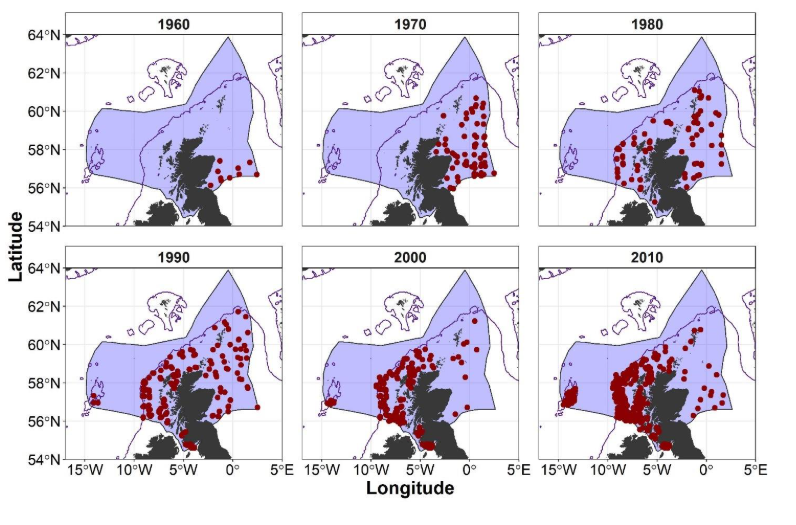
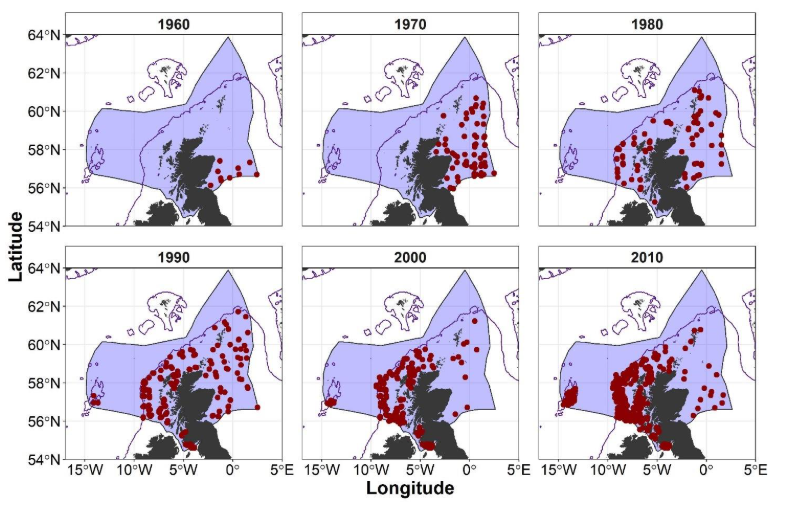
ICES DATRAS records for Thornback skate (Raja clavata) 1960- 2019.
Click for a full description
View a larger version of this image.
Six maps of the economic exclusion zone (EEZ) of Scotland showing locations of trawls where Thornback skate (Raja clavata) were captured from 1960 to 1969, 1970 to 1979, 1980 to 1989, 1990 to 1999, 2000 to 2009, and 2010 to 2019. Red points represent trawl shoot locations in which for Thornback skate (R. clavata) were captured. Between 1960 and 1969, records were sparsely distributed in the southern North Sea. From 1970 to 1979, records were widely distributed across the North Sea. From 1980 to 1989, records were distributed throughout the EEZ of Scotland on the continental shelf. From 1990 to 1999, there was a similar distribution of records with the addition of a small number of records on the Rockall Plateau. From 2000 to 2009 there were more records on the west coast of Scotland on the continental shelf, records in the North Sea were sparser and again there were records on the Rockall Plateau. Finally, from 2010 to 2019 records were denser on the west coast of Scotland on the continental shelf and on the Rockall Plateau and there were a few records in the North Sea. A change in the number or distribution of records over time does not reflect a change in occurrence or abundance since data have not been corrected for effort
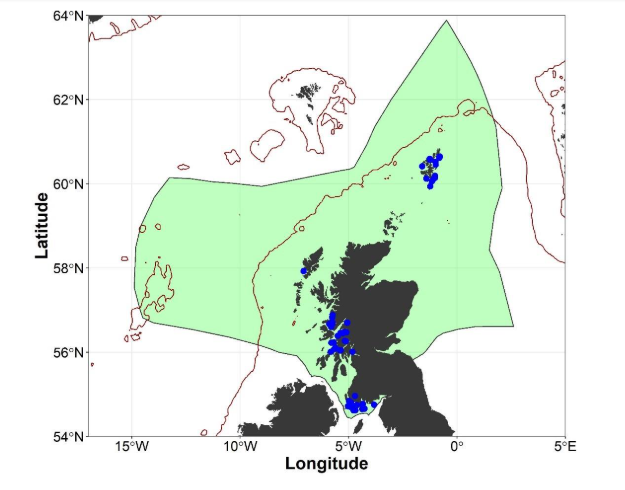
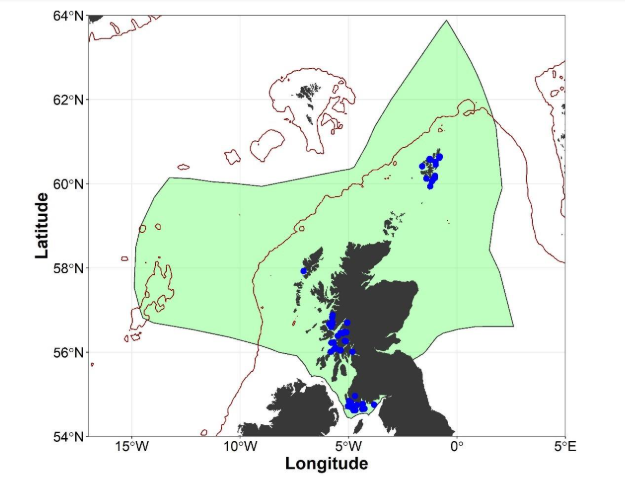
Tag / recapture records for Thornback skate (Raja clavata) from the Scottish Shark Tagging Programme, the Glasgow Museums tagging programme and the UK Shark Tagging Programme data from 1970 to 2025.
Click for a full description
View a larger version of this image.
Map of the economic exclusion zone of Scotland showing records for Thornback skate (Raja clavata) from the Scottish Shark Tagging Programme, Glasgow Museums tagging programme and the UK Shark Tagging Programme data from 1970 to 2025. Data assimilated by the Scottish Shark Tagging Programme. Data is presented as blue dots for each individual Thornback skate tagged or recaptured. Tag – recapture records provided by anglers and occasionally supplemented by reports of tagged animals subsequently captured on commercial fishing vessels show tight clusters in places where angling and tagging have occurred, in this case, the Solway Firth, the Sound of Jura, Loch Etive, Loch Sunart and the Shetland Isles.
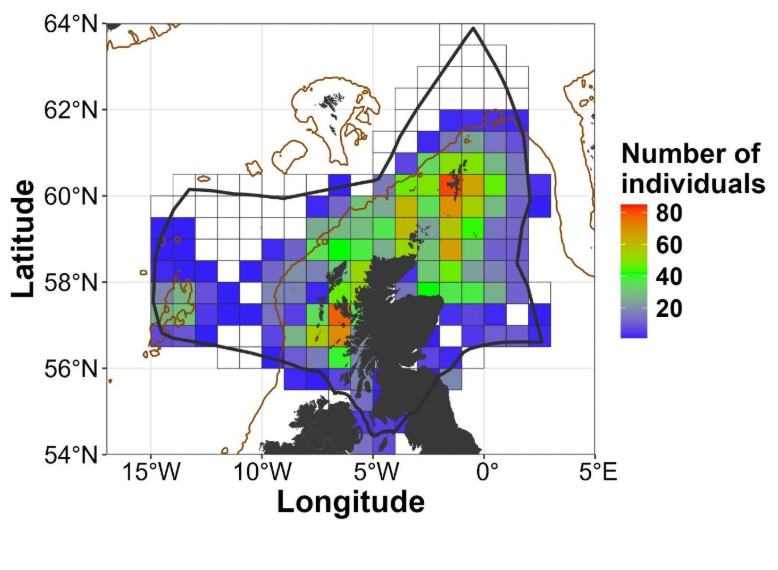
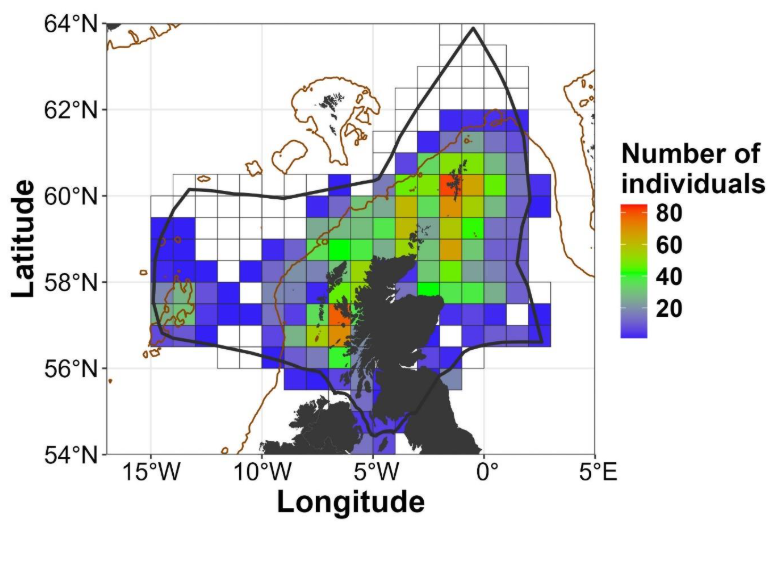
Landings data from commercial fishing vessels in ICES rectangles for Thornback skate (Raja clavata) 2011 - 2019.
Click for a full description
View a larger version of this image.
Map of the economic exclusion zone (EEZ) of Scotland showing landings data for Thornback skate (Raja clavata) recorded on commercial fishing vessels from 2011 to 2019. The EEZ of Scotland is covered by a grid dividing it into the International Council for the Exploration of the Sea (ICES) rectangles. Data is filtered to exclude information in rectangles where three vessels or less operate. Values are presented as individuals per trip and represented as a heat map, colouring each ICES rectangle from 1 (blue) to 81 (red). Lower levels of landings (blue squares) are widespread all along the continental shelf edge around Scotland, in the central North Sea, around the Rockall Plateau and in the Rockall Trough, as well as parts of the northern North Sea. Moderate landings represented by green squares (approximately 40 individuals per trip) were common across the continental shelf to the north of Scotland and around the Outer Hebrides. Higher landings represented by orange rectangles (approximately 60 individuals per trip) were reported to the South of the Isle of Skye. The highest landings represented by red rectangles (80 individuals per trip) were reported around the Isle of Skye and the Shetland Isles.
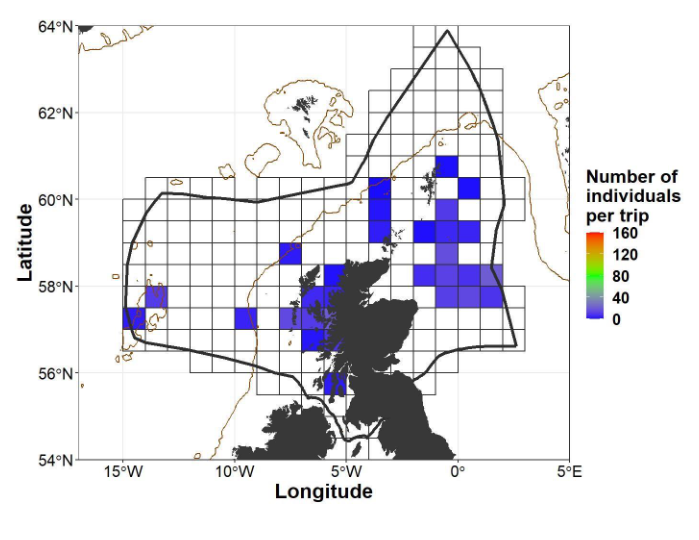
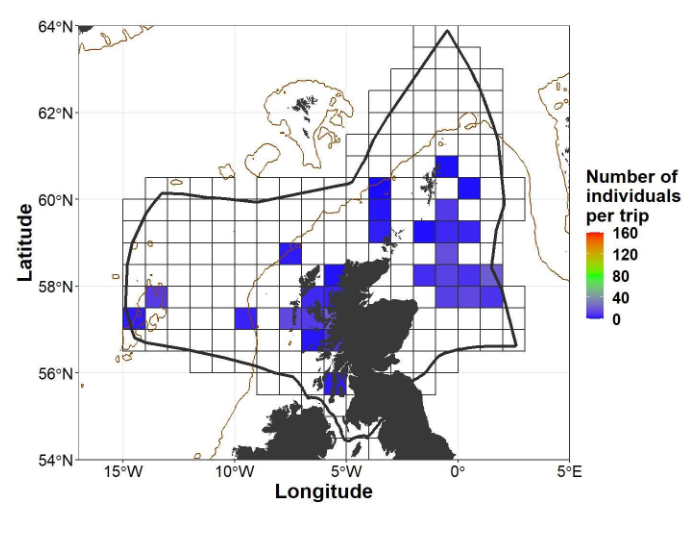
Discard data from commercial fishing vessels in ICES rectangles for Thornback skate (Raja clavata) 2014 - 2018.
Click for a full description
View a larger version of this image.
Map of the economic exclusion zone (EEZ) of Scotland showing discard data for Thornback skate (Raja clavata) recorded on commercial fishing vessels from 2014 to 2018. The EEZ of Scotland is covered by a grid dividing it into the International Council for the Exploration of the Sea (ICES) rectangles. Data is filtered to exclude information in rectangles where three vessels or less operate. Values are presented as the number of individuals per trip and illustrated as a heat map, with blue indicating 1 and red indicating 160, for each grid rectangle. Small numbers of discards were recorded represented by blue rectangles (0 to 40 individuals) distributed across the whole of the continental shelf in Scotland’s EEZ and on the Rockall Plateau.
Habitat
Thornback skate are an inshore demersal species that are found in relatively shallow water over a range of substrates, including mud, sand, shingle, gravel and rocky areas. Around the British Isles, they have been found at depths of 7-192 m (Ellis et al., 2005), and in the Northeast Atlantic, in general, they are most abundant between depths of 10-60 m (Ellis et al., 2016). Evidence from tagging studies suggests that they are a relatively sedentary species and stay within 30-50 nautical miles of their residing area (Walker, 1997). However, adults have been found to migrate from offshore, relatively deep (30 m) water in winter months to shallower inshore waters (10 m) in summer months, possibly to mate (Walker, 1997). High abundances of juveniles have been recorded in Luce Bay and the Solway Firth on the Scotland-England border, as well as in the Thames Estuary, north-eastern English Channel, northern Bristol Channel and Cardigan Bay (Ellis et al., 2005).
Biology and Ecology
Thornback skate can live for up to 12 years and grow to a maximum length of 110 – 130 cm TL (Ellis et al., 2016). In British waters, length at first maturity is estimated to be 74-78 cm TL for females and 47 cm TL for males (McCully et al., 2012), or approximately 5 years of age (Ellis et al., 2016), with fecundity estimated to be 100 – 150 eggs per year, although it may be as low as 48 (Ellis et al., 2005; Serra-Pereira et al., 2011). Eggs are typically laid between February and September, with a peak in May-June, eggs take 16-20.5 weeks to hatch, and newborns are 10-13 cm long (TL). Empty egg cases are commonly seen washed ashore and are known as “mermaids’ purses”. Thornback skate are usually sedentary during the day and feed at night on fauna such as crustaceans (swimming crabs and brown shrimp) sand-eels, herrings, sprats and small flatfish (Snowden, 2008).
Human interactions
Thornback skate are one of the main commercially important skate species in European waters, targeted by local, often seasonal fisheries using both trawls and static nets. The species remains relatively abundant and stable in some areas, particularly around the south-western British Isles, but populations have declined under fishing pressure in parts of the North Sea (OSPAR, 2010; ICES, 2024a; ICES, 2024c). A discard survival study in the Bristol Channel showed that 45% of male Thornback skates and 65% of females survived short-term (3 days) after capture in commercial twin-rig otter trawls (Enever et al., 2009). Thornback skate are also regularly caught by recreational anglers, though catch-and-release practices are widespread, and angling is thought to contribute little to overall mortality (Ellis et al., 2016).
ICES advises that when the maximum sustainable yield (MSY) approach is applied, catches in 2026 and 2027 should be no more than 6081 and 6045 tonnes, respectively. If discard rates do not change from the average of the last three years (2022 – 2024), this implies landings in 2026 and 2027 of no more than 4,922 and 4,894 tonnes, respectively, for the North Sea and eastern English Channel (ICES, 2025). Similarly, ICES advises that when the maximum sustainable yield (MSY) approach is applied, landings should be no more than 67 tonnes in each of the years 2025 and 2026 for west of Scotland (ICES, 2024a) and no more than 1699 tonnes in each of the years 2025 and 2026 for Irish Sea, Bristol Channel, Celtic Sea North (ICES, 2024b). ICES advises that when the precautionary approach is applied, landings should be no more than 170 tonnes in each of the years 2025 ‒ 2028 for the western English Channel (ICES, 2024d).
References
Ellis, J.R., Dulvy, N.K. & Serena, F. 2016. Raja clavata (Mediterranean assessment). The IUCN Red List of Threatened Species 2016: e.T39399A103113598.
Ellis, J., Dulvy, N., Walls, R. & Serena, F. 2016. Raja clavata (Europe assessment). The IUCN Red List of Threatened Species 2016: e.T39399A103111648.
Ellis, J. R. et al., (2005) ‘The Distribution of Chondrichthyan Fishes Around the British Isles and Implications for Conservation’, Journal of Northwest Atlantic Fisheries Science, 35, pp. 195–213.
Enever, R. et al., (2009) ‘The survival of skates (Rajidae) caught by demersal trawlers fishing in UK waters’, Fisheries Research, 97(1–2), pp. 72–76. doi: 10.1016/j.fishres.2009.01.001.
Finucci, B., McCully-Phillips, S.R., Ellis, J.R., Giovos, I., Serena, F., Soldo, A., Pacoureau, N. & Charles, R. 2024. Raja clavata. The IUCN Red List of Threatened Species 2024: e.T39399A183779744.
ICES. (2024a). Thornback ray (Raja clavata) in the West of Scotland (Subarea 6). ICES Advice 2024, precautionary approach.
ICES. (2024b). Thornback ray (Raja clavata) in the Irish Sea, Bristol Channel, and northern Celtic Sea (Divisions 7.a, 7.f, 7.g). ICES Advice 2024, precautionary approach.
ICES. (2024c). Report of the Working Group on Elasmobranch Fishes (WGEF). ICES Scientific Reports. 06:75. 994 pp. https://doi.org/10.17895/ices.pub.26935504
ICES. (2024d). Thornback ray (Raja clavata) in Division 7.e (western English Channel). In Report of the ICES Advisory Committee, 2024. ICES Advice 2024, rjc.27.7e.
ICES. 2025. Thornback ray (Raja clavata) in Subarea 4 and in divisions 3.a and 7.d (North Sea, Skagerrak, Kattegat, and eastern English Channel). In Report of the ICES Advisory Committee, 2025. ICES Advice 2025, rjc.27.3a47d.
McCully, S.R. et al., (2012) ‘Lengths at maturity and conversion factors for skates (Rajidae) around the British Isles, with an analysis of data in the literature’, ICES Journal of Marine Science. Narnia, 69(10), pp. 1812–1822. doi: 10.1093/icesjms/fss150.
OSPAR (2010) Background Document for Thornback ray Raja clavata, Biodiversity Series.
Serra-Pereira, B., Figueiredo, I., Gordo, L. S., & Moura, T. (2011). Maturation, fecundity, and spawning strategy of the thornback ray Raja clavata in Portuguese waters. ICES Journal of Marine Science, 68(5), 1096–1104.
Snowden, E. (2008) ‘Raja clavata Thornback ray.’, in Tyler-Walters, H. and Hiscock, K. (eds) Marine Life Information Network: Biology and Sensitivity Key Information Reviews. Plymouth, UK.: Marine Biological Association of the United Kingdom. Available at: https://www.marlin.ac.uk/species/detail/2187 (Accessed: 20 February 2020).
Walker, P. (1997) ‘Distribution, movement and stock structure of three ray species in the North Sea and eastern English Channel’, ICES Journal of Marine Science. Oxford University Press, 54(5), pp. 797–808. doi: 10.1006/jmsc.1997.0223.