Sharks and Skates of Scotland Report: Starry skate (Amblyraja radiata)
An extract from the Sharks and Skates of Scotland Report.
Starry skate - Amblyraja radiata (Donovan, 1808)
Occurrence in Scotland: Occurrence in Scotland: Shelf, slope, and deep-sea. Resident. Found commonly throughout the North Sea, more patchy distribution North and west Scotland. Found on the continental slope of the Faroe Shetland channel.
Synonym(s): Raja radiata; Order: Rajiformes; Family: Rajidae
Note: There are concerns about confusing this species with Thornback skate (Raja clavata) in the North Sea ecoregion.
Common name: Starry skate, Starry ray, Thorny skate
AlphaID: 105865 TSN Code: 564149
Population status
Scotland and Northeast Atlantic: Last assessed as stable in Europe (Kulka et al., 2015). However, steep declines have been observed since 1992, with an estimated median decrease of 83.2% over three generation lengths (31.8 years). Historically, populations of this species have fluctuated in this region, and current population levels are estimated to be similar to those seen in 1980 (Kulka et al., 2020).
Global: Decreasing (Kulka et al., 2020). On both sides of the Atlantic, very steep declines (>80% reduction in three generations) are seen in the most southerly parts of this species' distribution, coupled with recovery and increasing abundance at more northerly latitudes. (Kulka et al., 2020).
Conservation listings
- IUCN Red List Europe: Least Concern (assessment 09 December 2014)
- IUCN Red List Global: Vulnerable (assessment 01 July 2019)
- CITES: Not listed
- CMS: Not listed
- OSPAR: Not listed
- Listed on the UK’s ‘Prohibited Species’ list as documented in the ‘Written Record of fisheries consultations between the United Kingdom and the European Union for 2025’ for UK waters of ICES divisions 2a and 7d and Subarea 4
- Prohibited species with zero TAC under EU Regulations 2019/1241, 2023/194 and 2025/202
- Qualifying species for the East Shetland Channel ISRA
Range and distribution
Starry skate are found in the Northern Hemisphere from the NE to the NW Atlantic, ranging from South Carolina, USA, to Greenland, Iceland, Ireland, the United Kingdom, Norway, extending through the Barents Sea to Russia (Last et al., 2016). Their range in the Northeast Atlantic extends from the coasts of Svalbard (Norway), Greenland, Iceland, the Barents Sea, and the United Kingdom, down to the English Channel (Kulka et al., 2015).
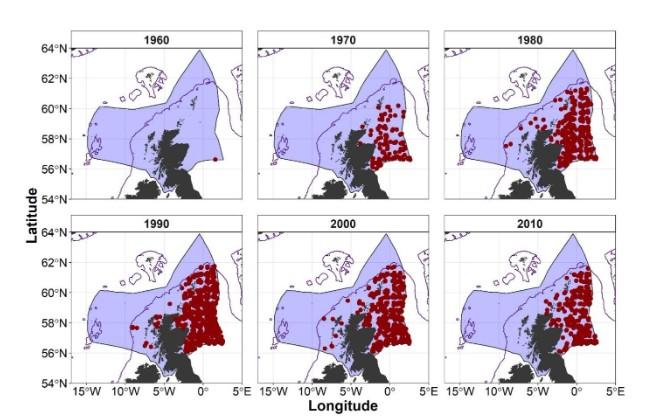
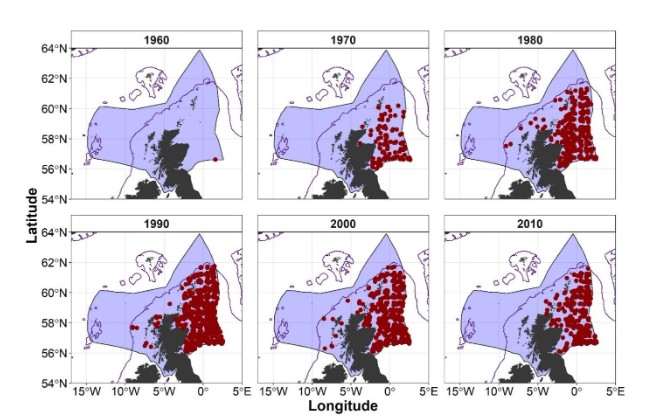
ICES DATRAS records for Starry skate (Amblyraja radiata) for 1960 - 2019
Click for a full description
View a larger version of this map.
Six maps of the economic exclusion zone (EEZ) of Scotland showing locations of trawls where Starry skate (Amblyraja radiata) were captured from 1960 to 1969, 1970 to 1979, 1980 to 1989, 1990 to 1999, 2000 to 2009, and 2010 to 2019). Red points represent trawl shoot locations in which Starry skate were captured. Between 1960 and 1969 Starry skate were recorded in a single trawl in the southern North Sea. From 1970 to 1979 Starry skate were recorded much more frequently across the North Sea. From 1980 to 1989 there were more records in the North Sea and sparse records occurred off the north coast of Scotland to the west of Orkney and off the west coast of Scotland to the west of the Outer Hebrides. From 1990 to 1999 records were denser still in the North Sea and a small number of records occurred in the north of the Minch, to the west of the Outer Hebrides and to the west of the Isle of Islay. From 2000 to 2019 records were very similar in coverage and density to 1990 to 1999 and in 2010 to 2019 records were very similar in the North Sea but absent from the west coast of Scotland. A change in the number or distribution of records does not reflect a change in occurrence or abundance since data have not been corrected for effort.
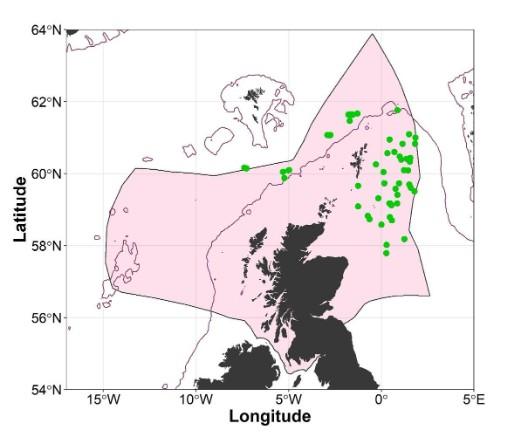
Records for the Starry skate (Amblyraja radiata) from SIAMISS and deep-water fisheries surveys undertaken by the Marine Directorate 1996 – 2019.
Click for a full description
Map of the economic exclusion zone (EEZ) of Scotland showing records for the Starry skate (Amblyraja radiata) from the Scottish-Irish anglerfish and megrim industry-science survey (SIAMISS) and deep-water fisheries surveys undertaken by the Marine Directorate 1996-2019. Records are illustrated as green points and evenly distributed across the continental shelf in the northern North Sea with a few records off the continental shelf to the north of Scotland.
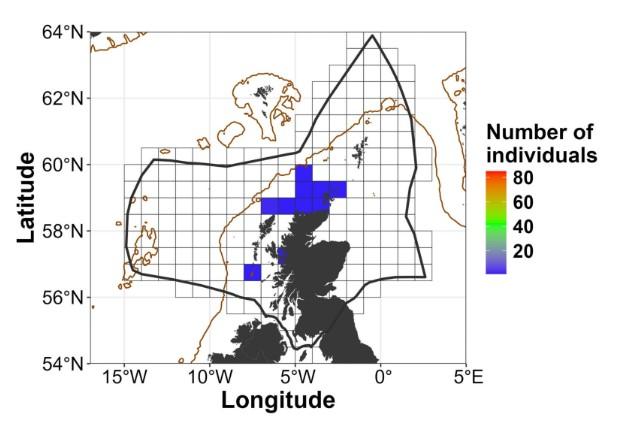
Landings data from commercial fishing vessels in ICES rectangles for Starry skate (Amblyraja radiata) 2011-2019.
Click for a full description
Map of the economic exclusion zone (EEZ) of Scotland showing landings data per ICES (International Council for the Exploration of the Sea) rectangle for Starry skate (Amblyraja radiata) recorded by commercial fishing vessels from 2011 to 2019. Values are presented as the number of individuals landed per trip. Data is illustrated in a heat map, colouring each ICES rectangle from one (blue) to 81 (red). Small numbers of landings illustrated by blue rectangles representing 0 to 20 individuals were reported around the north coast of Scotland, around the Orkney Isles, the inner sound of Skye, and around Mingulay to the South of the Outer Hebrides.
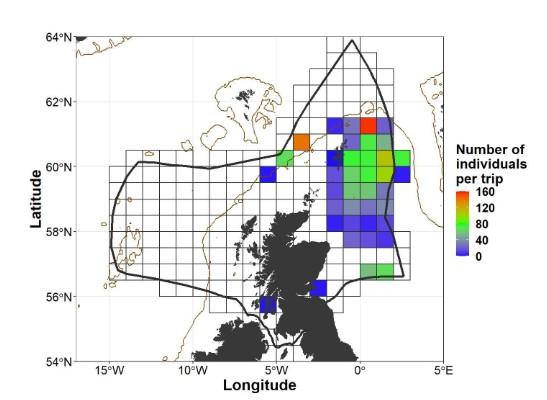
Discard data from commercial fishing vessels in ICES rectangles for Starry skate (Amblyraja radiata) 2014-2018.
Click for a full description
Map of the economic exclusion zone (EEZ) of Scotland showing discard data for Starry skate (Amblyraja radiata) recorded on commercial fishing vessels. The EEZ of Scotland is covered by a grid dividing it into the International Council for the Exploration of the Sea (ICES) rectangles. Data is filtered to exclude information in rectangles where three vessels or less operate. Values are presented as individuals per trip and represented as a heat map (blue is one and red is 160) for each rectangle in the grid. Discards are concentrated in the north North Sea where some green rectangles showing capture of around 80 individuals per trip are surrounded by blue rectangles showing capture of 0 to 40 individuals. There is a single red rectangle showing capture of 120 to 160 individuals at the northern most tip of Scotland’s EEZ. There are scattered records of low number of discards, with a blue rectangle covering the Sound of Jura and the Clyde, another covering the area east of the Firth or Forth and one on the edge of the continental shelf to the northwest of Orkney. There is also a green rectangle showing discard of around 80 individuals and a red rectangle indicating discard 120 to 160 individuals on the edge of the continental shelf northwest of Orkney.
Habitat
Starry skate are found at depths ranging from 0 – 1400 m, but most commonly between 25-440 m on continental and insular shelves and slopes over a range of seabed types including sand, gravel, broken shell and pebbles, and soft mud (Packer et al., 2003). In the waters of Eastern Canada, the species was found at temperatures ranging from −1.0 to 8.8 oC but was most abundant at 1.6–3.5 oC.
Biology and Ecology
Starry skate have relatively small home ranges, occasionally travelling hundreds of km from tagging sites but in general far shorter distances (Templeman 1984; Kneebone et al., 2020, Walker et al., 1997). They may undertake limited seasonal movements to deeper water during winter/spring and return to shallower water in summer/autumn (Packer et al., 2003). This skate exhibits differences in morphology and life history across its range. Individuals in the North Sea are generally smaller and mature earlier than those in the Northwest Atlantic. North Sea Starry skates reach a maximum size of 66 cm TL and mature at 5.6 years, versus 111 cm TL with maturation at 11 years on the Scotian shelf (Templeman, 1987; Ebert & Stehmann, 2013; McPhie & Campana, 2009; Kulka et al., 2020). There appears to be genetic differences coinciding with the geographical distribution of the species in the North Atlantic, predominantly between those inhabiting the Northwest and the Northeast Atlantic, however, the overall level of differentiation within the species across its range is relatively low (Denton et al., 2024; Lynghammar et al., 2016).
Starry skate are oviparous and lay 10-45 egg cases per year (Kulka et al., 2015). In the North Sea, egg cases were found primarily in waters > 50 m depth. Egg cases, early and mid-stage juveniles and adults were found together (without spatial segregation) (Ellis et al., 2023), suggesting that spawning (egg-laying) may be occurring across the whole region. Eggs hatch after approximately 4 months, and newborns are 8-12cm in length (McEachran & Dunn, 1998; Froese & Pauly, 2019). Egg laying may be seasonal in some regions of its distribution (del Río & Junquera, 2001); however, in the Western Gulf of Maine and in waters off Atlantic Canada, reproduction occurs all year round (Templeman, 1987; Sulikowski et al., 2005). Starry skate are known to be scavengers with a varied diet, including fish, crustaceans and polychaete worms, as well as hydroids, molluscs, cephalopods and echinoderms. Their diet is also known to change as they grow (McEachran & Dunn, 1998; Froese & Pauly, 2019).
Human interactions
Although not targeted, Starry skate are incidentally caught in the demersal trawl fishery in the Northeast Atlantic (North Sea, Irish Sea, Barents Sea). However, low length at maturity (~44 cm TL) allows the species to be more resilient to fishing mortality than other larger skate species (Kulka et al., 2015).
From 2008, species-specific landings data were required for Starry skate from EU Member States for the North Sea and Celtic Sea ecoregions. However, from 2014, the species became prohibited within the North Sea Ecoregion (ICES subareas 2 and 4, and Division 3.a). Starry skate are is included in the group of ‘other skates and rays’ in the ICES assessment for the west coast of Scotland, Rockall and Celtic seas, and for the period 2025–2028, ICES was unable to provide any advice due to the lack of sufficient survey and catch data (ICES, 2024).
References
Denton, J. S., Kneebone, J., Yang, L., Lynghammar, A., McElroy, D., Corrigan, S., ... & Naylor, G. J. (2024). Mitogenomic evidence of population differentiation of thorny skate, Amblyraja radiata, in the North Atlantic. Journal of Fish Biology, 104(5), 1513-1524.
Ebert, D.A. and Stehmann, M.F.W. 2013. Sharks, batoids, and chimaeras of the North Atlantic. FAO Species Catalogue for Fishery Purposes No. 7. Food and Agricultural Organization of the United Nations (FAO). FAO, Rome.
Ellis, J. R., Gordon, C. A., Allen, H. L., Silva, J. F., Bird, C., Johnston, G., ... & Hood, A. (2024). The distribution of the juvenile stages and eggcases of skates (Rajidae) around the British Isles. Aquatic Conservation: Marine and Freshwater Ecosystems, 34(4), e4149.
EU, (2019). Council Regulation (EU) 2019/124 of 30 January 2019 fixing for 2019 the fishing opportunities for certain fish stocks and groups of fish stocks, applicable in Union waters and, for Union fishing vessels, in certain non-Union waters. Official Journal of the European Union L29, 1–166.
Grieve, B. D., Hare, J. A., & McElroy, W. D. (2021). Modeling the impacts of climate change on thorny skate (Amblyraja radiata) on the Northeast US shelf using trawl and longline surveys. Fisheries Oceanography, 30(3), 300-314.
ICES, (2019). Starry ray (Amblyraja radiata) in subareas 2 and 4, and Division 3.a (Norwegian Sea, North Sea, Skagerrak and Kattegat). In Report of the ICES Advisory Committee, 2019. ICES Advice 2019, rjr.27.23a4.
ICES (2024). Other rays and skates (Rajiformes) in Subarea 6 and divisions 7.a-c and 7.e-k (Rockall, West of Scotland, Celtic Sea and western English Channel). ICES Advice: Recurrent Advice. Report. Kneebone, J., Sulikowski, J., Knotek, R., McElroy, W. D., Gervelis, B., Curtis, T., ... & Mandelman, J. (2020). Using conventional and pop-up satellite transmitting tags to assess the horizontal movements and habitat use of thorny skate (Amblyraja radiata) in the Gulf of Maine. ICES Journal of Marine Science, 77(7-8), 2790-2803.
Kulka, D.W., Sulikowski, J., Gedamke, J., Pasolini, P. & Endicott, M. 2015. Amblyraja radiata (Europe assessment). The IUCN Red List of Threatened Species 2015: e.T161542A48945123. Accessed on 14 March 2025.
Kulka, D.W., Ellis, J., Anderson, B., Cotton, C.F., Derrick, D., Pacoureau, N. & Dulvy, N.K. 2020. Amblyraja radiata. The IUCN Red List of Threatened Species 2020: e.T161542A124503504. Accessed on 14 March 2025.
Lynghammar, A. (2016). Widespread physical mixing of starry ray from differentiated populations and life histories in the North Atlantic. Marine Ecological Progress Sereis. 562:123-134.
McPhie, R. P., & Campana, S. E. (2009). Bomb dating and age determination of skates (family Rajidae) off the eastern coast of Canada. ICES Journal of Marine Science, 66(3), 546-560.
Packer, D. B., Zetlin, C. A., & Vitaliano, J. J. (2003). Essential fish habitat source document. Thorny skate, Amblyraja radiata, life history and habitat characteristics.
Skjæraasen JE, Bergstad OA (2000) Distribution and feeding ecology of Raja radiata in the northeastern North Sea and Skagerrak (Norwegian Deep). ICES J Mar Sci 57: 1249−1260)
Sulikowski, J. A., Kneebone, J., Elzey, S., Jurek, J., Danley, P. D., Howell, W. H., & Tsang, P. C. (2005). The reproductive cycle of the thorny skate (Amblyraid radiata) in the western Gulf of Maine. Fishery Bulletin.
Templeman, W. (1984). Migrations of thorny skate, Raja radiata, tagged in Newfoundland. Journal of Northwest Atlantic Fishery Science, 5(1).
Templeman, W. (1987) Differences in sexual maturity and related characteristics between populations of thorny skate (Raja radiata) in the Northwest Atlantic. J Northwest Atl Fish Sci 7: 155−167
Walker, P., Howlett, G., & Millner, R. (1997). Distribution, movement and stock structure of three ray species in the North Sea and eastern English Channel. ICES Journal of Marine Science, 54(5), 797-808.