Sharks and Skates of Scotland Report: Spurdog (Squalus acanthias)
An extract from the Sharks and Skates of Scotland Report.
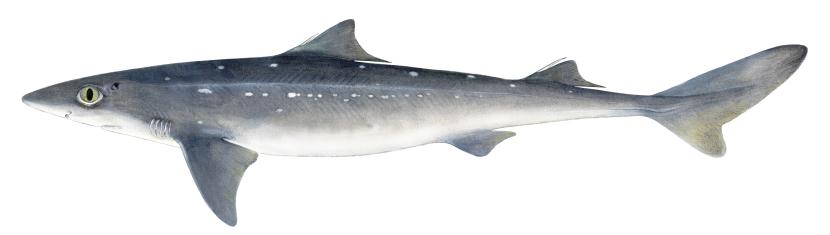
Spurdog - Squalus acanthias (Linnaeus, 1758)
Occurrence in Scotland: Widespread across continental shelf waters (primarily 10–200 m). Resident, highly site-faithful subpopulations occur in fjordic sea lochs on the west coast.
Synonym(s): Acanthias americanus, Acanthias antiguorum, Acanthias commun, Acanthias lebruni (numerous additional synonyms—see WoRMS for full list) ; Order: Squaliformes ; Family: Squalidae (dogfish sharks)
Common name: Spurdog, spiny dogfish, piked dogfish, spiked dogfish
AlphaID: 105923 TSN Code: 160617
Population status
Scotland and Northeast Atlantic: Increasing. ICES considers that there is a single Northeast Atlantic stock ranging from the Barents Sea to the Bay of Biscay. After a historical collapse caused by intensive exploitation (De Oliveira et al., 2013), strict management measures led to strong rebuilding. ICES stock assessments now indicate that biomass exceeds precautionary reference points and fishing pressure is below sustainable limits (ICES, 2024a).
Global: Decreasing (Finucci et al., 2020)
Conservation listings
- IUCN Red List Europe: Endangered (assessment 26 August 2014)
- IUCN Red List Mediterranean: Endangered (assessment 25 March 2016)
- IUCN Red List Global: Vulnerable (assessment 21 November 2019)
- CITES: Not listed
- CMS: Appendix II
- Memorandum of Understanding on the Conservation of Migratory Sharks: Listed on Annex 1
- OSPAR: Threatened and/or Declining Species
- Listed as a Priority Marine Feature in Scotland’s seas
- Scottish Biodiversity List
- Listed on The Sharks, Skates and Rays (Prohibition of Fishing, Trans-shipment and Landing) (Scotland) Order 2012
- Feature of Conservation Importance in England and Wales (FOCI)
- Species of Principal Importance in Wales and England (SPI)
- EU Regulation 2019/1241 prevents fishing for spurdog in ICES divisions 7c and 7k between 1 and 31 May
- Listed on the UK’s ‘Prohibited Species’ list as documented in the ‘Written Record of fisheries consultations between the United Kingdom and the European Union for 2025’ for UK waters in ICES Subareas 2, 4, 5, 6, 7, and 8
- Qualifying species on Firth of Lorn ISRA
Range and distribution
Temperate seas worldwide; continental shelves and upper slopes of the Atlantic and Pacific (Camhi et al., 2009; Ebert and Stehmann, 2013). In the Northeast Atlantic, the stock ranges from Norwegian–Barents waters to the Celtic Seas and Bay of Biscay, including UK waters, and extends into the Mediterranean and Black Sea (Pawson and Ellis, 2005; Ebert and Stehmann, 2013).
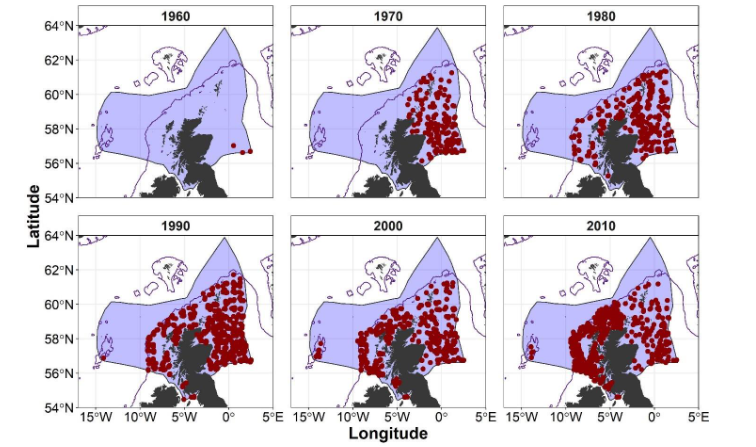
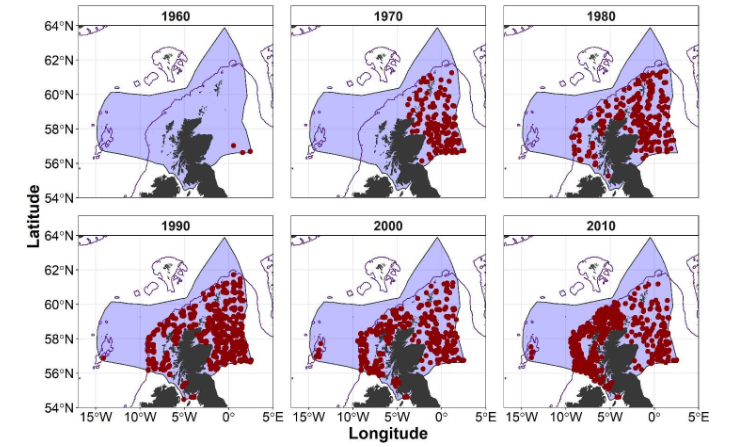
ICES DATRAS records for Spurdog (Squalus acanthias), 1980: 1980-1989, 1990: 1990-1999; 2000: 2000-2009 and 2010: 2010-2019.
Click for a full description
View a larger version of this image.
Four maps of the EEZ of Scotland showing the ICES (International Council for the Exploration of the Sea) DATRAS (database of trawl surveys hosted by ICES) records for Spurdog (Squalus acanthias) from bottom trawl surveys conducted between 1960 and 1969; 1970 and 1979; 1980 and 1989; 1990 and1999; 2000 and 2009 and 2010 and 2019. Red points represent trawl shoot positions in which Spurdog (S. acanthias) were recorded. From 1960 to 1969, a cluster of records were reported off the east coast of Scotland in the southern part of the North Sea. From 1970 to 1979, there were considerably more records throughout the North Sea, around all coasts of the Shetland and Orkney Isles. From 1980 to 1989, records occurred throughout the continental shelf of Scotland’s EEZ. From 1990 to 1999, 2000 to 2009, and 2010 to 2019, Spurdog were recorded throughout the continental shelf within Scotland’s EEZ and on the Rockall Plateau. A change in the number or distribution of records over time does not reflect a change in occurrence or abundance since data have not been corrected for effort.
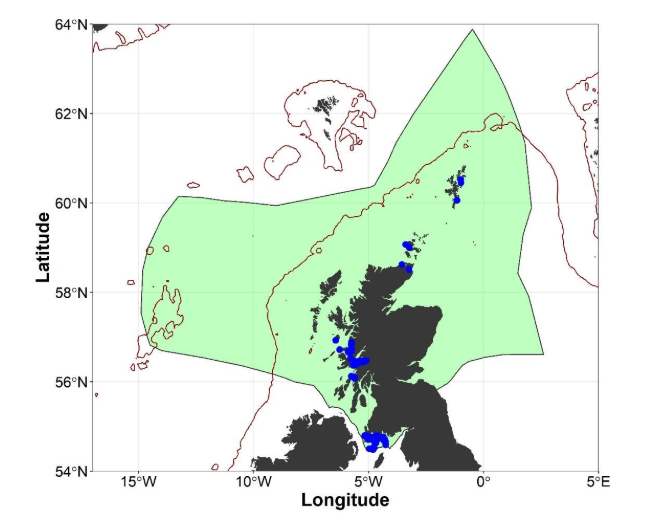
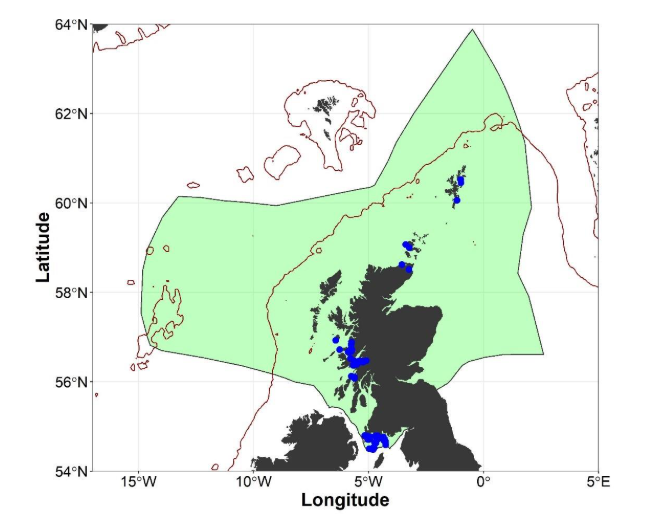
Tag – recapture records for Spurdog (Squalus acanthias) from the Scottish Shark Tagging Programme, the Glasgow Museums tagging programme and the UK Shark Tagging Programme data from 1970 to 2025.
Click for a full description
View a larger version of this image.
Map of the economic exclusion zone of Scotland showing records for Spurdog (Squalus acanthias) from the Scottish Shark Tagging Programme, Glasgow Museums tagging programme and the UK Shark Tagging Programme data from 1970 to 2025. Data are presented as blue dots for each Spurdog (S.acanthias) tagged or recaptured. These tag – recapture records provided by anglers and occasionally supplemented by reports of tagged animals subsequently captured on commercial fishing vessels show tight clusters in places where angling and tagging have occurred, in this case in south-west Scotland and the Firth of Lorn.
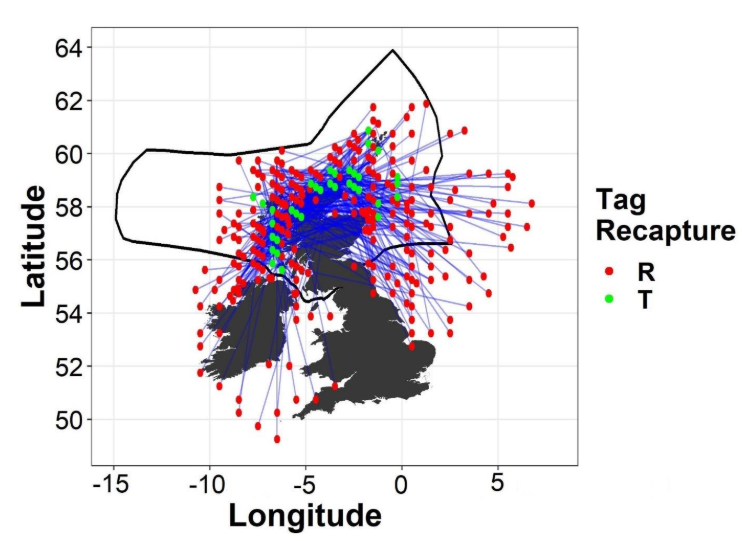
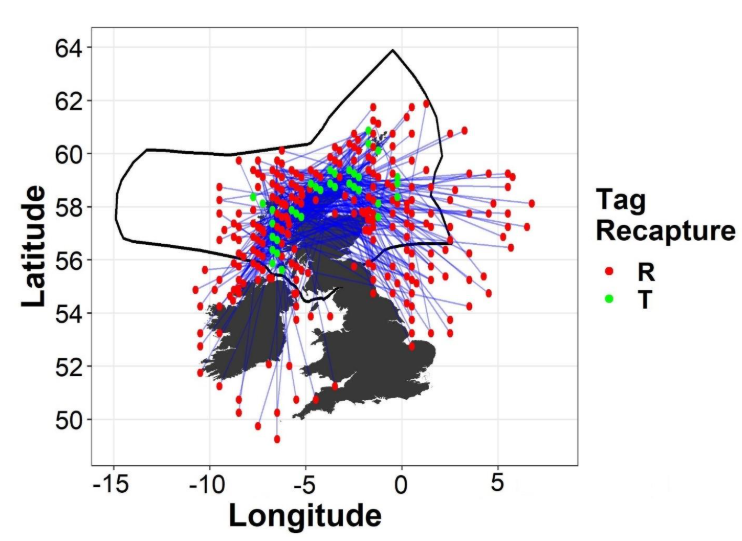
Tag – recapture records for Spurdog (Squalus acanthias) from Marine Directorate Science (collected under the name Fisheries Research Service) from 1972 to 2008.
Click for a full description
View a larger version of this image.
Map of the economic exclusion zone of Scotland showing records for Spurdog (Squalus acanthias) from Marine Directorate Science (collected under the name Fisheries Research Service) from 1972 to 2008. Green points indicate tag locations and red points recapture locations. Linked tag – recapture events are connected by a straight line that is not representative of actual movement. Tagging locations occurred in shelf waters off the west and north coasts of Scotland, around Orkney and Shetland, and in the northern North Sea. Recapture locations spread out from the inshore waters of Scotland to offshore waters. Recaptures also extend beyond Scotland’s EEZ east into the eastern North Sea and south into the EEZ of England, on the west and east coast, there were no recaptures the south coast of England.
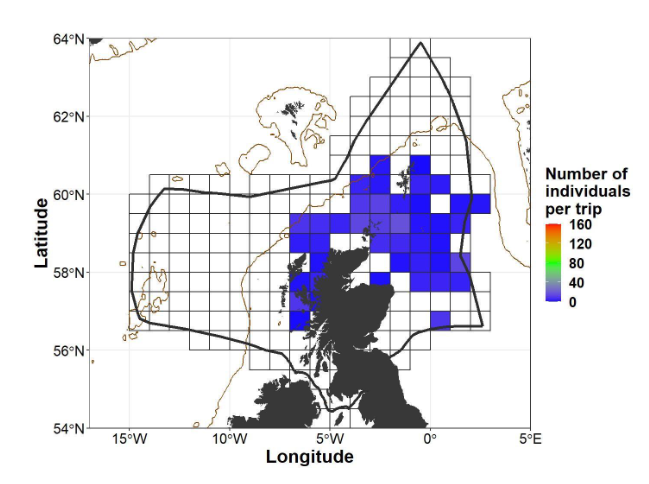
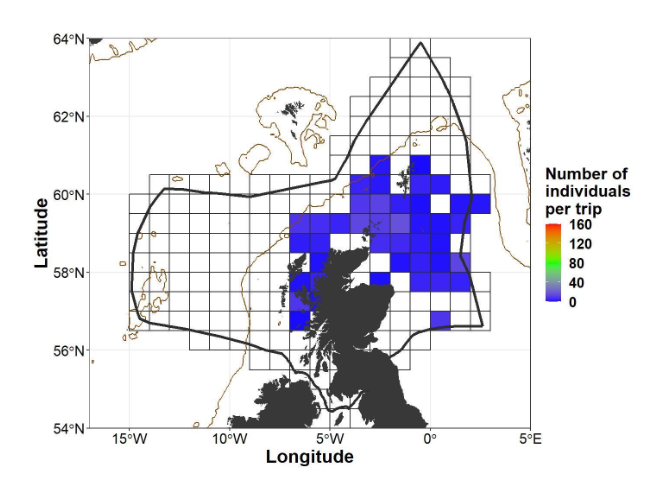
Discard data from commercial fishing vessels in ICES rectangles for Spurdog (Squalus acanthias) 2014 - 2018. Data is filtered to exclude information in rectangles where three vessels or less operate.
Click for a full description
View a larger version of this image.
Map of the economic exclusion zone (EEZ) of Scotland showing discard data for Spurdog (Squalus acanthias) recorded on commercial fishing vessels from 2014 to 2018. The EEZ of Scotland is covered by a grid dividing it into the International Council for the Exploration of the Sea (ICES) rectangles. Data is filtered to exclude information in rectangles where three vessels or less operate. Values are presented as individuals per trip and represented as a heat map colouring each ICES rectangle from 1 (blue) to 160 (red). Small numbers of discards represented by blue rectangles (1 to 10 individuals discarded) were reported around the west coast of Scotland, in the Sea of the Hebrides, the Minch, towards the continental shelf edge north of the Isle of Lewis, in the northern North Sea, around the Orkney and Shetland Isles, and in the Moray Firth.
Habitat
Globally, Spurdog (S. acanthias) occupy temperate seas and are generally highly mobile (Camhi et al., 2009), with evidence of transoceanic movement in the North Atlantic and no marked genetic differentiation between eastern and western Atlantic components (Holden, 1967; Templeman, 1976). In European waters, three regional subpopulations are typically recognised (Northeast Atlantic, Mediterranean, and Black Sea). In the Northeast Atlantic, offshore mark-recapture studies indicate wide dispersal of juveniles and maturing fish (Aasen, 1964; Holden, 1965; Hjertenes, 1980; Gauld and Macdonald, 1982; Vince, 1991). Spurdog are a bentho-pelagic shark, commonly found in continental-shelf habitats, occurring mainly between 10–200 m but occasionally to ~900 m (Hammond and Ellis, 2005; Ebert and Stehmann, 2013). They tolerate a broad thermal range (~5–15 °C) and often use waters around 10–11 °C (Klöcker et al., 2024; Sulikowski et al., 2010; Shepherd et al., 2002; Thorburn et al., 2015, 2024). Parturition and early-life nursery use are concentrated in shallow coastal and fjordic environments across the Northeast Atlantic, including southwest Ireland, Scottish sea lochs, and Norwegian fjords, where sheltered conditions and prey availability benefit neonates and small juveniles (Fahy, 1988; Thorburn et al., 2015, 2024; Junge et al., 2025). The species are thought to show strong residency and site fidelity in Scottish sea lochs as reported from Loch Etive, likely linked to the bathymetry of the sea lochs (narrow entrances and deep basins) resulting in enduring thermal stratification. Loch Etive appears to function as recurrent breeding and nursery habitat (Thorburn et al., 2015, 2024) and it is possible that similar sea lochs on the west coast of Scotland do the same although the species also uses other areas in the Northeast Atlantic for pupping.
Biology and Ecology
Spurdog are a long-lived, slow-growing, and late-maturing species. They grow to a maximum length of approximately 120 cm (females) and 92 cm (males) (Ellis and Shackley, 1997). Males mature at 55 – 61 cm, and females at 69 – 83 cm (Ellis and Shackley, 1997), with a maximum age of 40 years (Fahy, 1988). Females are aplacental viviparous (Hanchet 1988) and have a 24-month gestation period (Avsar, 2001). Fecundity is proportional to length (Ellis & Keable, 2008), with 3 to 19 pups typically reported (Ellis and Shackley, 1997). Life history characteristics demonstrate regional variation between ocean basins (Hanchet, 1988; Avsar, 2001; Alonso et al., 2002; Henderson et al., 2002; Chatzispyrou & Megalofonou, 2005; Hammond & Ellis, 2005; Stenberg, 2005; Campana et al., 2009). In the Northeast Atlantic population, mating is assumed to occur soon after females give birth (Holden, 1965), and populations segregate into sex- and size-based subunits (Alonso et al., 2002). This behaviour is considered a leading cause of the species’ collapse at the beginning of the 20th century, as females formed large, single-sex shoals (Wearmouth and Sims, 2008), which enabled commercial fisheries to target them because of their higher commercial value. They are opportunistic feeders (Hanchet, 1991; Ellis et al., 1996). In the Northeast Atlantic, the diet of Spurdog over 60 cm in length is predominantly composed of pelagic and epibenthic teleost fish, including herring, whiting, mackerel, and Norwegian pout, as well as crustaceans, ctenophores, and molluscs (Ellis et al., 1996). The diet of smaller Spurdog (<60 cm) is balanced between teleosts, such as herri
Human interactions
The Northeast Atlantic population of Spurdog is managed as a single stock. Historically, the species was subject to declining Total Allowable Catches (TACs) through the 2000s, before management became increasingly restrictive. TACs were progressively reduced from 2007, a maximum landing length of 100 cm was introduced in 2009 to protect large, highly fecund females, and a zero-TAC was implemented in 2010. In 2017, the species was placed on the EU prohibited species list, effectively closing directed fisheries, although small bycatch allowances were available to vessels participating in avoidance schemes. Following a period of strict protection, stock assessments now indicate substantial rebuilding, with biomass above precautionary reference points and fishing mortality below sustainable levels. As a result, ICES advised reopening the fishery in 2023 under tightly controlled conditions. Since then, EU–UK consultations have established precautionary TACs in line with ICES advice: ≤22,309 t and ≤22,594 t for 2025 and 2026, respectively (ICES, 2024a & b). At the time of writing (2025), the ≤100 cm maximum landing length remains in place, thereby ensuring that large females are released; however, this is currently under review. Habitat loss and degradation may pose a threat by damaging coastal and benthic habitats on which prey species rely (Ellis et al., 2015).
References
Aasen, O. (1964). The exploitation of the spiny dogfish (Squalus acanthias L.) in European waters. Fiskeridir. Skr. Ser. Havunders, 13(7), 5–16.
Alonso, M.K. (2002). Fishery and Ontogenetic Driven Changes in the Diet of the Spiny Dogfish, Squalus Acanthias, in Patagonian Waters, Argentina. Environmental Biology of Fishes 63 (2): 193–202.
Avşar, D. (2001). Age, growth, reproduction and feeding of the spurdog (Squalus acanthias) in the SE Black Sea. Estuarine, Coastal and Shelf Science, 52, 269–278.
Camhi, M. D., Pikitch, E. K., & Babcock, E. A. (2009). Sharks of the Open Ocean. Wiley-Blackwell.
Campana, S. (2009). “Growth and Reproduction of Spiny Dogfish off the Eastern Coast of Canada, Including Inference on Stock Structure.” In Biology and Management of Dogfish Sharks, 195–208. American Fisheries Society.
Chatzispyrou, A. and Persefoni M. (2005). “Sexual Maturity, Fecundity and Embryonic Development of the Spiny Dogfish, Squalus Acanthias, in the Eastern Mediterranean Sea.” Journal of the Marine Biological Association of the UK 85 (05): 1155.
De Oliveira, J. A. A., Ellis, J. R., & Dobby, H. (2013). Incorporating density-dependence in spiny dogfish stock assessment models. ICES Journal of Marine Science, 70, 554–566.
Ebert, D. A., & Stehmann, M. F. W. (2013). Sharks, batoids and chimaeras of the North Atlantic. FAO.
Ellis, J. R., Pawson, M. G., & Shackley, S. E. (1996). Comparative feeding ecology of Northeast Atlantic elasmobranchs. J. Mar. Biol. Assoc. UK, 76, 89–106.
Ellis, J.R. and Shackley, S. E. (1997). “The Reproductive Biology of Scyliorhinus Canicula in the Bristol Channel, U.K.” Journal of Fish Biology 51 (2): 361–72.
Ellis, J. R., & Keable, J. (2008). Fecundity of Northeast Atlantic spurdog. ICES J. Mar. Sci., 65, 979–981.
Ellis, J. R., McCully Phillips, S. R., & Poisson, F. (2015). Squalus acanthias—IUCN Red List (Europe/NEA).
Finucci, B., Cheok, J., Chiaramonte, G.E., Cotton, C.F., Dulvy, N.K., Kulka, D.W., Neat, F.C., Pacoureau, N., Rigby, C.L., Tanaka, S. & Walker, T.I. 2020. Squalus acanthias. The IUCN Red List of Threatened Species 2020: e.T91209505A124551959. Accessed on 14 September 2025.
Fahy, E. (1988). The spurdog fishery in SW Ireland. Fisheries Leaflet, Dept. Mar.
Gauld, J. A., & Macdonald, W. S. (1982). Results of tagging S. acanthias around Scotland. ICES CM, H:51.
Hammond, T. R., & Ellis, J. R. (2005). Bayesian assessment of NEA spurdog. J. Northwest Atl. Fish. Sci., 35, 299–308.
Hanchet, S. (1988). Reproductive biology of S. acanthias (NZ). NZ J. Mar. Freshw. Res., 22, 537–549.
Hanchet, S. (1991). Diet of S. acanthias (NZ). J. Fish Biol., 39, 313–323.
Henderson, A.C. (2002). “Growth and Reproduction in Spiny Dogfish Squalus Acanthias L.(Elasmobranchii: Squalidae), from the West Coast of Ireland.” Sarsia: North Atlantic Marine Science 87 (5): 350–361.
Hjertenes, P,O. (1980). “The Spurdogs in the North Sea Area in the Norwegian Fishery and Observations on Changes in Migration Pattern.” ICES Journal of Marine Science: Journal Du Conseil, no. 60: 18.
Holden, M. J. (1965). Stocks and migrations of S. acanthias in British waters. Fish. Invest. Lond., 24(4), 1–20.
ICES (2024a) Spurdog (Squalus acanthias) in subareas 1–10, 12, and 14 (the Northeast Atlantic and adjacent waters). ICES Advice on fishing opportunities, catch, and effort Ecoregions in the Northeast Atlantic and adjacent seas. Published 04 October 2024
Junge, C., Ferter, K., Klöcker, C. A., Bjelland, O., Albretsen, J., Lennox, R. J., Økland, F., Jac, R., Andrade, H., & Albert, O. T. (2024). Tag attachment innovation on spurdog (Squalus acanthias) reveals year-round coastal association of pregnant females in northeastern Atlantic waters. Journal of Fish Biology, 106(5), 1654–1667.
Klöcker, C.A., Albert, O.T., Ferter, K. et al. Seasonal habitat use and diel vertical migration in female spurdog in Nordic waters. Mov Ecol 12, 62 (2024).
Pawson, M.G., and Ellis, J.R. (2005). “Stock Identity of Elasmobranchs in the Northeast Atlantic in Relation to Assessment and Management.” Journal of Northwest Atlantic Fishery Science 35: 173–193.
Shepherd, T et al., (2002). “Length and Sex-Specific Associations between Spiny Dogfish (Squalus Acanthias) and Hydrographic Variables in the Bay of Fundy and Scotian Shelf.” Fisheries Oceanography 11 (2): 78–89.
Stenberg, C. (2005). “Life History of the Piked Dogfish (Squalus Acanthias L.) in Swedish Waters.” Journal of Northwest Atlantic Fishery Science 35: 155–164.
Sulikowski, J.A. et al., (2010). “Use of Satellite Tags to Reveal the Movements of Spiny Dogfish Squalus Acanthias in the Western North Atlantic Ocean.” Marine Ecology Progress Series 418 (November): 249–54.
Templeman, W. (1976). “Transatlantic Migrations of Spiny Dogfish (Squalus Acanthias).” Journal of the Fisheries Research Board of Canada 33 (11): 2605–9.
Thorburn, J., Neat, F., Bailey, DM., Noble, LR. & Jones, CS. (2015) Winter Residency and Site Fidelity in the Critically Endangered NE Atlantic Spurdog (Squalus acanthias). Marine Ecological Progress Series. 526.
Thorburn, J. et al., (2018). “Spatial versus Temporal Structure: Implications of Inter-Haul Variation and Relatedness in the North-East Atlantic Spurdog Squalus Acanthias.” Aquatic Conservation: Marine and Freshwater Ecosystems 28 (5): 1167–1180.
Thorburn, J., Gagnon, É., Martin, J., Henry, L.-A., Wright, P.J., Dodd, J., James, M. & Neat F. (2024) Fine-scale residency and temperature-driven habitat selection in a migratory shark species. Environmental Biology of Fishes.
Vince, M.R. (1991). “Stock Identity in Spurdog (Squalus Acanthias L.) around the British Isles.” Fisheries Research 12 (4): 341–54.
Wearmouth, V.J, and Sims, D.W (2008). “Sexual Segregation in Marine Fish, Reptiles, Birds and Mammals: Behaviour Patterns, Mechanisms and Conservation Implications.” Advances in Marine Biology 54: 107–170.