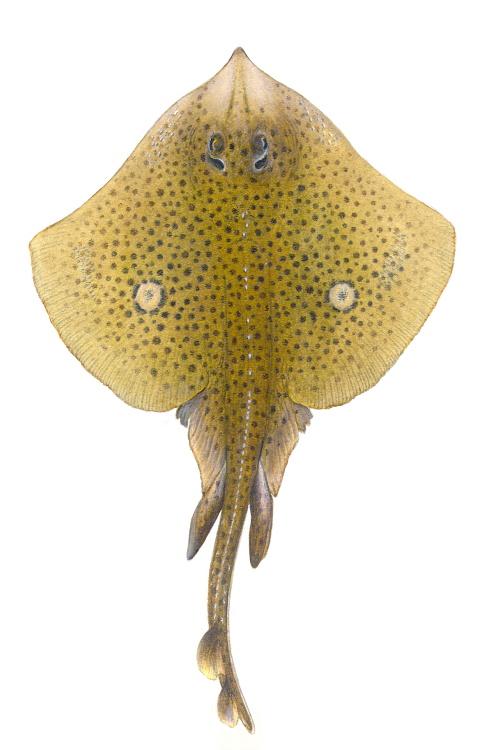
Sharks and Skates of Scotland Report: Spotted skate (Raja montagui)
An extract from the Sharks and Skates of Scotland Report.
Spotted skate - Raja montagui (Fowler, 1910)
Occurrence in Scotland: Shelf. Resident. Common throughout shelf waters. Less common in the southern part of the Scottish North Sea.
Synonym(s): None; Order: Rajiformes; Family: Rajidae
Common name: Spotted skate, Spotted ray
AlphaID: 105887 TSN Code: 160883
Note: accurate species-specific landings data is not available, and most reliable data are from fishery-independent surveys (ICES, 2018). Raja montagui is often landed and confused with Blonde skate (R. brachyura), and some of the data for these two species are confounded.
Population status
Scotland and Northeast Atlantic: Increasing in Northeast Atlantic (Rigby et al., 2024).
Global: Increasing. Trend analysis of the North Atlantic modelled biomass for 1950–2021 (71 years) revealed annual rates of increase of 4.22% over three generation lengths (27 years), with the highest probability of no major reductions in population over the past three generation lengths (Rigby et al., 2024).
Conservation listings
- IUCN Red List Global: Least Concern (assessment 14 April 2023)
- IUCN Red List Europe: Least Concern (assessment 23 March 2015)
- IUCN Red List Mediterranean: Least concern (assessment 25 March 2016)
- CITES: Not listed
- CMS: Not listed
- OSPAR: Threatened and/or Declining Species
Range and distribution
Spotted skate are found through much of the Northeast Atlantic from Norway to Morocco, and northern Africa in the Mediterranean Sea (Ellis et al., 2015; Last et al., 2016, Ebert and Dando 2021). Around the British Isles, they tend to be more abundant along the southern and western coasts (Ellis et al., 2005), although they can also be found in the North Sea and waters off the west of Scotland (Ellis et al., 2015).
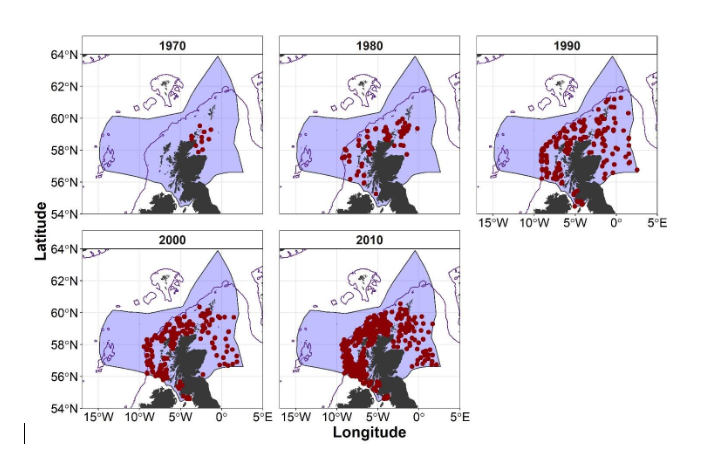
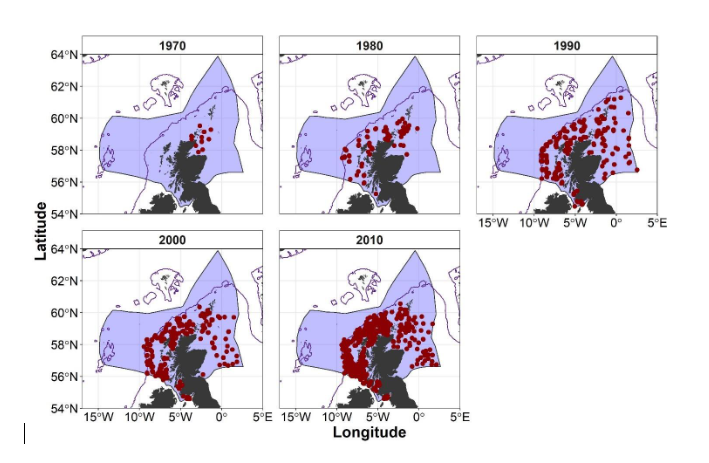
ICES DATRAS records for Spotted skate (Raja montagui), 1970 to 2019.
Click for a full description
View a larger version of this image.
Four maps of the EEZ of Scotland showing the ICES (International Council for the Exploration of the Sea) DATRAS (database of trawl surveys hosted by ICES) records for Spotted skate (Raja montagui) from bottom trawl surveys conducted between 1970 and 1979, 1980 and 1989; 1990 and1999; 2000 and 2009 and 2010 and 2019. Red points represent trawl shoot positions in which Spotted skate (R. montagui) were captured. From 1970 to 1979 records were distribute in the Moray Firth and around the Orkney Isles. From 1980 to 1989 records were distributed evenly on the west coast of Scotland up to the edge of the continental shelf, there were also some records in the Moray Firth and two dense clusters of records one on the north coast of Scotland extending north to the west of the Orkney Isles and one between the Orkney Isles and the Shetland Isles. From 1990 to 1999 records were evenly distributed throughout the EEZ of Scotland on the continental shelf. From 2000 to 2009 records were similar to 1990 to 1999 except for notable absences of records on the east coast of Scotland and to the west of the Outer Hebrides and in the most northerly areas of the EEZ of Scotland. Finally, from 2010 to 2019 records were similar to 2000 to 2009 but with higher density on the west coast of Scotland. A change in the number or distribution of records over time does not reflect a change in occurrence or abundance since data have not been corrected for effort.
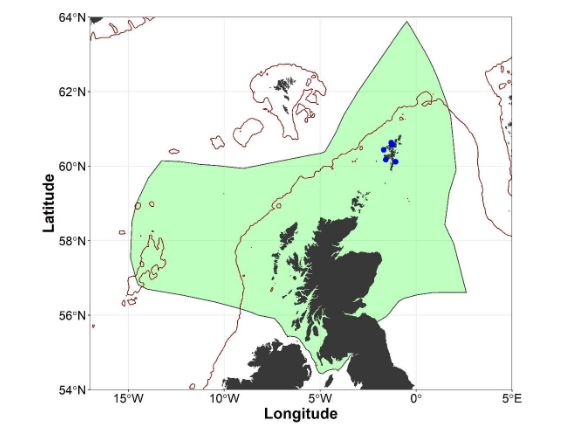
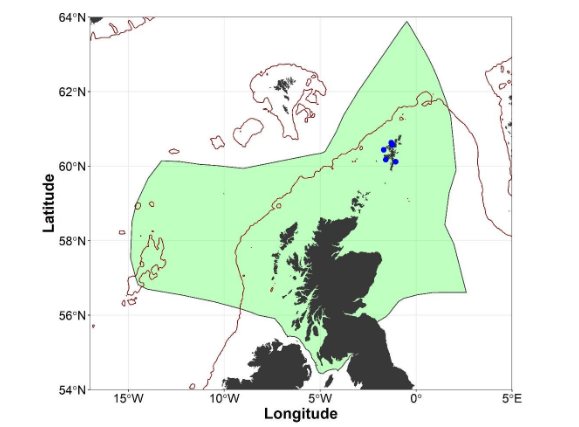
Tag – recapture records for Spotted skate (Raja montagui) from the Scottish Shark Tagging Programme, the Glasgow Museums tagging programme and the UK Shark Tagging Programme data from 1970 to 2025. Data assimilated by the Scottish Shark Tagging Programme.
Click for a full description
View a larger version of this image.
Map of the economic exclusion zone of Scotland showing records for Spotted skate (Raja montagui) from the Scottish Shark Tagging Programme, Glasgow Museums tagging programme and the UK Shark Tagging Programme data from 1970 to 2025. Data are presented as blue dots for each individual Spotted skate (R. montagui) tagged or recaptured. These tag – recapture records provided by anglers and occasionally supplemented by reports of tagged animals subsequently captured on commercial fishing vessels show tight clusters in places where angling and tagging have occurred, in this case, around the Shetland Isles.
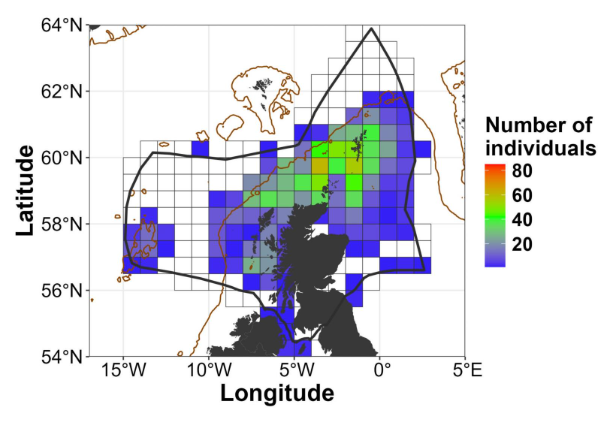
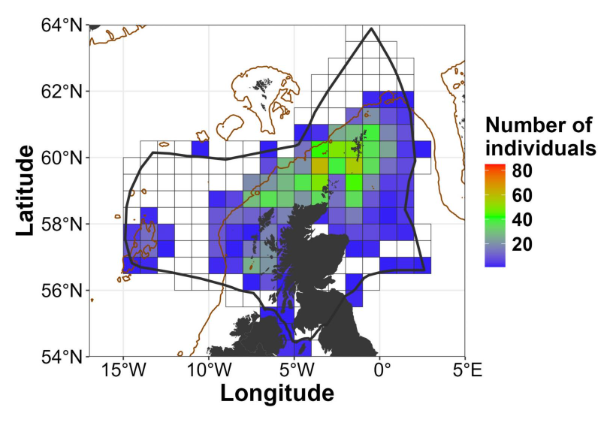
Landings data from commercial fishing vessels in ICES rectangles for Spotted skate (Raja montagui) 2011 - 2019.
Click for a full description
View a larger version of this image.
Map of the economic exclusion zone (EEZ) of Scotland showing landings data for Spotted skate (Raja montagui) recorded on commercial fishing vessels from 2011 to 2019. The EEZ of Scotland is covered by a grid dividing it into the International Council for the Exploration of the Sea (ICES) rectangles. Data is filtered to exclude information in rectangles where three vessels or less operate. Values are presented as individuals per trip and represented as a heat map, colouring each ICES rectangle from 1 (blue) to 81 (red). Small numbers of landings (0 to 20 individuals) represented by blue rectangles were recorded for the whole of the continental shelf in the EEZ of Scotland apart from on the southeast coast. Higher landings (around 40 individuals) represented by green rectangles were recorded around the north of Scotland, the Orkney Isles and the Shetland Isles. The highest reported landings (over 60 individuals landed) represented by orange rectangles were reported to the South and southwest of Shetland.
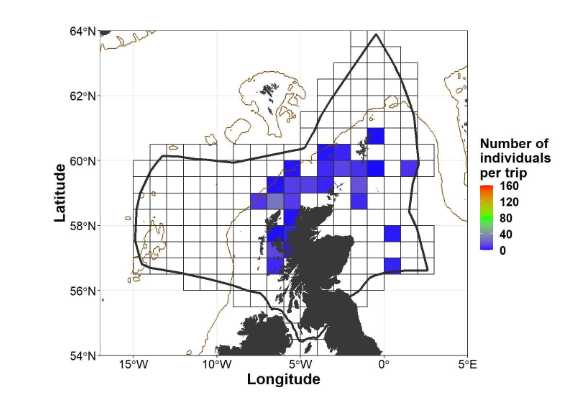
Discard data from commercial fishing vessels in ICES rectangles for Spotted skate (Raja montagui) 2014 - 2018.
Click for a full description
View a larger version of this image.
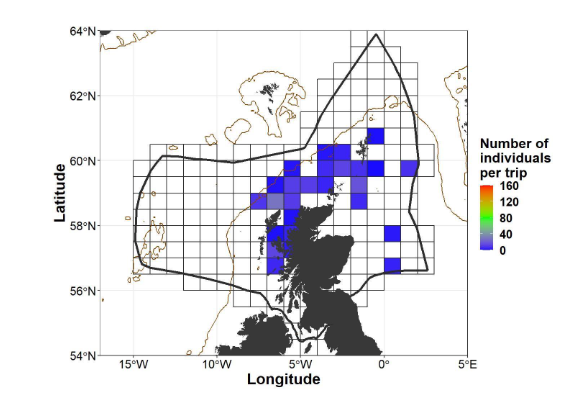
Map of the economic exclusion zone (EEZ) of Scotland showing discard data for Spotted skate (Raja montagui) recorded on commercial fishing vessels from 2014 to 2018. The EEZ of Scotland is covered by a grid dividing it into the International Council for the Exploration of the Sea (ICES) rectangles. Data is filtered to exclude information in rectangles where three vessels or less operate. Values are presented as individuals per trip and represented as a heat map, colouring each ICES rectangle from 1 (blue) to 160 (red). Small numbers of discards represented by blue rectangles (0 to 40 individuals) were recorded in the Minch, northwest of Scotland up to the edge of the continental shelf, around the Orkney and Shetland Isles and in the North Sea.
Habitat
Spotted skate are a relatively shallow-water species found on the continental shelf and upper slope at depths of 10–650 m, and possibly to 800 m, but is most common in waters 10–200 m (Ebert and Dando 2021; Rigby et al., 2024) on sandy sediments (Ellis et al., 2005)
Biology and Ecology
Spotted skate are a small-bodied species, with an average length of 60 cm TL, and a maximum recorded length of 80 cm (Ellis et al., 2015). Males and females reach maturity at around 40 cm and 49 cm, respectively, and there are no observed differences in length at maturity around UK waters (McCully et al., 2012). Females are thought to live for up to seven years and lay around 60 to 70 eggs per year (Ellis et al., 2015), with egg cases ranging from 10-15 cm long and 3-3.5 cm wide (Ebert and Stehmann, 2013). The generation time is estimated to be 6-7 years (Ellis et al., 2015). Juveniles are more common on shallow sandy sediments while adults tend to be found further from the shore over sand and coarser substates (Ellis et al., 2005; Ellis et al., 2015; ICES, 2018a). Potential nursery areas for Spotted skate have been identified in coastal areas with rock and sand substrates (ICES, 2024a). Spotted skate have a varied diet that includes crustaceans, polychaetes, fish and molluscs (Ellis et al.,1996).
Human interactions
Spotted Skate are an important commercial species across its range, and are caught in mixed demersal fisheries using trawl, set net (gillnet and trammel), and longline (Rigby et al., 2024). The current exploitation rate is not accurately known due to confusion with the larger bodied Blonde skate (Raja brachyura) in some landings data; however, its small body size may make it more resilient to overfishing than some of the larger, slower maturing skate (ICES, 2024).
ICES advised that when the maximum sustainable yield (MSY) approach is applied, catches in 2026 and 2027 should be no more than 1468 and 1357 tonnes, respectively. If discard rates do not change from the average of the last three years (2022–2024), this implies landings in 2026 and 2027 of no more than 832 and 769 tonnes, respectively, for the Greater North Sea and eastern English Channel (ICES, 2025). ICES advised that when the maximum sustainable yield (MSY) approach is applied, that landings should be no more than 757 tonnes in each of the years 2025 and 2026 for southern Celtic Seas and western English Channel (ICES, 2024b) and no more than 32 tonnes in each of the years 2025 and 2026 for the West of Scotland, west and southwest of Ireland (ICES, 2024c).
References
Ebert, D.A. and Dando, M. 2021. Field guide to sharks, rays & chimaeras of Europe and the Mediterranean. Princeton University Press, Plymouth, U.K.
Ebert, D A. and Stehmann, M.F.W. (2013) Sharks, batoids, and chimaeras of the North Atlantic. FAO Species Catalogue for Fishery Purposes. No. 7. Rome: Food and Agricultural Organization of the United Nations (FAO).
Ellis, J.R. et al., (1996) ‘The Comparative Feeding Ecology of Six Species of Shark and Four Species of Ray (Elasmobranchii) In The North-East Atlantic’, Journal of the Marine Biological Association of the United Kingdom. Cambridge University Press (CUP), 76(1), pp. 89–106. doi: 10.1017/s0025315400029039.
Ellis, J. R. et al., (2005) ‘The Distribution of Chondrichthyan Fishes Around the British Isles and Implications for Conservation’, Journal of Northwest Atlantic Fisheries Science, 35, pp. 195–213.
Ellis, J.R. et al., (2015) Spotted Skate, Raja montagui, The IUCN Red List of Threatened Species 2015: e.T63146A48919726.
ICES. (2024b). Spotted ray (Raja montagui) in divisions 7.a and 7.e-h (southern Celtic Seas and western English Channel). In Report of the ICES Advisory Committee, 2024. ICES Advice 2024, rjm.27.7ae-h.
ICES. (2024c). Spotted ray (Raja montagui) in Subarea 6 and divisions 7.b and 7.j (West of Scotland, west and southwest of Ireland). In Report of the ICES Advisory Committee, 2024. ICES Advice 2024, rjm.27.67bj.
ICES. (2025). Spotted ray (Raja montagui) in Subarea 4 and divisions 3.a and 7.d (North Sea, Skagerrak, Kattegat, and eastern English Channel). In Report of the ICES Advisory Committee, 2025. ICES Advice 2025, rjm.27.3a47d.
Martin, C.S. et al., (2010) ‘Spatio-temporal patterns in demersal elasmobranchs from trawl surveys in the eastern English Channel (1988–2008)’, Marine Ecology Progress Series, 417, pp. 211–228.
McCully, S.R. et al., (2012) ‘Lengths at maturity and conversion factors for skates (Rajidae) around the British Isles, with an analysis of data in the literature’, ICES Journal of Marine Science. Narnia, 69(10), pp. 1812–1822. doi: 10.1093/icesjms/fss150.
Rigby, C.L., McCully-Phillips, S.R., Ellis, J.R., Serena, F., Soldo, A., Pacoureau, N. & Charles, R. 2024. Raja montagui. The IUCN Red List of Threatened Species 2024: e.T63146A183780480.