Sharks and Skates of Scotland Report: Smalleye catshark (Apristurus microps)
An extract from the Sharks and Skates of Scotland Report.
Smalleye catshark - Apristurus microps (Gilchrist, 1922)
Occurrence in Scotland: Deep-sea. Resident. Common along the continental slope of the Rockall Trough and northwest Scotland. High number of records from deep-water surveys.
Synonym(s): cylliorhinus microps; Order: Carcharhiniformes; Family: Pentanchidae
Common name: Smalleye catshark
AlphaID: 105809 TSN Code: 160016
Note: The genus Apristurus is “one of the most taxonomically confused shark genera” (Walls, 2015), and contains at least 32 described species and a number of undescribed species (Compagno, 1984; Walls, 2015).
Population status
Scotland and Northeast Atlantic: Increasing abundance between 1998 - 2013 in the Rockall Trough (Neat et al., 2015).
Global: Stable (Pollom et al., 2019).
Conservation listings
- IUCN Red List Europe: Least Concern (assessment 17 November 2014)
- IUCN Red List Global: Least Concern (assessment 25 April 2015)
- CITES: Not listed
- CMS: Not listed
- OSPAR: Not listed
- Listed on the UK’s ‘Prohibited Species’ list as documented in the ‘Written Record of fisheries consultations between the United Kingdom and the European Union for 2025’ for UK waters of ICES Subareas 5-10
- Zero TAC under EU Regulation 2018/2025 & EU Regulation 2023/194
- Prohibited under EU Regulation 2025/202
- Listed on The Sharks, Skates and Rays (Prohibition of Fishing, Trans-shipment and Landing) (Scotland) Order 2012.
- Included in the NEAFC measures prohibiting directed fishing for deep-sea sharks
Range and distribution
Smalleye catshark have a restricted range in the north-eastern Atlantic and are found in deep water between Scotland and Iceland (Ebert & Stehmann, 2013), as well as west of Ireland (Clarke et al., 2016). The species also occurs in the North-western Atlantic and along the west and south coasts of South Africa (Ebert & Stehmann, 2013).
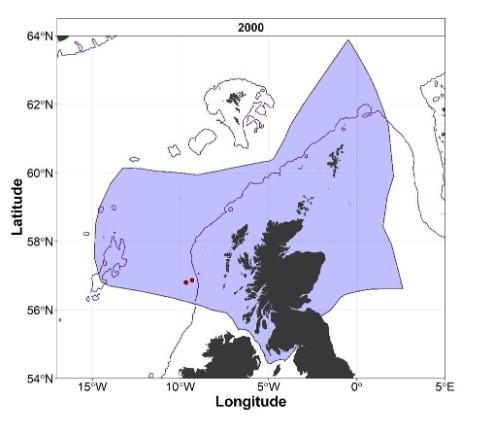
ICES DATRAS records for the Smalleye catshark (Apristurus microps) from 2000-2009.
Click for a full description
Map of the economic exclusion zone (EEZ) of Scotland showing the ICES (International Council for the Exploration of the Sea) DATRAS (database of trawl surveys hosted by ICES) records for the Smalleye catshark (Apristurus microps) from bottom trawl surveys conducted between 2000 and 2009. Two red points clustered to the west of the Isle of Barra beyond the continental shelf represent trawl shoot locations in which Smalleye catshark (A. microps) were captured.
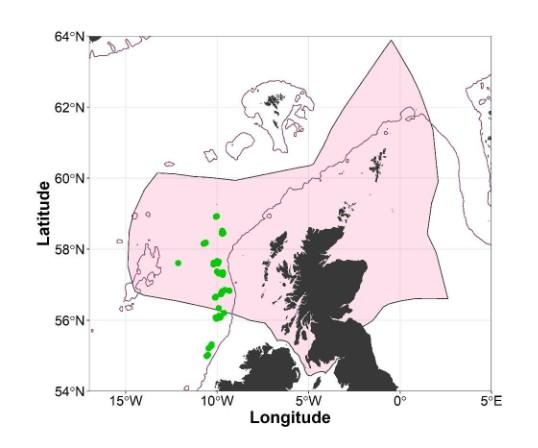
Records for the Smalleye catshark (Apristurus microps) from the SIAMISS and deep-water fisheries surveys undertaken by Marine Directorate 1996-2019.
Click for a full description
Map of the economic exclusion zone (EEZ) of Scotland showing records for the Smalleye catshark (Apristurus microps) from the Scottish-Irish anglerfish and megrim industry-science survey (SIAMISS) and deep-water fisheries surveys undertaken by Marine Directorate between 1996 and 2019. Records are illustrated as green points and are exclusively located off the west coast of Scotland and Northern Ireland off the edge of the continental shelf. Most records are located towards the bottom of the continental slope with some records in deeper water to the north-east of the Rockall Plateau.
Habitat
Smalleye catshark live on or near the seabed of continental slopes at depths of 700 – 2200 m (Ebert & Stehmann, 2013). In deep-water surveys west of Scotland Smalleye catshark were found regularly along the continental slope and out into the Rockall Trough at depths of 1500 – 2000 m, where their abundance increased with depths to 2000 m (Neat et al., 2015).
Biology and Ecology
Very little is known about the biology and ecology of this species. They are a medium-sized catshark, with a maximum total length of 85 cm in the Rockall Trough (Neat et al., 2015). Males reach sexual maturity at about 49 to 51 cm, and females mature at 47 to 49 cm (Ebert & Stehmann, 2013). They are an egg-laying species, and deposit small, smooth egg cases that are broad and thick, with small posterior horns and tendrils, measuring 4.7 to 5.2 cm in length with the posterior width of 32–37% of case length (Ebert et al., 2006; Ebert & Stehmann, 2013). Only the right ovary is functional, and a single egg case is produced per uterus (Ebert, et al., 2006, Kyne et al., 2011). Smalleye catshark females have shorter total length and length at first maturity than males, which is unusual in the class Chondrichthyes. Dietary studies of South African specimens revealed that their most common prey items were bony fish, crustaceans (including shrimps), and squid (Ebert et al., 1996). Smalleye catcharks are known to migrate off the bottom to feed on midwater prey. Neonates may inhabit the midwater for a period before becoming more demersal with maturation (Pollom et al., 2019).
Human interactions
Smalleye catsharks have been subject to a zero Total Allowable Catch in the Northeast Atlantic since 2010 (ICES, 2024) and has been a prohibited species since 2021. Apristurus spp. are prohibited species in UK, EU and international waters of ICES subareas 5-10 and 12 and vessels are prohibited from landing this species in Scottish waters.
References
Clarke, M. et al., (2016). Ireland Red List No. 11: Cartilaginous fish [sharks, skates, rays and chimaeras]. Dublin, Ireland.
Ebert, D.A. et al., (2006) ‘Reproductive biology of catsharks (Chondrichthyes: Scyliorhinidae) off the west coast of southern Africa’, ICES Journal of Marine Science, 63(6), pp. 1053–1065. doi: 10.1016/j.icesjms.2006.04.016.
Ebert, D.A. et al., (1996) ‘A preliminary investigation of the feeding ecology of catsharks (Scyliorhinidae) off the west coast of southern Africa’, South African Journal of Marine Science. Taylor & Francis, 17(1), pp. 233–240. doi: 10.2989/025776196784158563.
Ebert, D.A. and Stehmann, M.F.W. (2013). Sharks, batoids, and chimaeras of the North Atlantic. FAO Species Catalogue for Fishery Purposes. No. 7. Rome: Food and Agricultural Organization of the United Nations (FAO).
ICES (2018) Report of the Working Group on Elasmobranch Fishes (WGEF), 19-28. Lisbon, Portugal.
Kyne, P.M., Courtney, A.J. and Bennett, M.B. (2011). ‘Observations on the reproductive biology of three catsharks (Carcharhiniformes: Scyliorhinidae: Asymbolus and Figaro) from the continental shelf of southern Queensland, Australia’, Journal of the Marine Biological Association of the United Kingdom, 91(6), pp. 1157–1164. doi:10.1017/S0025315410001670.
Nakaya, K., White, W.T. & Ho, HC. Discovery of a new mode of oviparous reproduction in sharks and its evolutionary implications. Sci Rep 10, 12280 (2020).
Neat, F.C. et al., (2015) ‘The diversity, distribution and status of deep-water elasmobranchs in the Rockall Trough, north-east Atlantic Ocean’, Journal of Fish Biology. Blackwell Publishing Ltd, 87(6), pp. 1469–1488. doi: 10.1111/jfb.12822.
Pollom, R., Ebert, D.A. & Leslie, R. 2019. Apristurus microps. The IUCN Red List of Threatened Species 2019: e.T44657A124437644. Accessed on 10 February 2025.
Walls, R. (2015) Smalleye Catshark, Apristurus microps, The IUCN Red List of Threatened Species. (Accessed: 14 April 2020).