Sharks and Skates of Scotland Report: Shagreen skate (Leucoraja fullonica)
An extract from the Sharks and Skates of Scotland Report.
Shagreen skate - Leucoraja fullonica (Linnaeus, 1758)
Occurrence in Scotland: Shelf and slope. Resident. More commonly reported in the northern North Sea, patchy distribution on the west coast. Upper continental slopes and around Rockall.
Synonym(s): Raja fullonica; Order: Rajiformes; Family: Rajidae
Common name: Shagreen skate, Shagreen ray, Fuller's ray
AlphaID: 105874 TSN Code: 564134
Note: An accurate stock assessment has not been conducted due to a lack of long-term standardised abundance data for this species covering the whole stock area in the NE-Atlantic (McCully and Walls 2015), as well as a paucity of data on exploitation rate (ICES 2018). Some confusion/misidentification with larger individuals of small-eyed ray (Raja microocellata), ICES 2024. Suspected misidentification; Scottish landings of white skate (Rostroraja alba) may refer to shagreen skate (Leucoraja fullonica) in some cases (McCully-Phillips and Walls 2015).
Population status
Scotland and Northeast Atlantic: Stable. The trend analysis of the North Atlantic modelled biomass for 1997–2021 (24 years) revealed annual rates of increase of 0.23%, with the highest probability (36%) of no significant reductions in population over the past three generation lengths (36 years), though it was also quite probable that the species had exhibited a decline (Finucci et al., 2025). In the Mediterranean Sea, the shagreen skate is very scarce and is believed to have undergone a significant decline (Follesa et al., 2019; Geraci et al., 2021; Chatzispyrou and Koutsikopoulos, 2023; Finucci et al., 2025).
Global: Decreasing. Due to uncertain abundance trends in the North Atlantic, decreasing trends in the Mediterranean Sea, and high distribution overlap with intensive fishing pressure, a global population reduction of 30–49% was estimated over three generation lengths (36 years) based on abundance data and actual levels of exploitation (Finucci et al., 2025).
Conservation listings
- IUCN Red List Global and Europe: Vulnerable (assessed 20 February 2024)
- IUCN Red List Mediterranean: Critically Endangered (assessed 25 March 2016)
- CITES: Not listed
- CMS: Not Listed
- OSPAR: Not listed
Range and distribution
Shagreen skate are found in the Northeast Atlantic and the Mediterranean, and it is suspected that the populations are poorly connected (McCully-Phillips and Walls, 2015). The skate’s distribution in the Atlantic stretches from Madeira and northern Morocco up to Iceland, the Faeroes and around Norway, including the Skagerrak. Specifically around the British Isles, survey data from the 1960s to mid-2000’s indicate that it was absent from shallow waters of England and Wales, and catches were restricted to the northern North Sea (around the Shetland Isles) and Celtic Seas at depths of 90-424 m, with maximum catch rates of 7 individuals per hour (Daan et al., 2005; Ellis et al., 2005). Low numbers have also been recorded at Rockall Bank (McCully-Phillips and Walls, 2015). Historically, this species may have been more widely distributed along the continental shelf in the Northeast Atlantic, and its range is likely now restricted to deeper waters (McCully-Phillips and Walls, 2015). In recent Scottish surveys, catches have mostly been deeper than 200 m.
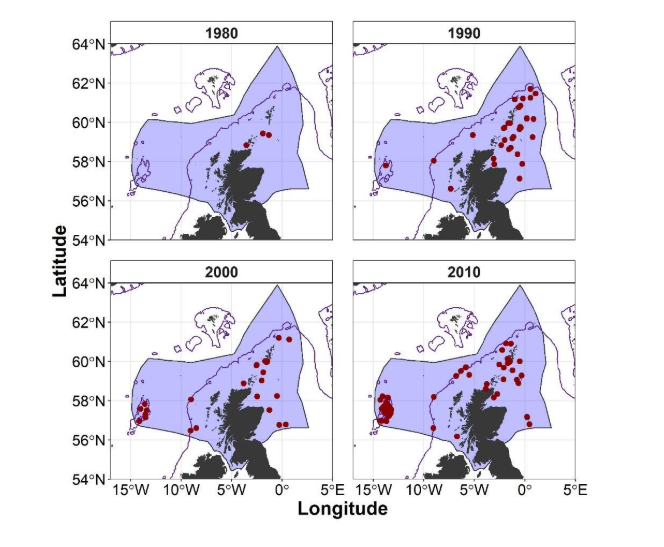
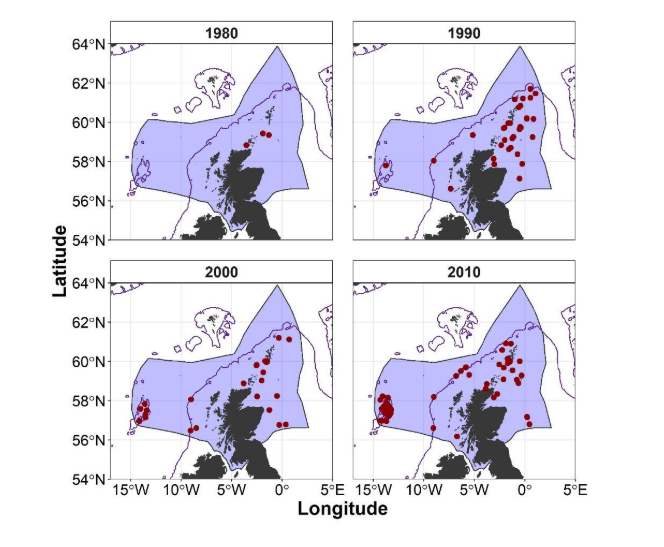
ICES DATRAS records for Shagreen skate (Leucoraja fullonica) 1980: 1980-1989, 1990: 1990-1999; 2000: 2000-2009 and 2010: 2010-2019.
Click for a full description
View a larger version of this image.
Four maps of the EEZ of Scotland showing the ICES (International Council for the Exploration of the Sea) DATRAS (database of trawl surveys hosted by ICES) records for Shagreen skate (Leucoraja fullonica) from bottom trawl surveys conducted between 1980 and 1989; 1990 and1999; 2000 and 2009 and 2010 and 2019. Red points represent trawl shoot positions in which Shagreen skate (L. fullonica) were captured. From 1980 to 1989, a few records were clustered around the Orkney Isles. From 1990 to 1999 there were records across the whole of the North Sea with single records to the west of the Isle of Tiree, on the north coast of Scotland on the edge of the continental shelf to the west of the Outer Hebrides and on the Rockall Plateau. From 2000 to 2009, records were similar to 1990 to 1999 except there were more records on the Rockall Plateau. Finally, from 2010 to 2019, records were similar again with more records on the Rockall Plateau. A change in the number or distribution of records over time does not reflect a change in occurrence or abundance since data have not been corrected for effort.
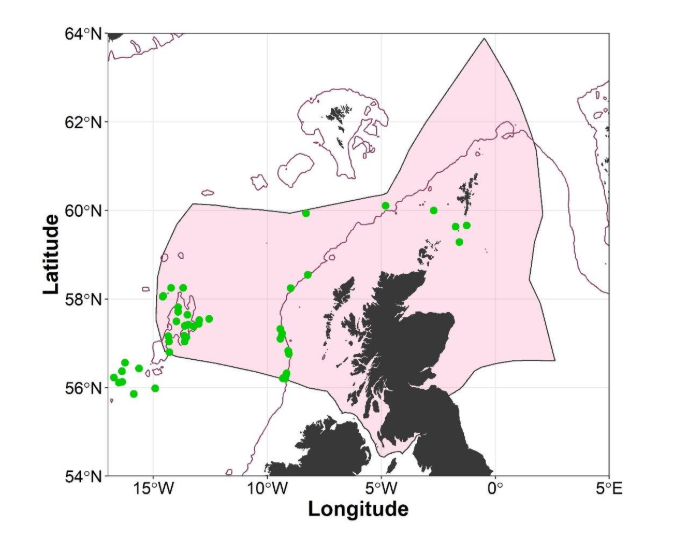
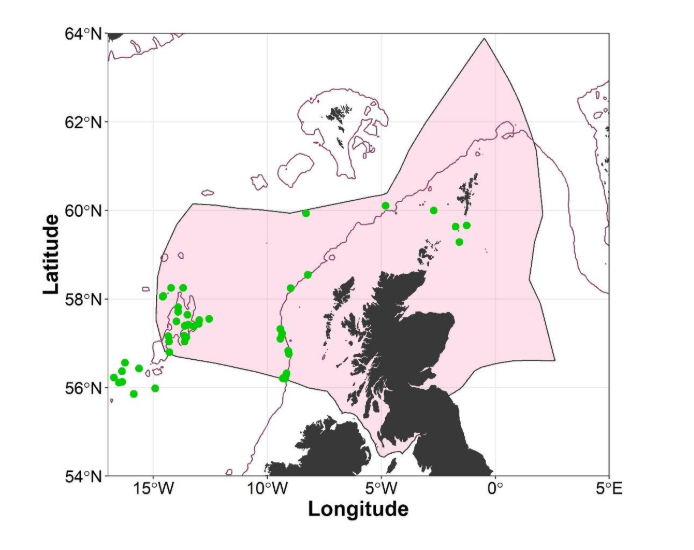
Records for Shagreen skate (Leucoraja fullonica) from SIAMISS and deep-water fisheries surveys undertaken by Marine Directorate 1996 – 2019.
Click for a full description
View a larger version of this image.
Map of the economic exclusion zone (EEZ) of Scotland showing records for Shagreen skate (Leucoraja fullonica) from the Scottish-Irish anglerfish and megrim industry-science survey (SIAMISS) and deep-water fisheries surveys undertaken by Marine Directorate 1996-2019. Records are illustrated as green points and occur along the edge of the continental shelf on the west coast of Scotland. There is a small group of records around Fair Isle and a larger cluster of records on and around the Rockall Plateau.
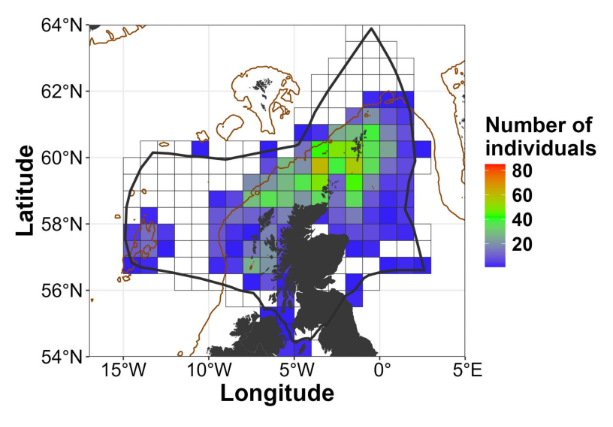
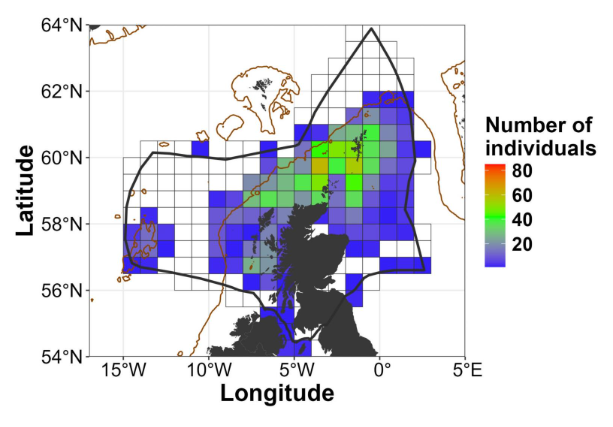
Landings data from commercial fishing vessels in ICES rectangles for Shagreen skate (Leucoraja fullonica) 2011-2019. Data is filtered to exclude information in rectangles where three vessels or less operate.
Click for a full description
View a larger version of this image.
Map of the economic exclusion zone (EEZ) of Scotland showing landings data for Shagreen skate (Leucoraja fullonica) recorded on commercial fishing vessels from 2011 to 2019. The EEZ of Scotland is covered by a grid that divides it into International Council for the Exploration of the Sea (ICES) rectangles. Data is filtered to exclude information in rectangles where three vessels or less operate. Values are presented as individuals per trip and represented as a heat map, colouring each ICES rectangle from 1 (blue) to 81 (red). Small numbers of landings (0 to 20 individuals) represented by blue rectangles were recorded around the Shetland Isles, on the continental shelf to the west and north of the Shetland Isles and on and around the north of the Rockall plateau.
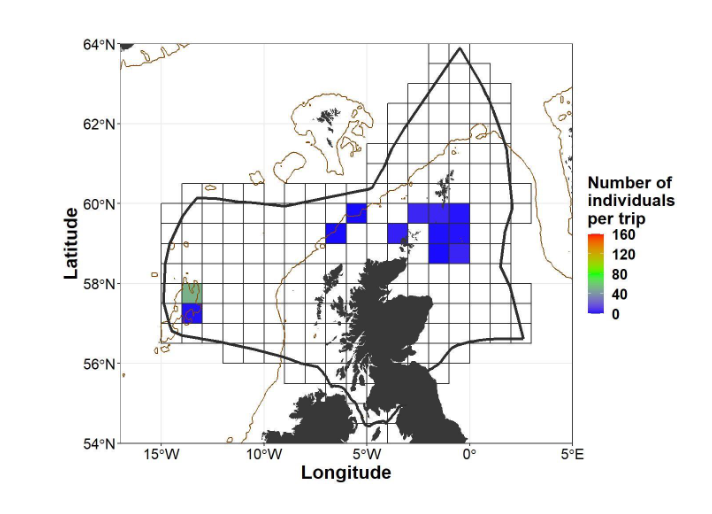
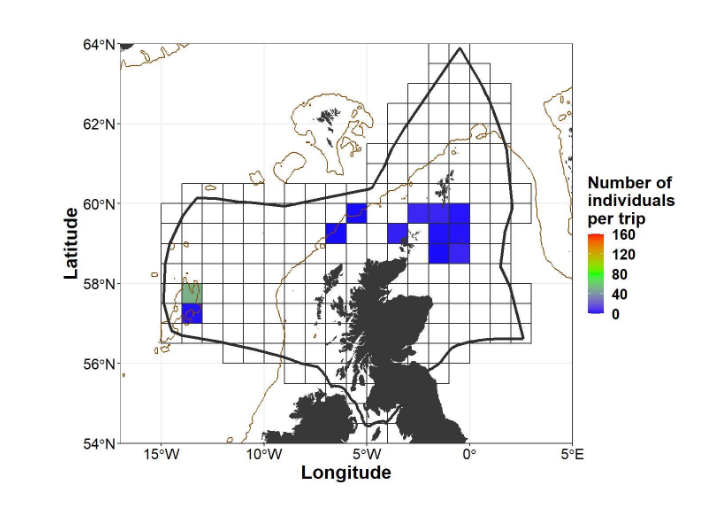
Discard data from commercial fishing vessels in ICES rectangles for Shagreen skate (Leucoraja fullonica) 2014-2018. Data is filtered to exclude information in rectangles where three vessels or less operate.
Click for a full description
View a larger version of this image.
Map of the economic exclusion zone (EEZ) of Scotland showing discard data for Shagreen skate (Leucoraja fullonica) recorded on commercial fishing vessels. The EEZ of Scotland is covered by a grid dividing it into the International Council for the Exploration of the Sea (ICES) rectangles. Data is filtered to exclude information in rectangles where three vessels or less operate. Values are presented as individuals per trip and represented as a heat map, colouring each ICES rectangle from 1 (blue) to 160 (red). Small numbers (0 to 40) of discards were recorded represented by blue rectangles to the west of the Orkney Isles and south of the Shetland Isles and along the edge of the continental shelf northwest of Scotland. Higher numbers of discards (40 to 80 individuals per trip) represented by green rectangles were recorded on the north of the Rockall plateau.
Habitat
In the Northeast Atlantic, this offshore species is most often found on the outer continental shelf at a depth of 30 to 600 m, but predominantly around 200 m (Last et al., 2016, Ebert and Dando 2021) from Murmansk (Russia), Iceland and Norway in the north to Morocco in the south, and the Mediterranean Sea (Last et al., 2016).
Biology and Ecology
Shagreen skate have a relatively large body size, with a recorded maximum size of 100-110 cm TL. Survey data from the Celtic Seas and North Sea (1992 - 2011) recorded males measuring from 21-96 cm (TL) and females measuring 24-70 cm TL, the vast majority of which were immature (McCully et al., 2012). The species are oviparous, laying paired eggs (Dulvy and Reynolds 1997) that measure 7.5-9.9 cm long to 4.5-9.9 cm wide and are deposited on sandy or muddy flats (Breder and Rosen 1996). Little else is known about the biology and reproduction of this species (Finucci et al., 2025).
Human interactions
There is no targeted fishery for Shagreen skate in Scottish waters, but their relatively large body size makes them vulnerable to exploitation, and they are usually taken as bycatch of trawl and gillnet fisheries, including mixed demersal fisheries targeting hake, anglerfish, and megrim (ICES 2024). The species can be a relatively important bycatch in the southwestern Celtic Sea and in some deep-water fisheries operating on continental slopes and offshore banks (ICES 2018).
Shagreen skate are included in the group of ‘other skates and rays’ in the ICES assessments for the North Sea, with ICES unable to provide any advice for the period 2024-2027 due to the lack of sufficient survey and catch data (ICES, 2023). For West of Scotland, southern Celtic Seas, and English Channel, ICES advised that when the precautionary approach is applied, landings should be no more than 134 tonnes in each of the years 2025–2028 (ICES, 2024).
References
Breder C. and Rosen D. (1996) Modes of reproduction in fishes. T.F.H. Publications, Neptune City, New Jersey
Chatzispyrou, A. and Koutsikopoulos, C. 2023. Tracing Patterns and Biodiversity Aspects of the Overlooked Skates and Rays (Subclass Elasmobranchii, Superorder Batoidea) in Greece. Diversity 15(1): 55.
Clarke M. et al., (2016) Ireland Red List No. 11: Cartilaginous fish [sharks, skates, rays and chimaeras]. Dublin, Ireland
Daan N, Heessen H, ter Hofstede R (2005) North Sea Elasmobranchs: distribution, abundance and biodiversity. ICES CM 2005/N:06.
Dulvy N.K. amd Reynolds J.D. (1997) Evolutionary transitions among egg-laying, live-bearing and maternal inputs in sharks and rays. Proc R Soc London B:1309–1315.
Ebert, D.A. and Dando, M. 2021. Field guide to sharks, rays & chimaeras of Europe and the Mediterranean. Princeton University Press, Plymouth, U.K.
Ellis, J. R. et al., (2005) The Distribution of Chondrichthyan Fishes Around the British Isles and Implications for Conservation. J Northwest Atl Fish Sci 35:195–213.
Finucci, B., Rigby, C.L., Ellis, J.R., McCully-Phillips, S.R., Serena, F. & Charles, R. 2025. Leucoraja fullonica. The IUCN Red List of Threatened Species 2025: e.T161461A124489576.
Follesa, M.C., et al., 2019. Spatial variability of Chondrichthyes in the northern Mediterranean. Scientia Marina 83: 81–100.
Geraci, M.L., Ragonese, S., Scannella, D., Falsone, F., Gancitano, V., Mifsud, J., Gambin, M., Said, A. and Vitale, S. 2021. Batoid abundances, spatial distribution, and life history traits in the Strait of Sicily (Central Mediterranean Sea): Bridging a knowledge gap through three decades of survey. Animals 11: 2189.
ICES (2023). Other rays and skates (Rajidae) in Subarea 4 and in divisions 3.a and 7.d (North Sea, Skagerrak, Kattegat, and eastern English Channel). In Report of the ICES Advisory Committee, 2023. ICES Advice 2023, raj.27.3a47d
ICES (2024). Shagreen ray (Leucoraja fullonica) in subareas 6-7 (West of Scotland, southern Celtic Seas, English Channel). In Report of the ICES Advisory Committee, 2024. ICES Advice 2024, rjf.27.6
Last, P., White, W., de Carvalho, M., Séret, B., Stehmann, M. and Naylor, G. 2016. Rays of the World. CSIRO Publishing, Clayton.
McCully S.R. et al., (2012) Lengths at maturity and conversion factors for skates (Rajidae) around the British Isles, with an analysis of data in the literature. ICES J Mar Sci 69:1812–1822. doi: 10.1093/icesjms/fss150 .