Sharks and Skates of Scotland Report: Richardson’s skate (Bathyraja richardsoni)
An extract from the Sharks and Skates of Scotland Report.
Richardson’s skate - Bathyraja richardsoni (Garrick, 1961)
Occurrence in Scotland: Deep-water. Occasional. Found on the continental slope of the Rockall Trough.
Synonym(s): Raja richardsoni; Order: Rajiformes; Family: Arhynchobatidae
Common name: Richardson’s skate, Deepsea skate, Richardson’s ray
AlphaID: 105867 TSN Code: 160931
Population status
Scotland and Northeast Atlantic: Unknown (Neat et al., 2015; Stehmann and Farrell, 2015).
Global: Unknown (Kulka et al., 2015).
Note: Species not encountered regularly enough in surveys to model temporal trends.
Conservation listings
- IUCN Red List Europe: Least Concern (assessment 22 October 2014)
- IUCN Red List Global: Least Concern (assessment 20 February 2015)
- CITES: Not listed
- CMS: Not listed
- OSPAR: Not listed
- Included in the NEAFC measures prohibiting directed fishing for deep-sea rays
Range and distribution
This skate species has been recorded in deep water across much of the North Atlantic and is suspected to be more widespread than current records indicate (Stehmann and Farrell, 2015). In the Northeast Atlantic, it occurs from the northern Bay of Biscay, Rockall Trough, west of Scotland and Ireland, and the Mid-Atlantic Ridge (Ebert and Stehmann, 2013), as well as off the Azores and in the Mid-Atlantic Ridge area (Orlov et al., 2006). It is also documented in the Southern hemisphere in waters off Tasmania and New Zealand (Last and Stevens, 2009; Garrick, 1961; Kulka et al., 2015).
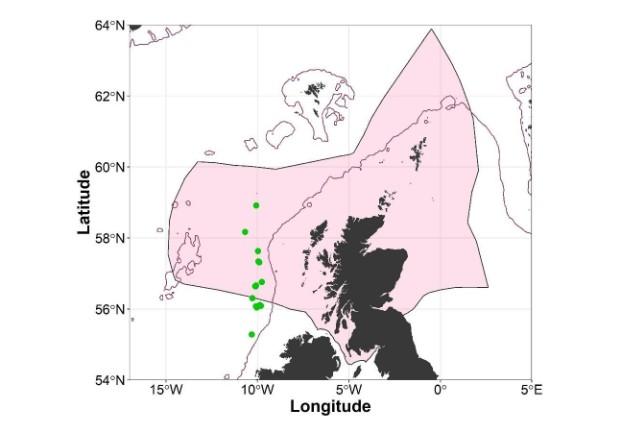
Records for Richardson’s skate (Centroscymnus crepidater) from the SIAMISS and deep-water fisheries surveys undertaken by Marine Directorate 1996-2019.
Click for a full description
Map of the economic exclusion zone (EEZ) of Scotland showing records for Richardson’s skate (Centroscymnus crepidater) from the Scottish-Irish anglerfish and megrim industry-science survey (SIAMISS) and deep-water fisheries surveys undertaken by Marine Directorate between 1996 and 2019. Records are illustrated as green points and are exclusively located off the west coast of Scotland and Northern Ireland off the edge of the continental shelf beyond the shelf slope.
Habitat
Richardson’s skate are a rarely encountered deep-water skate species, which have been found on continental slopes, submarine rises and deep-water plains at depths of 1219−2992 m (Ebert and Stehmann, 2013; Stehmann and Farrell, 2015). In deep-water surveys of the Rockall Trough, west of Scotland, Richardson’s skate were recorded in low numbers at depths of 1500 – 2030 m (Neat et al., 2015).
Biology and Ecology
This is a relatively large skate species, capable of reaching a maximum body size of ~174 cm (TL) and is 18.2 – 24.5 cm (TL) at birth (Tempelman, 1973). The species is oviparous (egg-laying) with egg capsules measuring between 20 - 21 cm in length and 11-12 cm in width, excluding horns (Stehmann and Merrett, 2001; Ebert and Dando 2021). In deep-water surveys west of Scotland most individuals captured were large males, with only one small juvenile female recorded. More recent ROV surveys of the Hebrides Terrace Seamount in the Rockall Trough found that Richardson’s skate deposit their egg capsules in sites with the following environmental characteristics: well-oxygenated waters between 4.20 and 4.55oC; salinity 34.95–35.06; at depths of 1489–1580 m, and on a coarse to fine-grained sandy seabed on the seamount’s eastern flank (Henry et al., 2016). In the waters off Tasmania, Richardson’s skate egg nurseries have been observed on seamount coral reefs at depths of 950 -1350 m at temperatures of 3.94 oC (Maguire et al., 2023). Richardson’s skate mainly prey on bony fish and crustaceans (Tempelman, 1973; Gordon and Duncan, 1989). Little else is known about their biology and ecology (Neat et al., 2015).
Human interactions
Incidental catch in deepwater fisheries is the predominant potential threat to Richardson's Skate in the North Atlantic (Kulka et al., 2015); however, due to the great depths at which it lives (mainly >1500 m), it has limited interaction with fisheries and is rarely caught. Since the introduction of general measures to protect deep-water elasmobranchs (ban of static net fisheries below 600 m and trawls below 800 m; ICES 2024), the species is likely to be afforded some protection due to the depths at which it occurs.
References
Ebert, D.A. and Stehmann, M.F.W. (2013) Sharks, batoids, and chimaeras of the North Atlantic. FAO Species Catalogue for Fishery Purposes. No. 7. Rome: Food and Agricultural Organization of the United Nations (FAO).
Ebert, D. A., & Dando, M. (2021). Field Guide to Sharks, Rays & Chimaeras of Europe and the Mediterranean. Princeton University Press.
Gordon, J.D.M. and Duncan, J.A.R. (1989) ‘A note on the distribution and diet of deep-water rays (rajidae) in an area of the rockall Trough’, Journal of the Marine Biological Association of the United Kingdom. Cambridge University Press, 69(3), pp. 655–658. doi: 10.1017/S0025315400031040.
Garrick, J.A.F. 1961. Studies on New Zealand Elasmobranchii. Part XIII. A new species of Raja from 1,300 fathoms. Transactions of the Royal Society of New Zealand 88: 743-748
Henry, L. A. et al., (2016) ‘Seamount egg‐laying grounds of the deep‐water skate Bathyraja richardsoni’, Journal of Fish Biology, 89(2), pp. 1473–1481.
Kulka, D.W., Orlov, A. & Barker, A.S. 2015. Bathyraja richardsoni. The IUCN Red List of Threatened Species 2015: e.T63127A70709214. Accessed on 27 March 2025.
Last, P.R. and Stevens, J.D. 2009. Sharks and Rays of Australia. Second Edition. CSIRO Publishing, Collingwood.
Maguire, K., O'Neill, H., Althaus, F., White, W., & Williams, A. (2023). Seamount coral reefs are egg case nurseries for deep‐sea skates. Journal of Fish Biology, 102(6), 1455-1469.
Neat, F.C. et al., (2015) ‘The diversity, distribution and status of deep-water elasmobranchs in the Rockall Trough, north-east Atlantic Ocean’, Journal of Fish Biology. Blackwell Publishing Ltd, 87(6), pp. 1469–1488. doi: 10.1111/jfb.12822.
Orlov, A.M. et al., (2006) ‘Deep-water skates (Rajidae) collected during the 2004 cruises of R.V. “G.O. Sars” and “M.S. Loran” in the Mid-Atlantic Ridge area’, Cybium: international journal of ichthyology, 30, pp. 35–48. (Accessed: 14 January 2020).
Stehmann, M.F.W. and Farrell, E. (2015) Richardson’s Skate, Bathyraja richardsoni, The IUCN Red List of Threatened Species 2015: e.T63127A48918113. (Accessed: 17 April 2020).
Stehmann, M.F.W. and Merrett, N.R. (2001) ‘First records of advanced embryos and egg capsules of Bathyraja skates from the deep north-eastern Atlantic’, Journal of Fish Biology, 59(2), pp. 338–349. doi: 10.1111/j.1095-8649.2001.tb00134.x.
Tempelman, W. (1973) ‘First records, description, distribution, and notes on the biology of Bathyraja richardsoni (Garrick) from the Northwest Atlantic.’, Journal of Fisheries Research Board of Canada, 30, pp. 1831–1840.