Sharks and Skates of Scotland Report: Portuguese dogfish (Centroscymnus coelolepis)
An extract from the Sharks and Skates of Scotland Report.
Portuguese dogfish - Centroscymnus coelolepis (Barbosa du Bocage and de Brito Capello, 1864)
Occurrence in Scotland: Deep-water. Resident. Found on the continental slope of the Rockall Trough and the continental shelf off NW Scotland, low numbers on Rosemary Bank, the Rockall slope of the Rockall Trough, the southern slopes of the Wyville Thomson ridge and to the north of Rockall.
Synonym(s): None; Order: Squaliformes; Family: Somniosidae
Common name: Portuguese dogfish;
AlphaID: 105907 TSN Code: 160724
Data note: In the past in some European fisheries, landings data for Leafscale gulper shark Centrophorus squamosus and Portuguese dogfish Centroscymnus coelolepis were combined, under a generic term “siki”.
Population status
Scotland and Northeast Atlantic: Decreasing (Finucci et al., 2021). Significant declines were recorded in the Northeast Atlantic until 2009 (Dureuil and Jung, 2015). There are some indications that there may be increasing numbers in Scottish waters.
Global: Decreasing. Despite an increasing trend in the Northeast Atlantic, overall, the species is estimated to have undergone a population reduction of 20–29% over the past three generations (111 years) based on abundance data and actual levels of exploitation (Finucci et al., 2021).
Conservation listings
- IUCN Red List Global: Near Threatened (assessment 21 November 2019)
- IUCN Red List Europe: Endangered (assessment 16 December 2014)
- CITES: Not listed
- CMS: Not listed
- OSPAR: Listed on OSPAR’s “List of Threatened and/or Declining Species & Habitats”
- Listed as a Priority Marine Feature in Scotland
- Scottish Biodiversity List
- Listed on the UK’s ‘Prohibited Species’ list as documented in the ‘Written Record of fisheries consultations between the United Kingdom and the European Union for 2025’ for UK waters in ICES Division 2a and Subarea 4
- Zero TAC under Regulation 2018/2025 (Annex I) & Regulation 2023/194 (Article 18)
- Prohibited under EU Regulation 2025/202
- Listed on The Sharks, Skates and Rays (Prohibition of Fishing, Trans-shipment and Landing) (Scotland) Order 2012
- Included in the NEAFC measures prohibiting directed fishing for deep-sea sharks
Range and distribution
Portuguese dogfish are a wide-ranging species that can be found across the eastern Atlantic, from Iceland to South Africa, the western Mediterranean and western Pacific, from Japan to Tasmania (Stevens and Correia, 2003). In European waters, the species inhabits the continental slope waters to the west of the British Isles. The Mediterranean population is believed to be a separate subpopulation of the Atlantic population (Clò et al., 2002, Catarino et al., 2015).
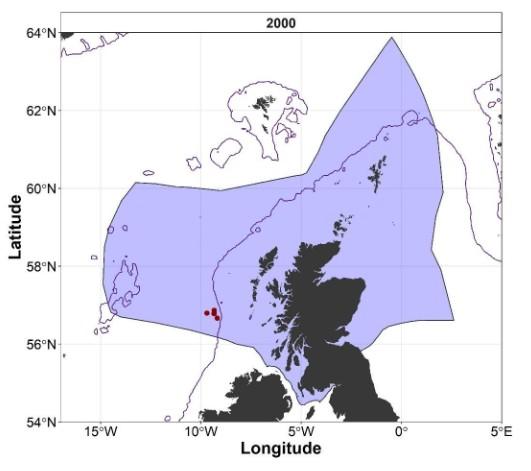
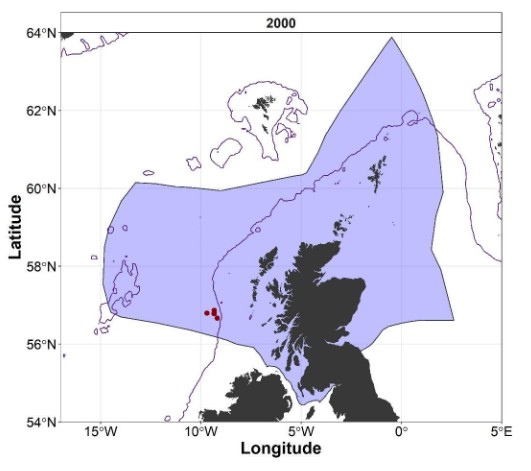
ICES DATRAS records for Portugese dogfish (Centroscymnus coelolepis), 2000-2009.
Click for a full description
View a larger version of this image.
Map of the EEZ of Scotland showing the ICES (International Council for the Exploration of the Sea) DATRAS (database of trawl surveys hosted by ICES) records for Portugese dogfish (Centroscymnus coelolepis) from bottom trawl surveys conducted between 2000 and 2009. Red points represent trawl shoot positions in which Portugese dogfish (C. coelolepis) were captured. Records are exclusively in a single cluster on the continental slope west of the Isle of Barra.
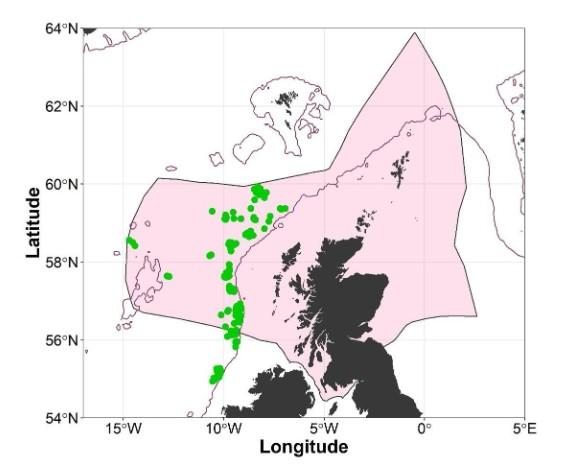
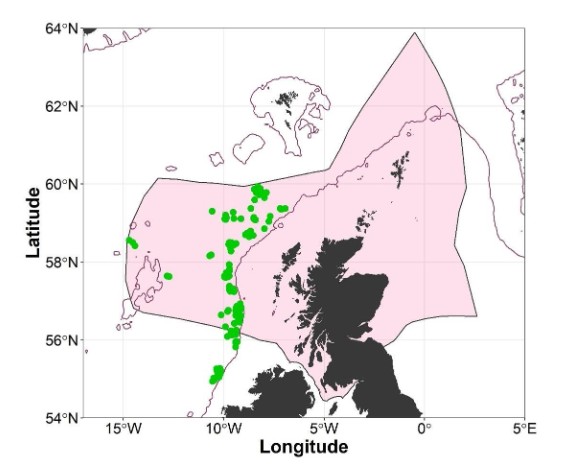
Records for Portugese dogfish (Centroscyllium coelolepis) from SIAMISS and deep-water fisheries surveys undertaken by the Marine Directorate 1996 – 2019.
Click for a full description
View a larger version of this image.
Map of the economic exclusion zone (EEZ) of Scotland showing records for Portugese dogfish (Centroscyllium coelolepis) from the Scottish-Irish anglerfish and megrim industry-science survey (SIAMISS) and deep-water fisheries surveys undertaken by Marine Directorate 1996-2019. Records are illustrated as green points and are exclusively located off the west coast of Scotland and Northern Ireland off the edge of the continental shelf. Most records are to the east of the Rockall Trough on the slope of the continental shelf with some records in the Rockall Trough to the west and northwest of the Outer Hebrides and some records on the slopes around the Rockall Plateau.
Habitat
Portugese dogfish are found between 200 m to 3700 m on continental slopes and abyssal plains. In surveys of the Rockall Trough the species was regularly caught between depths of 700m and 1900 m (Neat et al., 2015). In Portugal, individuals have not been found shallower than 800 m, whilst in the Mediterranean the bentho-pelagic species is found from 1301m to 3850 m and in Australia high catch rates occur at depths greater than 1000 m (Daley et al., 2002; Dureuil and Jung, 2016).
Biology and Ecology
Portugese dogfish reach a maximum length of around 130 cm (Weigmann et al., 2016). Males mature at a size of 85 – 100 cm, and females reach maturity at around 95 - 110 cm (Yano and Tanaka, 1988; Girard and Du Buit, 1999; Daley et al., 2002, Ebert et al., 2013). They are a viviparous aplacental species, with no defined breeding season (Stevens and Correia, 2003; Figueiredo et al., 2008). Litter sizes can range from 1 - 29 pups (Veríssimo et al., 2003), producing offspring of 23 - 30 cm in length after a gestation period of two or more years (Girard and Du Buit, 1999; Clarke et al., 2001; Daley et al., 2002; Figueiredo et al., 2008). The age at which Portugese dogfish mature, and their longevity is uncertain, but using available data for Centroselachus crepidater, maturity may be ~15 years, longevity at ~60 years and an approximate generation length of 37.5 years (Dureuil and Jung, 2015). No mating or nursery grounds have yet been reported for the species.
All adult reproductive stages, including mature and pregnant females, are found in the Northeast Atlantic (Moura et al., 2014), with some evidence for size and sex segregation by depth and area. Pregnant females are the most caught individuals as they occur in shallower waters (Clarke et al., 2001). Trawl and survey data from the Atlantic, Indian, and Pacific Oceans (prior to 2014) at depths of 200–3200 m indicate a predominance of females in the NE, CE, and SE Atlantic, and males in the SW Indian and SW Pacific Oceans. In Scotland, Mauritania and Namibia, the proportion of females increases with depth (Moura et al., 2014), however pregnant and mature females are commonly found in shallower water and a range of studies indicate that they move there to give birth (Girard and Du Buit, 1999; Moura et al., 2014; Clarke et al., 2001; ICES 2024). Neonates and juveniles of this species have been found only occasionally in the Northeast Atlantic (west of Scotland, Iceland, and Portugal) (Moura et al., 2014; ICES, 2019), whereas large numbers of juveniles have been found in the CE and SE Atlantic, as well as the SW Pacific. This could indicate an absence of nursery areas for the species in the Northeast Atlantic or simply reflect a lack of overlap of sampling and nursery habitat. In general, the stock structure and spatial dynamics of the species are poorly understood (ICES 2024). The species is thought to feed on cephalopods and teleost’s and occasionally crustaceans (Ebert et al., 2010).
Human interactions
Historically, this species was taken as a target (for liver oil and flesh) and as an incidental catch in small-scale and industrial fisheries along the continental slope of the Northeast Atlantic. However, since 2010 there has been a zero TAC in European waters for Portugese dogfish and from 2015, the species has been prohibited from ICES subareas 1, 2a, 4 and 14) which was extended in 2021 to all European waters in 2021 (ICES, 2024). Discards are thought to be relatively low since the introduction of measures banning static net fisheries below 600 m and trawls below 800 m (ICES, 2024).
Pregnant females are more susceptible to incidental catch by fisheries as they occur in shallower waters, which has a negative impact on the stock and species recovery. The species' longevity and late maturity suggest that it will take a considerable amount of time for them to recover. Immediate post-release discard mortality of Portugese dogfish was recorded in two of four tagged specimens, although the study used shorter soak times and slower haul speeds than commercial fisheries where mortality is likely to be higher (Rodríguez-Cabello and Sánchez, 2017; ICES 2024).
The species is offered some refuge from fisheries where the population occurs at depths beyond the limit of deepwater fisheries in the Northeast Atlantic. Globally, there is a high degree of distribution overlap with intensive fishing pressure and a lack of species-specific management across its entire range (Finucci et al., 2021), and the extent of illegal, unreported, and unregulated fishing is unknown (ICES 2024).
References
Catarino, D., Knutsen, H., Veríssimo, A., Olsen, E.M., Jorde, P.E., Menezes, G., Sannæs, H., Stanković, D., Company, J.B., Neat, F. and Danovaro, R. 2015. The Pillars of Hercules as a bathymetric barrier to gene flow promoting isolation in a global deep‐sea shark (Centroscymnus coelolepis). Molecular ecology 24(24): 6061-6079.
Clarke, M. et al., (2001) ‘Aspects of reproduction of the deep water sharks Centroscymnus coelolepis and Centrophorus squamosus from west of Ireland and Scotland’, Journal of the Marine Biological Association of the UK, 81, pp. 1019–1029. doi: 10.1017/S0025315401005008.
Daley, R. et al., (2002) Catch analysis and productivity of the deep-water dogfish resource in southern Australia. Report by CSIRO Marine Research and NSW Fisheries to the Fisheries Research and Development Corporation.
Dobby, H., Clarke, M. W., Johnston, G., Dransfeld, L., Neat, F., & Jones, E. Trends in abundance and distribution of deep‐water sharks to the west of the British Isles from trawl survey data. ICES CM 2010/E:09. Extended abstract.
Dureuil, M. & Jung, A. 2015. Centroscymnus coelolepis (Europe assessment). The IUCN Red List of Threatened Species 2015: e.T41747A48923952. Accessed on 20 March 2025. Figueiredo, I. et al., (2008) ‘Reproductive strategy of leafscale gulper shark Centrophorus squamosus and the Portuguese dogfish Centroscymnus coelolepis on the Portuguese continental slope.’, Journal of Fish Biology, 73, pp. 206–225. doi:
Ebert, D. A., Compagno, L. J. V., & Cowley, P. D. (1992). A preliminary investigation of the feeding ecology of squaloid sharks off the west coast of southern Africa. South African Journal of Marine Science, 12(1), 601–609.
Finucci, B., Cheok, J., Cotton, C.F., Kulka, D.W., Neat, F.C., Pacoureau, N., Rigby, C.L., Tanaka, S. & Walker, T.I. 2021. Centroscymnus coelolepis (amended version of 2020 assessment). The IUCN Red List of Threatened Species 2021: e.T41747A206647387. Accessed on 17 March 2025.
Girard, M. and Du Buit, M.H. (1999) ‘Reproductive biology of two deep-water sharks from the British Isles, Centroscymnus coelolepis and Centrophorus squamosus (Chondrichthyes: Squalidae).’, Journal of the Marine Biological Association of the UK, 79(5), pp. 923–931.
Gordon, J.D.M. 1999. Management considerations of deep-water shark fisheries. In: In: Shotton, R. (ed.) (ed.), Case studies of the management of elasmobranch fisheries., pp. 480–920.. FAO., Rome.
ICES (2019) Portuguese dogfish (Centroscymnus coelolepis, Centrophorus squamosus) in subareas 1–10, 12, and 14 (the Northeast Atlantic and adjacent waters), ICES Advice on fishing opportunities, catch, and effort Northeast Atlantic ecoregion. Available at: (Accessed: 30 March 2020).
Moura, T. et al., (2014). Large-scale distribution of three deep-water squaloidsharks: Integrating data on sex, maturity and environment. FisheriesResearch, 157,47–61.
Moura, T., Fernandes, A., Figueiredo, I., Alpoim, R., & Azevedo, M. (2018). Management of deep-water sharks’ by-catch in the Portuguese anglerfish fishery: from EU regulations to practice. Marine Policy, 90, 55-67.
NEAFC (2020) Recommendation on Conservation and Management Measures for Deep Sea Sharks in the NEAFC Regulatory Area from 2020 to 2023.
Neat, F.C. et al., (2015) ‘The diversity, distribution and status of deep-water elasmobranchs in the Rockall Trough, north-east Atlantic Ocean’, Journal of Fish Biology. Blackwell Publishing Ltd, 87(6), pp. 1469–1488. doi: 10.1111/jfb.12822.
OSPAR (2014) OSPAR Threatened and/or Declining Species and Habitats Implementation Report. Species: Portuguese Dogfish.
Rodríguez-Cabello, C. and Sánchez, F. (2017) ‘Catch and post-release mortalities of deep-water sharks caught by bottom longlines in the Cantabrian Sea (Northeast Atlantic)’, Journal of Sea Research. Elsevier B.V., pp. 248–255. doi: 10.1016/j.seares.2017.04.004.
Clò, S. et al., (2002) Serial No. N4702 NAFO SCR Doc. 02/83 SCIENTIFIC COUNCIL MEETING–SEPTEMBER 2002. Segregation of the Mediterranean Population of Centroscymnus coelolepis (Chondrichthyes: Squalidae): a Description and Survey.
Stevens, J. Correia, J.P.S. (2003) Centroscymnus coelolepis. The IUCN Red List of Threatened Species 2003: e.T41747A10552910.
Veríssimo, A., Gordo, L., & Figueiredo, I. (2003). Reproductive biology and embryonic development of Centroscymnus coelolepis in Portuguese mainland waters. ICES Journal of Marine Science, 60(6), 1335-1341.
Yano, K. and Tanaka, S. (1988) ‘Size at Maturity, Reproductive Cycle, Fecundity, and Depth Segregation of the Deep Sea Squaloid Sharks Centroscymnus owstoni and C. coelolepis in Suruga Bay, Japan’, Nippon Suisan Gakkaishi, 52(2), pp. 167–174.