Sharks and Skates of Scotland Report: Norwegian skate (Dipturus nidarosiensis)
An extract from the Sharks and Skates of Scotland Report.
Norwegian skate - Dipturus nidarosiensis (Storm, 1881)
Occurrence in Scotland: Slopes and deep-sea. Occasional. Found on the continental slope of the Rockall Trough, and to the west of Rockall.
Synonym(s): Raja nidarosiensis; Order: Rajiformes; Family: Rajidae
Note: There are concerns about confusing this species with Thornback skate (Raja clavata) and other Dipturus species.
Common name: Norwegian skate, Black skate
AlphaID: 105871 TSN Code: 621027
Note: Dipturus nidarosiensis may be a composite species with a small and large morphotype similar to that seen in Common skate complex (Iglésias et al., 2010). Dipturus nidarosiensis refers to the larger morphotype, and for now, the smaller morphotype is referred to as Dipturus sp. (Ebert and Stehmann, 2013).
Population status
Scotland and Northeast Atlantic: Suspected decline of nearly 30% over the past 30 years (three-generation period) (Stehmann et al., 2015). Declining biomass and abundance observed in the Celtic Sea during Porcupine surveys from 2014–2017 (ICES, 2018).
Global: Decreasing. A global population reduction of 50–79% over three generation lengths (66 years) is estimated (Finucci et al., 2024).
Conservation listings
- IUCN Red List Europe: Near Threatened (assessment 21 November 2014)
- IUCN Red List Global: Endangered (assessment 17 April 2023)
- CITES: Not listed
- CMS: Not listed
- OSPAR: Not listed
- Prohibited under EU Regulation 2025/202
- Listed on the UK’s ‘Prohibited Species’ list as documented in the ‘Written Record of fisheries consultations between the United Kingdom and the European Union for 2025’ for UK and EU waters of ICES divisions 6a, 6b, 7a, 7e, 7f, 7g and 7h, and EU waters of 7b, 7c and 7k
- Included in the NEAFC measures prohibiting directed fishing for deep-sea rays
Range and distribution
This deep-water skate species is confined to the Northeast Atlantic and the western Mediterranean. In the Northeast Atlantic it has been recorded in the deep fjords of central and southern Norway, along the slopes off southern Iceland, western Scotland (including Rockall Trough) and western Ireland (Ebert and Stehmann, 2013). Records on the edge of the Celtic Sea may have been misidentifications of another relative (Ebert and Stehmann, 2013). It may also be present along the Mid-Atlantic Ridge and the Iceland-Faroe Ridge, as well as the Bay of Biscay (Ebert and Stehmann, 2013).
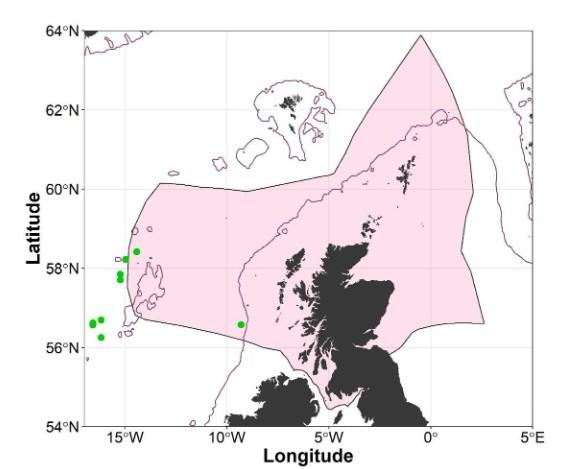
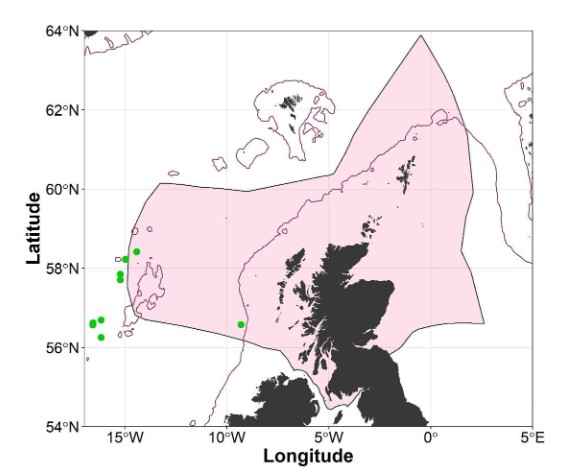
Records for Norwegian skate (Dipturus nidarosiensis) from SIAMISS and deep-water fisheries surveys undertaken by the Marine Directorate 1996 – 2019.
Click for a full description
View a larger version of this image.
Map of the economic exclusion zone (EEZ) of Scotland showing records for Norwegian skate (Dipturus nidarosiensis) from the Scottish-Irish anglerfish and megrim industry-science survey (SIAMISS) and deep-water fisheries surveys undertaken by Marine Directorate 1996-2019. Records are illustrated as green points, there is a single point representing capture of Norwegian skate in a single trawl off the edge of the continental shelf west of the Isle of Barra. There are several points on the western slopes of the Rockall Plateau representing capture of Norwegian skate in several trawls carried out in this area.
Habitat
Norwegian skate are a rarely recorded species that live either on or just above the seabed on continental slopes and submarine rises at depths of 200 m to more than 1,000 m (Stehmann and Bürkel, 1984). In surveys of the Rockall Trough, west of Scotland, this large skate was very rare and only three individuals were caught over the period 1998–2013, including one juvenile (TL =70 cm) on the continental slope at 950 m and two much larger mature specimens from west of Rockall between 600 and 700 m (Neat et al., 2015).
Biology and Ecology
Norwegian skate are one of the largest species of skate found in the Northeast Atlantic, and can grow to at least 200 cm TL, with a maximum reported size of 250 cm TL (Ebert and Stehmann, 2013). They reproduce via laying large rectangular egg capsules, measuring 180-260 mm long by 92-113 mm wide (Ebert and Stehmann, 2013). In a Mediterranean study, females measuring 128.8-136.5 cm (TL) were found to be maturing and reached maturity when >127 cm TL, and males measuring 102.0-107.0 cm TL were maturing, and one mature male was recorded at 119.0 cm TL (Follesa et al., 2012). In addition, females were found to attain a greater length than males and mature at larger sizes (Follesa et al., 2012). Little else is known about the species' biology and ecology, but it is estimated to have a generation length of about 10 years (Stehmann et al., 2015). In the Mediterranean Norwegian skate were found to prey almost entirely on decapod crustaceans and, to a lesser etxtent, bony fish (Follesa et al., 2012).
Human interactions
Norwegian skate are not targeted commercially but may be taken as bycatch in deep-water trawl and longline fisheries operating in the Northeast Atlantic. The species may occasionally be landed in French ports under the name Dipturus oxyrinchus (Longnose skate) and from ICES division 6a without a specific landing name (ICES, 2024). Their large size and assumed low productivity make them vulnerable to fishing pressure, and therefore they are assessed as Near Threatened by the IUCN in the European region, and they are close to meeting the threshold for Threatened under Criterion A2 (Stehmann et al., 2015).
References
Ebert, D.A. and Stehmann, M.F.W. (2013) Sharks, batoids, and chimaeras of the North Atlantic. FAO Species Catalogue for Fishery Purposes. No. 7. Rome: Food and Agricultural Organization of the United Nations (FAO).
Finucci, B., Lynghammar, A. & Charles, R. 2024. Dipturus nidarosiensis. The IUCN Red List of Threatened Species 2024: e.T161729A124534517. Accessed on 15 September 2025.
Follesa, M.C. et al., (2012) ‘Preliminary observations of the reproductive biology and diet for the Norwegian skate Dipturus nidarosiensis (Rajidae) from the Central Western Mediterranean Sea’, Cybium, 36(3), pp. 473–477.
Iglésias, S. P., Toulhout, L. and Sellos, D. Y. (2010) ‘Taxonomic confusion and market mislabelling of threatened skates: important consequences for their conservation status.’, Aquatic Conservation - Marine and Freshwater Ecosystems, 20(319–333).
Neat, F.C. et al., (2015) ‘The diversity, distribution and status of deep-water elasmobranchs in the Rockall Trough, north-east Atlantic Ocean’, Journal of Fish Biology. Blackwell Publishing Ltd, 87(6), pp. 1469–1488. doi: 10.1111/jfb.12822.
Stehmann, M. and Bürkel, D.L. (1984) ‘Rajidae’, in Whitehead, P. J. P. et al., (eds) Fishes of the north-eastern Atlantic and Mediterranean. Vol 1. Paris: UNESCO.
Stehmann, M.F.W. et al., (2015) Norwegian Skate, Dipturus nidarosiensis, The IUCN Red List of Threatened Species 2015: e.T161729A48927468. (Accessed: 21 April 2020).