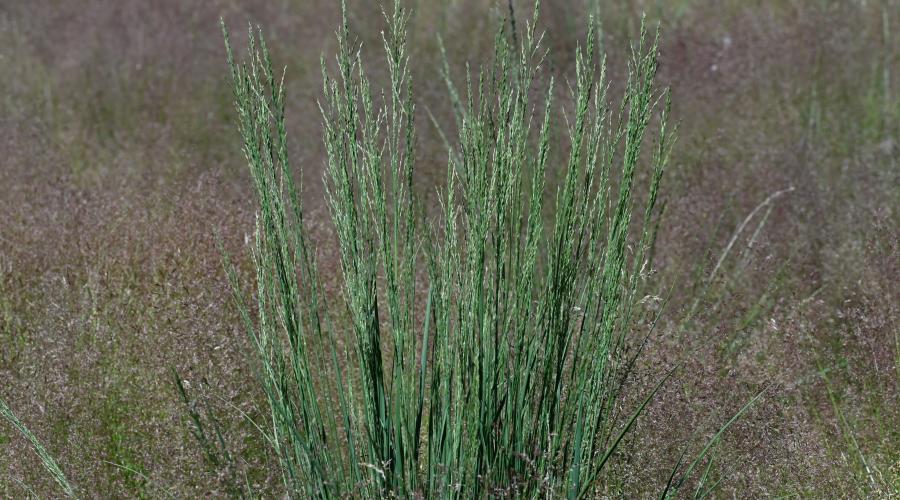
Genetic Scorecard Indicator - Purple moor-grass
Purple moor-grass (Molinia caerulea )

IUCN Category:
- Great Britain: Least Concern (indicated above)
- Europe: Least Concern
- Global: Not Evaluated

Genetic Health Status:
- Scottish Risk: Negligible (indicated above)
- UK Risk: Negligible
- Scottish Mitigation status: Not required
- UK Mitigation status: Not required
Background
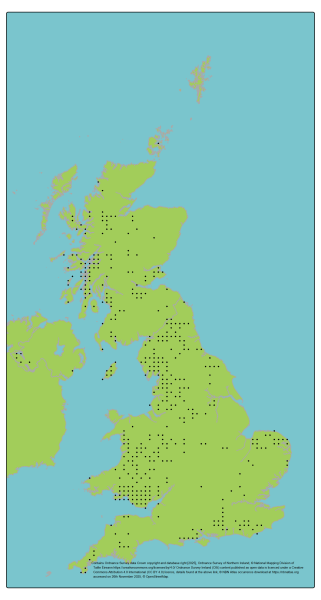
Perennial grass forming tussocks or extensive swards, capable of spreading clonally and dominating stands. A peat-forming member of acid-grasslands, wet heath, and bog; losses in the former are contrasted with a need for controlling populations in the latter habitats. Two subspecies (tetraploid ssp. caerulea and diploid and decaploid ssp. arundinacea) are known in Britain (Taylor et al., 2001). Ecotypic variation within subspecies can be due to both genetic and ecological factors. Common and locally abundant in north and west Britain and widespread in Europe and Asia. Can form a persistent seed bank (Taylor et al., 2001).
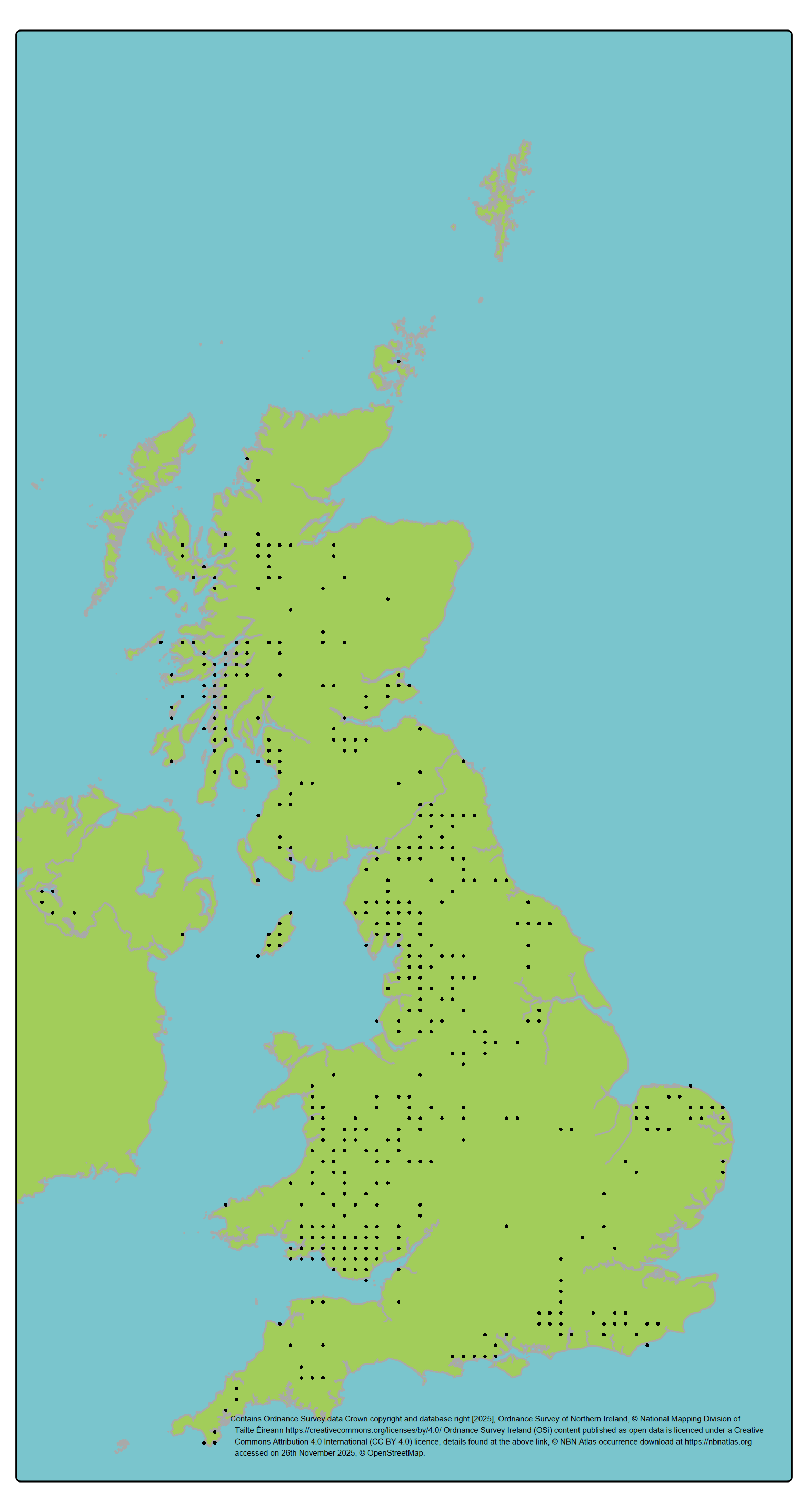
View a larger version of the distribution map for Purple Moor Grass.
Current Threats
Not considered to be under threat.
Contribution of Scottish/UK population to total species diversity
Locally adapted gene pools may be present, but the contribution to global species diversity is not considered particularly high.
Genetic risks
Diversity loss: population declines
The distribution is broadly stable with local increases in abundance potentially due to increased nitrogen deposition, reduced grazing and / or muirburn.
Global Biodiversity Framework Indicators
Population definitions:
Populations are defined based on management units. This species is widely and continuously distributed across UK in large numbers (Stroh et al., 2023; NBN, 2025). The four Great British Regions of Provenance (Herbert et al., 1999) were selected here to represent the major population groupings / management units (treating Northern Ireland as an additional region) as they broadly reflect the environmental variation across which the species is distributed and are likely to capture major patterns of genetic structure.
Ne500: The proportion of populations that have an effective population size of more than 500.
- Proportion of populations with Ne > 500 in Scotland = 2/2
- Proportion of populations with Ne > 500 in UK = 5/5
PM: Proportion of populations that existed in 2000 that still exist in 2025.
- Proportion of populations maintained in Scotland = 2/2
- Proportion of populations maintained in UK = 5/5
Diversity loss: functional variation
Functional variation
Ecotypic variation is likely to be preserved by large populations across a wide distribution.
Divergent lineages
No evidence for divergence from European populations, precluding loss of major divergent lineages.
Hybridisation/Introgression
No threats known.
Low turnover - constraints on adaptive opportunities
None known. Seed viability is low, but bare ground is readily colonized.
Cumulative Risk Summary
Overall Genetic Health Status
Scotland
- Risk: Negligible
- Mitigation: Negligible
Great Britain/UK
- Risk: Not Required
- Mitigation: Not Required
Overall Genetic Health status explanation
Losses to genetic variation in lowlands are possible, but overall population size is very large and increasing across its range.
In situ genetic threat level
In situ genetic threat level
- In situ Risk for Scotland: Negligible
- In situ Risk for UK: Negligible
This species is stable or locally increasing.
Confidence in in situ threat level
- Confidence score for Scotland: Medium
- Confidence score for UK: Medium
Assessment based on good distribution data supported by experimental evidence on competitive abilities and quantitative changes in cover in wet heath and blanket bog habitats; no direct genetic data available for populations in Scotland.
Ex situ representation
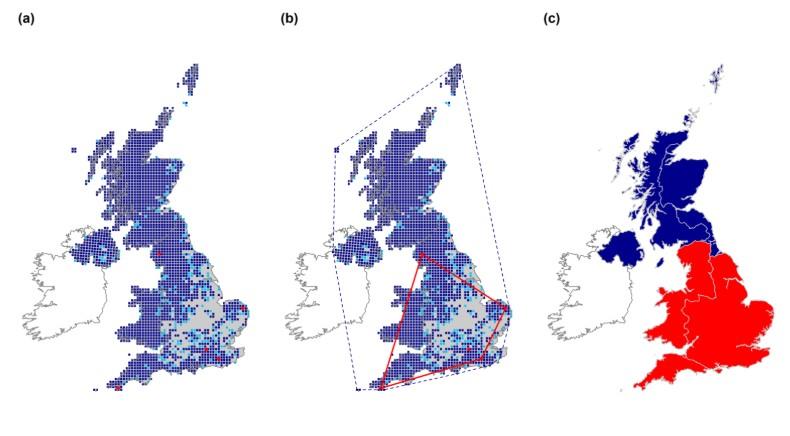
Seed collections in the Millenium Seed Bank (MSB) cover
Click for a full description
Dark blue = species distribution, red = represented in ex situ collection, light blue= pre 2000 records.
- (a) 5 of 2238 occupied 10-km squares (< 1%)
- (b) an EOO of 121,396 km² out of 575,039 km² occupied (21%)
- (c) 2 out of 5 Regions of Provenance (40%)
Current conservation actions
Burning, grazing and nitrogen regimes largely control the shifts between wet Calluna-dominated heath and Molinia-dominated heath over short and long time spans (APIS, 2019). Recent shifts are mostly toward Molinia, especially in continental lowland heath, and attributed to increases in nitrogen. Most management interventions aim to reduce Monilia in favour of promoting Calluna.
| Ex situ | Translocation | Habitat management | Legal protection of habitat or species | Regulation of exploitation | Control of INNS/pests/pathogens |
|---|---|---|---|---|---|
| X | - | - | - | - | - |
Population assessment/monitoring
Population
Demographic
N pops assessed/monitored in Scotland = 2/2
N pops assessed/monitored in UK = 5/5
Genetic
N pops assessed/monitored in Scotland = Not Required
N pops assessed/monitored in UK = Not Required
Further Research
Genetic surveys utilising the Darwin Tree of Life reference genome and subsequent resequencing across populations would provide more directly quantified insights into patterns of genetic diversity.
References
APIS, 2019. Nitrogen deposition - dwarf shrub heath.
Herbert, R., Samuel, S., & Patterson, G. 1999. Using Local Stock for Planting Native Trees and Shrubs. Forestry Commission Practice Note.
Stroh, P.A., Walker, K.J., Humphrey, T.A., Pescott, O.L. and Burkmar, R.J., 2023. Plant atlas 2020: mapping changes in the distribution of the British and Irish Flora. Princeton University Press.
Taylor, K., Rowland, A.P. & Jones, H.E. 2001. Molinia caerulea (L.) Moench. Journal of Ecology, 89, 126-144.
Assessor: Iain Macdonald, NatureScot
Reviewer: Pete Hollingsworth, Royal Botanic Garden Edinburgh