Sharks and Skates of Scotland Report: Mouse catshark (Galeus murinus)
An extract from the Sharks and Skates of Scotland Report.
Mouse catshark - Galeus murinus (Collett, 1904)
Occurrence in Scotland: Occurrence in Scotland: Deep-sea. Resident. Found on the slopes of the Rockall Trough. High number of records.
Synonym(s): Pristiurus murinus; Order: Carcharhiniformes; Family: Pentanchidae
Common name: Mouse catshark
AlphaID: 105813; TSN Code: 160037
Note: This species may have been confused with one or two others (primarily species within the genus Apristurus), causing uncertainty in some of the literature and further investigation is required into its taxonomy (Iglésias, 2015).
Population status
Scotland and Northeast Atlantic: Fluctuating/No significant trends over time in Rockall Trough (Neat et al., 2015). Stable in the rest of the Northeast Atlantic (Iglésias, 2015).
Global: Stable (Rigby et al., 2024).
Conservation listings
- IUCN Red List Europe: Least Concern (assessment 06 October 2014)
- IUCN Red List Global: Least Concern (assessment 19 May 2023)
- CITES: Not listed
- CMS: Not listed
- OSPAR: Not listed
- Listed on the UK’s ‘Prohibited Species’ list as documented in the ‘Written Record of fisheries consultations between the United Kingdom and the European Union for 2025’ for UK waters of ICES Subareas 5-10
- Zero TAC under EU Regulation 2018/2025 & EU Regulation 2023/194
- Prohibited under EU Regulation 2025/202
- Included in the NEAFC measures prohibiting directed fishing for deep-sea sharks
Range and distribution
Mouse catsharks are native to the Northeast Atlantic and resident around the coast of Iceland, the Faroes, across to the west coast of Scotland (including the Rockall Trough) and Ireland, and southwards towards the Cantabrian Sea on the French and Spanish coasts (Iglésias, 2015). The species may also be found off Morocco and the Western Sahara (Ebert & Stehmann, 2013).
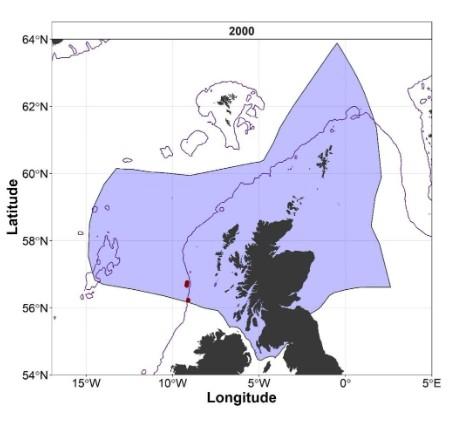
ICES DATRAS records for Mouse catshark (Galeus murinus) 2000-2009.
Click for a full description
Map of the economic exclusion zone (EEZ) of Scotland showing the ICES (International Council for the Exploration of the Sea) DATRAS (database of trawl surveys hosted by ICES) records for the Mouse Catshark (Galeus murinus) from bottom trawl fish surveys conducted between 2000 to 2009. Three red points clustered to the south west of the Isle of Barra off the edge of the continental shelf represent trawl shoot positions in with Mouse catshark (G. murinus) were captured.
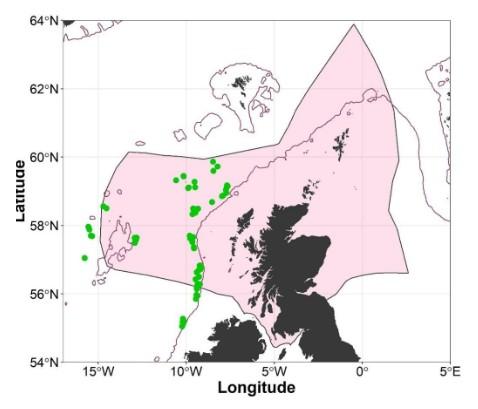
Records for the Mouse catshark (Galeus murinus) from SIAMISS and deep-water fisheries surveys undertaken by the Marine Directorate 1996-2019.
Click for a full description
Map of the economic exclusion zone (EEZ) of Scotland showing records for the Mouse catshark (Galeus murinus) from Scottish-Irish anglerfish and megrim industry and science survey (SIAMISS) and deep-water fisheries surveys undertaken by Marine Directorate between 1996 and 2019. Records are illustrated as green points and are exclusively located off the west coast of Scotland and Northern Ireland (as far north as the north west of the Outer Hebrides), off the continental shelf. Records on the continental slope and the slopes of the Rockall Plateau.
Habitat
This deep-water catshark species is demersal on continental slopes at depths of 380 – 1300 m (Rigby et al., 2024) and was found at 500 – 1500 m in the Rockall Trough with peak abundances at 1000 m (Neat et al., 2015).
Biology and Ecology
Mouse catsharks are relatively small-bodied, reaching 64 cm total length (Neat et al., 2015). Males reach sexual maturity at 50 – 63 cm TL, and females mature at 46 cm TL or less (Iglésias et al., 2002). Mouse catsharks are oviparous and only one egg case is carried per oviduct at one time. Egg cases are relatively small and slender measuring 54-56 mm long and 14-17 wide (Iglésias et al., 2002) with an absence of tendrils, and a fine fibrous covering giving a hairy appearance. The diet of mouse catsharks is reported as varied and comprised largely of fish, shrimps, Myctophids, Euphausiids and cephalopods (Sólmundsson et al., 2025). Very little else is known about the biology of this catshark.
Human interactions
Mouse catsharks are caught as bycatch in deep-water trawl fisheries that operate on the Northeast Atlantic slope and are of low commercial value and interest. Survival rates of the species after discarding are unknown, and since a zero TAC was set for deep-water sharks in 2010, discarding has likely increased (ICES, 2024). However, its small size makes it more capable of escaping trawl nets, and low and stable discard rates have been reported in the Northeast Atlantic over the past few decades (Rigby et al., 2024). It is offered some refuge from fisheries in the deeper parts of its range, and fishing measures in European waters that protect deep-water habitats are likely to provide some security for this species along with inclusion in the NEAFC measures prohibiting directed fishing for deep-sea sharks.
References
Ebert, D.A. and Stehmann, M.F.W. (2013) Sharks, batoids, and chimaeras of the North Atlantic. FAO Species Catalogue for Fishery Purposes. No. 7. Rome: Food and Agricultural Organization of the United Nations (FAO).
ICES (2024). Report of the Working Group on Elasmobranch Fishes (WGEF). ICES Scientific Reports.
Iglésias, S. (2015) Mouse Catshark, Galeus murinus, The IUCN Red List of Threatened Species 2015: e.T161705A48941031. (Accessed: 25 May 2020).
Iglésias, S.P. et al., (2002) ‘Egg capsules of deep-sea catsharks from eastern north Atlantic, with first descriptions of the capsule of Galeus murinus and Apristurus aphyodes (Chondrichthyes: Scyliorhinidae).’, Cybium, 26(1), pp. 59–63.
Neat, FC. et al., (2015) ‘The diversity, distribution and status of deep-water elasmobranchs in the Rockall Trough, north-east Atlantic Ocean’, Journal of Fish Biology. Blackwell Publishing Ltd, 87(6), pp. 1469–1488. doi: 10.1111/jfb.12822.
Rigby, C.L., Iglésias, S. & Rohner, C.A. 2024. Galeus murinus. The IUCN Red List of Threatened Species 2024: e.T161705A124530955. Accessed on 12 February 2025.
Sólmundsson, J., Jakobsdóttir, K. B., & Pétursdóttir, H. (2025). Deepwater Sharks at Their Northern Limits—Distribution, Diet and Trophic Relations. Marine Ecology, 46(1), e12854.