Sharks and Skates of Scotland Report: Longnosed skate (Dipturus oxyrinchus)
An extract from the Sharks and Skates of Scotland Report.
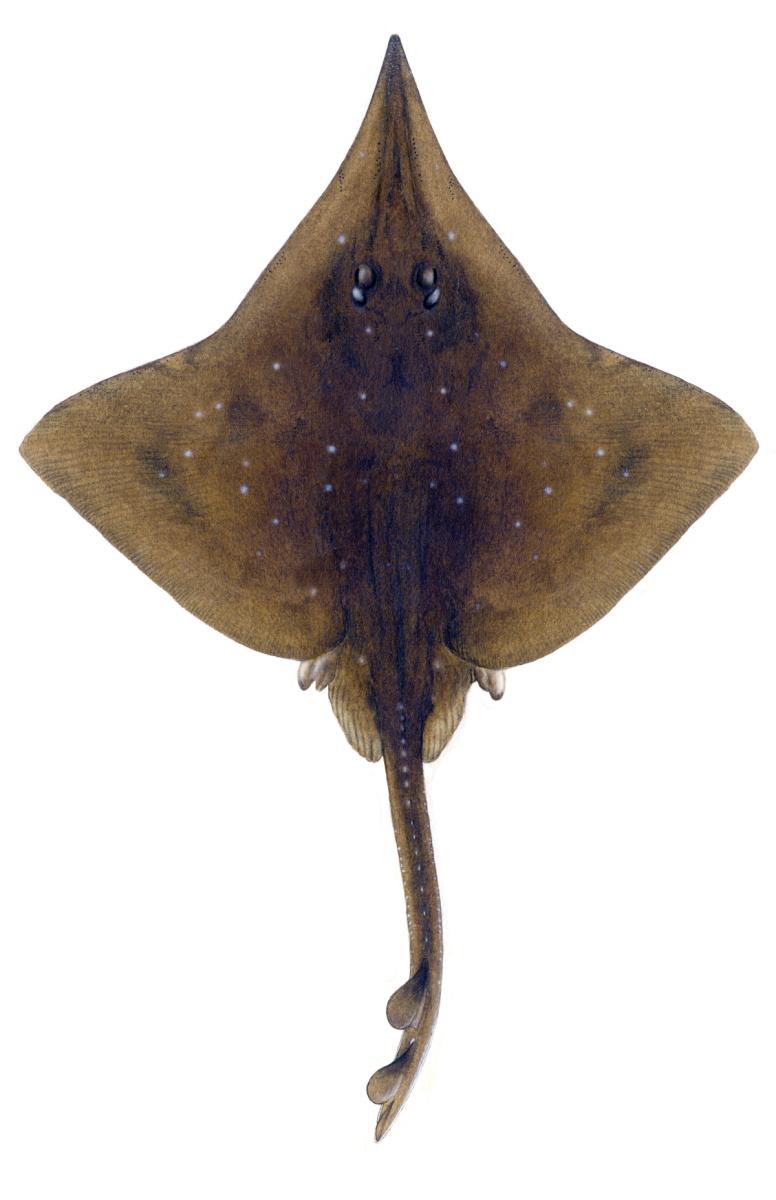
Longnosed skate - Dipturus oxyrinchus (Linnaeus, 1758)
Occurrence in Scotland: Shelf, slope and deep-sea. Occasional. Found on the continental slope of the Rockall Trough and Faroe Shetland Channel, and around Rockall.
Common name: Longnosed skate, sharpnose skate
AlphaID: 105872 TSN Code: 564148
Note: In the Northeast Atlantic, the Long-nosed Skate is often confused with other Dipturus species. Although rarely reported, declared landings increased after the 2009 ban on landing the common skate complex and Norwegian Skate (D. nidarosiensis) (ICES, 2022).
Population status
Scotland and Northeast Atlantic: Decreasing (Finucci et al., 2024). Overall population trend unknown due to limited data; however, Dipturus oxyrinchus is suspected to have declined by nearly 30% over the past 30 years (three-generation span) (Ellis et al., 2015). Possible signs of increases in biomass and numbers in the Norwegian coastal waters (ICES 2024).
Global: decreasing. a global population reduction of 30–49% was suspected over three generation lengths (45 years) based on abundance data and actual levels of exploitation (Finucci et al., 2024).
Conservation listings
- IUCN Red List Global: Vulnerable (assessment 20 April 2023)
- IUCN Red List Mediterranean: Near threatened (assessment 25 March 2016)
- CITES: Not listed
- CMS: Not listed
- OSPAR: Not listed
Range and distribution
There are two genetically distinct populations of Longnosed skate, one in the Northeast Atlantic and the other in the Mediterranean (Ellis et al., 2015). It is estimated that these populations separated 20,000 years ago (Griffiths et al., 2011). In the Northeast Atlantic the species has historically been recorded northwards from the Canaries, Madeira and Northern Morocco up to the Faroes, Shetland, central Norway, the northern part of the North Sea and Skagerrak. However, both the range and abundance of the skate are suspected to have reduced in the Northeast Atlantic subpopulation, and it is not common in UK waters. CEFAS research vessel survey data from the 1960s – 2002 found that Longnosed skate was absent from inshore waters of England and Wales, whereas they were recorded occasionally in Scottish waters in depths of 111–159 m. The species are known to occur in small but stable numbers on the Rockall Bank (UK-Scotland surveys) (Clarke et al., 2016). Longnosed skate is thought to be locally extinct in the Irish Sea; however, this is disputed by some who believe it was not historically present in Irish waters (Clarke et al., 2016). Surveys along the coast of Norway indicate that the species is relatively rare but may aggregate in certain areas. Data from the Bay of Biscay show large fluctuations in abundance over a decade (from 1999 to 2010).
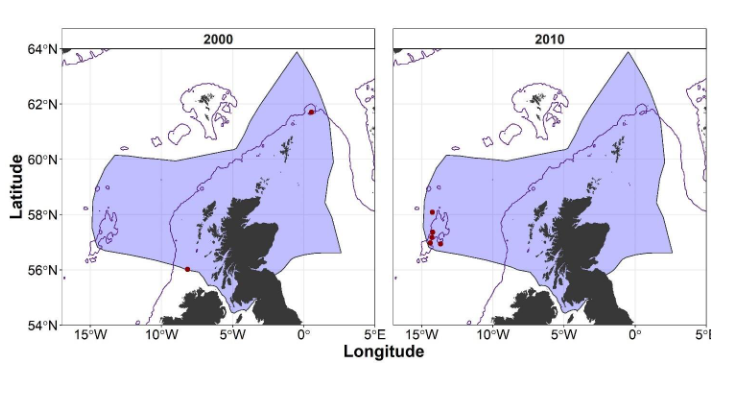
ICES DATRAS records for Longnosed skate (Dipturus oxyrinchus), 2000-2009 and 2010-2019. A change in the number or distribution of records over time does not reflect a change in occurrence or abundance since data have not been corrected for effort.
Click for a full description
Two maps of the EEZ of Scotland showing the ICES (International Council for the Exploration of the Sea) DATRAS (database of trawl surveys hosted by ICES) records for Longnosed skate (Dipturus oxyrinchus) from bottom trawl surveys conducted between 2000 and 2009 and 2010 and 2019. Red points represent trawl shoot positions in which Longnosed skate (D. oxyrinchus) were captured. From 2000 to 2009, Longnosed skate were captured in trawls carried out in 2 locations, one at the very northern tip of Scotland’s EEZ and one on the southern boundary of the EEZ in the west of Scotland about halfway across the continental shelf. From 2010 to 2019 the records were exclusively clustered on and around the Rockall Plateau. A change in the number or distribution of records over time does not reflect a change in occurrence or abundance since data have not been corrected for effort.
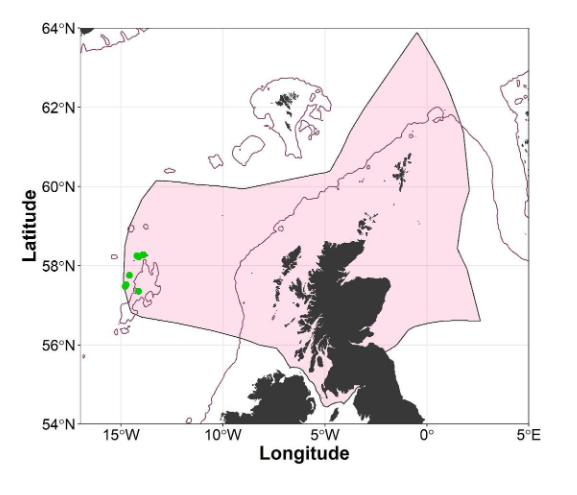
Records for Longnosed skate (Dipturus oxyrinchus) from SIAMISS and deep-water fisheries surveys undertaken by the Marine Directorate 1996 – 2019.
Click for a full description
Map of the economic exclusion zone (EEZ) of Scotland showing records for Longnosed skate (Dipturus oxyrinchus) from the Scottish-Irish anglerfish and megrim industry-science survey (SIAMISS) and deep-water fisheries surveys undertaken by Marine Directorate 1996-2019. Records are illustrated as green points and are exclusively located on and around the Rockall Plateau.
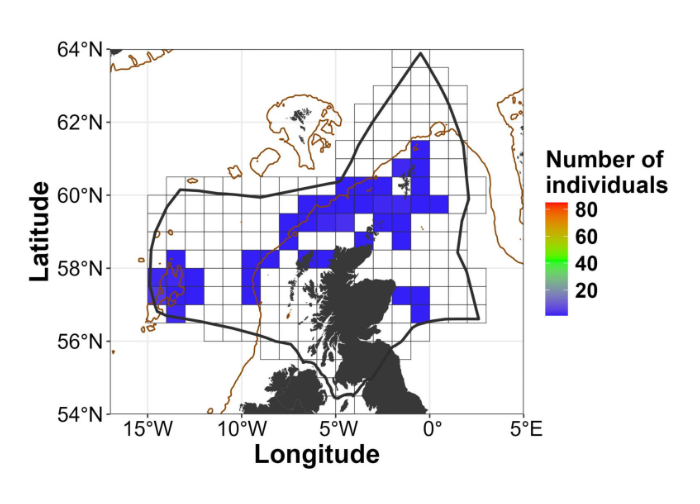
Landings data from commercial fishing vessels in ICES rectangles for Longnosed skate (Dipturus oxyrinchus) 2011-2019.
Click for a full description
Map of the economic exclusion zone (EEZ) of Scotland showing landings data per ICES (International Council for the Exploration of the Sea) rectangle for Longnosed skate (Dipturus oxyrinchus) recorded by commercial fishing vessels from 2011 to 2019. Values are presented as the number of individuals landed per trip. Data is illustrated in a heat map, colouring each ICES rectangle from 0 (white) to 81 (red). Small numbers of landings illustrated by blue rectangles representing 0 to 20 individuals were reported across the north of Scotland, up to and on the shelf edge including the waters around the Orkney and Shetland Isles, on the shelf edge to the west of Scotland, on and around the Rockall Plateau and off the east coast of Scotland between Peterhead and Aberdeen.
Habitat
Longnosed skate are found over sandy and muddy seabed habitats at depths ranging from 70-1230 m down the continental slopes of the Northeast Atlantic, in both shelf and deep-sea habitats (Clarke et al., 2016; Ellis et al., 2015; Finucci et al 2024). In the Mediterranean, the species is recorded most often at depths of 200-500 m, and it is moderately abundant in the central and eastern Mediterranean Sea but is no longer found in the western Mediterranean (e.g. Gulf of Lions and parts of the Adriatic Sea) (Ellis et al., 2015).
Biology and Ecology
Longnosed skate are oviparous and lay eggs between February and May. Egg cases are 10-15 cm long, and newborns measure ~ 17cm total length (Ellis et al., 2015); however, the Mediterranean subpopulation is thought to be reproductively active throughout the year (Bellodi et al., 2017). Both males and females become sexually mature between 6-8 years old (Ellis et al., 2015), and a study from Sardinian waters estimated length at maturity to be 91.0 cm TL for males and 103.5 cm TL for females (Bellodi et al., 2017), whereas in the Aegean Sea males are reported to mature at 64-65 cm and females at 82-83 cm TL (Yıgın and Ismen, 2010). The maximum age recorded varies; for example, in Sardinian waters, the oldest females and males recorded are 17 and 15 years, respectively (Bellodi et al., 2017), whereas in Tunisian waters, the oldest male and females reported are 26 and 38 years, respectively (Kadri et al., 2015). Longnosed skate can reportedly reach a maximum length of 150 cm TL. Studies of gut contents in the Mediterranean found that the juvenile Longnosed skate mainly feed on crustaceans (e.g. mysids), while more mature individuals prefer to feed on crustaceans (e.g. decapods), fish and molluscs including cephalopods (Yıgın and Ismen, 2010; Mulas et al., 2015; Arcioni et al., 2025).
Human interactions
Longnosed skate are vulnerable to overexploitation and local extinction due to their large body size, slow growth rates and the time they take to reach sexual maturity (6-8 years). Most size classes of the species can be taken as bycatch in demersal trawl fisheries (as well as longline fisheries), especially in deeper offshore waters (Ellis et al., 2015). Longnosed skate are grouped under “other skates and rays” in ICES advice on catch, effort and fishing opportunities. They are included in the group of ‘other skates and rays’ in the ICES assessments. ICES was unable to provide any advice for the period 2024-2028 due to the lack of sufficient survey and catch data (ICES, 2023, 2024b).
References
Arcioni, M., et al., (2025). Trophic ecology of the deep-sea skate Dipturus oxyrinchus (Linnaeus, 1758) in the bathyal food web of the central Mediterranean Sea, Deep Sea Research Part I: Oceanographic Research Papers, 225, 104602,
Bellodi, A. et al., (2017). Life-history traits of the long-nosed skate Dipturus oxyrinchus. J. Fish Biol. 90, 867–888.
Clarke, M. et al., (2016). Ireland Red List No. 11: Cartilaginous fish [sharks, skates, rays and chimaeras]. Dublin, Ireland.
Dulvy, N.K. (2000). Fishery Stability, Local Extinctions, and Shifts in Community Structure in Skates. Conserv. Biol. 14, 283–293.
Ellis, J.R., Abella, A., Serena, F. & Stehmann, M.F.W. 2016. Dipturus oxyrinchus (Mediterranean assessment). The IUCN Red List of Threatened Species 2016: e.T63100A16527733.
Finucci, B., Ellis, J.R., Serena, F., Pacoureau, N. & Armstrong, A.O. 2024. Dipturus oxyrinchus. The IUCN Red List of Threatened Species 2024: e.T63100A124458320.
Griffiths, A.M., (2011). Levels of connectivity between longnose skate (Dipturus oxyrinchus) in the Mediterranean Sea and the north-eastern Atlantic Ocean. Conserv. Genet. 12, 577–582.
ICES (2022). Working Group on Elasmobranch Fishes (WGEF). ICES Scientific Reports 4:74.
ICES (2023). Other rays and skates (Rajidae) in Subarea 4 and in divisions 3.a and 7.d (North Sea, Skagerrak, Kattegat, and eastern English Channel). In Report of the ICES Advisory Committee, 2023. ICES Advice 2023, raj.27.3a47d.
ICES (2024). Working Group on Elasmobranch Fishes (WGEF). ICES Scientific Reports 6:75.
ICES (2024b). Other rays and skates (Rajiformes) in Subarea 6 and divisions 7.a-c and 7.e-k (Rockall, West of Scotland, Celtic Sea and western English Channel). In Report of the ICES Advisory Committee, 2024. ICES Advice 2024, raj.27.67a-ce-k.
Kadri, H. (2015). Age, growth, longevity, mortality and reproductive biology of Dipturus oxyrinchus, (Chondrichthyes: Rajidae) off the Gulf of Gabès (Southern Tunisia, central Mediterranean). J. Mar. Biol. Assoc. United Kingdom 95, 569–577.
Mulas, A. (2015). Diet and feeding behaviour of longnosed skate Dipturus oxyrinchus. J. Fish Biol. 86, 121–138.
Yıgın, C. and Ismen, A. (2010). Age, growth, reproduction and feed of longnosed skate, Dipturus oxyrinchus (Linnaeus, 1758) in Saros Bay, the north Aegean Sea. J. Appl. Ichthyol. 26, 913–919.