Sharks and Skates of Scotland Report: Longnose velvet dogfish (Centroselachus crepidater)
An extract from the Sharks and Skates of Scotland Report.
Longnose velvet dogfish - Centroselachus crepidater (Barbosa du Bocage and de Brito Capello, 1864)
Occurrence in Scotland: Deep-water. Resident. Found on the slopes both sides of the Rockall Trough, to the west of Rockall, Rosemary Bank, and the continental shelf off NW Scotland, low numbers on the southern slopes of the Wyville Thomson ridge.
Synonym(s): Centroscymnus crepidater, Centrophorus jonssonii. Note: species Transferred from Centroscymnus to Centroselachus; Order: Squaliformes; Family: Somniosidae
Common name: Longnose velvet dogfish, golden dogfish;
AlphaID: 105908 TSN Code: 160725
Population status
Scotland and Northeast Atlantic: Increasing (Finucci et al., 2020). Increasing in Scotland after significant declines were recorded between 1998 – 2013 (Neat et al., 2015). The species is also estimated to be increasing in the Northeast Atlantic (Finucci et al., 2020).
Global: Decreasing. Overall, a population reduction of 20–29% is estimated over the last three generation lengths, based on abundance data and levels of exploitation (Finucci et al., 2020).
Conservation listings
- IUCN Red List Global: Near Threatened (assessment 21 November 2019)
- IUCN Red List Europe: Least concern (assessment 19 August 2014)
- CITES: Not listed
- CMS: Not listed
- OSPAR: Not listed
- Listed on the UK’s ‘Prohibited Species’ list as documented in the ‘Written Record of fisheries consultations between the United Kingdom and the European Union for 2025’ for UK waters in ICES Division 2a and Subarea 4
- Zero TAC under EU Regulation 2018/2025 & Regulation 2023/194
- Prohibited under EU Regulation 2025/202
- Listed on The Sharks, Skates and Rays (Prohibition of Fishing, Trans-shipment and Landing) (Scotland) Order 2012
- Included in the NEAFC measures prohibiting directed fishing for deep-sea sharks
Range and distribution
Longnose velvet dogfish are a moderately common deep-water species that have a wide ranging but patchy distribution in the eastern Atlantic, and can be found in waters of the Denmark Straits, Iceland, and Faroe Islands south along the Atlantic slope to Rockall Trough, Porcupine Seabight, Portugal, Morocco, Senegal, Madeira Islands, Azores, Gabon to Zaire, Namibia, and west coast of South Africa (Ebert and Stehmann, 2013). This shark is not found in the western Atlantic but occurs in the Indo–Pacific and Southeastern Pacific off Northern Chile (Ebert and Stehmann, 2013).
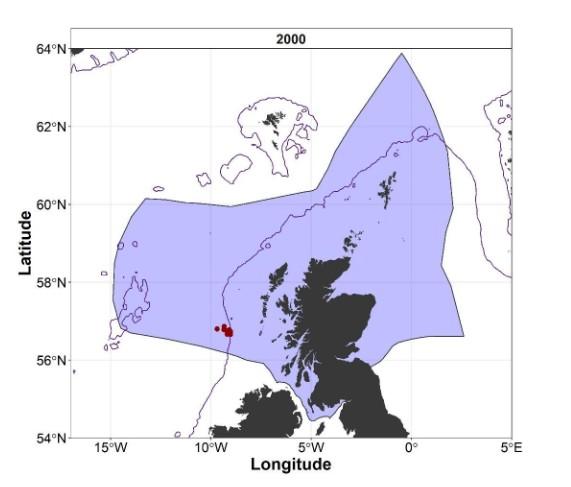
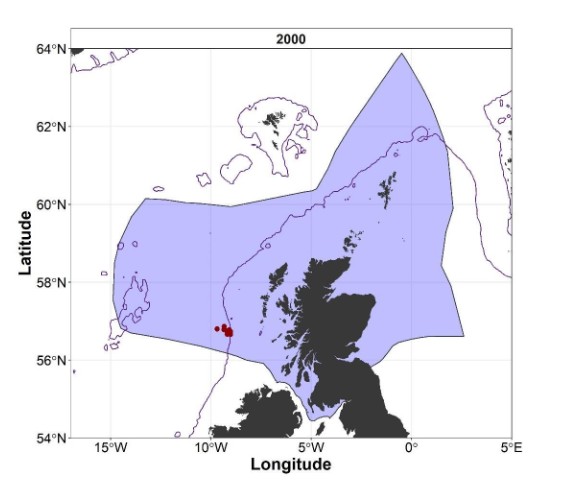
ICES DATRAS records for the Longnose velvet dogfish (Centroscymnus crepidater), 2000-2009.
Click for a full description
View a larger version of this image.
Map of the EEZ of Scotland showing the ICES (International Council for the Exploration of the Sea) DATRAS (database of trawl surveys hosted by ICES) records for the Longnose velvet dogfish (Centroscymnus crepidater) from bottom trawl surveys conducted between 2000 and 2009. Red points represent trawl shoot positions in which Longnose velvet dogfish (C. crepidater) were captured. Records are exclusively in a single cluster on the continental slope west of the Isle of Barra.
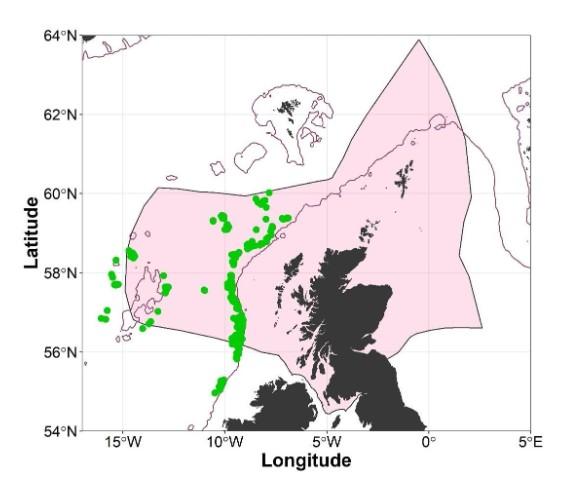
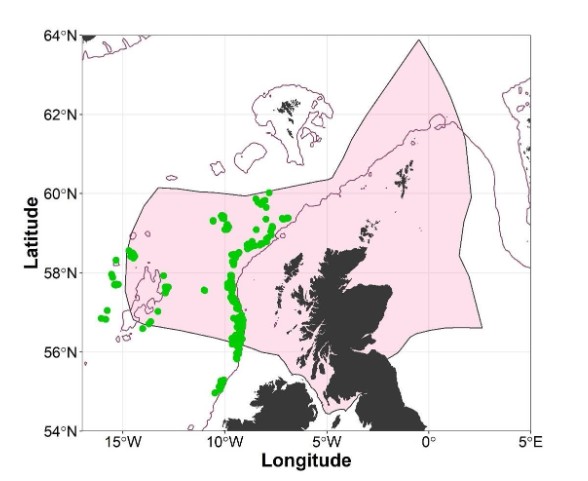
Records for the Longnose velvet dogfish (Centroscymnus crepidater) from SIAMISS and deep-water fisheries surveys undertaken by the Marine Directorate 1996 – 2019.
Click for a full description
View a larger verison of this image.
Map of the economic exclusion zone (EEZ) of Scotland showing records for the Longnose velvet dogfish (Centroscymnus crepidater) from the Scottish-Irish anglerfish and megrim industry-science survey (SIAMISS) and deep-water fisheries surveys undertaken by Marine Directorate 1996-2019. Records are illustrated as green points and are exclusively located off the west coast of Scotland and Northern Ireland off the edge of the continental shelf. Most records are to the east of the Rockall Trough (on the slope of the continental shelf) with some records in the Rockall Trough to the west and northwest of the Outer Hebrides and some records on the slopes around the Rockall Plateau.
Habitat
Longnose velvet dogfish live on or close to the seabed along the underwater slopes off continents and islands, typically at depths of 200–2,000 m, with most records occurring deeper than 500 m (Finucci et al., 2020), as well as on seamounts (Neat et al., 2015). Survey data from the Northeast Atlantic (Rockall Trough) indicate that Longnose velvet dogfish is most abundant at depths greater than 900 m, with a peak occurrence between 750 and 1,050 m depth (Neat et al., 2015).
Biology and Ecology
Longnose velvet dogfish are a long-lived, late-maturing deep-water shark species that are poorly studied. They are medium sized, and in the Northeast Atlantic, can grow to a maximum total length of about 105 cm, with females attaining a greater length than males (Ebert and Stehmann, 2013; Blasdale et al., 2015). In the Rockall Trough, the size at first maturity was estimated to be 57.2 cm TL for males (~ 9 years old) and 75.4 cm TL for females (~20 years) (Moore et al., 2013). The species are viviparous, and uterine fecundity ranged from 1 to 9 embryos (Nolan and Hogan, 2003). The size at birth ranges from about 28 to 35 cm (Ebert and Stehmann, 2013), and Longnose velvet dogfish do not appear to have a defined breeding season (Nolan and Hogan, 2003). The species has a non-continuous reproductive cycle (meaning the periods of vitellogenesis (yolk accumulation) and gestation (pregnancy) occur consecutively, not at the same time, this results in a "resting" or non-pregnant period for the female after giving birth, and before her ovaries are ready for the next ovulation, extending the full cycle to every two or three years (biennial or triennial), rather than annual) with no seasonal trends in maximum ovum diameter or gonadosomatic index (Daley et al., 2002). Gestation length is unknown, but it has been suggested that with follicle development, gestation and a resting phase the reproductive cycle is likely to be at least two years (Francis et al., 2018; Irvine et al., 2006; Simpfendorfer & Kyne, 2009). Unvalidated estimates suggest Longnose velvet dogfish may live to 54 years (Daley et al., 2002; Sarah Irvine CSIRO Marine Research, unpublished data). Deep-water survey data from the Rockall Trough show that sex ratio of males to females in the area was 1.5:1. A full range of sizes and maturities (including late-stage pregnant females) were present suggesting that all life-history stages are found in the Rockall Trough (Neat et al., 2015). Dietary studies found that Longnose velvet dogfish mainly feed on micronekton (fauna 2–20 cm in size) in the vicinity of the seabed (Mauchline and Gordon, 1983), with mesopelagic fishes and squids also recorded (Dunn et al., 2010).
Human interactions
There is currently no targeted fishery for this species. Since 2010 there has been a zero TAC in European waters for Longnose velvet dogfish and from 2015, the species has been prohibited from ICES division 2a and subarea 4 which was extended in 2021 to all European waters in 2021 (ICES, 2024). Since the introduction of general measures to protect deep-water elasmobranchs (ban of static net fisheries below 600 m and trawls below 800 m), bycatch and discards are thought to be relatively low (ICES 2024). Where the species is occasionally incidentally caught, discards will occur, with the discard mortality thought to be high (Moura et al., 2018; Finucci et al., 2020). The species is offered some refuge from fisheries because a large proportion of the population occurs at depths beyond the limit of deepwater fisheries in the Northeast Atlantic.
References
Blasdale, T. et al., (2015) Longnose Velvet Dogfish, Centroselachus crepidater, The IUCN Red List of Threatened Species 2015: e.T46864A48916791. (Accessed: 28 February 2020).
Daley, R. et al., (2002) Catch analysis and productivity of the deep-water dogfish resource in southern Australia. FRDC 1998/. CSIRO Marine Research.
Dunn, M.R. et al., (2010) ‘The diet of deep-water sharks and the benefits of using DNA identification of prey’, Deep-Sea Research Part I: Oceanographic Research Papers. Pergamon, 57(7), pp. 923–930. doi: 10.1016/j.dsr.2010.02.006.
Ebert, D.A. and Stehmann, M.F.W. (2013) Sharks, batoids, and chimaeras of the North Atlantic. FAO Species Catalogue for Fishery Purposes. No. 7. Rome: Food and Agricultural Organization of the United Nations (FAO).
Finucci, B., Cheok, J., Cotton, C.F., Kulka, D.W., Neat, F.C., Pacoureau, N., Rigby, C.L., Tanaka, S. & Walker, T.I. 2020. Centroselachus crepidater. The IUCN Red List of Threatened Species 2020: e.T46864A68615502. https://dx.doi.org/10.2305/IUCN.UK.2020-3.RLTS.T46864A68615502.en. Accessed on 20 March 2025.
Francis, M., Jones, E. G., Lyon, W. S., & Maolagáin, C. Ó. (2018). Growth and reproduction of four deepwater sharks in New Zealand waters. Ministry for Primary Industries, Manatū Ahu Matua.
Gordon, J.D.M. 1999. Management considerations of deep-water shark fisheries. In: In: Shotton, R. (ed.) (ed.), Case studies of the management of elasmobranch fisheries., pp. 480–920.. FAO., Rome.
ICES (2024). Report of the Working Group on Elasmobranch Fishes (WGEF). ICES Scientific Reports. 06:75. 994 pp.
Mauchline, J. and Gordon, J.D.M. (1983) ‘Diets of the sharks and chimaeroids of the Rockall Trough, NEern Atlantic Ocean’, Marine Biology. Springer-Verlag, 75(2–3), pp. 269–278. doi: 10.1007/BF00406012.
Moore, D.M. et al., (2013) ‘Population biology and ageing of the deep water sharks Galeus melastomus, Centroselachus crepidater and Apristurus aphyodes from the Rockall Trough, north-east Atlantic’, Journal of the Marine Biological Association of the United Kingdom. Cambridge University Press, 93(7), pp. 1941–1950. doi: 10.1017/S0025315413000374.
Neat, F.C. et al., (2015) ‘The diversity, distribution and status of deep-water elasmobranchs in the Rockall Trough, north-east Atlantic Ocean’, Journal of Fish Biology. Blackwell Publishing Ltd, 87(6), pp. 1469–1488. doi: 10.1111/jfb.12822.
Nolan, C.P. and Hogan, F. (2003) ‘A note on the reproductive biology of the longnose velvet dogfish (Centroscymnus crepidater) from the Northeast Atlantic.’, in Deep Sea 2003: Conference on the Governance and Management of Deep-sea Fisheries. Part 2: Conference poster papers and workshop papers. Queenstown, New Zealand.