Sharks and Skates of Scotland Report: Leafscale gulper shark (Centrophorus squamosus)
An extract from the Sharks and Skates of Scotland Report.
Leafscale gulper shark - Centrophorus squamosus (Bonnaterre, 1788)
Occurrence in Scotland: Deep-water. Resident. Found on both slopes of the Rockall Trough, to the west of Rockall, Rosemary Bank, the southern slopes of the Wyville Thomson ridge and the continental shelf off NW Scotland.
Synonym(s): Squalus squamosus, Centroscymnus fuscus, Centrophorus nilsoni, Centrophorus ferrugineus, Lepidorhinus squamosus, Machephilus dumerili, Centrophorus foliaceus, Encheiridiodon hendersoni; Order: Squaliformes; Family: Centrophoridae
Common name: Leafscale gulper shark
AlphaID: 105901; TSN Code: 160635
Note on data quality: In the past in some European fisheries, landings data for Leafscale gulper shark Centrophorus squamosus and Portuguese dogfish Centroscymnus coelolepis were combined, under a generic term “siki”.
Population status
Scotland and Northeast Atlantic: Significant decline from 1998 in Scottish waters but then a stabilisation, with increasing abundance since 2012 (ICES, 2024; Finucci et al., 2024). Declining in the wider Northeast Atlantic: The IUCN assessment for the Northeast Atlantic revealed an annual decrease of 2.9% consistent with an estimated decrease of 98.3% over three generation lengths (158 years) (Finucci et al., 2024).
Global: Decreasing (Finucci et al., 2024).
Conservation listings
- IUCN Red List Europe: Endangered (assessment 22 September 2014)
- IUCN Red List Global: Endangered (assessment 27 February 2024)
- CITES: Not listed
- CMS: Not listed
- OSPAR: Threatened and/or Declining Species
- Listed as a Priority Marine Feature in Scotland
- Scottish Biodiversity List
- Listed on the UK’s ‘Prohibited Species’ list as documented in the ‘Written Record of fisheries consultations between the United Kingdom and the European Union for 2025’ for UK waters of ICES Division 2a and Subareas 4-10.
- Zero TAC under EU Regulation 2018/2025 & Regulation 2023/194
- Prohibited under EU Regulation 2025/202
- Listed on The Sharks, Skates and Rays (Prohibition of Fishing, Trans-shipment and Landing) (Scotland) Order 2012.
- Included in the NEAFC measures prohibiting directed fishing for deep-sea sharks
Range and distribution
Leafscale gulper sharks are a widely distributed migratory species that are found around the world (Rodríguez-Cabello and Sánchez, 2014). Within the NE and Central Atlantic, they occur from Iceland and Atlantic slopes southwards to the Faroe Islands, Canary Islands, Madeira, the Azores and Senegal (Ebert and Stehmann, 2013).
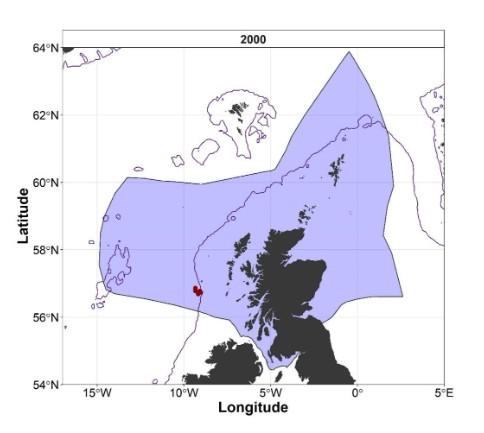
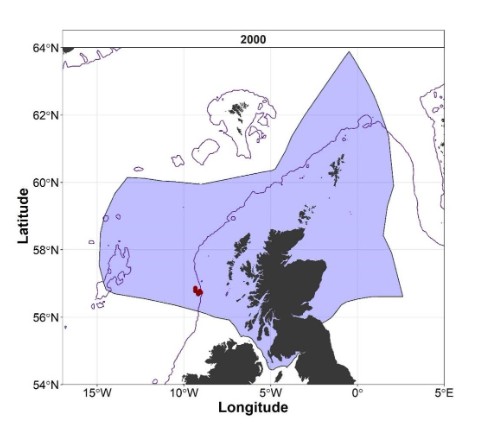
ICES DATRAS records for the Leafscale gulper shark (Centrophorus squamosus), 2000-2009.
Click for a full description
View a larger version of this image.
Map of the EEZ of Scotland showing the ICES (International Council for the Exploration of the Sea) DATRAS (database of trawl surveys hosted by ICES) records for the Leafscale gulper shark (Centrophorus squamosus) from bottom trawl surveys conducted between 2000 and 2009. Red points represent trawl shoot positions in which Leafscale gulper shark (C. squamosus) were captured. Records are exclusively in a single cluster on the continental slope west of the Isle of Barra.
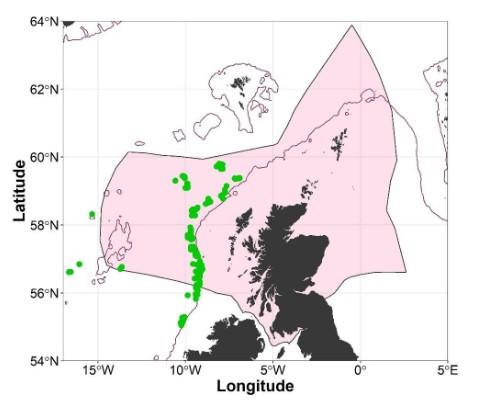
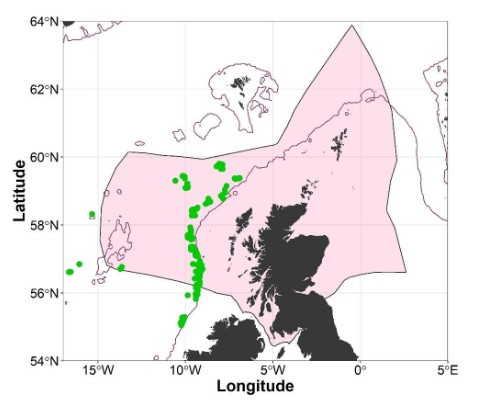
Records for the Leafscale gulper shark (Centrophorus squamosus) from SIAMISS and deep-water fisheries surveys undertaken by the Marine Directorate 1996 – 2019.
Click for a full description
View a larger version of this image.
Map of the economic exclusion zone (EEZ) of Scotland showing records for the Leafscale gulper shark (Centrophorus squamosus) from the Scottish-Irish anglerfish and megrim industry-science survey (SIAMISS) and deep-water fisheries surveys undertaken by Marine Directorate 1996-2019. Records are illustrated as green points and are exclusively located off the west coast of Scotland and Northern Ireland off the edge of the continental shelf. Most records are to the east of the Rockall Trough (on the slope of the continental shelf) with some records in the Rockall Trough to the west and northwest of the Outer Hebrides and some records on the slopes around the Rockall Plateau.
Habitat
Leafscale gulper sharks can be found in both demersal and pelagic habitats, at depths ranging from 0 – 2360 m (Ebert and Stehmann, 2013, Ebert et al., 2021). In the Rockall Trough they are found at relatively low abundance at depths of 500 and 1800m, peaking in abundance around 800 m (Neat et al., 2015). The species is highly migratory and can move hundreds of kilometres in several weeks along the continental slope waters. Females generally do not travel as far as males and might be philopatric (have a tendency to stay or habitually return to an area), (Veríssimo et al., 2012; Moura et al., 2014; Rodríguez-Cabello et al., 2016). The species appears to segregate by sex, size and maturity, with separation determined by factors such as depth and temperature (Moura et al., 2014). Seventy five percent of Leafscale gulper sharks caught mostly between 750 and 1000 m were male (O'Hea et al., 2020). Pregnant females tend to inhabit shallower and / or warmer waters (Moura et al., 2014). A number of pregnant females have been found off the Madeira Archipelago and Iceland, suggesting the areas are used as spawning grounds (Moura et al., 2014; Severino et al., 2009). Juveniles / neonates are rarely found in the Northeast Atlantic, larger immature sharks are generally found in deeper water than mature sharks (Moura et al., 2014).
Biology and Ecology
Leafscale gulper sharks are very long-lived and slow-growing. They are estimated to live for up to 70 years (Clarke et al., 2002) and can grow up to 166 cm TL (Weigmann 2016). The species is late to mature, with males maturing at 100 - 110 cm TL and females at 110 - 125 cm TL (Clarke et al., 2002; Ebert and Stehmann, 2013). Leafscale gulper sharks are aplacental viviparous and give birth to live young. They can produce 2 – 10 pups per litter, with newborns measuring between 35 – 43 cm TL (Severino et al., 2009). Sperm storage has been confirmed in females caught off New Zealand (Dutilloy and Dunn 2020). The stomach contents of 713 of Leafscale gulper sharks sampled in the Northeast Atlantic off Morocco consisted of teleosts, cephalopods, crustaceans, nematodes and condrichthians (Chimaera monstrosa and Dalatias licha), with teleosts having the highest relative importance of all the prey items identified (Nafia et al., 2023).
Human interactions
Leafscale gulper sharks were once an important component of mixed trawl fisheries, and mixed and directed longline and gillnet shark fisheries on continental slopes of the Northeast Atlantic (ICES, 2018), and both the flesh and the liver were sold. There is no longer a target fishery for this species following the introduction of a zero TAC for International waters in 2010 and All other waters in 2015. Vessels have been prohibited from landing the species in Scottish waters since 2012. The species is still taken as bycatch in mixed fisheries (trawl, long-line and gillnet), although this is thought to be relatively low (ICES, 2018). A study on discard survival of Leafscale gulper sharks captured on longlines at depths of 900 – 1100 m estimated a vessel mortality of 18.9% (when sharks in poor condition were included with those dead on retrieval). A subsequent tagging study of surviving Leafscale gulper sharks found that, of 9 sharks tagged successfully, three died within 5–10 weeks of release, and six survived for periods of at least 45–120 days. This corresponds to a mortality rate of 33% within 1-3 months post-capture (Rodríguez-Cabello and Sánchez, 2017). However, the study used much shorter soak times and slower haul speeds than would likely be encountered under normal commercial fishing conditions and therefore, mortality in these circumstances may be greater (ICES, 2024). Since 2021, Leafscale gulper shark has been a prohibited species in most of the Northeast Atlantic (ICES, 2024).
References
Clarke, M.W. et al., (2002) ‘Age estimation of the exploited deep-water shark Centrophorus squamosus from the continental slopes of the Rockall Trough and Porcupine Bank’, Journal of Fish Biology. Wiley, 60(3), pp. 501–514. doi: 10.1111/j.1095-8649.2002.tb01679.x.
Dutilloy, A., & Dunn, M. R. (2020). Observations of sperm storage in some deep-sea elasmobranchs. Deep Sea Research Part I: Oceanographic Research Papers, 166, 103405.
Ebert, D.A. and Stehmann, M.F.W. (2013) Sharks, batoids, and chimaeras of the North Atlantic. FAO Species Catalogue for Fishery Purposes. No. 7. Rome: Food and Agricultural Organization of the United Nations (FAO).
Guallart, J. et al., (2015) Leafscale Gulper Shark, Centrophorus squamosus, The IUCN Red List of Threatened Species 2015: e.T41871A48954989.
Finucci, B., Rigby, C.L., Bineesh, K.K., Cheok, J., Cotton, C.F., Kulka, D.W., Neat, F.C., Pacoureau, N., Rohner, C.A., Tanaka, S. & Walker, T.I. 2024. Centrophorus squamosus. The IUCN Red List of Threatened Species 2024: Centrophorus squamosus is listed as Endangered under criteria A2bd e.T41871A254975849. Accessed on 25 February 2025. Centrophorus squamosus is listed as Endangered under criteria A4b. (Accessed: 25 March 2020).
ICES (2018) Report of the Working Group on Elasmobranch Fishes (WGEF), 19-28. Lisbon, Portugal.
Moura, T. et al., (2014) ‘Large-scale distribution of three deep-water squaloid sharks: Integrating data on sex, maturity and environment’, Fisheries Research. Elsevier, 157, pp. 47–61. doi: 10.1016/j.fishres.2014.03.019.
Nafia, M., El Achi, A., Manchih, K., Baali, A., & Moncef, M. (2023). Diet of the leaf scale gulper shark (Centrophorus squamosus) in the North Atlantic off Morocco. Aquaculture, Aquarium, Conservation & Legislation, 16(4), 1963-1973.
Neat, F.C. et al., (2015) ‘The diversity, distribution and status of deep-water elasmobranchs in the Rockall Trough, north-east Atlantic Ocean’, Journal of Fish Biology. Blackwell Publishing Ltd, 87(6), pp. 1469–1488. doi: 10.1111/jfb.12822.
O'Hea, B., Davie, S., Johnston, G., & O’Dowd, L. (2020). Assemblages of Deepwater shark species along the north east Atlantic continental slope. Deep Sea Research Part I: Oceanographic Research Papers, 157, 103207.
Rodríguez-Cabello, C. and Sánchez, F. (2014) ‘Is Centrophorus squamosus a highly migratory deep-water shark?’, Deep-Sea Research Part I: Oceanographic Research Papers. Elsevier Ltd, 92, pp. 1–10. doi: 10.1016/j.dsr.2014.06.005.
Rodríguez-Cabello, C., González-Pola, C., & Sánchez, F. (2016). Migration and diving behavior of Centrophorus squamosus in the Northeast Atlantic. Combining electronic tagging and Argo hydrography to infer deep ocean trajectories. Deep Sea Research Part I: Oceanographic Research Papers, 115, 48-62.
Rodríguez-Cabello, C. and Sánchez, F. (2017) ‘Catch and post-release mortalities of deep-water sharks caught by bottom longlines in the Cantabrian Sea (Northeast Atlantic)’, Journal of Sea Research. Elsevier B.V., pp. 248–255. doi: 10.1016/j.seares.2017.04.004.
Severino, R. et al., (2009) ‘Aspects of the biology of the leaf-scale gulper shark Centrophorus squamosus (Bonnaterre, 1788) off Madeira archipelago’, Arquipélago : Life and Marine Sciences, 26.
Veríssimo, A. et al., (2012) ‘Genetic population structure and connectivity in a commercially exploited and wide-ranging deep-water shark, the leafscale gulper (Centrophorus squamosus)’, Marine and Freshwater Research, 63. doi: 10.1071/MF11237.