Sharks and Skates of Scotland Report: Knifetooth dogfish (Scymnodon ringens)
An extract from the Sharks and Skates of Scotland Report.
Knifetooth dogfish - Scymnodon ringens (Barbosa du Bocage & de Brito Capello, 1864)
Occurrence in Scotland: Deep-water. Occasional. Found on the continental slope of the Rockall Trough.
Synonym(s): none; Order: Squaliformes; Family: Somniosidae
Common name: Knifetooth dogfish
AlphaID: 105918 TSN Code: 160755
Population status
Scotland and Northeast Atlantic: Unknown status in Scotland. The population is considered to be increasing in the Northeast Atlantic (Finucci et al., 2020; Fernandez-Zapico et al., 2024).
Global: Decreasing. Population declines are suspected in the Eastern Central Atlantic, whilst the population is increasing in the Northeast Atlantic, a global population reduction of 30–49% was estimated over three generation lengths (111 years) (Finucci et al., 2020).
Conservation listings
- IUCN Red List Global: Vulnerable (assessment 21 November 2019)
- IUCN Red List Europe: Least Concern (assessment 03 March 2015)
- CITES: Not listed
- CMS: Not listed
- OSPAR: Not listed
- Listed on the UK’s ‘Prohibited Species’ list as documented in the ‘Written Record of fisheries consultations between the United Kingdom and the European Union for 2025’ for UK waters in ICES Subareas 5-10 and for all EU waters except ICES subarea 4
- Zero TAC under EU Regulation 2018/2025 & Regulation 2023/194
- Prohibited under EU Regulation 2025/202
- Listed on The Sharks, Skates and Rays (Prohibition of Fishing, Trans-shipment and Landing) (Scotland) Order 2012
- Included in the NEAFC measures prohibiting directed fishing for deep-sea sharks
Range and distribution
This species is mostly known to inhabit the Eastern Atlantic, with only a handful of records from the Western South Pacific. In the Northeast Atlantic, they occur in deep water along the Atlantic slope from Scotland to Spain, Portugal, Mauritania, and south to Senegal (Ebert and Stehmann, 2013). Deep-water surveys conducted from 1996 to 2013 in the Rockall Trough found that the species was rare. Knifetooth dogfish were recorded in the early years of the surveys and then were absent until 2013 when only a single specimen was caught (Neat et al., 2015).
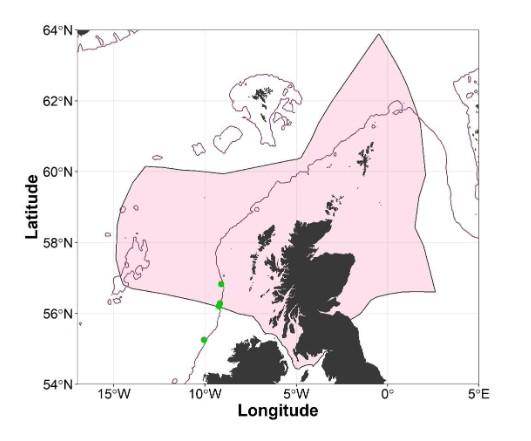
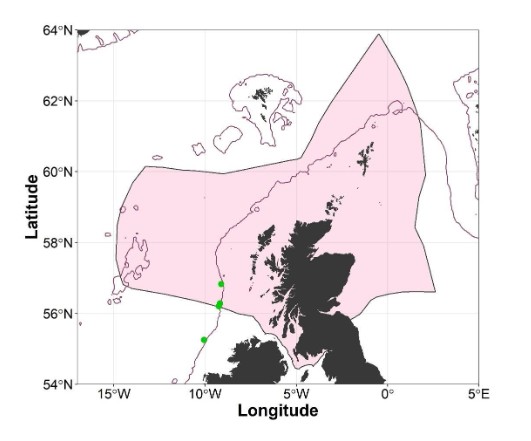
Records for the Knifetooth dogfish (Scymnodon ringens) from SIAMISS and deep-water fisheries surveys undertaken by the Marine Directorate 1996 – 2019.
Click for a full description
View a larger version of this image.
Map of the economic exclusion zone (EEZ) of Scotland showing records for the Knifetooth dogfish (Scymnodon ringens) from the Scottish-Irish anglerfish and megrim industry-science survey (SIAMISS) and deep-water fisheries surveys undertaken by Marine Directorate 1996-2019. Records are illustrated as green points and a small number are exclusively located off the west coast of Scotland and Northern Ireland off the edge of the continental shelf.
Habitat
Very little is known about the habitat preferences for this species other than they have been recorded at depths of 200 –1,600 m, on or near the seabed in the Northeast Atlantic (Ebert and Stehmann, 2013). In deep-water surveys west of Scotland (Rockall Trough), Knifetooth dogfish were recorded between 600 – 800 m on the southern end of the continental slope (Neat et al., 2015); however, the species was rare.
Biology and Ecology
In surveys of the Rockall Trough, the size of Knifetooth dogfish captured ranged from 34 –111 cm TL, and it is considered a ‘large’ species of shark (Neat et al., 2015). Knifetooth dogfish are aplacental viviparous, giving birth to live young (Ebert and Stehmann, 2013). Other biological characteristics, such as length at birth, maturity, and longevity, are currently unknown. Their triangular razor-sharp bottom teeth indicate that they are capable of catching large prey (Ebert and Stehmann, 2013). Stable isotope analysis of muscle tissue from Knifetooth dogfish in Portuguese waters suggests the diet is composed largely of bathyal cephalopods, crustaceans and teleosts (Graça Aranha et al., 2023).
Human interactions
There is currently no targeted fishery for this species in the Northeast Atlantic. Since 2010 there has been a zero TAC in European waters for Knifetooth dogfish and from 2015, the species has been prohibited from international waters, which was extended in 2021 to all European waters (ICES, 2024). Since the introduction of general measures to protect deep-water elasmobranchs (ban of static net fisheries below 600 m and trawls below 800 m), bycatch and discards are thought to be relatively low (ICES 2024). The species is still captured occasionally in crustacean bottom trawlers in Portuguese waters (Graça Aranha et al., 2025; Graça Aranha et al., 2023). Discard mortality in all fisheries is likely to be high (Graça Aranha et al., 2025). The species is offered some refuge from fisheries where the population occurs at depths beyond the limit of deepwater fisheries in the Northeast Atlantic.
References
Ebert, D.A. and Stehmann, M.F.W. (2013) Sharks, batoids, and chimaeras of the North Atlantic. FAO Species Catalogue for Fishery Purposes. No. 7. Rome: Food and Agricultural Organization of the United Nations (FAO).
Fernandez-Zapico, O., Ruiz-Pico, S., Blanco, M., Ortiz, P., Velasco, F., Rodriguez-Cabello, C., Baldó, F. 2023. Results on main elasmobranch species from the 2023 Spanish Groundfish Survey on the Porcupine Bank (Northeast Atlantic). Working Document presented to ICES WGEF 2024; 41 pp.
Finucci, B., Cheok, J., Cotton, C.F., Kulka, D.W., Neat, F.C., Pacoureau, N., Rigby, C.L., Tanaka, S. & Walker, T.I. 2020. Scymnodon ringens. The IUCN Red List of Threatened Species 2020: e.T161717A116739828. Accessed on 27 March 2025.
Graça Aranha Carvalho Ramos, S., Dias, E., Marsili, T., Pires da Rocha, P., Modesto, T., Guerreiro, P. M., ... & Figueiredo, I. Under Pressure: Deep-Sea Elasmobranchs Experience High Mortality and Stress in a Crustacean Trawling Fishery. Frontiers in Fish Science, 3, 1473376.
Graça Aranha, S., Teodósio, A., Baptista, V., Erzini, K., & Dias, E. (2023). A glimpse into the trophic ecology of deep‐water sharks in an important crustacean fishing ground. Journal of Fish Biology, 102(3), 655-668.
Neat, F.C. et al., (2015) ‘The diversity, distribution and status of deep-water elasmobranchs in the Rockall Trough, north-east Atlantic Ocean’, Journal of Fish Biology. Blackwell Publishing Ltd, 87(6), pp. 1469–1488. doi: 10.1111/jfb.12822.
Ruiz-Pico, S. et al., (2018) ‘Results on main elasmobranches species from 2001 to 2017 Porcupine Bank (Northeast Atlantic) bottom trawl surveys’, in ICES Working Group on Elasmobranch Fishes (WGEF). Lisbon, Portugal.
Valenti, S. et al., (2015) Knifetooth Dogfish, Scymnodon ringens, The IUCN Red List of Threatened Species 2015: e.T161717A48932626. (Accessed: 4 May 2020).