Sharks and Skates of Scotland Report: Jensen’s skate (Amblyraja jenseni)
An extract from the Sharks and Skates of Scotland Report.
Jensen’s skate - Amblyraja jenseni (Bigelow and Schroeder, 1950)
Occurrence in Scotland: Slope and Deep-water. Resident. Found on the slopes of both sides of the Rockall Trough.
Synonym(s): Raja jenseni; Order: Rajiformes; Family: Rajidae
Common name: Jensen’s skate, Short-tailed skate
AlphaID: 105864 TSN Code: 564207
Population status
Scotland and Northeast Atlantic: Stable in Europe (Farrell et al., 2015). Unknown in Scotland.
Global: Increasing. Survey trawl data from the Newfoundland, Labrador Shelf and Grand banks between 1995 and 2017 reveal an increasing CPUE, suggesting the population is either stable or increasing (Kulka et al., 2020).
Conservation listings
- IUCN Red List Global: Least Concern (assessment 19 July 2019)
- IUCN Red List Europe: Least Concern (assessment 12 November 2014)
- CITES: Not listed
- CMS: Not listed
- OSPAR: Not listed
- Included in the NEAFC measures prohibiting directed fishing for deep-sea rays
Range and distribution
Jensen’s skate is a deep-water species that has a wide distribution across the North Atlantic, from Canada and the USA across to Iceland and Greenland (including the Mid-Atlantic ridge) and to the west of the British Isles (Orlov and Cotton, 2015). More specifically, in the Northeast Atlantic, they have been reported in waters north and west of Ireland (including the Porcupine Seabight) and off the west coast of Scotland (in the Rockall Trough). Despite their wide range, this species is rarely encountered in Scottish waters and only 24 individuals have been caught in total between 1998 – 2013 in Scottish deep-water surveys (ICES, 2018).
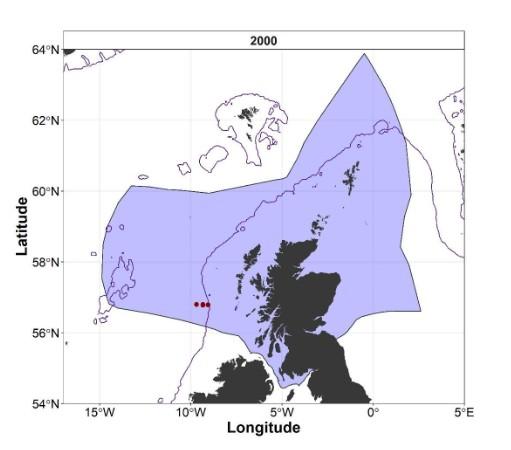
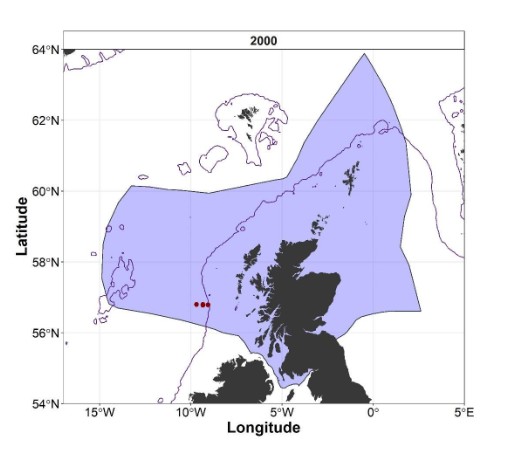
ICES DATRAS records for Jensen’s skate (Amblyraja jensini), 2000-2009.
Click for a full description
View a larger version of this image.
Map of the EEZ of Scotland showing the ICES (International Council for the Exploration of the Sea) DATRAS (database of trawl surveys hosted by ICES) records for Jensen’s skate (Amblyraja jensini) from bottom trawl surveys conducted between 2000 and 2009. Red points represent trawl shoot positions in which Jensen’s skate (A. jensini)
were captured. Records are exclusively in a single cluster on the continental slope west of the Isle of Barra.
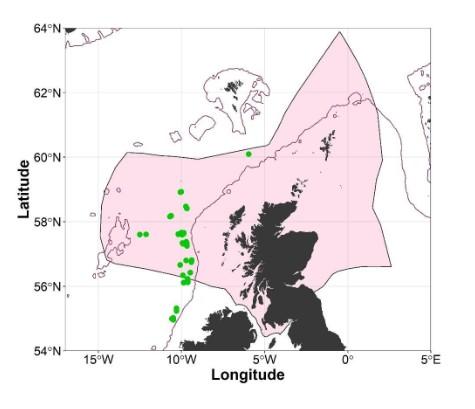
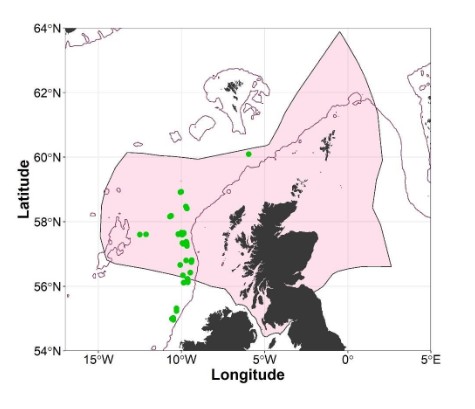
Records for Jensen’s skate (Amblyraja jenseni) from SIAMISS and deep-water fisheries surveys undertaken by the Marine Directorate 1996 – 2019.
Click for a full description
View a larger version of this image.
Map of the economic exclusion zone (EEZ) of Scotland showing records for Jensen’s skate (Amblyraja jenseni) from the Scottish-Irish anglerfish and megrim industry-science survey (SIAMISS) and deep-water fisheries surveys undertaken by Marine Directorate 1996-2019. Records are illustrated as green points and are exclusively located off the west coast of Scotland and Northern Ireland off the edge of the continental shelf. Most records are to the east of the Rockall Trough with some records further from the continental shelf in deeper water to the west, northwest and north of the Outer Hebrides. There are 2 records further west on the east facing slope of the Rockall Plateau.
Habitat
Jensen’s skate have been recorded from 165 – 2550 m, however they are predominantly found at depths greater than 650 m and in waters ranging from 2.6–5.5 °C (Orlov and Cotton, 2015; Kulka et al., 2024). In the North Atlantic juveniles and adults have been found in similar depth ranges, with no significant difference in capture depth between males and females (Orlov and Cotton, 2015). The species is morphologically similar to (and often confused with) the Arctic skate Amblyraja hyperborea, however recent research has demonstrated a geographic and thermal separation between the species in the Northwest Atlantic, with the Jensen’s skate occupying waters to the South of the Davis Strait, and the Arctic skate occupying the colder Arctic waters to the North (in Baffin Bay) (Kulka et al., 2024).
Biology and Ecology
Data on the biology and ecology of Jensen’s skate are generally limited. Maximum size is reported as 112 cm. Males become sexually mature at around 90 cm TL, and females at 84 cm TL (Kulka et al., 2024). Jensen’s skate are oviparous and lay paired eggs that have horn-like projections. Size at hatching is around 14 cm. The juveniles and adults feed on small fishes and crustaceans (McEachran and Dunn, 1998).
Human interactions
There is no target fishery for this species in the Northeast Atlantic and its habitat preference for waters deeper than 1000 m means that it is only occasionally taken as bycatch (Farrell et al., 2015; Orlov and Cotton, 2015). In Canada, Jensen’s skate is incidentally caught and discarded from the deepwater trawl, longline, and gillnet fisheries for Greenland Halibut (Reinhardtius hippoglossoides), and discard mortality is likely to be high in longline fisheries due to automatic hook removal (Kulka et al., 2020). Jensen’s skate are managed under a combined regional TACs for ‘skates and rays’ in Scottish waters as part of the Celtic Seas ecoregion and the Greater North Seas ecoregions. However, since the introduction of general measures to protect deep-water elasmobranchs (ban of static net fisheries below 600 m and trawls below 800 m; ICES 2024), the species is unlikely to be incidentally caught due to the depths at which it occurs.
References
Farrell, E., Orlov, A., Walls, R., Stehmann, M.F.W. & Barker, A.S. 2015. Amblyraja jenseni (Europe assessment). The IUCN Red List of Threatened Species 2015: e.T161491A48927682. Accessed on 15 September 2025.
ICES (2019) ICES Advice on fishing opportunities, catch, and effort Greater North Sea Ecoregion: Other rays and skates (Rajidae) in Subarea 4 and in divisions 3.a and 7.d (North Sea, Skagerrak, Kattegat, and eastern English Channel), Report of the ICES Advisory Committee.
Kulka, D.W., Cotton, C.F., Anderson, B., Herman, K., Pacoureau, N. & Dulvy, N.K. 2020. Amblyraja jenseni. The IUCN Red List of Threatened Species 2020: e.T161491A124494959. Accessed on 02 April 2025.
Kulka, D. W., Miri, C. M., Atchison, S., & Simpson, M. R. (2024). Sibling Species Amblyraja hyperborea and A. jenseni in Slope Waters of Eastern Canada: An Ecomorphological Description. Diversity, 16(8), 479.
McEachran, J.D. and Dunn, K.A. (1998) ‘Phylogenetic analysis of skates, a morphologically conservative clade of elasmobranchs (Chondrichthyes: Rajidae)’, Copeia, 2, pp. 271–290.
Neat, F.C. et al., (2015) ‘The diversity, distribution and status of deep-water elasmobranchs in the Rockall Trough, north-east Atlantic Ocean’, Journal of Fish Biology. Blackwell Publishing Ltd, 87(6), pp. 1469–1488. doi: 10.1111/jfb.12822.
Orlov, A.M. and Cotton, C.F. (2015) ‘New data on the rare deep-sea skate Amblyraja jenseni (Rajidae) from the North Atlantic Ocean’, Journal of Ichthyology. Maik Nauka Publishing / Springer SBM, 55(4), pp. 478–496. doi: 10.1134/S0032945215040086.