Sharks and Skates of Scotland Report: Iceland catshark (Apristurus laurussonii)
An extract from the Sharks and Skates of Scotland Report.
Iceland catshark - Apristurus laurussonii (Saemundsson, 1922)
Occurrence in Scotland: Deep-sea. Resident. Found on the slopes of both sides of the Rockall Trough, continental shelf off NW Scotland and Rosemary Bank.
Synonym(s): Apristurus atlanticus, Apristurus maderensis, Scyllium laurussonii; Order: Carcharhiniformes; Family: Pentanchidae
Common name: Iceland catshark
AlphaID: 105807; TSN Code: 159992
Note: The genus Apristurus is “one of the most taxonomically confused shark genera” (Walls, 2015), and contains at least 32 described species and several undescribed species (Compagno, 1984; Walls, 2015).
Population status
Scotland and Northeast Atlantic: Unknown (Neat et al., 2015; Walls, 2015).
Global: Stable (Kulka et al., 2020).
Conservation listings
- IUCN Red List Europe: Least Concern (assessment 17 November 2014)
- IUCN Red List Global: Least Concern (assessment 19 June 2019)
- CITES: Not listed
- CMS: Not listed
- OSPAR: Not listed
- Listed on the UK’s ‘Prohibited Species’ list as documented in the ‘Written Record of fisheries consultations between the United Kingdom and the European Union for 2025’ for UK waters of ICES Subareas 5-10
- Zero TAC under EU Regulation 2018/2025 & EU Regulation 2023/194
- Prohibited under EU Regulation 2025/202
- Listed on The Sharks, Skates and Rays (Prohibition of Fishing, Trans-shipment and Landing) (Scotland) Order 2012
- Included in the NEAFC measures prohibiting directed fishing for deep-sea sharks
Range and distribution
Iceland catsharks are deep-water species that inhabit the Northeast and Eastern Central Atlantic from Iceland to Gabon (Iglésias & Nakaya, 2004). In the Northeast Atlantic, they can be found in the waters of southeast Greenland, Iceland, the Faroe Islands, down to the Canary and Madeira Islands (Neat et al., 2008; Ebert & Stehmann, 2013). In Scottish waters, they are found on the slopes of the Rockall Trough.
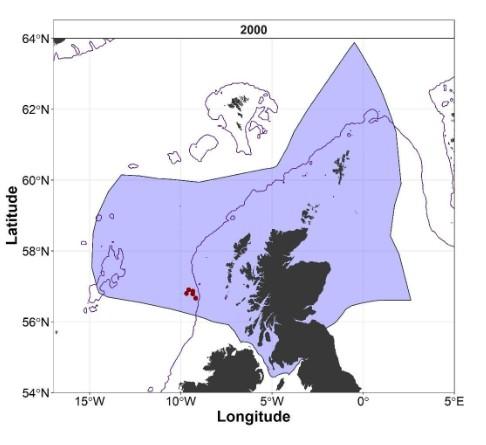
ICES DATRAS records for the Iceland catshark (Apristurus laurussonii) from 2000-2009.
Click for a full description
Map of the economic exclusion zone (EEZ) of Scotland showing the ICES (International Council for the Exploration of the Sea) DATRAS (Database of trawl surveys hosted by ICES) records for the Iceland catshark (Apristurus laurussonii) from bottom trawl surveys conducted between 2000 and 2009. Five red points clustered to the west of the Isle of Barra beyond the continental shelf represent trawl shoot positions in which Iceland catshark (A. laurussonii) were captured.
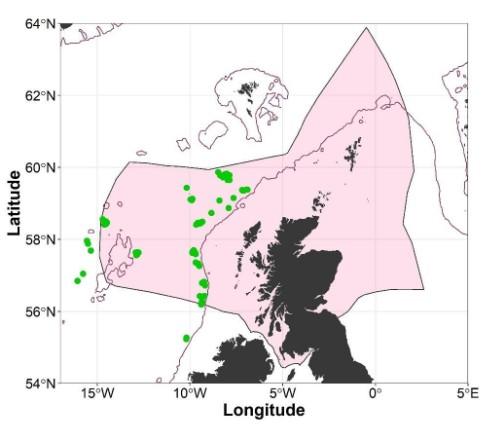
Records for the Iceland catshark (Apristurus laurussonii) from SIAMISS and deep-water fisheries surveys undertaken by the Marine Directorate 1996 – 2019.
Click for a full description
Map of the economic exclusion zone (EEZ) of Scotland showing records for the Iceland catshark (Apristurus laurussonii) from Scottish-Irish anglerfish and megrim industry-science survey (SIAMISS) and deep-water fisheries surveys undertaken by the Marine Directorate 1996 – 2019. Records are illustrated as green points and are exclusively located off the west coast of Scotland and Northern Ireland off the edge of the continental shelf and around the Rockall Plateau.
Habitat
Iceland catsharks are a relatively common shark species that lives at depths of 560 – 2060 m on or near the seabed of upper continental slopes (Ebert et al., 2013). In surveys of the Rockall Trough, the species was regularly encountered at depths of 900 – 1500 m, with its abundance peaking at 1000 m (Neat et al., 2015). The shark has been captured in areas where bottom water temperatures range from 1.7 °C to 4.3 °C (Ebert & Stehmann, 2013).
Biology and Ecology
Very little is known about the biology and ecology of the Iceland catshark. It is considered to be a slow-moving, medium-sized catshark. Individuals are recorded as ranging from 13 – 71 cm TL in surveys of the Rockall Trough (Neat et al., 2015), and the largest recorded individual in the Northeast Atlantic is recorded as ~72 cm TL (Nakaya and Sato, 1998). They are an oviparous species (egg laying). Egg cases measure ~6 cm long, 2.5 cm wide, and have distinct ridges (Nakaya and Sato, 1998; Walls, 2015).
Human interactions
Iceland catsharks have been subject to a zero Total Allowable Catch in the Northeast Atlantic since 2010 (ICES, 2024), and since 2021 have been a prohibited species. Apristurus spp are prohibited species in UK, EU and international waters of ICES subareas 5-10 and 12 and vessels are prohibited from landing this species in Scottish waters.
References
Compagno, L.J.V. (1984) Sharks of the world. An annotated and illustrated catalogue of shark species known to date. Part 1. Hexanchiformes to Lamniformes., FAO species catalogue. Rome.
Ebert, D.A. and Stehmann, M.F.W. (2013) Sharks, batoids, and chimaeras of the North Atlantic. FAO Species Catalogue for Fishery Purposes. No. 7. Rome: Food and Agricultural Organization of the United Nations (FAO)
ICES. (2024). Report of the Working Group on Elasmobranch Fishes (WGEF). ICES Scientific Reports. 06:75. 994 pp.
Iglésias, S.P. and Nakaya, K. 2004. Apristurus atlanticus (Koefoed, 1927), a junior synonym of A. laurussonii (Saemundsson, 1922) (Chondrichthyes: Carcharhiniformes: Scyliorhinidae). Cybium 28(3): 217-223.
Kulka, D.W., Cotton, C.F., Anderson, B., Crysler, Z., Herman, K. & Dulvy, N.K. 2020. Apristurus laurussonii. The IUCN Red List of Threatened Species 2020: e.T44216A124430838.
Nakaya, K. and Sato, K. (1998) ‘Taxonomic review of Apristurus laurussoni (Saemundsson, 1922) from the eastern North Atlantic (Elasmobranchii: Scyliorhinidae).’, Cybium, 22(2), pp. 149–157.
Neat, F.C. et al., (2008) The Deepwater Ecosystem of the Continental Shelf Slope and Seamounts of the Rockall Trough: A Report on the Ecolog and Biodiversity Based on FRS Scientific Surveys. Fisheries Research Services Internal Report No 02/08
Neat, F.C. et al., (2015) ‘The diversity, distribution and status of deep-water elasmobranchs in the Rockall Trough, north-east Atlantic Ocean’, Journal of Fish Biology. Blackwell Publishing Ltd, 87(6), pp. 1469–1488. doi: 10.1111/jfb.12822.
Walls, R. (2015) Iceland Catshark Apristurus laurussonii, The IUCN Red List of Threatened Species 2015: e.T44216A48921001. (Accessed: 14 April 2020).