Sharks and Skates of Scotland Report: Great lanternshark (Etmopterus princeps)
An extract from the Sharks and Skates of Scotland Report.
Great lanternshark - Etmopterus princeps (Collett, 1904)
Occurrence in Scotland: Deep-water. Resident. Found on the slopes both sides of the Rockall Trough, to the west of Rockall, Rosemary Bank, and the continental shelf off NW Scotland.
Synonym(s): In geographic regions other than North America sharks referred to as this species are Etmopterus baxteri or Etmopterus unicolor (Jung et al., 2015); Order: Squaliformes; Family: Etmopteridae
Common name: Great lanternshark
AlphaID: 105911; TSN Code: 160659
Population status
Scotland and Northeast Atlantic: Stable (Jung et al., 2015). Scottish research surveys found no trend between 2000 and 2012 (Neat et al., 2015; ICES, 2024). Surveys along the coast of the Basque Country (ICES region 8c) between 2015 – 2023 report a fluctuating CPUE (catch per unit effort) with no overall trend (ICES 2024).
Global: Stable (Kulka et al., 2020).
Conservation listings
- IUCN Red List Global: Least Concern (assessment 20 June 2019)
- IUCN Red List Europe: Least Concern (assessment 24 October 2014)
- CITES: Not listed
- CMS: Not listed
- OSPAR: Not listed
- Listed on the UK’s ‘Prohibited Species’ list as documented in the ‘Written Record of fisheries consultations between the United Kingdom and the European Union for 2025’ for UK waters of ICES Division 2a and Subarea 4
- Zero TAC under EU Regulation 2018/2025 & Regulation 2023/194 (Article 18)
- Prohibited under EU Regulation 2025/202
- Listed on The Sharks, Skates and Rays (Prohibition of Fishing, Trans-shipment and Landing) (Scotland) Order 2012
- Included in the NEAFC measures prohibiting directed fishing for deep-sea sharks
Range and distribution
Great lanternsharks are found in both the NE and Northwest Atlantic oceans. In the Northeast Atlantic they occur from the Denmark strait between Greenland and Iceland, and southern Iceland along the Atlantic slope to the Faroes, across to Norway and Scotland (including Rockall Trough), down to Irish waters, south-west England, Bay of Biscay, France and Spain, out to the Canary Islands and Azores, and southwards to the coast of West Africa (Ebert and Stehmann, 2013; Jung et al., 2015; Kulka et al., 2020).
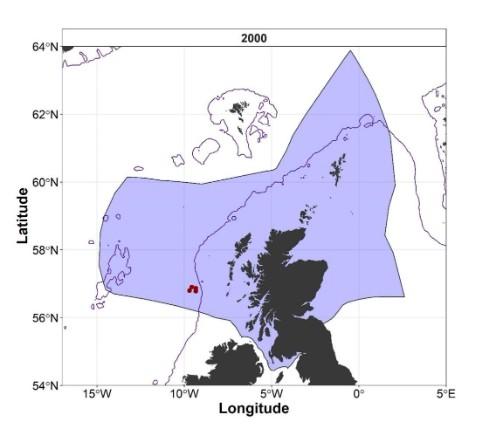
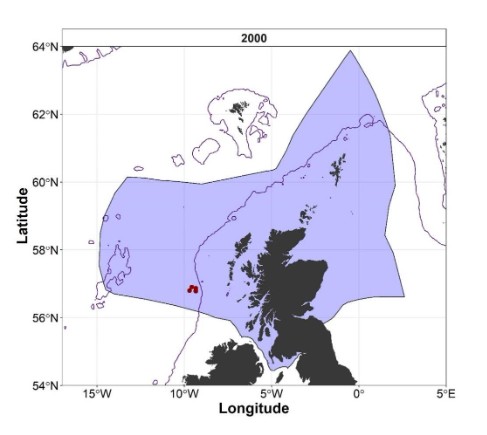
ICES DATRAS records for the Great lanternshark (Etmopterus princeps), 2000-2009.
Click for a full description
View a larger version of this image.
Map of the EEZ of Scotland showing the ICES (International Council for the Exploration of the Sea) DATRAS (database of trawl surveys hosted by ICES) records for the Great lanternshark (Etmopterus princeps) from bottom trawl surveys conducted between 2000 and 2009. Red points represent trawl shoot positions in which Great lanternshark (E. princeps) were captured. Records are exclusively in a single cluster on the continental slope west of the Isle of Barra.
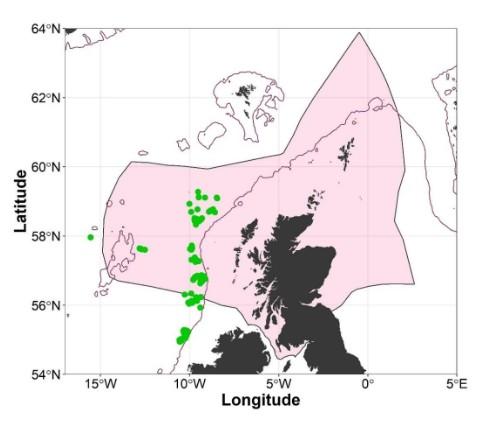
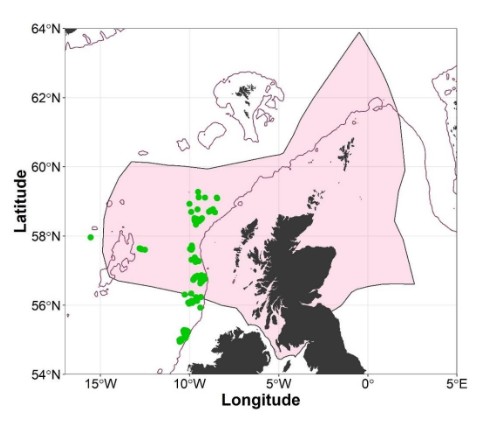
Records for the Great lanternshark (Etmopterus princeps) from SIAMISS and deep-water fisheries surveys undertaken by the Marine Directorate 1996 – 2019.
Click for a full description
View a larger version of this image.
Map of the economic exclusion zone (EEZ) of Scotland showing records for the Great lanternshark (Etmopterus princeps) from the Scottish-Irish anglerfish and megrim industry-science survey (SIAMISS) and deep-water fisheries surveys undertaken by the Marine Directorate 1996-2019. Records are illustrated as green points and are exclusively located off the west coast of Scotland and Northern Ireland, off the edge of the continental shelf. Most records are to the east of the Rockall Trough (on the slope of the continental shelf) with some records in the Rockall Trough to the west and northwest of the Outer Hebrides and some records on the slopes around the Rockall Plateau.
Habitat
This deep-water shark species is mainly found near the seabed on continental slopes at depths of up to 4500 m (Jung et al., 2015) but is most abundant between depths of 800 – 1000 m in the Northeast Atlantic (Ebert and Stehmann, 2013). In the Rockall Trough, the species was commonly found on lower slope areas at depths of 900 – 2000 m (Neat et al., 2015).
Biology and Ecology
Great lanternsharks are a medium-sized species, and specimens ranging from 15 – 84 cm TL have been caught in surveys of the Rockall Trough (Neat et al., 2015). The largest adult recorded was a female measuring 89 cm TL off Iceland (Jakobsdóttir, 2001), and size at maturity was estimated to be 57cm TL and 69 cm TL for males and females, respectively (Mulvey, 2000). This species is viviparous, giving birth to live pups measuring around 12-17 cm TL (Ebert and Stehmann, 2013). Females have 11 pups on average per litter, with a range of 7 – 18 (Cotton et al., 2015). The species is thought to have two periods of reproduction, one in June-July and one in October (Ebert and Stehmann, 2013). In the waters off Iceland, females were significantly more numerous than males at depths greater than 1000 m, suggesting depth segregation by sex and size in this species; however, no defined pupping season was identified (Jakobsdóttir, 2001). The generation length for Great lanternsharks is estimated to be about 43.5 years (Jung et al., 2015).
In common with many species in the family Etmopteridae, the Great lanternshark is capable of bioluminescence. Light is emitted from specialised light organs (photophores) in the skin, and is under hormonal control (Duchatelet et al., 2020; Duchatelet et al., 2021). The ecological function of this is thought predominantly to be camouflage (counterillumination). Their diet consists mainly of teleosts (mostly Myctophidae), crustaceans and cephalopods (Jakobsdóttir, 2001), with a dietary shift from crustaceans to teleosts as they increase in size (Sólmundsson et al., 2025). Along with some other species of deep-sea squaloid shark, the Great lanternshark is host to a mesoparasitic barnacle, Anelasma, which retards the development of reproductive organs (ova, testes and claspers) in parasitized individuals (Yano and Musick, 2000).
Human interactions
There is currently no targeted fishery for this species, and it has been subject to a zero Total Allowable Catch since 2010 and the species has been listed as prohibited since 2015 (ICES, 2024). However, it is still taken as bycatch (and discarded) in deep-water trawl and longline fisheries (Kulka et al., 2020). Discards are thought to be relatively low due to the introduction of general measures to protect deep-water elasmobranchs (i.e. ban of certain net fisheries below 600 m, and trawls below 800 m) (ICES 2024), discard mortality is unknown.
References
Clarke, M. et al., (2016) Ireland Red List No. 11: Cartilaginous fish [sharks, skates, rays and chimaeras]. Dublin, Ireland
Cotton, C. F., Grubbs, R. D., Dyb, J. E., Fossen, I., & Musick, J. A. (2015). Reproduction and embryonic development in two species of squaliform sharks, Centrophorus granulosus and Etmopterus princeps: Evidence of matrotrophy? Deep Sea Research Part II: Topical Studies in Oceanography, 115, 41-54.
Duchatelet, L., Claes, J. M., Delroisse, J., Flammang, P., & Mallefet, J. (2021, December). Glow on sharks: state of the art on bioluminescence research. In Oceans (Vol. 2, No. 4, pp. 822-842). MDPI.
Duchatelet, L., Delroisse, J., & Mallefet, J. (2020). Bioluminescence in lanternsharks: Insight from hormone receptor localization. General and Comparative Endocrinology, 294, 113488.
Ebert, D.A., Fowler, S. and Compagno, L. 2013. Sharks of the World. Wild Nature Press, Plymouth.
Ebert, D.A. and Stehmann, M.F.W. (2013) Sharks, batoids, and chimaeras of the North Atlantic. FAO Species Catalogue for Fishery Purposes. No. 7. Rome: Food and Agricultural Organization of the United Nations (FAO).
ICES (2024). Report of the Working Group on Elasmobranch Fishes (WGEF). ICES Scientific Reports. 06:75. 994 pp.
Fossen, I., Cotton, C., Bergstad, O. and Dyb, J. 2008. Species composition and distribution patterns of fishes captured by longlines on the Mid-Atlantic Ridge. Deep-Sea Research II 55: 203-217.
Jakobsdóttir, K.B. (2001) ‘Biological aspects of two deep-water squalid sharks: Centroscyllium fabricii (Reinhardt, 1825) and Etmopterus princeps (Collett, 1904) in Icelandic waters’, in Fisheries Research. Elsevier, pp. 247–265. doi: 10.1016/S0165-7836(01)00250-8.
Jung, A. et al., (2015) Great Lanternshark, Etmopterus princeps, The IUCN Red List of Threatened Species 2015: e.T60242A48911736. (Accessed: 12 March 2020).
Kulka, D.W., Cotton, C.F., Buscher, E., Dureuil, M., Herman, K., Jung, A., Anderson, B. & Dulvy, N.K. 2020. Etmopterus princeps. The IUCN Red List of Threatened Species 2020: e.T60242A124455321. Accessed on 05 March 2025.
Mulvey, T. (2000) Distribution, maturity and discarding of the elasmobranch species, Etmopterus princeps (Collett, 1904), in the deep-waters of the Porcupine Bank and Sea Bight. University College Cork.
Neat, F.C. et al., (2015) ‘The diversity, distribution and status of deep-water elasmobranchs in the Rockall Trough, north-east Atlantic Ocean’, Journal of Fish Biology. Blackwell Publishing Ltd, 87(6), pp. 1469–1488. doi: 10.1111/jfb.12822.
Sólmundsson, J., Jakobsdóttir, K. B., & Pétursdóttir, H. (2025). Deepwater Sharks at Their Northern Limits—Distribution, Diet and Trophic Relations. Marine Ecology, 46(1), e12854.
Yano, K., & Musick, J. A. (2000). The effect of the mesoparasitic barnacle Anelasma on the development of reproductive organs of deep-sea squaloid sharks, Centroscyllium and Etmopterus. Environmental biology of fishes, 59, 329-339.