Sharks and Skates of Scotland Report: Ghost catshark (Apristurus manis)
An extract from the Sharks and Skates of Scotland Report.
Ghost catshark - Apristurus manis (Springer, 1979)
Occurrence in Scotland: Deep-sea. Resident. Found on the continental slope of the Rockall Trough and NW Scotland. Medium number of records.
Synonym(s): Parmaturus manis; Order: Carcharhiniformes; Family: Pentanchidae
Common name: Ghost catshark
AlphaID: 105808 TSN Code: 160014
Note: The genus Apristurus is “one of the most taxonomically confused shark genera” (Walls, 2015), and contains at least 32 described species and several undescribed species (Compagno, 1984; Walls, 2015).
Population status
Scotland and Northeast Atlantic: Unknown (Neat et al., 2015; Walls, 2015)
Global: Stable (Pollom et al., 2019)
Conservation listings
- IUCN Red List Europe: Least Concern (assessment 10 October 2014)
- IUCN Red List Global: Least Concern (assessment 24 April 2018)
- CITES: Not listed
- CMS: Not listed
- OSPAR: Not listed
- Listed on the UK’s ‘Prohibited Species’ list as documented in the ‘Written Record of fisheries consultations between the United Kingdom and the European Union for 2025’ for UK waters of ICES Subareas 5-10
- Zero TAC under EU Regulation 2018/2025 & EU Regulation 2023/194
- Prohibited under EU Regulation 2025/202
- Listed on The Sharks, Skates and Rays (Prohibition of Fishing, Trans-shipment and Landing) (Scotland) Order 2012
- Included in the NEAFC measures prohibiting directed fishing for deep-sea sharks
Range and distribution
Ghost catshark have a limited distribution in the Northeast Atlantic and have been recorded in the deep-water of the Porcupine Bank west of Ireland, as well as in the Rockall Trough west of Scotland (Ebert & Stehmann, 2013; Neat et al., 2008 & 2015; Walls, 2015). It is considered to be ‘rare’ and is among the less frequently recorded catsharks in recent Irish deep-water surveys (Clarke et al., 2016) and is also rare in surveys of the Rockall Trough (Neat et al., 2015). The species is also found in deep-water canyons in the north-western Atlantic and has been caught in deep-water off South Africa (Ebert & Stehmann, 2013).
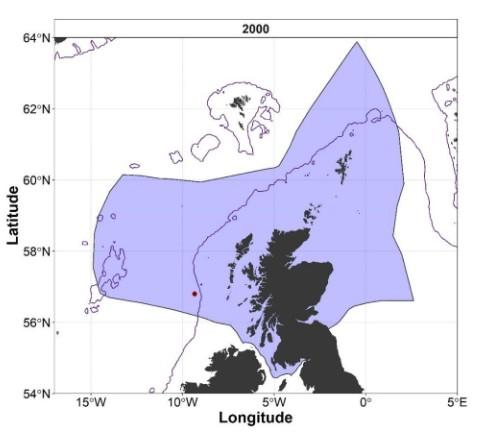
ICES DATRAS records for the Ghost catshark (Apristurus manis) from 2000-2009.
Click for a full description
Map of the economic exclusion zone (EEZ) of Scotland showing the ICES (International Council for the Exploration of the Sea) DATRAS (database of trawl surveys hosted by ICES) records for the Ghost catshark (Apristurus manis) from bottom trawl surveys conducted between 2000 and 2009. One red point is shown to the west of the Isle of Barra beyond the continental shelf representing a single trawl shoot position in which Ghost catshark (A. manis) were captured.
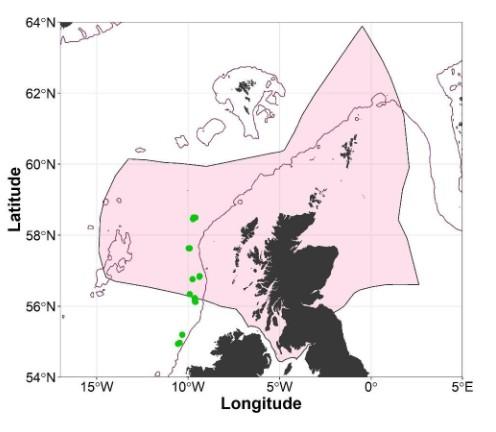
Records for the Ghost catshark (Apristurus manis) from SIAMISS and deep-water fisheries surveys undertaken by The Marine Directorate 1996 – 2019.
Click for a full description
Map of the economic exclusion zone (EEZ) of Scotland showing records for the Ghost catshark (Apristurus manis) from the Scottish-Irish anglerfish and megrim industry-science survey (SIAMISS) and deep-water fisheries surveys undertaken by Marine Directorate 1996-2019. Records are illustrated as green points and are exclusively located off the west coast of Scotland and Northern Ireland towards the bottom of the slope of the continental shelf.
Habitat
Ghost catshark are a deep-water species that has been recorded at depths of 600 – 1900 m in the Northeast Atlantic. In surveys of the Rockall Trough the species was found along the base of the continental slope at depths of 1500 –1900 m (Neat et al., 2015).
Biology and Ecology
Ghost catsharks are the largest of the catshark species that have been found in the Rockall Trough, west of Scotland, with a maximum total length of 96 cm (Neat et al., 2015). The species can reportedly grow to a maximum length of 88 cm (TL), and the size at maturity for females and males is 76 cm TL and 85 cm TL, respectively (Castro, 2011; Walls, 2015). They are oviparous, producing smooth egg cases of 63-71mm in length with short anterior horns and an absence of tendrils (Flammang et al., 2007). Very little else is known about their biology and ecology.
Human interactions
Ghost catsharks have been subject to a zero Total Allowable Catch in the Northeast Atlantic since 2010 (ICES, 2024) and have been a prohibited species since 2021. All Apristurus spp are prohibited species in the UK, EU and international waters of ICES subareas 5-10 and 12 and vessels are prohibited from landing this species in Scottish waters. The majority of the species' habitat range (>1500 m) is beyond the reach of deep-water fisheries.
References
Castro, J.I. (2011). The sharks of North American waters. Oxford: Oxford University Press.
Clarke, M. et al., (2016). Ireland Red List No. 11: Cartilaginous fish [sharks, skates, rays and chimaeras]. Dublin, Ireland
Ebert, D.A. and Stehmann, M.F.W. (2013). Sharks, batoids, and chimaeras of the North Atlantic. FAO Species Catalogue for Fishery Purposes. No. 7. Rome: Food and Agricultural Organization of the United Nations (FAO).
Flammang, B. E., Ebert, D. A., & Cailliet, G. M. (2007). Egg cases of the genus Apristurus (Chondrichthyes: Scyliorhinidae): phylogenetic and ecological implications. Zoology, 110(4), 308-317.
Neat, F.C. et al., (2008). The Deepwater Ecosystem of the Continental Shelf Slope and Seamounts of the Rockall Trough: A Report on the Ecology and Biodiversity Based on FRS Scientific Surveys. Fisheries Research Services Internal Report No 02/08
Neat, F.C., Burns, F., Jones, E., Blasdale, T. (2015). The diversity, distribution and status of deep-water elasmobranchs in the Rockall Trough, north-east Atlantic Ocean. J Fish Biol. 2015 Dec;87(6):1469-88. doi: 10.1111/jfb.12822. PMID: 26709217.
Pollom, R., Ebert, D.A. & Leslie, R. (2019). Apristurus manis. The IUCN Red List of Threatened Species 2019: e.T44599A124434315.
Pollom, R., Ebert, D.A. & Leslie, R. (2019). Apristurus manis. The IUCN Red List of Threatened Species 2019: e.T44599A124434315. (Accessed on 14 September 2025.)
Walls, R. (2015). Ghost Catshark, Apristurus manis, The IUCN Red List of Threatened Species 2015: e.T44599A48956731. (Accessed: 12 April 2020).