Sharks and Skates of Scotland Report: Cuckoo skate (Leucoraja naevus)
An extract from the Sharks and Skates of Scotland Report.
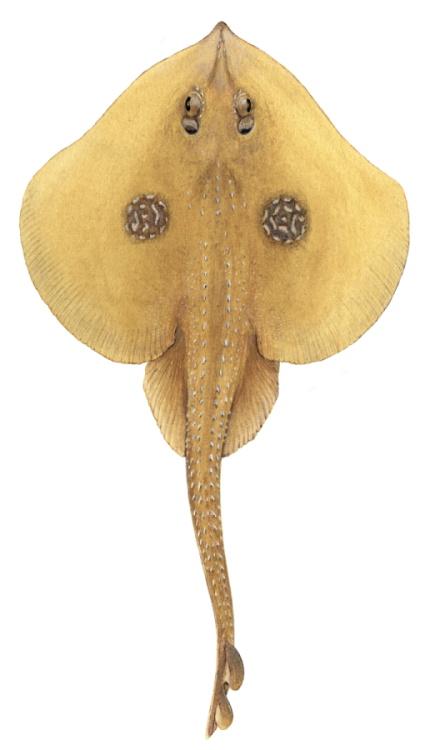
Cuckoo skate - Leucoraja naevus (Müller & Henle, 1841)
Occurrence in Scotland: Shelf. Resident. Common throughout shelf waters. Occasional records from Rockall.
Synonym(s): Raja naevus; Order: Rajiformes; Family: Rajidae
Common name: Cuckoo skate
AlphaID: 105876 TSN Code: 564143
Note: In the past, Cuckoo skate have been confused with Sandy skate (Leucoraja circularis).
Population status
Scotland and Northeast Atlantic: Stable. The trend analysis of the Northeast Atlantic modelled biomass for 1950–2021 (71 years) revealed the highest probability of no major reductions in population over the past three generation lengths (30 years) (Finucci et al., 2025). The Cuckoo skate is considered uncommon across the Mediterranean Sea, with no decline detected (Ellis et al. 2015; Ramírez-Amaro et al. 2020).
Global: Decreasing. Due to estimated increasing abundance in part of its range (Northeast Atlantic, parts of the northern Mediterranean Sea) but suspected decreasing trends in others (southern Mediterranean Sea, Northwest Africa), and high levels of exploitation, a global population reduction of 20–29% was estimated over three generation lengths (30 years) based on abundance data and actual levels of exploitation (Finucci et al., 2025).
Conservation listings
- IUCN Red List Global and Europe: Near Threatened (assessment 20 February 2024)
- IUCN Red List Mediterranean: Near Threatened (assessment 25 March 2016)
- CITES: Not listed
- CMS: Not listed
- OSPAR: Not listed
Range and distribution
Cuckoo skate are widespread in the Northeast Atlantic, ranging from the coasts of southern Norway and the Shetland Islands in the north, down to Morocco and even Senegal in the south (Finucci et al., 2025). They are found all around the coast of the UK. They are relatively common in the North Sea Ecoregion, the Celtic Seas, the Irish Seas and adjacent waters (including the English Channel) (Ellis et al., 2005; 2015), with highest abundances previously recorded in the western Irish Sea and northern St George’s Channel (Ellis et al., 2005). However, the species is rarely recorded in the eastern English Channel and southern North Sea (Ellis et al., 2005). They are also found in the Mediterranean and the Black Sea, with lower abundances in trawled areas (Ellis et al., 2015). More information on stock boundaries and status is needed, especially in areas where the species is most exploited in the Northeast Atlantic, such as the Celtic Sea and the Bay of Biscay.
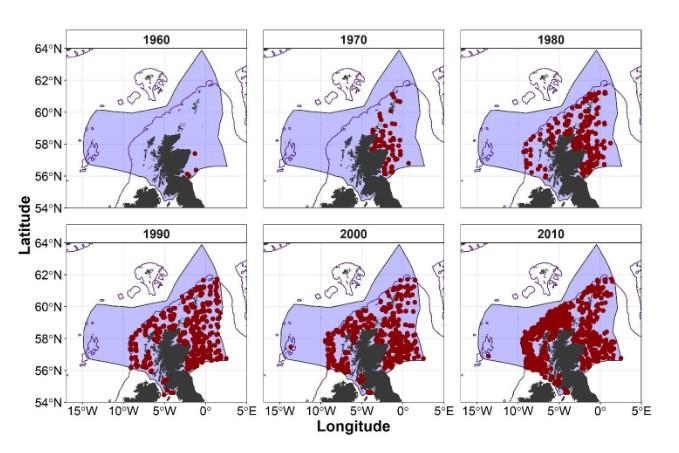
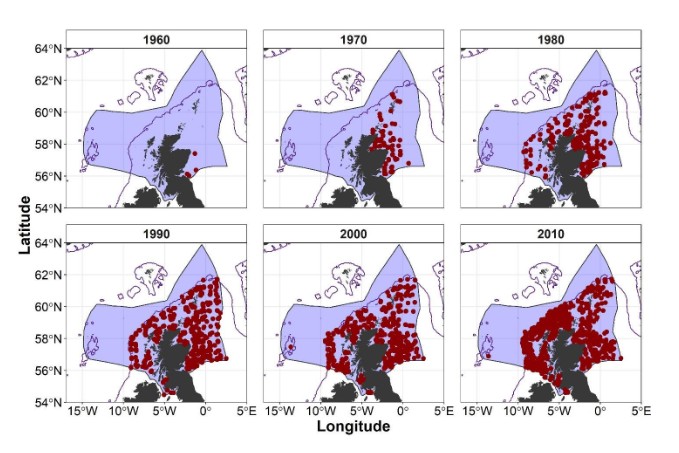
ICES DATRAS records for Cuckoo skate (Leucoraja naevus) for 1960-2019.
Click for a full description
View a larger version of this image.
Six maps of the economic exclusion zone (EEZ) of Scotland showing locations of trawls where Cuckoo skate (Leucoraja naevus) were captured from 1960 to 1969, 1970 to 1979, 1980 to 1989, 1990 to 1999, 2000 to 2009, and 2010 to 2019. Red points represent trawl shoot locations in which Cuckoo skate (L. naevus) were captured. Between 1960 and 1969 records of Cuckoo skate are sparse and are concentrated in the southern North Sea. From 1970 to 1979 there are more records covering the whole of the North Sea and extending north around the Orkney Isles and the Shetland Isles. From 1980 to 1989 Cuckoo skate were recorded more frequently throughout the EEZ of Scotland on the continental shelf but are absent from southwest Scotland. From 1990 to 1999 records are similar to 1980 to 1989 but records are more numerous on the west coast of Scotland with some records in the south west. Records are similar in the period 2000 to 2009 with a notable absence of records to the west of the Outer Hebrides and the north of the Orkney Isles. From 2010 to 2019, the records are similar to those from 2000 to 2009 but are denser. A change in the number or distribution of records over time does not reflect a change in occurrence or abundance since data have not been corrected for effort.
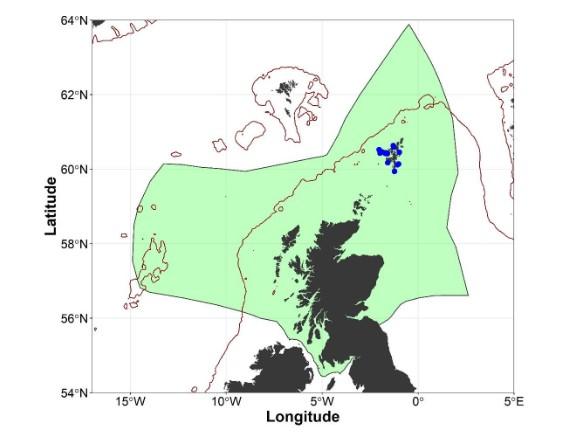
Tag – recapture records for Cuckoo skate (Leucoraja naevus) from the Scottish Shark, Glasgow Museums and the UK Shark Tagging Programmes data from 1970 to 2025.
Click for a full description
Map of the economic exclusion zone of Scotland showing records for Cuckoo skate (Leucoraja naevus) from the Scottish Shark Tagging Programme, Glasgow Museums tagging programme and the UK Shark Tagging Programme data from 1970 to 2025. Data assimilated by the Scottish Shark Tagging Programme. Data is presented as blue dots for each individual Cuckoo skate (L. naevus) tagged or recaptured. These tag – recapture records provided by anglers and occasionally supplemented by reports of tagged animals subsequently captured on commercial fishing vessels show tight clusters in places where angling and tagging have occurred, in this case, around the Shetland Isles.
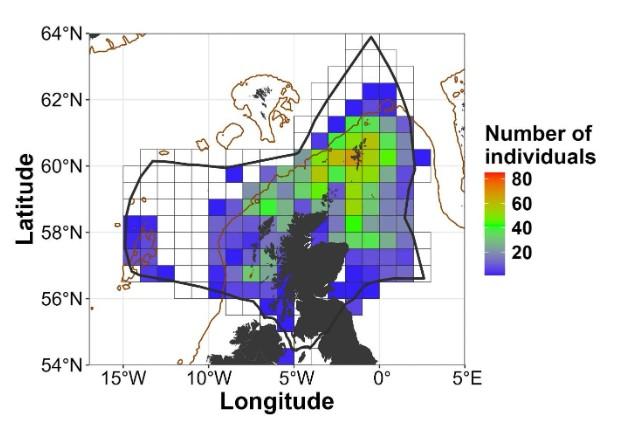
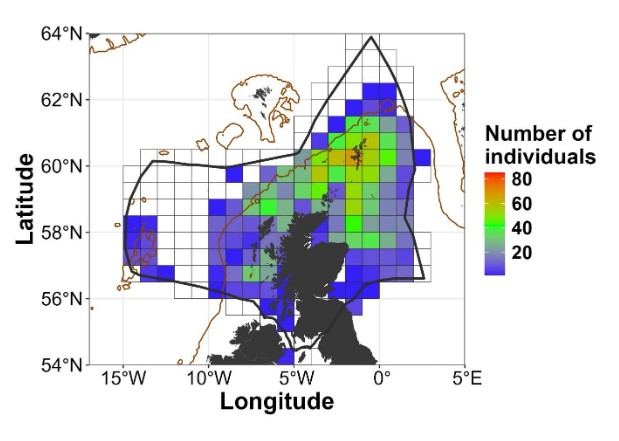
Landings data from commercial fishing vessels in ICES rectangles for Cuckoo skate (Leucoraja naevus) 2011 - 2019.
Click for a full description
View a larger version of this image.
Map of the economic exclusion zone (EEZ) of Scotland showing landings data for Cuckoo skate (Leucoraja naevus) recorded on commercial fishing vessels from 2011 to 2019. The EEZ of Scotland is covered by a grid dividing it into the International Council for the Exploration of the Sea (ICES) rectangles. Data is filtered to exclude information in rectangles where three vessels or less operate. Values are presented as individuals per trip and represented as a heat map, colouring each ICES rectangle from 1 (blue) to 81 (red). Small numbers of landings were recorded throughout Scottish waters on the continental shelf and around the Rockall plateau, resulting in blue rectangles covering most of the area except the southwest coast of Scotland where no Cuckoo skate were caught. Forty to 60 individuals per trip represented by green rectangles were reported in the North Sea, along the continental shelf edge north of Shetland south to the Outer Hebrides, south of Skye and around Mingulay. Sixty to 80 individuals pre trip represented by orange rectangles were reported around the Shetland Isles.
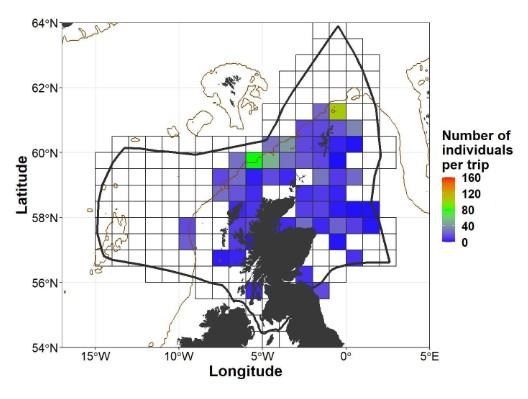
Discard data from commercial fishing vessels in ICES rectangles for Cuckoo skate (Leucoraja naevus) 2014 - 2018.
Click for a full description
View a larger version of this image.
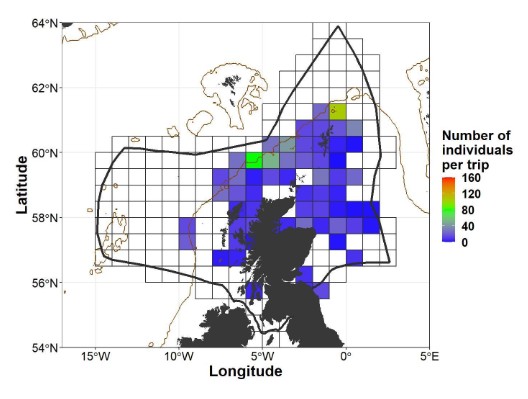
Map of the economic exclusion zone (EEZ) of Scotland showing discard data Cuckoo skate (Leucoraja naevus) recorded on commercial fishing vessels from 2014 to 2018. The EEZ of Scotland is covered by a grid dividing it into the International Council for the Exploration of the Sea (ICES) rectangles. Data is filtered to exclude information in rectangles where three vessels or less operate. Values are presented as individuals per trip and represented as a heat map, colouring each ICES rectangle from 1 (blue) to 160 (red). Zero to 40 individuals per trip represented by blue or grey rectangles were recorded as discarded throughout Scottish waters on the continental shelf except for the southwest coast of Scotland where no discards were recorded. One hundred to 150 individuals per trip were recorded as discarded resulting in a single green rectangle north of the Shetland Isles and a single green rectangle northwest of Scotland on the edge of the continental shelf.
Habitat
Cuckoo skate occur in inshore waters to the continental shelf and upper slope at depths of 10–900 m and are most common at depths of 50–300 m (Ellis et al., 2015; Heesen et al. 2015; Ellis and Dulvy, 2016; Last et al., 2016, Ebert and Dando 2021).
Biology and Ecology
This species has a relatively small body size (maximum size of 73 cm total length, and possibly 81 cm TL); males mature at 50–57 cm TL and females mature at 53–60 cm TL (McCully et al. 2012, Last et al., 2016, Ebert and Dando 2021). Age at maturity is estimated to be 7.4 years for females and 6.8 years for males in the North Seas, and the skate can live for 12 years. The generation time of the skate in the Irish Sea was estimated to be 8 years (Ellis et al., 2015), however both sexes of the skate are significantly smaller at 50% maturity in the North Sea, when compared to the Celtic Seas (Ellis et al., 2015). This egg laying species is reported to be reproductively active throughout the year, and a study from Portuguese waters found that peak spawning activity occurred in the winter months from January and May (Maia et al., 2012). The same study found that females can produce around 63 eggs per year, which are released in nine batches containing an average of 7 eggs per batch (Maia et al., 2012). An earlier study in the Celtic Sea estimated that females produce 90 eggs year (Buit, 1976).
Human interactions
This species is both a target and a non-target (bycatch) species in mixed demersal trawl fisheries across much of its range; however, it is relatively resilient to fishing pressure compared with larger skates (Ellis et al., 2015). It is frequently landed by commercial fisheries operating in the Celtic Seas and has previously comprised about 27% of the bycatch of scallop dredge fisheries operating in the northern Irish Sea around the Isle of Man (Craven et al., 2013; Ellis et al., 2015). Cuckoo skate were found to have high survivability (>80%) after catch in Irish otter trawl fisheries (Oliver et al., 2019) and are currently exempt from the landings obligation based on their survivability, which means they can continue to be discarded (Oliver et al., 2019).
ICES advised that when the maximum sustainable yield (MSY) approach is applied for this species, landings should be no more than 95 tonnes in each of the years 2026 and 2027 for the Greater North Sea ecoregion (Subarea 4 and Division 3.a) (ICES, 2025). For other areas, Cuckoo skate are included in the group of ‘other skates and rays’ in the ICES assessments for Rockall, West of Scotland, Celtic Sea and western English Channel. ICES could not provide catch advice for the years 2025–2028 due to the lack of sufficient survey and catch data (ICES, 2024).
References
Buit, M.H. (1976). The ovarian cycle of the cuckoo ray, Raja naevus (Muller and Henle), in the Celtic Sea. J. Fish Biol. 8, 199–207.
Clarke, M. et al., (2016). Ireland Red List No. 11: Cartilaginous fish [sharks, skates, rays and chimaeras]. Dublin, Ireland.
Craven, H.R. et al., (2013). Patterns and impacts of fish bycatch in a scallop dredge fishery. Aquat. Conserv. Mar. Freshw. Ecosyst. 23, 152–170.
Ebert, D.A. and Dando, M. 2021. Field guide to sharks, rays & chimaeras of Europe and the Mediterranean. Princeton University Press, Plymouth, U.K.
Ellis, J.R. & Dulvy, N.K. (2016). Leucoraja naevus (Mediterranean assessment). The IUCN Red List of Threatened Species 2016: e.T161626A16527841 Ellis, J.R. et al., (2005). The Distribution of Chondrichthyan Fishes Around the British Isles and Implications for Conservation. J. Northwest Atl. Fish. Sci. 35, 195–213.
Ellis, J.R., Heessen, H.J.L. and McCully Phillips, S.R. 2015. Skates (Rajidae). In: Heessen, H.J.L., Daan, N. and Ellis, J.R. (eds), Fish atlas of the Celtic Sea, North Sea, and Baltic Sea, pp. 96–124. Wageningen Academic Publishers / KNNV Publishing, Wageningen, Netherlands.
Finucci, B., Ellis, J.R., McCully-Phillips, S.R., Pacoureau, N., Rohner, C.A. & Serena, F. (2025). Leucoraja naevus. The IUCN Red List of Threatened Species 2025: e.T161626A124517373.
Heessen, H.J.L., Daan, N. and Ellis, J.R. (Eds.). 2015. Fish atlas of the Celtic Sea, North Sea, and Baltic Sea. Wageningen Academic Publishers / KNNV Publishing, Wageningen, The Netherlands.
ICES (2024). Other rays and skates (Rajiformes) in Subarea 6 and divisions 7.a-c and 7.e-k (Rockall, West of Scotland, Celtic Sea and western English Channel). ICES Advice: Recurrent Advice. Report.
ICES (2025). Cuckoo ray (Leucoraja naevus) in Subarea 4 and Division 3.a (North Sea, Skagerrak and Kattegat). In Report of the ICES Advisory Committee, 2025. ICES Advice 2025, rjn.27.3a4.
Last, P., White, W., de Carvalho, M., Séret, B., Stehmann, M. and Naylor, G. 2016. Rays of the World. CSIRO Publishing, Clayton.
McCully, S.R., Scott, F. and Ellis, J.R. 2012. Lengths at maturity and conversion factors for skates (Rajidae) around the British Isles, with an analysis of data in the literature. ICES Journal of Marine Science 69: 1812-1822.
Maia, C. et al., (2012). Reproductive biology of cuckoo ray Leucoraja naevus. J. Fish Biol. 81, 1285–1296.
Oliver, M. et al., (2019). Post-capture condition of cuckoo ray in an Irish otter trawl fishery. Galaway, Ireland. Ramírez-Amaro, S., Ordines, F., Esteban, A., García, C., Guijarro, B., Salmerón, F., Terrasa, B. and Massutí, E. (2020). The diversity of recent trends for chondrichthyans in the Mediterranean reflects fishing exploitation and a potential evolutionary pressure towards early maturation. Scientific Reports 10(1): 547.