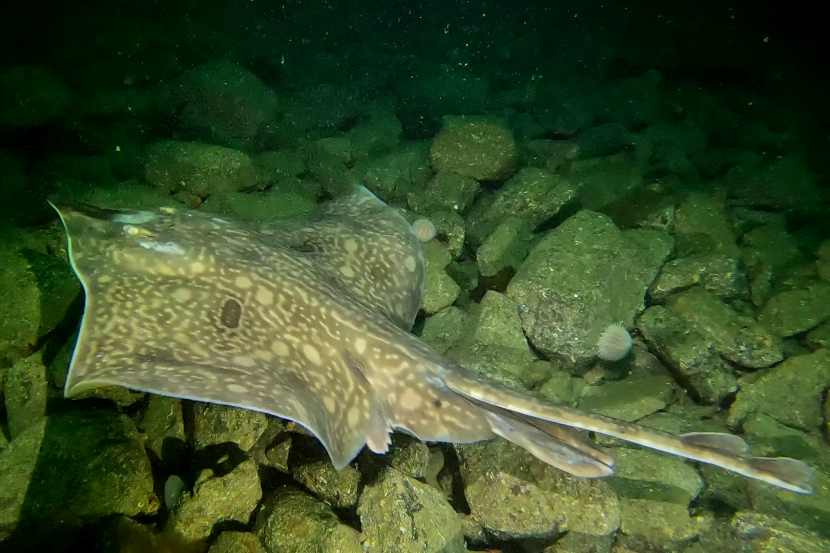
Sharks and Skates of Scotland Report: Common blue skate (Dipturus batis)
An extract from the Sharks and Skates of Scotland Report.
Common blue skate - Dipturus batis (Linnaeus, 1758)
Occurrence in Scotland: Present on the continental shelf and slope, generally found in deeper waters around the West and North of Scotland and in relatively high abundance at Rockall.
Synonym(s): Raja batis, Raja macrorynchus, Propterygia hyposticta, Raja flossada, Raia gaimardi, Batis vulgaris, Dipturus flossada; Order: Rajiformes; Family: Rajidae
Common name: Common blue skate
AlphaID: 105869, 711847; TSN Code: 564126
Image ©Orkney Skate Trust
Population status
Scotland and Northeast Atlantic: Increasing. While a population reduction of > 80% is suspected to have occurred over the past three generation lengths (~60 years) due to earlier levels of exploitation and a reduction in its range, recent fishery-independent trawl surveys have shown positive signals in either catch rates and/or occurrence of Common blue skate (Ellis et al., 2024).
Conservation listings
- IUCN Red List: Critically Endangered (assessment 02 April 2021)
- CITES: Not listed
- CMS: Not listed
- OSPAR: Threatened and/or Declining Species
- Listed as a Priority Marine Feature in Scotland
- Scottish Biodiversity List
- Feature of Conservation Importance in England and Wales (FOCI)
- Species of Principal Importance in Wales and England (SPI)
- Protected species in Northern Ireland, under the Wildlife (Northern Ireland) Order 1985
- Listed on the UK’s ‘Prohibited Species’ list as documented in the ‘Written Record of fisheries consultations between the United Kingdom and the European Union for 2025’ for UK waters of ICES divisions 2a and Subareas 4, 6, 7 and 8 and for EU waters of Subareas 3, 4, and 6 to 10.
- Listed on The Sharks, Skates and Rays (Prohibition of Fishing, Trans-shipment and Landing) (Scotland) Order 2012.
- Prohibited under EU Regulation 2025/202
- Common blue skate (as the common skate) are a feature of Loch Sunart to the Sound of Jura Marine Protected Area (MPA) (Marine (Scotland) Act 2010
Range and distribution
Common blue skate are more characteristic of warmer, stable offshore environments (Frost et al., 2020). They are typically associated with offshore areas of the Northeast Atlantic, extending from the Western Approaches and Celtic Sea to Rockall, Iceland, and northern waters. As data pre-2010 is combined for Dipturus intermedius and Dipturus batis, the data is presented for the “common skate complex”, unless otherwise stated.
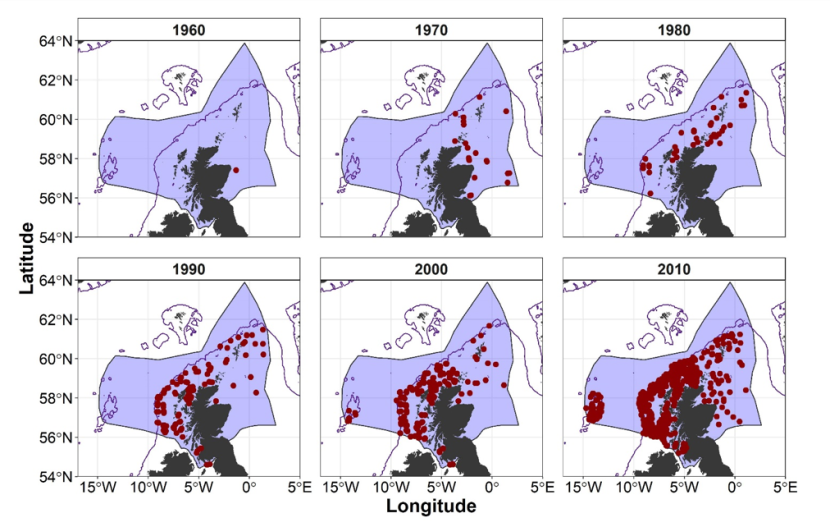
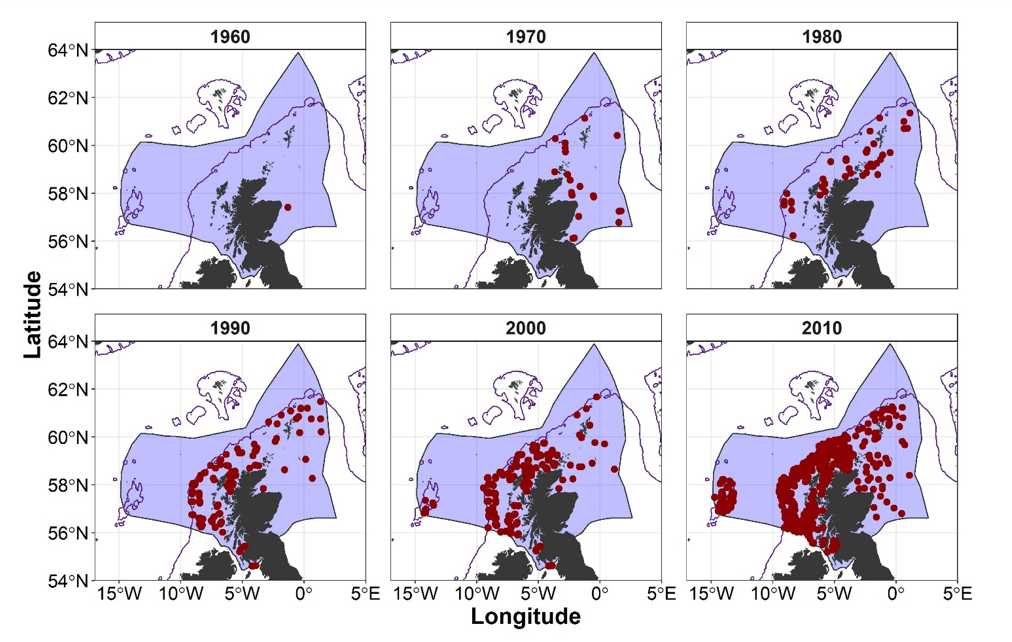
ICES DATRAS records for ‘the common skate complex’ (Flapper skate (Dipturus intermedius) and / or Common blue skate (Dipturus batis) combined) for 1960-2019.
Click for a full description
View a larger version of this image.
Six maps of the economic exclusion zone (EEZ) of Scotland showing locations of trawls where ‘the common skate complex’ (Flapper skate (Dipturus intermedius) and / or Common blue skate (Dipturus batis) combined) were captured from 1960 to 1969, 1970 to 1979, 1980 to 1989, 1990 to 1999, 2000 to 2009, and 2010 to 2019). Red points represent trawl shoot locations in which ‘the common skate complex’ (Flapper skate (Dipturus intermedius) and / or Common blue skate (Dipturus batis) combined) were captured. Between 1960 and 1979 records of ‘common skate’ are sparse and mostly concentrated in the northern North Sea. From 1980 to 1989 ‘common skate’ were recorded more frequently throughout the EEZ of Scotland on the continental shelf, with records west of the Outer Hebrides, in the north of the Minch, on the north coast of Scotland west and east of the Orkney Isles, around the Shetland Isles and in the north North Sea. From 1990 to 1999 records are more numerous and more widely distributed, covering much of the Scottish west coast extending to the edge of the continental shelf west of the Outer Hebrides and the northern North Sea. From 2000 to 2019 there are more records throughout the EEZ of Scotland on the continental shelf with highest density on the west coast and some records in the North Sea. The spatial spread and density of points increase through the decades however the data are not corrected for effort, so, the increasing number of records do not necessarily reflect an increase in abundance.
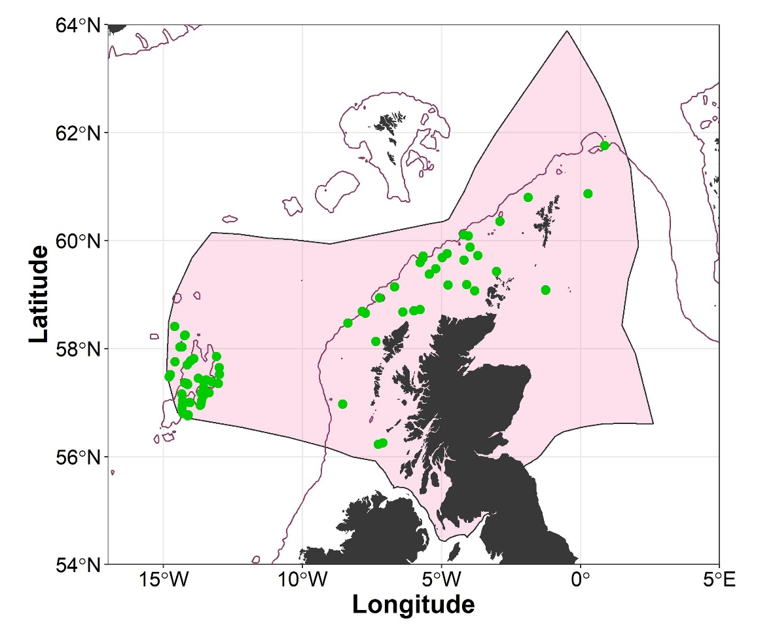
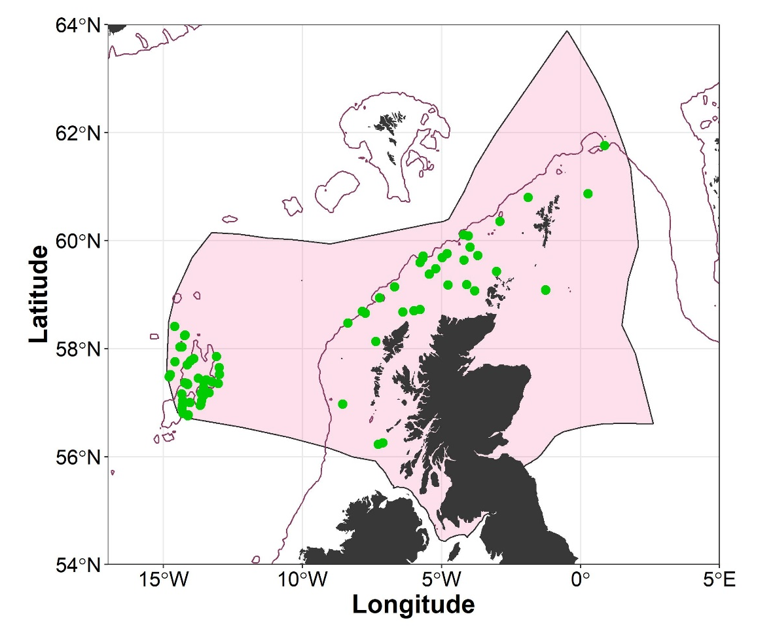
Records for Common blue skate (Dipturus batis) from SIAMISS and deep-water fisheries surveys undertaken by Marine Directorate 1996 – 2019.
Click for a full description
View a larger version of this image.
Map of the economic exclusion zone (EEZ) of Scotland showing records for Common blue skate (Dipturus batis) from the Scottish-Irish anglerfish and megrim industry-science survey (SIAMISS) and deep-water fisheries surveys undertaken by Marine Directorate 1996-2019. Records are illustrated as green points and are sparsely distributed throughout the continental shelf to the northwest and north of Scotland, and in the northern north sea. There are also individual records to the west of the Isle of Islay and the Isle of Barra and a cluster of records on and around the Rockall Plateau.
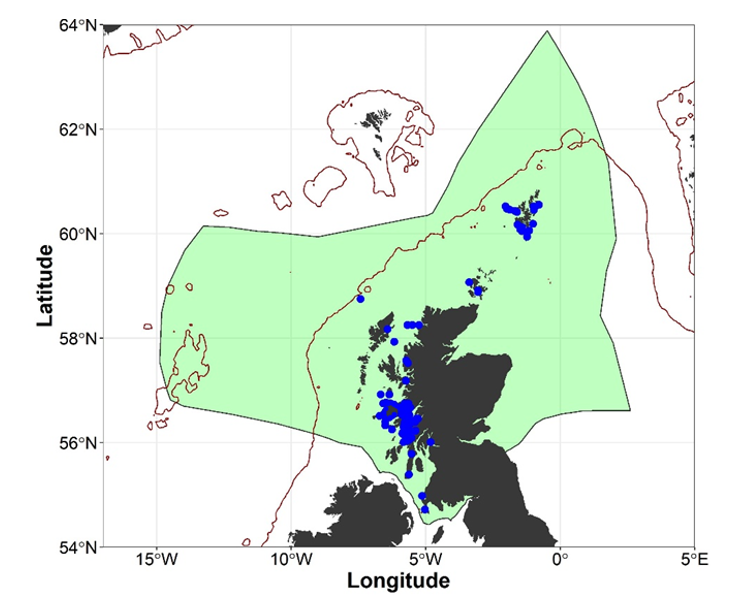
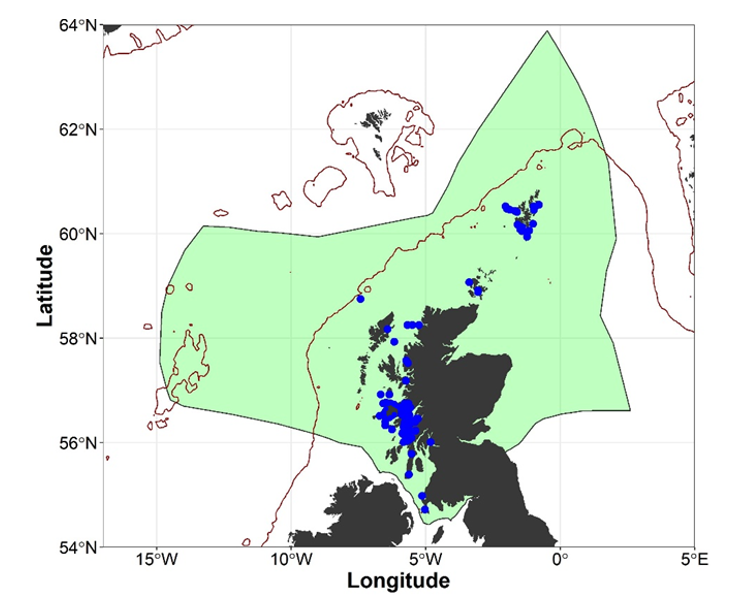
Tag - recapture records for ‘the common skate complex’ (Flapper skate (Dipturus intermedius) and / or Common blue skate (Dipturus batis) combined) from the Scottish Shark Tagging Programme, the Glasgow Museums tagging and the UK Shark Tagging Programmes.
Click for a full description
View a larger version of this image.
Map of the economic exclusion zone (EEZ) of Scotland showing tag - recapture records for ‘the common skate complex’ (Flapper skate (Dipturus intermedius) and / or Common blue skate (Dipturus batis) combined) from the Scottish Shark Tagging Programme, the Glasgow Museums tagging programme and the UK Shark Tagging Programme data from 1970 to 2025. Records are illustrated as blue points and are located in coastal waters off the western coast of Scotland and the coastal waters of Orkney and Shetland. These tag – recapture records provided by anglers and occasionally supplemented by reports of tagged animals captured by commercial fishing vessels are thought to be mostly Flapper skate (D. intermedius) and show tight clusters in places where angling and tagging have occurred, for example the Sound of Mull, the Firth of Lorn and the Sound of Jura.
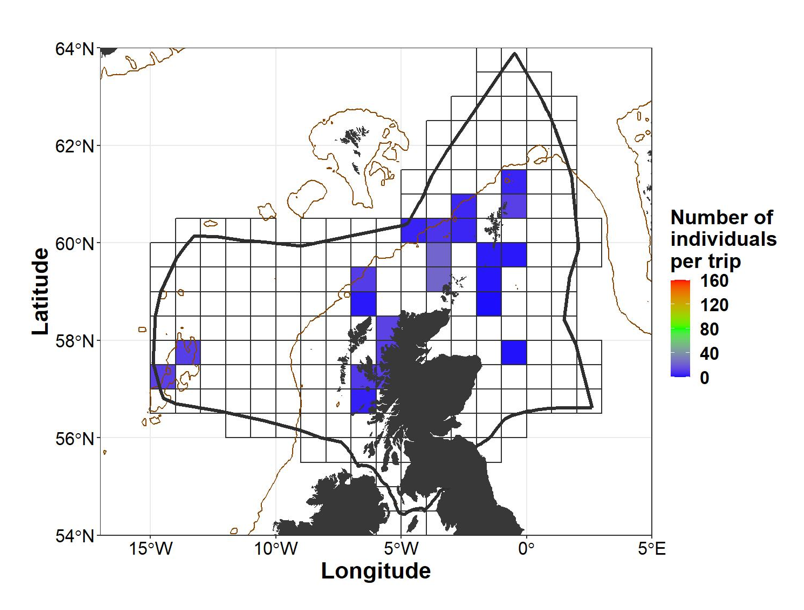
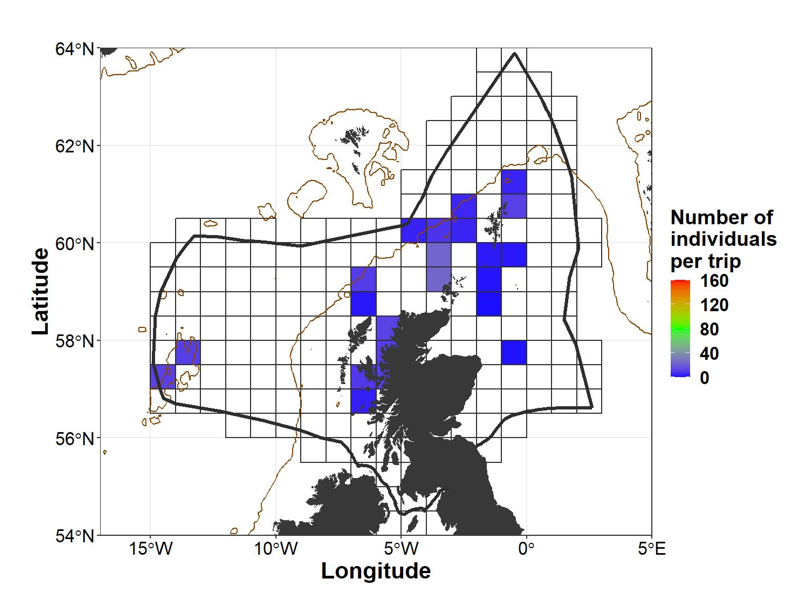
Discard data for ‘the common skate complex’ (Flapper skate (Dipturus intermedius) and / or Common blue skate (Dipturus batis) combined) from commercial fishing vessels for 2014-2018.
Click for a full description
View a larger version of this image.
Map of the economic exclusion zone (EEZ) of Scotland showing discard data for ‘the common skate complex’ (Flapper skate (Dipturus intermedius) and / or Common blue skate (Dipturus batis) combined) from commercial fishing vessels from 2014 to 2018. The EEZ of Scotland is covered by a grid dividing it into International Council for the Exploration of the Sea (ICES) rectangles. Data is filtered to exclude information in rectangles where three vessels or less operate. Values are presented as individuals per trip and represented as a heat map (blue is zero and red is 160) for each rectangle in the grid. Small numbers of discards were recorded resulting in blue rectangles patchily distributed all around Scotland, Orkney, Shetland and on the Rockall Plateau. There were also records of low discards resulting in blue rectangles in the northern North Sea extending to the northern and northwestern edge of the continental shelf.
Habitat
Common blue skate inhabit continental shelf and upper slope habitats from 30 to 600 m, occasionally to ~1000 m depth (Last et al., 2016). Ontogenetic dietary shifts have been observed, with smaller individuals feeding primarily on shrimps and larger Common blue skates targeting crabs and teleosts (Brown-Vuillemin et al., 2020).
Biology and Ecology
Common blue skate mature at a smaller size than Flapper skate (Dipturus intermedius), with males at ~115 cm TL and females at ~123 cm TL (Last et al., 2016; Iglésias et al., 2010). Females lay large egg capsules annually, each ~20–25 cm long. Common blue skate are long-lived, slow-growing, and exhibit K-selected strategies. Trophic role analyses indicate larger individuals occupy higher trophic levels, acting as mesopredators in Celtic Sea ecosystems (Brown-Vuillemin et al., 2020).
Human interactions
Their large size, late maturity and low fecundity combine to make Common blue skate extremely vulnerable to fishing pressure, with both eggs and juveniles at risk from being caught as bycatch in mobile fishing gear. As a result, this species, grouped with Flapper skate (Dipturus intermedius) as the ‘common skate complex’, have historically experienced severe reductions in numbers and have been extirpated from parts of their former range (Brander 1981, Walker and Hislop 1998). Species-specific discard survival is poorly understood, but it has been previously shown that the ‘common skate’ can survive being trawled if they are released after capture (Little, 1995). Removal of the tickler chain from trawl gear can reduce the number of sharks and skates captured as bycatch, without impacting the catch excessively (Kynoch et al., 2015).
Note on 'the common skate complex', formerly Dipturus batis
Genetic research revealed in 2009 that what was formerly known as the common skate (Dipturus batis) was two distinct species, with Iglesias et al. (2009) naming the larger of these the flapper skate (Dipturus intermedia) and the smaller the blue skate (Dipturus flossada). These names have subsequently undergone some revision, and the most recently accepted nomenclature is the Flapper skate (Dipturus intermedius) and the Common blue skate (Dipturus batis) (Last et al., 2016). Because of this recent separation, “common skate” or “the common skate complex” still appears in some UK policy measures, which refers to flapper skate and blue skate combined. Also, historic information should be taken as referring to either flapper or blue skate. This relatively recent change creates uncertainty around the recorded data, as it is not clear which species (Flapper or Common blue skate) ‘common skate’ refers to.
References
Brown-Vuillemin, S., Barreau, T., Caraguel, J.-M., & Iglésias, S. P. (2020). Trophic ecology and ontogenetic diet shift of the blue skate (Dipturus cf. flossada). Journal of Fish Biology, 97(2), 515–526.
Bache-Jeffreys, M., de Moraes, B.L.C., Ball, R.E. et al.,Resolving the spatial distributions of Dipturus intermedius and Dipturus batis—the two taxa formerly known as the ‘common skate’. Environ Biol Fish 104, 923–936 (2021).
Ellis, J.R., McCully-Phillips, S.R., Sims, D., Derrick, D., Cheok, J. & Dulvy, N.K. 2024. Dipturus batis (amended version of 2021 assessment). The IUCN Red List of Threatened Species 2024: e.T203364219A256580832. Accessed on 30 November 2025.
Frost, M., Neat, F. C., Stirling, D., Bendall, V., Noble, L. R., & Jones, C. S. (2020). Distribution and thermal niche of the common skate species complex in the north-east Atlantic. Marine Ecology Progress Series, 656, 65-74.
Griffiths, A. M., Sims, D. W., Cotterell, S. P., El Nagar, A., Ellis, J. R., Lynghammar, A., McHugh, M., Neat, F. C., Pade, N. G., Queiroz, N., Serra-Pereira, B., Rapp, T., Wearmouth, V. J., & Genner, M. J. (2010). Molecular markers reveal spatially segregated cryptic species in a critically endangered fish, the common skate (Dipturus batis complex). Proceedings of the Royal Society B: Biological Sciences, 277(1687), 1497–1503.
Iglésias, S. P., Toulhoat, L., & Sellos, D. Y. (2010). Taxonomic confusion and market mislabelling of threatened skates: Important consequences for their conservation status. Aquatic Conservation: Marine and Freshwater Ecosystems, 20(3), 319–333.
Last, P. R., White, W. T., de Carvalho, M. R., Séret, B., Stehmann, M. F. W., and Naylor, G. J. P. 2016. Rays of the world. CSIRO Publishing & Cornell University Press, Comstock Publishing Associates, vii + 790 pp.