Sharks and Skates of Scotland Report: Bluntnose sixgill shark (Hexanchus griseus)
An extract from the Sharks and Skates of Scotland Report.
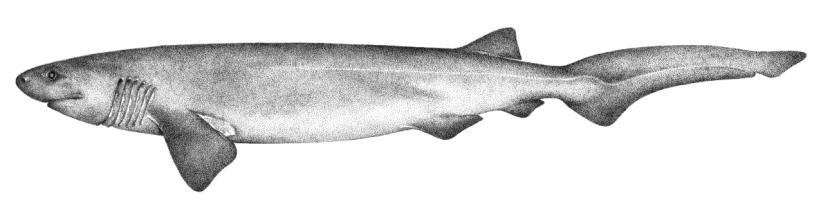
Bluntnose sixgill shark - Hexanchus griseus (Bonnaterre, 1788)
Occurrence in Scotland: Deep-sea. Resident. Records from the continental shelf of the Rockall Trough. Also found on the Northern Scotland continental shelf and slope. Medium number of data records.
Synonym(s): qualus griseus, Notidanus griseus, Squalus vacca, Hexanchus corinus, Notidanus vulgaris, Hexanchus griseus ssp., Monopterinus griseus, Notidanus monge; Order: Hexanchiformes; Family: Hexanchiformes
Common name: Bluntnose sixgill shark
AlphaID: 105833 and 322614 and 322613 TSN Code: 159819 and 159827 and 159821
Population status
Scotland and Northeast Atlantic: Increasing. Annual rate of increase of 1.4% between 1998 – 2018, which gives an estimated increase of 80.4% over 3 generations (160 years) (Neat unpubl. data; Finucci et al., 2020)
Global: Decreasing. A global population reduction of 20–29% was estimated over three generation lengths (160 years), primarily due to declines in Maldives (Finucci et al., 2020).
Conservation listings
- IUCN Red List Europe: Least Concern (assessment 05 February 2015)
- IUCN Red List Global: Near Threatened (assessment 21 November 2019)
- UNCLOS: Annex I (Highly Migratory Species)
- CITES: Not listed
- CMS: Not listed
- OSPAR: Not listed
- Listed on the UK’s ‘Prohibited Species’ list as documented in the ‘Written Record of fisheries consultations between the United Kingdom and the European Union for 2025’ for UK waters of ICES Subareas 5-10
- Zero TAC under Regulation 2018/2025 and Regulation 2023/194
- Prohibited under EU Regulation 2025/202
- Listed on The Sharks, Skates and Rays (Prohibition of Fishing, Trans-shipment and Landing) (Scotland) Order 2012
- Included in the NEAFC measures prohibiting directed fishing for deep-sea sharks
Range and distribution
This shark species is found worldwide, with a patchy distribution in boreal, temperate, and tropical seas, and may be absent from the Arctic and Antarctic oceans (Ebert and Stehmann, 2013). In the Northeast Atlantic, it occurs in deep waters around Iceland, the Faroe Islands, Norway, the northern North Sea, Ireland, Scotland, England and Wales, France, Spain and Portugal, as well as in the Mediterranean (Ebert and Stehmann, 2013). The species may be capable of long migrations in the open ocean (Walls et al., 2015). The Bluntnose sixgill shark is infrequently caught in trawl surveys in the Northeast Atlantic, both in the Scottish deep-water survey, where the relative abundance of the species between depths of 300–800 m averaged less than one individual per hour between 1998 - 2013 (ICES, 2018), and in the Spanish Porcupine and Spanish groundfish surveys (ICES, 2024).
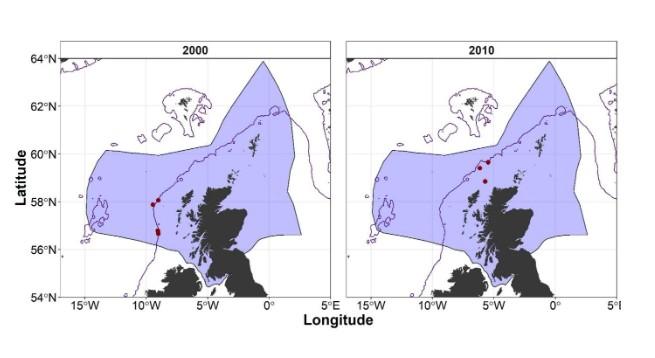
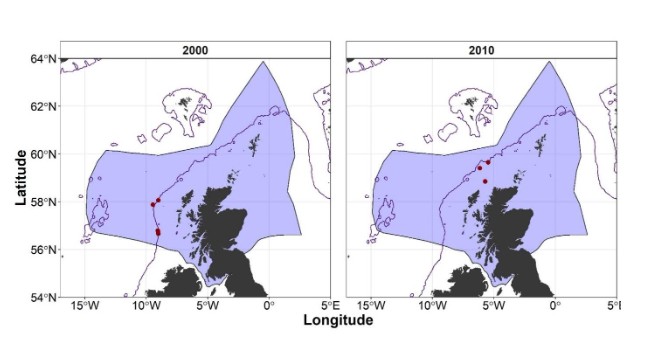
ICES DATRAS records for the Bluntnose sixgill shark (Hexanchus griseus), 1980-2019.
Click for a full description
View a larger version of this image.
Two maps of the EEZ of Scotland showing the ICES (International Council for the Exploration of the Sea) DATRAS (database of trawl surveys hosted by ICES) records for the Bluntnose sixgill shark (Hexanchus griseus) from bottom trawl surveys conducted between 2000 and 2009 and 2010 and 2019. Red points represent trawl shoot positions in which Bluntnose sixgill shark (H. griseus) were captured. From 2000 to 2009, a small number of records were exclusively clustered just off the continental shelf on the west coast of Scotland. From 2010 to 2019 a small number of records occurred to the northeast of the Outer Hebrides. A change in the number or distribution of records over time does not reflect a change in occurrence or abundance since data have not been corrected for effort.
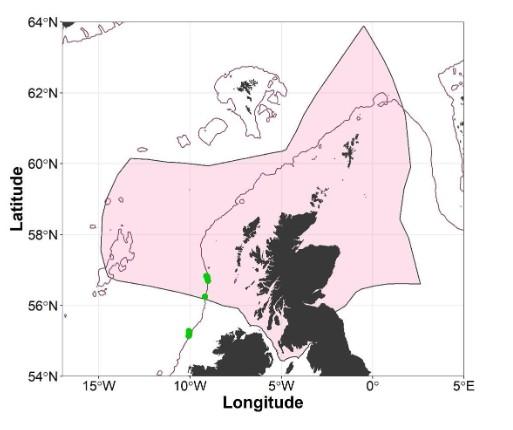
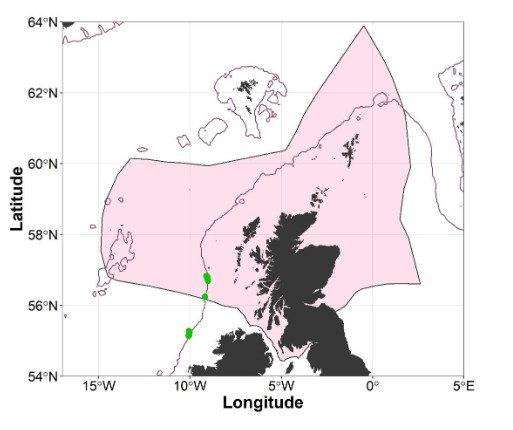
Records for the Bluntnose sixgill shark (Hexanchus driseus) from SIAMISS and deep-water fisheries surveys undertaken by the Marine Directorate 1996 – 2019.
Click for a full description
View a larger version of this image.
Map of the economic exclusion zone (EEZ) of Scotland showing records for the Bluntnose sixgill shark (Hexanchus driseus) from the Scottish-Irish anglerfish and megrim industry-science survey (SIAMISS) and deep-water fisheries surveys undertaken by the Marine Directorate 1996-2019. Records are illustrated as green points and are exclusively located off the west coast of southern Scotland and Northern Ireland, just off the edge of the continental shelf.
Habitat
The Bluntnose sixgill shark is a deep-water demersal and pelagic shark, which can be found on the upper slopes of continental shelves and off seamounts and underwater ridges at depths of up to 2,500 m and are often associated with highly productive upwelling areas (Ebert and Stehmann, 2013). In the Rockall Trough, the species has been found between 300 and 1000 m on the upper continental slope but is uncommon in the area (Neat et al., 2015). The shark occurs near the seabed and in the water column and may rise to the surface in cold temperate waters or in response to fishing activities in offshore areas (Ebert and Stehmann, 2013).
Biology and Ecology
Bluntnose sixgill sharks are a large-bodied species that can grow to approximately 550 cm (Weigmann, 2016), with females attaining greater lengths than males of the same age (Walls et al., 2015). Not much is known about the biology of this shark in the Northeast Atlantic. In South African waters, males are estimated to reach sexual maturity at 309 – 330 cm TL, and females at 421 cm TL (Ebert, 2002). The sharks reproduce via yolk–sac viviparity, with litters ranging from 47-108 pups (Ebert and Stehmann, 2013). There is evidence of multiple paternities in this species, with as many as nine males siring a single female’s litter (Larson et al., 2011). Little is known about their reproductive cycle, but it might be biannual with a 12-month resting phase followed by a 12-month gestation period (Ebert, 1986). Pupping grounds in the Northeast Atlantic are poorly understood but are thought to occur on the upper slopes of continental shelves. Neonates appear seasonally in the Bay of Biscay (Ebert and Dando, 2021). Young individuals are often found close inshore, moving into progressively deeper water as they grow (Walls et al., 2015). Adults and juveniles undergo daily vertical migrations whereby they remain in deep water near the bottom during the day and move upwards towards the surface at night (Coffey et al., 2020, Walls et al., 2015).
Bluntnose sixgill sharks are considered generalist feeders, and teleosts, invertebrates (including cephalopods), chondrichthyans and cetaceans have been identified as dietary items. It is currently unclear whether these sharks predate on or scavenge cetaceans, but they have been found in the stomach contents of Bluntnose sixgill sharks across their range (Barría et al., 2015; Ebert, 1994; Reum et al., 2020; Ruiz-García et al., 2023). In the waters off Hawaii, they were found to be active at depth (500 – 650 m) during the day in cold water with very low dissolved oxygen, suggesting this species has a tolerance for low oxygen conditions (Coffey et al., 2020).
Human interactions
The species is caught as bycatch in industrial and artisanal trawl, longline, handline and gillnet fisheries across its global range (Fauconnet et al., 2019; Finucci et al., 2020). It is also targeted by recreational fisheries and occasionally caught by anglers in UK and Irish waters (Britishseafishing.co.uk). Discard survival for the species may be relatively high (Ellis et al., 2017) but likely will vary according to fishing method and handling practices (Kabasakal 2010). In the Celtic and North Sea ecoregions between 2002 and 2016, bycatch of Bluntnose sixgill sharks was mainly from otter trawl nets and nephrops trawl nets, predominantly in the Celtic Sea (Silva and Ellis 2019). Incidentally caught Bluntnose sixgill sharks must be returned to the sea.
References
Barría, C., Coll, M., & Navarro, J. (2015). Unravelling the ecological role and trophic relationships of uncommon and threatened elasmobranchs in the western Mediterranean Sea. Marine Ecology Progress Series, 539, 225-240.
Ebert, D. A. (1986, July). Aspects on the biology of hexanchid sharks along the California coast. In Indo-Pacific Fish Biology: Proceedings of the Second International Conference on Indo-Pacific Fishes (pp. 437-449). Tokyo.
Ebert, D.A. (1994) ‘Diet of the sixgill shark Hexanchus griseus off Southern Africa’, South African Journal of Marine Science, 14(1), pp. 213–218. doi: 10.2989/025776194784287030.
Ebert, D. A. (2002). Some observations on the reproductive biology of The sixgill shark Hexanchus griseus (Bonnaterre, 1788) from southern African waters. South African Journal of Marine Science, 24(1), 359–363.
Ebert, D. A. and Stehmann, M.F.W. (2013) Sharks, batoids, and chimaeras of the North Atlantic. FAO Species Catalogue for Fishery Purposes. No. 7. Rome: Food and Agricultural Organization of the United Nations (FAO).
Ebert, D. A., & Dando, M. (2021). Field Guide to Sharks, Rays & Chimaeras of Europe and the Mediterranean. Princeton University Press.
Ellis, J. R., McCully Phillips, S. R., & Poisson, F. (2017). A review of capture and post‐release mortality of elasmobranchs. Journal of fish biology, 90(3), 653-722.
Fauconnet, L., Pham, C. K., Canha, A., Afonso, P., Diogo, H., Machete, M., ... & Morato, T. (2019). An overview of fisheries discards in the Azores. Fisheries Research, 209, 230-241.
Finucci, B., Barnett, A., Bineesh, K.K., Cheok, J., Cotton, C.F., Dharmadi, Graham, K.J., Kulka, D.W., Neat, F.C., Pacoureau, N., Rigby, C.L., Tanaka, S. & Walker, T.I. 2020. Hexanchus griseus. The IUCN Red List of Threatened Species 2020: e.T10030A495630. Accessed on 21 February 2025.
ICES (2018) Report of the Working Group on Elasmobranch Fishes (WGEF), 19-28. Lisbon, Portugal.
Kabasakal, H. (2010). Post-release behavior and anthropogenic injuries of the bluntnose sixgill shark, Hexanchus griseus (Bonnaterre, 1788)(Chondrichthyes: Hexanchidae) in Turkish waters. In Annales: Series Historia Naturalis (Vol. 20, No. 1, p. 39). Scientific and Research Center of the Republic of Slovenia.
Larson, S., Christiansen, J., Griffing, D., Ashe, J., Lowry, D., & Andrews, K. (2011). Relatedness and polyandry of sixgill sharks, Hexanchus griseus, in an urban estuary. Conservation Genetics, 12, 679-690.
Neat, F.C. et al., (2015) ‘The diversity, distribution and status of deep-water elasmobranchs in the Rockall Trough, north-east Atlantic Ocean’, Journal of Fish Biology. Blackwell Publishing Ltd, 87(6), pp. 1469–1488. doi: 10.1111/jfb.12822.
Reum, J. C., Williams, G. D., Harvey, C. J., Andrews, K. S., & Levin, P. S. (2020). Trophic ecology of a large-bodied marine predator, bluntnose sixgill shark Hexanchus griseus, inferred using stable isotope analysis. Environmental Biology of Fishes, 103, 147-162.
Ruiz-García, D., García-Salinas, P., Raga, J. A., Viola de Moura, A. E., Dromby, M., & Barría, C. (2023). New record of Hexanchus griseus in the northwestern Mediterranean Sea with insights into its biology and feeding ecology: predator or scavenger?. Mediterranean Marine Science, 24(1).
Soldo, A., Bariche, M., Buscher, E., Cook, S.F. & Compagno, L.J.V. 2016. Hexanchus griseus (Mediterranean assessment). The IUCN Red List of Threatened Species 2016: e.T10030A16527980. Accessed on 21 February 2025.
Walls, R., Soldo, A., Bariche, M., Buscher, E., Cook, S.F. & Compagno, L.J.V. 2015. Hexanchus griseus (Europe assessment). The IUCN Red List of Threatened Species 2015: e.T10030A48939463. Accessed on 21 February 2025.Weigmann, S. 2016. Annotated checklist of the living sharks, batoids and chimaeras (Chondrichthyes) of the world, with a focus on biogeographical diversity. Journal of Fish Biology 88(3): 837-1037.