Sharks and Skates of Scotland Report: Blue shark (Prionace glauca)
An extract from the Sharks and Skates of Scotland Report.
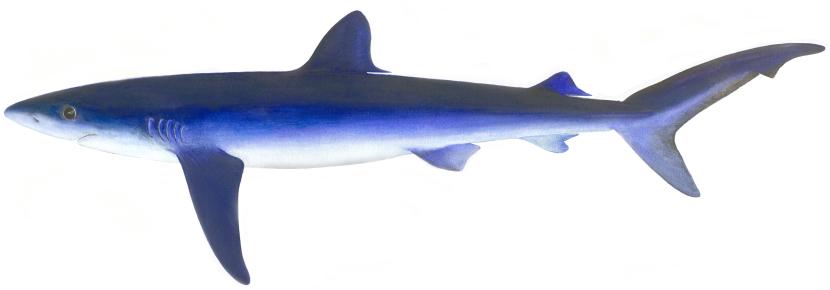
Blue Shark - Prionace glauca (Linnaeus, 1758)
Occurrence in Scotland: Oceanic, summer visitor to west Scotland; low number of data records
Synonym(s): Squalus glaucus; Order: Carcharhiniformes; Family: 160424
Common name: Blue shark, blue dog, blue whaler
AlphaID: 105801 TSN Code: 160424
Population status
Scotland and Northeast Atlantic: Declining, although great uncertainty in the data for stock assessment.
Global: Population reduction (highest probability) of 20–29% over three generations, or 30–31.5 years (Rigby et al., 2019). The population is noted as increasing in the Pacific, showing its potential for recovery (Rigby et al., 2019).
Conservation listings
- IUCN Red List Global: Near threatened (assessment 06 November 2018)
- IUCN Red List Mediterranean: Critically Endangered (assessment 25 March 2016)
- IUCN Red List Europe: Near threatened (assessment 12 November 2014)
- UNCLOS: Annex 1 (Highly Migratory Species)
- CITES: Appendix II
- CMS: Appendix II
- OSPAR: Not Listed
- Bern Convention: Listed in Appendix III (in the Mediterranean)
- Species of Principal Importance in Wales and England (SPI)
Range and distribution
Blue sharks occur in all tropical and temperate waters down to 1000 m and have the broadest range of all shark species. Three separate stocks exist: the Northern Hemisphere, the Southern Hemisphere, and the Mediterranean (CMS, 2025). They are a highly migratory species that undertakes a clockwise migration in the North Atlantic, generally passing through Scottish waters during the summer months (June to September; Baxter et al., 2011; Vandeperre et al., 2016).
Habitat
Blue sharks are an oceanic pelagic species found from the surface to depths of 1000 m (Rigby et al., 2019), although in Scotland they have been reported to 600 m (Baxter et al., 2011). They also occur in inshore waters where the continental shelf is narrow. They are highly migratory and move according to the location of their prey and their breeding cycle. There is little data on Blue shark in Scottish waters, but they are an oceanic species, regularly reported off the western coasts of the British Isles (Baxter et al., 2011) with occaisonal sightings in the North Sea.
Biology and Ecology
Blue sharks have the highest known population growth rate potential of the pelagic sharks as they mature young and have large litters of pups. This large shark can reach a maximum of about 3.8 meters (TL), with the male maturing at 1.8-2.1m and females maturing at 1.8-2.2m (Rigby et al., 2019). Females in the Atlantic mature at around 5-6 years, with a generation length of 10 years and an age span of 15.5-16 years. Blue sharks give birth to live young (viviparous) and have a gestation period of 9-12 months (Rigby et al., 2019). They often produce 25-35 pups at a time, but litter size ranges from 4 to 135, and newborn pups measure 35-60 cm (TL). The species can reproduce every 1 to 2 years (Rigby et al., 2019). Juveniles tend to prefer areas with high primary production, where zooplankton and pelagic prey aggregate (Vandeperre et al., 2016). In the Southern Atlantic, reproduction is annual, and parturition occurs in cold, productive Southern waters (Mas et al., 2023). In general, Blue sharks are opportunistic predators feeding on fish and cephalopods, although a variety of other food has been found in their guts, including seabirds, elasmobranchs and cetaceans (possibly carrion) (Campana et al., 2016).
Human interactions
Blue sharks are thought to be the most heavily fished shark species in the world. They dominate the shark fin trade, and in 2014, nearly half of all shark fins imported into Hong Kong were from Blue sharks (Rigby et al., 2019). The shark meat itself is mostly discarded, but in some regions, it may be sold for human consumption (fresh, frozen or dried), including in southern Europe. Fisheries that target Blue sharks include commercial and small-scale pelagic longline, purse seine, and gillnet fisheries (Rigby et al., 2019). However, globally, the majority of catch comprises bycatch (discards) of the industrial pelagic fleets in offshore and high-seas waters (principally longline). Blue sharks can also be taken as bycatch by coastal longlines, gillnets, trammel nets, and sometimes trawls, especially in areas with narrow continental shelves (Rigby et al., 2019). Blue sharks are important to big-game recreational catch and release fisheries and are commonly caught by recreational anglers around the UK (Scotts, 2023). There are no measures fully regulating catches of Blue sharks in the North Atlantic. However, the International Commission for the Conservation of Atlantic Tunas (ICCAT) provided updated catch limit recommendations for the North Atlantic Blue shark stock in 2023 (entry into force June 2024), with the annual TAC set at 30,000t, and the UK restricted to 25t. The Convention on the Conservation of Migratory Species of Wild Animals (CMS) recommends taking precautionary, regionally coordinated action to ensure that Blue shark fisheries are sustainable throughout the shark’s migratory range (CMS, 2025). Measures that could help safeguard Blue shark populations include preventing overfishing via regional and national catch limits, improved reporting of catch and discard data, efforts to minimise bycatch mortality, and full implementation of all commitments agreed through international treaties (Rigby et al., 2019).
References
Baxter, J. M. et al., (2011) Sharks and Rays, In: Scotland’s MariNortheast Atlas, Scotland’s MariNortheast Atlas: Information for The National Marine Plan. (Accessed: 13 January 2020).
Campana, S. E. et al., (2016) ‘Discards, hooking, and post-release mortality of porbeagle (Lamna nasus), shortfin mako (Isurus oxyrinchus), and (Prionace glauca) in the Canadian pelagic longline fishery’, ICES Journal of Marine Science. Oxford University Press, 73(2), pp. 520–528. doi: 10.1093/icesjms/fsv234.
CMS (2025) Prionace glauca, Convention on the Conservation of Migratory Species of Wild Animals. (Accessed: 15 January 2025).
Mas, F., et al., (2023) ‘New insights into the reproductive biology of the blue shark (Prionace glauca) in the South Atlantic Ocean.’ Fisheries Research 262 (2023): 106643.
Rigby, C. L. et al., (2019) ‘Prionace glauca’, The IUCN Red List of Threatened Species 2019, e.T39381A2.
Scotts, G. L. et al., (2023) ‘Socio-cultural relationship between recreational sea anglers and blue sharks (Prionace glauca) in the United Kingdom.’ Marine Policy 157 105831
Vandeperre, F. et al., (2016) ‘Essential pelagic habitat of juvenile blue shark (Prionace glauca) inferred from telemetry data’, Limnology and Oceanography. Wiley Blackwell, 61(5), pp. 1605–1625. doi: 10.1002/lno.10321.