Sharks and Skates of Scotland Report: Blue pygmy skate (Neoraja caerulea)
An extract from the Sharks and Skates of Scotland Report.
Blue pygmy skate - Neoraja caerulea (Stehmann, 1978)
Occurrence in Scotland: Deep-water. Occasional. Found on both slopes of the Rockall Trough.
Synonym(s): Breviraja caerulea Stehmann, 1976 ; Order: Rajiformes; Family: Rajidae
Common name: Blue pygmy skate
AlphaID: 105879; TSN Code: 564230
Population status
Scotland and Northeast Atlantic: Stable.The Blue Pygmy Skate has refuge from commercial fishing activities because of its deep distribution and small size, and there is nothing to infer or suspect population decline at this time (Lewis & Rohner, 2025).
Conservation listings
- IUCN Red List Europe: Least Concern (assessment 27 September 2024)
- CITES: Not listed
- CMS: Not listed
- OSPAR: Not listed
Range and distribution
This species is considered endemic to the Northeast Atlantic. It occurs from waters west of Scotland (Rockall Trough region) southwards into the Bay of Biscay, including off northwest Spain (Galicia) (Ebert & Stehmann 2013; Rodriguez-Cabello et al., 2013; Last et al., 2016, Ebert and Dando 2021). Its confirmed range extends along the continental slopes of the Rockall Trough and adjacent banks. There are unconfirmed reports of similar pygmy skates farther south on the Iberian slope; in fact, a separate species Neoraja iberica (“Iberian pygmy skate”) was described in 2008 from the southern Iberian Peninsula coasts (Stehmen et al., 2008), suggesting that earlier records of Blue pygmy skate in Spanish waters may need revision.
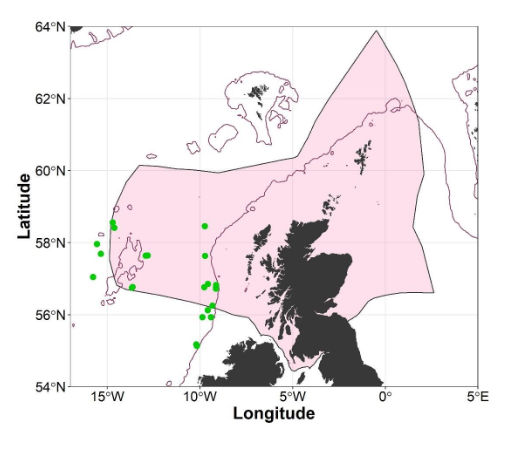
Records for Blue pygmy skate (Neoraja caerulea) from SIAMISS and deep-water fisheries surveys undertaken by the Marine Directorate 1996 – 2019.
Click for a full description
Map of the economic exclusion zone (EEZ) of Scotland showing records for Blue pygmy skate (Neoraja caerulea) from the Scottish-Irish anglerfish and megrim industry-science survey (SIAMISS) and deep-water fisheries surveys undertaken by Marine Directorate 1996-2019. Records are illustrated as green points representing surveys in which Blue pygmy skate (N. caerulea) were recorded. Records are located off the west coast of Scotland and Northern Ireland off the edge of the continental shelf and around the Rockall Plateau.
Habitat
Blue pygmy skate are found on the upper and mid-continental slope and adjacent submarine banks at depths of 600–1,540 m (Last et al., 2016). They appear to favour mud and sand substrates, temperatures that are > 6°C and salinities that are > 35 psu (Stehmann 1976).
Biology and Ecology
Blue pygmy skate reach a maximum size of ~35 cm total length (TL), with males maturing at 20–25 cm TL (Stehmann and Bürkel 1984, Ebert & Stehmann 2013; Last et al., 2016) and reaching a maximum of 32 cm (Stehmann and Bürkel 1984, Quéro et al., 2003). They are assumed to be oviparous like other skates. There are no published data on female size at maturity or fecundity, and overall life-history information is sparse.
Human interactions
The species is not targeted by commercial fisheries and its depth range largely extends beyond the range of deep-water fisheries. Bycatch and discards are likely to be relatively low due to the introduction of general measures to protect deep-water elasmobranchs (i.e. ban of certain net fisheries below 600 m, and trawls below 800 m) (ICES 2024).
References
Ebert, D.A. and Dando, M. 2021. Field guide to sharks, rays & chimaeras of Europe and the Mediterranean. Princeton University Press, Plymouth, U.K.
Ebert, D.A. and Stehmann, M.F.W. (2013). Sharks, batoids, and chimaeras of the North Atlantic. FAO Species Catalogue for Fishery Purposes No. 7. Food and Agricultural Organization of the United Nations (FAO). FAO, Rome.
ICES (2024). Report of the Working Group on Elasmobranch Fishes (WGEF). ICES Scientific Reports. 06:75. 994 pp. https://doi.org/10.17895/ices.pub.26935504.
Last, P., White, W., de Carvalho, M., Séret, B., Stehmann, M. and Naylor, G. 2016. Rays of the World. CSIRO Publishing, Clayton.
Lewis, H.M.K. & Rohner, C.A. 2025. Neoraja caerulea. The IUCN Red List of Threatened Species 2025: e.T161666A124524678.
Quéro J.-C. et al., (2003). Guide des poissons de l’Atlantique européen. Coll. Les guides du naturaliste. Delachaux et Niestlé, Paris.
Rodríguez-Cabello, C. (2013). New records of chondrichthyans species caught in the Cantabrian Sea (southern Bay of Biscay). Journal of the Marine Biological Association of the United Kingdom 93(7): 1929-1939.
Stehmann, M. (1976). Breviraja caerulea spec.nov. (Elasmobranchii, Batoidea, Rajidae) eine neue archibentale Rochenart und zugleich ein Erstnachweis ihrer Gattung im Nordostatlantik. Archiv für Fischereiwissenschaft 27(2): 97-114.
Stehmann, M. and Bürkel, D.L. (1984). Rajidae. In: P.J.P. Whitehead, M.-L. Bauchot, J.-C. Hureau, J. Nielsen and E. Tortonese (eds), Fishes of the North-eastern Atlantic and Mediterranean, pp. 163-196. UNESCO, Paris.
Stehmann, M.F.W, Seret, B., Baro, J. (2008). Neoraja iberica n. sp., a new species of pygmy skate (Elasmobranchii, Rajidae) from the southern upper slope of the Iberian Peninsula (Eastern North Atlantic). Cybium: International Journal of Ichthyology 32(1):51-71.