Sharks and Skates of Scotland Report: Birdbeak dogfish (Deania calceus)
An extract from the Sharks and Skates of Scotland Report.
Birdbeak dogfish - Deania calceus (Lowe, 1839)
Occurrence in Scotland: Deep-water. Resident. Found on the slopes both sides of the Rockall Trough, Rosemary Bank, the southern slopes of the Wyville Thomson ridge and the continental shelf off NW Scotland.
Synonym(s): none; Order: Squaliformes; Family: Centrophoridae
Common name: Birdbeak dogfish, brier shark, shovelnose spiny dogfish
AlphaID: 105903 TSN Code: 160742
Population status
Scotland and Northeast Atlantic: Increasing. Annual rate of increase of 12%, consistent with an estimated increase of 100% over the past three generation lengths (90 years), with the highest probability of no major reductions in population over three generation lengths (F. Neat, unpublished data 2019, Finucci et al., 2024).
Global: Decreasing. Overall, a population reduction of 20–29% is estimated over the last three generations, when increases in populations in the Northeast Atlantic and SW Pacific are weighted against declines in the NW Pacific and West Africa (Finucci et al., 2024).
Conservation listings
- IUCN Red List Europe: Endangered (assessment 20 February 2015)
- IUCN Red List Global: Near threatened (assessment 21 November 2019)
- CITES: Not listed
- CMS: Not listed
- OSPAR: Not listed
- Listed on the UK’s ‘Prohibited Species’ list as documented in the ‘Written Record of fisheries consultations between the United Kingdom and the European Union for 2025’ for UK waters of ICES Division 2a and Subarea 4.
- Zero TAC under EU Regulation 2018/2025) & Regulation 2023/194
- Prohibited under EU Regulation 2025/202
- Listed on The Sharks, Skates and Rays (Prohibition of Fishing, Trans-shipment and Landing) (Scotland) Order 2012
- Included in the NEAFC measures prohibiting directed fishing for deep-sea sharks
Range and distribution
Birdbeak dogfish are found in East Atlantic, Western Indian, Western North Pacific, and South Pacific oceans. In the Northeast Atlantic they occur from the Faroe Island in the north, down to the waters of North Scotland and west of the British Isles, Ireland, France, Spain, Portugal, Morocco, Azores, Madeira Islands, and down to west Africa (Ebert & Stehmann, 2013). The species is not found in the Mediterranean Sea (Ebert & Stehmann, 2013; Dureuil, 2015).
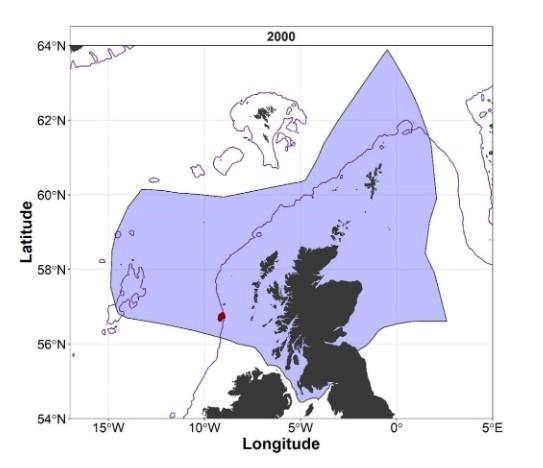
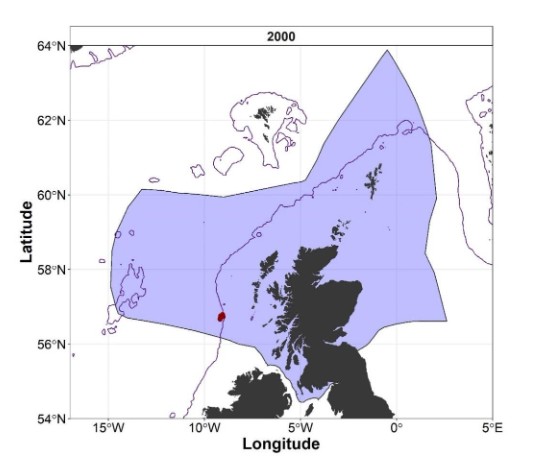
ICES DATRAS records for the Birdbeak dogfish (Deania calcea), 2000-2009.
Click for a full description
View a larger version of this image.
Maps of the EEZ of Scotland showing the ICES (International Council for the Exploration of the Sea) DATRAS (database of trawl surveys hosted by ICES) records for the Birdbeak dogfish (Deania calcea) from bottom trawl surveys conducted between 2000 and 2009. Red points represent trawl shoot positions in which Birdbeak dogfish (D. calcea) were recorded. Records are exclusively in a single cluster on the continental slope west of the Isle of Barra.
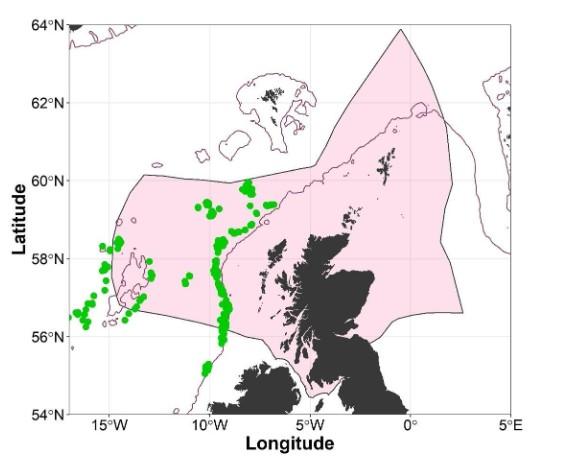
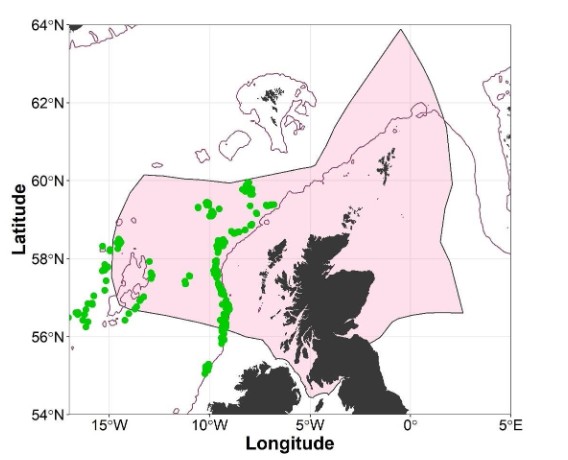
Records for the Birdbeak dogfish (Deania calcea) from SIAMISS and deep-water fisheries surveys undertaken by the Marine Directorate 1996 – 2019.
Click for a full description
View a larger version of this image.
Map of the economic exclusion zone (EEZ) of Scotland showing records for the Birdbeak dogfish (Deania calcea) from the Scottish-Irish anglerfish and megrim industry-science survey (SIAMISS) and deep-water fisheries surveys undertaken by Marine Directorate 1996-2019. Records are illustrated as green points representing the position of surveys in which Birdbeak dogfish (D. Calcea) were recorded. Records are exclusively located off the west coast of Scotland and Northern Ireland off the edge of the continental shelf. Most records are to the east of the Rockall Trough (on the slope of the continental shelf) with some records in the Rockall Trough to the west and northwest of the Outer Hebrides and some records on the slopes around the Rockall Plateau.
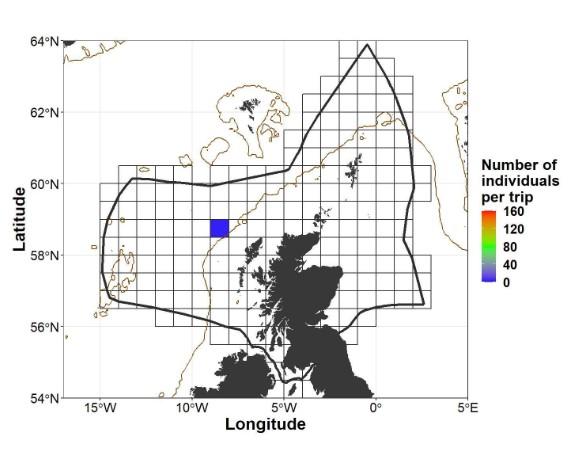
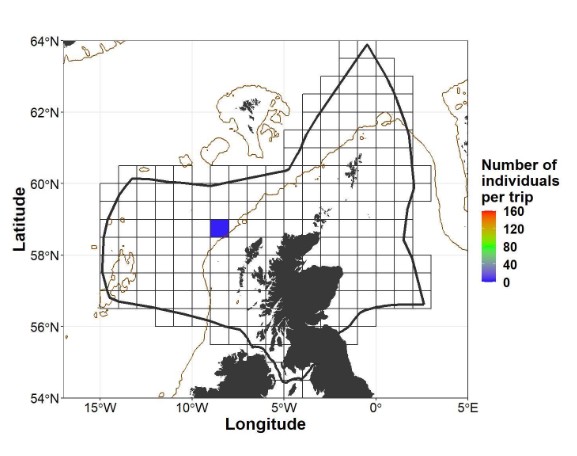
Discard data from commercial fishing vessels in ICES rectangles for Birdbeak dogfish (Deania calcea) 2014-2018.
Click for a full description
View a larger version of this image.
Map of the economic exclusion zone (EEZ) of Scotland showing discard data for Birdbeak dogfish (Deania calcea) recorded on commercial fishing vessels. The EEZ of Scotland is covered by a grid dividing it into the International Council for the Exploration of the Sea (ICES) rectangles. Data is filtered to exclude information in rectangles where three vessels or less operate. Values are presented as individuals per trip and represented as a heat map colouring each ICES rectangle from 0 (white) to 160 (red) for each rectangle in the grid. Small numbers of discards (0 to 40 individuals per trip) were recorded resulting in a single blue rectangle off the edge of the continental shelf to the northwest of the Outer Hebrides.
Habitat
This deep-water shark species can be found at depths of 60–1,500 m on or near the seabed of outer continental slopes and insular shelves (Ebert & Stehmann, 2013). Surveys of the Rockall Trough west of Scotland found they are most abundant between 800 – 1200 m (Neat et al., 2015). The species is thought to undertake migrations along the continental slopes between Irish and Portuguese waters, possibly associated with reproduction (Moura et al., 2014).
Biology and Ecology
Birdbeak dogfish are a large (27 – 122 cm), slow-growing, late-maturing and long-lived species (Neat et al., 2015; Ebert & Stehmann, 2013). Length at maturity is 81−94 cm and 99−106 cm TL for males and females, respectively (Clarke et al., 2002; Ebert & Stehmann, 2013). Estimated age at maturity is 17 years for males and 25 years for females (Dureuil, 2015). It is estimated Birdbeak dogfish can live for ~35 years (Clarke et al., 2002).
These sharks have been found to segregate by sex, size, and maturity status (Moura et al., 2014). Pregnant females tend to inhabit shallower and warmer waters, whereas males are more broadly distributed than mature females, and juveniles inhabit deeper waters (Moura et al., 2014). Gestation period can be up to two years, and this ovoviviparous species (pups feed solely on yolk) gives birth to an average of 7 pups per litter (range from 1 – 17), with newborns measuring 25-34 cm TL (Dureuil, 2015). Their diet includes a variety of teleost fish, squids and shrimp (Ebert & Stehmann, 2013). Lanternfish (Myctophidae), black and silver scabbardfish (Trichiuridae), squid, rose shrimp (Paraepinaeus longirostris) and various Annelids were found in the stomachs of 683 birdcaught on the Moroccan continental slope and shelf between 2018 – 2021 (Nafia et al., 2023). A study in Icelandic waters combining stomach content and stable isotope analysis suggested a feeding strategy primarily involving predation of mesopelagic fish, Myctophids and Pearlside (Sólmundsson et al., 2025).
Human interactions
Globally, Birdbeak dogfish have historically been used for their flesh and liver oil (Finucci et al., 2024). There is currently no targeted fishery for this species, and it has been subject to a zero Total Allowable Catch since 2010 (ICES, 2018) and has been a prohibited species since 2015 (ICES, 2024). However, Birdbeak dogfish may be taken and discarded as bycatch by bottom trawls, longline and gillnet fisheries in the Northeast Atlantic, although bycatch is thought to be low (Ebert & Stehmann, 2013, ICES 2024). Discard survival is presumed to be low (Clarke et al., 2016).
References
Clarke, M.W. et al., (2002) ‘Catch, discarding, age estimation, growth and maturity of the squalid shark Deania calceus west and north of Ireland’, Fisheries Research. Elsevier, 56(2), pp. 139–153. doi: 10.1016/S0165-7836(01)00419-2.
Clarke, M. et al., (2016) Ireland Red List No. 11: Cartilaginous fish [sharks, skates, rays and chimaeras]. Dublin, Ireland
Connolly, P.L. and Kelly, C.J. (1996) ‘Catch and discards from experimental trawl and longline fishing in the deep water of the Rockall Trough’, Journal of Fish Biology. Wiley, 49(sa), pp. 132–144. doi: 10.1111/j.1095-8649.1996.tb06071.x.
Dureuil, M. (2015) Birdbeak Dogfish Deania calcea, The IUCN Red List of Threatened Species 2015: e.T41798A48911942. (Accessed: 10 March 2020).
Ebert, D.A. and Stehmann, M. F. W. (2013) Sharks, batoids, and chimaeras of the North Atlantic. FAO Species Catalogue for Fishery Purposes. No. 7. Rome: Food and Agricultural Organization of the United Nations (FAO)
ICES (2018) Report of the Working Group on Elasmobranch Fishes (WGEF), 19-28. Lisbon, Portugal.
Finucci, B., Cheok, J., Cotton, C.F., Kulka, D.W., Neat, F.C., Pacoureau, N., Rigby, C.L., Tanaka, S. & Walker, T.I. 2024. Deania calceus (amended version of 2024 assessment). The IUCN Red List of Threatened Species 2024: e.T41798A267283710. Accessed on 27 February 2025.
ICES. 2024. Report of the Working Group on Elasmobranch Fishes (WGEF). ICES Scientific Reports. 06:75. 994 pp. Kelly, E. and Gerritsen, H. (2022). Monitoring the recovery of exploited deep-water species. EMFF 2014-2020 Marine Institute Report Series. Marine Institute.
Moura, T. et al., (2014) ‘Large-scale distribution of three deep-water squaloid sharks: Integrating data on sex, maturity and environment’, Fisheries Research. Elsevier, 157, pp. 47–61. doi: 10.1016/j.fishres.2014.03.019.
Nafia, M., El Achi, A., Manchih, K., Ouaach, A., & Moncef, M. (2023). Diet of Two Deep-Water Sharks, Deania calcea (Lowe, 1839) and Deania profundorum (Smith and Radcliffe, 1912), in the North Atlantic of Morocco. Egyptian Journal of Aquatic Biology & Fisheries, 27(4).
Neat, F.C. et al., (2015) ‘The diversity, distribution and status of deep-water elasmobranchs in the Rockall Trough, north-east Atlantic Ocean’, Journal of Fish Biology. Blackwell Publishing Ltd, 87(6), pp. 1469–1488. doi: 10.1111/jfb.12822.
Sólmundsson, J., Jakobsdóttir, K. B., & Pétursdóttir, H. (2025). Deepwater Sharks at Their Northern Limits—Distribution, Diet and Trophic Relations. Marine Ecology, 46(1), e12854.