Sharks and Skates of Scotland Report: Arctic skate (Amblyraja hyperborea)
An extract from the Sharks and Skates of Scotland Report.
Arctic skate - Amblyraja hyperborea (Collett, 1879)
Occurrence in Scotland: Slope and Deep-water. Resident. Found on the continental slope of the Faroe-Shetland channel and Rockall, and shelf waters west of Shetland.
Synonym(s): Raja hyperborea; Order: Rajiformes; Family: Rajidae
Common name: Arctic skate, blackbelly skate, boreal skate;
AlphaID: 105808; TSN Code: 160014
Population status
Scotland and Northeast Atlantic: Unknown (Kulka et al., 2016)
Global: Stable (Finucci et al., 2025)
Conservation listings
- UCN Red List Global: Least Concern (assessment 3 March 2024)
- IUCN Red List Europe: Least Concern (assessment 16 December 2014)
- CITES: Not listed
- CMS: Not Listed
- OSPAR: Not listed
- Prohibited under EU Regulation 2025/202
- Included in the NEAFC measures prohibiting directed fishing for deep-sea rays
Range and distribution
Arctic skate are a polar species with a wide distribution among across the Arctic seas and shelves. Its range extends from eastern Canada to Greenland and across to Russia and Siberia (Barents, Kara and Laptev Seas) and between Russia and western Canada (Chukchi and Beaufort Seas). It also occurs in more localised areas of the southern hemisphere, for example, off the southern tips of Australia, South Africa, around New Zealand and some areas off South America (Agustin and Capuli, 2019; Kulka et al., 2016). Arctic skate are not common in much of Europe other than the deep arctic water of the Faroe-Shetland Channel (Baxter et al., 2011).
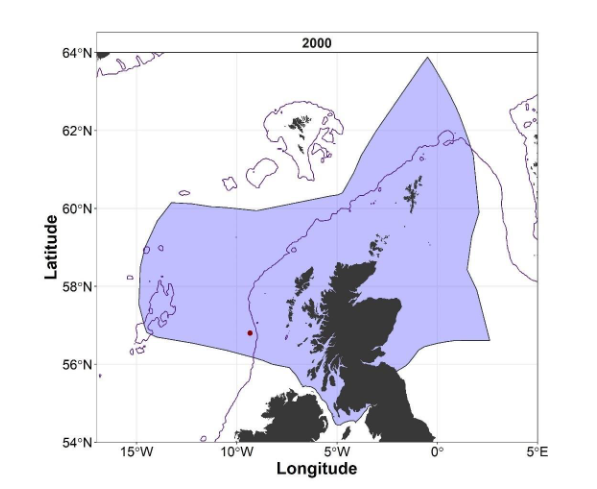
ICES DATRAS records for the Arctic skate (Amblyraja hyperborea), 2000-2009.
Click for a full description
Map of the economic exclusion zone (EEZ) of Scotland showing the ICES (International Council for the Exploration of the Sea) DATRAS (Database of trawl surveys hosted by ICES) records for the Arctic skate (Amblyraja hyperborea) from bottom trawl surveys conducted between 2000 and 2009. Red points represent trawl shoot positions in which Arctic skate (Amblyraja hyperborea) were recorded. There is a single location where the species has been recorded on the continental slope west of the Isle of Barra.
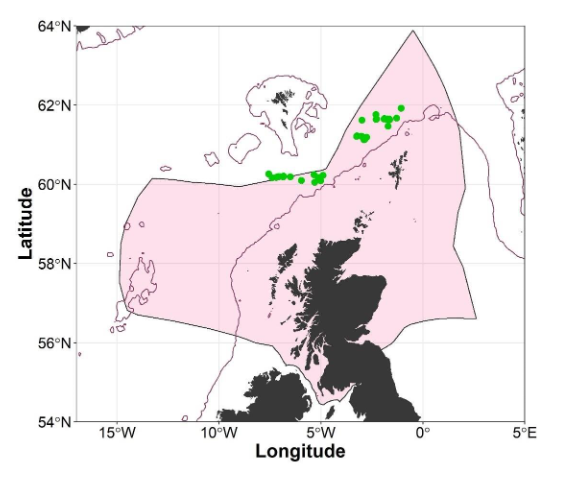
Records for the Arctic skate (Amblyraja hyperborea) from SIAMISS and deep-water fisheries surveys undertaken by the Marine Directorate 1996 – 2019.
Click for a full description
Map of the economic exclusion zone (EEZ) of Scotland showing records for the Arctic skate (Amblyraja hyperborea) from the Scottish-Irish anglerfish and megrim industry-science survey (SIAMISS) and deep-water fisheries surveys undertaken by Marine Directorate 1996-2019. Records are illustrated as green points and are exclusively located off the north of Scotland in deep water off the continental shelf to west and north of the Shetland Isles.
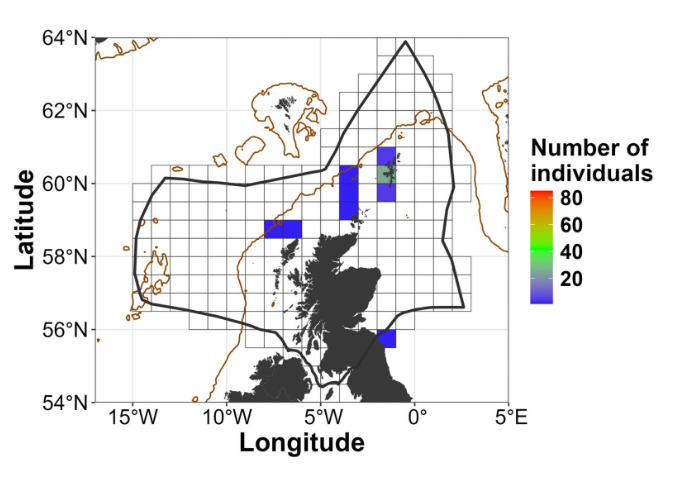
Landings data from commercial fishing vessels in ICES rectangles for Arctic skate (Amblyraja hyperborea) 2011-2019.
Click for a full description
Map of the economic exclusion zone (EEZ) of Scotland showing landings data per ICES (International Council for the Exploration of the Sea) rectangle for Arctic skate (Amblyraja hyperborea) recorded by commercial fishing vessels from 2011 to 2019. Values are presented as the number of individuals landed per trip. Data is illustrated in a heat map, colouring each ICES rectangle from one (blue) to 81 (red). Small numbers of landings illustrated by blue rectangles representing 0 to 20 individuals were reported around the Shetland Isles, to the north of the Orkney Isles, to the north of the Outer Hebrides, and to the east of Berwickshire.
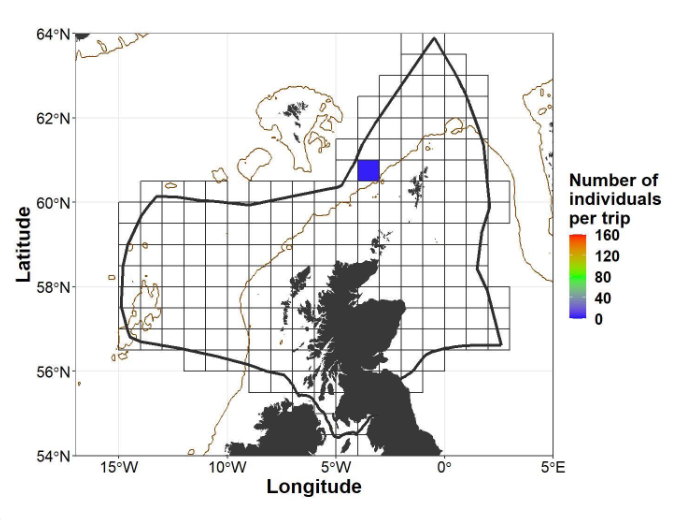
Discard data from commercial fishing vessels in ICES rectangles for Arctic skate (Amblyraja hyperborea) 2014-2018. Data is filtered to exclude information in rectangles where three vessels or less operate.
Click for a full description
Map of the economic exclusion zone (EEZ) of Scotland showing discard data for Arctic skate (Amblyraja hyperborea) recorded on commercial fishing vessels. The EEZ of Scotland is covered by a grid dividing it into the International Council for the Exploration of the Sea (ICES) rectangles. Data is filtered to exclude information in rectangles where three vessels or less operate. Values are presented as individuals per trip and represented as a heat map from one (blue) to 160 (red) for each rectangle in the grid. Small numbers of discards illustrated by blue rectangles representing 0 to 40 individuals were recorded off the edge of the continental shelf west of the Shetland Isles.
Habitat
Arctic skate are a polar species with a wide distribution among across the Arctic seas and shelves. Its range extends from eastern Canada to Greenland and across to Russia and Siberia (Barents, Kara and Laptev Seas) and between Russia and western Canada (Chukchi and Beaufort Seas). It also occurs in more localised areas of the southern hemisphere, for example, off the southern tips of Australia, South Africa, around New Zealand and some areas off South America (Agustin and Capuli, 2019; Kulka et al., 2016). Arctic skate are not common in much of Europe other than the deep arctic water of the Faroe-Shetland Channel (Baxter et al., 2011).
Biology and Ecology
Arctic skate are oviparous, laying egg capsules that range from 81 -125 mm long and 50 – 80 mm wide (Ebert 2014). The size of hatched individuals ranges from 16-18 cm TL (Stehmann et al., 2015). Maximum size is recorded as possibly as high as 97 cm in the Northeast Atlantic (Kulka et al., 2024). Females in the North Atlantic were found to mature at approximately 71 cm, and males at 67 cm (López Climent 2021). Egg nurseries have been found in association with cold water coral reefs on deep-water seamounts in the waters off Tasmania (Maguire et al., 2023). The age at maturity is unknown. Arctic skate are opportunistic feeders and consume benthic animals (e.g. prawn) as well as pelagic species such as herring (Clupea harengus), blue whiting (Micromesistius poutassou) and capelin (Mallotus villosus) (Bjelland et al., 2000; Benzik and Chetyrkin 2022). A recent survey in the Northwest Atlantic found that they are capable of feeding on animals 50% to 80% of their own size, such as eelpout (Zoarcidae sp) (Byrkjedal et al., 2015). Video footage of Arctic skate in-situ in the Pacific Ocean revealed typically slow and deliberate swimming activity, skates were observed skimming the seafloor and using a combination of ‘punting’ (a form of locomotion utilised by skates whereby the pelvic fins are used to ‘walk’) and undulatory swimming (Kuhnz et al., 2019).
Human interactions
Arctic skate generally have limited interaction with fisheries due to its occurrence at depth (Kulka et al., 2016). However, it may be represented in the bycatch of longline and deep-water trawl fisheries in certain areas, such as the cod and haddock fisheries of Northeast Atlantic and longline fisheries targeting mainly Greenland Halibut (Reinhardtius hippoglossoides), Cod (Gadus morhua) and Northern wolfish (Anarhichas denticulatus). Arctic skate have been reported as a significant bycatch species, along with Greenland sharks (Somniosus microcephalus), in the Greenland halibut fisheries in the Canadian Arctic (Peklova et al., 2014) and in the Barent Sea Arctic skate accounted for approximately 20% of longline catches between 1996 - 2001, at times comprising 99% of some catches (Kulka et al., 2016). Discarding of this species is known to take place but has not been quantified, and discard survival has not been estimated (ICES, 2018, 2019). Arctic skate are managed under a combined regional TACs for ‘skates and rays’ in Scottish waters as part of the Celtic Seas ecoregion and the Greater North Seas ecoregions (Batsleer et al., 2024). However, since the introduction of general measures to protect deep-water elasmobranchs (ban of static net fisheries below 600 m and trawls below 800 m; ICES 2024), the species has unlikely to be incidentally captured due to the depths at which it occurs.
References
Agustin, L.Q. and Capuli, E. E. (2019) Amblyraja hyperborea (Collett, 1879), Arctic skate, FishBase. (Accessed: 13 January 2019).
Batsleer, J., Griffiths, C., Bleeker, K., Johnston, G, Cardinale, M., Lorance, P. (2024).
Comparisons of landings to scientific advice indicate overshooting within the common TAC for skates and rays in the Northeast Atlantic. Ices Journal of Marine Science (1054-3139) (Oxford University Press (OUP)), 2024-04, Vol. 81, N. 3, P. 470-479.
Benzik, A. N., & Chetyrkin, A. A. (2022). Diet Composition of Skates of the Barents Sea in 2004–2021. Journal of Ichthyology, 62(7), 1343-1351.
Bjelland, O., Bergstad, O. A., Skjæraasen, J. E., & Meland, K. (2000). Trophic ecology of deep-water fishes associated with the continental slope of the eastern Norwegian Sea. Sarsia, 85(2), 101-117.
Byrkjedal, I. et al., (2015) ‘Arctic skate Amblyraja hyperborea preys on remarkably large glacial eelpouts Lycodes frigidus’, Journal of Fish Biology, 86(1), pp. 360–364. doi: 10.1111/jfb.12554.
Ebert, D. A., & Dando, M. (2021). Field Guide to Sharks, Rays & Chimaeras of Europe and the Mediterranean. Princeton University Press.
Ebert D.A. (2014). Deep–sea Cartilaginous Fishes of the Indian Ocean. Volume 2. Batoids and Chimaeras. FAO Species Catalogue for Fishery Purposes. No. 8, Vol. 2. Rome, FAO. 129 pp.
Finucci, B., García, E., Kulka, D.W. & Orlov, A.M. 2025. Amblyraja hyperborea. The IUCN Red List of Threatened Species 2025: e.T205175804A124460245.
ICES (2018) ICES Advice on fishing opportunities, catch, and effort Celtic Seas Ecoregion: Other skates and rays in subareas 6–7 (excluding Division 7.d) (Rockall and West of Scotland, southern Celtic Seas, western English Channel), Report of the ICES Advisory Committee.
ICES (2019) ICES Advice on fishing opportunities, catch, and effort Greater North Sea Ecoregion: Other rays and skates (Rajidae) in Subarea 4 and in divisions 3.a and 7.d (North Sea, Skagerrak, Kattegat, and eastern English Channel), Report of the ICES Advisory Committee
Kuhnz, L. A., Bizzarro, J. J., & Ebert, D. A. (2019). In situ observations of deep-living skates in the eastern North Pacific. Deep Sea Research Part I: Oceanographic Research Papers, 152, 103104.
Kulka, D. et al., (2016) Amblyraja hyperborea. The IUCN Red List of Threatened Species 2016.
Kulka, D. W., Miri, C. M., Atchison, S., & Simpson, M. R. (2024). Sibling Species Amblyraja hyperborea and A. jenseni in Slope Waters of Eastern Canada: An Ecomorphological Description. Diversity, 16(8), 479.
López Climent, R. (2021). Distribution, reproductive ecology, and colouration of the Arctic skate Amblyraja hyperborea (Collett, 1879) in the North Atlantic Ocean (Master's thesis, UiT Norges arktiske universitet).
Mecklenburg, C.W. et al., (2018) Marine fishes of the Arctic Region.Volume I. Conservation of Arctic Flora and Fauna, Akureyri, Iceland.
Peklova, I., Hussey, N. E., Hedges, K. J., Treble, M. A., & Fisk, A. T. (2014). Movement, depth and temperature preferences of an important bycatch species, Arctic skate Amblyraja hyperborea, in Cumberland Sound, Canadian Arctic. Endangered Species Research, 23(3), 229-240.
Stehmann, M.F.W. et al., (2015) ‘Arctic Skate, Amblyraja hyperborea’, Amblyraja hyperborea. The IUCN Red List of Threatened Species 2015, e.T63119A4.