Piloting an Outcomes Based Approach in Scotland (POBAS)
Piloting an Outcomes Based Approach in Scotland (POBAS) ran for three phases between April 2019 and December 2022. It was led by NatureScot with funding provided by Scottish Government to inform the development of Scotland’s future rural support framework.
The project aimed to test new place-based approaches to delivering environmental outcomes across Scotland and across different farm and croft types through future agri-environment type mechanisms. The emphasis was on greater farmer and crofter engagement, allowing innovation and flexibility with the aim of having more sustainable and resilient businesses, as well as delivering better outcomes for Scotland’s people.
The POBAS work focussed on a outcomes-based approach, drawing on experience from various outcomes-based schemes that have been trialled across Europe (Europe, Ireland and England.)
Outcomes-based schemes have payments linked to evidence of the outcome achieved rather than evidence of completing specific management actions, with payments not fixed per hectare but available on a sliding scale – the more you deliver for nature, the higher the payment you can get.
It engaged around 80 farmers in seven farming and crofting clusters across Scotland representing different farm types to understand the issues arising from the implementation of an outcomes-based approach including practical barriers, issues and opportunities, as well as farmer behaviour, relying on a co-production approach
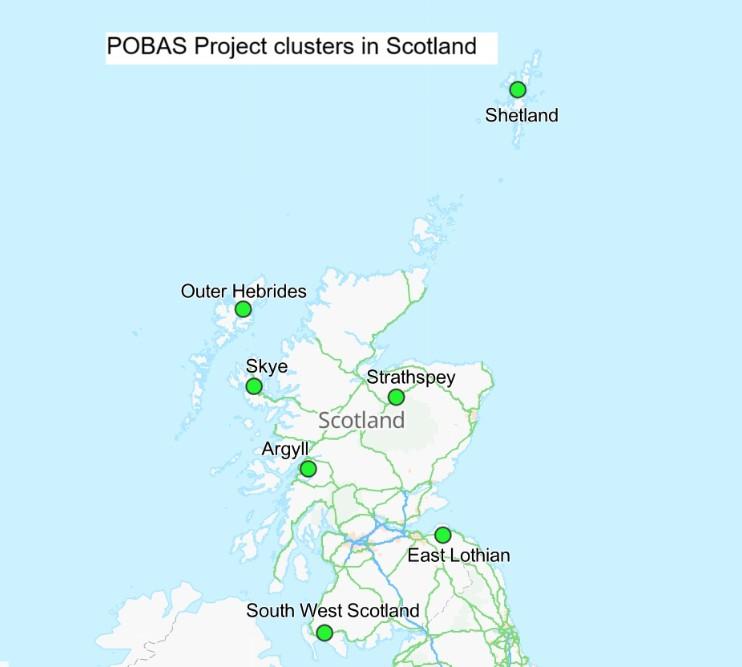
POBAS project clusters in Scotland Map.
The scheme tested a range of outcomes that can be delivered through an outcome-based approach and how these are translated to management measures and indicators at the field, farm and landscape levels. It developed scorecards to measure delivery of outcomes across a range of habitats and identified solutions and recommendations to inform future farming support.
Scorecards were developed for the following habitats:
- Hedges
- Field margins
- General habitats (covering mosaics of grassland, heath & woodland)
- Waders (including a Shetland specific wader scorecard)
- Peatland (including a Shetland specific peatland scorecard)
- Machair
- Dairy farms – whole farm approach incorporating scores from farm level practices, in-field (arable and improved grassland) and field boundaries
- Woodland.
The scorecards were incorporated into an App to help farmers assess the quality of their habitats (this App became the prototype for the Farm Biodiversity Scotland mobile app and web platform).
The App was developed as part of a CivTech challenge: Civtech Challenge 3 - How can technology help farmers improve the environment under their stewardship, and track that improvement?
The following key lessons were drawn from feedback received from the three phases of the project:
- Most participating farmers and crofters had positive attitudes to working on an outcomes based approach. They were keen to have a system of support that was less prescriptive about the land management measures they needed to take to get results. A key request was for schemes to avoid being unnecessarily complex.
- Farmers and crofters welcomed flexibility of outcomes based approach and the recognition of their knowledge and understanding of their land and habitats. They welcomed the concept of choice about the extent to which they could pursue environmental outcomes to fit with the management of their whole farm or croft holding with the recognition that they could pursue income from either management for nature, food production, or both.
- Farmers and crofters liked using an outcome-based approach to decision making when they are deciding how to manage a particular habitat or ecosystem/feature on their holding where the outcomes can be sufficiently broken down to achievable attributes that can be measured on the ground (the score card approach)
- Some farmers were concerned about the potential for inconsistency, their lack of expertise and the time required particularly if a results-based approach were to be applied across the whole farm.
- One of the key benefits identified from an outcomes-based approach was the ability to allow for variation in farm type, location and bio-geographical constraints to the methods by which the outcome is achieved and how they are incentivised and measured.
- There is the potential for financial incentives (market, public or otherwise) to be aligned with the outcomes achieved but the investment required to deliver them may differ across the country.
- Another benefit identified from this pilot was the avoidance of unintended negative consequences, insofar as it did not disadvantage those who have preserved nature on their holding or conversely provide an incentive to restore environmental features that have been damaged. It provides a way to reward existing good practice by farmers, crofters and other land managers in delivering nature outcomes as well as the restoration of key habitats and features that are currently in poor condition.
- A variety of support interventions was tested, with the best outcomes achieved by a mixture of farmer knowledge coupled with advisory support, compared to farmer on their own, or adviser on their own.
- Training and other support was identified as an important component to maximise the benefits from outcomes-based decision making, including user friendly platforms that help collate and present data farmers need to make informed decisions.
- As with other aspects of decision-making in agriculture, knowledge and understanding is essential for successful outcomes. POBAS farmers and crofters showed a willingness to learn more about the biodiversity on their land and this approach could help underpin deeper behavioural change.
- This pilot did not make actual payments for an outcomes based approach, so there may be differences in behaviour when faced with the real life decisions rather than conceptual decisions.
- The time taken to develop a outcomes-based approach and provide an appropriate level of support to farmers and crofters should not be underestimated.
- Clarity on setting the environmental outcomes required is essential, so that farmers can choose how far they want to go in delivering those outcomes.
- The key approach relied on the development of scorecards which are used as a tool to measure success and effectively highlight the key outcomes for each habitat, through a series of multiple-choice questions. Farmers choose the most relevant answer for their habitat which generates a final score. A payment level could then be derived from the banding in which the final score falls as illustrated below:

POBAS Scorecard
Click for a full description
| Outcomes | Refrain | Refrain | Reduce | Reduce | Restore | Restore | Restore | Restore | Renew | Renew |
|---|---|---|---|---|---|---|---|---|---|---|
| Scores | 1 | 2 | 3 | 4 | 5 | 6 | 7 | 8 | 9 | 10 |
- While there was general support for an outcomes based approach, the Pilot only tested some outcomes, and other outcomes may not fit with this approach.
- Not all outcomes require a outcomes-based approach; for example some capital items or in-field climate actions such as cover crops. These are usually one-off, or annual, actions where strict implementation is more likely to lead or contribute to delivering the desired outcomes without the need for assessment of how they have been implemented, or where there would be a long lag in the response of the scoring criteria to an otherwise desirable change of management. They are more suited to payment based on evidence of installation or implementation.
“The current schemes reward following rules, not achieving benefit.”
“It is farmer and specific to one's farm. One has more control.”
“There is flexibility in management and incentive to make improvements.”
“The app has enabled me to become more interested in nature and what I do on my land
Last updated: