Nature30
Nature30 represents a fresh approach to conservation. They offer an alternative to traditional Protected Areas by recognising areas that deliver positive, sustained, and long-term outcomes for biodiversity, as a result of the land management, regardless of the primary objective of this management.
Nature30 represents a fresh approach to conservation. They offer an alternative to traditional Protected Areas by recognising areas that deliver positive, sustained, and long-term outcomes for biodiversity, as a result of the land management, regardless of the primary objective of this management.
Nature30 in Scotland
Nature30 sites will safeguard a diverse range of ecosystems and include areas managed to support ecosystem resilience, connectivity, restoration and ecosystem function and services. This is a bottom-up or ‘opt-in’ approach that recognises land management that will deliver great things for biodiversity.
To decide how Nature30 will work in Scotland, a set of criteria has been designed. These criteria have been based on the International Union for Conservation of Nature (IUCN) guidance on OECMS – Other Effective area-based Conservation Measures - to ensure they align with robust international approaches, and informed by a group of stakeholders in Scotland, to tailor them to the Scottish context. At their simplest Nature30 sites are;
- Not an existing protected area
- Managed in a way that has positive outcomes for biodiversity
- Subject to a long-term (a minimum of 25 years) assurance that it will continue to be managed to deliver for biodiversity
- Recognised with the informed consent from the landowner or manager
The full criteria for an area to be considered for Nature30 recognition is provided here. Anyone responsible for an area of land or fresh water, that might meet these criteria, can nominate it for Nature30 recognition and where demonstration of alignment with the criteria is clear, have it contribute to Scotland’s 30 by 30 commitment.
As well as recognising effective stewardship of our nature-rich areas, and their contribution to a global commitment for biodiversity, being recognised as part of 30 by 30 should provide a route to attracting financial incentives (whether private or public) to further support and recognise effective management.
Unlike Protected Areas, Nature30 sites do not have statutory protection and therefore do not have enforced regulation. Instead, the emphasis is on the Nature30 site’s governance authorities meeting voluntarily agreed management commitments in the long-term. If it becomes evident that the land is not being managed effectively with benefits for biodiversity, then the site will no longer receive Nature30 recognition.
What’s the difference between Nature30 (OECMs) and protected areas?
- The primary objective of protected areas is always biodiversity conservation, whereas this is not necessarily true for Nature30 sites.
- The procedure for recognising Nature30 sites is more accessible and flexible than that for protected areas.
- Sites recognised as Nature30 already have an established governance and management system, whereas the management system for a protected area is instituted—based on conservation objectives—only once the protected area has been designated.
- Both of these mechanisms produce positive results for biodiversity conservation, of equal value, in the long term.
Nomination Process
The nomination and recognition process for Nature30 aims to be as simple as possible whilst remaining robust to maintain confidence in their continued importance for biodiversity.
Landowners or managers use a self-assessment Nomination Form to demonstrate how their site meets each of the Nature30 criteria. These nominations will then be assessed, and then considered and reviewed by a panel, before receiving confirmation of recognition. NatureScot are committed to supportive process, working with landowners, managers, communities, private companies or public bodies through the process. Where existing arrangements do not allow for recognition, NatureScot will support governing bodies to understand how alignment can be increased so they understand the route to inclusion and can make informed decisions as to how they wish to progress. The approach has initially be developed through a pilot programme and continue to adapt moving forward to ensure that it is effective and responds to users’ needs.
Please find linked to here and above the criteria, and the form for nominating a site for Nature30 recognition.
Recognising what we have
As well as sites nominating themselves through this open nomination and recognition process, NatureScot is currently reviewing the landscape designations Scotland already has, as well as other land-based accreditation schemes, and how they align with the Nature30 criteria. Where there is alignment, these may offer opportunities for sites to become recognised at a quicker pace, removing duplication and reducing the burden on those already accredited through existing schemes.
Be part of a global movement
Nature30 sites count toward the achievement of the international and national target of conserving 30% of land and fresh water by 2030 (CBD’s third target, better known as ‘30 by 30’ or ‘30x30’). This target is one of 23 action-oriented global targets in the Global Biodiversity Framework adopted at the 15th meeting of the Conference of the Parties to the United Nations Convention on Biological Diversity (COP15).
Nature30 is Scotland’s approach to the globally recognised approach of OECMs. The Convention on Biological Diversity’s (CBDs) global definition of an OECM is:
“a geographically defined area other than a protected area, which is governed and managed in ways that achieve positive and sustained long-term outcomes for the in situ conservation of biodiversity, with associated ecosystem functions and services and where applicable, cultural, spiritual, socio–economic, and other locally relevant values.”
NatureScot worked with the OECM Working Group and pilot sites to ensure the international definition and guidance, including that from the IUCN, could be applied simply and effectively to Scotland.
Scotland’s Nature30 sites will be added to the World Database of OECMs, showcased across the globe for their contribution.
Maintaining Integrity
Ensuring Nature30 is effective
For Nature30 sites to make a meaningful contribution to 30 by 30 alongside protected areas, and broader efforts across Scotland’s working landscapes, it is critical that they deliver for biodiversity.
Alongside using robust criteria that align with the CBD and IUCN criteria for ‘other effective area-based conservation measures’, good governance and transparency of the recognition process is central to ensuring the effectiveness of Nature30 sites.
Nature30 Governance
In developing the approach to recognising Nature30 sites in Scotland, two considerations were key.
- That the process was robust enough to provide confidence in the ability of Nature30 sites to deliver for biodiversity.
- That the process remained simple and accessible for those who wish to apply.
To ensure both goals have been met, as much of the assessment as possible is done centrally to reduce the burden on applicants. The process is outlined below and critically involves expertise not just from NatureScot but from independent externals.
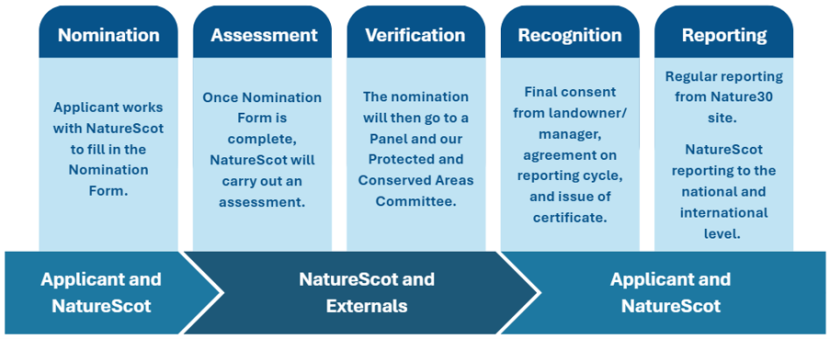
NatureScot staff will work with applicants to ensure that all required information is collected, only sending forward Nominated sites where it is mutually agreed with applicants and there is a high level of confidence that all criteria have been met.
The Recognition Panel
The Recognition Panel is made up of five members: a NatureScot representative, a Scottish Government representative and senior representatives from Scottish Land and Estates, Community Land Scotland and Scottish Environment LINK.
Their role is to help ensure integrity of the Nature30 accolade by providing independent scrutiny of Nature30 nominations, not on the basis of specialist knowledge of specific criteria but, by representing a range of stakeholder interests. They will assess applications objectively and against agreed criteria and guidance. They will either recommend that the PAC award the accolade or will pass the nomination back to the 30 by 30 Delivery Team for further discussion with the nominee.
The Terms of Reference for this group can be found below.
The Protected Areas Committee (PAC)
The PAC is a subset of NatureScot’s Board and form a key pillar in the governance of area-based conservation in Scotland. Full membership of the PAC can be found on the NatureScot website .
Their role in Nature30 site recognition is to consider the recommended nominations from the Panel and to agree or otherwise with the recommendation. Where the PAC agrees with the recommendation of recognition of a site, an award letter will be sent to the applicant on behalf of the PAC. If they do not agree with the recommendation, the nominee (and Panel) will be informed, with the reasons for refusal and, if appropriate, any options for remediation.
The PAC’s role in maintaining the integrity of Nature30 sites extends to ensuring that the accolade is only associated with sites that are continuing to deliver for biodiversity. Where evidence, either through contact with the site representative(s), as part of the agreed monitoring programme (covered in the nomination and assessment forms) or by any other means, comes to light that indicates the Nature30 criteria are no longer being met on a particular site the evidence will be passed to the PAC. This could result in a time-limited improvement notice which, if not fulfilled, would result in rescindment. A detailed formal rescindment will be issued by the PAC in such cases.
Any changes to Panel membership, including appointments, replacements or resignations, shall be approved by the PAC as the decision-making authority.
Continual learning process
The supporting information and assessors’ guidance will be continually updated in light of decision-making. Systemic issues will be taken to the 30x30 Programme Board and PAC for consideration.
Appeals
Nominated sites have the ability to appeal decisions that they disagree with.
Availability of Data
It is important that the Nature30 recognition, like protected areas, remains as transparent as possible.
Alongside general site data such as boundaries, aims and governance type being made available on SiteLink and the World Database of Protected and Conserved Areas (WDPCA) there will also be an annual report on progress towards 30 by 30 that will summarise progress over the last year.
The first report coming out Summer 2026.
Contacts
30x30