Sharks and Skates of Scotland Report: Round skate (Rajella fyllae)
An extract from the Sharks and Skates of Scotland Report.
Round skate - Rajella fyllae (Lütken, 1887)
Occurrence in Scotland: Slope and deep-water. Resident. Found on the slopes both sides of the Rockall Trough, Rosemary Bank, the southern slopes of the Wyville Thomson ridge and the continental shelf off NW Scotland.
Synonym(s): Raja fyllae, Breviraja marklei; Order: Rajiformes; Family: Rajidae
Common name: Round skate, round ray
AlphaID: 105894 TSN Code: 564135
Population status
Scotland and Northeast Atlantic: Unknown (ICES, 2024).
Global: Increasing. There has been an estimated median increase of 170% over three generation lengths (34.5 years) (Kulka et al., 2020).
Conservation listings
- IUCN Red List Global: Least Concern (assessment 20 June 2019)
- CITES: Not listed
- CMS: Not Listed
- OSPAR: Not listed
- Prohibited under EU Regulation 2025/202
- Listed on the EU’s ‘Prohibited Species’ list as documented in the ‘Written Record of fisheries consultations between the United Kingdom and the European Union for 2025’ for all EU waters except of ICES Subarea 4
- Included in the NEAFC measures prohibiting directed fishing for deep-sea rays
Range and distribution
Round skate are widely distributed residents of the Northeast Atlantic, and can be found from the Southeast Barents Sea to southern Norway, southern Greenland, Iceland, the Faeroes and Shetland Isles, along the west coast of Britain and down to the Bay of Biscay (Ebert and Stehmann 2013; Last et al. 2016; Kulka et al., 2020). They are also found in the Northwest Atlantic off the coast of Canada and the Arctic fringes (Ebert and Stehmann 2013, Last et al., 2016, Kulka et al., 2020).
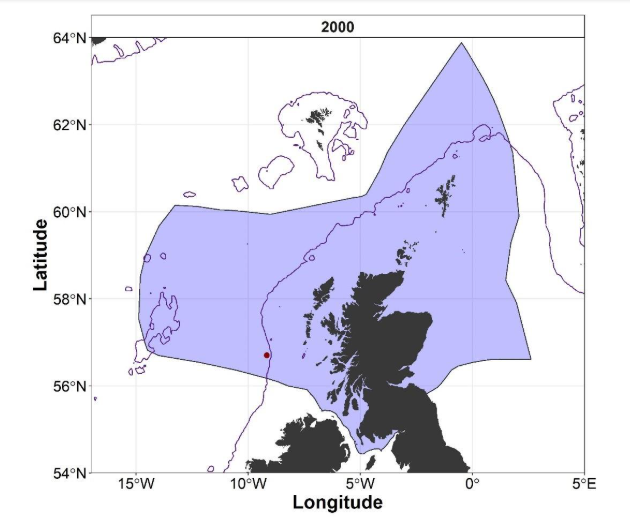
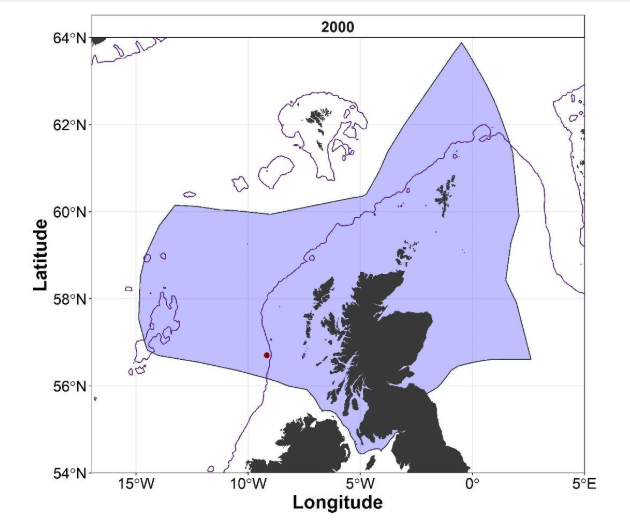
ICES DATRAS records for Round skate (Rajella fyllae), 2000: 2000-2009.
Click for a full description
View a larger version of this image.
Map of the EEZ of Scotland showing the ICES (International Council for the Exploration of the Sea) DATRAS (database of trawl surveys hosted by ICES) records for Round skate (Rajella fyllae) from bottom trawl surveys conducted between 2000 and 2009. Red points represent trawl shoot positions in which Round skate (R. fyllae) were captured. There is a single record indicating that Round skate (R. fyllae) were recorded in a single trawl off the continental shelf to the west of the Isle of Barra.
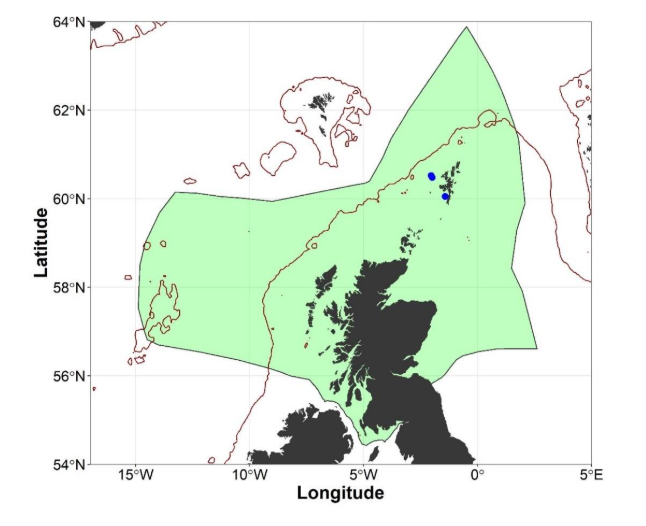
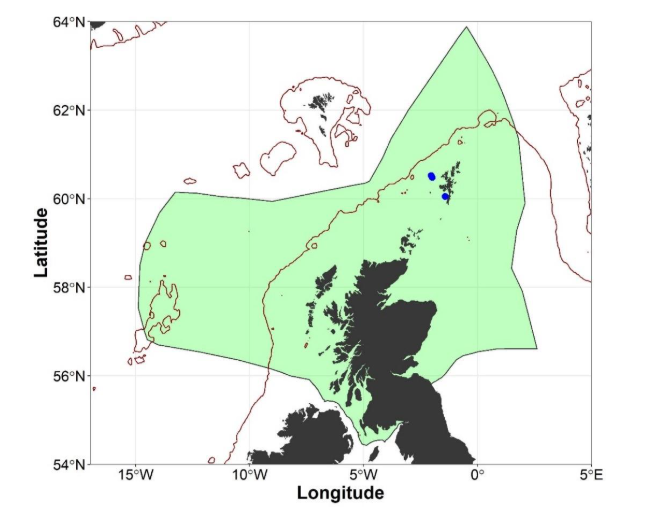
Tag - recapture records for Round skate (Rajella fyllae) from the Scottish Shark Tagging Programme, the Glasgow Museums tagging programme and the UK Shark Tagging Programme data from 1970 to 2025.
Click for a full description
View a larger version of this image.
Map of the economic exclusion zone of Scotland showing records for Round skate (Rajella fyllae) from the Scottish Shark Tagging Programme, Glasgow Museums tagging programme and the UK Shark Tagging Programme data from 1970 to 2025. Data assimilated by the Scottish Shark Tagging Programme. These tag – recapture records presented as blue dots are provided by anglers and occasionally supplemented by reports of tagged animals subsequently captured on commercial fishing vessels. The data shows tight clusters in places where angling and tagging have occurred, in this case in the Shetland Isles.
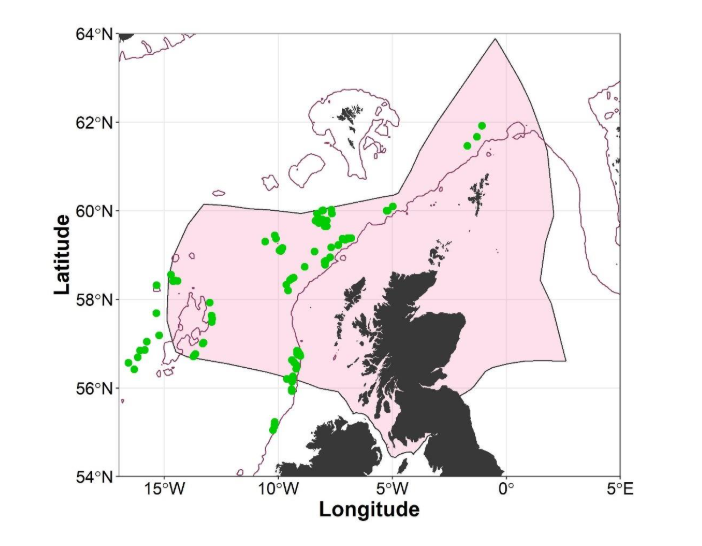
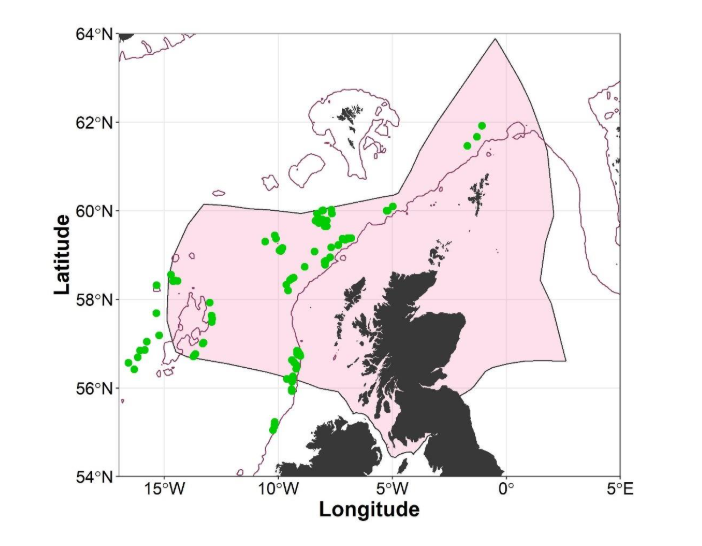
Records for Round skate (Rajella fyllae) from SIAMISS and deep-water fisheries surveys undertaken by the Marine Directorate 1996 – 2019.
Click for a full description
View a larger version of this image.
Map of the economic exclusion zone (EEZ) of Scotland showing records for Round skate (Rajella fyllae) from the Scottish-Irish anglerfish and megrim industry-science survey (SIAMISS) and deep-water fisheries surveys undertaken by Marine Directorate from 1996 to 2019. Records are illustrated as green points and are located off the west coast of Scotland and Northern Ireland off the edge of the continental shelf. There is also a group of records further off the continental shelf to the northwest of the Outer Hebrides, and off the continental shelf north of the Shetland Isles. There are also records around the Rockall Plateau.
Habitat
Round skate live in deep-water shelf and slope habitats, at depths of 170 – 2050 m. In the Northeast Atlantic they are most regularly encountered at depths between 500 – 1500 m (Neat et al., 2015). In the north-eastern Norwegian Sea and NE North Sea they were found to prefer relatively warm Atlantic water masses (Skjæraasen and Bergstad, 2001).
Biology and Ecology
Very little is known about the biology of this small skate species. In the scientific deep-water trawl surveys in the Northeast Atlantic, specimens ranged from 11 – 59 cm TL (Neat et al., 2015). Like other skates, this species lay eggs, which are presumed to take several months to develop due to the cold-water they inhabit (Kulka et al., 2020). Egg capsules are 3.8 – 4.2 cm long and 2.4-2.6 cm wide (Funicelli, 1972), and newly hatched skate are estimated to be 7-11 cm long (Kulka et al., 2020). Their diet includes a wide range of invertebrates that live on or near the seafloor, such as polychaetes, gammarids, northern shrimp, and fisheries waste, as well as some fish (caplin and young cod) (Dolgov, 2005; González-Iglesias et al., 2006). Juvenile Round skate almost exclusively feed on small invertebrates living in the seabed and only switch to larger prey when they reach 36-40 cm TL (Dolgov, 2005).
Human interactions
There are currently no targeted commercial fisheries for Round skate however, they may be caught as bycatch by deep-water fisheries in some locations (Kulka et al., 2020). As a prohibited species in EU waters (except the North Sea), all individuals incidentally caught must be returned to the sea. This species is also offered some refuge from fisheries in the deeper waters that they inhabit, which are beyond the reach of most deep-water fishing vessels following the introduction of general measures to protect deep-water elasmobranchs (i.e. ban of certain net fisheries below 600 m, and trawls below 800 m) (ICES 2024).
References
Dolgov, A.V. (2005). Feeding and Food Consumption by the Barents Sea Skates. J. Northwest Atl. Fish. Sci. 35, 495–503.
Funicelli, N.A. (1972). Egg cases of cartilaginous fishes of the Western North Atlantic. Long Island University.
González-Iglesias, M.C. et al., (2006). Feeding Habits and Diet Overlap of Skates (Amblyraja radiata, A. hyperborea, Bathyraja spinicauda, Malacoraja senta and Rajella fyllae) in the North Atlantic. North Atl. Fish. Organ. N5285.
ICES. (2024). Report of the Working Group on Elasmobranch Fishes (WGEF). ICES Scientific Reports. 06:75. 994 pp.
Kulka, D.W., Anderson, B., Derrick, D., Pacoureau, N. & Dulvy, N.K. 2020. Rajella fyllae. The IUCN Red List of Threatened Species 2020: e.T197086A22515038. .
Neat, F.C. et al., (2015). The diversity, distribution and status of deep-water elasmobranchs in the Rockall Trough, north-east Atlantic Ocean. J. Fish Biol. 87, 1469–1488.
Skjæraasen, J.E., Bergstad, O.A., (2001). Notes on the distribution and length composition of Raja lintea, R. fyllae, R. hyperborea and Bathyraja spinicauda (Pisces: Rajidae) in the deep NEern North Sea and on the slope of the eastern Norwegian Sea. ICES J. Mar. Sci. 58, 21–28.