Sharks and Skates of Scotland Report: Nursehound (Scyliorhinus stellaris)
An extract from the Sharks and Skates of Scotland Report.
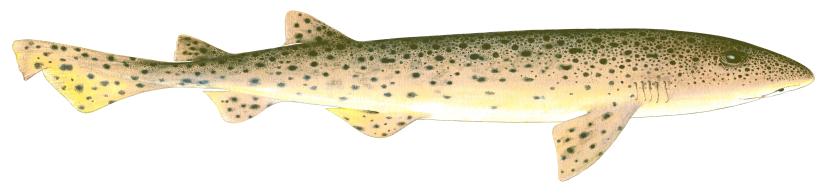
Nursehound - Scyliorhinus stellaris (Linnaeus, 1758)
Occurrence in Scotland: Shelf. Resident. Patchy distribution throughout shelf waters.
Synonym(s): Squalus stellaris, squalus catulus;; Order: Carcharhiniformes; Family: Scyliorhinidae ‘Catsharks’
Common name: Nursehound, Greater-spotted dogfish, bull huss
AlphaID: 105815 TSN Code: 160067
Note on data quality: ICES advise that landings and catch data for this species continue to be unreliable, and fisheries-dependent data should be viewed with caution (ICES, 2024).
Population status
Scotland and Northeast Atlantic: Reported landings have increased since 2009 and stabilised 2017 – 2024 in Celtic Seas Ecoregion subareas 6 and 7 (ICES, 2024), increasing in the rest of the Northeast Atlantic (ICES, 2024, Finucci et al., 2021).
Global: While the population is estimated to have increased in the Northeast Atlantic, it has decreased in the Mediterranean Sea and overall is estimated to have undergone a global population reduction of 30–49% over the past three generation lengths (48 years) (Finucci et al., 2021).
Conservation listings
- IUCN Red List Europe: Near threatened (assessment 30 September 2014)
- IUCN Red List Global: Vulnerable (assessment 31 August 2020)
- CITES: Not listed
- CMS: Not listed
- OSPAR: Not listed
Range and distribution
Nursehounds are native to the central and northern Atlantic as well as the Mediterranean. In the Northeast Atlantic their range extends from southern Scandinavia and the British Isles down to the Southern tip of Spain (Ebert and Stehmann, 2013). Around the British Isles, Nursehounds are rarely caught in the North Sea, but are locally abundant in areas of the southern and south-western coasts of the UK, including the Irish Sea (Ellis et al., 2005).
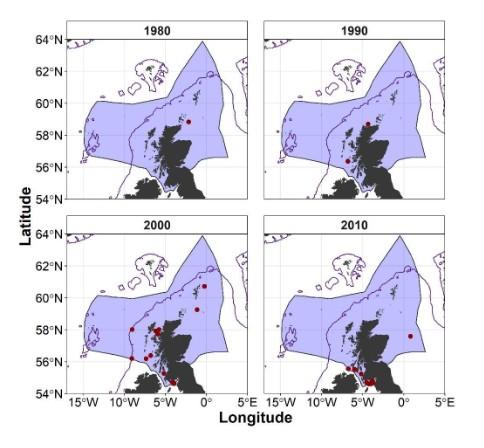
CES DATRAS records for the Nursehound (Scyliorhinus stellaris), 1980 to 2019.
Click for a full description
Four maps of the EEZ of Scotland showing the International Council for the Exploration of the Sea (ICES) database of trawl surveys hosted by ICES (DATRAS) records for the Nursehound (Scyliorhinus stellaris) from bottom trawl surveys conducted between 1980 and 1989; 1990 and1999; 2000 and 2009 and 2010 and 2019. Red points represent trawl shoot positions in which Nursehound (S. stellaris) were captured. In 1980 to 1989 there was a single red point to the east of Orkney Isles. In 1990 to 1999 there were 2 records one on the north coast of Scotland and one to the west of the Isle of Mull. In 2000 to 2009 there were more records, with a cluster in the Minch to the north of the Isle of Skye and a cluster on the north coast of the Solway Firth. Finally in 2010 to 2019 all but one of the records were clustered on the south west coast of Scotland, with the highest density on the northern coast of the Solway Firth. A single record was recorded in the North Sea in 2010 to 2019. A change in the number or distribution of records over time does not reflect a change in occurrence or abundance since data have not been corrected for effort.
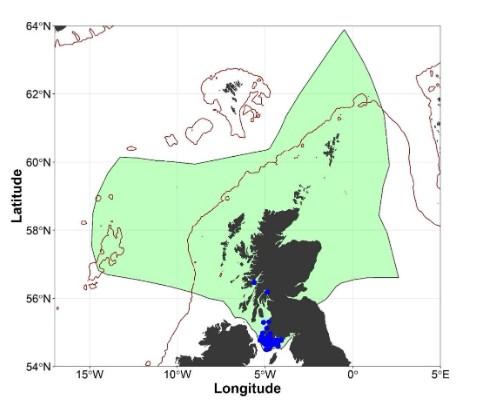
Tag / recapture records for Nursehounds (Scyliorhinus stellaris) from the Scottish Shark Tagging Programme, the Glasgow Museums tagging programme and the UK Shark Tagging Programme data from 1970 to the present day.
Click for a full description
Map of the economic exclusion zone of Scotland showing records for Nursehound (Scyliorhinus stellaris) from the Scottish Shark Tagging Programme, Glasgow Museums tagging programme and the UK Shark Tagging Programme data from 1970 to the present day. Data was provided by anglers and is occasionally supplemented by reports of tagged animals subsequently captured in commercial fisheries. It is presented as blue dots for each individual Nursehound tagged or recaptured. Data is predominantly clustered around the southwest of Scotland in Luce Bay and around the Mull of Galloway where angling and tagging took place apart from 2 outlying points, one in the Sound of Mull and one at Loch Long.
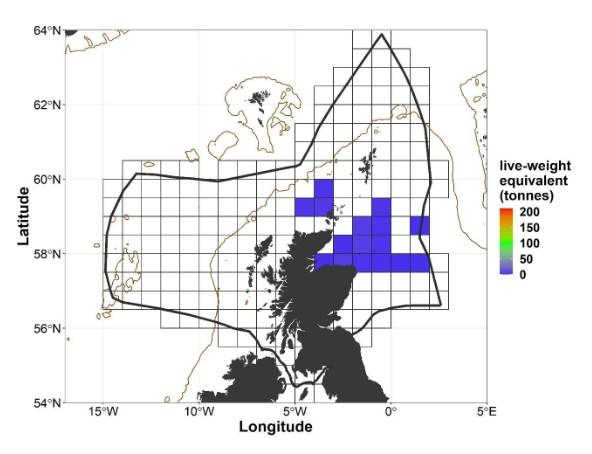
Landings data from commercial fishing vessels in ICES rectangles for Nursehound (Scyliorhinus stellaris) 2011-2019.
Click for a full description
Map of the economic exclusion zone (EEZ) of Scotland showing landings data per ICES (International Council for the Exploration of the Sea) rectangle for Nursehound (Scyliorhinus stellaris) recorded by commercial fishing vessels from 2011 to 2019. Landings records are presented in live weight equivalent (tonnes) per trip. Data is illustrated in a heat map, colouring each ICES rectangle from 0 (blue) to 200 (red). Small numbers of landings were made throughout much of the northern North Sea and to the northwest of the Orkney Isles, therefore rectangles here are coloured blue.
Habitat
Nursehounds inhabit both inshore and offshore waters, between depths of 1- 380 m, but are most commonly found in water <60 m deep (Weigmann 2016). In the Northeast Atlantic they are thought to prefer rocky or cobble seabed (Ebert and Stehmann, 2013).
Biology and Ecology
Nursehounds are Europe’s largest catshark species growing to a maximum size of 162 cm TL and commonly measuring about 125 cm TL (Ebert and Stehmann, 2013). Data on sexual maturity is lacking for the Northeast Atlantic, but in the Mediterranean males and females become sexually mature at 77 cm TL and 79 cm TL, respectively (Ellis et al., 2015). They are oviparous like other catsharks and produce large thick-walled egg cases 10-13 cm minimum length, which are deposited on macroalgae in the lower intertidal and subtidal zones in spring and summer (Ebert and Stehmann, 2013). Eggs are laid all year round except for December and January and take 9 – 12 months to hatch. Newly hatched sharks are around 105 -110 mm TL (Capapé et al., 2006, Soares and Carvalho 2019). Nursehound diet is mainly made up of crustaceans and cephalopods, with smaller amounts of shellfish and fish. The most important prey reported are lesser octopus, squat lobsters, and both brown crabs and hermit crabs. The species occasionally eats thornback rays (Ellis et al., 1996). A tagging study found that Nursehounds go on foraging excursions during the night, and refuge in narrow-entrance holes in rocks during the day (Sims et al., 2005). Several Nursehounds may find refuge in the same rocky locations or “home refuges” at the same time, and the species displays philopatric behaviour whereby tending to return to or remain near a particular site (Sims et al., 2005).
Human interactions
NNursehounds are of limited importance to fisheries, but may be taken as bycatch in bottom trawls, gillnets, longlines and fixed bottom nets. They are also targeted by recreational fisheries (Ebert and Stehmann, 2013, Finucci et al., 2021). Data from the Cefas observer programme (2002 -2016) in the Celtic Seas and North Seas ecoregions indicated that 68 -98% of bycatch of this species from net and beam trawl fisheries, respectively, were discarded (Silva and Ellis 2019). However, the species' preference for rocky inshore habitats (Cook et al., 2024) may offer it some protection from demersal fisheries that cannot operate over such grounds (Ellis et al., 2015). In addition, the survival of catsharks after discarding is believed to be relatively high, although this has not been studied for Nursehounds (ICES, 2018). In the Northeast Atlantic, France and Portugal report the highest landings of this species, where they may be sold fresh or dried and salted for human consumption. In the Mediterranean, overfishing is considered the primary cause of the species' decline. Species misidentification (confusion with S. canicula) is common and is likely to lead to inaccuracies in fisheries reporting data (Silva and Ellis, 2019; ICES, 2024). The stock status is currently only assessed by ICES for Subareas 6 and 7 (Celtic Seas Ecoregion, including west Scotland). ICES advised that when the MSY approach is applied, landings should be no more than 682 tonnes in 2025 (ICES, 2024).
References
Capapé, C., Vergne, Y., Vianet, R., Guélorget, O., & Quignard, J. P. (2006). Biological observations on the nursehound, Scyliorhinus stellaris (Linnaeus, 1758)(Chondrichthyes: Scyliorhinidae) in captivity. Acta Adriatica, 47(1), 29-36.
Cook, N. D., Jenkins, A., Perry, S. L., Perkins, S. E., & Cable, J. (2024). Temporal niche partitioning as a potential mechanism for coexistence in two sympatric mesopredator sharks. Frontiers in Marine Science, 11, 1443357.
Ebert, D. A. and Stehmann, M. F. W. (2013) Sharks, batoids, and chimaeras of the North Atlantic. FAO Species Catalogue for Fishery Purposes. No. 7. Rome: Food and Agricultural Organization of the United Nations (FAO).
Ellis J. R, Pawson M. G, Shackley S. E. (1996) The Comparative Feeding Ecology of Six Species of Shark and Four Species of Ray (Elasmobranchii) In The North-East Atlantic. Journal of the Marine Biological Association of the United Kingdom 76(1):89-106. doi:10.1017/S0025315400029039
Ellis, J.R et al., (2015) Nursehound, Scyliorhinus stellaris, The IUCN Red List of Threatened Species 2015: e.T161484A48923567. (Accessed: 2 March 2020).
Ellis, J.R. et al., (2005) ‘The Distribution of Chondrichthyan Fishes Around the British Isles and Implications for Conservation’, Journal of Northwest Atlantic Fisheries Science, 35, pp. 195–213.
Finucci, B., Derrick, D. & Pacoureau, N. 2021. Scyliorhinus stellaris. The IUCN Red List of Threatened Species 2021: e.T161484A124493465. Accessed on 18 February 2025.
ICES. (2024). Report of the Working Group on Elasmobranch Fishes (WGEF). ICES Scientific Reports. 06:75. 994 pp.
Silva, J. F., & Ellis, J. R. (2019). Bycatch and discarding patterns of dogfish and sharks taken in English and Welsh commercial fisheries. Journal of Fish Biology, 94(6), 966-980.
Sims D.W. et al., (2005) ‘Refuging behaviour in the nursehound Scyliorhinus stellaris (Chondrichthyes: Elasmobranchii): Preliminary evidence from acoustic telemetry’, Journal of the Marine Biological Association of the United Kingdom. Cambridge University Press, 85(5), pp. 1137–1140. doi: 10.1017/S0025315405012191.
Soares, K. D., & De Carvalho, M. R. (2019). The catshark genus Scyliorhinus (Chondrichthyes: Carcharhiniformes: Scyliorhinidae): taxonomy, morphology and distribution. Zootaxa, 4601(1), 1-147.
Weigmann, S. (2016). Annotated checklist of the living sharks, batoids and chimaeras (Chondrichthyes) of the world, with a focus on biogeographical diversity. Journal of Fish Biology, 88(3), 837-1037.