Sharks and Skates of Scotland Report: Kitefin shark (Dalatias licha)
An extract from the Sharks and Skates of Scotland Report.
Kitefin shark - Dalatias licha (Bonnaterre, 1788)
Occurrence in Scotland: Deep-water. Occasional. Found on the continental slope of the Rockall Trough and the continental shelf off NW Scotland.
Synonym(s): Squalus licha, Scymnorhinus licha, Squalus americanus, Pseudoscymnus boshuensis, Scymnorhinus brevipinnis, Centrina broussonetii, Squalus nicaeensis, Scymnorhinus phillippsi, Squalus scymnus, Dalatias sparophagus, Dalatias tachiensis, Scymnus vulgaris;
Order: Squaliformes; Family: Dalatiidae
Common name: Kitefin Shark, Black Shark, Seal Shark;
AlphaID: 105910 TSN Code: 160651
Note on data quality: Existing research surveys rarely catch Kitefin sharks (Dalatias licha), as the surveys are not designed for the species (ICES, 2018). There are no landings data available after 2009 due to the implementation of zero TAC.
Population status
Scotland and Northeast Atlantic: Decreasing. Decline of 94% observed in trawl survey catch rate from 1970’s to 2015. However, this data must be treated with caution due to likely species misidentification in earlier surveys, and sampling in areas where species abundance may naturally be low in later surveys (Finucci et al., 2018). Fisheries data from historical targeted fisheries in the waters of the Azores documented a decline in landings until the fishery collapsed at the end of the 1990’s. (Finucci et al., 2018).
Global: Decreasing. Considered to have declined by at least 30% (at the time of the last IUCN assessment in 2017) (Finucci et al., 2018).
Conservation listings
- IUCN Red List Global: Vulnerable (assessment 03 July 2017)
- IUCN Red List, Mediterranean: Vulnerable (assessment 25 March 2016)
- IUCN Red List Europe: Endangered (assessment 09 December 2014)
- CITES: Not listed
- CMS: Not listed
- OSPAR: Not listed
- Listed on the UK’s ‘Prohibited Species’ list as documented in the ‘Written Record of fisheries consultations between the United Kingdom and the European Union for 2025’ for UK waters ICES Division 2a and Subarea 4
- Zero TAC under Regulation 2018/2025 & Regulation 2023/194
- Prohibited under EU Regulation 2025/202
- Listed on The Sharks, Skates and Rays (Prohibition of Fishing, Trans-shipment and Landing) (Scotland) Order 2012
- Included in the NEAFC measures prohibiting directed fishing for deep-sea sharks
Range and distribution
Kitefin shark can be found in the waters of the North Atlantic, as well as in the Mediterranean, central and western Pacific and Indian Oceans. In the Northeast Atlantic it occurs on the Atlantic slopes of the British Isles, south to Spain and Portugal, and out to the Azores, Madeira and Mid-Atlantic ridge (Ebert and Stehmann, 2013). However, it is more abundant in the southern area of the Mid-Atlantic Ridge and is rare elsewhere in the Northeast Atlantic (ICES, 2024). It may also occasionally be found on the continental shelf, including the Celtic Seas and the North Sea (Walls and Guallart, 2015). The stock identity of Kitefin shark in the Northeast Atlantic is unknown (ICES, 2024).
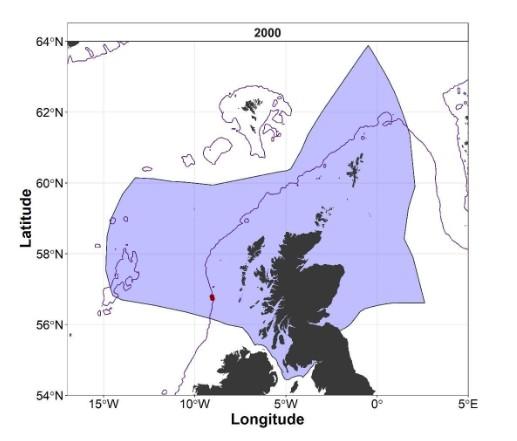
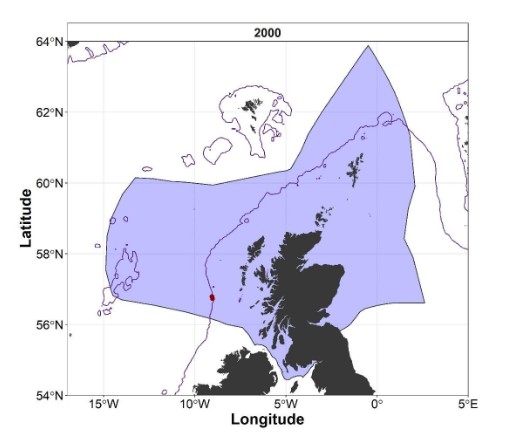
ICES DATRAS records for the Kitefin shark (Dalatias licha), 200-2009.
Click for a full description
View a larger version of this image.
Maps of the EEZ of Scotland showing the ICES (International Council for the Exploration of the Sea) DATRAS (database of trawl surveys hosted by ICES) records for the Kitefin shark (Dalatias licha) from bottom trawl surveys conducted between 2000 and 2009. Red points represent trawl shoot positions in which Kitefin shark (D. licha) were captured. Records are exclusively in a single cluster on the continental slope west of the Isle of Barra.
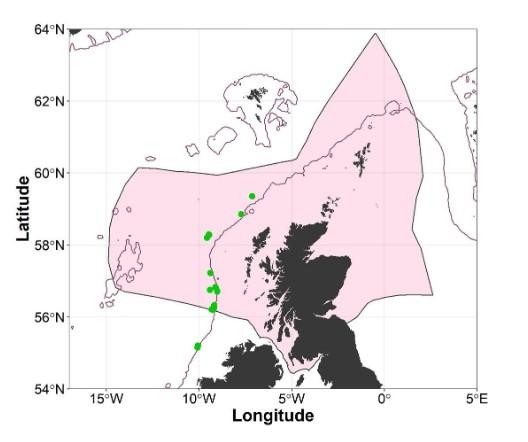
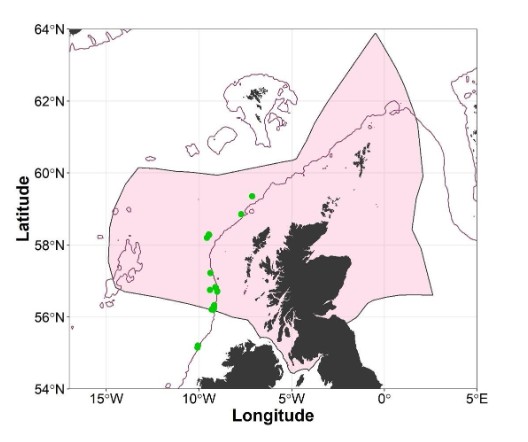
Records for the Kitefin shark (Dalatias licha) from SIAMISS and deep-water fisheries surveys undertaken by the Marine Directorate 1996 – 2019.
Click for a full description
View a larger version of this image.
Map of the economic exclusion zone (EEZ) of Scotland showing records for the Kitefin shark (Dalatias licha) from the Scottish-Irish anglerfish and megrim industry-science survey (SIAMISS) and deep-water fisheries surveys undertaken by Marine Directorate 1996-2019. Records are illustrated as green points and are exclusively located off the west coast of Scotland and Northern Ireland on the slope of the continental shelf.
Habitat
Kitefin sharks are a deep-water shark species that have been recorded from 37 – 1800m but are most common below 200m (Compagno and Cook, 2005; Walls and Guallart, 2015). In the Rockall Trough, they have been found in low abundances at depths of 400 – 1000m (Neat et al., 2015). The shark mostly occurs on or near the seabed but may also venture up into the water column (Ebert and Stehmann, 2013).
Biology and Ecology
The Kitefin shark is capable of bioluminescence and is notable for being the largest known luminous vertebrate (Mallefet et al., 2021). Light emission occurs in specialised cells (photocytes) and is controlled by hormones. Luminescence, which in this species is emitted predominantly from the lower (ventral) aspect of the body, is thought to either provide camouflage in the form of counter-illumination or be used to light up the ocean floor when searching for prey (Mallefet et al., 2021; Duchatelet et al., 2023). Counter-illumination may disguise the shark from its prey (or predators) below, by hiding its silhouette by blending into the blue light from above. Kitefin sharks have one of the slowest cruising speeds ever recorded in a shark but may be capable of shorts bursts of speed for capturing prey (Pinte et al., 2019).
Males and females mature at ~ 83 - 100cm TL and ~ 100 - 159cm TL, respectively (Daley et al., 2002; Mulas et al., 2021). The species generation length is estimated to be 29 years (Walls and Guallart, 2015, Finucci 2018). Data from the Mediterranean, where females were observed only in the Spring and Summer, suggests a possible spatial segregation according to gender (Bottaro et al., 2023). This gender segregation may also occur with depth in the Azores, with larger females being found in shallower water and males being more numerous than females at depths of 300 – 480 m (Silva, 1987; Fauconnet et al., 2023). There is limited information on the reproductive biology of this species. They are yolk-sac viviparous, giving birth to live young with reports in the literature of examined uteri containing between one and 16 embryos (Bigelow and Schroeder 1948; Chen 1963; Quéro et al., 1987; Capapé et al., 2008). Females are thought to give birth in late summer in the Mediterranean (Capapé et al., 2008) and there may be a non-continuous breeding cycle (Daley et al., 2002). Newborns measure 30 – 40 cm TL, and adults can grow to a maximum of ~180 cm TL (Ebert et al., 2013; Daley et al., 2002). The diet of D. licha comprises of a wide variety of bony fishes, cartilaginous fishes, crustacea, cephalopods, polychaetes, siphonophores, and tunicates (Capapé et al., 2008; Ebert and Stehmann, 2013). In the Strait of Sicily, stomach content analysis of 46 individuals suggested a generalised benthopelagic feeding strategy with a predominance of cephalopods followed by small demersal sharks (such as Galeus melastomus) (Calabro et al., 2024).
Human interactions
There is currently no targeted fishery for this species, and it has been subject to a zero Total Allowable Catch since 2010 and prohibited from 2021 (ICES, 2024). As with other deep-water elasmobranchs, slow growth and relatively late maturity make this species sensitive to exploitation by fisheries (Walls and Guallart, 2015; Fauconnet et al., 2023). ICES advice for fisheries remains at zero catches for 2024 – 2027 (ICES 2024).
References
Bigelow, H. B. & Schroeder, W. C. 1948. Sharks. p. 59-546. In: Fishes of the Western North Atlantic, Ed. J. Tee-Van, C. M. Breder, S. F. Hildebrand, A. E. Parr, and W. C. Schroeder (eds).
Bottaro, M., Sinopoli, M., Bertocci, I., Follesa, M. C., Cau, A., Consalvo, I., ... & Danovaro, R. (2023). Jaws from the deep: biological and ecological insights on the kitefin shark Dalatias licha from the Mediterranean Sea. Frontiers in Marine Science, 10, 1155731.
Calabrò, M. (2024). Diet of the rare deep-sea kitefin shark dalatias licha (bonnaterre, 1788)(chondrichthyes: dalatiidae) in the strait of sicily. Biologia Marina Mediterranea, 28(1), 176-179.
Capapé, C., Hemida, F., Quignard, J. P., Ben Amor, M. M., & Reynaud, C. (2008). Biological observations on a rare deep-sea shark, Dalatias licha (Chondrichthyes: Dalatiidae), off the Maghreb coast (south-western Mediterranean). Pan-American Journal of Aquatic Sciences, 3(3), 355-360.
Chen, J. T. F. (1963). A review of the sharks of Taiwan. Biological Bulletin, Tunghai University, Department of Biology, College of Science, Ichthyology Series. 1: 1-102.
Compagno, L.J.V. and Cook, S.F. (2005) ‘Kitefin shark Dalatias licha’, in Fowler, S. L. et al., (eds) Sharks, rays and chimaeras: The status of chondrichthyan fishes, IUCN/SSC Shark Specialist Group. Gland, Switzerland: IUCN.
Daley, R., Stevens, J. and Graham, K. 2002. Catch analysis and productivity of the deepwater dogfish resource in southern Australia. Report by CSIRO Marine Research and NSW Fisheries to the Fisheries Research and Development Corporation. FRDC Project 1998/108.
Duchatelet, L., Nuyt, C., Puozzo, N., Mallefet, J., & Delroisse, J. (2023). Evolutionary conservation of photophore ultrastructure in sharks: the case of a dalatiid squalomorph. Fishes, 8(2), 87.
Ebert, D.A. and Stehmann, M.F.W. (2013) Sharks, batoids, and chimaeras of the North Atlantic. FAO Species Catalogue for Fishery Purposes. No. 7. Rome: Food and Agricultural Organization of the United Nations (FAO).
Ebert, D.A., Fowler, S. and Compagno, L. 2013. Sharks of the World. Wild Nature Press, Plymouth.
Fauconnet, L., Catarino, D., Das, D., Giacomello, E., Gonzalez-Irusta, J. M., Afonso, P., & Morato, T. (2023). Challenges in avoiding deep-water shark bycatch in Azorean hook-and-line fisheries. ICES Journal of Marine Science, 80(3), 605-619.
Finucci, B., Walls, R.H.L., Guallart, J. & Kyne, P.M. 2018. Dalatias licha. The IUCN Red List of Threatened Species 2018: e.T6229A3111662. Downloaded on 26 May 2020.
ICES (2024). Report of the Working Group on Elasmobranch Fishes (WGEF). ICES Scientific Reports. 06:75. 994 pp.
Mallefet, J., Stevens, D. W., & Duchatelet, L. (2021). Bioluminescence of the largest luminous vertebrate, the kitefin shark, Dalatias licha: first insights and comparative aspects. Frontiers in Marine Science, 8, 633582.
Mulas, A., Bellodi, A., Carbonara, P., Cau, A., Marongiu, M. F., Pesci, P., ... & Follesa, M. C. (2021). Bio-ecological features update on eleven rare cartilaginous fish in the Central-Western Mediterranean Sea as a contribution for their conservation. Life, 11(9), 871.
Neat, F.C. et al., (2015) ‘The diversity, distribution and status of deep-water elasmobranchs in the Rockall Trough, north-east Atlantic Ocean’, Journal of Fish Biology. Blackwell Publishing Ltd, 87(6), pp. 1469–1488. doi: 10.1111/jfb.12822.
Pinte, N., Parisot, P., Martin, U., Zintzen, V., De Vleeschouwer, C., Roberts, C. D., & Mallefet, J. (2020). Ecological features and swimming capabilities of deep-sea sharks from New Zealand. Deep Sea Research Part I: Oceanographic Research Papers, 156, 103187.
Quéro, J. C., Decamps, P., Du Buit, M.-H., Fonteneau, J. & Vayne, J. J. 1987. Observations ichtyologiques effectuées en 1986. Annales de la Société des Sciences Naturelles de Charente-Maritime
Walls, R. and Guallart, J. (2015) Kitefin Shark, Dalatias licha, The IUCN Red List of Threatened Species 2015: e.T6229A48948357. (Accessed: 9 March 2020).