Sharks and Skates of Scotland Report: Black roughscale catshark (Apristurus melanoasper)
An extract from the Sharks and Skates of Scotland Report.
Black roughscale catshark - Apristurus melanoasper (Iglésias, Nakaya & Stehmann, 2004)
Occurrence in Scotland: Deep-sea. Resident. Found on the slopes of both the Rockall Trough and the continental shelf off NW Scotland. High number of records.
Synonym(s): None; Order: Carcharhiniformes; Family: Pentanchidae
Common name: Black roughscale catshark, fleshynose catshark
AlphaID: 271345 TSN Code: 772430
Population status
Scotland and Northeast Atlantic: Unknown (Neat et al., 2015; Walls, 2015).
Global: Stable (Finucci et al., 2024).
Note: Due to problems with the identification of this species in years prior to 2007, the data were insufficient to model temporal variation in the Rockall Trough, west of Scotland (Neat et al., 2015).
Conservation listings
- IUCN Red List Global: Least Concern (assessment 17 November 2014)
- IUCN Red List Europe: Least Concern (assessment 07 July 2023)
- CITES: Not listed
- CMS: Not listed
- OSPAR: Not listed
- Listed on the UK’s ‘Prohibited Species’ list as documented in the ‘Written Record of fisheries consultations between the United Kingdom and the European Union for 2025’ for UK waters of ICES Subareas 5-10
- Zero TAC under EU Regulation 2018/2025 & EU Regulation 2023/194
- Prohibited under EU Regulation 2025/202
- Listed on The Sharks, Skates and Rays (Prohibition of Fishing, Trans-shipment and Landing) (Scotland) Order 2012.
- Included in the NEAFC measures prohibiting directed fishing for deep-sea sharks
Range and distribution
Black roughscale catshark are found in the Northwest Atlantic, the Southeastern Atlantic (Namibia), the central Indian Ocean and south of Madagascar, and in the Western South Pacific (Australia, New Zealand, and New Caledonia and surrounding seamounts) (Ebert & Stehmann, 2013). In the Northeast Atlantic, Black roughscale catsharks occur in deep-water off the Faroes, British Isles, Ireland and France (Ebert & Stehmann, 2013).
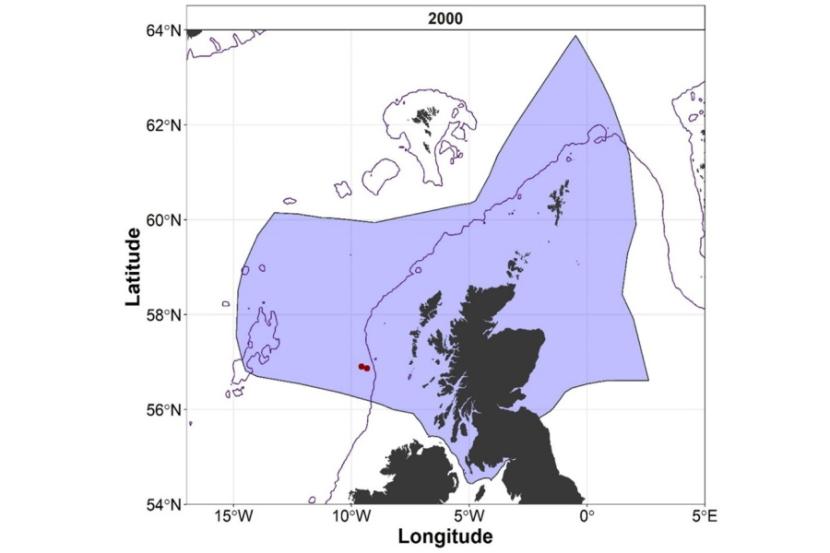
ICES DATRAS records for Black roughscale catshark (Apristurus melanoasper) from 2000-2009.
Click for a full description
View a larger version of this map.
Map of the economic exclusion zone (EEZ) of Scotland showing the ICES (International Council for the Exploration of the Sea) DATRAS (Database of trawl surveys hosted by ICES) records for the Black roughscale catshark (Apristurus melanoasper) from bottom trawl surveys conducted between 2000 and 2009. Two red points clustered to the west of the Isle of Barra off the edge of the continental shelf represent trawl shoot positions in which Black roughscale catshark (A. melanoasper) were captured.
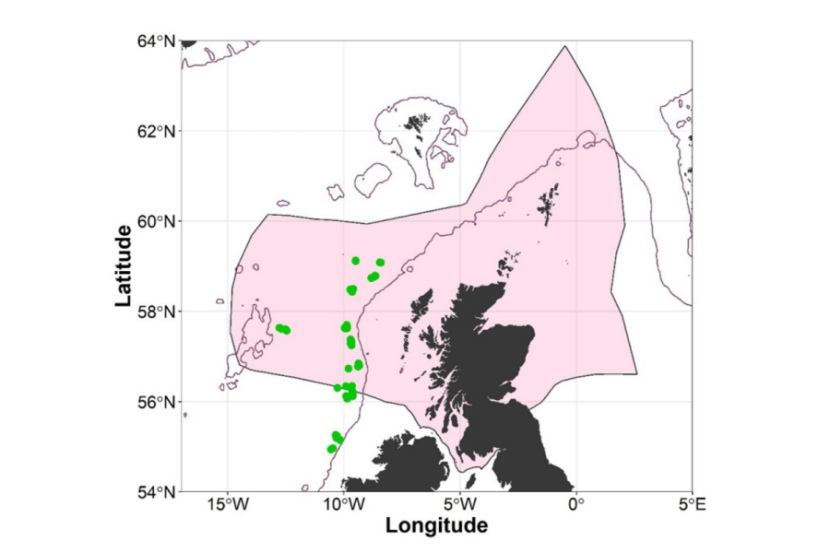
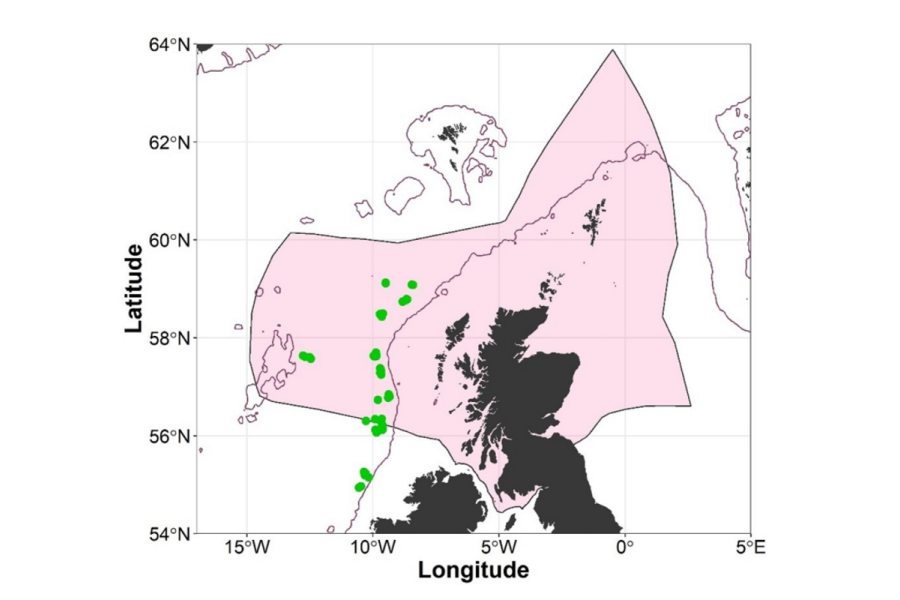
Records for the Black roughscale catshark (Apristurus melanoasper) from SIAMISS and deep-water fisheries surveys undertaken by the Marine Directorate 1996 – 2019.
Click for a full description
View a larger version of this map.
Map of the economic exclusion zone (EEZ) of Scotland showing records for the Black roughscale catshark (Apristurus melanoasper) from the Scottish-Irish anglerfish and megrim industry-science survey (SIAMISS) and deep-water fisheries surveys undertaken by Marine Directorate 1996-2019. Records are illustrated as green points and are exclusively located off the west coast of Scotland and Northern Ireland off the edge of the continental shelf. Most records are to the east of the Rockall Trough (on the slope of the continental shelf) with a few records to the west of the Rockall Trough on the slope of the Rockall Plateau.
Habitat
This species lives on continental mid-slopes and seamounts, and have been recorded at depths of 512-1900 m, but mostly below 1000 m (Iglésias et al., 2004; Nakaya et al., 2008; Neat et al., 2015). In groundfish surveys in the Porcupine Seabight a few specimens were found at depths below 1000m (Fernández-Zapico et al., 2023). While in surveys of the Rockall Trough, west of Scotland, the species was found regularly throughout the area at depths ranging of 1000 – 1900 m (Neat et al., 2015).
Biology and Ecology
The Black roughscale catshark is a medium-sized deep-water catshark species, with a maximum total length of 79 cm (Iglésias et al., 2004). There is a lack of information on the biology and ecology of this species, and data is only available from a small number of specimens. Males and females are generally sexually mature at 60 cm total length or greater. An oviparous species, the Black roughscale catshark produces egg cases of ≃ 6 cm in length with two very long, coiled tendrils positioned close together at the base (Iglésias et al., 2004).
Human interactions
Black roughscale catshark has been subject to a zero Total Allowable Catch in the Northeast Atlantic since 2010 (ICES, 2024), and since 2021 has been a prohibited species. Apristurus spp are prohibited species in UK, EU and international waters of ICES subareas 5-10 and 12 and vessels are prohibited from landing this species in Scottish waters. The species is generally found in water deeper than 1000 m, which offers some refuge from fishing pressure.
References
Ebert, D.A. and Stehmann, M.F.W., (2013), Sharks, batoids, and chimaeras of the North Atlantic. FAO Species Catalogue for Fishery Purposes. No. 7. Rome: Food and Agricultural Organization of the United Nations (FAO).
Ebert, D.A., Dando, M. and Fowler, S.F., (2021). Sharks of the World. A complete guide. Princeton University Press, New Jersey.
Fernández-Zapico, O., Ruiz-Pico, S., Blanco, M., Ortiz, P., Velasco, F., Rodríguez-Cabello, C., & Baldó, F., (2024). Results on main elasmobranch species from the 2023 Spanish Groundsh Survey on the Porcupine Bank (Northeast Atlantic).
Finucci, B. & Armstrong, A.O. (2024). Apristurus melanoasper. The IUCN Red List of Threatened Species 2024: e.T42700A124425926.
ICES (2018) Report of the Working Group on Elasmobranch Fishes (WGEF), 19-28. Lisbon, Portugal.
Iglésias, S. P., Nakaya, K., & Stehmann, M. (2004). Apristurus melanoasper, a new species of deep-water catshark from the North Atlantic (Chondrichthyes: Carcharhiniformes: Scyliorhinidae). Cybium, 28(4), 345-356.
Nakaya, K. et al., (2008) ‘Occurrence of Apristurus melanoasper from the South Pacific, Indian and South Atlantic oceans (Carcharhiniformes: Scyliorhinidae).’, in White, P. R., Last, W. T., and Pogonoski, J. J. (eds) Descriptions of new Australian chondrichthyans. CSIRO Marine and Atmospheric Research Paper No. 022., pp. 61–74.
Neat, F.C., Burns, F., Jones, E., Blasdale, T. (2015). The diversity, distribution and status of deep-water elasmobranchs in the Rockall Trough, north-east Atlantic Ocean. J Fish Biol. 87(6):1469-88. doi: 10.1111/jfb.12822. PMID: 26709217