Sharks and Skates of Scotland Report: Bigelow's skate (Rajella bigelowi)
An extract from the Sharks and Skates of Scotland Report.
Bigelow's skate - Rajella bigelowi (Stehmann, 1978)
Occurrence in Scotland: Slope and deep-water. Occasional. Found on the continental slope of the Rockall Trough and NW Scotland.
Synonym(s): Raja bigelowi; Order: Rajiformes; Family: Rajidae
Common name: Bigelow's skate
AlphaID: 105893 TSN Code: 564219
Note: May be difficult to distinguish from the Deep-water skate (Rajella bathyphila), and the two species may be sympatric. Also misidentified as Rajella fyllae (Dulvy and Walls, 2015).
Population status
Scotland and Northeast Atlantic: Unknown (Neat et al., 2015; Dulvy and Walls, 2015).
Global: Stable. Due to its substantial refuge from fishing at depth, the population is inferred to be stable (Kulka et al., 2020).
Conservation listings
- IUCN Red List Global: Least Concern (assessment 20 June 2019)
- IUCN Red List Europe: Least Concern (assessment 17 October 2014)
- CITES: Not listed
- CMS: Not listed
- OSPAR: Not listed
Range and distribution
Bigelow’s skate are found in deep water throughout much of the North Atlantic. In the Northeast Atlantic, they occur in waters of Greenland, Iceland, the Rockall Trough, the Porcupine Seabight, the Bay of Biscay, and off Northwest Africa, from off Mauritania, Rio de Oro, and Guinea, with a single record from off the Azores (Ebert and Stehmann, 2013).
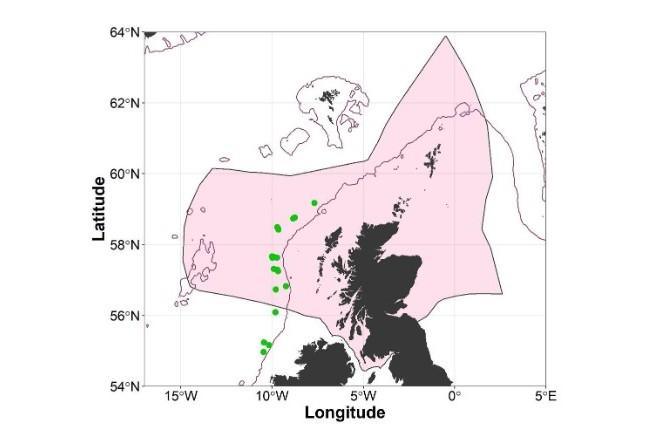
Records for Bigelow’s skate (Rajella bigelowi) from SIAMISS and deep-water fisheries surveys undertaken by the Marine Directorate 1996 – 2019.
Click for a full description
Map of the economic exclusion zone (EEZ) of Scotland showing records for Bigelow’s skate (Rajella bigelowi) from the Scottish-Irish anglerfish and megrim industry-science survey (SIAMISS) and deep-water fisheries surveys undertaken by Marine Directorate from 1996 to 2019. Records are illustrated as green points and are exclusively located off the west coast of Scotland and Northern Ireland at the bottom of the continental shelf slope.
Habitat
Bigelow’s skate is found on continental slopes, abyssal plains and deepwater rises at depths of 367−4,156 m (mostly greater than 1,000 m) over a variety of seabed types on continental slopes, abyssal plains and deep-water rises, and within a temperature range of 2.5 to 4oC (Priede et al., 2010; Ebert and Stehmann, 2013; Dulvy and Walls, 2015; Last et al. 2016; Kulka et al., 2020). Low abundance has been recorded throughout the Rockall Trough at depths of 800 to 1500 m (Neat et al., 2015).
Biology and Ecology
This is a small-to-medium-sized skate species, reaching a maximum total length (TL) of 55 cm; males mature at 40–45 cm TL, whereas no information is available on female maturity (Orlov et al., 2006; Ebert and Stehman, 2013). Reproduction is oviparous, and young hatch at 12 cm TL (Ebert and Stehmann 2013, Last et al. 2016).
Human interactions
Historically, this species may occasionally be taken as bycatch in demersal trawl fisheries. However, bycatch and discards are unlikely today due to the introduction of general measures to protect deep-water elasmobranchs (i.e., bans on certain net fisheries below 600 m and on trawls below 800 m) (ICES 2024).
References
Dulvy, N. & Walls, R. (2015). Rajella bigelowi (Europe assessment). The IUCN Red List of Threatened Species 2015: e.T161371A48954487.
Ebert, D.A. and Stehmann, M.F.W. (2013) Sharks, batoids, and chimaeras of the North Atlantic. FAO Species Catalogue for Fishery Purposes. No. 7. Rome: Food and Agricultural Organization of the United Nations (FAO).
ICES. (2024). Report of the Working Group on Elasmobranch Fishes (WGEF). ICES Scientific Reports. 06:75. 994 pp.
Kulka, D.W., Dulvy, N.K. & Derrick, D. (2020). Rajella bigelowi. The IUCN Red List of Threatened Species 2020: e.T161371A124473309
Last, P., White, W., de Carvalho, M., Séret, B., Stehmann, M. and Naylor, G. 2016. Rays of the World. CSIRO Publishing, Clayton.
Neat, F.C. et al., (2015) ‘The diversity, distribution and status of deep-water elasmobranchs in the Rockall Trough, north-east Atlantic Ocean’, Journal of Fish Biology. Blackwell Publishing Ltd, 87(6), pp. 1469–1488. doi: 10.1111/jfb.12822.
Orlov, A. et al., (2006) ‘Deep-water skates (Rajidae) collected during the 2004 cruises of R.V. “G.O.Sars” and M.S. “Loran” in the Mid-Atlantic Ridge area.’, Cybium, 30(4), pp. 35–48.
Priede, I.G. et al., (2010) ‘Deep‐sea demersal fish species richness in the Porcupine Seabight, Northeast Atlantic Ocean: global and regional patterns’, Marine Ecology, 31(1), pp. 247–260.