Sharks and Skates of Scotland Report: Basking shark (Cetorhinus maximus)
An extract from the Sharks and Skates of Scotland Report.
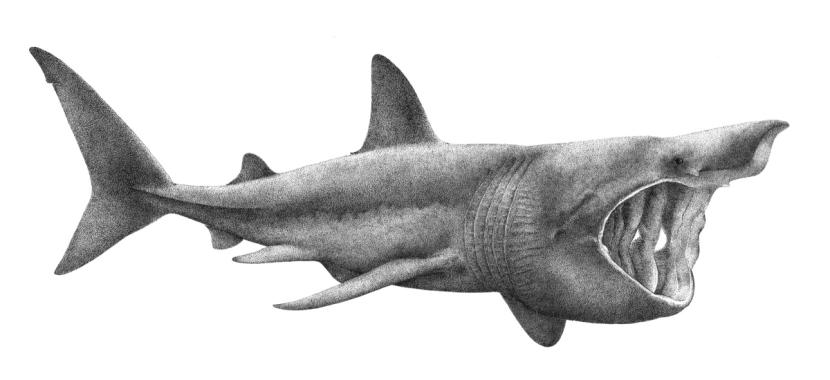
Basking shark - Cetorhinus maximus (Gunnerus 1765)
Occurrence in Scotland: Shelf. Greater surface sightings reported in summer. Very High number
of records (sightings), but no DATRAS (zero TAC). Proven migratory links with other countries
(e.g. Ireland, Northern Ireland, England, France, Azores).
Synonym(s): Squalus maximus; Order: Lamniformes; Family: Cetorhinidae
Common name: Basking shark; Gaelic name: Cearban;
AlphaID: 105837 TSN Code: 0159907
Population status
Scotland and Northeast Atlantic: Basking sharks have been assessed as being in favourable condition within the Sea of the Hebrides Marine Protected Area on the west coast of Scotland (NatureScot, 2019). Their population was considered stable in European waters based on available evidence (Sims et al., 2015). In Scotland, population estimates are limited and largely derived from small spatial areas, primarily within the Sea of the Hebrides (Booth et al., 2013; Gore et al., 2016). Notably, over 900 individuals were recorded in a single day during surveys in this region (Booth et al., 2013). A synthesis of boat-based surveys, statistical modelling, and satellite tagging data demonstrates the persistent seasonal presence of large numbers of basking sharks on Scotland’s west coast, supporting a favourable condition assessment for this area (NatureScot, 2019b). There has also been an increase in reported sightings of large sharks in UK waters since 2005, based on public sighting schemes and targeted surveys, which may indicae partial population recovery (Bloomfield and Solandt, 2011; Witt et al., 2012).
Global: Population decreasing (Rigby et al., 2019)
Conservation listings
- IUCN Red List Global: Endangered (assessment 07 November 2018)
- IUCN Red List Europe: Endangered (assessment 18 November 2014)
- UNCLOS: Annex I (Highly Migratory Species)
- CITES: Appendix II
- CMS: listed on Appendix I and Appendix II
- Memorandum of Understanding on the Conservation of Migratory Sharks: Listed
on Annex 1 - OSPAR: Threatened and/or Declining Species.
- Listed as a Priority Marine Feature in Scotland
- Scottish Biodiversity List
- Listed on Schedule 5 of the Wildlife and Countryside Act 1981 (as amended) and Wildlife and Countryside Act 1981 (as in Scotland).
- Listed under Section 23 of the Wildlife Act (Ireland) of 1976
- Listed on the Nature Conservation (Scotland) Act 2004
- Listed on the Countryside Rights of Way Act 2000
- Listed on The Sharks, Skates and Rays (Prohibition of Fishing, Trans-shipment and Landing) (Scotland) Order 2012.
- Listed on the UK’s ‘Prohibited Species’ list as documented in the ‘Written Record of fisheries consultations between the United Kingdom and the European Union for 2025’ for all UK waters
- Prohibited species under a number of EU Regulations including EU Regulation 2019/1241 & Regulation 2025/202
- EU Regulation 2024/1991 requires restoration measures for the marine habitat of basking shark
- Included in the NEAFC measures prohibiting directed fishing for basking shark
- A designated feature in the Sea of the Hebrides Marine Protected Area (MPA), a public consultation on management measures for fishing activity is planned for Scottish MPAs and includes this site.
- The following voluntary measures help to manage anthropogenic interactions with Basking sharks in Scotland: The Scottish Marine Wildlife Watching Code provides best practice and guidance on how all sea users can avoid disturbing basking sharks; the Shark Trust Code of Conduct provides advice for those on and in the water with Basking sharks to help reduce disturbance during interactions; the WiSE (Wildlife Safe) scheme offers a standard to commercial skippers to ensure safe wildlife watching that will also reduce the risk of disturbance to wildlife, including basking sharks
- Qualifying species of Northeast Atlantic Corridor, Firth of Clyde, Inner Hebrides and Moray Firth ISRAs
Range and distribution
Basking sharks occur globally in temperate and boreal waters, with genetic evidence indicating a single global population (Noble et al., 2006). In Scottish waters, large seasonal aggregations occur in shallow coastal areas during summer, particularly within the Sea of the Hebrides (Speedie et al., 2009; Doherty et al., 2017a; NatureScot, 2019a). Repeated use of areas around Tiree, Coll, and the Skerryvore lighthouse demonstrates strong seasonal site fidelity, with individuals returning in consecutive years (Doherty et al., 2017a; Lieber et al., 2020; Thorburn et al., 2024). Sightings have also been recorded around the northern isles and highlight groups of sharks on the east coast (e.g. Moray Firth).
There are a few online interactive map-based tools that provide information on basking shark sightings and locations which are based on citizen science, effort corrected or modelled data and tagging records: National Marine Plan interactive; HWDT sightings map and Marine mammal Atlas; The Shark Trust Basking shark project sightings database.
During winter months, basking sharks leave surface coastal waters and occupy deeper offshore habitats, utilising a range of migration strategies suggested by satellite tagging research (Doherty et al., 2017b). These include: 1. Remain within the Celtic Seas around UK (epipelagic depths of 0 -200m); 2. Travel south to the waters around the Bay of Biscay (epipelagic depths of 0 – 500m) and; 3. Travel to the Iberian Peninsula as far as the Azores off Africa, a distance of circa 4000km (epipelagic/mesopelagic depths (0-1000m) with some ventures to bathypelagic > 1000m). The Celtic Sea and west coast of Ireland function as key migration corridors (Doherty et al., 2017b). Trans-Atlantic movements have also been documented, including individuals migrating from the Isle of Man and Ireland to the western Atlantic (Gore et al., 2008; Johnston et al., 2019a).
Habitat
Basking sharks are pelagic, but seasonally aggregate in coastal shelf and shelf-edge waters where thermal and productivity fronts enhance zooplankton availability (Sims et al., 2003; Sims, 2008). During the summer months they are frequently observed feeding at the surface for long periods of time (Speedie et al., 2009; Doherty et al., 2017a). Recent camera telemetry has also shown sharks swimming close to the seabed in shallow waters for considerable times (Hawkes et al, 2020, Rudd et al., 2021a). In Scotland, persistent summer hotspots occur along the west coast, particularly where bathymetry creates stable frontal systems (Miller et al., 2010).
Biology and Ecology
Basking sharks reach sexual maturity at approximately 16–20 years (8–10 m) in females and 12–16 years (5–7 m) in males (Compagno, 1984). They are aplacental viviparous, producing live young; fecundity is poorly known and based on a single observation of six pups (Sund, 1943). Gestation period remains unknown. Courtship and social behaviour have been repeatedly observed, particularly within summer aggregations. Documented behaviours include nose-to-tail following, parallel swimming, fin–fin contact, breaching, and, more recently, “torus” circling, in which individuals roll to expose their ventral surfaces and engage in close physical interactions (Sims, 2008; Gore et al., 2018; Sims et al., 2022). These behaviours are interpreted as courtship and breeding-related, and are energetically costly, particularly repeated breaching (Johnston et al., 2019b; Rudd et al., 2021b). Basking sharks exhibit seasonal vertical habitat use. During summer, individuals utilise the full water column but spend over 50% of daytime activity within the upper 10 m (Witt et al., 2016). However, video evidence from Tiree has shown prolonged periods of near-seabed swimming with closed mouths, suggesting non-feeding behaviour (Hawkes et al., 2020). During winter, sharks increasingly occupy deeper offshore waters, occasionally exceeding 1000 m depth, and preferentially remain within temperatures of 8–16 °C (mean 11.6 °C) (Doherty et al., 2019). There are very few records of juveniles (<3 m), and it remains unclear whether younger sharks occupy different habitats. To date, no sex-based habitat segregation has been detected (Witt et al., 2016). Basking sharks display social associations, with individuals swimming in close proximity and maintaining pairwise relationships across space and time, suggesting structured social behaviour (Lieber et al., 2020; Rudd et al., 2021a; Thorburn et al., 2024).
Basking sharks are obligate filter feeders, relying on high densities of zooplankton. They actively forage along frontal boundaries, moving between prey patches influenced by tidal dynamics (Sims and Quayle, 1997). Feeding is concentrated where Calanus helgolandicus is abundant and larger in size (Sims and Merrett, 1997). Sharks typically abandon prey patches below 0.6 g zooplankton m⁻³ and preferentially feed at densities exceeding 3 g m⁻³ (Sims, 1999). Declines in zooplankton abundance have been proposed as a contributing factor to historical population declines (Sims and Reid, 2002). Basking sharks also exude a protective skin mucus, which has been used in non-invasive genetic sampling to investigate connectivity and relatedness (Lieber et al., 2013; Lieber et al., 2020).
Human interactions
Since the 18th century, Basking sharks have been fished in Scotland, with peaks of around 300 individuals caught in 1948 and 120 in 1983. The last legal landing of nine basking sharks occurred in Scotland in 1994 (Fairfax, 1998), in the same year that basking sharks received their first legislative protection in the UK. The combination of life-history characteristics, site fidelity, and knowledge gaps across their life cycle makes Basking sharks vulnerable and potentially limits their ability to recover from adverse pressures, consistent with the Northeast Atlantic position (OSPAR, 2021). Several anthropogenic ‘threats’ to Basking sharks have been identified including bycatch (accidental capture and entanglement), marine ecotourism/tourism (collision and disturbance) and potentially large-scale renewable developments (e.g. disturbance, restricting access to key areas for feeding or breeding, Speedie et al., 2009; OSPAR, 2015). There are also environmental shifts associated with climate change and ocean acidification that may affect zooplankton, with potential consequences for Basking sharks that could further reduce their ability to recover from human pressures (Sun et al., 2024).
Basking sharks with injuries that could have been caused by a collision with a boat propeller have been observed (Bloomfield and Solandt, 2008, Speedie et al., 2009, Chapple et al., 2024, McInturf et al., 2022). There are also a limited number of accounts of Basking sharks being caught in nets or ropes (Bloomfield and Solandt, 2008, Scottish Creel Fishermen’s Federation, NatureScot and JNCC Fisheries Guidance Note; MacLennan et al., 2021, Calderan et al., 2024). The Scottish Entanglement Alliance is working to better understand the scale and impact of marine animal entanglements in our waters and develop strategies to reduce this threat. Marine ecotourism offers the opportunity to have close encounters with basking sharks, but may cause disturbance to their normal behaviours (Inman et al., 2016). A number of voluntary codes have been developed to help mitigate potential impacts (Scottish Marine Wildlife Watching Code, The Shark Trust - Code of conduct for boat users, kayakers, swimmers, divers and surfers, WiSE accreditation for commercial skippers), and rely on public awareness of these.
References
Bloomfield, A. & Solandt, J-L. (2008). The Marine Conservation Society Basking Shark Watch 20-year report (1987-2006). Marine Conservation Society, Ross on Wye, UK.
Booth, C.G. et al., (2013). Argyll Array Wind farm basking shark draft chapter for Environmental Statement. SMRU Ltd. Report SMRUL_WSP-2013001. (Unpublished).
Braun, C.D. et al., (2018). Integrating archival tag data and a high-resolution oceanographic model to estimate basking shark movements in the western Atlantic. Front. Mar. Sci. 5:25.
Calderan, S., Cisternino, B., De Noia, M., Leaper, R., MacLennan, E., Philp, B. (2025). Successful collaborative trials of simple gear modifications to reduce entanglement of whales and other megafauna in Scotland’s static pot (creel) fisheries. ICES Journal of Marine Science, 82(6), fsae157.
Chapple, T.K. et al., (2024). Behavioral response of megafauna to boat collision measured via animal-borne camera and IMU. Front. Mar. Sci. 11.Compagno, L.V.J. (1984). FAO species catalogue Vol 4: Sharks of the world. FAO Fisheries Synopsis 125. FAO, Rome, Italy.
Doherty, P.D. et al., (2017a). Testing the boundaries: seasonal residency and inter-annual site fidelity of basking sharks in a proposed MPA. Biol. Conserv. 209:68-75.
Doherty, P.D. et al., (2017b). Long-term satellite tracking reveals variable seasonal migration strategies of basking sharks in the north-east Atlantic. Sci. Rep. 7:42837.
Fairfax, D. (1998). The Basking Shark in Scotland: Natural History, Fishery and Conservation.
Gore, M.A. et al., (2016). Use of photo-identification and mark-recapture methodology to assess basking shark populations. PLOS ONE 11(3): e0150160.
Hawkes, L.A. et al., (2020). Autonomous underwater videography and tracking of basking sharks. Anim. Biotelem. 8(29).
Inman, A. et al., (2016). The use of marine wildlife-watching codes and their role in managing activities within marine protected areas in Scotland. Ocean Coast. Manag. 132:132-142.
Jacoby, D.M.P. et al., (2012). Social behaviour in sharks and rays: analysis, patterns and implications for conservation. Fish Fish. 13:399-217.
Johnston, E.M. et al., (2019a). Latent power of basking sharks revealed by exceptional breaching events. Biol. Lett. 14(9):20180537.
Johnston, E.M. et al., (2019b). Serendipitous re-sighting of a basking shark reveals inter-annual connectivity between American and European coastal hotspots. J. Fish Biol. 95:1-5.
Lieber, L. et al., (2013). Mucus: aiding elasmobranch conservation through non-invasive genetic sampling. Endanger. Species Res. 21:215–222.
Lieber, L. et al., (2020). Spatio-temporal genetic tagging of a cosmopolitan planktivorous shark provides insight to gene flow, temporal variation and site-specific re-encounters. Sci. Rep. 10:1661.
MacLennan, E., Hartny-Mills, L., Read, F.L., Dolman, S.J., Philp, A., Dearing, K.E., Jarvis, D. and Brownlow, A.C. (2021) Scottish Entanglement Alliance (SEA) - understanding the scale and impacts of marine animal entanglement in the Scottish creel fishery. NatureScot Research Report 1268.
McInturf, A. G., Muhling, B., Bizzarro, J. J., Fangue, N. A., Ebert, D. A., Caillaud, D., & Dewar, H. (2022). Spatial distribution, temporal changes, and knowledge gaps in basking shark (Cetorhinus maximus) sightings in the California Current Ecosystem. Frontiers in Marine Science, 9, 818670.
Miller, P.I. et al., (2010). Oceanic thermal fronts from Earth observation data - a potential surrogate for pelagic diversity. Report to DEFRA, Contract MB102. Plymouth Marine Laboratory.
NatureScot (2019a). Data Confidence Assessment for the Sea of the Hebrides MPA. https://sitelink.nature.scot/site/10474
NatureScot (2019b). Conservation and Management Advice for the Sea of the Hebrides MPA. https://sitelink.nature.scot/site/10474
Noble, L.R. et al., (2006). Conservation genetics of basking sharks. DEFRA Tender CR0288.
OSPAR (2015). Background document on basking sharks Cetorhinus maximus – Update. Biodiversity and Ecosystems Series. OSPAR Commission.
Paxton, C.G.M. et al., (2014). Statistical approaches to aid the identification of MPA for minke whale, Risso’s dolphin, white-beaked dolphin and basking shark. SNH Commissioned Report 594.
Pratt, H.L. & Carrier, J.C. (2001). A review of elasmobranch reproductive behaviour with a case study on the nurse shark Ginglymostoma cirratum. Environ. Biol. Fish. 60:157-188.
Rigby, C.L., et al., (2021). Cetorhinus maximus (amended version of 2019 assessment). The IUCN Red List of Threatened Species 2021 (Accessed on 11 July 2025.)
Rudd, J. et al., (2021a). Basking shark sub-surface behaviour revealed by animal-towed cameras. PLOS ONE 16(7).
Rudd, J. et al., (2021b). High resolution biologging of breaching by the world’s second largest shark species. Sci. Rep. 11:5236.
Speedie, C.D. et al., (2009). Basking shark hotspots on the West Coast of Scotland: Key sites, threats and implications for conservation. SNH Commissioned Report No.339.
Sims, D.W. & Merrett, D.A. (1997). Zooplankton characteristics in the presence of surface feeding basking sharks. Mar. Ecol. Prog. Ser. 158:297–302.
Sims, D.W. & Quayle, V.A. (1998). Selective foraging behaviour of basking sharks on zooplankton in a small-scale front. Nature 393:460–464.
Sims, D.W. (1999). Threshold foraging behaviour of basking sharks on zooplankton: Life on an energetic knife-edge? Proc. R. Soc. B 266:1437–1443.
Sims, D.W. (2000). Filter-feeding and cruising speeds of basking sharks compared with optimal models. J. Exp. Mar. Biol. Ecol. 249:65–76.
Sims, D.W. et al., (2000). Annual social behaviour of basking sharks associated with coastal front areas. Proc. R. Soc. B 267:1897–1904.
Sims, D.W. & Reid, P.C. (2002). Congruent trends in zooplankton decline and basking shark fishery catches off west Ireland. Fish. Oceanogr. 11:59–63.
Sims, D.W., et al., (2003) Seasonal movements and behaviour of basking sharks from archival tagging: no evidence of winter hibernation. Marine Ecology Progress Series, 248, 187–196.
Sims, D.W. (2008). Sieving a living: a review of the biology, ecology and conservation status of the basking shark. Adv. Mar. Biol. 54:171-220.
Sims, D., et al., (2015). Cetorhinus maximus. Europe Regional Assessment The IUCN Red List of Threatened Species 2015: e.T4292A48953216. (Accessed: 5 March 2019).
Sims, D.W. et al., (2022). Circles in the sea: annual courtship “torus” behaviour of basking sharks in the eastern North Atlantic. J. Fish Biol. 101(5).
Southall, E.J. et al., (2005). Spatial distribution patterns of basking sharks on the European shelf. J. Mar. Biol. Assoc. UK 85:1083–1088.
Speedie, C.D., Johnson, L.A. & Witt, M.J., 2009. Basking Shark Hotspots on the West Coast of Scotland: Key sites, threats and implications for conservation of the species,
Inverness: Scottish Natural Heritage.
Sun, R., Liu, K., Huang, W., Wang, X., Zhuang, H., Wang, Z., Zhang, Z., Zhao, L. (2024). Global distribution prediction and ecological conservation of basking shark (Cetorhinus maximus) under integrated impacts. Global Ecology and Conservation, 56.
Thorburn, J. et al., (2024). Assessing acoustic telemetry for regional basking shark management. Anim. Biotelem. 12:20.
Witt, M.J. et al., (2012). Basking sharks in the northeast Atlantic: spatio-temporal trends from UK sightings. Mar. Ecol. Prog. Ser. 459:121-134.
Witt, M.J. et al., (2019). Identifying zones for basking shark occurrence to aid MPA discussions. NatureScot publication.