SBAG Scottish Beaver Advisory Group Report - December 2025
1.Introduction
This second annual report of the Scottish Beaver Advisory Group (SBAG), outlines the progress made in monitoring, reviewing and guiding the delivery of Scotland’s Beaver Strategy 2022-2045 and associated Implementation Plan. Building on the structure of NatureScot’s Beaver Management Report: 01 April 2024 to 31 March 2025, this Report follows the thematic areas set out in the Beaver Strategy, with additional headings to track progression against indicators of success.
A key highlight from this year was the 10th International Beaver Symposium, held in Inverness 17-19 September 2025. This event was organised by University of the Highlands and Islands and NatureScot, with 150 leading beaver specialists from 23 countries attending. Participants gave presentations and posters, and also attended field excursions to beaver sites in the Cairngorms National Park as well as to conservation projects run by the Royal Zoological Society of Scotland. This symposium strengthened global collaboration, fostered the exchange of best practice, and highlighted innovative approaches for successful co-existence with beavers.
During this reporting year, SBAG also adopted a more targeted approach to specific issues by hosting two, dedicated workshops on high priority topics: new translocation sites and understanding beaver impacts on floodbanks. These sessions brought together a wider range of experts and stakeholders, encouraging open discussion and the co-development of practical pathways for future action. Each workshop resulted in distinct and valuable outcomes, and this collaborative format will be continued in the year ahead.
2.Conservation Translocations
There has been progression towards the vision of expanded beaver populations through conservation translocations and reinforcements, as outlined in NatureScot’s Beaver Management Report: 01 April 2024 to 31 March 2025. A particular achievement was the successful applications by Forestry and Land Scotland, supported by Trees for Life, to release beavers into Glen Affric, and by Abriachan Forest Trust, supported by Scotland: The Big Picture, to release beavers on community land. In line with the Beaver Strategy, both decision documents are available on NatureScot’s website.
However, the process of stakeholder engagement and community consultation extended over a considerable period, during which there was, at times, a lack of clarity regarding the level of engagement considered proportionate to the scale and nature of the translocation. Given that Goal 3 of the Beaver Strategy aims to ensure transparent, inclusive, timely, and straightforward translocation licence application processes to build trust and engagement, the process highlights important lessons that can inform future translocations.
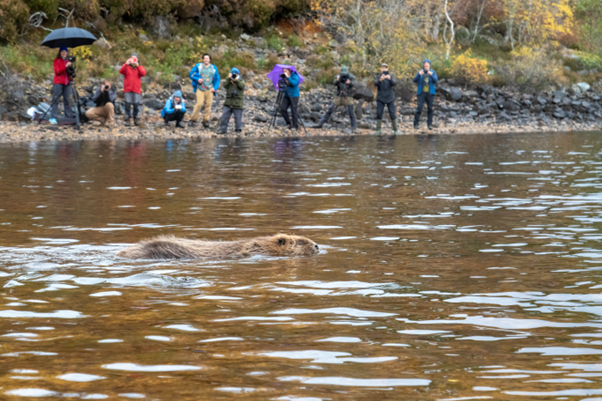
Female beaver swimming in Loch Beinn a’ Mheadhoin. copyright Beaver Trust.
Goal 2 of the Beaver Strategy is to develop a considered and dynamic approach to conservation translocations of beavers to new areas to maximise benefits and minimise conflict with humans and existing biodiversity. Objective A for this goal is to identify higher benefit, lower conflict areas for a phased programme of beaver translocations. A Translocation Workshop was organised by SBAG in Inverness on 27 February 2025, to have a strategic exploration of beaver translocation using the specific geography of the Ness catchment to further understanding and to refine the processes in place. Spatial assessment tools were used to understand population growth dynamics, other species of interest were discussed such as lichen and salmon populations, and possibilities of conflict with agriculture and infrastructure were also explored.
Following this Workshop, Trees for Life in partnership with Beaver Trust are now carrying out community and stakeholder consultation regarding the reintroduction of beavers to the Loch Ness area. A series of in-person and online events were held in September and October 2025, with NatureScot staff also in attendance. Outreach also included social media and a mail drop to ensure broad participation. Consultation was focused on ecological, social, and economic impacts including biodiversity benefits, flood regulation and potential land-use conflicts. Feedback will inform mitigation, monitoring and any future licence applications.
Further, to gain more information about future translocation sites, NatureScot issued an expression of interest form, inviting individuals and organisations to note their interest in hosting beavers in new catchments in Scotland. The deadline was set for 30 November 2025 and 36 of expressions were received. Publishing a call for expressions of interest is an action of the Beaver Strategy and is intended to steer focused discussion regarding new sites.
3.Mitigation and Management
Within the previous SBAG annual report, beaver impacts on floodbanks were noted as one of the most challenging mitigation and management issues in relation to co-existence with beavers. The challenges are especially evident in relation to prime agricultural land in Tayside, where the river systems have historically been vulnerable to flooding, and a changing climate is likely to exacerbate the problems.
As a result, on 20 and 21 August 2025, SBAG convened a two-day Workshop to explore the interactions between beavers and flood embankments, with a focus on understanding risks, management challenges, and potential adaptive approaches. The Workshop comprised field visits on 20 August to several sites along the River Isla, where participants engaged directly with local land managers to observe the impacts of beaver activity on flood protection infrastructure and discuss management responses. These site visits highlighted the practical and economic implications for farmland adjacent to embanked rivers. On 21 August, the group held an indoor session featuring presentations from Dutch experts, SEPA, and river restoration specialists. Discussions centred on flood risk management policy, hydro-morphological processes, international best practice, and options for co-existence with beavers within managed river systems.
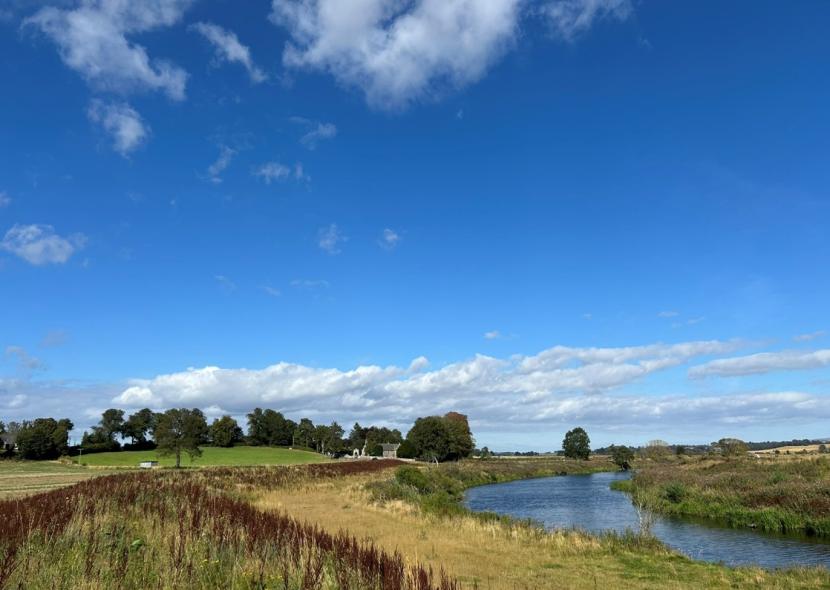
A setback floodbank along the River Isla. copyright Jill Robbie.
The Workshop aimed to identify shared understanding and practical pathways to improve the resilience of flood embankments for agriculture while supporting beaver re-introduction and sustainable land management. It concluded with agreement on several short, medium, and long term actions for further exploration. One short-term action was to develop a targeted Nature Restoration Fund (NRF) application to support a demonstration trial of floodbank realignment and riparian planting in agricultural areas, in collaboration with local land managers. This application was submitted by Beaver Trust, with contributions from the River Restoration Centre, on 3 November 2025. This Workshop and its outcomes aligns with Goal 5 of the Beaver Strategy, to establish systems to support land managers in the development of naturalised riparian networks that can accommodate beavers.
3.1 Mitigation and Management Sub-Group
The Mitigation and Management sub-group has convened twice to examine woodland management issues and riparian planting in relation to beaver activity. This has led to a series of recommendations which propose the next steps required for designing woodland creation schemes which account for potential beaver activity such as tree felling and dam building. The recommendations build upon the research carried out by the NatureScot Research Report regarding how to create woodlands that are resilient in the presence of beavers:
- Wilson, K., Bryce, J., Skilbeck, A., Needham, R., McAllister, S., and Campbell-Palmer, R. 2025. How to create woodlands that are resilient in the presence of beaver (Castor fiber): a review of current evidence. NatureScot Research Report 1368.
Following the riparian woodland themed meetings, NatureScot have funded Forest Research to scope trials of high-density willow planting to support successful woodland establishment. Beaver Trust have contributed to discussions of potential sites and to funding applications for progressing these trails in Scotland and England.
The sub-group has also met to explore agricultural themes. Key points raised included the financial burden on landowners, the need for explore alternative funding mechanisms and opportunities to utilise technology such as drone surveys to reduce resource demands. The sub-group’s most recent meeting has focused on mapping out the different sources of mitigation information including identifying knowledge gaps and different platforms for knowledge sharing.
3.2 Fish and Fisheries Sub-Group
The fish and fisheries sub-group met in February and November where its focus was on developing a beaver dam assessment methodology and prioritising research needs. The group considered a Beaver Dam Assessment Methodology (developed by a steering group including Beaver Trust, Wild Trout Trust, Atlantic Samon Trust, Devon Wildlife Trust) but concluded that this approach required amendment to be suitable in a Scottish context. There has been significant discussion on the potential impacts of beaver dams (positive and negative) on different fish species and ensuring that this is fully reflected in the narrative and methodology. For example, the habitat preferences of Atlantic salmon and brown trout are very different, and yet these species are often considered together in the context of beaver dams. A slightly different narrative and approach, informed by the Scottish Wild Salmon Strategy Science and Evidence Board, and recognising the wild salmon crisis, is now under consideration and the group hope to finalise the approach in 2026.
4.Research and Innovation
4.1 Research and Innovation Sub-Group
The sub-group held two thematic meetings where a number of postgraduate and postdoctoral researchers were invited to present their recent research findings and to contribute to discussion about alignment to strategy actions and where gaps remain:
Social and human dimensions - There were a series of presentations on current research around coexistence; cultural landscapes and aesthetics of beaver modified landscapes; human disturbance and community engagement. The sub-group identified a need to develop methods to quantify and monitor the economic cost/benefits and non-monetary value of beavers, to integrate these into assessment frameworks and track social attitudes over time. The group expressed strong support for a follow-up workshop on this topic.
Physical and biogeochemical processes and hydro-morphological monitoring - Researchers presented on work carried out in Scotland, England and Switzerland looking at carbon storage and emissions, water quality, sediment retention, nutrient fluxes and how these change when beavers are present in the landscape. The group noted the absence of consensus regarding beaver-related carbon storage and climate change mitigation and identified a need for a policy brief summarising current knowledge.
The sub-group intends to hold a series of joint meetings with the other sub-groups to discuss where there are overlaps for some goals, such as data and evidence for planning for conservation translocations and innovations for mitigations and potential to work on these actions together.
5.Fostering Stakeholder Trust
Fostering stakeholder trust in the implementation of the Beaver Strategy is a key measure of success and in light of the polarising debate in relation to environmental issues more generally, and reintroduced species more specifically, this remains a challenge. The Chair of SBAG continues to work to cultivate a constructive environment that supports open and respectful dialogue on complex and contentious issues. SBAG members have demonstrated a collaborative approach, contributing to productive discussions and joint problem-solving. This year’s site visits focused on areas of high stakeholder concern, providing valuable opportunities for members to hear local perspectives directly. These site visits help to strength mutual understanding. While several members have shown consistent commitment, attendance by some key representatives has been limited. Nevertheless, recent workshops have successfully broadened engagement, bringing additional stakeholders into the discussion.
5.1 Communication Sub-Group
The communications sub-group met in November to discuss the development of a community outreach pack for areas where beavers are moving into through natural re-population. Key considerations included identifying priority audiences and their preferred information channels, defining the core messages of the pack and clarifying the intended outcomes of the resource. Discussions addressed potential delivery formats, including online material, and face to face outreach. Funding and the timescale under which this would be delivered was also discussed.
The next steps of this work are to collate all the relevant existing information regarding beavers and identify where the gaps are. There was a proposal for SBAG as a whole to review the draft outputs of the communications sub-group, at a dedicated workshop in February 2026.
Indicator - Beavers in Scotland have achieved and are maintaining Favourable Conservation Status.
6.Progress against indicators of success
Progress
- Further translocations into the Cairngorms National Park and successful applications for translocation into the Beauly catchment.
On-going Challenges
- Level of proportionate engagement for translocation is unclear at times and requirements can be unpredictable.
Indicator - Beaver populations are connected through networks of improved and expanded wetland and riparian habitat.
Progress
- Range and distribution of beaver population expanding naturally and to be confirmed by pending survey report.
- Translocations and reinforcements expanding population. EOI will focus resources on catchments with interest.
On-going Challenges
- Stakeholder engagement processes are expensive and challenging for potential hosts to carry out without support.
Indicator
Negative impacts on environmental interests or socio-economic assets, including land, are effectively managed and/or mitigated in a timely manner.
Progress
- Mitigation and management scheme in place and implemented by NatureScot.
On-going Challenges
- Floodbank impacts remain a challenging issue which requires adopting a holistic river catchment approach.
- Costs to land managers and availability of funding to be covered at a future workshop.
Indicator - Communities across Scotland feel empowered to act in an informed way to promote and benefit from beaver presence and their positive impacts and monitor and learn from the experience.
Progress
- First community-led translocation application submitted by Abriachan Forest Trust.
On-going Challenges
- Debates about potential translocations can be polarising especially online and on social media.
Indicator - The ecological, socio-cultural and economic benefits of beavers have been fully assessed at a national scale and effectively communicated.
Progress
- International Beaver Symposium held in Inverness to present the benefits of beavers in Scotland to an international audience.
On-going Challenges
- Further communication required in an accessible manner about the benefits of beavers to local communities.
Indicator - Research and monitoring are embedded within all management interventions to inform and improve the effectiveness and efficiency of actions.
Progress
- Monitoring embedded into translocations and some mitigation interventions.
On-going Challenges
- Need to develop methods to quantify and monitor the economic cost/benefits and non-monetary value of beavers, to integrate these into assessment frameworks and track social attitudes over time.
Indicator - Stakeholder trust in strategy implementation is nurtured through effective communication, transparent decision-making and mutual respect.
Progress
- Positive collaborative environment with context of SBAG.
On-going Challenges
- Greater connection with and trust required between land managers and other stakeholders.
7.Conclusions
Over the past year, SBAG has made clear progress in monitoring and guiding the delivery of Scotland’s Beaver Strategy, with notable developments in translocations and stakeholder engagement. Mitigation and management work has advanced understanding of challenging issues such as floodbank impacts, with the August 2025 Workshop helping to shape practical pathways for adaptive management. Research efforts have identified evidence gaps around social attitudes, economic impacts and carbon cycling processes, which inform a focused programme of future work.
Stakeholder trust remains central to successful implementation. Constructive dialogue, sites visits and broader workshop participation have supported this aim, though polarised debate and stakeholder attendance continue to present challenges. Initial steps towards a community outreach pack demonstrate growing emphasis on accessible communication.
Overall, this year has strengthened Scotland’s capacity for collaborative beaver management. Continued integration of research, clearer processes and strong cross-sector cooperation will be essential as beaver populations expand and interactions with existing land use evolve.
Annex - Membership of SBAG
Membership of SBAG
Institution type
Public Bodies - NatureScot, Scottish Government, Scottish Forestry or Forestry and Land Scotland, Scottish Environment Protection Agency, National Parks and Scottish Water.
Local Authorities - COSLA
Fisheries and Water - Fisheries Management Scotland, River Restoration Centre or Centre of Expertise for Waters.
Land Management - National Farmers Union Scotland, Scottish Land and Estates, Confederation of Forest Industries.
Conservation - Scottish Environment Link, The Scottish Rewilding Alliance, Royal Zooligical Society of Scotland.
Management Advice - Beaver Trust.