Beaver Management Report: 01 April 2024 to 31 March 2025
Summary
- The report covers the 12-month period from 01 April 2024 to 31 March 2025, with annual licence returns now aligned with management activity which largely occurs from mid-August to end of March each year.
- A new survey of beaver populations in Tayside and adjacent catchments is underway with results expected in the late Autumn 2025 and will provide an up-to-date assessment of beaver populations. It is expected to show a trend of continuing increase in population and range expansion.
- This period saw a further 47 beavers released in Scotland; to the Cairngorms National Park, to Forestry and Scotland Land in the Trossachs and in Tay Forest Park, and to sites within the Tay catchment. A further 30 beavers were moved to licenced projects in England and Wales.
- Licences for beaver releases to the Beauly catchment have recently been approved. To deliver Scotland’s Beaver Strategy vision of seeing beavers restored to suitable parts of Scotland, there is a need to identify more new catchments for beaver release. To help make the best use of available resources, NatureScot plan to invite expressions of interest for the wild release of beavers to new catchments in Scotland. We hope this will help to highlight where there is most interest and enable further focused discussion of these locations and inform strategic planning for conservation translocation proposals. A webform is available to submit expressions of interest by 30th November 2025.
- A total of 102 beavers were removed from 19 conflict sites over the year, with 79 or 77% of these being by trapping rather than by lethal control. The pattern of beaver removals indicates the same areas are continuing to experience conflicts, with a small number of removals from new locations. A total of 119 dams were removed under licence in the same period.
- Twenty-three beavers were lethally controlled under licence this year, still significantly reduced from previous levels and reflecting the level of effort that has again gone into supporting trapping and captive care of animals for translocation by Beaver Trust and Five Sisters Zoo and land manager’s willingness to use this approach.
- Last year saw a further increase in the number of cases where beaver advice or mitigation works were requested. We have also noted more cases where beavers are impacting on local communities rather than land management interest and we might expect to see more such cases as beavers continue to move into new areas. The Scottish Beaver Advisory Group have recommended the development of communications resources to help communities prepare for beaver population expansion. We have included a case study in this report where we have adopted the ‘living with wildlife’ approach.
- We identified a need for clearer licensing arrangements and guidance for burrow and lodge destruction to safeguard beaver welfare. As a further evolution of beaver licensing, from August 2025 NatureScot are introducing a new Code of Practice that will be issued with any licences that permit this action.
Introduction
This report follows the same format as previous years with themes based on those of Scotland’s Beaver Strategy. Progress with delivery of Scotland’s Beaver Strategy is co-ordinated by the Scottish Beaver Advisory Group and its working groups and is not reported on in this summary.
A new survey of beaver populations in the Tay catchment and surrounding catchments is ongoing and will be reported on by late Autumn 2025. The ongoing survey is expected to help us better understand what is happening in terms of the number and distribution of beaver territories, group size and management influences, at the same time as refining a sampling regime and protocol for future national beaver surveys. It is expected to show a trend of continuing range expansion with evidence from surveys and public sightings confirming beaver presence beavers in the South Esk for the first time and new locations in the Tay and Forth coastal catchments. Based on trends from previous surveys (Campbell-Palmer et al. 2021), it is also anticipated that the population will have continued to increase.
Conservation translocations (and reinforcements)
This period saw the second year of beaver releases in the Cairngorms National Park, with four more pairs/families being released. This makes 10 pairs/groups (33 individuals) now released to the Upper Spey catchment. CNPA publish monthly updates on beavers in the Cairngorms National Park.
The Trossachs also saw further reinforcement with 21 beavers released on Forestry and Land Scotland (FLS) land over four sites, and one further family released on FLS land in Tay Forest Park. Six beavers were released within catchment to sites in Tayside and a further 30 beavers were moved to licenced projects in England and Wales. Most releases in England were to enclosures, but with four beavers being released on the National Trust Purbeck reserve, the first under DEFRAs new wild release and management policy in England.
FLS submitted an application to release four beaver families to Glen Affric at the end of January 2025. This followed two years of public engagement regarding proposals to bring beavers to the River Beauly catchment. The initial engagement related to a wider programme of releases in the catchment, but following the first phase of engagement by Trees for Life, the proposal was focused on FLS Glen Affric. FLS commissioned further consultation and submitted the consultation report in support of their application. We welcomed the application and recognised the significant efforts made by Forestry and Land Scotland and Trees for Life to consult with local communities and stakeholders. However, there remained concerns about the proposal among the local community and its representatives. As Licensing Authority NatureScot undertook to meet with land and fisheries interests to better understand their specific concerns and discuss with them the management and mitigation that would be available if a licence for beaver release were to be issued.
Following local community engagement, the Abriachan Forest Trust working with Scotland the Big Picture also submitted an application for two release sites within the Community landholdings, which also sits within the river Beauly catchment.
Both applications have recently been approved with details of the decisions now published. NatureScot together with FLS have committed to establishing and supporting a Beauly Beaver Mitigation and Monitoring Group for at least 10 years post-release. The group will bring together representatives of all interested parties to effectively manage any potential issues.
The Glen Affric proposal has illustrated that public views can be very polarised when it comes to proposals for beaver restoration. NatureScot received a lot of correspondence both in support of and raising concerns about this proposal. Licensing decisions on species translocation are informed by the Scottish Code for Conservation Translocations, taking account of the likely benefits and potential for negative consequences and mitigations. After careful consideration, our view is that in this case it will be possible to realise these many benefits while ensuring that the community is supported in living with beavers.
NatureScot has continued to provide financial support for licenced translocations/ reinforcement in Scotland, delivered through a Partnership Agreement with the Beaver Trust and Five Sisters Zoo. Trapping, transportation, captive care and health screening of animals has been carried out to an agreed protocol delivering high standards of animal welfare. Beaver Trust have invested in new veterinary facilities and equipment specifically for trapped beavers at the Five Sisters Zoo helping to deliver the health screening with improved biosecurity. A scientific paper has been submitted detailing the health screening results, and the paper will be available once published.
In the financial year 2024/25 NatureScot contributed £100K towards beaver translocation costs. This included £7.8K of support for monitoring of beaver impacts on fish; working with Loch Lomond and Argyll Fisheries Trusts. Funding was also contributed to a Partnership Project with Natural England and Natural Resources Wales developing a beaver population model simulation App to help inform translocation proposals. A version of the App is now running on a trial basis, and NatureScot can help prospective applicants with exploring the population predictions for translocation scenarios.
| - | Spend £K |
|---|---|
| Partnership agreement for practical delivery of beaver translocations. | 83 |
| Monitoring and surveillance relating to fish populations - Loch Lomond and Argyll | 7.8 |
| Contribution to beaver population modelling tools | 9.2 |
| Total | 100 |
The Beauly decisions brings new opportunities for licenced beaver release and there remain beaver release sites available in the Spey catchment and in licenced projects in England, with the prospect of more wild releases in England under the new policy. Trapping capacity has been increased with investment from partners, and we recognise trapping is contingent on the number of available release sites. At the same time, Scotland’s Beaver Strategy has a vision of seeing beavers restored to suitable parts of Scotland and Scottish Government has supported the desire to see more beavers translocated within Scotland to reduce the number of beavers killed via licenced control on conflict sites.
Scottish Beaver Advisory Group have been considering how further new catchments for beaver release can be identified. It is recognised there are challenges around the resources required to properly engage with local communities over proposals. Hence NatureScot intend to invite expressions of interest for wild release of beavers to new catchments in Scotland with a view to collating where there is interest in beaver restoration, to bring interests together to develop strategic plans for conservation translocations and make the best use of available resources. Projects do not need to be fully formed, but there should be some assessment of habitat suitability and some knowledge of landowner support for potential release sites. NatureScot produced a national overview of the potential for beavers in all mainland river catchments in 2022. A webform is now available to submit expressions of interest with a first deadline of 30th November. Further windows for expressions of interest may follow, but it is hoped the initial call can gather projects at a range of stages of readiness to gauge geographically where there is most interest. This should help to ensure that limited resources from a range of stakeholders, are used to best effect.
Work on a national Habitats Regulations Assessment for beaver translocation is in progress, drawing on the assessments to date and considering potential impacts on European sites potentially impacted across Scotland. This will also require some consideration of cross-border interests.
Management and Mitigation
Beaver mitigation
As in previous years NatureScot has provided a Beaver Mitigation Scheme for land managers through both staff resource and contractors. NatureScot logged 124 beaver mitigation cases between 01 April 2024 and the 31 of March 2025. A case includes requests for advice on beaver impacts and for mitigation works. Of these cases 116 (94%) were from the Tay, two (2%) were from the Forth and five were from the Earn catchment (4%). The number of mitigation cases is 38% more than that of the previous reporting period. This may be a reflection of more people being aware of beaver signs and beaver presence, an increased awareness of where to seek advice, but is likely to be largely a reflection of an increase in beaver population range/ occupancy of new areas.
The primary beaver activity causing negative impacts, was recorded for each case. As in 2023 dam building was the most common impact recorded (65%), this was followed by bark stripping and/or tree felling (23%) and burrowing (8%).
The assets affected by beaver activity was recorded for each case and are as follows: compromise to infrastructure 39%; crop damage/loss and loss of grazing 23%; tree damage/loss 22%; bank erosion/collapse 6%, with property impacts making up the remaining 2% of cases. In 8% of cases no impact was recorded.
For most enquiries regarding impacts on trees, NatureScot provide advice enabling the landowner/manager to assess and manage impacts for themselves. Where there is a clear public interest, tree protection using either weldmesh or WOBRA deterrent paint, is carried out under the NatureScot Beaver Mitigation Scheme. There were four cases where this was undertaken this year.
A total of 11 new flow devices were installed, and eight existing devices maintained. Flow devices continue to provide an effective co-existence solution in cases where a compromise can be reached between the beavers and the land manager regarding water levels. Water level monitors continue to provide a useful alert to the presence of dams in sensitive locations; two new ones were installed.
In addition to the works supported by the NatureScot Beaver Mitigation Scheme, the Beaver Trust have directly supported tree protection works at several sites, including a knowledge sharing day with SSE.
Hence there continue to be a small number of tried and tested beaver mitigation techniques applied that are effective and are relatively inexpensive.
Although these designs are commonly used in North America, a new trial for culvert protection was undertaken using a trapezoidal culvert fence design supported by the NatureScot Mitigation Scheme and installed by the Beaver Trust. The fence protects the culvert by physically excluding beavers from the area around the culvert inlet using wire fencing. The shape of the fence also alters the physical and auditory cues that promote dam building. The mitigation was undertaken to prevent a culvert from being blocked and prevent water levels from being raised which would have had an impact on land drainage causing flooding to neighbouring agricultural fields. The fence mesh surrounds the culvert allowing no place for beavers to tunnel underneath.
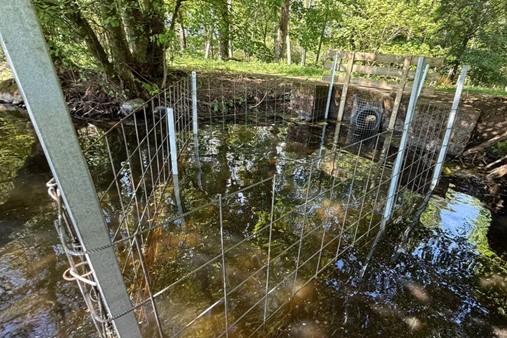
Trapezoidal culvert fence installed by the Beaver Trust © Beaver Trust
In the financial year 2024/25 the beaver advice and mitigation budget spend was £63K. This included contractor costs for providing advice and practical assistance to land managers. The spend also includes the cost of electro-fishing: monitoring the efficacy/ impact of a beaver watergate on fish, as part of a trial of beaver exclusion from an area of high value agricultural land.
NatureScot also commissioned research reviewing international practice for woodland creation in the presence of beavers and reporting on the Scottish experience to date; with a view to making recommendations. This work was published as NatureScot Research Report 1368 - How to create woodlands that are resilient in the presence of beaver (Castor fiber): a review of current evidence. We are now working with Forest Research and Beaver Trust and a range of partner organisations to develop trials for some of these recommendations.
We have also continued to support the costs of beaver post-mortems and the RiverEye App used by staff for collating information on beaver impacts.
| Mitigation budget | Spend £K |
|---|---|
| Beaver team costs - Attending conferences, travel, equipment. | 0.7 |
| Scottish Beaver Advisory Group catering, events. | 0.3 |
| Electrofishing (wategates) | 11 |
| Woodland creation Commissioned Report | 5 |
| Professional services (PMs, cryobanking, RiverEye hosting). | 11.1 |
| Beaver advice and mitigation call-off contracts | 30.1 |
| Equipment (incl water level monitor data charges). | 5 |
| Total | 63 |
NatureScot have also partnered with Beaver Trust and the University of St Andrews on beaver population survey and modelling. Our financial contribution was £52K last year (2024/25) and £39K for the current year.
Case Study, Deich Burn, Bridge of Earn
Bridge of Earn was where beavers were first confirmed as living wild in Scotland in 2006. NatureScot have been involved in advising on beaver impacts on the Deich burn from before beavers were given legal protection in 2019. In October 2024 we became involved again when a local resident was experiencing flooding of their garden as a result of a dam on a neighbouring property. On one side of the burn, landownership is divided between the owners of the (multiple) properties adjoining the burn and land on the opposite bank has been in a prolonged process of legal transfer but with no current ‘owner’. This highlights one of the challenges of managing beaver impacts where impacts may be experienced by those other than the immediate landowner. NatureScot can issue a licence where the licensing tests are met, but landowner consent is needed before any licenced actions can take place. Knowing who your neighbours are can be a big help.
Beavers have long been present in the Bridge of Earn area and NatureScot’s view has been that beaver removal in this location would be short-lived with other beavers quickly moving into the vacant territory and hence this approach would not resolve the conflicts. Instead, we have sought to support mitigation approaches that allow the beavers to remain whilst minimising the negative impacts on local residents. Earlier this year after reaching agreement with the neighbouring homeowner, and a second homeowner further up the burn, NatureScot instructed the Beaver Trust to instal two flow devices in dams on the burn. This has helped the water to continue to flow and has prevent the water backing up into people’s gardens. However, as the water level dropped, this exposed a third older dam that was submerged. The beavers have recently been rebuilding this dam, so a third flow device has also been installed.
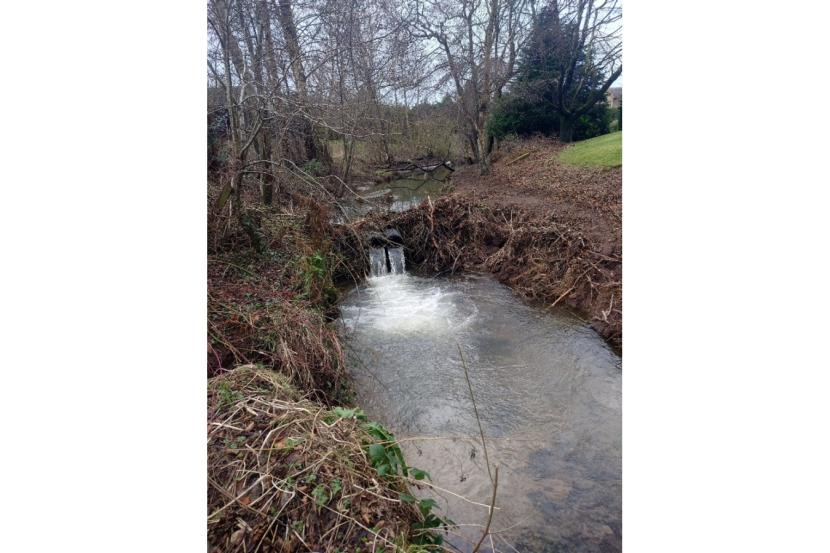
Flow device installed by Beaver Trust under the NatureScot Beaver Mitigation Scheme on the Deich burn. Vegetation indicates previous water levels prior to installation. Water can still flow over or around the dam at high levels .
Other concerns have been raised on the Deich burn relating to the potential flood risk, beaver felling of trees with potential impacts on a public footpath; on nearby property and on the impact of dams on fish passage.
Our involvement here (and elsewhere) has highlighted the range of views held by local residents; with some residents feeling the protection given to beavers is impacting on their enjoyment of their property, that insufficient assistance has been given to them with mitigation of other impacts, including on garden trees. At the same time there are other residents who enjoy the beaver presence and feel that the impacts can be managed by limited interventions and that have been willing to help others with this.
A local site meeting was organised involving NatureScot staff and was led by a local Councillor. This was well attended by people with views, both positive and negative, of beavers. Living with wildlife can be emotive and can be complicated by landownership and differing interests. We can anticipate more such cases as beavers move into rural communities and urban areas. Involving the community in discussion of the issues and communicating about actions that can help resolve conflicts would seem to be a sensible approach in such cases. In this case the Community Council, Council Flooding and Greenspace teams, local volunteers, Beaver Trust and NatureScot have all played a role. We know this site will need some ongoing advice, but in the longer term we would hope that we can learn more about the adaptions that can help us to live with our beaver neighbours and how we can support communities to manage any negative impacts.
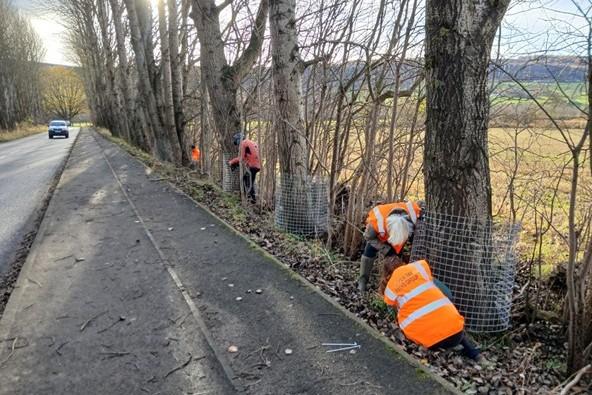
Community tree wrapping day organised by Upper Tays Paths Group at Aberfeldy poplar avenue. November 2024. Supported by NatureScot staff and PKC Greenspace team. ©PKC.
Beaver licensing
There was an increase in the number of beaver management licences in 2024-25 with a total of 75 licences in operation. A number of these reflect beaver range expansion with one licence issued in the Spey catchment, one in the Beauly catchment and one in Knapdale (all non-lethal). Within the Earn and Tay coastal catchments there were also licences issued in new locations and in relation to infrastructure projects; the new Taylink crossing and Scottish Water works at Glenfarg.
| Activity licenced | Preventing serious damage to livestock, foodstuffs for livestock, crops, vegetables, fruit, growing timber, property or fisheries. | Public Safety | IROPI (reasons of overriding public interest) |
|---|---|---|---|
| Lethal control and dam removal | 36 | 1 | 0 |
| Dam removal only | 24 | 10 | 2 |
| Damage/disturbance to burrows | 2 | ||
| Total for purpose | 60 | 13 | 2 |
The submission of licence returns was notably poor from some licence holders this year, requiring considerable chasing from licensing staff. We are still waiting for 8 licence returns from last year. Compliance letters have been issued to 10 licence holders. New licences will not be issued until outstanding licence returns have been received
| Licenced actions taken | Year 1st April 2024- 31st March 2025 (plus 4 animals trapped in KDP under an exceptional licence). |
|---|---|
| Lethal control – number of animals killed | 23 |
| Number of animals trapped and removed (including sites where carried out under the licence held by specialist trappers). | 79 |
| Total number of animals removed | 102 |
| Other actions taken |
|
|
|
Since August 2024 under licences that permit the use of lethal control, there has been a requirement for accredited controllers to notify NatureScot (within 48 hours) that a beaver has been shot and that either a carcass is available for collection for post-mortem or alternatively to that it was not possible to retrieve the carcass for health and safety reasons. A number of controllers were very timely with this requirement and consequently four carcasses arising from lethal control were submitted for post-mortem. This is greatly welcomed and will help to evidence the welfare implications of beaver control. However, several accredited controllers failed to notify NatureScot in advance of providing licence returns and have been issued with compliance notices. If there is further failure to comply with this requirement, controllers may be asked to re-attend training or have their controller status revoked.
Two controllers did not provide grid-references and only two controllers provided details of the size of the group from which animals were lethally removed. Hence there remains the opportunity to improve on beaver control records and it is hoped the use of the Deer Management App that has been developed to accommodate beaver records will afford the opportunity/ driver for this. This will be made available from the controller training organised for October 2025. Existing accredited controllers that have submitted returns in the last 3 years will also be contacted with details of how to access the App, how they will receive tags for scanning, how to record details of shot beavers and how this will notify NatureScot if a carcass is available for collection.
Of the 67 licence returns received, 30 returns reported having taken no action under licence. Trapping took place on eight of these sites under a separate licence held by specialist trappers and no actions took place on 22 of 67 sites (33%). A total of 23 beavers were reported to have been killed under licence and 119 dams were removed.
The wording of beaver management licences has to date included authorisation to ‘damage destroy place of shelter/protection’ reflecting the link between dams and their function in protecting breeding sites/ resting places. This year saw an increase in the number of requests for licences for burrow destruction (normally where collapsed) and returns reporting this action had been carried out. We also had a number of requests to carry out repairs to flood banks arising from burrowing activity, with burrows being exposed during low river levels. From August 2025 we are changing the wording on licences to clarify if a licence does or does not permit the destruction of beaver lodges and burrows. At the same time, we are introducing a new Code of Practice for the destruction of beaver lodges and chambered burrows, which will be issued with all licences where these actions are permitted. The requirement to follow the Code aims to safeguard beaver welfare and ensure appropriate steps are taken to minimise the risk of harm to beavers when carrying our licenced actions.
| Release site | Number Released | Year | Notes |
|---|---|---|---|
| Cairngorms National Park | 15 | 2024 | |
| FLS Trossachs | 21 | 2024/25
| |
| FLS Tay Forest Park | 5 | 2024 | |
| Release within catchment (Tayside) | 6 | 2025 | One animal known to have subsequently died in road traffic accident from PIT tag. |
| Broughton Sanctuary Skipton, England | 2 | 2025 | Enclosure |
| Brynmawr, Shropshire England | 2 | 2025
| Enclosure |
| Castletown Estate, Cumbria, England | 7 | 2025 | Enclosure |
| East Meon Hampshire, England | 2 | 2024
| Enclosure |
| Llangorse, Wales | 1 | 2024 | Enclosure |
| Nene Wetlands, Northamptonshire, England. | 8 | 2025 | Enclosure |
| Purbeck National Trust, Dorset, England | 4 | 2025
| Wild release |
| Shropshire Wildlife Trust, England | 2 | 2025 | Enclosure |
| Wildwood, Herne Bay, England. | 2 | 2024 | Enclosure |
A total of 79 beavers were trapped on 19 conflict sites (includes 2 trapped into April completing family groups already captured in March 2025 and 4 individuals captured under 3 exceptional licences issued during May-July 2025). The average group size (n=19 on 18 sites) trapped was 3.9 (range 1-10). Release sites for all animals trapped this year are shown in Table 5.
Two animals died in captive care: an adult male beaver was health screened and died later that day following anaesthesia. An independent postmortem was undertaken SRUC who determined an existing significant pneumonia bacterial infection. The second death was a small male kit, who was trapped as part of a larger family, who was found dead in the captive water facility with suspected hypothermia.
The increase in animals trapped reflects the very significant efforts by Beaver Trust to respond to requests for trapping. The trapping returns (and group size) indicates the success in capturing whole family groups. The success of this approach can also be attributed to most land managers being willing to try trapping before resorting to lethal control.
Analysis of beaver removals
Following the same methods as in earlier reports an analysis of beaver removals (control and trapping) in the Tay and Forth catchments was carried out with the following results.
Medium scale
- Between 0 and 30 beavers were removed per river section, with under half (9 of 23) river sections having none taken. This indicates a slight increase in the number of river sections where beavers had been removed (increased from 12 in the last reporting period to 14). Of those sections where beavers were removed, a mean of 7.3 individuals were taken.
- There was a significant correlation between the numbers of beavers removed in each section this period and the total numbers removed between 2019 and the end of the previous reporting period: Spearman’s correlation, r=0.799, p<0.001, Fig. 1).
- Together, these results indicate that most conflict sites in previous years continue to experience conflict.
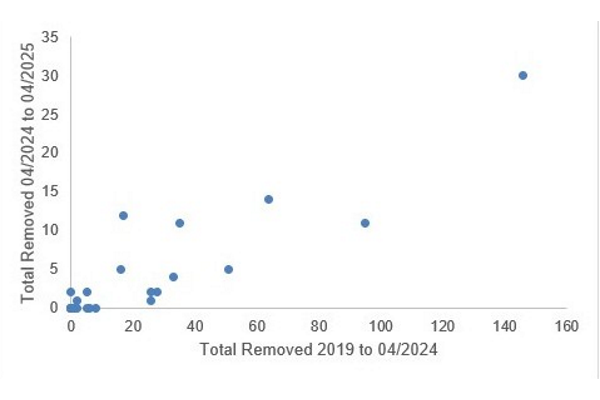
Figure 1. Within each river section, total number of beavers removed in this reporting period versus the combined figures for all prior reporting periods. Note that five sections have had zero removals overall.
Large scale
The Isla sub-catchment continues to contain the largest portion of removed beavers at 47%, followed by the Earn (28%) and the Tay (25%, Fig 2.). These sub-catchment differences are not as great as in previous years.
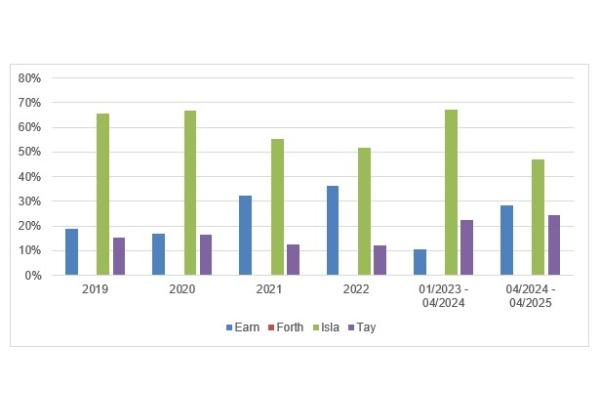
Figure 2. the percentage of the total number of beavers removed under licence in Tayside over each reporting period by main river sub-catchment.
Post-mortem details
Between 01 April 2024 and 31 March 2025, 29 dead beavers were reported to us of which 16 were collected. These figures include four beavers shot under licence in late March 2025, which were collected but for which postmortem results are not yet available. Ten postmortem assessments are available at the time of writing. There were four adult females, three adult males and an adult and two juveniles whose sex could not be determined. For seven of these (the four adult females and three adult males), cause of death was attributed to trauma most likely as a result of a motor traffic accident, and for the remaining three, cause of death was unattributed due to the condition of the carcass.
Postmortem findings from a single animal shot under licence during the previous reporting period is now available. This was an adult male and no welfare issues were raised in the report.
Research and Innovation
We have been working with Beaver Trust the Argyll Fisheries Trust to assess the impact of beaver dams on the habitat and breeding of sea trout within a short burn in Knapdale Forest where a series of dams have created an impressive wetland. Detailed survey by the Argyll Fisheries Trust has assessed the suitability of river habitat for sea trout and they have carried out electrofishing and redd counts to assess spawning success. Trials have also been conducted of notching of dams/ deepening of by-pass channels at key times for sea trout migration. A partnership project with Argyll Fisheries Trust will continue monitoring here so we can learn more about the need for and success of interventions for sea trout whose populations are considered to be in significant decline. This work has sought to reduce the potential for conflicts whilst minimising the impact on the beavers.
Scotland is due to host the 10th International Beaver Symposium in September of this year with 150 delegates from around 20 different countries expected to attend. We expect this will help to develop collaborative opportunities for new projects across the range of Scotland’s Beaver Strategy Research and Innovation theme actions.