Priority Marine Feature - Northern sea fan and sponge communities
Improving the protection given to Priority Marine Features
An overview of northern sea fan and sponge community records
Description
Characteristics
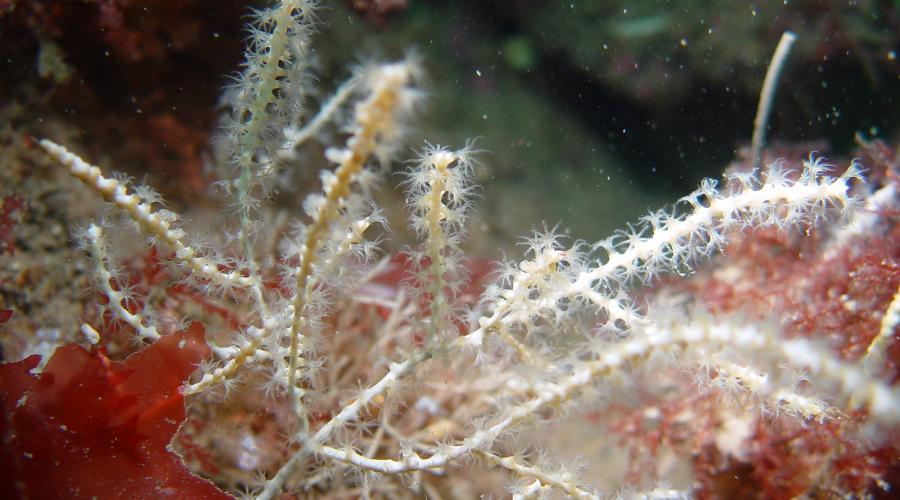
Northern sea fan and sponge communities occur on upward-facing and vertical bedrock, boulders and cobbles. The northern sea fan (Swiftia pallida) and cup corals (Caryophyllia smithii) characterise the habitat between ~20-50 m. In deeper waters, sea fan numbers are lower or the species may be absent and a varied sponge community is conspicuous alongside aggregations of cup corals. The rocky substrates are typically also colonised by bryozoans, sea firs, soft corals (e.g. dead man’s fingers), feather stars, starfish and sea squirts; with crevices providing shelter for squat lobsters and wrasse. The northern sea fan can host the nationally rare sea fan anemone (Amphianthus dohrnii).
Definition
The northern sea fan habitat is defined by the presence of frequent S. pallida (ca. 1-9 per 100 m2) and locally abundant cup corals. The associated biological community varies depending on the physical setting (depth, degree of wave exposure and the strength of tidal currents). Moderately tide-swept conditions support the most diverse fauna with large solitary sea squirts (e.g. Corella parallelogramma and Ascidia mentula), the colonial football sea squirt (Diazona violacea), a varied hydroid turf, erect bryozoans such as Porella compressa and sponges. Areas of vertical and overhanging rock may support the white cluster anemone Parazoanthus anguicomus. In very wave sheltered conditions with little tidal flow, the rocky substrates can be heavily silted. The rich community associated with the sea fans here can include a number of different sponges including Suberites carnosus and Polymastia boletiformis, with the cotton spinner sea cucumber Holothuria forskali on rocky ledges and occasionally, red sea fingers Alcyonium glomeratum.
The deeper sponge communities are fairly distinct, being dominated by cup-shaped (e.g. Phakellia ventilabrum and Axinella infundibuliformis) and branching sponges (e.g. Axinella dissimilis and Stelligera stuposa) with few or no northern sea fans, in depths typically below 50 m. [Note - this habitat is not the same as the Deep sea sponge aggregations PMF which is restricted to offshore waters around Scotland in water depths >250 m]
Environmental preferences
Circalittoral bedrock, boulders and cobbles in wave-exposed to wave sheltered areas, in fully marine conditions at depths of 20-220 m (Connor et al., 2004; Howson et al., 2012). The northern sea fan is most commonly recorded from depths between 18-60 m but has also been reported from up to 1200 m off the coast of Ireland (Wilson, 2007).
Distribution
Scottish distribution
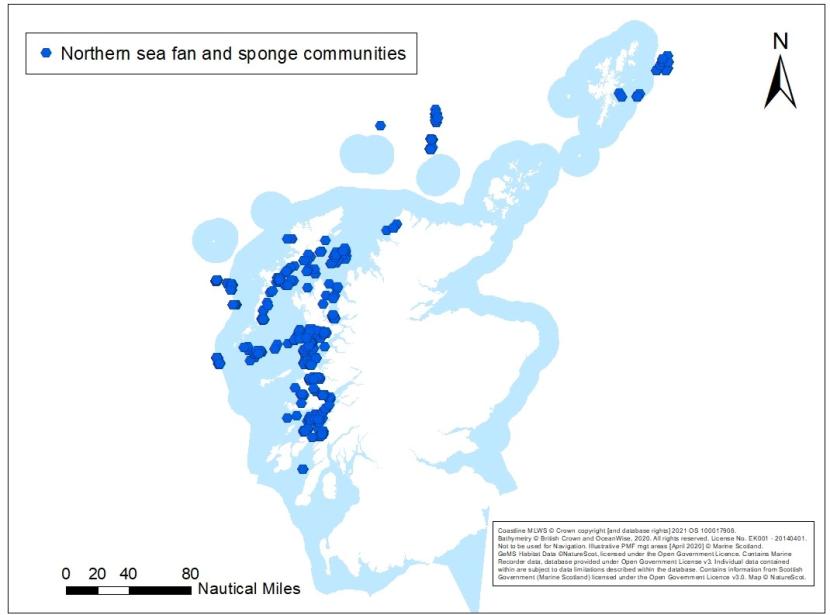
Northern sea fan communities are restricted to the west coast; from Shiant East Bank in the north (Moore, 2014) to the Sound of Jura in the south; across the Minch and down the east coast of the Outer Hebrides. Records of the northern sea fan as a species occurring in low numbers in other habitats, extend this distribution to Loch Laxford in the north (Moore et al., 2010), St Kilda in the west and the Isle of Bute in the Firth of Clyde, to the south (Wilson, 2007). Deep sponge communities have been recorded from the Firth of Lorn, the Sea of the Hebrides off Mingulay and the Small Isles (Moore & Roberts, 2011), the Inner Sound (the strait separating the Inner Hebridean islands of Skye, Raasay and South Rona from the Applecross peninsula on the Scottish mainland) and on the Shiant East Bank. In offshore waters, deep sponge communities are known from west of the Outer Hebrides, the north of Scotland and east of Shetland.
Estimated known Scottish extent
Known examples of northern sea fan and sponge communities vary considerably in the area of seabed covered, from isolated 2-3 ha patches on mixed coarse sediments surrounded by burrowed mud in the Sound of Canna (Howson et al., 2012; Envision Mapping, 2014) through to extensive bedrock plateaus and steep vertical cliffs with a predicted extent of several 1000s of hectares in the Firth of Lorn and Shiant East Bank (Miller et al., 2017). Large areas of potentially suitable habitat (Brown et al., 2017) have yet to be surveyed so new examples of these habitats are anticipated.
Wider distribution
Outside of Scotland, northern sea fan communities have only been recorded at two locations off the west coast of Ireland, at Donegal in 2010 and from the Kenmare River since 1985 (Minchin, 1987; MERC Consultants, 2009). The northern sea fan has a wider ‘species only’ distribution including Norway, Sweden and deep waters off Ireland. A tentative record of a Swiftia species (provisionally thought to be S. pallida) was made from the Haig Fras SAC situated approx. 95 km north-west of the Isles of Scilly in the Celtic Sea in 2015 (Callaway, 2015). There is some doubt whether records from more southerly climes, including off north-west Africa, Madeira, Bay of Biscay and in the Mediterranean are of the same species (Wilson, 2007). Deep sponge communities are broadly distributed and can be found off Northern Ireland, the west coast of Ireland, Pembrokeshire, south-west England and the English Channel. The sponge community composition varies with latitude. Southern examples lack Phakellia ventilabrum and have a greater diversity of axinellid sponges together with the pink sea fan Eunicella verrucosa which is not currently known in Scottish waters (Readman, 2018).
Status
Scottish northern sea fan and sponge communities are of global importance. All British records of northern sea fan habitats are from Scotland apart from the uncertain record in the Haig Fras SAC. Swiftia pallida is believed to be towards the southern limit of its range in Scotland and at the two locations known from south-west Ireland (and the uncertain record at Haig Fras SAC). Northern sea fan and sponge communities are recognised as biogenic reefs which can be part of the broadscale habitats protected in Special Areas of Conservation (SACs) under Annex 1 of the EU Habitats Directive (European Commission, 2013). The Directive is transposed into domestic legislation through The Conservation (Natural Habitats, &c.) Regulations 1994 (as amended in Scotland) (Habitats Regulations).
These diverse and functionally important communities are highly characteristic of moderately exposed reefs on the Scottish west coast. Examples of the habitat on low relief bedrock, cobbles or mixed substrates are considered at greater risk to towed bottom-contacting fishing gears. Picton & Goodwin (2007) attribute deterioration in the condition of an area of diverse sponge and rare hydroid communities on boulders on the east coast of Rathlin Island (NI) to scallop dredging activity. Large Axinella infundibuliformis cup sponges recorded on boulders in 1984 were thought to be over 50 years old. Scallop dredging started in the area in 1989 and subsequently, boulders were observed to have been turned or disappeared and the previously abundant sponges and hydroids were greatly reduced (Goodwin et al., 2011).
Observations of turned boulders and dredge marks on low relief bedrock have also been made in Scottish waters. Exploring the impacts of scallop dredging on rocky reefs was the subject of a number of studies undertaken as part of the Firth of Lorn Science Project 2006-2013 (Turrell et al., 2014).
Drivers for improving protection
Northern sea fan and sponge communities are included on the PMF list which means that National Marine Plan General Policy 9(b) (avoiding significant impact on national status) applies. The Scottish Biodiversity Strategy to 2045, the Scottish Biodiversity Duty and UK Marine Strategy Good Environmental Status provide further drivers to ensure biological diversity is restored, and ecosystems are safeguarded.
Sensitivity (including recovery)
[Key sources: FeAST, Fisheries Management Guidance]
Northern sea fan and sponge communities are particularly sensitive to organic enrichment, siltation, abrasion and physical disturbance as well as contamination and changes in water flow, wave exposure and water clarity.
Activities such as mobile demersal fishing, as well as high levels of demersal static fishing can impact this habitat by causing physical damage which may lead to the detachment of sessile species. Where towed bottom-contacting fishing gears overlap with these communities the fragile epifauna is liable to suffer high mortality (Løkkeborg, 2005) from direct impact and from disturbance of their substrate (e.g. overturning of boulders; Freese et al., 1999; Boulcott et al., 2014). Boulcott & Howell (2011) demonstrate that dredging over bedrock is possible and is damaging, with low relief substrates at greater risk of exposure. Hinz et al. (2011) concludes that not all temperate reef fauna are affected equally by scallop dredging and that more complex stony reef habitats may provide some measure of protection at low fishing intensities. Aquaculture and pollution can also impact on this habitat. Re-colonisation of these delicate, long-lived and slow growing suspension feeders is variable depending on intensity and frequency of disturbance (Jennings & Kaiser, 1998). If lost, northern sea fan communities may take many years or decades to recover.
Northern sea-fan and sponge communities may be vulnerable to future climate impacts associated with increased temperatures and ocean acidification. Increased temperatures may lead to a reduction or loss of northern sea fans in Scottish waters (northwards retreat). It is thought that colonization of the Shetland Isles has been prevented by geographical barriers which would likely continue even in a situation of climate induced retreat (Hiscock et al., 2001).
Connectivity
Between northern sea fan and sponge communities
It is generally considered that populations of the northern sea fan are self-sustaining due to their short-lived larvae (1-10 days; Hiscock et al., 2001; Hill et al., 2010; Gallego et al., 2013). Many sponges reproduce asexually by fragmentation and budding; however, sexual reproduction also occurs, often seasonally. The dispersal duration for sponge larvae ranges from a few hours to a few days (Hill et al., 2010; based on Axinella spp. sponges) so these will also be largely self-sustaining. The reproductive strategies of the other species vary widely.
Further research is required to better understand connectivity between northern sea fan and sponge communities, including the likely variation between component species.
With other PMFs
Northern sea fan and sponge communities have an association with the cold-water coral reefs PMF. The coral framework and adjacent hard substrates may be colonised by sponges and sea fans.
Extensive sponge communities were recorded around the Mingulay cold-water coral reef complex during survey work undertaken in 2003 (Roberts et al., 2004) and subsequent Marine Directorate sampling in 2010 (Moore & Roberts, 2011). Sponges play a key role in carbonate recycling (Beuck et al., 2007; Bell, 2008), they help to bind coral structures and facilitate lateral patch expansion (Wilson, 1979). The East Mingulay corals are characterised by encrusting sponges (Davies et al., 2009). Small colonies of Swiftia pallida occurred at high densities in sponge dominated communities around the coral reefs at some of the 2010 Mingulay survey stations in water depths 50-120+ m (Moore & Roberts, 2011).
The fan mussel PMF (Atrina fragilis) has been recorded from sublittoral sediments adjacent to bedrock, boulder and cobble habitats supporting the northern sea fan and sponge communities PMF in the Small Isles MPA (Howson et al., 2012; Moore, 2012 & 2013). This relationship almost certainly reflects the natural refuge function afforded to pockets of sediments within rough ground favoured by northern sea fans.
Tide-swept algal communities PMF may be found above northern sea fan habitats. Pink sea fingers PMF (Alcyonium hibernicum), white cluster anemonesPMF (Parazoanthus anguicomus), European spiny lobstersPMF (Palinurus elephas) and northern feather starsPMF (Leptometra celtica) can all be found within the northern sea fan and sponge communities PMF.
Ecosystem services
Northern sea fan and sponge communities have a complex structure providing shelter for a number of other species and contributes to the protection of biodiversity. The suspension feeders of the northern sea fan and sponge communities have a role in waste breakdown. The habitat also supports commercially valuable fish and shellfish and has an interest for recreational divers.
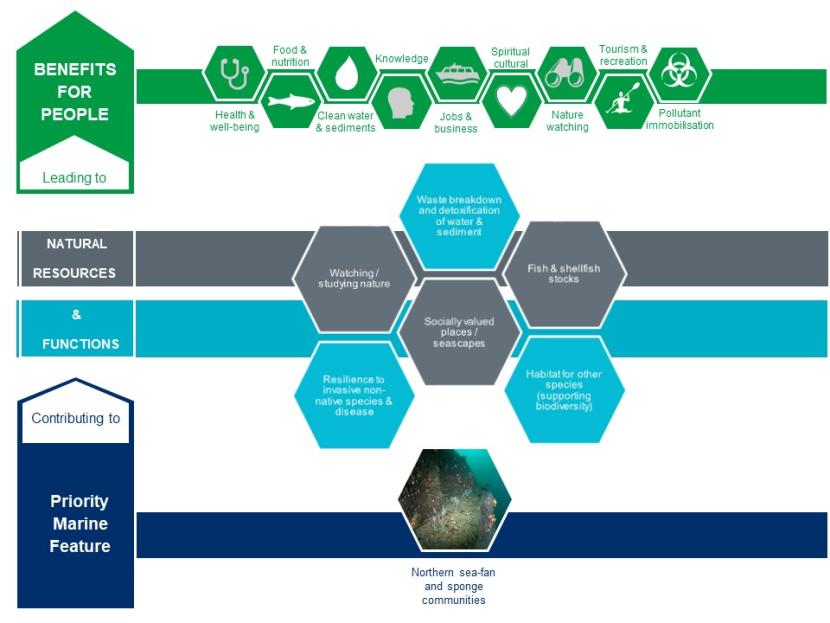
The contribution northern sea fan and sponge communities make to natural resources and functions and the benefits for people that these lead to.
Click for a full description
- Priority Marine Feature: Northern sea fan and sponge communities contributing to
- Natural resources (NR) and functions (F)
- Waste breakdown and detoxification of water and other sediments (F)
- Socially valued places/seascapes (NR))
- Resilience to invasive non-native species & disease (F)
- Formulation of habitat for other species (supporting biodiversity) (F)
- Fish and shellfish stocks (NR)
- Watching/studying nature
- Which leads to benefits for people
- Health & wellbeing
- Knowledge
- Clean water and sediments
- Jobs and business
- Spiritual/cultural
- Nature watching
- Food and nutrition
- Tourism and recreation
Existing Marine Protected Areas
Northern sea fan and sponge communities are a protected feature of 9 MPAs in Scottish territorial waters: Loch Laxford; Lochs Duich, Long and Alsh; St Kilda; East Mingulay; Sunart; Firth of Lorn; Small Isles; Loch nam Madadh; and Shiant East Bank.
The PMF is also a protected feature of the Pobie Bank MPA in offshore waters.
Existing and proposed fishing measures providing PMF protection
Northern sea fan and sponge communities are protected by the following existing fishing measures:
- The Inshore Fishing (Scotland) Order 2015 (Loch Laxford; Lochs Duich, Long and Alsh (through the combined Southern Inner Sound measures CA150); St Kilda; East Mingulay; and Sunart).
- The Wester Ross Marine Conservation Order 2016.
- The Loch Sunart to the Sound of Jura Marine Conservation Order 2016 (Firth of Lorn and Loch Sunart to the Sound of Jura).
- The Loch Gairloch (CA58) and Loch Torridon and the Northern Inner Sound (CA56) fisheries areas and the BUTEC Outer Sea Area (British Underwater Test and Evaluation Centre).
The following new fishing measures are proposed for northern sea fan and sponge communities in MPAs:
- Small Isles, Loch nam Madadh and Shiant East Bank.
Approach to assessing improvements in management needed to protect northern sea fan and sponge communities from impacts related to towed bottom-contacting fishing gear
The assessment presented in this document relates to fishing using towed bottom-contacting gear only. It is consistent with the approach taken for assessing proposed developments.
When considering biodiversity evidence more weight has been given to clusters of northern sea fan and sponge communities records and records which show the extent of northern sea fan and sponge communities (i.e. polygon data) where available, in preference to isolated observations. There has been particular consideration of larger communities in comparison to smaller ones (where extent is known), except where smaller or fragmented communities are the only remaining examples in a geographic area and require protection to support recovery of the PMF.
Consideration of key locations for northern sea fan and sponge communities has included ensuring the areas/locations are distributed to cover the full range of environmental conditions in which the PMF occurs (type of wider environment e.g. sea loch vs. coastal, depth, geographic range, on a rocky reef or in a mosaic with burrowed mud etc.), and the connectivity of communities.
A greater biological diversity of associated faunal and floral communities across an extensive area with a higher abundance of northern sea fans, cup corals, and sponges or a greater number of northern sea fan biotopes are factors which increase the conservation importance of examples of this habitat. Information on these characteristics does not exist for all records in Scottish waters precluding their detailed application in this assessment. However, such information will be sought and used in development licensing and consenting processes.
Any towed bottom-contacting fishing activity that leads to the loss of habitat or damage to communities, such that function or provision of ecosystem services cannot be maintained and reduces the range of feature community types (dependent on physical settings), in combination with the considerations mentioned above should be considered to have a significant impact on national status and as a result not meet General Policy 9(b) in the National Marine Plan. Existing licensing and consenting processes will continue to consider the potential for significant impacts on northern sea fan and sponge communities.
In a fisheries context, further protection measures from pressures associated with towed bottom-contacting gear are most easily focused on discrete areas that hold good examples of northern sea fan and sponge communities.
Key locations for the protection of northern sea fan and sponge communities outside designated sites and existing towed bottom-contacting fisheries restrictions
Summary
We recommend that the development of spatial fisheries measures to protect northern sea-fan and sponge communities from pressures associated with towed bottom-contacting gears should cover records of the feature within the following key locations (outside of MPAs that protect this feature and areas with existing fisheries measures). These are shown in Map 2: Little Minch; East of Mingulay and, South of Muck.
The recommendations for northern sea fan and sponge communities need to be considered alongside the recommendations for the other 10 PMFs considered as part of the development of PMF management areas. These recommendations are based on biodiversity evidence taking into consideration the information above and will inform fisheries management led by Marine Directorate.
If fisheries management measures were established to protect records in all these key locations it would achieve substantial protection for northern sea fan and sponge communities, complementing the protection already in place for some MPAs and proposed for other MPAs (see map 2).
Details of locations
The bank encompassed by the Little Minch area is more tide-swept than the Shiant East Bank MPA and this is reflected in the sediments, with little to no burrowed mud habitat present. High densities of northern sea fans are accompanied by a moderately rich sponge fauna over a wide area. White cluster anemones PMF Parazoanthus anguicomus are also a feature of the sea fan habitat here. Dense fields of the northern feather star PMF Leptometra celtica on mixed substrates were also recorded at a number of stations in 2011 (Moore, 2012). The Little Minch area extends across the Minch to the eastern margins of the Sound of Harris where multiple records of the diverse, tide-swept sea fan communities with large solitary sea squirts were recorded in 2005 (Malthus et al., 2006). The focus of any management measures should be around the clusters of existing records on the bank. Parts of the bank area around a number of the existing feature records appear to be subject to a moderate level of dredging pressure.
To the south, the East of Mingulay area is notable for the extensive development of diverse, erect deep sponge communities with a fauna including small colonies of northern sea fans at high density on broad areas of flatter rock. This area is adjacent to the East Mingulay SAC and was surveyed during studies to map the cold-water coral reefs feature of that site (summarised in Davies et al., 2009). The possibility of cold-water corals occurring on ‘Mingulay 4’ was discussed in Roberts et al. (2004) but references to small coral colonies may have been observations of globular growths of aggregations of Filograna implexa tube worms which were subsequently recorded in 2010 (Moore & Roberts, 2011). Deep sponge communities are present and protected within the adjacent SAC but not in association with high densities of northern sea fans. The Sea of Hebrides area comprises comparatively low relief habitat in close proximity to areas of moderately high intensity trawl activity.
A broad area to the South of Muck and Bo Fascadale has also been identified. All three sub-biotope variants of the northern sea fan and sponge communities are present here (Moore, 2020) that are also considered to be potentially exposed to pressures associated with towed bottom-contacting fishing activity (either directly or linked to smothering from disturbed sediments). Consideration of the need for management measures should focus on the northern sea fan and sponge community records and areas of adjacent suitable habitat. The Oberon Bank is situated to the south-east of the area and appears to be fished heavily on all sides. Records of northern sea fan communities from the bank were made in 2003 by Seasearch divers looking for fan mussels (Solandt & Duncan, 2003). Other records are distributed off the south-east coast of Eigg and to the north and east of Muck. Additional information for this area may be available from Marine Directorate following survey work undertaken in 2014 to map the distribution of fan mussels (see Stirling, 2016).
Clusters of unprotected records are also present on the east coast of the Outer Hebrides from Loch Erisort (Lewis) to Loch Boisdale (south Uist); at south Skye - in Soay Sound, Loch Scavaig, Loch Slapin and Loch Eishort (Moore, 2015 & 2017) and in the Sound of Jura - at the mouths of Lochs Craignish and Crinan. Records from the west coast of Mull include a more sheltered example of the habitat with red sea fingers Alcyonium glomeratum present at MacQuarrie’s Rock in Loch na Keal (Dipper, 2016).
Data confidence
We have recent records from 2019. Surveys vary in their original aims from Seasearch (carried out by volunteer divers such as the Oberon Bank 2003 survey), studies undertaken to support aquaculture development proposals, to MPA-related nature conservation assessments (e.g. SNH/MSS Little Minch and Mingulay surveys in 2011). Records primarily come from diving and remote video methodologies.
Deep sponge community records from a 2003 survey undertaken to map the distribution of cold-water corals were derived from the classification presented in Roberts et al. (2004). These records are not currently held within GeMS.
Knowledge gaps and other recommended work
We recommend continuing efforts to explore opportunities for collaborative monitoring, survey and research to improve our understanding of this habitat, for example:
- Northern sea fan and sponge communities are considered to be under-recorded on the west coast of Scotland. Areas in which they may be present have been identified primarily on the basis of modelled habitat (predictive rock distribution datalayers, bathymetry and the distribution of existing records): west of the Hebrides; south-west Barra Head; west of Tiree; east of Uists; north-west Skye; west of Skye; and, Sound of Jura.
- The most southerly examples of northern sea fan communities in Scottish waters are known from the Sound of Jura. There have been recent records of extensive, very high quality habitat from this area but it is currently unclear how the distribution of the PMF relates to the existing fisheries management area at the top of the sound (associated with the Loch Sunart to the Sound of Jura MPA). Further survey work is required in this area to determine whether the existing measures provide sufficient protection to the northern sea fan and sponge communities present in this location. Some additional information on habitat presence and distribution may be available from Marine Directorate-led studies undertaken to explore the impacts of scallop dredging on rocky-reef substrata (Boulcott & Howell, 2011).
- There are records of northern sea fan communities to the north of the existing Loch Torridon and Inner Sound fisheries management area (CA56), including the more diverse tide-swept faunal turf habitat. A slight extension to existing measures would provide protection in a northerly area for this component, but the extent of habitat here requires further investigation.
- Sea lochs on the south coast of Skye support clusters of records; however, these were not considered particularly high-quality examples of the PMF, especially when compared to examples within the adjacent Small Isles MPA, with sparse densities of northern sea fans (Moore, 2015 & 2017).
- Extensive records of the PMF were recorded west of the Crowlin Islands in the Inner Sound; however, these are considered as low diversity examples (Moore, 2020).
Key locations for the protection of northern sea fan and sponge communities
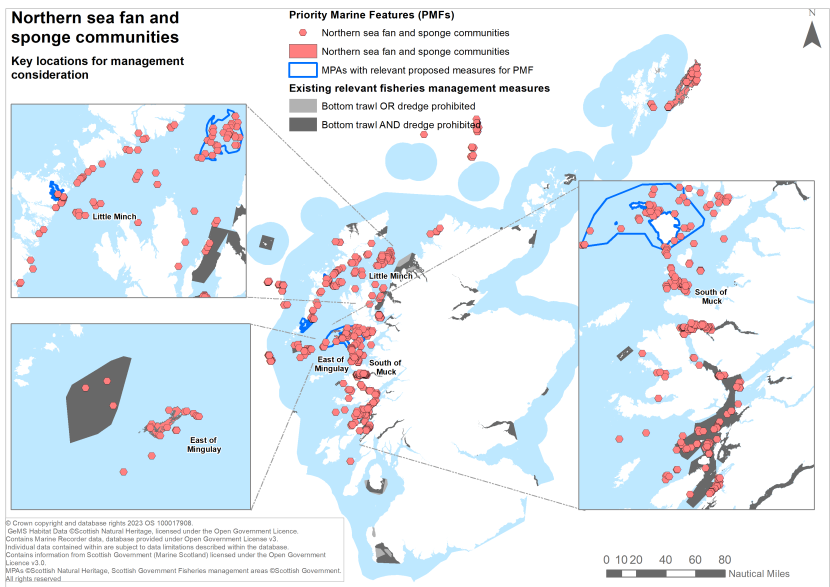
Key locations for the protection of northern sea fan and sponge communities outside of MPAs with management measures and existing towed bottom-contacting fisheries restrictions
Click for a full description
For further details about the locations marked in this map see above, section Key locations for the protection of northern sea fan and sponge communities outside designated sites and existing towed bottom-contacting fisheries restrictions.
References
Bell, J.J. 2008. The functional role of marine sponges. Estuarine, Coastal and Shelf Science, 79(3): 341-353.
Beuck, L., Vertina, A., Stepina, E., Karolczak, M. & Pfannkuche, O. 2007. Skeletal response of Lophelia pertusa (Scleractinia) to bioeroding sponge infestation visualized with micro-computed tomography. Facies, 53: 157-176.
Boulcott, P. & Howell, T.R.W. 2011. The impact of scallop dredging on rocky-reef substrata. Fisheries Research, 110(3): 415-420.
Boulcott, P., Millar, C.P. & Fryer, R.J. 2014. Impact of scallop dredging on benthic epifauna in a mixed-substrate habitat. ICES Journal of Marine Science, 71(4): 834-844.
Brown, L.S., Green, S.L., Stewart, H.A., Diesing, M., Downie, A.-L., Cooper, R. & Lillis, H. 2017. Semi-automated mapping of rock in the Irish Sea, Minches, western Scotland and Scottish continental shelf. Peterborough: Joint Nature Conservation Committee. JNCC Report No. 609, 29 pages.
Callaway, A. 2015. CEND0915 cruise report: Monitoring at Haig Fras candidate Special Area of Conservation / Site of Community Importance and East of Haig Fras Marine Conservation Zone. JNCC/Cefas Partnership Report Series No. 5, 110 pages.
Connor, D.W., Allen, J.H., Golding, N., Howell, K.L., Lieberknecht, L.M., Northen, K.O. & Reker, J.B. 2004. The National Marine Habitat Classification for Britain and Ireland Version 04.05. In: JNCC. 2015. The Marine Habitat Classification for Britain and Ireland Version 15.03 [on-line]. ISBN 1 861 07561 8.
Davies, A.J., Green, S.L., Long, D. & Roberts, J.M. 2009. Developing the necessary data layers to inform the development of a site boundary for the East Mingulay dSAC - Phase II. Scottish Natural Heritage Commissioned Report No. 306.
Dipper, F. (Ed.). 2016. Intertidal and sublittoral survey of islands within the Staffa Island group, Inner Hebrides. September 16-20, 2016. Porcupine Marine Natural History Society Field Trip Report.
Envision Mapping Ltd. 2014. Predictive Mapping of MPA protected features within selected possible Nature Conservation MPAs in Scottish territorial waters using available datasets. Scottish Natural Heritage Commissioned Report No. 600.
European Commission. 2013. Interpretation manual of European Union habitats. EUR 28, 144 pages.
Freese, J.L. 2001. Trawl-induced damage to sponges observed from a research submersible. Marine Fisheries Review, 63(3): 7-13.
Freese, L., Auster, P.J., Heifetz, J. & Wing, B.L. 1999. Effects of trawling on seafloor habitat and associated invertebrate taxa in the Gulf of Alaska. Marine Ecology Progress Series, 182: 119-126.
Gallego, A., Gibb, F.M., Tulett, D. & Wright, P.J. 2013. Connectivity of Benthic Priority Marine Species within the Scottish MPA Network. Scottish Marine and Freshwater Science, 4(2).
Goodwin, C., Edwards H., Breen, J. & Picton, B. 2011. Rathlin Island - A survey report from the Nationally Important Marine Features Project 2009-2011. Northern Ireland Environment Agency Research and Development Series No. 11/03.
Hill J., Pearce, B., Georgiou, L., Pinnion, J. & Gallyot, J. 2010. Meeting the MPA Network Principle of Viability: Feature specific recommendations for species and habitats of conservation importance. Natural England Commissioned Report No. 043.
Hinz. H., Tarrant, D., Ridgeway, A., Kaiser, M.J. & Hiddink, J.G. 2011. Effects of scallop dredging on temperate reef fauna. Marine Ecology Progress Series, 432: 91-102.
Hiscock, K. 1994. Marine communities at Lundy - origins, longevity and change. Biological Journal of the Linnean Society, 51(1-2): 183-188.
Hiscock, K. 1996. Marine Nature Conservation Review: rationale and methods. Peterborough: Joint Nature Conservation Committee. Coasts and seas of the United Kingdom. MNCR series.
Hiscock, K., Southward, A., Tittley, I., Jory, A. & Hawkins, S. 2001. The impact of climate change on subtidal and intertidal benthic species in Scotland. Scottish National Heritage Research, Survey and Monitoring Report 182.
Howson, C.M., Clark, L., Mercer, T.S. & James, B. 2012. Marine biological survey to establish the distribution and status of fan mussels Atrina fragilis and other Marine Protected Area (MPA) search features within the Sound of Canna, Inner Hebrides. Scottish Natural Heritage Commissioned Report No. 438.
Jennings, S. & Kaiser, M.J. 1998. The effects of fishing on marine ecosystems. Advances in Marine Biology, 34: 201-212.
Lancaster, J. (Ed.), McCallum, S., Lowe A.C., Taylor, E., Chapman A. & Pomfret, J. 2014. Development of detailed ecological guidance to support the application of the Scottish MPA selection guidelines in Scotland’s seas. Scottish Natural Heritage Commissioned Report No. 491. Supplementary documents.
Løkkeborg, S. 2005. Impacts of trawling and scallop dredging on benthic habitats and communities. Rome: FAO Fisheries Technical Paper. No. 472, 58 pages.
Malthus, T.J., Harries, D.B., Karpouzli, E., Moore, C.G., Lyndon, A.R., Mair, J.M., Foster-Smith, B., Sotheran, I. & Foster-Smith, D. 2006. Biotope mapping of the Sound of Harris, Scotland. Scottish Natural Heritage Commissioned Report No. 212.
MERC Consultants. 2009. Surveys of sensitive sublittoral benthic communities in Kenmare River SAC, Tralee Bay & Maharee Islands West to Cloghane SAC. Report to the National Parks and Wildlife Service, Galway.
Miller, F., McCallum, S., White, A., Azzarello, J. & Caryl, F. 2017. Predictive mapping of seabed features within selected Special Areas of Conservation and Nature Conservation MPAs in Scottish territorial waters using available datasets. Scottish Natural Heritage Commissioned Report No. 980.
Minchin, D. 1987. Swiftia pallida Madsen (Coelenterata: Gorgonacea) in Irish waters, with a note on Pseudanthessius thorelli (Brady) (Crustacea: Copepoda) new to Ireland. Irish Naturalists' Journal, 22(5): 183-185.
Moore, C.G. 2012. An assessment of the conservation importance of benthic epifaunal species and habitats identified during a series of research cruises around NW Scotland and Shetland in 2011. Scottish Natural Heritage Commissioned Report No. 507.
Moore, C.G. 2013. Biological analyses of underwater video from research cruises in Lochs Kishorn and Sunart, off the Mull of Kintyre and islands of Rum, Tiree and Islay, and in the Firth of Lorn and Sound of Mull approaches. Scottish Natural Heritage Commissioned Report No. 574.
Moore, C.G. 2014. Biological analyses of underwater video from proposed marine protected areas, renewable energy sites and spoil grounds around Scotland. Scottish Natural Heritage Commissioned Report No. 746.
Moore, C.G. 2015. Biological analyses of underwater video from research cruises in marine protected areas and renewable energy locations around Scotland in 2014. Scottish Natural Heritage Commissioned Report No.819.
Moore, C.G. 2017. Biological analyses of underwater video from ongoing monitoring and research cruises in Lochs Sunart, Etive and Alsh, sea lochs off South Skye, the Sounds of Barra and Arisaig and around the Southern Trench. Scottish Natural Heritage Commissioned Report No. 959.
Moore, C.G. 2020. Biological analyses of underwater video from monitoring and research
cruises carried out from 2017 to 2019 in the Sounds of Barra and Mull, Lochs Sunart, Alsh
and Carron, the Inner Sound, and off the Small Isles and east of Shetland. NatureScot
Research Report No. 1229.
Moore, C.G. & Atkinson, R.J.A. 2012. Biological analyses of underwater video from research cruises in the Clyde Sea, Loch Torridon and the Inner Sound, the North Minch, Loch Eriboll and off Orkney. Scottish Natural Heritage Commissioned Report No. 536.
Moore, C.G., Harries, D.B., Porter, J.S. & Lyndon, A.R. 2010. The establishment of site condition monitoring of the marine features of Loch Laxford Special Area of Conservation. Scottish Natural Heritage Commissioned Report No. 378.
Moore, C.G. & Roberts, J.M. 2011. An assessment of the conservation importance of species and habitats identified during a series of recent research cruises around Scotland. Scottish Natural Heritage Commissioned Report No. 446.
NatureScot. 2024. Geodatabase of Marine features adjacent to Scotland (GeMS). GeMS V10 (i26).
Picton, B.E. & Goodwin, C.E. 2007. Sponge biodiversity of Rathlin Island, Northern Ireland. Journal of the Marine Biological Association of the United Kingdom, 87(6): 1441-1458.
Readman, J.A.J. 2018. Deep sponge communities. In: Tyler-Walters, H. & Hiscock, K, eds Marine Life Information Network: Biology and Sensitivity Key Information Reviews, [on-line]. Plymouth: Marine Biological Association of the United Kingdom.
Roberts, J.M., Brown, C.J., Long, D., Wilson, C.K., Bates, C.R., Mitchell, A.J. & Service, M. 2004. Mapping INshore Coral Habitats: The Minch Project. Final Report. Scottish Association for Marine Science, 115 pages.
SNH: Scottish Natural Heritage. 2014. Further advice to Scottish Government on the selection of Nature Conservation Marine Protected Areas for the development of the Scottish MPA network. Scottish Natural Heritage Commissioned Report No. 780.
Solandt, J-L. & Duncan, C. 2004. Oberon Bank Seasearch 2003. A report by the Marine Conservation Society for Scottish Natural Heritage.
Stirling, D. 2016. Assessing the conservation benefit of Marine Protected Areas to vulnerable benthic species as illustrated by the fan-mussel, Atrina fragilis. PhD Thesis. University of Aberdeen.
Turrell, W.R., Boulcott. P., Fryer. R., Donnan, D. & Dodd, J. 2014. Conclusions from the Firth of Lorn Science Project 2006-2013. Marine Scotland Science Report 01/14.
Wilson, E. 2007. Northern sea fan (Swiftia pallida). In: Tyler-Walters, H. & Hiscock, K, eds. Marine Life Information Network: Biology and Sensitivity Key Information Reviews, [on-line]. Plymouth: Marine Biological Association of the United Kingdom.
Wilson, J.B. 1979. 'Patch' development of the deep-water coral Lophelia pertusa (L.) on Rockall Bank. Journal of the Marine Biological Association of the United Kingdom, 59(1): 165-177.
Wulff, J. 2001. Assessing and monitoring coral reef sponges: Why and how? Bulletin of Marine Science, 69: 831-46.