Priority Marine Feature - Blue mussel beds
Improving the protection given to Priority Marine Features (PMFs)
Blue mussel beds occur from areas where they are exposed at low tide (intertidal), to areas always covered by water (subtidal). Both habitats are classified as Priority Marine Features. The PMF management areas being proposed, however, only consider subtidal blue mussel beds.

An overview of blue mussel bed records
Description
Characteristics
At high densities, blue mussels (Mytilus edulis) form beds on subtidal sediments. The mussels attach to the substratum and to each other using tough threads (known as byssus) to create a distinctive multi-layered framework that stabilises the sediments and can extend over several hectares. Silt, organic detritus and shell debris accumulate within the bed. In this way, blue mussel beds modify sedimentary habitats and provide a habitat for a diverse community of animals and plants living on, within, or under the bed (Buschbaum et al., 2009). Intertidal blue mussel beds are not considered because there are no overlaps with towed bottom-contacting fisheries. Similarly, records of subtidal blue mussel beds on rock in reduced salinity conditions are considered inaccessible to towed gear and this component of the blue mussel beds PMF has therefore also been excluded from the review.
Definition
Blue mussels should provide at least 20% cover of subtidal sediments over an area of at least 5 m x 5 m to qualify as a bed. This definition is informed by the OSPAR case study report for intertidal blue mussel beds on mixed and sandy sediment (OSPAR, 2010), which indicates that the ecosystem engineering effect caused by the mussels is most apparent under high densities, when substrate binding and habitat provision for other plants and animals occur. Blue mussel beds are slightly elevated (though rarely exceeding 30-50 cm thick) and support an associated community that is distinct from that inhabiting the surrounding substratum (Holt et al., 1998; Fariñas-Franco et al., 2014).
The patchy nature of most beds makes it difficult to establish their outer boundaries. A working definition used in the Wadden Sea monitoring programmes (Nehls et al., 2009) proposes that small habitat patches (of at least 1-2 m diameter) may be considered part of a bed if they are within 25 m of other larger patches of habitat and if the small areas collectively cover more than 5% of the seabed. Habitat patches >25 m apart should be considered as distinct, separate beds (Fariñas-Franco et al., 2014).
Environmental preferences
Blue mussel beds occur in areas of moderately strong water movement (1 to 3 knots or 0.5-1.5 m/sec.) in the shallow sublittoral (down to ~10 m depth). They develop principally on mixed sediments but also on sands and muds. Blue mussels are generally tolerant to a range of temperature, salinity, oxygen concentration and water quality conditions (Holt et al., 1998; Fariñas-Franco et al., 2014).
Distribution
Scottish distribution
Subtidal blue mussel beds are restricted to a few scattered locations in lochs and firths including the Solway Firth, Firth of Clyde, Loch Creran, Loch Ailort, Dornoch Firth, Moray Firth (Moore, 2016), Firth of Tay and Whiteness Voe in Shetland.
Estimated known Scottish extent
The largest known subtidal blue mussel beds are in the Firth of Tay (estimated to cover an area of ~335 ha; Miller et al., 2017). Several discrete beds exceeding 35 ha in size were formerly known from the Dornoch Firth (Bromham, 2010); although a 2016 survey concluded that the extent of most subtidal beds has decreased with only isolated clumps of mussels and small beds <1 hectare observed (Cook et al., 2016).
Wider distribution
Blue mussels are ubiquitous throughout the world’s temperate waters but are most commonly encountered in exposed or moderately wave-exposed areas. Beds of the species are restricted to shallow areas with suitable substrates. In the UK, M. edulis is hybridised to varying degrees with two other mytilids, M. galloprovincialis and M. trossulus, and authors often refer to a “Mytilus edulis complex” rather than to a single species (Mathiesen et al., 2016).
Status
Subtidal blue mussel beds on sediment are recognised as biogenic reefs (Holt et al., 1998; Maddock, 2008), which can be part of reefs, large shallow inlets and bays and estuaries protected in Special Areas of Conservation (SACs) under Annex 1 of the EU Habitats Directive (European Commission, 2013). The Directive is transposed into domestic legislation through The Conservation (Natural Habitats, &c.) Regulations 1994 (as amended in Scotland) (Habitats Regulations).
Blue mussels are a commercially targeted species and subtidal beds have been fished for hundreds of years. McKay & Fowler (1997) report multiple beds across Scotland in the 1990s, from the Solway Firth to Loch Fyne and Laxford Bay, with the majority of landings from the east coast, particularly the Dornoch Firth and the Montrose Basin.
Almost all blue mussel beds recognised as a protected feature of an MPA (e.g. as a biogenic reef or as part of a broader estuary feature) are, or have been, exploited historically (Holt et al., 1998). The approach adopted for qualifying beds within MPAs is generally to ensure that blue mussel stocks remain above a threshold that secures the long-term sustainability of the resource and that guarantees wading bird populations that rely on blue mussels as a source of food are not impacted (Moore, 2009; Stillman et al., 2010).
Declines in blue mussels have been reported globally (Baden et al., 2021). The reasons for the declines are uncertain and despite the overall reduction in Mytilus sp. abundance, reports have suggested that there is a high degree of local variation in these declines.
The Dornoch Firth was once the largest mussel producer in the UK with two vessels operating and landings of over 2500 tonnes in 1991 (McKay & Fowler, 1997). Mussel scalps were dredged to thin out the beds and mussels were also moved around within the firth to enhance growing rates. Cook et al. (2016) report a substantial decline in subtidal mussel beds in the Dornoch Firth with scattered, small (<1 ha) beds likely to be the remains of larger beds present in the 1990s and later reported by BMT Cordah (2004) and Bromham (2012). In 2016/17 the mussel fishery in the Dornoch Firth was 'rested’ on the basis of professional advice to allow the stock to recover to former levels prior to any fisheries activity restarting (The Highland Council, 2017).
Drivers for improving protection
Blue mussel beds are included on the PMF list which means that National Marine Plan General Policy 9(b) (avoiding significant impact on national status) applies. The Scottish Biodiversity Strategy to 2045, the Scottish Biodiversity Duty and UK Marine Strategy Good Environmental Status provide further drivers to ensure biological diversity is restored, and ecosystems are safeguarded.
Sensitivity (including recovery)
[Key sources: FeAST, Fisheries Management Guidance]
Blue mussel beds are sensitive to various pressures, particularly habitat structure changes, physical loss of habitat and removal of substratum. Mass mortalities of blue mussels can occur due to hypoxia (Fariñas-Franco et al., 2014). Blue mussels can also be out-competed by the slipper limpet Crepidula fornicata (Mainwaring et al., 2014).
Activities such as towed bottom-contacting fishing (targeted or accidental), anchoring, pollution and potential development can all impact subtidal blue mussel beds. Over-exploitation of subtidal beds may reduce subsequent recruitment, although this relationship is poorly understood. Blue mussel populations are considered to have a strong ability to recover from environmental disturbance but annual recruitment cannot always be guaranteed (i.e. it is episodic). Recovery potential is therefore thought to be variable (Mainwaring et al., 2014; Tillin & Mainwaring, 2016).
Blue mussel beds may be vulnerable to future climate impacts associated with salinity changes, increased storminess, marine heatwaves and ocean acidification (Seuront et al., 2019, Mainwaring et al., 2014, OARUG, 2009). Blue mussels exhibit reduced growth and altered material properties when grown under future projected ocean acidification conditions (Fitzer et al., 2014). The blue mussel shells harden and the reduction in elasticity makes them more prone to fracture in stormy conditions and vulnerable to predation (Fitzer et al., 2014). Ocean acidification may also weaken the byssus threads that attach the mussels to the seabed or shoreline increasing the likelihood of detachment (O’Donnell et al., 2013; Zhao et al., 2017).
Connectivity
Between subtidal blue mussel beds
Spawning and successful settlement by blue mussels is sporadic and unpredictable (Seed and Brown, 1977) and can be influenced by a number of factors including temperature, the presence of neap tides, lunar cycles and current pathways (Demmer et al., 2022). Larvae stay in the plankton for between 20 days and two months depending on water temperature (Bayne, 1976) and can delay metamorphosis for 6 months in unfavourable conditions (Lane et al., 1985). Connectivity between blue mussel beds is typically linked to tidal currents (Larsson et al., 2017) and wind driven currents (Demmer et al., 2022), with evidence that larvae can travel more than 25 km, 1 week after spawning (Demmer et al., 2022). This long pelagic larval dispersal phase may result in high potential connectivity with beds >80 km apart in the Wadden Sea genetically similar (Steinert et al., 2012). In Scotland, beds have been found to be genetically similar to beds in Svalbard, with the potential of flotsam acting as stepping stones by providing a surface for blue mussel settlement (Kotwicki et al., 2021). Further analysis using particle tracking models suggests that larvae from beds off the West Coast of Scotland can travel up to 170 km from source (Corrochano-Fraile et al., 2022).
Intertidal mussel beds are more common than subtidal beds and sometimes continue into the subtidal where the substrate is suitable. It is likely that subtidal beds rely on a supply of larvae from intertidal beds in places and vice versa. In this way, intertidal beds may act as stepping stone populations to maintain connectivity of subtidal populations. On the other hand, there is evidence that mussels can be adapted to a variety of environments from offshore to inshore high salinity showing a degree of phenotypic plasticity. This can limit connectivity between populations as whilst areas may be connected via ocean currents, species may be adapted to different environment to the colonised site (Larsson et al., 2017; Kijewski et al., 2019). Further research is required to better understand connectivity of blue mussel beds.
With other PMFs
Subtidal blue mussel beds have been reported from the same location as the horse mussel beds PMF in the Dornoch Firth (The Highland Council, 2017) although the latter PMF is more commonly encountered in deeper waters.
Subtidal blue mussel beds on sediment are believed to compete for space with reefs of the honeycomb worm Sabellaria alveolata in the outer part of the Solway Firth (Axelsson et al., 2006). S. alveolata is not a PMF in Scottish waters because it reaches its northerly limit in the Solway Firth, but is a habitat of nature conservation importance that, like blue mussels, forms biogenic reefs recognised under the EU Habitats Directive.
Ecosystem services
Blue mussel beds have a role in physical coastal protection and sediment stabilisation. The habitat provided by blue mussels support a number of other species and contributes to the protection of biodiversity. Blue mussels also have an important role in nutrient cycling as well as in filtering sea water and removing potentially toxic algae and are an important source of food for a range of species including wildfowl, seabirds and humans.
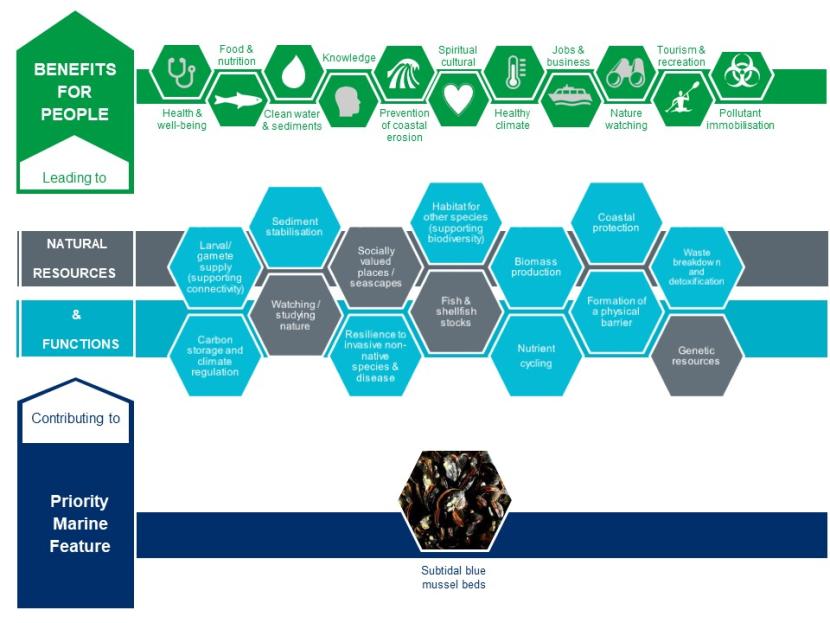
The contribution blue mussel beds make to natural resources and functions and the benefits for people that these lead to. Subtidal blue mussel beds contribute to the following functions:
Click for a full description
- Priority Marine Feature: Subtidal blue mussel beds contributing to
- Natural resources (NR) and functions (F)
- Laval/gamete supply (supporting connectivity (F)
- Sediment stabilisation (F)
- Carbon storage and climate regulation (F)
- Watching/studying nature (NR)
- Socially valued places/seascapes (NR)
- Resistance to invasive non-native species & disease (F)
- Habitat for other species (supporting biodiversity) (F)
- Fish & shellfish stocks (NR)
- Biomass production (F)
- Nutrient cycling (F)
- Coastal protection (F)
- Formation of a physical barrier (F)
- Waste breakdown and decalcification (F)
- Genetic resources (NR)
- Which leads to benefits for people
- Health & well-being
- Food and nutrition
- Clean water & sediments
- Knowledge
- Prevention of coastal erosion
- Spiritual/cultural
- Healthy climate
- Jobs & business
- Nature watching
- Tourism & recreation
- Pollutant immobilisation
Existing Marine Protected Areas
Blue mussel beds on subtidal sediments are a protected feature of three MPAs: Firth of Tay and Eden Estuary; Dornoch Firth and Morrich More; and Solway Firth.
Existing and proposed fishing measures providing PMF protection
Blue mussel beds are protected by the following existing fishing measures:
- The Inshore Fishing (Scotland) Order 2015 (Upper Loch Fyne and Loch Goil and Loch Creran).
- The St Andrew’s Bay (CA80), Dornoch Firth (CA72) and Inverness Firth (CA74) fisheries areas.
New fishing measures are proposed which will protect blue mussel beds in the following MPAs:
- Sound of Arisaig; Moray Firth; Firth of Tay and Eden Estuary; and Dornoch Firth and Morrich More.
Proposed measures in the Dornoch Firth are expected to derogate the Tain blue mussel fishery from wider mechanical dredge prohibitions and enable future fishing subject to satisfying a Habitats Regulation Appraisal (HRA) for the SAC.
The cockle fishery within the Solway Firth SAC is currently closed and there are significant spatial and technical restrictions in place for the shrimp fishery.
Approach to assessing improvements in management needed to protect blue mussel beds from impacts related to towed bottom-contacting fishing gear
The assessment presented in this document relates to fishing using towed bottom-contacting gear only. It is consistent with the approach taken for assessing proposed developments.
When considering biodiversity evidence more weight has been given to clusters of blue mussel records and records which show the extent of blue mussel beds (i.e. polygon data) where available, in preference to isolated observations. There has been particular consideration of larger beds in comparison to smaller ones (where extent is known), except where smaller or fragmented beds are the only remaining examples in a geographic area and require protection to support recovery of the PMF.
Consideration of key locations for blue mussel beds has included ensuring the areas/locations are distributed to cover the full range of environmental conditions in which blue mussel beds occur (e.g. sea loch vs. coastal, depth, geographic range, substrate, etc.), and the connectivity of beds.
A greater biological diversity of associated faunal and floral communities and greater bed extents are factors which increase the conservation importance of a bed. Information on these characteristics does not exist for all records in Scottish waters precluding their detailed application in this assessment. However, such information should be sought and used in development licensing and consenting processes.
Any towed bottom-contacting fishing activity that leads to the loss of entire beds or damage to beds, such that function or provision of ecosystem services cannot be maintained should be considered to have a significant impact on national status and as a result not meet General Policy 9(b) in the National Marine Plan. We expect existing licensing and consenting processes will continue to consider the potential for significant impacts on subtidal blue mussel beds.
Key locations for the protection of blue mussel beds outside designated sites and existing towed bottom-contacting fisheries restrictions
Summary
We recommend that the development of spatial fisheries measures to protect blue mussel beds from pressures associated with towed bottom-contacting gears should cover records of the feature within the following key locations (outside of MPAs that protect this feature and areas with existing fisheries measures). These are shown in Map 2: Loch Long (upper) and Whiteness Voe.
The recommendations for subtidal blue mussel beds need to be considered alongside the recommendations for the other 10 PMFs considered as part of the development of PMF management areas. These recommendations are based on biodiversity evidence taking into consideration the information above and have been provided to help inform the development of fishing measures, led by Marine Directorate.
If fisheries management measures were established to protect records in all these key locations it would achieve substantial protection for blue mussel beds, complementing the protection already in place for some MPAs and proposed for other MPAs (see map 2).
Details of locations
Blue mussel beds were recorded in 2012 and 2018 close to horse mussel beds and intertidal blue mussel beds in Loch Long (upper). The 2012 record is within the Coulport Fishing Exclusion Area, and the 2018 record is within the Clyde Dockyard Port of Loch Long fisheries area, although it is unclear if dredging is prohibited.
A blue mussel bed was recorded at the head of Whiteness Voe in Shetland in 1994 and is present alongside seagrass bed records. It is the most northenly known bed in Scotland and the only record of blue mussel beds in the northern isles. Whiteness Voe is one of the SSMO prohibition areas which is closed to dredging.
Fisheries management in the Dornoch Firth
Subtidal beds within the Dornoch Firth are considered managed because proposed measures would prohibit bottom-contacting fishing gear. However, a derogation is proposed for the Tain blue mussel dredge fishery to continue on its current basis providing that it satisfies a HRA.
Fisheries management should aim to limit levels of exploitation to a point which allows beds to persist over the long-term and maintain associated biodiversity. Where historic exploitation has reduced the extent of beds, management of effort may be necessary in order to allow recovery. In light of the declines observed in both the extent and abundance of subtidal blue mussel beds across the firth, it is recommended that the HRA be informed by further and ongoing assessment of the current status of the blue mussel beds (which should encompass parameters such as area covered, biomass, and adult mussel abundance; see Fariñas-Franco et al., 2014 for further details). Formalising spatial restrictions to protect a recently mapped horse mussel bed and associated fragile sponge communities in the outer part of the estuary should also be considered. The responsible approach taken by Highland Council and Tain Community Council in resting the blue mussel fishery until 2005 levels of stocks are reached again; stipulating the need for a future stock assessment survey that can inform HRA; and, in identifying the horse mussel bed as a sensitive area to be avoided if the fishery re-starts (The Highland Council, 2017) is recognised and welcomed.
It is currently unclear whether the declines observed in the Dornoch Firth blue mussel beds reflect a broader picture across the North Sea (OSPAR, 2010). Surveys of rocky shores around the Scottish coastline over the last 20 years have seen a marked decline in blue mussels (Burrows et al., 2017) with comparable observations from more localised studies (e.g. Moore & Howson, 2014; Wallace, 2016). Declines in mussel species have also been charted on the east coast of the USA (Sorte et al., 2016) and on the Pacific west coast of North America, where the changes were associated with a decadal decline in nearshore pH levels (Wootton et al., 2008). Blue mussel populations have been known to fluctuate in abundance historically over similar timescales so it is inappropriate to infer a long-term climatic effect on Scottish mussel populations but due consideration should be given to the wider status of blue mussels as part of the Dornoch Firth HRA process.
Fisheries management in the Solway Firth
In the Solway Firth, very high densities of blue mussels were recorded (10,500 individuals per 0.1 m2) in Silloth Channel in 2004 (Axelsson et al., 2006). High densities of blue mussels were recorded at an additional site during the 2004 survey but this was assigned to a honeycomb worm habitat due to the high abundance of Sabellaria alveolata (Axelsson et al., 2006). Horse mussel beds have also been reported from subtidal scar grounds in the Solway Firth (Cutts & Hemmingway, 1996; Allen et al., 1999, records not in GeMS), although, the authors suggest that these beds may be short lived due to fishing pressures (Allen et al., 1999). Both blue mussels and horse mussels have been identified in previous studies within the Solway Firth (Williams et al., 1965; Perkins, 1968; 1986). The mussel scars in the Solway Firth may be quite ephemeral, with newly formed beds appearing each year following spat settlement events only to be washed away by storms, suggesting that their exact location and extent will continue to be highly variable (Fariñas-Franco et al., 2014).
Marine Directorate consider the existing spatial and technical restrictions in place for the only two fisheries of note (shrimp and cockle fisheries) sufficient to protect the seabed habitats within the MPA but it is currently unclear how these fishing activities relate to the blue mussel beds. There are records of opportunistic landings of mussels from subtidal beds in the Solway by brown shrimp dredgers (see McKay & Fowler, 1997).
Data confidence
We have recent records from 2020. Surveys vary in their original aims from Seasearch (carried out by volunteer divers); to studies undertaken to inform development proposals and dedicated MPA-related nature conservation assessments (e.g. the 2004 SNH survey in the Solway Firth).
Blue mussel bed stock assessment data collected in the Dornoch Firth in 2016 were also considered as part of this assessment (Cook et al., 2016; The Highland Council, 2017). The work, which was undertaken by experienced marine biologists, explored earlier intertidal and subtidal mussel bed records using drop-down video, diver-based density estimates and shore-based, structured walk methodologies.
Knowledge gaps and other records
We recommend continuing efforts to explore opportunities for collaborative monitoring, survey and research to improve our understanding of this habitat, for example:
- This feature is likely to be under-recorded, additional subtidal blue mussel beds may be identified around the Scottish coastline.
- Future targeted surveys should be guided by species distribution / habitat suitability modelling studies as well as knowledge of historic presence. It is possible that beds exist within formerly exploited areas such as the Firth of Forth and possible records could be investigated in Largs marina. The extent of the existing subtidal records that sit alongside other PMF records in Loch Long and Whiteness Voe could also be further explored.
- Some records not accessible to towed bottom-contacting fishing gear have not been considered as part of this process.
Key locations for the protection of blue mussel beds
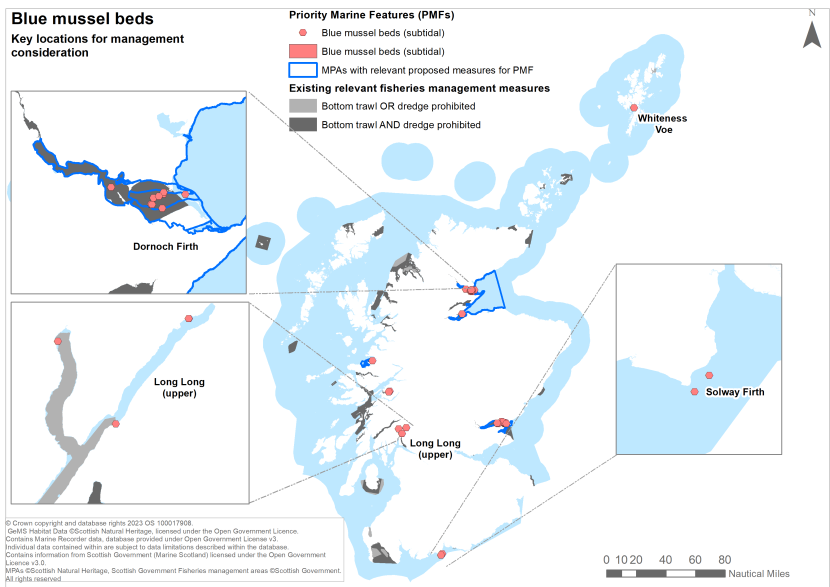
Key locations for the protection of blue mussel beds outside of MPAs with management measures and existing towed bottom-contacting fisheries restrictions
Click for a full description
For further details about the locations marked on this map see above, section Key locations for the protection of blue mussel beds outside designated sites and existing towed bottom-contacting fisheries restrictions.
References
Allen, J., Cutts, N., Elliott, M., Hemingway, K. & Read, S. 1999. Solway Firth - Marine SAC mapping subtidal sediments and scars. Scottish Natural Heritage Report No. ZO93-F-99.
Axelsson, M., Dewey, S., Tourell, A. & Karpouzli, E. 2006. Site condition monitoring - the sublittoral sandbanks of the Solway Firth. Scottish Natural Heritage Commissioned Report No. 155.
Baden, S., Hernroth, B. and Lindahl, O. 2021. Declining Populations of Mytilus spp. in North Atlantic Coastal Waters—A Swedish Perspective. Journal of Shellfish Research, 40(2): 269-296.
Bayne, B.L. (ed.). 1976. Marine mussels: their ecology and physiology. Cambridge: Cambridge University Press. International Biological Programme 10.
BMT Cordah. 2004. Site condition monitoring: Survey of estuarine environments in the Dornoch Firth and Morrich More SAC. Unpublished Scottish Natural Heritage Commissioned Report.
Bromham, J. 2010. Tain Mussel Fishery - Dornoch Firth, Mussel Stock Survey 2010. Highland Council Planning and Development Service, 12 pages.
Bromham, J. 2012. Tain Mussel Fishery - Dornoch Firth, Mussel Stock Survey - March / April 2012. Highland Council Planning and Development Service, 10 pages.
Burrows, M.T., Twigg, G., Mieszkowska, N. & Harvey, R. 2017. Marine Biodiversity and Climate Change (MarClim): Scotland 2014/15. Scottish Natural Heritage Commissioned Report No. 939.
Buschbaum, C., Dittmann, S., Hong, J.S., Hwang, I.S., Strasser, M., Thiel, M., Valdivia, N., Yoon, S.P. & Reise, K. 2009. Mytilid mussels: Global habitat engineers in coastal sediments. Helgoland Marine Research, 63: 47-58.
Cook, R.C., Cordingley, A., Woolmer, A.P. & Sanderson, W.G. 2016. Mussel bed stock assessment for the Tain mussel fishery, Dornoch Firth. Report to the Highland Council by Heriot Watt University, 14 pages.
Corrochano-Fragile, A., Adams, T.P., Aleynik, D., Bekaert, M. & Carboni, S. 2022. Predictive biophysical models of bivalue larvae dispersal in Scotland. Frontiers in Marine Science, 9: 985748.
Cutts, N. & Hemmingway, K. 1996. The Solway Firth: broad scale habitat mapping. Scottish Natural Heritage Research, Survey and Monitoring Report No. 46.
Demmer, J., Robins, P., Malham, S., Lewis, M., Owen, A., Jones, T. & Neill, S. 2022. The role of wind in controlling the connectivity of blue mussels (Mytilus edulis L.) populations. Movement Ecology, 10(1): 3.
European Commission. 2013. Interpretation manual of European Union habitats. EUR 28, 144 pages.
Fariñas-Franco, J.M., Pearce, B., Porter, J., Harries, D., Mair, J.M., Woolmer, A.S. & Sanderson, W.G. 2014. Marine Strategy Framework Directive indicators for biogenic reefs formed by Modiolus modiolus, Mytilus edulis and Sabellaria spinulosa Part 1: Defining and validating the indicators. Peterborough, Joint Nature Conservation Committee. JNCC Report No. 523.
Fitzer, S.C., Phoenix, V.R., Cusack, M. & Kamenos, N.A. 2014. Ocean acidification impacts mussel control on biomineralisation. Scientific Reports, 4: 6218.
Holt, T.J., Rees, E.I., Hawkins, S.J. & Seed, R. 1998. Biogenic Reefs (Volume IX). An overview of dynamic and sensitivity characteristics for conservation management of marine SACs. Scottish Association for Marine Science (UK Marine SACs Project), 169 pages.
Howson, C.M., Steel, L., Carruthers, M. & Gillham, K. 2012. Identification of Priority Marine Features in Scottish territorial waters. Scottish Natural Heritage Report No. 388.
Jessop, R.W. 2017. WFO mussel stock assessment. Research report 2017. Eastern IFCA (Inshore Fisheries and Conservation Authority), 58 pages.
Kijewski, T., Zbawicka, M., Strand, J., Kautsky, H., Kotta, J., Rätsep, M. & Wenne, R. 2019. Random forest assessment of correlation between environmental factors and genetic differentiation of populations: Case of marine mussels Mytilus. Oceanologia, 61(1): 131-142.
Kotwicki, L., Weslawski, J.M., Włodarska-Kowalczuk, M., Mazurkiewicz, M., Wenne, R., Zbawicka, M., Minchin, D. & Olenin, S. 2021. The re-appearance of the Mytilus spp. complex in Svalbard, Arctic, during the Holocene: The case for an arrival by anthropogenic flotsam. Global and Planetary Change, 202: 103502.
Lane, D.J.W., Beaumont, A.R. & Hunter, J.R. 1985. Byssus drifting and the drifting threads of young post-larval mussel Mytilus edulis. Marine Biology, 84: 301-308.
Larsson, J., Lind, E.E., Corell, H., Grahn, M., Smolarz, K. & Lönn, M. 2017. Regional genetic differentiation in the blue mussel from the Baltic Sea area. Estuarine, Coastal and Shelf Science, 195: 98-109.
Maddock, A. (ed.). 2008. UK Biodiversity Action Plan: Priority Habitat Descriptions. Updated December 2011, 100 pages.
Mainwaring, K., Tillin, H. & Tyler-Walters, H. 2014. Assessing the sensitivity of blue mussel beds (Mytilus edulis) to pressures associated with human activities. Peterborough, Joint Nature Conservation Committee. JNCC Report No. 506.
Mathiesen, S.S., Thyrring, J., Hemmer-Hansen, J., Berge, J., Sukhotin, A., Leopold, P., Bekaert, M., Sejr, M.K. & Nielsen, E.E. 2017. Genetic diversity and connectivity within Mytilus spp. in the subarctic and Arctic. Evolutionary Applications, 10(1): 39-55.
McKay, D.W. & Fowler, S.L. 1997. Review of the exploitation of the mussel Mytilus edulis, in Scotland. Scottish Natural Heritage Review No. 68.
Miller, F., McCallum, S., White, A., Azzarello, J. & Caryl, F. 2017. Predictive mapping of seabed features within selected Special Areas of Conservation and Nature Conservation MPAs in Scottish territorial waters using available datasets. Scottish Natural Heritage Commissioned Report No. 980.
Moore, C.G. 2016. Biological analysis of underwater video and infaunal data from surveys of the Moray Firth SAC. Scottish Natural Heritage Commissioned Report No. 940.
Moore, J.J. 2009. Surveys of cockle and mussel stocks in the Burry Inlet, 2004 to 2008 Report commissioned by the Countryside Council for Wales. Bangor: CCW Marine Monitoring Report No. 34.
Moore, J.J. & Howson, C.M. 2014. Survey of the rocky shores in the region of Sullom Voe, Shetland, July 2013. A report to SOTEAG from Aquatic Survey & Monitoring Ltd., Cosheston, Pembrokeshire, 30 pages + iv.
NatureScot. 2024. Geodatabase of Marine features adjacent to Scotland (GeMS). GeMS V10 (i26).
Nehls, G., Dankers, N. & Ruth, M. 2009. Beds of blue mussels and Pacific oysters. Wadden Sea Ecosystem No. 25.
OARUG (Ocean Acidification Reference User Group). 2009. Ocean Acidification: The Facts. A special introductory guide for policy advisers and decision makers. Laffoley, D. d’A., & Baxter, J.M, eds. European Project on Ocean Acidification (EPOCA), 12 pages.
O’Donnell, M.J., George, M.N. & Carrington, E. 2013. Mussel byssus attachment weakened by ocean acidification. Nature Climate Change, 3: 587-590.
OSPAR. 2010. Intertidal Mytilus edulis beds on mixed and sandy sediments. Quality Status Report 2010. Case Reports for the OSPAR List of threatened and/or declining species and habitats – Update, 5 pages.
Perkins, E.J. 1968. The marine flora and fauna of the Solway Firth area (parts I-III). Transactions of the Dumfriesshire and Galloway Natural History And Antiquarian Society (DGNHAS), 45: 15-43 (part I, 1968); 46: 1-26 (part II, 1969); and, 48: 12-68 (part III, 1971).
Perkins, E.J. 1986. The ecology of scar grounds in the Solway Firth. Transactions Of The Dumfriesshire And Galloway Natural History and Antiquarian Society, 61: 4-19.
Ragnarsson, S.Á. & Raffaelli, D. 1999. Effects of the mussel Mytilus edulis L. on the invertebrate fauna of sediments. Journal of Experimental Marine Biology and Ecology, 241(1): 31-43.
Seed, R., & Brown, R.A. 1977. A Comparison of the Reproductive Cyles of Modiolus modiolus (L.), Ceratoderma (=Cardium) edule (L.), and Mytilus edulis L. in Strangford Lough, Northern Ireland. Oecologia, 30: 178-188.
Seuront, L., Nicastro, K. R., Zardi, G. I. & Goberville, E. 2019. Decreased thermal tolerance under recurrent heat stress conditions explains summer mass mortality of the blue mussel Mytilus edulis. Scientific Reports, 9: 17498.
Sorte, C.J.B., Davidson, V.E., Franklin, M.C., Benes, K.M., Doellman, M.M., Etter, R.J., Hannigan, R.E., Lubchenco, J. & Menge, B.A. 2016. Long‐term declines in an intertidal foundation species parallel shifts in community composition. Global Change Biology, 23(1): 341-352.
Steinert, G., Huelsken, T., Gerlach, G., & Bininda-Emonds, O.R.P. 2012. Species status and population structure of mussels (Mollusca: Bivaliva: Mytilus spp.) in the Wadden Sea of Lower Saxony (Germany). Organisms Diversity & Evolution, 12: 387-402.
Stillman, R.A., Moore, J.J., Woolmer, A.P., Murphy, M.D., Walker, P., Vanstaen, K.R., Palmer, D. & Sanderson, W.G. 2010. Assessing waterbird conservation objectives: An example for the Burry Inlet, UK. Biological Conservation, 143(11): 2617-2630.
The Highland Council. 2017. Tain Common Good - Mussel Fishery. Report by the Director of Development and Infrastructure, Agenda item 6, Report No. RC/004/17.
Tillin, H.M. & Mainwaring, K. 2016. Mytilus edulis beds on sublittoral sediment. In Tyler-Walters, H. and Hiscock, K, eds. Marine Life Information Network: Biology and Sensitivity Key Information Reviews, [on-line]. Plymouth: Marine Biological Association of the United Kingdom
Wallace, N. 2016. Stock assessment of the Edible Mussel (Mytilus edulis) beds on Fenham Flats. Northumberland IFCA (Inshore Fisheries and Conservation Authority), 18 pages.
Williams, B.R.H., Perkins, E.J. & Hinde, A. 1965. The biology of the Solway Firth in relation to the movement and accumulation of radioactive material. III Fisheries and food chains. United Kingdom Atomic Energy Authority. PG report 611 (CC).
Wootton, J.T., Pfister, C.A. & Forester, J.D. 2008. Dynamic patterns and ecological impacts of declining ocean pH in a high-resolution multi-year dataset. Proceedings of the National Academy of Sciences USA, 105(48): 18848-18853.
Zhao, X., Guo, C., Han, Y., Che, Z., Wang, Y., Wang, X., Chai, X., Wu, H. & Liu, G. 2017. Ocean acidification decreases mussel byssal attachment strength and induces molecular byssal responses. Marine Ecology Progress Series, 565: 67-77.