Pollinator Strategy - 2025 Progress Report
Published: June 2026
In our eighth Annual Progress Report we celebrate a wide range of pollinator-friendly projects across Scotland. As with previous years, we acknowledge that progress relies heavily on partnership working and the support of enthusiastic individuals and expert groups. Creating and restoring pollinator-friendly habitats, adopting sympathetic greenspace management, and establishing green corridors remain crucial to restoring pollinator numbers, and these factors are arguably better understood than ever before. But we cannot let our guard down or be complacent, and issues such as climate change and invasive species will doubtless bring new challenges for pollinators.
This year we moved our annual conference from Spring to Autumn to reflect more closely recent fieldwork. From the Ayrshire Nectar Network, to the National Museum of Scotland and Aberdeen City Council, we heard of imaginative projects to help pollinators across Scotland. Overseas speakers allowed us to compare and contrast our approaches to those in a Mediterranean urban setting and in Estonia’s capital Tallinn. We had our biggest conference attendance to date, and feedback suggests the day was stimulating and helpful.
The UK Pollinator Monitoring Scheme surveys continued through 2025 with the highest ever annual total of FIT Counts submitted, a likely reflection of the good weather and increase in local projects getting involved with monitoring through FIT Counts. Results will be published in the PoMS Annual report once the analyses have been carried out.
This report also provides an opportunity to applaud the efforts of Scotland’s Local Authorities and environmental community groups. From Dundee to Lochinver, from the Scottish Borders to Aberdeen, many inspirational projects are making a difference through practical actions.
We will soon turn our attention to the next version of the Pollinator Strategy for Scotland. The current strategy is two years shy of its tenth year, and several lessons can be incorporated in shaping the next 10-year plan. If you would like to help shape that revised strategy, we would love to hear your views and ideas.
Contents
- Our Partners
- Objective 1: Pollinator-friendly habitats
- Objective 2: Understanding pollinators and their pollination services
- Objective 3: Manage commercial use of pollinators to benefit native pollinators
- Objective 4: Raise awareness and encourage action
- Objective 5: Evidence - monitor and evaluate whether Scotland's pollinators are thriving
- Community Group Projects
Our Partners
In December 2015, we launched a consultation inviting views on proposals for pollinator conservation. The responses underlined the need for collaboration across sectors to promote action that would benefit our pollinators.
The resulting Strategy, covering the period 2017 to 2027, includes actions for everyone, from Scottish Government and its agencies to conservation groups, farmers, landowners, managers, gardeners, agricultural businesses, commercial businesses and members of the public.
We are reliant on, and grateful to, the following champions of the Pollinator Strategy for Scotland for their ongoing support and project skills:
- Bee Farmers’ Association
- Bee Health Improvement Team
- Buglife
- Bumblebee Conservation Trust
- Butterfly Conservation Scotland
- Central Scotland Green Network Trust
- Forestry and Land Scotland
- Glasgow City Region Green Network
- Historic Environment Scotland
- James Hutton Institute
- Keep Scotland Beautiful
- National Farmers’ Union, Scotland (NFUS)
- Plantlife
- Royal Botanic Garden Edinburgh
- RSPB Scotland
- Science & Advice for Scottish Agriculture
- Scottish Beekeepers’ Association
- Scottish Environment Protection Agency
- Scottish Farming and Wildlife Advisers’ Group
- Scottish Forestry
- Scottish Government
- Scottish Land & Estates
- Scottish Quality Crops
- Scotland’s 32 local authorities
- Scotland’s Farm Advisory Service
- Scotland’s Rural College
- ScotRail & Network Rail
- Scottish Water
- Scottish Wildlife Trust
- UK Centre for Ecology & Hydrology
- University of Edinburgh
- Woodland Trust
Objectives
Objective 1: Pollinator-friendly habitats
What we need to do:
- Prevent further habitat loss and degradation by maintaining and improving the current diversity of semi-natural habitats,
- Promote the restoration and creation of natural flower-rich habitats in the countryside and in urban areas, to support a national ecological network,
- Retain connected habitat networks for wild pollinators, and extend pollinator habitats to adjacent areas,
- Implement measures to protect and enhance pollinator habitats,
- Recognise the importance of brownfield sites and manage these to benefit pollinators and other species,
- Encourage the inclusion of pollinators’ needs in land management, and development planning and management, through demonstrable biodiversity net gain,
- Incorporate green infrastructure in developments, such as green roofs and rain gardens, to provide additional pollinator habitats, and
- Support the use and development of pollinator-friendly pest control measures, including integrated pest management, in agricultural and urban areas, building on the principles set out in the EU Directive on the Sustainable Use of Pesticides.
Aberdeen City Council reduction of intensive management of public greenspaces. (L)
Organisation(s): Aberdeen City Council
Reduction of intensive management of public greenspaces continues. Aberdeen’s Environmental Services team has adopted a more natural approach to managing many of the city’s greenspaces. This approach brings a collection of actions and covers a range of projects including Spaces for Nature, Aberdeen B-Lines, Aberdeen Communities Together, Flagship Parks for Pollinators, tree planting and Meadow in a Box. In extending naturalised greenspace management to the popular Duthie and Seaton Parks, the Council has visibly improved habitats for pollinators by creating new and improved existing wildflower meadow areas and planting native trees.
Aberdeenshire Pollinator Action Plan (L)
Organisation(s): Aberdeenshire Council
Aberdeenshire Council’s Pollinator Action Plan covers the period to 2027. It recognises the need for urgent action to protect and enhance pollinator populations. The Action Plan is a cross-service document that identifies key areas of Council in alignment with the Pollinator Strategy for Scotland. A key aim is to have 10% of public greenspace managed for pollinators and biodiversity. Yearly monitoring of the plan shows the majority of actions to be on track, with various works being delivered by a range of services within the Council. In 2025 the Council continued to support the B-Lines project by buying schools materials to study and manage their B-Lines sites. The Council is also providing plants and materials to over 100 community groups to enhance habitat for pollinators in public greenspaces. The Council is also progressing refurbishment of greenhouses for growing wildflowers and native trees for use by the Council and community groups. 2025 saw a small trial of local wildflower seed collection and subsequent growing-on as a pilot for a bigger scheme.
Angus coastal grassland and meadow enhancements for pollinators (L) & Montrose Space for Nature project. Changing grass-cutting regime and herbicide application on open sites in Montrose (M) Space for Nature Urban Trees. Strathmore B-Lines. Habitat enhancement and changing cutting regimes. A Place for Everyone (L) (M)
Organisation(s): Angus Council, Tayside Biodiversity Partnership, Butterfly Conservation, Buglife, Sustrans.
- Local communities and Angus Council continued to plant kidney vetch plug plants at numerous sites on the Angus coast to increase habitat connectivity for small blue butterfly. Kidney vetch ‘corridors’ have been enhanced in Angus since 2014.
- Coastal active travel routes at Elliot and Carnoustie have been enhanced for pollinators with kidney vetch introduced on bare ground where path upgrades have taken place along the National Cycle Network. This approach has been expanded in Montrose where kidney vetch was planted along ditch and berms in 2025. This planting connects well with the ongoing Space for Nature cycle path in Montrose where the number of cuts have been reduced. A 2km stretch of the cycle path is now down from 16 to two cuts per year, and yellow-rattle seeding has taken place, with the aim of suppressing grasses to allow wildflowers (and thus pollinators) to thrive. Following a change to the cutting regime at Curlie and Borrowfield ponds in Montrose, pollinator habitat around the boundary of the ponds continues to improve. These areas enhance pollinator corridors across the town and out into the neighbouring rural area.
- Nature Network connectivity has been improved through tree-lined corridors across Angus settlements. Gaps were identified across several towns and villages. Over 650 standard trees and 154m of hedgerow have been planted since 2021, including 159 trees during 2025. Species are selected to benefit pollinators and other wildlife including silver birch, hawthorn, holly, crab apple, rowan, and willow species. Through the Space for Nature project, various sites in Montrose and Arbroath are managed for pollinators and this approach will be rolled out in more Angus burghs.
- The Strathmore B-lines People and Pollinators project was implemented in 2023. The project spans from Dunkeld to Montrose and Angus Council have committed to manage 2.35 ha of land for pollinators at various Angus locations including Montrose, Edzell, Kirriemuir, Brechin, and Glen Lethnot. Management of these areas includes introduction of yellow rattle and locally sourced native seed mixed where appropriate, introduction of native plugs, changes to cutting regimes to once annual cut and removal of cuttings in autumn or twice annual in identified areas with the addition of a spring cut and removal.
- The A92 active travel scheme through Arbroath has included pollinator-friendly biodiversity enhancement through landscaping along the 1.5km stretch of cycleway. Improvements include coastal biodiversity planting and avenues of trees which link with biodiversity improvements implemented along the National Cycle Network.
Pollinator habitat creation
Organisation(s): Argyll & Bute Council
A range of activities carried out included working with RePollinate on its Beds for Bees scheme, and supporting local community groups to create pollinator-friendly planting schemes across Argyll and Bute. The Friends of Hermitage Park in Helensburgh (and the Council Amenities Team) created wildflower areas within the park to benefit pollinators. The Council established a roadside verge and grass management scheme with Roads and Amenities Team to create Nature Networks for pollinators. Participation in ‘No Mow May’ and ‘Let It Bloom’ in June raised awareness of the importance of pollinators to members of the public. Biodiversity enhancement through native wildflower planting to benefit pollinators was carried out in new developments. Nature Restoration Funding allowed for the planting of native trees, shrubs and perennial plants in and around Argyll and Bute, including at Bowmore, Kilmory and Dunoon. Finally, tree-planting within the grounds of 34 schools, and play-park enhancements successfully introduced pollinator habitats to various amenity areas.
Pollinator friendly approaches in Clackmannanshire
Organisation(s): Clackmannanshire Council
A proposed Pollinator Strategy 2024-2029 went out to consultation in autumn 2024. 400 Managed for Wildlife signs aimed at raising public awareness of new management of greenspace areas have been used. Great Outdoors, an Ochil Youth Project, included planting and growing in key locations for pollinators. Pollinator-friendly habitat creation and management was carried out in Alva Glen, Devon Meadow, Blairlogie Meadows, Menstrie, and Tillicoultry Glen.
Pollinator-friendly approaches in the Western Isles. (M)
Organisation(s): Comhairle nan Eilean Siar
The Nature Restoration Fund (NRF) programme in the Western Isles continues to support work that benefits pollinators through habitat creation, restoration, and management. In particular: RSPB Corncrake Land Management sees ongoing support for crofters to maintain corncrake-friendly practices such as delayed mowing and seasonal grazing. These low-intensity management approaches sustain wildflower meadows that provide both nesting cover and rich foraging habitat for pollinators. Bumblebee Conservation Trust – No Fence Collars saw the use of GPS collars to enable targeted grazing under the Species on the Edge initiative. This approach encourages the growth of flowering plants and increases habitat diversity in crofting areas, directly benefitting pollinators. Community Land Outer Hebrides – Gunnera tinctoria Control brought expanded invasive species management across community estates, helping restore native plant communities whilst simultaneously improving conditions for pollinators and other wildlife.
Pollinator-friendly habitat management and creation (M)
Organisation(s): Dumfries and Galloway Council
As part of the Rhins of Galloway Coast Path project, Dumfries and Galloway Council have seeded a number of sites post-construction with local provenance coastal meadow seed mix to kick start revegetation of bare earth. The mix from Scotia Seeds consists of 21 wildflower species and 5 grass species. Dumfries and Galloway Council has supported Dumfries and Galloway Woodlands to test 110 samples of Wild Apple (Malus sylvestris). 80% were found to be ‘pure’, marking Dumfries and Galloway as a hotspot for national population of Wild Apples. The project has resulted in increased awareness, protection and planting of wild apple trees in the region. In 2024/25, 73 awards were made through the Dumfries & Galloway Tree Planting Grant Scheme – planting more than 9,000 native trees in total, with a strong emphasis on orchards, fruit trees and other pollinator-friendly trees. The Council supported a school planting day at Rephad Primary in Stranraer in March 2025, primarily planting pollinator-friendly trees around the school grounds.
Management and enhancement of grassland areas across Dundee (L)
Organisation(s): Dundee City Council
In 2024/25 the council maintained around 49 hectares of naturalised grassland,10 hectares of biodiversity grassland, 3.3 hectares of native coastal grassland, 3.4 hectares of native perennial wildflower meadows and 1 hectare of annual meadows. Also, 3.3 hectares of native meadows were managed in partnership with the Eden project. A ‘Trees for Cities’ funding bid of £8,219 resulted in the planting 2200 small native trees and 20 larger native trees in parks and woodland. The Council’s Countryside Rangers and Community Environment Officer supported volunteers to conduct bumblebee and butterfly transects across the city. Several projects have taken place across Dundee to ensure that areas of planting are climate-resilient and biodiversity-friendly. These include new planting at the V&A Dundee Museum, Dryburgh Sheltered Housing, Lochee High Street and along Princes Street.
Pollinator-friendly planting and a sympathetic regime of grass-cutting across substantial areas of East Ayrshire Council estate (S)
Organisation(s): East Ayrshire Council
Wildflowers were planted throughout the River Ayr Way path, mainly around posts and gates. This reduced the amount of strimming and completely removed the need to use any pesticides. Wildflowers were also planted within Dean Park with a new meadow planted at the rear of the Treehouse Residential Centre. This meant that the team did not need to cut the grass next to a wall with a drop-off, thus helping resolve a potential Health & Safety issue. A further two meadows were added in the park, helping reduce cutting of grass and providing colour throughout path networks. The Council also intends to introduce more meadows within the Annanhill golf course in spring 2026. East Ayrshire Council’s Greener Communities are continuing with an Urban Wild Spaces project, which is now in its 4th year with over 60 locations across East Ayrshire managed to a favourable condition.
Pollinator-friendly planting and sympathetic regime of grass cutting across substantial areas of council grounds. (S)
Organisation(s): East Dunbartonshire Council
Wildflower meadow creation at: Anne Crescent, Lenzie; Lennox Crescent Park, Bishopbriggs; and Windyhill Way, Baljaffery, Bearsden. These sites all used Scotia Seeds Heavy Clay Soil Mix with 6 grams/m2 sown for rapid establishment as in urban areas. This gives a total meterage for all areas of approximately 1.66 hectares. During meadow creation a wide amenity grass band adjacent to households and formal path edges was left for increased access.
The Council identified greater butterfly orchid growing in two new sites in East Dunbartonshire and ceased cutting of these areas to allow these orchids to grow. The High Park site now has stands of devils-bit scabious and tormentil.
High Park Lennoxtown saw the creation of 2000 m2 of new wildflower meadow in 2025 as part of the ecological mitigation for a new astroturf pitch. In addition, mining bee bricks were installed around the new changing rooms and were immediately used by mason bees.
One major change in the maintenance of wildflower meadows is rotating the areas to be cut and lifted within each site. This is to provide key uncut habitat for overwintering insects and other invertebrates and feeding opportunities for mammals, amphibians and birds.
Habitat restoration and Nature Networks projects (L)
Organisation(s): East Lothian Council
The Council has continued to manage and maintain existing projects to ensure the quality of pollinator habitats. For example, within the turf nursery at Yellowcraig there is a continued routine cut-and-lift of grass arisings, alongside monitoring of species within the site in conjunction with citizen science and volunteer survey projects. Wildflower and grass seed sowing of car park bunds continues at Yellowcraig. The Council re-seeded some Nature Network areas in parks and greenspaces, particularly in Musselburgh, across roundabouts and within Lewisvale Park. The Council adopted an alternative grass-cutting regime within the overflow car parks at Yellowcraig and Gullane Bents. This saw changes from cutting every three weeks, and leaving arisings, to cut-and-lift twice-yearly using an Amazone machine funded through the Nature Restoration Fund. This has resulted in a maintained higher sward length during the growing and flowering season to benefit pollinators while also maintaining a functioning overflow car park to help manage visitor pressures to East Lothian’s coast. Wildflower species that thrived in the first year of the change in cutting regime included harebell, wild thyme, eyebright, common knapweed, devil’s-bit scabious, common restharrow, yarrow purple milk vetch and greater knapweed.
Community projects continue to expand across the county. Examples include community partnership projects for reducing herbicide use along paths in Aberlady with volunteers working to remove problematic weed species by hand and maintain the vegetation alongside the path instead of using chemical herbicide. Groups liaise with the East Lothian Council Amenity Team and at Oldhamstocks village established a Nature Network projects including spring bulbs, wildflower patches and pollinator-friendly beds that are managed to provide habitat year-round for invertebrates. Within urban areas such as Musselburgh, Tranent, Prestonpans, Port Seton and Cockenzie the Council are continuing to enhance and expand habitat ‘stepping stones’ as part of Nature Networks in parks and greenspaces.
Amongst other actions the Council took were wildflower meadow establishment in Pencaitland Park and across road verges near Pencaitland, New Winton and Gladsmuir village. This was supplemented with changes in cutting regime at the verges near former Cockenzie Power Station Site. Pollinator-friendly bulbs were planted at Prestonpans Garden of Remembrance and there was a continuation of the ‘Greening the Grey’ project in urban areas, creating green spaces in former hard-standing areas around Council Housing areas.
Pollinator-focused improvements (S)
Organisation(s): East Renfrewshire Council
Tree Planting: 10,000 tree whips were planted, with a species mix including grey/goat willow, sloe, hawthorn, wild cherry, and hazel. These species provide early-season forage for pollinators and were planted primarily in mown amenity grassland, which previously offered minimal biodiversity benefits. Grassland Management: The Countryside Ranger Service has invested in a scythe mower for managing grass. Although it arrived too late for 2025 cutting, it will enable scything and baling in parks next summer. This opens opportunities to transition amenity grassland toward more biodiversity-friendly habitats. Planning Policy: With the support of Glasgow City Region's Green Network team, East Renfrewshire Council have mapped Nature Networks across the East Renfrewshire area. The woodland, wetland and grassland networks link together areas of better-quality existing habitats but crucially identify where there are gaps or weaknesses to be targeted for future improvement. The nature networks will be included in the forthcoming Local Development Plans, and share collected data with the B-Lines project.
Pollinator-friendly approaches in Edinburgh (L)
Organisation(s): Edinburgh City Council
- Pollinator monitoring; The Council conducts regular butterfly and bumblebee transects at a variety of sites. This includes rare pollinator species monitoring for a small number of priority species. In partnership with University of Edinburgh, plant and pollinator surveys and sampling was carried out across 52 sites with different habitat types, meadow types and control sites.
- NRF Meadow Oversowing Trial at Cramond: In partnership with University of Edinburgh and Edinburgh Shoreline, this trial aims to develop a methodology to restore tired perennial meadows by oversowing with annuals, and will evaluate biodiversity impact and public appeal. The end result will provide a practical method of restoring perennial meadows across the city and ensuring ecological robustness, pollinator benefits and aesthetic appeal. NRF funding allowed the Council to purchase a harrow, and Edinburgh Shoreline have provided match funding for material and ongoing monitoring.
- Overwintering Meadows: efforts were made to leave parts of naturalised grassland and meadows longer over winter to provide habitat to invertebrates. This will be undertaken on a rotational basis between plots within sites. The Council developed Edinburgh Nature Networks signage to convey this message to the public and raise awareness for the change in management.
- Edinburgh City Nature Estate: In March 2024, the City of Edinburgh Council began a trial project to introduce new grassland management standards in residential areas currently lacking in biodiversity and habitat. A new mowing standard is informed by evidence and best practice. Throughout 2024, the Council gathered data on plant and pollinator species from plots in wards that were still cut every two weeks and compared these to plots that were cut approximately every six weeks in our trial areas. Naturalised plots contained significantly more species of flowering plants, and pollinator resources. This work included staff training workshops on biodiversity in partnership with the University of Edinburgh, the development of a range of communication resources and signage, investment in new grassland machinery and a feature on a NatureScot training video on managing grassland for nature. In autumn 2025 the Council continued to enhance plots by sowing native seeds and planting perennial bulbs which will bloom next spring.
Management of parks and greenspaces for environmental benefits (L)
Organisation(s): Falkirk Council
Falkirk Council has continued to maintain land converted from amenity grass under the Spaces for Nature (formerly Sustainable Grassland Management) project. It has planted a total of 2.45 hectares of sown meadow and created 29 hectares of naturalised grassland since the start of the project. The Council has also been tackling invasive species, and removed an area of invasive sea buckthorn from the coast. Removal of this wind-pollinated species will hopefully allow a more varied coastal grassland to develop, and provide greater benefits for pollinators. The area is on the John Muir Way Beeline so there are benefits for overall connectivity from this work also.
A project is taking place at Muiravonside Country Park to improve the wildflower meadow there. An area of meadow has been sown, and a greenhouse is being purchased by the Council to help grow meadow plug plants. Orchard planting is taking place as part of the A9/A904 road redevelopment scheme. Besides providing fruit for the local community, this will provide support for pollinators. Some wetland has also been created, which is also expected to have benefits for pollinators as it develops.
Fife Council grassland and meadow management (L)
Organisation(s): Fife Council
74.4 ha of grassland meadows are now under a 'Rewilding' maintenance regime (single cut and lift). 10,000 m2 of ‘Fife Wildflowers Mix’ was sown at 2g per square metre to increase wildflower diversity within grassland meadows. 45% of summer bedding designs now incorporating pollinator-friendly planting. 2,500 m2 of pollinator-friendly bulb planting was completed.
Habitat creation and management in Glasgow City Council area. (L)
Organisation(s): Glasgow City Council
Nature Networks: Glasgow City Council (GCC) working with Glasgow City Region Green Network (GCRGN) mapped nature networks throughout the city. This will benefit pollinators as well as other wildlife.
Grassland Management: 18.6 hectares of grassland managed across GCC sites, and 1435 metres of foraging hedgerow created across GCC sites.
Green Connectors: Creating and enhancing greenspaces across the city through meadow, hedgerows and woodland planting, connecting habitats to form Glasgow’s Nature Network; 13,000 wildflower plugs were planted across the city, 500,000 daffodils were machine planted, covering approximately 12,500 m2. Woodland meadow habitat was created at Knightswood Park and Maryhill Park. RSPB identified and planted in four areas across Springburn – creating 2 hectares of species-rich grasslands.
RSPB North Glasgow Greener Futures (NGGF): The project planted 7000 plug plants, 15 kg of wildflower seed, and 1200 hedge whips.
GCC Countryside Rangers: At Pollok CP Flower Power Nursery the Rangers raised 800 wildflowers. Friends of Parks Groups carried out a vital role in protecting, enhancing and promoting Glasgow’s parks and greenspaces. They organised a range of projects, events and activities and in Local Nature Reserves continued to enhance the planters created as part of their Shelters Upgrade at Hogganfield Park. Friends of King’s Park established two fruit guilds containing three fruit trees each, underplanted with currant and berry bushes, perennials and herbs and low-growing edibles (rhubarb and strawberries). Langside Sports Club Bio Group planted a native hedgerow and a ‘dead hedge’ and maintained areas of flowering and wildflower plants to provide nectar and pollen sources for pollinators. A sympathetic cutting-regime was established to encourage greater percentage of native wild flowers along banking around cricket pitch.
Glasgow Natural History Society members made significant contributions to the Glasgow Museums Biological Records Centre database with sightings recorded at events and on individual excursions, also from monitoring butterfly transects and regular moth-trapping.
Pocket meadow project in Highland area (M)
Organisation(s): Highland Council
High Life Highland Countryside Rangers organised the second Highland Big Pollinator Count to collect data in August 2025 at pocket meadows and other wildflower meadows across the Highlands. An easy-to-access online form was created to help people to submit their findings. Other Pollinator work included wildflower seed collecting and sowing with schools and local community groups and a Primula Scotica count and a meadow minibeast hunt. Moreover 2025 saw the introduction of four seed libraries in Wick, Caol, Ardnamurchan and Dingwall with wildflower seed-growing activities. Farr Glebe Bumblebee Nature Reserve saw improvements for the Great Yellow Bumblebee, after Council Rangers and volunteers re-fenced the area to remove the overgrazing by rabbits.
Pollinator-friendly practices in Inverclyde district (L)
Organisation(s): Inverclyde Council
In a busy year the Council added 20kg of yellow-rattle seed to perennial meadows at Parklea, a perennial meadow border to the Coronation Park in Port Glasgow (approx. three metres wide by 50 metres long), sowed 20 square metres of perennial meadow at St Ninians in Gourock, and sowed an extra 12 beds with annuals instead of summer bedding. The latter were centred around Gourock. Green Action Trust partners with local authorities on many projects, and in Inverclyde over 6 ha of new habitat was created across 20 sites in Greenock and Port Glasgow, funded through Inverclyde Council’s Nature Restoration Fund allocation and delivered by Green Action Trust. The Trust owns and manages a small community greenspace in Kilmacolm, Inverclyde. This includes a mosaic grassland, woodland and wetland with informal paths well used by locals. The Council aimed to retain these areas of grassland, improve woodland habitat networks and create new wetland during the winter of 2025/26. This will be supported by pollinator-focused planting.
Meadow management improvements in Midlothian (L)
Organisation(s): Midlothian Council
Volunteers have been working on all seven Midlothian Council-operated countryside sites. Ongoing meadow maintenance continues at sites including Vogrie Country Park, Roslin Glen Country Park, Springfield Mill local biodiversity site, and Straiton Local Nature Reserve. Funding from the Nature Restoration Fund enabled 0.8 ha of public space across 20 locations in Midlothian to be planted with pollinator bulbs and perennial wildflowers. Funding from the Nature Restoration Fund also meant 4.9 hectares of wildflower planting was introduced at Vogrie Country Park.
Living Lawn and wildflower programme (M)
Organisation(s): Moray Council
A wildflower and living lawn initiative, which now spans 46 sites across the region, currently covers nearly 7 hectares - the equivalent of 10 football pitches. These areas, were introduced to enhance biodiversity and support pollinators, and are testament to successful collaborative efforts between the council, local communities, and partners. The programme began in 2016, with small pilot sites, and expanded significantly following Council approval in 2020. Today, wildflower areas can be found in locations such as Cooper Park in Elgin, Bogton Playing Field in Forres, and Queen Street Orchard in Buckie, creating vibrant spaces that benefit wildlife and people alike. The initiative supports Scotland’s Pollinator Strategy, the Council’s Biodiversity Duty, and its Climate Change Strategy, contributing to nature-positive management of public land.
Wildflower planting in town parks (M)
Organisation(s): North Lanarkshire Council
The Council is continuing to expand wildflower areas over its estate, in partnership with their Grounds Maintenance department. Areas were prioritised using Nature Networks goals and site surveys. These sites were subject to a public consultation before implementation of new management practices. Some sites were to be seeded, whilst some will be left to grow without intervention and then surveyed, this dual approach is intended to better inform and evidence identification of the most appropriate treatment. In 2025 new sites were suggested by a member of the public who wished to carry out improvements. This revealed the challenges that councils can face, some of the sites were very small, and some drew criticism when not in flower. The Council has a further 37 sites under consideration as ‘No Mow’ sites for 2026.
Ayrshire Nectar Network (L)
Organisation(s): Scottish Wildlife Trust, North Ayrshire Council , South Ayrshire Council, Ayrshire Community Trust
With support from both North and South Ayrshire Council and working with an extensive partnership network, the Ayrshire Nectar Network continues to increase and expand habitat for pollinators, delivering a pollinator network as part of the Region’s Nature Networks. Habitat creation: 3.5 hectares of new wildflower grasslands was created and over 2000 pollinator-friendly trees planted across the Network.
Habitat management: 30-plus partners are now actively managing over 50 hectares for pollinators, across 95 sites.
Monitoring and Mapping: Monitoring and evaluating the impact on pollinator populations is a vital part of the project. Using a bespoke landscape-scale monitoring method, designed with SAC Consulting, a third year of citizen science and professional monitoring was completed. A guidance document was produced with SAC Consulting, to provide practical advice on establishing a monitoring regime for pollinators. The document provides practical guidance for councils, conservation groups, and communities who want to measure the true impact of pollinator-friendly interventions at a landscape scale.
Training: As part of the training programme, three training videos were produced and available for all to use. 1) ‘Grassland management’– using green hay in the creation of wildflower meadows, 2) ‘The use of scythes to manage wildflower grasslands’, and 3) ‘An introduction to Solitary Bees and how to identify them in the field’. The network then facilitated and delivered in-person skills training with various partners. Topics covered included hedge-laying, scything, pollinator and botanical identification, and species recording.
Pollinator-friendly Community work continued with the establishing of three new pollinator-friendly communities across the region, to support community-led action for habitat creation and enhancement.
Pollinator-friendly greenspace management
Organisation(s): Perth and Kinross Council.
A Community Greenspace project to create wildflower areas on greenspaces has identified 54 sites across Perth and Kinross, with a particular focus on high-profile locations along key routes in larger towns starting with Perth and Blairgowrie. The Council has been working with communities to agree locations and include additional areas where requested. This initiative follows the successful trial site at Perth’s North Inch, which was planted in May 2025. Building on the success of that trial, the Grounds Maintenance Team have cultivated the soil at the selected sites in Perth and Blairgowrie with a stone-burying machine. The areas that have been identified at other sites will be prepared throughout winter for early spring, The Council involves local communities in this process by organising planting days, offering opportunities for residents to take part in seeding these areas. Additional to these wildflower areas, the Council recently supplied 157,805 pollinator-friendly bulbs to 44 community groups, these bulbs were planted during October and November at targeted Greenspaces and Grow Wild sites.
Planning Pollinator Pathways (L)
Organisation(s): Renfrewshire Council
Working in partnership with the Glasgow & Clyde Valley Green Network to identify existing and potential habitat networks, with this to inform the emerging Local Development Plan. Restoration of 220 ha of peatland and pollinator-rich habitat at West Tandlemuir Farm, Lochwinnoch was completed in March 2025, funded by NatureScot’s Peatland Action Fund.
Pollinator-friendly planting and community engagement in Scottish Borders (M)
Organisation(s): Scottish Borders Council
The Council continued to expand the number and size of managed wildflower sites within greenspaces across the Scottish Borders. Following a successful pilot exercise the Council implemented revised grass-cutting regimes on three amenity grass routes in both urban and rural localities where sites (agreed with local communities) are being left to naturalise during the growing season. The reduced cutting regime is benefitting pollinators and, as a result of the pilot’s success, the new regime has been expanded to other areas across the region. Scottish Borders Council also implemented the next phase of the Pollinators Along The Tweed project for the Eildon Area (as part of the Destination Tweed project) with Buglife to enhance existing naturalised grass areas by introducing wildflowers, bulbs, etc. New grassland management regimes are now in place for Tweeddale, Cheviot and Eildon Areas to ensure successful establishment and maintenance of the sites.
In addition to the above, large-scale planting of wildflowers along a new Active Travel Network footpath in Hawick was carried out, and pollinator-friendly planting introduced as part of the Hawick Flood Protection Scheme. The Council completed the community consultation and development of a site/habitat Management Plan for Gala Policies, an area of urban woodland and grassland in Galashiels. Thereafter it commenced implementation of the associated Action Plan through fund raising activities and with volunteers from the Friends of Gala Policies group. The Council also commenced a project with Solas for Nature where sites have been identified which lend themselves to a reduced maintenance regime. Along with enhancement interventions, the aim is to reduce habitat loss and, thereby, contribute towards both the region and Scotland becoming more nature positive. The project is currently at ecological survey stage before moving to the development of draft Enhancement Plans.
Wildflower meadow creation and management in South Lanarkshire (M)
Organisation(s): South Lanarkshire Council
There has been continued reduction of intensively-managed grasslands throughout the region with the intention of improving habitat for pollinators. The Council has also started a project to map pollinator sites to help co-ordinate projects, identify gaps and develop future projects to enhance our proposed grassland nature network. The software will allow the Council to produce reports, upload photographs, record observations on flora, fauna, and monitor the current management regime There are plans for the design and installation of interpretation panels, highlighting pollinator sites to the local community.
Stirling Council Pollinator Plan (L)
Organisation(s): Stirling Council
Stirling Council Land Services manage and maintain over 250 hectares of grass open space and 26 hectares of grass within cemeteries. Approx one-quarter of this open space is managed under different management regimes that provide benefits for biodiversity and which support delivery of Stirling's Pollinator Strategy.
This continued commitment to an alternative management regime has resulted in areas with high grass and floral diversity which provide vital food, over-wintering and nesting habitat for pollinating insects as well as benefits for birds, bats, and small mammals. New sites added in 2025 include: 885 m2 of new meadow through the Climate FORTH Glendevon Drive project (funded by RSPB, Green Action Trust & Stirling Council), a new site close to Strathblane Primary School led by Strathblane Community Development Trust, On the Verge, and funded by Clackmannanshire & Stirling Environmental Trust.
The Council continues to benefit from the support of partners such as On the Verge who are able to lever in additional funding and local voluntary support to manage wildflower meadows at various locations throughout Stirling. Several Council pollinator sites have ‘Managed for Wildlife’ signage to help local people know why the sites are managed in this way, with links to further information on Stirling’s Pollinator Strategy.
Enhancement of public greenspaces for nature (L)
Organisation(s): West Dunbartonshire Council
Five existing pollinator-friendly sites were resown with wildflower seed. These included road verges and green spaces at Renton Road, Barloan Roundabout, Mill Dam area, Dumbarton Common and adjacent to Bannachara Crescent at Tullichewan. Two new sites were added to the Council suite at Main Street Churchyard, Alexandria and a raised bed on Woodyard Road. In 2026 the Council intends to start UK PoMS FIT pollinator counts on some of these sites to get a baseline of how good they are for pollinators.
West Lothian pollinator-friendly actions (L)
Organisation(s): West Lothian Council
West Lothian Council (WLC) manages 24 wildflower meadows, seven sites of high-density bulb planting, and nine raingardens in parks.
New planting: 600 native flowering / fruiting trees and 550 primroses were planted along the Whitburn Town Path active travel route, with volunteers from the community. Approximately 2000 native trees were planted across three Wee Forest sites at Linlithgow Academy, James Young High School, and Inveralmond Community High School
Ranger team: 300 native trees were planted at Little Boghead, a new native hedgerow was planted at Blackmoss, native planting was carried out at Witchcraig, along with native tree and plug planting at Polkemmet. All of this was achieved with the help of schools and volunteers.
Tree & Woodland team: native tree planting — 70 trees at Boghall Primary, 70 at St Ninians Primary, and 40 at St Marys RC Bathgate.
Open Space team: Springfield Park, Linlithgow – 12,000 Crocus bulbs; Sommers Park, Mid Calder – 2 Scottish heritage apple trees, 208 wildflower plug mix; Bedlormie Park, Blackridge – 3 field maples, 3 Prunus ‘Umineko’, 9000 crocus; Deans Park, Livingston North – 40 m2 of 1000 mixed Camassia and 3750 crocus; Fallas Park, Fauldhouse – 5 Birch trees. Approximately 70 birch trees planted around Livingston schools, funded by Livingston Designer Outlet. Forth Rivers Trust carried out Nell Burn enhancement planting, with volunteers – 0.6 ha of tree planting, wetland creation and wildflower planting, with living willow spiling on riverbanks.
Monitoring / engagement: Buglife Scotland continues to monitor 21 Council wildflower meadows – this was the second of four years of monitoring, which helps to inform meadow management. They also ran three community engagement workshops to assist the Council. Bug hunts at public events at Beecraigs and Almondell in July 2025 engaged adults and children in pollinator identification workshops. The Council also held an initial Biodiversity Month in August 2025, promoting various habitats and species through workshops and talks, including a hedgerow workshop, bat talk, community garden sessions, and citizen science webinar.
Strategy: The WLC Sustainable Amenity Grassland Management Strategy was approved by full Council in May. This has already resulted in a reduction of grass-mowing around trees, with 10% of all amenity grassland managed by WLC given over to nature management (reduced mowing) to benefit invertebrates, birds and small mammals. The long-term aim is for 40% of amenity grassland to be managed for nature by 2035.
Planning: Biodiversity enhancement measures increasingly feature in new planning applications covering improvements such as flowering meadows, perennial planting, hedgerows, flowering/fruiting trees, and wetlands / biodiverse SUDS, together with bee/butterfly banks, all in accordance with National Planning Framework4 Policy 3. Examples of measures that have been implemented include: butterfly banking at Murieston cricket ground, meadows at St Paul’s Primary School in East Calder, and two bus shelters with sedum roofs in Winchburgh and Livingston.
Creation of meadows in Caithness using wildflowers nurtured in polytunnels in Lairg (S)
Organisation(s): Forestry and Land Scotland
2025 saw maintenance of existing wildflower areas across two locations at Sibster and by the community at Newton Hill. Where polytunnels previously saw around 20-30 species grown, this year the team changed emphasis by growing fewer species in larger individual quantities. This will allow the establishment of a basic ‘starting mix’ for use across various places – rather than focusing all of the plants on limited locations. The focus will thus be on plants such as ox-eye daisy, kidney vetch, devils-bit scabious, and bugle; almost 4,000 plants were grown. In addition to this, in Lairg the team have established a large number of plants to create a seed bank. This will be harvested from 2026 and used for cost-effective direct seeding to help generate larger areas of pollinator habitat.
Encouraging the inclusion of pollinator needs by supporting a pollinator-friendly award recognising community creation of space managed for pollinators. (M)
Organisation(s): KSB, NatureScot
Annual awards for effective community-focused pollinator-friendly projects under the ‘It’s Your Neighbourhood’ scheme have been run by KSB and funded by NatureScot for the past six years. NatureScot provided wildflower seed packs and Managed for Wildlife signs to all entrants. The FARE Community Allotment in Glasgow won the 2025 award, Green St Boswells won the 2023 and 2024 awards, in 2021 and 2022 Yorkhill Greenspaces were the winners and the 2020 award went to Bonnie Dundee.
Targeted installation of biodiversity enhancements across Scottish Water operational sites.(L)
Organisation(s): Scottish Water
Biodiversity enhancements, including pollinator-friendly landscaping and modified maintenance regimes, have continued to be rolled out across offices and sites including reservoirs and treatment works. Site-specific wildflower seeding has been incorporated into the design of the majority of ground-mounted photovoltaic schemes that are being installed on operational sites (e.g. at Rothesay, Cumnock, Newbridge and Cowdenbeath). Native grass seeding, urban pollinator and wetland meadow mixes have been used in conjunction with native thorny scrub and habitat piles during reinstatement of emergency repairs in Strathclyde Country Park. Targeted species enhancements were implemented on an operational site on Islay, with wildflower seeding and plug planting introduced to support fritillary butterflies. Larger infrastructure projects in Perthshire, Edinburgh and the Lothians (in conjunction with partners Caledonian Water Alliance and Efficient Service Delivery) also incorporated wildflower seeding into the reinstatement of suitable locations, including amenity areas with public access.
Buglife Scotland B-Lines (L)
Organisation(s): Buglife Scotland
- Aberdeen B-Lines enjoyed NatureScot Nature Restoration Fund support and the project ran from 26 February 2024 until 31 March 2025. The project was led by Buglife and delivered in partnership with Aberdeen City Council. The project focused on 11 key Council-owned sites, across the city of Aberdeen, all located within the mapped B-Lines along the coast and Rivers Don and Dee; an additional two sites benefitted from enhancement work. Those enhancements included 2 hectares of wetland and the direct creation of roughly 3.88 hectares of wildflower-rich habitat. The creation and enhancement of the 5.88 hectares has expanded pre-existing habitats on the project sites, contributing to around 12.24 hectares of invertebrate habitat in total. Habitat creation was achieved via a variety of methods ranging from changes in management regimes, direct sowing of wildflower and grass seed mixes, to plug and bulb planting. Invertebrate nesting sites were created by installing two solitary bee banks at two sites, and three bee hotels were built and donated to community groups within the B-Lines area. This project benefitted significantly from the input of the partner organisation, Aberdeen City Council, who provided time-in-kind through site visits, ground preparation, and collaborative actions such as moth nights, bioblitzes, seeding events and bee bank building with the Countryside Rangers team. In addition to partner organisation input, the project was also grateful for the help of 190 volunteers via an impressive 13,720 volunteer hours.
- Aberdeen Nectar Networks will create and enhance 8 hectares of pollinator habitat, across urban green spaces within the city of Aberdeen. Supported by the Scottish Government’s Nature Restoration Fund, managed by NatureScot, this project is the result of last year’s successful B-Lines project, Aberdeen B-Lines. There are currently three partners working in collaboration with Aberdeen Nectar Networks. Robert Gordon University & Cove Woodland Trust completed the majority of their project activities for the year, enhancing 0.9 ha of green space. The remaining hectarage lies with Aberdeen City Council, who began ground preparation for wildflower sites in December 2025. This includes wildflower seed sowing, nectar-rich bulb and plug planting, plus the construction of two bee banks. There is a significant associated benefit to these works as spending time outdoors has been proven to not only benefit our physical health, but our mental wellbeing too. By improving and contributing to accessible, nature-rich areas, Aberdeen Nectar Networks is helping both local pollinators and people. Regular voluntary opportunities to assist with project activities have afforded local communities the chance to get outdoors. In feedback received, project volunteers have observed a notable boost in their wellbeing, comments including positive responses such as, ‘as a result of today’s activity, I feel happier and more connected to nature.’
- West Lothian B-Lines. Funded by West Lothian Council, this project completed wildflower grassland assessments at 21 sites across West Lothian in spring and summer in 2025. Additionally, three events were held to raise awareness of the diversity and importance of insect pollinators, and the work West Lothian is doing to create habitat for them.
Pollinators along the Tweed (L)
Organisation(s): Buglife
Pollinators Along the Tweed is a partnership project, led by Buglife, which aims to create and restore up to 40 hectares of pollinator habitat across 50 sites along the River Tweed as part of the Destination Tweed Source-to-Sea River Revitalisation project. To date, over 21 hectares of wildflower-rich habitat has been created or enhanced across 33 sites, through sowing native wildflower seed, planting wildflower plugs and pollinator-friendly shrubs and also through changes in grassland management regimes. In terms of public engagement, 50 events including school sessions, FIT counts and pollinator identification workshops, nature connection sessions and talks have been held, engaging over 1,500 people throughout the Scottish Borders. 30 practical volunteer sessions have also been held with volunteers contributing over 400 hours to grassland enhancement along the River Tweed.
Biodiversity measures around Scotland’s railway lines and stations (L)
Organisation(s): ScotRail and Network Rail
Near Glenfinnan viaduct the natural environment surrounding rail infrastructure has been enhanced with native tree planting, including birch and rowan. This will benefit pollinators. In addition wildflower meadow strips, hedgerows and small orchards have been planted around some rail depots.
ScotRail continue to work with TCV to improve stations and depots for nature. Dead hedges and wildflower meadows have been created and maintained and over 500 square metres of invasive species removed. School STEM sessions were held to develop species identification skills and engage young people with nature. A focus this year has been on surveying invertebrate and wildflower species present on ScotRail land to monitor and report on any changes.
Enhancement of the Scottish canal network vegetation to favour pollinators, and the creation of new, wildflower-rich towpath-side grasslands, hedgerows and orchards. (L)
Organisation(s): Scottish Canals
Forth & Clyde, Monkland and Union Canals including The Falkirk Wheel and Kelpies: Enhancement of 57 km of canal towpath-side meadows, and land adjacent to canal feeder channels and six water supply reservoirs through pollinator-friendly mowing regimes. Working in partnership with The Conservation Volunteers and John Muir Way project environmental trainees, work was carried out to promote the growth of wildflowers at the Falkirk Wheel by removing perennial weeds and planting yellow-rattle. The recently-planted native hedgerow around a campervan parking area has been maintained and new dead hedging has been created to provide additional pollinator habitat. In the heart of Edinburgh, at the terminus of the Union Canal a major public realm upgrade has been complemented by the adjacent residential developer with pollinator-friendly planting. On the Forth & Clyde Canal at Auchinstarry Basin near Kilsyth and Hamiltonhill Claypits Nature Reserve in Glasgow, volunteers have undertaken pollinator-friendly management of vegetation. The Auchinstarry canal-side community orchard continues to thrive and produced a bumper fruit crop in 2025. Work continued around the Caledonian Canal to establish a low-intensity mowing regime. 35 km of man-made canal sections in the Great Glen now favour pollinators along towpaths, and this creates a visual spectacle of wildflowers and grasses for land- and water-based visitors. Crinan Canal improvements included a mowing regime to favour wildflowers including a wide variety of orchids which will provide food plants for the local marsh fritillary population around 14 km of canal towpaths.
More generally, and canal network-wide, new co-branded pollinator signage was developed in partnership with NatureScot and installed at a few locations to raise awareness of the value of canal vegetation for pollinators for both our staff and visitors. Further sign installations are planned in 2026 for the flowering season.
Work also continued with regard to control of invasive non-native terrestrial plants. This was carried out by both contractors and volunteers with a focus on Japanese knotweed, Himalayan balsam, skunk cabbage and giant hogweed. This will create space for native plants. Plans are underway for additional pollinator-friendly planting projects in 2026; These include hedgerow and orchard planting at The Falkirk Wheel, herb garden creation at Crinan Basin, green bridge new planting at Bowling, and tree planting along the Forth & Clyde Canal as part of the Clyde and Forth Climate Forest projects.
Sympathetic mowing of grounds around NMS Collection Centre in Granton (M)
Organisation(s): National Museum of Scotland
Changes to grounds maintenance have been implemented since 2021. Yellow-rattle, sown into several area, to promote greater plant diversity, has spread and a complimentary Scottish lowland wildflower-mix was sown in the main area of grassland. The majority of grassland is left to grow throughout Spring and Summer, with just edges and pathways cut. A cut-and-uplift is carried out at the end of the growing season, with 20% left uncut, to provide winter cover. Staff, volunteers and specialist visitors, participate in long-term monitoring of animals and plants on the grounds. In 2025, work focused on engagement, including collaboration with Plantlife for their ‘No Mow May’ campaign and features on BBC Radio Scotland Out of doors and BBC Gardeners’ World to promote the work and encourage others to take action. New Biodiversity Action Hours take place once a month throughout the year, where staff take part in tasks such as plant removal from paths, seed collection and sowing/planting of additional wildflowers.
Increasing promotion of management and creation of pollinator-friendly road verges nationwide (L)
Organisation(s): Plantlife
Managing Grassland Road Verges publication is now an established and important resource which further enhances the argument that roadside verges managed for wildlife are a pollinator advantage.
Contributing to BeeWalk project along north coast of Scotland (M)
Organisation(s): Species on the Edge (Plantlife)
Guided BeeWalks run monthly at three north coast locations providing participants with the skills and knowledge required to set up their own BeeWalks and improve their bumblebee ID skills.
Bettyhill Bumblebee Emergency: In partnership with High Life Highland Countryside Ranger, this project convened community meetings to raise awareness of the plight of Great Yellow bumblebee in the locality; worked with local crofters and farmers to provide advice on land management for great yellow bumblebee; and installed rabbit-proof fencing at the Farr Glebe bumblebee reserve.
Small blue butterfly task force: Convening and coordinating the actions to protect SmallbBlue butterfly on the north coast, including awareness-raising through a programme of schools workshops and community events; habitat management in partnership with High Life Highland Countryside Rangers and Caithness Environment Volunteers; creation and management of two butterfly banks in partnership with Dunnet Community Forest; promotion of a community kidney vetch growing scheme in partnership with Thurso Community Development Trust.
Creation of pollinator-friendly landscaping around NatureScot Golspie office (M)
Organisation(s): NatureScot
At our Golspie office the creation of three small meadows, has significantly enhanced opportunity for pollinators, whilst also making the office a more attractive place to visit and work. Small-scale planting of fruit trees adds to the flowering potential of the office grounds.
Pollinator friendly habitat creation around electricity substation (L) & Caithness road verge enhancement (L)
Organisation(s): BBCT, Consultants WSP, Scottish & Southern Electricity Networks (SSEN
Meadow creation at Thurso South substation, managed by Scottish and Southern Energy Networks, continues. Following the sowing of a tailored pollinator wildflower seed mix on 10 hectares around the substation near Thurso, in 2020 a Great Yellow Bumblebee was recorded for the first time on the site. Further sightings were recorded in 2021 by BBCT staff. Follow-up management in 2022 successfully knocked back areas of coarse grass that had started to dominate. Further vegetation monitoring surveys in 2025 flagged encroaching gorse and pine seedlings, and SSEN plan to take appropriate management to control these.
Creation of pollinator-friendly habitat around Historic Environment Scotland Estate (L)
Organisation(s): Historic Environment Scotland (HES)
2025 saw continued surveys on the Estate and advice on grassland management. Bonawe Iron Foundry saw relaxation of the cutting regime to an annual cut-and-lift with visitor paths managed through the season has had positive results with the remnant seedbank showing good species diversity and a good showing of Dactylorrhiza orchids this summer.
Fort George has introduced a new cutting regime to control gorse on the short well-drained coastal soils, undisturbed by agricultural improvement. This population exists within the short rabbit-grazed species-rich turf. Management also aims to increase the heathland habitat.
Auchindoun Castle continued with HES’s management maintaining the species diversity of the lime-rich earthworks. The site has frog orchid and field gentian (a new 10 km square record – verified by the Vice County Botanical Society of Britain and Ireland recorder). It was also confirmed that a northern brown agus colony is present and breeding on the site – with eggs confirmed by Butterfly Conservation this year.
Ring of Brodgar The Orkney Rangers continue to both manage the grassland, and to host Species on the Edge on great yellow bumblebee monitoring on the site, which draws considerable public interest.
In Holyrood Park, where a wildflower meadow is being expanded, HES staff undertook 72 butterfly transects which returned 527 records of 18 species. At the same site HES also carried out surveys of 26 bumblebee transects.
Management & Maintenance of the National Trunk Road verges and embankments to support plant and animal communities and ecological connectivity (L)
Organisation(s): Transport Scotland
- Natural Capital – development of a natural capital baseline assessment for the entire network (including a 1 km buffer area for connectivity). This recorded a range of habitats and associated ecosystem services, including an innovative approach to assessing pollination, based on the NATURE tool.
- Transport Scotland Biodiversity Strategy and Delivery Plan – preparation of a strategy covering all the agency’s assets to align with, and support, the SG goals of halting biodiversity loss by 2030 and reversing it by 2045. The strategy will be published in 2026 and includes strategic aims to protect, restore, and expand natural ecosystems and to increase landscape connectivity.
- Native Woodland Creation – establishment of over 100 hectares of native woodland and under-seeding across five sites, all registered with the Woodland Carbon Code as part of the agency’s carbon management plan, with additional benefits for local biodiversity and wider habitat connectivity.
- Sustainable Drainge Systems and Amphibians guidance – research project, in partnership with NatureScot, to improve the design of SuDS facilities for the benefit of amphibians and other wildlife, including flora.
- Biodiversity Net Gain – adoption of Biodiversity Net Gain principles and Natural Capital accounting in the assessment and design of all new major infrastructure schemes, such as the A9 Dualling Programme and A83 Access to Argyll.
- Contract Supply – development of contracts for the supply of native wildflower and grass species (and planting) for use throughout the A9 Dualling Programme over the next 10 years, guaranteeing the most appropriate species are available in the quantity, quality and at the right time to maximise the ecological value of the relevant schemes.
Climate FORTH (Fife, Falkirk, Clackmannanshire, Stirling) (M)
Organisation(s): Inner Forth Futures
The following sites had pollinator-friendly work carried out:
Falkirk (Rannoch Park ) – Creation of three wetland scrapes undertaken and sowing of 4,433 m2 new meadow (Urban pollinator 1,865 m2, flowering lawn 973 m2, Wet meadow 1,595 m2)
Stirling (Glendevon Drive) – Design / planning for up to 884 m2 of new meadow to be sown (winter 2025/26).
Falkirk (Dawson Park) – Design / planning approximately 1,500 m2 of new meadow creation (Feb-April 2026).
Species Rich Grasslands (L)
Organisation(s): Cairngorms National Park
Mapping of grassland habitats and getting grassland into better management for botanical diversity, which will benefit pollinators. Speyside Fields For Wildlife is a local charity which works towards creating meadows for wildlife, both short-term opportunistic habitat and also long-term perennial meadows. They help landowners to create, manage and enhance meadows by providing expertise and equipment (see 2023 report) .
Clyde Grasslands (L)
Organisation(s): Glasgow City Region Green Network (GCRGN),
Building on the data outputs from the GCRGN Species Rich Grassland Opportunity Mapping Study, Grassland Nature Network spatial mapping is now largely complete, and in consultative draft form. To date, it has informed five local authority Evidence Reports in East Renfrewshire, Glasgow, East Dunbartonshire, Inverclyde, and Renfrewshire, and is also being used to inform the ‘Call for Sites’ process with Glasgow City and East Renfrewshire. GCRGN are working to draft policy for Glasgow's City Development Plan with Development Management colleagues and spatial planners, to help protect, enhance and extend Grassland Nature Networks. They are also continuing to use the spatial Grassland Nature Networks to model opportunities and target delivery on land owned/managed by local authorities, and also with linear infrastructure organisations. For example, in 2025 they helped prioritise work on over 100 LNCS for South Lanarkshire, and over 100 greenspace opportunities for West Dunbartonshire. They also worked with Amey to develop a pilot project creating ‘ambassador corridors’ of wildflowers along the M8. Delivery of the first sites is scheduled for Spring 2026.
Tweed Meadows Project (L)
Organisation(s): Merlindale Nature
The NRF-funded Tweed Meadows Project made a significant contribution to biodiversity enhancement and pollinator habitat creation in the region. Despite facing numerous challenges, the project successfully improved over 65 hectares of habitat, exceeding the original target of 53 hectares across 17 sites. The project established effective management practices through the reintroduction of traditional mowing and grazing regimes, and built valuable partnerships that will support ongoing conservation efforts. This network of restored meadows provides essential stepping stones for pollinators, contributes directly to the B-Lines network along the Tweed Valley, and complements the Pollinators Along The Tweed project.
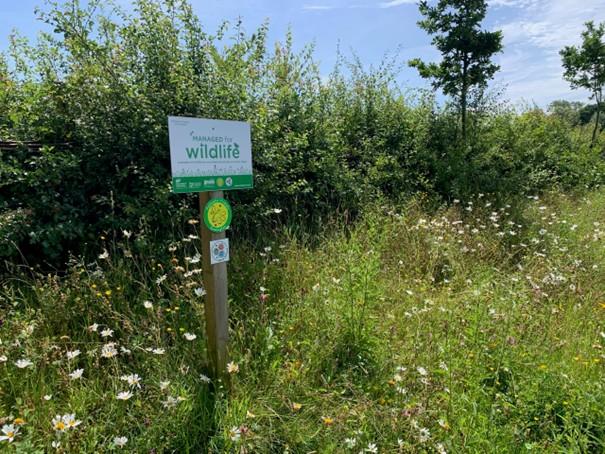
Signage near Symington, highlighting the work of the Ayrshire Nectar Network
Objective 2: Understanding pollinators and their pollination services
What we need to do:
- Improve our knowledge of plant–pollinator interactions, including the relationship between wild pollinators and habitat size, quality, type and connectedness to other areas of habitat, and
- Better understand, through spatial mapping, the resources available to pollinators on a landscape scale.
Species-Rich Grassland Project (L)
Organisation(s): Dumfries and Galloway Council / Butterfly Conservation
Butterfly Conservation has been awarded £727,000 for a project to help farmers improve their land for wildlife and make their business more financially viable at the same time. The Species-Rich Grassland project, part of the Borderlands Inclusive Growth Deal / Natural Capital Scotland programme will trial experimental techniques at farms in the south of Scotland (Scottish Borders and Dumfries and Galloway) over the next six years. The funding has been given as part of the Borderlands Inclusive Growth Deal an agreement between UK and Scottish governments to invest £452 million to boost the economy around the Border. It will focus on species-rich grassland and the conservation of the Northern Brown Argus butterfly. The northern brown argus is an 'indicator species' the number breeding in any location gives a useful guide to the wider health of the natural environment for other wildlife including invaluable pollinators such as bees.
PollMap (L)
Organisation(s): NatureScot
NatureScot has developed and published a spatial mapping resource to better understand the habitat resources available to pollinators on a landscape scale. This is available on the NatureScot website, as a web-mapping application available via a dashboard. The mapping will help with understanding what habitats are where, and their suitability as resources for pollinators. It will also help identify areas where positive changes could be made to enhance the resource for pollinators. A story map has also been provided which explains more about pollinators and what they need in terms of habitat for their whole life cycles (including signposting to relevant resources), explain the rationale behind the mapping and caveats relating to data resolution.
Integrated Pest Management (M)
Organisation(s): SG, SQC
- Encouraging Scottish growers to complete an Integrated Pest Management (IPM) plan and encouraging local authorities to apply the principles of IPM to ground maintenance and management. Supporting and promoting IPM, and targeted use of pesticides, in agricultural and urban areas. Supporting and complying with approved advice supplied for the GB governance structure
- The UK Pesticides National Action Plan (NAP) was published in March 2025 and sets out our strategy for managing pesticide use and minimising risk. It aims to promote the sustainable use of pesticides to minimise impacts on the environment and human health, whilst managing pests and pesticide resistance effectively and ensuring farmers have the tools they need for food production.
- The Pesticides National Action Plan introduces a domestic reduction target for pesticides in the UK. The target is based on the UK Pesticide Load Indicator (PLI), which combines data on pesticide usage with information on pesticide properties (hazard and environmental behaviour) to illustrate and track trends in the potential pressure that pesticides are placing on the environment. The target is to reduce each of the UK PLI metrics by at least 10% by 2030. The PLI currently applies only to the agricultural arable sector, which accounts for around 90% of overall pesticide use in agriculture and horticulture. This will contribute to the global target to reduce the overall risk from pesticides by at least half by 2030, as set out in the Kunming-Montreal Global Biodiversity Framework.
- The Scottish Government encourages all pesticides users to adopt integrated pest management (IPM) approaches and the actions in the NAP demonstrate Scottish Government support in this area. For example, recently updated IPM advice is available on the SG website. The Scottish Government also collects information on the adoption of IPM every four years, which is published alongside pesticide usage reports when available.
- Completion of an IPM plan is currently an option of the Whole Farm Plan, which applies to agricultural businesses that claim Basic Payment Scheme, and will become a requirement by May 2028. The Plant Health Centre hosts an IPM assessment plan template for Scottish businesses, and guidance for completing it, on its website. The plan allocates scores for the different components of IPM, enabling users to establish a baseline score and measure improvements year-on-year.
- The Scottish Government continues to support regulatory decisions taken to restrict the use of neonicotinoid insecticides in response to the evidence of their effect on the environment, particularly on bees.
- Scottish Quality Crops (SQC) have a requirement for growers to complete an IPM plan to meet the SQC assurance scheme standards.
Identifying optimum plants and habitat area size for wild pollinators in different management situations (M)
Organisation(s): SRUC
Research projects exploring optimum farm management and landscape-scale measures to protect and promote pollinators.
- Pollinator-friendly management actions are being evaluated at AHDB Prestonhall Monitor Farm and Soil Association Pollinator Demonstration Farm. This work has helped shape NatureScot’s field margin scorecard and is being written up for publication. Monitoring will continue at Prestonhall Farm via a PhD studentship (in conjunction with the University of Edinburgh).
- SAC/SRUC contributed to a meta-analysis that aimed to determine minimum habitat thresholds required to support insect pollinators. Thresholds were found to range from 6% semi-natural habitat for hoverflies, to 18% for bumblebees to 37% for butterflies. The work led by Wageningen University is now published in Science.
- SAC/SRUC contributed to an evidence synthesis comparing pollinator-promoting interventions in urban environments. The evidence found that bumblebees and butterflies benefited most from pollinator-friendly interventions. The work led by HUN-REN Centre for Ecological Research, Hungary, is now published in Ecology Letters.
Promoting Integrated Pest Management (IPM) plans and delivering knowledge exchange activities on IPM and beneficial insects to key stakeholders (L)
Organisation(s): Scottish Farm Advisory Service (FAS), Scotland’s Rural College (SRUC), Agriculture and Horticulture Development Board (AHDB)
- IPM Assessment Plans for arable crops, grassland, and horticulture crops are available on the Plant Health Centre website.
- Promoted through PHC (Plant Health Centre), SRUC and FAS activities including. FAS Crop Trials Events and Webinars, FAS Nutrient Management Workshops, FAS/AHDB winter agronomy roadshows (three locations each year), Arable Scotland, and Plant Health Centre conferences.
- Scottish IPM Assessment Plan | Plant Health Centre
- Integrated Pest Management’s top tips from high scoring farms | The Scottish Farmer
- Reduced Tillage & the Impact on Integrated Pest Management (IPM) | Information helping farmers in Scotland | Farm Advisory Service
- Cropcast: Integrated Pest Management | Scotland’s Farm Advisory Service Podcast Episode on Amazon Music
- Information video on IPM is available online via the Farm Advisory Service’s Crop and Soils and Environmental Portals.
- FAS publications focusing on Making Pesticide Use Sustainable are in development.
- Content developed for FAS environmental portal highlighting the value different habitats play in promoting beneficial insects, with signposting to other resources. Resources from this portal were highlighted through social media posts targeted for World Bee Day, National Insect Week and National Meadows Day.
- A series of on-farm Biodiversity Workshops and Farm Wildlife Walks were held in 2023, 2024 and 2025. The Biodiversity Workshops aim to help farmers recognise and baseline farmland habitats. The Farm Wildlife Walks demonstrate the variety of habitats and species Scottish Farmland supports.
- Farm Advisory Service Scotland held a series of beekeeping events in Skye, Dingwall and Nairn to provide guidance on how to start beekeeping. The events covered a variety of topics to promote sustainable beekeeping.
Use of automated Pollinator Sensors (S)
Organisation(s): Clackmannanshire Council
Scotland’s International Environment Centre (SIEC) obtained funding from Clackmannanshire Council’s Nature Restoration Fund to deploy 40 automated pollinator sensors throughout the Council area. The sensors are solar-powered and transmit their data via mobile connectivity. The sensors, developed by AgriSound, detect sounds around them and identify bees from the frequency of their wing-beats. This data is then collated and the time when pollinators are active can be calculated. The sensors have been deployed at a range of sites throughout Clackmannanshire, in both urban and rural settings, such as Gartmorn Dam, Devon Meadow, Clackmannan and Wimpy Park.
Objective 3: Manage commercial use of pollinators to benefit native pollinators
What we need to do:
- Ensure the process of screening commercial honey bees, and imported/managed bumblebees, for pests and diseases continues to safeguard our wild pollinators,
- Review biosecurity measures for imported bees, particularly bumblebees, aiming to support healthy populations of pollinators in the wild,
- Ensure that practical advice is available to reduce the potential for pest and pathogen transfer, and disease impacts on wild pollinators,
- Reduce the reliance on imported bees for commercial pollination, and
- Encourage and support ways to increase the use of naturally occurring pollinators.
Supporting and sustaining a healthy honey bee population and beekeeping industry in Scotland through continuing to implement the measures set out in the Honey Bee Health Strategy for Scotland (L)
Organisation(s): SG, SASA, SRUC, Bee Farmers’ Association, SBA
In 2022 Scottish Government, in collaboration with the Bee Health Improvement Partnership (BHIP), published its second 10-year Honey Bee Health Strategy 2022-2032. The main aim of the strategy is ‘Working in partnership to achieve a healthy and sustainable population of honey bees in Scotland’ and the BHIP meet regularly to agree priorities and monitor progress. The Implementation Plan is a working document detailing the actions required to deliver the aims of this strategy and updates are regularly published. The Plan contains an action to educate beekeepers and raise awareness of the potential impact managed honey bees have on wild pollinators. Through presentations to local associations, the BHIP deliver education on responsible beekeeping which includes the impact of managed bees on wild pollinators. This topic has also been highlighted through beekeeping magazine articles. The BHIP’s progress is detailed in their Annual Report. Work has also been carried out on developing a suite of tests and a standardised process to assess bumblebee health and to ensure best practice guidance is available for pollinator box users.
Imported bees: Identifying actions required to minimise the risks of managed bees (imported and locally produced) to native pollinator species. Reviewing the pathways by which commercially-produced pollinators enter Scotland to determine scale and biosecurity risks. Developing a suite of tests and a standardised process to assess bumblebee health; ensure best practice guidance is available for pollinator box users (L)
Organisation(s): Scottish Bee Inspectorate
- The Scottish Bee Inspectorate has strong certification procedures to ensure disease and pest freedom of imported bees into Scotland. Furthermore, these certification procedures are bolstered with a risk-based approach to post-import checks.
- Following Brexit, Great Britain has a third-country trading relationship with the EU. Domestic legislation avoids the import of colonies and packages of honey bees directly into Great Britain with the exemption of New Zealand. The only imports of honey bees allowed, other than from New Zealand, are queen bees with up to 20 attendants. Post-import checks on these imported queens have also been strengthened as a result of the third-country status.
- The Honey Bee Health Strategy (HBHS) supports beekeeper education and local breeding to reduce requirement for imported honey bees and potential impact of disease. The HBHS and SG Bee Health team contribute towards reducing honey bee losses through improved disease control, thus reducing the requirements for imports, and generally raising the health status of managed (honey) bees and their wild neighbours.
- In accordance with Article 11A(1) of the Bee Diseases and Pests Control (Scotland) Order 2007, Scottish Ministers have introduced special measures to mitigate the risk of Tropilaelaps mite entering Scotland
A statement on the interplay between wild bumblebees and managed honey bees (M)
Organisation(s): BBCT
The Bumblebee Conservation Trust has a position statement on the interactions between managed honey bee colonies and wild bumblebees with recommendations for minimising conflict.
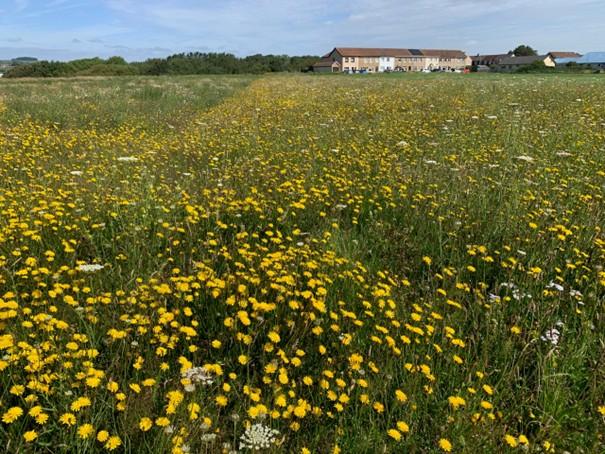
Successful meadow creation near Ardeer in Ayrshire.
Objective 4: Raise awareness and encourage action
What we need to do:
- Ensure that the value and vulnerability of plants and their pollinators is widely recognised,
- Increase awareness within key sectors and among the public of opportunities to help pollinators and their habitats,
- Support and raise awareness of schemes and organisations that encourage people to identify and record pollinating species,
- Support initiatives by local and national environmental groups that increase the diversification and connectivity of flower-rich and other pollinator habitats in the countryside and urban areas,
- Encourage and support land managers to restore or create native flower-rich habitats to enhance pollinator abundance and diversity. Work together to carry out management at a landscape scale, including urban green space and urban fringe areas.
The Royal Botanic Garden Edinburgh provides pollinator education and outreach (M)
Organisation(s): RBGE
- RGBE runs a short course called 'Plants and Pollinators' for amateur gardeners to learn about pollinators and how to provide for them in their own gardens through planting solutions and sustainable gardening practices.
- RGBE offers free online course 'Keep Edinburgh Buzzing!' developed as part of the Edinburgh Living Landscapes project. It is an entry level course for ages 13+ and is part of RGBE schools outreach work.
- In 2025 the RBGE Schools Outreach Team worked with the University of the Highlands and Islands (UHI) to create Plant Discovery Kits to be taken into primary schools. The kit can be used to deliver a Pollination lesson for Second Level learners (often upper primary). 12 UHI Science, Technology, Engineering and Mathematics Coordinators (STEM) have been given these kits to deliver lessons in schools across the Highlands and Islands, Argyll and Bute, Moray, and Perthshire.
- The RGBE online learning team developed a new online course in partnership with NatureScot. It is called 'Nature-Positive Amenity Grasslands' and focuses on teaching semi-urban grassland development and management with the aim of contributing to the restoration of Scotland's biodiversity.
Ongoing awareness-raising of the invasive non-native Yellow-legged hornet, also known as Asian hornet, through the contingency plan and associated guidance on BeeBase and SG Bee Health pages (M)
Organisation(s): SG, SASA, SBA
Scottish Government published its Yellow-legged Asian hornet Contingency Plan in April 2024 to tackle any incidences of this invasive insect in Scotland. SG Bee Inspectors are receiving vital training in the field by assisting the National Bee Unit (NBU) with their yellow-legged hornet response in the south of England. Both table-top and infield exercises have taken place to test the Scottish Government contingency plan, confirming readiness to respond to a credible sighting of a Yellow-legged Asian hornet. Continued awareness-raising activities through both public engagement activities and communication channels to encourage extra vigilance and highlight how to spot and report the Yellow-legged hornet. SG attend regular meetings with GB-wide groups to exchange information, and updates are regularly forwarded to relevant audiences.
Awareness-raising of the invasive non-native species, Tropilealaps and Small Hive Beetle, through a contingency plan and associated guidance on BeeBase and SG Bee Health pages
Organisation(s): SG, SASA, SBA
Scottish Government is currently developing a Pest-Specific Contingency Plan to tackle any incidences of these invasive species in Scotland. Scottish Government attend regular meetings with GB-wide groups to exchange information, and updates are regularly forwarded to relevant audiences.
Species on the Edge – project includes habitat creation, surveying, land manager engagement, public engagement and monitoring (L)
Organisation(s): Amphibian and Reptile Conservation, Bat Conservation Trust, BBCT, Buglife, Butterfly Conservation, NatureScot, Plantlife, RSPB
- Species on the Edge is a partnership between NatureScot and seven conservation organisations, working to secure a future for 37 priority species found on Scotland’s coasts and islands. Through nine species project plans delivered across seven project areas, Species on the Edge is carrying out a range of activities including survey and monitoring, habitat management and creation and engaging with landowners and communities to build awareness and capacity.
- Bees on the Edge is one of the projects within Species on the Edge. It focuses on the Great Yellow bumblebee, the moss carder bumblebee and the northern colletes mining bee. Work for pollinators also takes place under a small blue butterfly-focused project active along the east and north coast (titled Rockin’ the Blues) and a burnet moth and marsh fritillary project in Argyll and the Inner Hebrides (aBrighter Future for Herb-Rich Pastures).
- In 2025 Species on the Edge funded over 100 virtual fence collars for livestock belonging to crofters in Shetland, the Outer Hebrides and Ulva to help with grazing to benefit a range of species including great yellow bumblebee, Shetland bumblebee (Bombus muscorum ssp. agricolae), and the slender Scotch burnet moth. In April, Orkney Islands Council announced a new verge management scheme which sees all roadside verges classified as 'conservation verges' meaning they will be cut only once per year to support local wildlife and wildflowers (excluding verges that need to be cut for safety reasons). The approach was developed in collaboration with the Orkney Verge Working Group, formed in 2024 by Species on the Edge.
- Species on the Edge has continued to work with crofters in Shetland this year to help them grow 'bumblebird crops' - crops specially designed to benefit Shetland's pollinators in the summer and seed-eating birds in the winter. Species on the Edge has also produced an advice leaflet for crofters on how they can help support Shetland's vulnerable wildlife. This includes information on growing and enhancing meadows and the funding available.
- Through Species on the Edge, communities across Scotland's east and north coast are being supported in building, managing and monitoring local 'butterfly banks' – specially designed habitat to support the small blue butterfly. Species on the Edge officers have been supporting community surveying efforts for the small blue, resulting in an over 500% increase of Small Blue records between 2023 and 2025 compared with the period 2017 – 2019 across the east and north coast. A Species on the Edge Conservation Trainee has been carrying out extensive survey and monitoring of transparent burnet moths in northern Argyll. This has resulted in the extension of existing sites, as well as recording Transparent Burnet moths at historic sites where no records have been made for many years. The trainee has also led online and in-field training for crofters and land managers in surveying Transparent Burnet and Marsh Fritillary and has led habitat management work parties. A Species on the Edge East Coast Officer has been conducting northern brown argus surveys, accessing remote areas along the Easter Ross peninsula by kayak. In 2025 the project discover two new sites for northern brown argus, with several colonies present at each location.
Agri-Environment Climate Scheme, under the SRDP (L)
Organisation(s): NatureScot, Scottish Governments Rural Payments And Inspections Directorate (SGRPID)
Agri-environment funding for pollinators is being accessed via this scheme. 80% of crops grown in Scotland rely on insect pollination. NatureScot is acting in partnership with Scottish Government in delivering the Agri-Environment Climate Scheme (AECS), There were 2,270 AECS contracts in place in 2025, with a total value of £127 million. AECS contracts include many actions that directly benefit pollinators on arable land and on semi-natural habitats. For example, creation of hedgerows, grass strips in arable fields, species-rich grassland management, and cropped machair management. The scheme has been running annual application rounds since 2015, with more restricted rounds in some years. Another round of the scheme will be held in 2026.
NatureScot is working with Scottish Government to develop a new agriculture policy post-2024 (M)
Organisation(s): NatureScot
- Focus on maintaining stability of current farming support-scheme architecture, taking forward pilots to inform future rural support, and advising on the development of future agriculture and rural support to help address the climate change emergency (see 2019 Intergovernmental Panel on Climage Change report) and biodiversity crisis (see 2019 Intergovernmental Science-Policy Platform on Biodiversity and Ecosystem Services (IPBES) report.
- A new Agriculture and Rural Communities (Scotland) Act 2024 that will provide the framework and the powers for developing future support systems including nature restoration was adopted by the Scottish Parliament in June 2024.
- As part of its Farming with Nature programme NatureScot has been trialling different approaches, such as the Farm Biodiversity Project which is developing and testing the Farm Biodiversity Scotland tool to be used by farmers and crofters for biodiversity auditing and planning.
Public engagement projects in Glasgow City Council area. (L)
Organisation(s): Glasgow City Council (GCC)
- The Council’s Countryside Rangers supported 40 community groups and interacted with almost 5000 people on biodiversity projects.
- RSPB ran a bee workshop and a ‘Rewilding Glasgow Challenge’ LEGO workshop. This engaged with 54 young people.
- RSPB delivered five plug-planting sessions working with 123 primary-age pupils.
- RSPB North Glasgow Greener Futures undertook seven plug planting sessions with volunteers and local community and five hedge-planting sessions with volunteers.
- Meadow signage continues to promote pollinators and highlight the value of long grass and wildflowers for nature.
NHS Scotland greenspace management (L)
Organisation(s): NHS Scotland
NHS greenspaces are a valuable resource for patients and nature alike. NHS boards are surveying their estates, working closely with environmental organisations, and impressing upon staff the multiple benefits good outdoor spaces offer.
NatureScot commissioned a habitat survey and a Natural Capital Account of all NHS land in Scotland. This will provide a baseline habitat map for all NHS sites to support site management and will assess the value of the pollinator services the NHS estate provides.
The Royal Botanic Garden Edinburgh helps provide suitable habitat for pollinators in the capital through targeted planting, whilst highlighting the presence and role of pollinators to visitors (L)
Organisation(s): RBGE
On-site pollinator-friendly and visitor-engaging plantings include:
- An annual ‘pictorial meadow’ of c. 40 native wildflower species and large ‘living lawn’ areas, encouraging visitors to think about different forms of meadow landscapes and to create similar habitats in their own communities, whilst providing valuable nectar sources during the season.
- Additional plantings of nectar-rich herbaceous perennials in the Queen Mother’s Memorial Garden.
- A demonstration ‘bug hotel’ in the Demonstration Garden to support overwintering and nesting.
- Winter garden management practices for established beds are being modified to provide standing stems for overwintering insect habitat.
- Throughout the summer mowing regimes are managed adaptively to boost the biodiversity supported in lawns and meadow features across the garden. Of particular interest is the Living Lawn in the Wild Orchard.
- The Nature-Based Solutions team is expanding work with urban greening for biodiversity and climate resilience, including pollinator-friendly green roofs and plantings, and by providing advice to off-site organisations.
- A long-running volunteer phenology-recording project documents annual changes in flowering time across the RBGE estate, highlighting pollinator-impacting shifts due to climate change.
Downloadable guides offering tips and encouragement for wildlife-friendly gardening (S)
Organisation(s): Keep Scotland Beautiful / Garden for Life Forum
A number of resources are available on the Garden for Life page on the KSB website. These offer advice geared to supporting sustainable gardening in a way which benefits biodiversity.
Providing regular updates, news and features on pollinator-related activity across Scotland and Europe.(S)
Organisation(s): NatureScot
Publishing blogs, children’s resources, and website updates on pollinator-related matters. There have been over 94,000 views of the Scottish Pollinators blog since 2021. Children’s resources include activity sheets exploring bumblebees, honey bees, solitary bees, wasps and moths. Website pages include links to the UK Pollinator Monitoring Scheme, and offer practical advice around planting for pollinators.
Native wildflower seeds for gardens and communities and ‘Managed for Wildlife’ signage (S)
Organisation(s): NatureScot
We provide, on request, native wildflower seeds, both small packets for individuals to use in containers and window boxes, and larger ‘community packets’ for schools and community groups. Our ‘Managed for Wildlife’ signage helps communities and local authorities explain what is happening when areas are converted to meadows and pollinator patches.
Skills for Bees, and Bee the Change. (M)
Organisation(s): BBCT
- Skills for Bees: This project focuses on rare bumblebee surveys and training of public in bumblebee identification, survey and monitoring techniques in the Cairngorms National Park. Fieldwork started in 2022 and aims to train the public, Cairngorms staff, ranger teams, and landowners in bumblebee ID and monitoring within the Cairngorms National Park. Alongside this aim, and using these new surveyors, the project carries out bumblebee surveys with a particular focus on rare and scarce species. The goal of the project is to enhance the understanding of the current status of bumblebees within the Park, while establishing a legacy of bumblebee recorders and long-term monitoring. In 2025, 29 events were delivered (five BeeWalk demonstrations, nine Beginners/intermediate bee ID courses, and 15 survey sessions)
- Bee the Change is a project focusing on people who are new to bumblebees and want to take action for them and other pollinators. It aims to engage people and encourage action through micro steps within four main areas: habitat creation, fundraising, campaigning, and volunteering. There are free ‘how-to’ guides and resources including monthly planting guides, pesticide-free gardening guide, garden maintenance guides and information about bumblebee nests. There are also blogs to inspire and guide people in making bumblebee-friendly choices. In 2025 a new resource (Bumblebee-friendly planters — aimed at those with small or no-dig outdoor spaces) was created.
Continuing to develop guidance, tailored to a range of audiences (farmers, councils, schools, gardeners), on practical action to help pollinators. (S)
Organisation(s): BBCT, Buglife, Butterfly Conservation
A wide range of guidance continues to be published on these organisations’ websites. For example, BBCT and RSPB jointly published a factsheet on managing golf courses for bumblebees. Hard copies are available from these organisations on request.
Butterfly Conservation has created a new guide to making and maintaining habitats for butterflies and moths in Scotland, with particular focus on urban areas.
Bumblebee Conservation Trust has published a Bumblebee Manifesto and Tree Planting Statement which can be found on their website.
Working with partners, including policymakers and those with practical skills in the management of habitats, to raise public awareness and understanding of the needs and status of pollinator populations. Video guidance and information for farmers. (S)
Organisation(s): SFAS, SRUC, Soil Association
SAC Consulting are working with Fife Coast and Countryside Trust to develop Farm Transition Plans which identify pathways to more sustainable and nature positive farming initiatives.
SFAS practical guides continue to be available online via the Farm Advisory Service’s Environmental Portal:
- Why and How to Increase Pollinators on Your Farm
- Pollinator Types and Food Sources on Small Units
- 10 Steps To Helping Pollinators On Small Units
Podcast highlighting the role that Moths play in our ecosystem in conjunction with Butterfly Conservation.
Targeted information for Land Management for the Great Yellow Bumblebee is now available through the FAS environmental portal.
SRUC and SFAS have provided on-farm events targeted to enhancing the environmental sustainability of grassland farms. Written outputs included a practical guide on Encouraging Pollinators without costing production .
An online toolkit is available to help farmers select site-specific mixtures for establishment of multi-species swards.
SFAS works with Net Zero Arran, on climate change benchmarking, and exploring the island for nature conservation opportunities, supported by the Bumblebee Conservation Trust. This farmer-led focus group is implementing land management practices targeted to pollinators.
Illustrating what public good looks like on Scottish Farms (pollinators are listed as a public good) to demonstrate the public benefits generated by farm support schemes and nature-friendly practices (L)
Organisation(s): NatureScot
- Producing the nature hero series to inspire and showcase contributions to biodiversity. A number of these examples have received funding from AECS
- Monitoring the outcomes generated by the current SRDP/AECS scheme on Scottish farms. Two reports have been published (a case study evaluation and heat map report) showing the value for pollinators
- Publishing some illustrative case studies on public good associated with different farming systems
- Supporting projects working to improve biodiversity for example the GWCT Balgownie demonstration site which uses pollen mixtures and wild bird mixtures and the farmer cluster PepsiCo FAB (Farmland Arable Biodiversity project led by the GWCT and PepsiCo which works with arable farmers to use wild bird and pollinator seed mixes.
- Gathering evidence from across Europe on ways in which land managers are encouraged to deliver environmental outcomes on farmland to inform future rural policy. For example, participating in projects such as the Interreg-funded PARTRIDGE
- Working with Scottish Government to develop advice for farmers and crofters for improving biodiversity through the Farm Advisory Services.
Butterfly Conservation Wild Spaces Project (S)
Organisation(s): Butterfly Conservation
Butterfly Conservation’s ‘Wild Spaces Perth and Stirling’ project ended in December 2024, and a new ‘Wild Spaces Glasgow’ project began in January 2026 and is intended to run for two years. The project will create new habitats for butterflies and moths in Glasgow, train new volunteers to record insects, and host a series of public engagement events. It is funded partly by the National Lottery Heritage Fund, with additional funding from NatureScot.
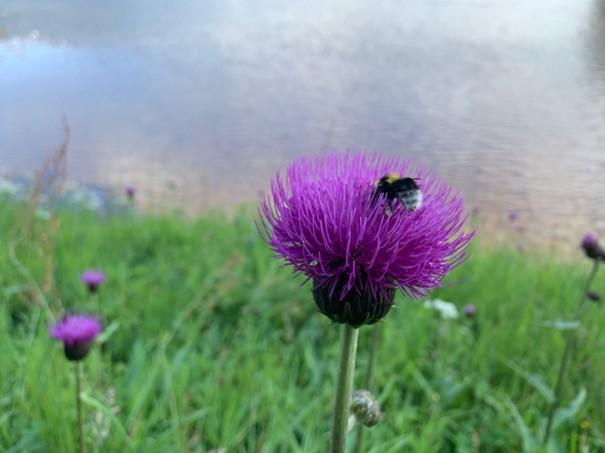
Bumblebee feeding on knapweed near Murthly, Perthshire.
Objective 5: Evidence - monitor and evaluate whether Scotland's pollinators are thriving
What we need to do:
- Gather and analyse data to better understand pollinator population trends, habitat availability and connectivity to ensure that the correct actions are being taken for pollinators and habitats,
- Support monitoring and recording schemes for key species, notably bees, hoverflies, moths, butterflies and wild plants, and
- Encourage citizen science and other volunteer projects that add value to existing monitoring initiatives to help deliver the National Pollinator Monitoring Scheme.
BeeWalk is a standardised citizen science monitoring scheme that collects bumblebee data from across the UK to gain an accurate understanding of current bumblebee populations and distributions (L)
Organisation(s): BBCT
BeeWalk has been running since 2008 and opened to the public from 2011. Volunteer BeeWalkers survey a fixed-route transect once a month between March and October (inclusive), recording the abundance of each bumblebee species seen. This data is submitted via the BeeWalk website (hosted by the Biological Records Centre), enabling population trend analysis. The outputs of BeeWalk are now widely used to inform policy and conservation interventions.
The 2025 BeeWalk Annual Report covers UK bumblebee population and phenology changes in the 2024 season. It looks at long-term trends, and abundance trends for each bumblebee species where there is sufficient data to make this analysis.
Preliminary data for the 2025 season indicates a good season for bumblebees, due to generally warm, sunny weather, especially in spring, which saw bee numbers bounce back after a poor 2024. With 8458 records to date, 2025 is the year with the largest number of BeeWalk records in Scotland so far.
Monitoring bumblebees in Cairngorms National Park (L)
Organisation(s): BBCT, Cairngorms National Park
Establishing BeeWalk transects helps improve understanding of bumblebees in the Cairngorms National Park and monitor their status long-term. Engagement with a wide range of stakeholders in bumblebee recording increases the amount of data collected on bumblebees in the Cairngorms National Park.
Between April and October 2025:
- The project engaged 272 people in recording and ID
- 11 rare species surveys were conducted
- Work was carried out with 20 organisations
- Seven additional BeeWalks were held, taking total up to 23.
Overall, 13 new BeeWalks have been established in the Cairngorms National Park since 2023. BeeWalk is the national monitoring scheme for bumblebee abundance. The data from 900+ transects across Great Britain is invaluable in helping understand how bumblebees are doing, and informing conservation efforts. The data is regularly used in research, including publications such as this one on the effects of climate & land use on bumblebees.
Cairngorms Nature Index (M)
Organisation(s): Cairngorms National Park Authority
Development of a tool to allow habitat health to be monitored, using key indicator species and environmental variables. Several species of pollinators are to be used in the index including bumblebees and rare hoverflies.
Rare Invertebrates in the Cairngorms project
Organisation(s): RSPB, Cairngorms National Park Authority (CNPA), RZSS, Butterfly Conservation, NatureScot and Buglife.
- This project, part funded by CNPA, has run since 2017 and funding secured to continue studying three pollinator species (small scabious mining bee, aspen hoverfly and pine hoverfly), up to April 2028.
- There has been an increased survey effort to better understand distribution of this bee in the Cairngorms National Park. Mapping of suitable habitat in GIS has been used to better understand distribution of habitat and connectivity. Research on population at RZSS Highland Wildlife Park is being conducted to understand foraging distances from nest sites – this will determine dispersal distances, and which sites are likely to be connected or where colonies could be isolated. Engagement with planning department and conservation staff is planned to raise awareness of presence of bee habitat needs.
Cairngorms Pollinator Plan and FIT Counts
Organisation(s): Cairngorms National Park Authority
Development of a pollinator plan for the Cairngorms National Park. The Cairngorms National Park Junior Rangers were trained up to undertake FIT counts as part of their summer camp. Rangers in the Angus Glens area of the Cairngorms National Park have been undertaking FIT counts and training volunteers on how to use this method to record pollinators.
The Royal Botanic Garden Edinburgh supports monitoring of pollinator communities across Scotland and Europe (M)
Organisation(s): RBGE
A joint initiative is underway between the Royal Botanic Garden Edinburgh and the charity Pollinating London Together. The project's objective is to reverse the decline of pollinators in urban areas through research in Edinburgh’s green spaces, and by encouraging the adoption of pollinator-friendly management practices.
In 2025, 31 green spaces were surveyed in central Edinburgh, including allotments, public gardens, cemeteries and roof gardens, to assess pollinator diversity and resource availability. A report outlining the findings of the 2025 surveys is being prepared. A second season of surveying is planned for 2026.
NatureScot Pollinator Strategy Annual Report and Annual Conference (L)
Organisation(s): NatureScot
This Annual Progress Report ensures current and completed projects are highlighted to help inform future actions. An Annual Conference highlights pertinent issues each year and encourages sharing good practice. Previous Annual Progress Reports can be found on the NatureScot website.
Supporting the UK Pollinator Monitoring Scheme (PoMS) in Scotland (L)
Organisation(s): UK Centre for Ecology & Hydrology, NatureScot, SG
PoMS aims to understand how insect populations are changing across the UK. This is done through two large-scale surveys: FIT Counts, and 1km square surveys (with 22 fixed PoMS 1km squares across Scotland), which are carried out by a combination of volunteer and professional recorders. Annual reports are produced each year, along with the full datasets generated from both PoMS surveys including species records for bees and hoverflies https://ukpoms.org.uk/data. During 2025 the UK PoMS Annual Report 2024 was published, with the latest updates on results and a range of articles featuring updates from volunteers and other research connected to PoMS. PoMS also issues an e-newsletter, which can be found on the UK PoMS website. SG funds support this work and NatureScot are members of the steering group.
Between 2017 and 2024, a total of 20,684 FIT Counts were submitted to the scheme, and 1,723 survey visits to the network of 95 1 km squares were carried out. 2025 saw the highest ever annual total of FIT Counts submitted, which is good news, and results will be published once the analyses have been completed.
Assessing approaches to monitoring pollinators at the landscape scale (S)
Organisation(s): SRUC / SAC, Scottish Wildlife Trust, University of Padova (Italy)
SRUC/SAC Consulting contributed to a European synthesis that brought together data from across Europe to identify the potential for wild bee abundance to act as a proxy for wild bee species-richness. Such a proxy provide a practical way to assess the impact of interventions (e.g. agri-environment climate schemes) by non-experts and can help fill expertise gaps. This research was led by the University of Padova, Italy, and is now published in the Journal of Applied Ecology.
SAC Consulting are collaborating with The Scottish Wildlife Trust, to monitor the impact of the Ayrshire Nectar Network on insect pollinators. To assist other pollinator-friendly initiatives they have produced a practitioner’s guide outlining how to conduct cost-effective landscape scale monitoring. A blog has been written providing an overview of the monitoring and to raise awareness of the guide.
Community Group Projects
There is increasing recognition of the significant role Community Groups play in helping Scotland’s pollinators. This section of our annual report is designed to highlight some of the actions being carried out in Scotland’s communities.
- Bonnie Dundee
is part of a larger Dundee network of over 30 community gardens. They work in partnership with Dundee City Council, and one of their aims has been to encourage gardeners to change some gardening habits to encourage pollinators and provide habitats. In 2025 they grew a variety of cornfield mix and saved the seed heads, dried them and packaged them. 80 packets were then given to the congregation of St. Paul's Cathedral, Dundee, another 25 to friends and families and 20 to the city seed saving and sharing event in January 2025. This mix attracted many pollinators, and gardeners said they felt it helped with their own well-being as well, stating that the flowers were attractive to look at, and they loved watching the pollinators.
- Crook of Devon and Drum Growing Together
created and manage wildflower areas along with a small orchard. They carried out pollinator-friendly planting and worked with Tayside Biodiversity Group in establishing no-mow areas and bulb-planting. The group received more bulbs recently via Perth and Kinross Council and the Nature Restoration Fund, and these pollinator-friendly small daffodils, camassia, crocus and grape hyacinth will further enhance the area for pollinators.
- On the Verge
is a Stirling-based group working with local schools and community groups to manage pollinator-friendly sites. They sow new areas of native wildflowers, work with local community groups to establish and manage community meadows, and enhance school grounds, parkland and pockets of abandoned land. Leigh Biagi established On the Verge in 2010 and is also a project coordinator with RePollinate who work with businesses, councils, and communities to build a network of pollinator-friendly spaces. Each design is unique and packed with a carefully chosen mix of trees, flowers, herbs, and shrubs — all selected to suit the space and support a wide range of pollinators through all their life stages.
- Beith Community Food Garden
supports pollinating insects and enhance biodiversity — essential to an organic growing approach. They use companion planting throughout vegetable beds, integrating marigolds, nasturtiums, borage, dill, limnanthes, and viper’s bugloss. These attract a wide range of beneficial insects, improving pollination and pest control.
- Coldstream Community Larder
planted crocuses for early pollen, and herbs such as marjoram, sage and thyme which flower in the summer. Cultivating plants with open flowers such as marigolds, verbena bonariensis and sedum to attract hoverflies and butterflies.
- Ninewells Community Garden
in Dundee. Managing a therapeutic garden within the grounds of NHS Ninewells Hospital. In 2024 they worked with RePollinate to plant a wildflower garden in Ninewells Oncology Courtyard. Now developing a new wildlife garden and focusing on building a dead-hedge and adding as many native species as possible.
- Yorkhill Green Spaces
in Glasgow manages three areas of grassland in parks as wildflower meadows. In 2025 over 1000 pollinator-friendly spring bulbs were planted on the slopes of Yorkhill Park and in and around Overnewton Park. In addition 500 crocus bulbs were planted in a newly cleared grassy area adjacent to the old wall at Yorkhill Park. Species planted included snowdrops, native bluebells, narcissus, grape hyacinths, spring crocuses, autumn crocuses, alliums, snake’s-head fritillaries, and wood anemones. Approximately 1 ha of grassland in Yorkhill Park are managed as a wildflower meadow. Of which 0.8 ha was cut by Glasgow City Council staff and scythed by Yorkhill Green Space volunteers. Cut vegetation in Yorkhill Park was moved to shrubby areas on site to reduce nutrients in meadow areas. Yellow -rattle seeds were harvested and the sowing area extended to reduce the nutrients around bog garden areas. Work was also carried out to improve existing meadows and woodland areas in Yorkhill Park by planting over 800 native wildflower plug plants and a small number of larger plants. This included cowslips, primroses, forget-me-nots, ramsons, calendula, columbine, borage, foxgloves, ivy-leaved speedwell, and honeysuckle.
- St Machar Cathedral
in Aberdeen was awarded Level 5 Outstanding in KSB Its Your Neighbourhood awards. They have planted bulbs for spring and have been introducing a mix of shrubs around the boundary walls to provide winter shelter. They planted five lairs with a mix of native and garden plants to increase the diversity of plants. St Machar also held a community Bioblitz in early July with local experts in bats, insects and fauna present. To inform visitors of their activities they have an interpretation board at the main entrance to the kirkyard.
- Cove Woodland Trust
has been working with Aberdeen Nectar Network to plant wildflower areas. Aberdeen Nectar Network’s intention is to extend B-lines throughout the district and ensure that pollinators have access to wild flowers across the city.
- In Tiree community group
who were behind the Great Yellow Bumblebee Project (2017-2021) now works with RSPB on the Species on the Edge Programme to help Tiree and Coll’s Great Yellow Bumblebee populations. There has been much progress on both islands and a full report will be produced in 2026.
- The Denmarkfield Rewilding project
near Luncarty, Perthshire, has taken fields formerly devoted to barley growing and transformed them into a nature-rich area. They have planted orchards and hedgerows and surveys show a significant return of wildflower and bumblebee species.
- Green St Boswells
community group won the 2024 KSB It’s Your Neighbourhood pollinator-friendly award, and 2025 was another busy year for them. They used the prize money from their award to invest in more spring-flowering plants, shrubs and trees to help support early pollinators. In their community woodland they planted native bluebells under old beech trees. Using gaps created by winter storms they planted Rowan, Crab Apple, Field Maple, Downy Birch and Guelder Rose, as well as winter aconites, snowdrops, native primrose and cowslips.
- Wyndford Community Group
maintained a ‘Bed for Bees’, planted a ‘Fruits and Flowers’ bed and a raised bed of vegetables for a local children’s nursery which included wildflowers.
- Sustainable Kirriemuir
Action for Nature group is made up of over 50 volunteers, who take practical actions for nature, some specially aimed at making their local area more pollinator-friendly. Key actions during 2025 included planting and maintenance of 400+ native hedging trees at their farm on Kinnordy Estate alongside the local High School’s rural skills pupils, and working with Kirriemuir Scout Group to plant and maintain 60 native trees in the grounds surrounding the Scout Hall. They created two new perennial pollinator beds in their Community Garden, with plants donated from the charity rePollinate.
- FARE Community Allotment
in Glasgow dedicated 2025 to significantly improving habitats, food sources and learning opportunities to find out about Scotland’s pollinators. A volunteer team created a landscape that supports pollinators across all seasons with hundreds of cornflowers, calendula, rudbeckia, chives and cosmos — many of which continued flowering into November, thereby considerably extending the foraging season. FARE represents Family action in Rogerfield and Easterhouse, Glasgow.
- Raasay Walled Garden
In the 2025 season further commitments were made to working with nature. Their garden is a sheltered haven where pollinators thrive and can stay active even on windy days. Early-flowering plants such as crocus, willow, and flowering currant have been planted to support emerging queen bumblebees, and ivy is encouraged on old walls, providing valuable nectar and pollen late into autumn and winter.
If you are involved in a community project which supports the aims of the Pollinator Strategy for Scotland please get in touch.
Find out more in our blog
You can read about many of the projects contributing to Scotland’s Pollinator Strategy, and discover fascinating facts about pollinators and pollination, in our regular blogs.
2025 subjects included the following:
- Brilliant St Boswells
- An undesirable pilgrim
- Irresistible benefits
- Turning the Tide
- A few notes from Assynt
- The pollinators muckle friend
- A new chapter for pollinators in Aberdeen?
- Good to the core
- Help yourself, but don’t overdo it
- Coping with calamities
- The road to Ardnamurchan
- Biodiversity at Glasgow University
- Your call is very important: please hold
- Tough little flies
- Oil-prospecting and private messages
- No short-cuts and a clear route
- Back to the future
- Help yourself – you have what it takes
- Ayrshire’s Amazing Nectar Network
- Coming up for air
Tell us about your project
Do you have a pollinator-friendly project which hasn’t been mentioned in our Progress Report?
If so, we would love to hear from you and acknowledge your work.
Please contact: [email protected]
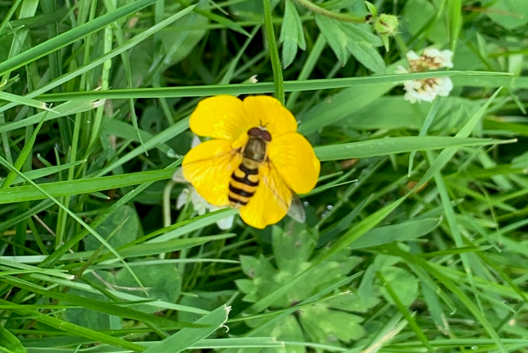
Hoverflies are amongst Scotland’s array of interesting pollinators.
Note: The sections which follow track the progress made towards meeting our objectives, and list projects and actions. This is a dynamic process, and will be updated with new priorities and actions as necessary. Information on completed projects can be found in earlier Annual Pollinator Reports. A timescale is proposed for the core actions: S = short- (up to 5 years), M = medium- (5 – 10 years) or L = long-term (10 years or more).
Abbreviations
A number of abbreviations are used throughout this Progress Report:
- AECS Agri-Environment Climate Scheme
- AHDB Agriculture and Horticulture Development Board
- BBCT Bumblebee Conservation Trust
- BC Butterfly Conservation
- BHIP Bee Health Improvement Partnership
- BHIT Bee Health Improvement Team
- CP Country Park
- CEH Centre for Ecology and Hydrology
- CSGNT Central Scotland Green Network Trust
- FIT Flower-insect Timed (count)
- FLS Forestry and Land Scotland
- GWCT Game and Wildlife Conservation Trust
- HBHS Honey Bee Health Strategy for Scotland
- HLF Heritage Lottery Fund
- IPM Integrated Pest Management
- JHI James Hutton Institute
- KSB Keep Scotland Beautiful
- LBAP Local Biodiversity Action Plan
- LNCS Local Nature Conservation Site
- LNR Local Nature Reserve
- NNR National Nature Reserve
- NRF Nature Restoration Fund
- PMRP Pollinator Monitoring and Research Partnership (see PoMS)
- PoMS UK Pollinator Monitoring Scheme
- RBGE Royal Botanic Garden Edinburgh
- RHS Royal Horticultural Society
- RSPB Royal Society for the Protection of Birds
- RZSS Royal Zoological Society of Scotland
- SASA Science & Advice for Scottish Agriculture
- SBA Scottish Beekeepers’ Association
- SFAS Scotland’s Farm Advisory Service
- SG Scottish Government
- SNHBS Scottish Native Honey Bee Society
- SQC Scottish Quality Crops
- SRDP Scottish Rural Development Programme
- SRUC Scotland’s Rural College
- SSSI Sites of Special Scientific Interest
- SuDS Sustainable Drainage System
- SWT Scottish Wildlife Trust
- TCV The Conservation Volunteers