Genetic Scorecard Indicator - Wildcat
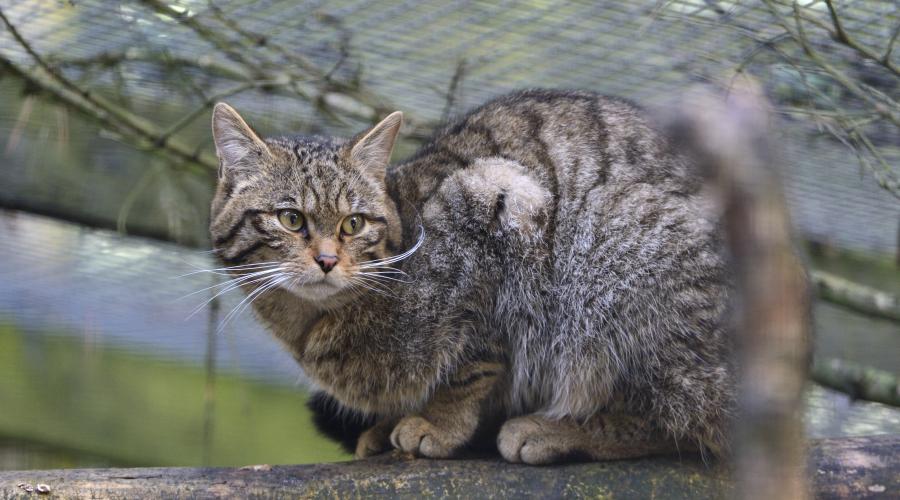
Wildcat (Felis silvestris)

IUCN Category:
- Great Britain: Critically Endangered (indicated above)
- Europe: Least Concern
- Global: Least Concern

Genetic Health Status:
- Scottish Risk: Serious (indicated above)
- UK Risk: Serious
- Scottish Mitigation status: Effectiveness unknown
- UK Mitigation status: Effectiveness unknown
Background
A Scottish icon and the only remaining native British cat. Scottish Wildcats are a subpopulation of the European Wildcat (Kitchener et al., 2017), although previously described as a subspecies. Although once found throughout the UK, they are now restricted to Scotland due to declines resulting from persecution and possibly other drivers, such as habitat change. The range contracted to the far northwest before recovering to areas north of the Highland boundary fault (Langley & Yalden, 1977). Further contractions occurred in 21st C, due to illegal or accidental persecution and/or declines in prey (rabbit) populations, with no recent records from the northwest of Scotland (Sainsbury et al., 2019). Genetic analysis has shown existence of a hybrid swarm, with all wild-living Wildcats sampled showing some hybridisation and most showing significant introgression (Senn et al., 2018). The population is considered to be Critically Endangered by the IUCN because during the Scottish Wildcat Action project (2014-2019) the Wildcat population was found to be small, highly fragmented and hybridised (Campbell et al., 2023; Gerngross et al., 2021).
Genomic analysis dates the onset of hybridisation in Scotland to after the 1950’s. Hybridisation is therefore potentially a symptom of small population size caused by other factors, not a primary cause of decline. Disease resistance of hybrids has also potentially been implicated in the development of the hybrid swarm (Howard-McCombe et al., 2023). The idea of limited genetic contact between Wildcats and the domestic cat species pre 1900 is also supported by the genetic analysis of archaeological samples (Jamieson et al., 2023). Hybridisation risks misidentification and consequently Wildcats being killed during legal predator control by land managers and identification guidance for Wildcats and Wildcat hybrids is therefore complex and context dependant (NatureScot, 2023).
The captive breeding population of Wildcats was found to contain lower levels of hybridisation than the wild Wildcat population and is managed to minimise hybridisation and preserve genetic diversity (Barclay & Senn., 2023). Subsequent to a recommendation by the IUCN (Breitenmoser et al., 2019) restoration of Wildcat populations to the Badenoch and Strathspey area of the Cairngorms National Park through conservation breeding for release and threat mitigation began in 2023. (Langridge et al., 2025; Barclay et al., in prep).
Ecologically Wildcats favour a mosaic of woodland and grassland habitat and often navigate the landscape using linear features. Habitat and landscape feature distribution and that of favoured prey (e.g. rabbits) in the relation to sources of domestic/feral cat may influence the risk of hybridisation, however further work would be required to determine this.
Current Threats
Primary current threats are genetic introgression with domestic cat, Felis catus, persecution and poor habitat quality.
Contribution of Scottish/UK population to total species diversity
The species status on mainland Europe varies by population but overall is estimated as Least Concern (Gerngross et al., 2021). It is likely that the Scottish Wildcat belongs to Western/Central European Wildcat genetic lineages. The population is the most northernmost in Europe and may therefore contain local adaptions.
Genetic risks
Diversity loss: population declines
There is a high risk of diversity loss associated with recent population decline, however genomic analysis indicates that the captive Scottish Wildcat population and wild-living hybrids retain almost the full ancestral genome (Howard-McCombe et al., 2023). Paradoxically therefore, hybridisation may have preserved a Wildcat genome that might have otherwise been driven to extinction, all be it in fragmented form.
Global Biodiversity Framework Indicators
Population definitions:
Although the individual wildcats are scattered in Scotland, we consider there to be a single population rather than clearly definable units within this (based on geographic and genetic information).
Ne500: The proportion of populations that have an effective population size of more than 500.
- Proportion of populations with Ne > 500 in Scotland = 0/1
- Proportion of populations with Ne > 500 in UK = 0/1
PM: Proportion of populations that existed in 2000 that still exist in 2025.
- Proportion of populations maintained in Scotland (mean range) = 1/1
- Proportion of populations maintained in UK (mean range) = 1/1
This figure masks the genetic threats to the population through hybridisation.
Diversity loss: functional variation
Functional variation
No data available. Functional variation may be retained within hybridised individuals, but populations lost from the far north and west may have had unique adaptations to those environments.
Divergent lineages
Limited risk as no evidence for phylogenetically divergent lineages in Scotland. Kitchener et al. (2017) concluded there was insufficient evidence to recognise the Wildcats in Scotland as a separate subspecies from F. s. silvestris in central and western Europe.
Hybridisation/Introgression
Serious risk. Wildcats in Scotland have very high rates of introgressive hybridisation with domestic cats. Since 2014, all wild-living cats sampled have shown domestic cat ancestry (Senn et al., 2018; Howard-McCombe, 2023).
Low turnover - constraints on adaptive opportunities
Excessive influx of domestic cats into the wild-living population likely limits adaptive opportunities but insufficient data is available to confidently state this. Hybrids may be better adapted to a human influenced landscape than Wildcats, or to the diseases of domestic cats (Howard-McCombe et al., 2023) but not enough research has been conducted to be confident of this.
Cumulative Risk Summary
Overall Genetic Health Status
Scotland
- Risk: Serious
- Mitigation: Serious
Great Britain/UK
- Risk: Effectiveness unknown
- Mitigation: Effectiveness unknown
Overall Genetic Health status explanation
Highly threatened by population decline and hybridisation in Scotland, absent from the rest of the UK. Conservation breeding and release work in Badenoch and Strathspey is showing early signs of success but is at far too early a stage to make an evaluation; ongoing issues with hybridisation are likely to be a challenge as well as, potentially, small founder base for reintroductions, unless carefully managed. Threats posed to demographic stability and population cohesion by persecution, road traffic mortality and habitat availability/distribution have the potential to elevate the risk of hybridisation by increasing the potential for interaction with the domestic cat species.
In situ genetic threat level
In situ genetic threat level
- In situ Risk for Scotland: Serious
- In situ Risk for UK: Serious
Small, fragmented populations of hybridising species present genetic risks.
Confidence in in situ threat level
- Confidence score for Scotland: High
- Confidence score for UK: High
Assessment on public records across the range and intensive camera trap surveys repeated in Wildcat Priority Areas, supported by direct data on genetic introgression, based on Campbell et al., 2023, Gerngross et al., 2021 & Langridge et al., 2025.
Ex situ representation
Wildcat ex-situ representation has increased significantly from ~60 animals in 2015 to >160 in 2025. The population is genetically tested and contains animals with estimated >75% Wildcat ancestry. The population has a reconstructed pedigree traceable back to an estimated 26 founders (Senn et al., 2019; Senn and Barclay et al., 2023). The coordinated breeding of the population in captivity is overseen by the Royal Zoological Society of Scotland with the participation of ~40 individual holders. Best practise studbook management methods are applied to manage the population for retention of genetic diversity according to European Association of Zoos and Aquariums. Breeding and release is managed sustainably to ensure that the captive population can act as a source for multiple reintroductions in the future. There is currently a plan to augment the population with additional founder animals from northern Spain underpinned by genomic assessment and population viability analysis.
The release population in Badenoch and Strathspey is founded from individuals from the UK captive population. As of August 2025, 40 Wildcats have been released, and reproduction has been documented. As with any initial release population, relatedness has the potential to increase quickly if the population is not augmented with new founders regularly. Regular releases to boost genetic diversity, demographic stability and to cover unoccupied territories to reduce the risk of hybridisation are part of the long-term plan for the population.
Current conservation actions
Current actions include establishing a large-scale dedicated conservation ‘breeding for release’ centre for Wildcats; growing the wild population of Wildcats through release into the wild in Badenoch & Strathspey; removal of the threats facing Wildcats in Badenoch & Strathspey; working with local communities to enhance conservation.
| Ex situ | Translocation | Habitat management | Legal protection of habitat or species | Regulation of exploitation | Control of INNS/pests/pathogens |
|---|---|---|---|---|---|
| X | X | - | X | - | X |
Population assessment/monitoring
Population
Demographic
Camera trapping and satellite tracking collars are used to monitor the released cats in the core of their range in Badenoch and Strathspey.
N pops assessed/monitored in Scotland = 1/1
N pops assessed/monitored in UK = 1/1
Genetic
All released cats in the core of their range, in Badenoch & Strathspey have been hybrid tested with a 35 single nucleotide polymorphisms test and whole-genome sequencing data is currently being generated for each. There is currently ad hoc hybrid testing of wild born kittens in Badenoch and Strathspey.
N pops assessed/monitored in Scotland = 1/1
N pops assessed/monitored in UK = 1/1
Further Research
It is hypothesised that reproductive isolating mechanisms exist between Wildcat and domestic cats (see Howard-McCombe, 2023), research into this would support our understanding of how to successfully re-establish populations.
Point of use genetic testing would greatly support management of hybridisation in the field.
Research into the genetic inheritance of pelage traits and the potential correlation of domestic pelage traits with domestic behaviours would support management approaches to hybridisation in captivity and the field.
References
Barclay, D., Morgan, E., Williams, R., Perry, A., Painter, B., Bacon, A., López, G., Rivas, A., Serra, R., Nygren, E., Maran, T., Sliwa, A., Hartmann, M., Langridge, K., Hetherington, D., Gaywood, M., Kortland, K., Kitchener, A. C., Howard-McCombe, J., Ball, A., Amos, R., Byford, L., Senn, H. & Díez-León, M. (in prep.) Evidence based ex-situ strategy for breeding and release management to support European Wildcat (Felis silvestris) recovery in Scotland.
Barclay, D. & Senn, H. (2023) Scottish Wildcat Action: Conservation Breeding. NatureScot, Inverness. (Accessed: 18 November 2025).
Campbell, R. D., Gaywood, M. J. & Kitchener, A. C. (eds.) (2023) Scottish Wildcat Action: Final Summary Report. NatureScot, Inverness. (Accessed: 18 November 2025).
Gerngross, P., Ambarli, H., Angelici, F. M., Anile, S., Campbell, R., Ferreras de Andrés, P., Gil-Sánchez, J. M., Götz, M., Jerosch, S., Mengüllüoglu, D., Monterroso, P. & Zlatanova, D. (2023) IUCN Red List Assessment for European Wildcat (Felis silvestris).
Howard-McCombe, J., Jamieson, A., Carmagnini, A., Russo, I. R. M., Ghazali, M. et al. (2023) ‘Genetic swamping of the critically endangered Scottish Wildcat was recent and accelerated by disease’, Current Biology, 33(21), pp. 4761–4769.e5. doi: 10.1016/j.cub.2023.10.026.
Jamieson, A., Carmagnini, A., Howard-McCombe, J., Doherty, S., Hirons, A. et al. (2023) ‘Limited historical admixture between European Wildcats and domestic cats’, Current Biology, 33(21), pp. 4751–4760.e14. doi: 10.1016/j.cub.2023.08.031.
Langridge, K., Kilshaw, K., Bacon, A., Barclay, D., Hughes, L., Scurrah-Price, A., Semple, L., Sneddon, J., MacPherson, J., Campbell, R., Wilson, M., Gaywood, M., Hetherington, D., Kortland, K., Howard-McCombe, J. & Senn, H. (2025) ‘Saving Wildcats in Scotland: First releases of captive-bred European Wildcats’, CATnews, 84 (Autumn) pp.6-10.
NatureScot (2023) Definition of a Wildcat: Updated Guidance (Version 9, August 2023). NatureScot. (Accessed: 18 November 2025).
Senn HV, Ghazali M, Kaden J, Barclay D, Harrower B, Campbell RD, Macdonald DW, Kitchener AC (2018) Distinguishing the victim from the threat: single nucleotide polymorphisms-based methods reveal the extent of introgressive hybridization between Wildcats and domestic cats in Scotland and inform future in situ and ex situ management options for species restoration. Evol Appl.12(3):399-414. doi: 10.1111/eva.12720.
Assessor: Helen Senn, Royal Zoological Society of Scotland
Reviewer: Rob Ogden, University of Edinburgh