Genetic Scorecard Indicator - Knotted Wrack
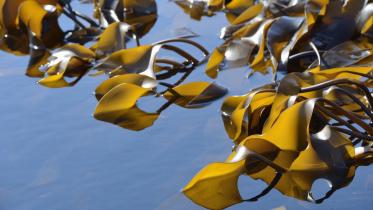
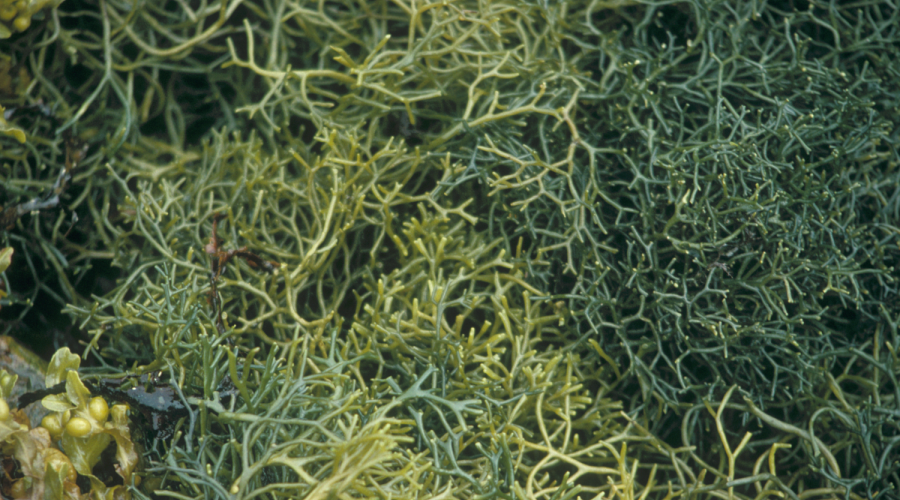
Knotted Wrack or Egg Wrack (Ascophyllum nodosum)

IUCN Category:
- Great Britain: Not Assessed (indicated above)
- Europe: Not Assessed
- Global: Not Assessed

Genetic Health Status:
- Scottish Risk: Neglibible (indicated above)
- UK Risk: Negligible
- Scottish Mitigation status: Not in place
- UK Mitigation status: Not in place
Background
Ascophyllum nodosum is a large fucoid brown algal species. Dominant on sheltered rocky shores around the mid to low tide zone. Distributed around much of the North Atlantic, particularly around the UK and Northwest Europe. Forms long thong-like fronds up to 2 metres in length with large air bladders at regular intervals. A long-lived species, with individual plants living up to several decades. Reported to take around 5 years to reach sexual maturity. Plants are dioecious, with individual fronds being either male or female. Dispersal of zoospores is thought to be very localised (10s of meters), and zoospore settlement and survival is thought to be low. However, dispersal by floating rafts of adult material is thought to allow long-distance dispersal, for instance cross-Atlantic dispersal between Europe and America (Olsen et al., 2010). A. nodosum populations generally exhibit strong local but weak global population structure (Olsen et al., 2010). The UK has a near continuous population distribution, all of which are thought to have colonised since the Last Glacial Maxima (~20 KYA).
A. nodosum is of commercial interest and has been harvested (coppiced) from the wild, in particular from the Outer Hebrides, for several decades. A recent review of the species is presented by Pereira et al. (2020). A review of harvesting is available on the scottish Government website: Potential scale of Scottish seaweed-based industries: research paper.
Current Threats
There are some indications of range shifts due to climate change in A. nodosum populations leading to losses in southern edge populations (Spain and Portugal in Europe, and New York in North America) (Ugarte et al., 2010; Pereira et al., 2024). Populations are likely to expand at their northern limits (Iceland and Greenland) (Marbà et al., 2017). There is no evidence at present of abundance changes in UK populations (Simkanin et al., 2005; Yesson et al., 2015).
Wild harvest of A. nodosum operates at low intensities, primarily in the Outer Hebrides. Annual harvests are approximately ~10,000 – 15,000 tonnes a year for the UK (Scotland). Harvesting techniques are based around mechanical coppicing of the plants, leaving the mature base of the plant to regrow. A review of the impacts of harvesting on population persistence is presented by Burrows et al. (2012).
Contribution of Scottish/UK population to total species diversity
There is little genetic data available for UK populations. In contrast to other brown algal species, glacial refugia populations were restricted to Brittany, and were not identified from southern and western Ireland and the UK (Olsen et al., 2010).
The west coast of Scotland is a global hotspot for the free-living morphotype A. nodusum ecad mackaii (Gibb, 1957) (pictured above). This morphotype is thought to be a plastic response to environment (an ecad), rather than an adaptation with genetic underpinnings. However, the populations affected are geographically isolated (narrow fjord-like sea-lochs) and able to sexually reproduce, suggesting the potential for selective adaptation to this lifestyle. No genetic data exists at present for the ecad.
Genetic risks
Diversity loss: population declines
There is no evidence of population declines in UK that may lead to loss of genetic diversity.
Global Biodiversity Framework Indicators
Population definitions:
Populations cannot currently be effectively defined in A. nodosum because populations can exhibit genetic structure but there is no genetic data to support population designation. Therefore, populations are not meaningfully calculable and not assessed further.
Ne500: The proportion of populations that have an effective population size of more than 500.
- Proportion of populations with Ne > 500 in Scotland = not assessed
- Proportion of populations with Ne > 500 in UK = not assessed
PM: Proportion of populations that existed in 2000 that still exist in 2025.
- Proportion of populations maintained in Scotland = not assessed
- Proportion of populations maintained in UK = not assessed
Diversity loss: functional variation
Functional variation
There is no evidence of loss of functional variation at present and the immediate risk appears small. Populations of A. nodosum ecad mackaii potentially represent a form of functional diversity, that is significant globally. There are no known threats to A. nodosum ecad mackaii, however data and monitoring is limited.
Divergent lineages
There are no known or expected losses of divergent lineages.
Hybridisation/Introgression
There are no known cases of interspecific hybridization in A. nodosum. The species is the only species in its genus, with no closely related members of Fucaceae (Neiva et al., 2016).
There is little to no evidence of intraspecific introgression or hybridisation in UK populations. There is evidence of migration from European populations to North America, but little evidence of reciprocal transfer (Olsen et al., 2010).
Low turnover - constraints on adaptive opportunities
A. nodosum are long lived, with localised dispersal of zoospores, and low levels of survival and recruitment by zoospores. As such turnover and adaptive opportunity is likely to be slower and more limited than in other fucoid species (Olsen et al., 2010).
However, as a species, A. nodosum has survived multiple inter-glacial periods and exhibits high levels of genetic diversity within populations, suggesting opportunities for adaptation.
Cumulative Risk Summary
Overall Genetic Health Status
Scotland
- Risk: Negiligible
- Mitigation: Not in place
Great Britain/UK
- Risk: Negligible
- Mitigation: Not in place
Overall Genetic Health status explanation
Widespread distribution around the UK. Likely strong population structuring from localised dispersal limitations.
Populations are currently healthy and not predicted to be affected by warming in near future.
In situ genetic threat level
In situ genetic threat level
- In situ Risk for Scotland: Negligible
- In situ Risk for UK: Negligible
A. nodosum are long lived, with localised dispersal of zoospores, and low levels of survival and recruitment by zoospores. As such turnover and adaptive opportunity is likely to be slower and more limited than in other fucoid species (Olsen et al., 2010).
However, as a species, A. nodosum has survived multiple inter-glacial periods and exhibits high levels of genetic diversity within populations, suggesting opportunities for adaptation.
Confidence in in situ threat level
- Confidence score for Scotland: Medium
- Confidence score for UK: Medium
Assessment based on genetic data from EU and North American populations. No population genetic data available for UK A. nodosum. Well characterised biology, and well-defined population trends.
Ex situ representation
None
Current conservation actions
A. nodosum ecad mackaii beds are designated as a Priority Marine Feature in Scottish waters, which means that National Marine Plan General Policy GEN 9b applies. This ensures that development and use of the marine environment do not have a significant effect on their national status.
Populations are likely to benefit from the wider effects of MPA designations. The Scottish Biodiversity Strategy to 2045, the Scottish Biodiversity Duty and UK Marine Strategy Good Environmental Status provide further drivers to ensure biological diversity is restored, and ecosystems are safeguarded.
Harvesting is managed and is operated under licence by Marine Scotland.
| Ex situ | Translocation | Habitat management | Legal protection of habitat or species | Control of INNS/pests/pathogens |
|---|---|---|---|---|
| - | - | X | X | - |
Population assessment/monitoring
Population
Demographic
N pops assessed/monitored in Scotland = Unknown
N pops assessed/monitored in UK = Unknown
Scotland and UK:
No routine monitoring of population dynamics of A. nodosum exists in Scotland or the UK.
Ad-hoc monitoring of population dynamics is undertaken by research groups (Yesson et al., 2015)
Genetic
N pops assessed/monitored in Scotland = Unknown
N pops assessed/monitored in UK = Unknown
No baseline of routine monitoring of population genetics exists for A. nodosum populations in Scotland or the UK.
Further Research
- Baseline genetic diversity and population structuring of UK A. nodosum
- Improved understanding of local adaptation and environmental (temperature) tolerance in A. nodosum populations
- Improved understanding of the genetics and adaptation processes in A. nodosum ecad mackaii, and their wider ecological (habitat) significance
- Improved understanding of community shifts, their environmental drivers, and threats from eg. harvesting impacts on UK A. nodosum stands
References
Burrows, M., MacLeod, M., & Orr, K. K. (2012). Mapping the intertidal seaweed resources of the Outer Hebrides. (SAMS Internal reports; No. 269). Scottish Association for Marine Science.
Gibb, D.C. (1957). The free-living forms of Ascophyllum nodosum (L.) Le Jol. The Journal of Ecology, 49-83.
Marbà, N., Krause-Jensen, D., Olesen, B., Christensen, P.B., Merzouk, A., Rodrigues, J., Wegeberg, S. and Wilce, R.T. (2017). Climate change stimulates the growth of the intertidal macroalgae Ascophyllum nodosum near the northern distribution limit. Ambio, 46(Suppl 1): 119-131.
Neiva, J., Serrão, E.A., Assis, J., Pearson, G.A., Coyer, J.A., Olsen, J.L., Hoarau, G. and Valero, M. (2016). Climate oscillations, range shifts and phylogeographic patterns of North Atlantic Fucaceae. In Seaweed phylogeography: Adaptation and evolution of seaweeds under environmental change (pp. 279-308). Dordrecht: Springer Netherlands.
Olsen, J.L., Zechman, F.W., Hoarau, G., Coyer, J.A., Stam, W.T., Valero, M. and Åberg, P. (2010). The phylogeographic architecture of the fucoid seaweed Ascophyllum nodosum: an intertidal ‘marine tree’and survivor of more than one glacial–interglacial cycle. Journal of Biogeography, 37(5): 842-856.
Pereira, L., Morrison, L., Shukla, P.S. and Critchley, A.T. (2020). A concise review of the brown macroalga Ascophyllum nodosum (Linnaeus) Le Jolis. Journal of Applied Phycology, 32(6): 3561-3584.
Pereira, L.F., Arenas, F., Seabra, R., da Silva, R., Monteiro, C., Pereira, J., Vale, C.G., Serôdio, J., Frankenbach, S., Ghiglione, V. and Ribeiro, P. (2025). Simulated intertidal heat stress on the brown seaweed Ascophyllum nodosum demonstrates differential population sensitivity to future climate. Journal of Ecology.
Simkanin, C., Power, A.M., Myers, A., McGrath, D., Southward, A., Mieszkowska, N., Leaper, R. and O'Riordan, R. (2005). Using historical data to detect temporal changes in the abundances of intertidal species on Irish shores. Journal of the Marine Biological Association of the United Kingdom, 85(6): 1329-1340.
Ugarte, R.A., Craigie, J.S. and Critchley, A.T. (2010). Fucoid flora of the rocky intertidal of the Canadian Maritimes: implications for the future with rapid climate change. In Seaweeds and their role in globally changing environments (69-90). Dordrecht: Springer Netherlands.
Yesson, C., Bush, L.E., Davies, A.J., Maggs, C.A. and Brodie, J. (2015). Large brown seaweeds of the British Isles: evidence of changes in abundance over four decades. Estuarine, coastal and shelf science, 155: 167-175.
Websites
Scottish Government - Potential scale of Scottish seaweed-based industries: research paper
Assessor: Alex Thomson, Seawilding
Reviewer: Jack Burton, Queens University Belfast